“
Analysis and Corrective Study for RC
Building under Explosion Loading”
Vinod Prajapat & Mr. Arpit Chawda
Abstract
Many of the existing buildings, which were
not designed for blast loads, get damaged or
even fully collapsed when subjected to such
loadings. The main aim of this study is to
evaluate the effects of explosion on the
structure and to suggest various safety
measures to protect those in/around the
building, which may get killed or injured by
the collapse of the structure. If the structure
is designed to resist the blast load impact,
the cost of the structure tends to be very
high and talking about civil buildings cost
of the structure is one of the most important
constraints and therefore it is avoided.
In last few years, a number of public
buildings, buildings of national and
strategic importance have been targeted
therefore there is a need to develop
measures to reduce the hazard of such
attacks. In case of accidental or intentional
explosion building is subjected to blast
impact and therefore dynamic analysis is
required. Dynamic analysis computes the
inertia forces developed on the structure
when it is excited by means of dynamic
loads applied suddenly (e.g., wind,
explosion or earthquake). Dynamic
analysis is done using ANSYS Workbench
(Version 14.0) Explicit Dynamics.
In this study, dynamic analysis is
performed in order to determine the effects
of blast impact on the modeled structure,
parameters considered in terms of energy
in the analysis is compare with the manual
calculation. Further, temporal behaviour of
deformation and pressure on the structure
as well as parameters of explosive such as
total energy, kinetic energy, internal
energy and density of the explosive, results
are studied. Analysis is carried out in two
parts, in first part, the behaviour of a two
by four bay three story rectangular shape
frame when subjected to a large amount of
explosive is studied. The distance between
structure and explosive was varied from 10
m up to 25 m in longer as well as in shorter
side of the structure. In the second part a
G+7 story building is analysed
this building was subject to a explosion of
half ton of TNT at a distance of 10m away
from the structure.
The energy in the explosive is stored in
form of potential energy and after
detonation or deflagration energy released
in form of kinetic energy. This released
energy creates shock wave and push the
surrounding away from the detonation,
fragmentation throws shrapnel outward
causes local damage to human beings as
well as structure. It was observed that
deformation in the structure is less when
explosion takes place in front of shorter
side, as well as pressure on the structure is
less when explosion takes place in front of
longer side. The stress developed in
supporting column is much higher than the
yield stress of concrete, therefore local
failure of the main supporting column
occurs. Due to this localized failure, the
entire upper floor gets unsupported and
collapse of structure occurs.
In order to prevent the collapse of
structure, modifications such as heavy
section, shear wall, and steel bracing were
suggested. Feasibility of each of these
methods is analyzed. From the analysis it
was found that deformation increases in
case of shear wall by 18% and stress
section deformation reduces with 25% and
stress reduces to 39%. Apart from these
remedies, if any local failure occurs due to
increased stresses, the collapse of the
whole structure can be prevented with the
use of alternate supporting members like
steel bracing which leads to about 1.6%
increase in the total cost of the structure.
The use of heavier sections leads to an
increment of about 0.8% in the costing and
the same comes to be 0.9% when shear
wall is considered.
It was observed that it is very difficult to
design and costly to construct a structure
for the forces acting at the time of blast.
While another way to secure the structure
from the blast is to mitigate the energy of
explosive by proper arrangements of
interior & exterior architecture as well as
aesthetics & functionality of the building.
Introduction
In recent years due to different accidental or intentional, blasts all over the world, resulted in number of initiatives to study the resistance of structures to blast and to develop systems to reduce the hazard of such attacks. The main aim of these is to protect & provide safety to those who are in/around the building, and can be killed or injured by the collapse of the structure and the falling debris.
the assumption that civilian buildings had a very low probability to be a target of terrorist attack. But it is not so after events like April 19, 1995 Murrah Federal Office Building, Oklahoma City bombing, September 11, 2001 World Trade Centre, Pentagon, attacks. These recent events show the importance of study & design of blast resistant structures to withstand the main and secondary effects due to blast. In recent times of heightened terrorist activities and alarming threats of future attacks, it has become of the utmost importance to develop blast resistant structures. In case of accidental or intentional blast problem is referred as a BLAST-IMPACT problem, this problem may be divided in two parts: the first part involves assessing the damage that a structure will suffer when it is hit by a blast wave of a specific strength, the second part deals with the design and testing of structures that are capable to withstand or mitigate the strength of the blast wave. One of the biggest challenges in this area is the lack of knowledge of the amount and the location of the explosive, especially in the case of a terrorist attack. Past studies indicate that structures
designed to resist earthquake show positive resistance for blast forces. As per IS 4991-1968 “Code of blast resistant design of structure for explosions above ground”, Wind or earthquake forces shall not be assumed to occur simultaneously with blast effects. There is sometimes a
misunderstanding about the blast
resistance that is
provided by a building designed to resist earthquakes. Although there is some overlap between the disciplines (see Figure 1-1), mostly in the area of
progressive collapse prevention,
earthquake resistant buildings are unlikely to meet the direct effects of an air-blast loading acting on the exterior skin of a building. The reasons for the differences between these loading are as follows:
Explosion loads act directly on the
exterior envelope whereas
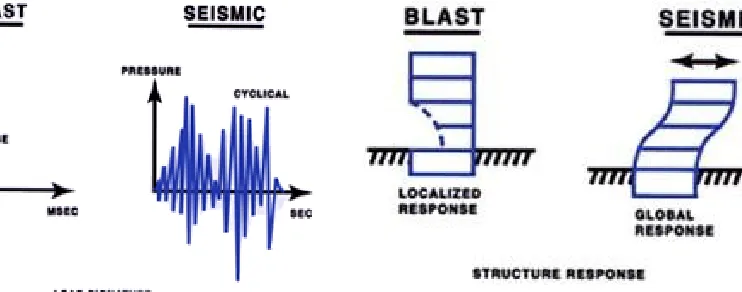
Figure 1- 1 Seismic v/s. blast overlap Figure 1-2 Seismic v/s. blast loading type.
Explosion loads are characterized by a single high pressure impulsive pulse acting over
milliseconds rather than the vibration loading of earthquakes which is acting over seconds (see Figure 1-3)
Explosion loads generally cause localized damage whereas seismic loads cause global
response (see Figure 1-4)
Figure 1-3 Seismic v/s. blast loading time histories Figure 1-4 Seismic versus blast response
Methodology
In the current project blast analysis is
same amount of explosive material. For this analysis the methodology is as follows:
An extensive survey of the literature on theblast analysis and there effects on the structure is performed.
Based on the numerical and parametricstudy, a step by step procedure for the simplified blast analysis and there effects have been suggested.
Dynamic analysis in ANSYS14.0 forevaluating energy of the explosive and its comparison with energy has been calculated manually.
For determine the behaviour of explosive &effects of blast on structure, a problem of a G+ 3 structures having 2×4 bay is taken & analyzed for different stand-off distances with a large amount of explosive.
After that a G+ 7 unsymmetrical structureis taken and analyzed for stand-off distances of 10 m with half ton of TNT explosive & determine the failure of vertical supporting member.
Effects of explosive on the structure andthere safety measures are determined.
Results & Discussion
In this study, dynamic analysis is
performed in order to determine the effects of blast impact on the modeled structure, parameters considered in terms of energy in the analysis is compare with the manual calculation. Effects of the energy released from the explosive are study on a G+3 structure and then a G+7 actual structure is analysed and determine their vulnerability.
Various parameters considered in the analysis are listed below,
I. Total Energy, Internal Energy, Kinetic
Energy & Density of Explosive
II. Total & Directional Deformation of
Structure
III. Shear Elastic Strain of Structure
IV. Shear Stress of Structure
V. Pressure on the structure
energy and density of the explosive with respect to time and graph shows
exponential decremental behaviour due to exothermic reaction.
Figure 6-23 temporal variation of absolute deformation in
the structure Table6-4 Absolute deformation
in structure
Time
Actual structure With heavy section With shear wall
Total deformation
1.00E-03
0.00
0.00
0.00
1.50E-03
0.01
0.00
0.01
2.00E-03
0.02
0.00
0.02
2.50E-03
2.80
2.32
2.34
3.00E-03
3.63
1.88
2.21
3.50E-03
3.01
2.06
2.99
4.00E-03
4.67
4.37
3.39
4.50E-03
3.47
3.90
5.01
5.00E-03
3.85
3.73
7.61
5.50E-03
4.03
3.42
7.86
9.00E+00
8.00E+00
7.00E+00
6.00E+00
5.00E+00
4.00E+00
3.00E+00
Actual
structure Heavy
section
Shear wall 2.00E+00
1.00E+00
0.00E+00
-3.12E-17
2.50E-03 5.00E-03
Time (S)
6.00E-03
4.77
3.78
6.67
6.50E-03
5.27
4.07
6.08
7.00E-03
5.49
4.17
6.59
7.50E-03
5.58
4.62
7.31
8.00E-03
5.76
4.86
7.68
8.50E-03
6.16
5.04
7.92
9.00E-03
6.49
5.10
8.01
9.50E-03
6.64
5.12
7.99
1.00E-02
6.73
5.05
7.93
Figure 6-24 temporal variation of absolute shear stress in
the structure Table 6-4 Absolute Shear stress in
the structure
Time
Actual structure
With heavy section
Shear stress
With shear wall
1.00E-03
0.01
0.00
0.01
1.50E-03
0.02
0.00
0.04
2.00E-03
0.04
0.00
0.07
80.00
70.00
60.00
50.00
40.00
30.00
Actual structure
heavy section
shear wall 20.0
0
10.0 0
0.00
-3.12E-17 2.50E-03
5.00E-03
Time (S)
7.50E-03 1.00E-02
Sh
ear
S
tr
e
ss
(
M
P
2.50E-03
50.39
40.16
40.86
3.00E-03
23.65
20.19
23.49
3.50E-03
23.31
11.53
14.14
4.00E-03
31.34
24.94
8.96
4.50E-03
29.88
34.29
22.39
5.00E-03
65.99
44.37
62.95
5.50E-03
42.30
20.64
58.59
6.00E-03
28.44
33.36
53.44
6.50E-03
44.14
41.87
37.69
7.00E-03
40.23
31.06
35.01
7.50E-03
33.48
31.22
46.18
8.00E-03
72.77
33.03
43.82
8.50E-03
31.25
34.75
38.23
9.00E-03
40.82
36.30
25.10
9.50E-03
33.21
16.97
31.71
1.00E-02
64.09
24.62
41.83
Conclusion
The blast phenomenon and the response of the structure for the explosion are studied. But practical analysis is very tedious, thus for the purpose simulation and real time analysis of the condition is required. By this analysis we concluded that energy released from the explosion decays with time and distance. Thus in order to keep the structure safe, we should consider all forces in action while designing the structure. Apart from this, proper arrangement of interior & exterior architecture as well as aesthetics & functionality of the building should be maintained.
1. Predict the position where probability
of the explosion is high as well as affect the structure maximum.
2. Determination of the member failure
due to air blast. Analysis result helps in adopting proper preventative measure. From the above analysis we conclude that heavy section is better from both structural and economical point of view.
3. Physical security & arrangements made
should also help in decaying the energy of the explosive, following purpose may serve by:
Preventing and delaying the attack.
intended target
Mitigating the effects of the attack. If these precautions are implemented and the attack still takes place, then structural protection efforts will serve to control the extent and consequences of damage.
Layout of insecure area. The
insecure areas of the structure should be kept unmerged. For instance a separate lobby pavilion or loading dock area outside of the main building should be made and if it is not possible to place vulnerable areas outside the main building a “hard lines” or buffer zones should be created in building layout.
. References
T. Krauthammer, S. Shahriar, and H.
M. Shanaa, 1990. “Response of Reinforced
Concrete Elements to Severe Impulsive
Loads,” Journal of Structural Engineering,
Vol. 116, No. 4, 1990, pp. 1061–1079.
L.L. Davis, L.G. Hill, 2001. “ANFO
Cylinder Tests,” American Physical Society
Topical Conference on Shock Compression of Condensed Matter Atlanta, GA June 25- 29, 2001
V. F. Nesterenko, 2003 “Shock (Blast)
Mitigation by “Soft” Condensed Matter,”
Materials Research Society Symposium Proceedings, Vol. 759, Boston, MA, 2003, pp. 135–146.
B.M. Luccioni, R.D. Ambrosini, and
R.F. Danesi, 2003. “Analysis of building
collapse under blast loads,” Elsevier Ltd.,
August 2003.
P. C. Souers, P. Vitello, 2004. “ANFO
Calculations for Sedat Esen,” Lawrence