© 2015, IJCSMC All Rights Reserved
815
Available Online atwww.ijcsmc.com
International Journal of Computer Science and Mobile Computing
A Monthly Journal of Computer Science and Information Technology
ISSN 2320–088X
IJCSMC, Vol. 4, Issue. 6, June 2015, pg.815 – 821
RESEARCH ARTICLE
Implementation of Network Security
Using Neural Network Architecture
Dr. Soumya Paul
1, Dr. Sudipto Bhattacharyya
2¹Associate Professor and HOD, Department of Computer Applications, BPPIMT, WBUT, India ²Associate Professor and HOD, Department of IT, ILEAD, WBUT, India
1 [email protected]; 2 [email protected]
Abstract— This paper concerns about the security of confidential information and data transmission through Neural Network using symmetric key in order to provide confidentiality, authentication, integrity and non-repudiation of the messages. First, an encryption algorithm is developed and implemented to achieve the aforesaid purpose. It is basically a program that takes any number and a private key as input from the user and produces a cipher text which is sent to the source node of the neural network. Now the cipher text is again encrypted and fragmented in successive layers of neural network architecture to produce the final cipher text. Finally all the fragments are collected and decrypted using the same private key at destination node to get the cipher text which was input to the source node. Then the cipher text is decrypted to get the original text at the other end of the network.
Keywords— Symmetric-Key, Artificial Neural Network, Hidden Layer, Network Security, Cipher Text
I. INTRODUCTION
© 2015, IJCSMC All Rights Reserved
816
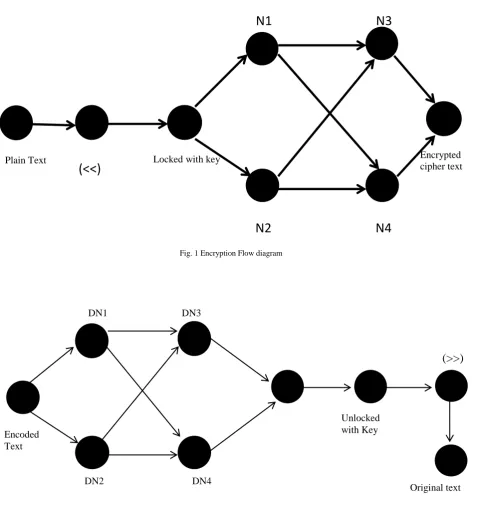
II. FLOWDIAGRAM
N1 N3
(<<)
N2 N4
Fig. 1 Encryption Flow diagram
DN1 DN3
DN2 DN4
Fig. 2 Decryption Flow diagram
III.ALGORITHM
A. Proposed Encryption – Decryption Heuristic
Input: A plain text and key is taken as input.
Process: Plain text is converted into a cipher text using a key and transmitted over network.
Output: Encoded cipher text is decoded to get back original plain text at the receiving end of the network.
Step 1: Call secret key generation algorithm. Step 2: Input a plain text for encryption
Encoded Text
Encrypted cipher text Locked with key
Plain Text
Unlocked with Key
(>>)
© 2015, IJCSMC All Rights Reserved
817
Step 3: Call encryption algorithm using Neural Network Architecture.
Step 4: Call decryption algorithm using Neural Network Architecture (output). Step 5: Stop.
1) Algorithm for encoded secret key generation:
Step 1: Take a 4x4 matrix with the numbers from 0-9. Step 2: Take a numeric secret key (fixed).
Step 3: Interchange the row and column positions of the secret key values. Step 4: Transpose the positional matrix which we got after step 3.
Step 5: Stop
2) Algorithm for input matrix to be encrypted:
Step 1: Place the input values sequentially in the 4x4 matrix in row-major order.
Step 2: Operate left shift (<<) operation on the ASCII values of the elements of the input matrix. Step 3: Subtract the encoded secret key form the left shifted matrix got from step 2.
Step 4: Convert the 4X4 matrix into a single dimension array by row-major order.
Step 5: Split the array equally into two single dimensional arrays (called nodes) containing 8 elements each according to their even and odd positions. Send the even positional elements to N1 and the odd positional elements to N2.
Step 6: Take a single dimensional array of prime numbers (starts from 2 and increasing sequentially) of equal size of the two halves got from Step 5.
Step 7: Add the elements of the prime number array with the corresponding elements of N1. Step 8: Subtract the elements of the prime number array with the corresponding elements of N2. Step 9: Send the even positional elements of N1 & N2 to N3 alternatively from N1 & N2. Step 10: Send the odd positional elements of N1 & N2 to N4 alternatively from N1 & N2. Step 11: Concatenate the elements of N3 & N4 in a 1-D array.
Step 12: Convert the 1-D array into a 2-D 4x4 matrix. Step 13: Stop
3) Decryption algorithm:
Step 1: Convert the 2-D 4x4 cipher text matrix received in a single 1-D array in row-major order. Step 2: Break the 1-D array into 2 equal halves.
Step 3: Put the values of 1st half to even cell positions of DN1 & DN2 alternatively. Step 4: Put the values of 2nd half to odd cell positions of DN1 & DN2 alternatively.
Step 5: Take a single dimensional array of prime numbers (starts from 2 and increasing sequentially) of equal size of the two halves got from Step 1.
Step 6: Subtract the elements of the prime number array with the corresponding elements of DN1. Step 7: Add the elements of the prime number array with the corresponding elements of DN2. Step 8: Merge the values of DN1 & DN2 alternatively in a 1-D array.
Step 9: Convert the 1-D array into a 4X4 matrix.
Step 10: Add the encoded secret key with the matrix got from Step 9.
Step 11: Operate right shift (>>) operation on the ASCII values of the elements of the resultant matrix. Step 12: Extract the input string whenever the special character is found.
Step 13: Stop.
IV.EXAMPLEILLUSTRATION
A. Example Illustrating Encryption Algorithm
Initial matrix is taken like
0 1 2 3
0 0 1 2 3
1 4 5 6 7
2 8 9 ? ?
3 ? ? ? ?
Input the SECRET KEY as 786
© 2015, IJCSMC All Rights Reserved
818
0 1 2 3
0 0 1 8 3
1 4 5 9 ?
2 2 6 ? ?
3 ? 7 ? ?
We found 7 at (1, 3). So we swapped with? (3, 1). Similarly all other elements in the secret key are also swapped to get the positional matrix.
Step 2: Transpose the positional matrix.
0 1 2 3
0 0 4 2 ?
1 1 5 6 7
2 8 9 ? ?
3 3 ? ? ?
Step 3: Find the corresponding ASCII values to get the key matrix.
0 1 2 3
0 48 52 50 63
1 49 53 54 55
2 56 57 63 63
3 51 63 63 63
Step 4: Input the plain text i.e. 631257
Step 5: Converting it into 4x4 matrix & replacing white spaces by “?”
0 1 2 3
0 6 3 1 2
1 5 7 ? ?
2 ? ? ? ?
3 ? ? ? ?
Corresponding ASCII value matrix is
0 1 2 3
0 54 51 49 50
1 53 55 63 63
2 63 63 63 63
3 63 63 63 63
Step 6: Left shift operation (<<) on the matrix by 1
0 1 2 3
0 108 102 98 100
1 106 110 126 126
2 126 126 126 126
3 126 126 126 126
Step 7: Subtract the encoded key matrix from the resultant matrix
0 1 2 3
0 60 50 48 37
1 57 57 72 71
2 70 69 63 63
3 75 63 63 63
Step 8: Corresponding character matrix
0 1 2 3
0 < 2 0 %
1 9 9 H G
2 F E ? ?
© 2015, IJCSMC All Rights Reserved
819
Step 9: Converting the matrix elements into a 1-D array
< 2 0 % 9 9 H G F E ? ? K ? ? ?
Step 10: Placing the even positional values at N1 & the odd positional values at N2
0 1 2 3 4 5 6 7 8 9 10 11 12 13 14 15
< 2 0 % 9 9 H G F E ? ? K ? ? ?
N1
N2
ASCII values of the characters at N1
60 48 57 72 70 63 75 63
ASCII values of the characters at N2
50 37 57 71 69 63 63 63
Step 11: Taking a 1D array of prime numbers starts from „2‟ & increasing sequentially& of equal size of the arrays of N1 and N2
2 3 5 7 11 13 17 19
Step 12: Adding the array of prime numbers with the elements of N1 & subtracting the same from the elements of N2
N1
62 51 62 79 81 76 92 82
N2
48 34 52 64 58 50 46 44
Step 13: Placing the even positional elements of N1 & N2 to N3 alternatively from N1 & N2 N3
62 48 62 52 81 58 92 46
Step 14: Placing the odd positional elements of N1 & N2 to N4 alternatively from N1 & N2 N4
51 34 79 64 76 50 82 44
Step 15: Concatenating the elements of N3 & N4 in a 1-D array.
62 48 62 52 81 58 92 46 51 34 79 64 76 50 82 44
Corresponding character array
> 0 > 4 Q : \ . 3 “ O @ L 2 R ,
The encrypted final cipher text is
0 1 2 3
0 > 0 > 4
1 Q : \ .
2 3 “ O @
3 L 2 R ,
B. Example Illustrating Decryption Algorithm
The encrypted cipher text received is converted in a 1-D array
< 0 9 H F ? K ?
© 2015, IJCSMC All Rights Reserved
820
> 0 > 4 Q : \ . 3 “ O @ L 2 R ,
Step 1: Breaking the cipher text into 2 equal halves. DN1
DN2
ASCII values of the characters at DN1
0 1 2 3 4 5 6 7
62 48 62 52 81 58 92 46
ASCII values of the characters at DN2
0 1 2 3 4 5 6 7
51 34 79 64 76 50 82 44
Step 2: Placing the values of 1st half to even cell positions of DN1 & DN2 alternatively at DN3 & the values of 2nd half to odd cell positions of DN1 & DN2 alternatively at DN4
DN3
DN4
0 1 2 3 4 5 6 7
48 34 52 64 58 50 46 44
Step 3: Taking a 1-D array of prime numbers starts from „2‟ & increasing sequentially & of equal size of the arrays of DN1 & DN2.
2 3 5 7 11 13 17 19
Step 4: Subtracting the array of prime numbers from the array elements of DN3 & adding the same with the array elements of DN4.
DN3
60 48 57 72 70 63 75 63
DN4
50 37 57 71 69 63 63 63
Step 5: Merging the values of DN3 & DN4 alternatively in a 1-D array
60 50 48 37 57 57 72 71 70 69 63 63 75 63 63 63
Step 6: Converting the array into a 4X4 matrix
0 1 2 3
0 60 50 48 37
1 57 57 72 71
2 70 69 63 63
3 75 63 63 63
Step 7: Adding the encoded secret key with the matrix
0 1 2 3
0 108 102 98 100
1 106 110 126 126
2 126 126 126 126
3 126 126 126 126
> 0 > 4 Q : \ .
3 “ O @ L 2 R ,
0 1 2 3 4 5 6 7
© 2015, IJCSMC All Rights Reserved
821
Step 8: Right shift operation (>>) on the matrix by 1
0 1 2 3
0 54 51 49 50
1 53 55 63 63
2 63 63 63 63
3 63 63 63 63
Corresponding character matrix
0 1 2 3
0 6 3 1 2
1 5 7 ? ?
2 ? ? ? ?
3 ? ? ? ?
Step 9: Extract the input string whenever the special character is found except „?‟ Step 10: Plain text 631257 is received at destination end.
Step 11: Stop
V. CONCLUSIONS
The paper emphasizes a procedure whereby a plain text containing numbers are sent from one end of a network to another end by enciphering the text with the means of Neural Network architecture thereby ensuring network security. The encoding is done with the help of the hidden layer concept of Artificial Neural Network and symmetric-key cryptography. Thus the integrity, availability and confidentiality of the message passed over a network is secured and is not compromised.
REFERENCES [1] William Stallings, Cryptography and Network Security, 2nd edition.