ISSN 2286-4822 www.euacademic.org
Impact Factor: 3.1 (UIF) DRJI Value: 5.9 (B+)
A Review of the Multi-perspective, Systems-based
(MPSB) Research with an MPSB Knowledge Supply
Chain Framework
JOSEPH KIM-KEUNG HO Independent Trainer Hong Kong, China
Abstract:
A key concern in management research and management development is on how to produce and transfer relevant and actionable management knowledge to the world of management practices. Addressing this concern is an aspiration of the Multi-perspective, Systems-based (MPSB) Research, which was launched by the writer in 1992 to evaluate various management disciplines based on Critical Systems Thinking (CST). This paper provides an updated account of the MPSB Research and examines how the MPSB Research can create relevant and actionable management knowledge, based on a proposed theoretical framework called an MPSB knowledge supply chain framework.
Key words: MPSB Research, MPSB knowledge supply chain
framework, Management research, Critical systems thinking.
Introduction
enlightening route on managerial intellectual development by practicing managers. The writer refers to the following writings so as to indicate why this is an important topic in contemporary management research and practices:
“During the last 10 years, private-sector and public sector organizations have come under increased pressure to do more with less. In an effort to increase the efficiency of human resource-related activities, human resources professionals may have initiated new practices that were not adequately developed or evaluated….. As a result, some HR professionals and their organizations are using HR practices that do not contribute positively to organizational functioning and may be unaware of HR-related research findings that could assist in enhancing organizational functioning..” (Burke et al., 2004).
“findings from academic as well as consulting studies are not useful to practitioners” (Van de Ven and Johnson, 2006).
“Professors… have too little incentive to produce usable research…” (The Economist, 2014).
In the writer’s view, these problems indicate both a management knowledge transfer and a managerial intellectual learning problem. The Multi-perspective, Systems-based (MPSB) Research addresses these problems raised on management research and managerial intellectual learning. It is explained in the ensuing discussion.
An updated account of the Multi-perspective, Systems-based Research
information systems and supply chain management (Ho, 1996a; 1996b). From the outset, the research aim was to investigate management disciplines from a Critical Systems Thinking (CST) perspective (Jackson, 2000, Part III). For Ellis (1995), there are four main features of CST: (a) it seeks to show social awareness; (b) it is dedicated to human emancipation; (c) it is committed to complementary and informed use of all systems methodologies, and (d) it seeks to demonstrate critical awareness. An updated account by Jackson (2010) on CST identifies three CST commitments, i.e. ‘critical awareness, pluralism and improvement.
useful in the conduct of the MPSB Research (Ho, 2013c). In terms of areas of investigation, four have been identified, namely:
a. Review the theoretical foundation of the MPSB Research and the nature of MPSB Frameworks1, see Ho (1994a; 1995a; 1995b; 1996a). It is recognized that CST, as the present theoretical foundation of the MPSB Research, is also evolving as a strand of systems thinking (see Jackson, 2010) - CST itself is not yet a finished intellectual product.
b. Review management disciplines, namely, information systems management (e.g. Ho, 1997a; 2014a; Ho and Sculli, 1993; 1994a; 1995; Sculli and Ho, 2001), management accounting (e.g. Ho 1994b: 2014b), logistics management (e.g. Ho 1995c; 1997b), organizational change (e.g. Ho and Sculli, 1994b; Ho, Partington and Sculli, 1996) from the perspective of the MPSB Research.
c. Review issues that are related to the MPSB Research, e.g. (i) building up a rich picture facing the MPSB Research program; (ii) explaining how the MPSB Research can contribute to management education and managerial intellectual learning (e.g. Ho, 2007; 2008; 2013a; 2013b; 2013c; 2014c; 2014d); and (iii) investigating how the MPSB Research is related to other systems-based research programs (e.g. Ho, 1995d) and topics, such as CST and TSI, as well as the rich picture building (RPB) exercise in Checkland’s Soft Systems Methodology.
d. Conduct case study research using the key MPSB concepts as part of an MPSB cognitive filter for
1An MPSB Framework is a knowledge structure of a management discipline,
management2(e.g. Ho (2014a).
The MPSB Research conducts literature review on a management topic or a management discipline at three levels: (i) at the theoretical level; (ii) at the methodological level, and (iii) at the application level (Ho, 1997a). At the theoretical level, at present, there are three perspectives considered in the MPSB Research: the Unitary (objective) perspective endorses the organizational metaphors of brain, organism and brain; the Pluralist (subjective) perspective favors the organizational metaphors of culture and political system; finally, the Critical (emancipatory) perspective embraces the organizational metaphors of political systems and instrument of domination. The updated version of CST has four perspectives, namely, functionalist, interpretive, emancipator and postmodern (Jackson, 2010) perspectives. In view of this change in CST, the MPSB Research is need of an update in the near future. The specific context that triggers an MPSB Research initiative can be an academic who notices an emerging management topic from reading business journals that has significant academic and practical value; or a manager whose company is about to launch a major management project, such as an introduction of balanced scorecard system or business process outsourcing and who feels perplexed about this management technology. A major practice in an MPSB Research exercise is to construct an MPSB Framework in the following way (Ho, 1997b): (i) select a specific management approach or practice, e.g. Business Process Re-engineering; (ii) identify and expose the underlying image(s) of organization (Morgan, 1986) and perspective(s) of the management approach, and contrast them with alternative images of organization and perspectives; finally, (iii) construct the MPSB Framework and elucidate the nature of the
2 An MPSB cognitive filter for management is “a set of inter-related MPSB
management approach under review.
The MPSB Framework construction process has been called an MPSB knowledge compilation, with the review steps involved as an MPSB knowledge compiler (Ho, 1996b; 2013c). The analogies of a compiler and an operating system (or just called platform) in computer science are used here. Specifically, a compiler is a program that translates a high level program into machine code while an operating system is a program that performs a set of tasks to control a computer’s resources. In employing these analogies in the MPSB Research, there is a job of taking in the concepts/ techniques from various management disciplines as source codes, and compiling them into software solutions (e.g. in the form of MPSB Frameworks) that are able to function on the CST platform. This job amounts to a literature review exercise. An MPSB framework so constructed can be perceived as an “assembled product” (and a conceptual one for that) that is able to be used by “the customers” (i.e. the managers) in a usable form; thus the “assembled product” is “useful”, in Markides (2011)’s words. For this writer, this MPSB Framework can have relevance and actionable value to the manager who uses it, depending also on the managerial intellectual competence of the person who constructs the framework. [Note: the research topic of how an MBSB Framework is to work with other diagramming techniques such as a mind map or a cognitive map to make up a “comprehensive assembled product” has not been explicitly studied so far.]
supportive position towards the identity of management disciplines, the MPSB Research has certain pragmatic, though minor, advantages over the CST/TSI project: (i) it provides a more receptive forum for exchanging ideas between systems theorists and professionals in various management disciplines; and (ii) due to its focus on management disciplines, it has a more ready access to opportunities to get involved in management projects that introduce a chosen management methodology/ technique, such as Business Process Re-engineering, from a particular management discipline to an organization. Furthermore, Ho (1996b) argued that the MPSB Research can be considered intellectually stimulating in that: (i) new research questions are raised and examined, and (ii) existing management concepts are reviewed and re-combined. In retrospect, the 1996 vision on the MPSB Research, its related research guidelines and research agenda, as recorded in the consolidated Ph.D. thesis of Ho (1996b), remains largely intact in 2014. Regardless, the relevance and actionable value of the MPSB Research has not been explicated in the 1996 version of the MPSB Research. The ensuing discussion in this paper tries to redress this deficiency.
Using an MPSB knowledge supply chain framework to study the MPSB Research
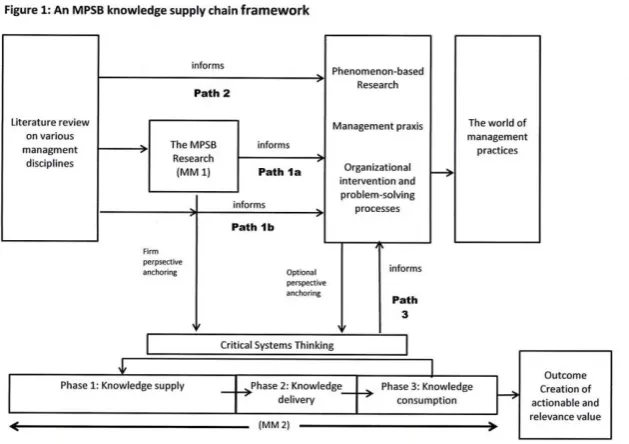
there in the early 90s. To provide an updated evaluation of the MPSB Research, with special regard to the concern on management research relevance, an MPSB knowledge supply chain framework is developed. This framework is shown in Figure 1.
review-informed management praxis3 and practice-oriented management research. [Note: Path 3 does not involve literature review on (functional) management disciplines. It does involve literature review on management research methods based on CST, see, for examples, Levin (1994) and Flood (2010).] Path 1 involves using Critical Systems Thinking (CST) as the underlying theoretical perspective (Path 1a being MPSB Research based and Path 1b being non-MPSB Research based) while Path 2 is a conventional literature review as explained in Business Research Methods textbooks without the employment of CST. Bentley, Cao and Lehaney (2013) and Gregory (1995) are examples related to Path 1b. Both Paths 1 and 2 benefit from an initial literature review, which, as Strauss and Corbin (1990; Chapter 3) remind us, heightens the researcher’s theoretical sensitivity in practice-oriented management research. The MPSB Research has a firm perspective anchoring4 on Critical Systems Thinking and has its own set of
key MPSB concepts to use in literature review for Path 1a. As depicted in Figure 1, there are organizational intervention and problem-solving processes, such as the Total Systems Intervention (TSI) methodology of Flood and Jackson (1991) that are theoretically grounded on CST, while others are not. It is also feasible to evaluate practice-oriented management research methods or organizational intervention processes based on CST without doing an MPSB Research in a specific case study (identified as Path 3). Nevertheless, a reported CST-based (Path 3) case study can subsequently be re-interpreted based on MPSB thinking to generate MPSB management knowledge, see, for example, Ho (1995b). All the paths (Paths 1-3) require managerial intellectual learning (Ho,
3Management praxis is the process by which a management theory “becomes
lived experience” via “reflective contemplation” (Stephenson, Jr. and Christensen, 2007).
4Perspective anchoring, as a key MPSB concept, is the “intellectual effort to
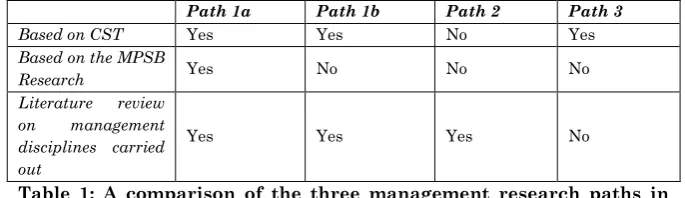
2013b) by managers, either by themselves or with others, e.g. academics and consultants, in a collaborative mode of learning and problem-solving. Thus, these management research approaches and the accompanying managerial learning process, as represented by Paths 1 to 3, should be appealing to academics, practicing managers, management consultants and scholar-practitioners who are committed to continuous professional development. Table 1 provides a comparison of the three management research paths in table form.
Path 1a Path 1b Path 2 Path 3
Based on CST Yes Yes No Yes
Based on the MPSB
Research Yes No No No
Literature review on management disciplines carried out
Yes Yes Yes No
Table 1: A comparison of the three management research paths in Figure 1
As Path 1a involves managerial intellectual learning with the MPSB Research, it is able to enhance the MPSB cognitive filter for management5 in a specific organizational setting who, for
examples, are conducting management praxis or an action research, etc.. The MPSB Research, with Path 1a, can also be employed in a Phenomenon-based Research (von Krogh, Rossi-Lamastra, and Haefliger, 2012), which is also noted in Figure 1. [Phenomenon-based Research “tackles problems that are relevant to management practices” and “scientific discourse” (von Krogh, Rossi-Lamastra, and Haefliger, 2012), thus falling within the scope of the MBSB knowledge supply chain framework.] Phenomenon-based Research, management praxis
5MPSB cognitive filter for management, as a key MPSB concept, is “a set of
and organizational intervention/ problem-solving processes are chosen because of their direct involvement in creating relevant, useful and actionable management knowledge (Heracleous and DeVogue, 1998). There are other management research methods, based on positivism, that are mainly concerned with producing generalizable management knowledge with external validity (Wikipedia, 2014a); these management research methods, being non-practice-oriented, hold much less interest and ability in producing relevant and actionable management knowledge; therefore, they are outside the scope of direct academic interest in the MPSB knowledge supply chain framework and are ignored in Figure 1. Figure 1 compartmentalizes the MPSB Research and related management research into 3 phases of a proposed MPSB knowledge supply chain framework. The framework views all the activities related to the MPSB Research as a set of related knowledge management processes forming a knowledge supply chain to produce relevant and actionable management knowledge for consumption. Its primary focus is on Path 1a, but is appreciative of the intellectual contribution from the other paths. The three phases and the outcome variable of the framework are described as follows:
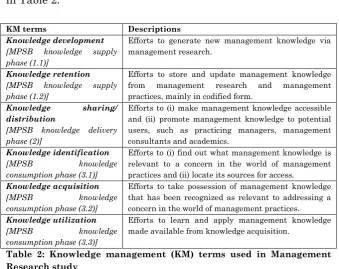
in Table 2.
KM terms Descriptions
Knowledge development [MPSB knowledge supply phase (1.1)]
Efforts to generate new management knowledge via management research.
Knowledge retention [MPSB knowledge supply phase (1.2)]
Efforts to store and update management knowledge from management research and management practices, mainly in codified form.
Knowledge sharing/ distribution
[MPSB knowledge delivery phase (2)]
Efforts to (i) make management knowledge accessible and (ii) promote management knowledge to potential users, such as practicing managers, management consultants and academics.
Knowledge identification [MPSB knowledge consumption phase (3.1)]
Efforts to (i) find out what management knowledge is relevant to a concern in the world of management practices and (ii) locate its sources for access.
Knowledge acquisition [MPSB knowledge consumption phase (3.2)]
Efforts to take possession of management knowledge that has been recognized as relevant to addressing a concern in the world of management practices.
Knowledge utilization [MPSB knowledge consumption phase (3.3)]
Efforts to learn and apply management knowledge made available from knowledge acquisition.
Table 2: Knowledge management (KM) terms used in Management Research study
To date, the writer has been focusing on the knowledge supply phase (1.2) of the knowledge supply chain framework with some
knowledge delivery phase (Phase 2) activity; the knowledge supply phase mainly comprises scholarly activities on developing and publishing new management knowledge in peer-reviewed journals. Phase 1 on MPSB knowledge supply is expected to be mainly carried out by academics or scholar-practitioners (Ho, 2014d).
deliver management knowledge (Seal, 2010).] As the writer is neither a management guru nor a management consultant, at present MPSB knowledge delivery is done via part-time teaching at some business schools in Hong Kong, publication in academic journals and sharing of MPSB ideas via the digital social media platform (Ho, 2013a). For Markides (2011), communicating research findings and distributing academic articles to students contribute to “managerially relevant research”; from this perspective, this writer’s teaching and publication works, as covered in the knowledge delivery phase, are able to improve MPSB Research relevance too. MPSB knowledge delivery can also take place when a management researcher, acting as an advisor on the subject of the MPSB Research, collaborates with other participants in a practice-oriented management research.
Research projects (via Path 1a), thus counting as MPSB knowledge consumption as well as contributing to the theoretical development of the MPSB Research. In practice, most of the writer’s Undergraduate and Postgraduate students are not yet intellectually capable to do so. Making use of the MPSB Research to conduct Phenomenon-based Research by the writer (or academics who are interested in the MPSB Research), on the other hand, is quite feasible. Interesting phenomena related to management practices can be investigated from time to time via study of business/ professional journals, newspapers and Internet search as well as heeding practicing managers’ concerns in their work settings. [Many of the writer’s part-time students are practicing managers.] Finally, it is quite feasible to make use of the MPSB Research to examine reported management cases, e.g. those from South Asian Journal of Business Management Cases (Sage publications) and Asian Journal of Management Cases (Sage publications) by practitioners as a limited form of MPSB knowledge consumption, though studying reported management cases is much inferior to working on a live management case in the real world. It is because in a live management case study, participants are able to properly carry out practice-oriented management research, e.g. an actual organizational change for an Action Research project.
MPSB knowledge supply chain outcome: When the MPSB Research is employed in management praxis and management research with managers’ engagement, the relevance of the MPSB Research findings and the actionable value of the MPSB Research are thus established for these managers. Such
actionable management knowledge is able to meet the assessment criteria in both management research as well as the business needs of one or more organizations. This view on
attributed to research that closes the gap between theory and practice” (Brownlie and Saren, 1997), and closing the theory-practice gap is an aspiration of the MPSB Research. To realize the expected MPSB knowledge supply chain outcome, it must be emphasized, engaging managerial intellectual learning efforts have to be made by its practitioners, who act as scholar-practitioners.
While Figure 1 depicts the MPSB knowledge supply chain as comprising three phases, it should be clear that, due to it practice-orientation, some of the knowledge processes are concurrent, e.g. knowledge development, knowledge sharing and knowledge utilization all take place at the same time. Having introduced the MPSB knowledge supply chain framework, it is now ripe to distinguish between two MPSB Research modes:
Mode 1 (MM 1) concentrates on Phases 1 and 2 of the knowledge supply chain,
Mode 2 (MM 2) covers the whole knowledge supply chain.
An overall assessment on the MPSB Research
Making use of Management Research concepts, the nature of the MPSB Research can be more clearly explained:
Transfied (2002) discusses two types of management research, called MK1 and MK2: For MK1, problems are “set and solved by the academic community, using a disciplinary staff base patrolled by elite academic gate keepers called professors, based in institutionalized research organizations such as universities…” while, for MK2, “methods of knowledge production” that endorse a soft, applied, divergent, and rural orientation in management research are employed (Transfield, 2002). The MPSB Research sides more with M2K than M1K (Transfield, 2002).
Katri et al. (2012) discern 3 types of management research, i.e., (i) practice-oriented research, (ii) positivist research, and (iii) nostalgic research. In the case of the MPSB Research, it mainly supports practice-oriented research, rather than positivist research or nostalgic research.
Furthermore, Katri et al. (2012) identify 3 main criteria to evaluate management research, namely, (i) correspondence, (ii) consistence, and (iii) practicality or relevance. Regarding the MPSB Research, it favors (ii) consistency (i.e. to be consistent with Critical Systems Thinking) and (iii) relevance, while placing a lower priority on (i) correspondence (i.e. “the extent to which a theory relies on observations from the phenomenon of interest for its truth value” (Katri et al., 2012).)
identified by Van de Ven and Johnson (2006):
Aspect 1: As a knowledge transfer problem - the MPSB Research response: translating and diffusing the MPSB Research knowledge is currently done via (i) publications in academic journals, (ii) e-learning support to students in the digital social media, and (iii) teaching and dissertation project supervision to business administration students. Knowledge transfer can also be facilitated via collaborative mode of management research such as Action Research and practice-oriented research which the MPSB Research favors.
Aspect 2: Knowledge of theory and knowledge of practice are fundamentally distinct kinds of knowledge – the MPSB Research response: the MPSB Research is mainly interested in practice-oriented research; it embraces a view of knowledge of theory and practice that is inter-related, possessing three related parts of complexity, i.e. the natural world complexity, the social world complexity and the internal world complexity (Midgley, 1992). Based on this view, this writer maintains that knowledge of theory and practice are not fundamentally distinct; nevertheless, in university dissertation report writing, it is a good practice, as the University of Greenwich of UK does, to ask a dissertation project student to produce 2 reports, namely, one dissertation report for the academics and one consultancy report for the management in a client company, based on one dissertation project. In this case, dissertation students are taught both the subjects of Management Research and Management Consulting (Wickham, 2004; Sadler, 2007).
in a given domain” (Van de Ven and Johnson, 2006). Also, Phenomenon-based Research-cum-MPSB Research (Path 1a) can be carried out by management researchers with a scholar-practitioner mindset to address this knowledge production problem. This makes up a future research topic for the MPSB Research.
So far, the MPSB Research is able to be conducted without external funding; it can be done by a team of collaborators or by individual aspiring scholar-practitioners, who are working in the industry or at universities. [Nevertheless, presently, the MPSB Research does not catch the attention of the academic community – it remains a single-person management research venture.] It does require access to academic and business journals, textbooks in business management, and the Internet as well as intellectual efforts from its practitioners. As a scholarly activity, it is important to share the findings from the MPSB Research with peers via publication in academic journals. Conducting the MPSB Research is a form of personal managerial intellectual learning in systems thinking (Ho, 2013b). Those who build up stronger managerial intellectual competence via continuous and committed managerial intellectual learning are able to produce better quality MPSB Research findings and vice versa.
Concluding remarks
is a need to investigate how to design the MPSB knowledge supply chain process so that users are able to experience the consumption of usable knowledge products in
practice-oriented management research and
management praxis, with the term usable [the noun is
usability (Wikipedia, 2014b)] from the usability engineering
discipline, meaning (i) easy to use, (ii) easy to learn and (iii) enjoyable to use. In this case, this usability criterion incorporates the relevant, actionable and useful research quality criteria in the current management research literature to make up a more coherent criterion. If the MPSB Researcher is an MPSB management knowledge constructor for MM 1, then this person is expected to be an MPSB user experience manager
for MM 2.
BIBLIOGRAPHY:
___________. 2014. “Systems Thinking and Practice: Diagramming”. Open University. (url address: http://systems.open.ac.uk/materials/T552/) [visited at February 21, 2014].
___________. 2014a. “External validity” Wikipedia. (url address: http://en.wikipedia.org/wiki/External_validity) [visited at February 9, 2014].
___________. 2014b. “Usability” Wikipedia. (url address: http://en.wikipedia.org/wiki/Usability) [visited at February 9, 2014].
Bentley, Y., G.M. Cao and B. Lehaney. 2013. “The Application of Critical Systems Thinking to Enhance the Effectiveness of a University Information System”
Systems Practice and Action Research 26: 451-465.
Marketing 14. Elsevier: 147-161.
Bryman, A. and E. Bell. 2007. Business Research Methods. Oxford University Press, Oxford, England.
Burke, M.J., F. Drasgow and J.E. Edwards. 2004. “Closing science-practice knowledge gaps: contribution of psychological research to human resource management”
Human Resource Management 43(4) Winter. Wiley: 299-304.
Coghlan, D. and A.B. Shani. 2013. “Creating Action Research Quality in Organization Development: Rigorous, Reflective and Relevant” Systems Practice and Action Research, published online Nov. 14, Springer.
Ellis, R.K. 1995. “Critical Considerations in the Development of Systems Thinking and Practice” Systems Practice 8(2), April, Plenum, New York: 199-214.
Flood, R.L. 2010. “The Relationship of ‘Systems Thinking’ to Action Research” Systems Practice and Action Research
23(4) August: 269-284.
Flood, R.L. and M.C. Jackson. 1991. Creative Problem Solving: Total Systems Intervention. Wiley, Chichester.
Gregory, A. 1995. “72: Critical reflections on the past, present and future development of organizational evaluation” in Ellis, K., A. Gregory, B.R. Mears-Young and G. Ragsdell. (editors) Critical Issues in Systems Theory and Practice. Plenum Press. New York: 479-486.
Heracleous, L. and S. DeVogue. 1998. “Bridging the Gap of Relevance: Strategic Management and Organisational Development” Long Range Planning 31(5), Pergamon: 742-754.
Ho, J.K.K. 1994a. "Is Total Systems Intervention (TSI) no better than common sense and not necessarily related to Critical Systems Thinking (CST)?: A Research Note"
Systems Practice Vol. 7, No. 5, Plenum Press: pp. 569-573.
Research" at the Fourth Conference of the Operational Research Society of Hong Kong Proceedings, Oct. 17: 198-206.
Ho, J.K.K. 1995a. “MPSB Frameworks Explained” in Ellis, K., A. Gregory, B. Mears-Young and G. Ragsdell. (editors).
Critical Issues in Systems Theory and Practice. Plenum Press: 487-492.
Ho, J.K.K. 1995b. “An Example on the Operation of the MPSB Filter” Systems Research Vol. 12, No. 4, Wiley, Chichester: 297-308.
Ho, J.K.K. 1995c. "Formulating MPSB Frameworks, using Logistics Management as an example: A Research Note"
Systems Practice Vol. 8.2, April, Plenum Press: 223-230. Ho, J.K.K. 1995d. “Operational Research and the knowledge
structure of management disciplines” Management Research News Vol. 18, No. 8/9, Barmarick Publications, Hull, UK: 27-39.
Ho, J.K.K. 1996a. “MPSB Research Explained” Journal of the Operational Research Society 47, Stockton: 843-852. Ho, J.K.K. 1996b. Development of Multi-perspective,
Systems-based Frameworks, Doctor of Philosophy thesis submitted to Faculty of Engineering, University of Hong
Kong, July. (url address:
http://hub.hku.hk/handle/10722/34952) [visited at February 8, 2014].
Ho, J.K.K. 1997a. “MPSB Frameworks and Decision Support Systems studies” Systems Research and Behavioral Science Vol. 14, No. 4, Wiley, Chichester: 287-293.
Ho, J.K.K. 1997b. “What can contemporary systems thinking offer to logistics management as a management discipline?” European Journal of Purchasing and Supply Management Vol. 3, No. 2, Pergamon: 77-81.
Hybrid Learning 2007, on July 9 at Open University, HK, organized by HK Web Symposium Consortium: 66-77.
Ho, J.K.K. 2008. "E-coaching for management development in Hong Kong: an examination of market potential and business value from knowledge
management perspective" Hybrid Learning: A new frontier, proceedings of 1st International Conference on Hybrid Learning – ICHL 2008, Hong Kong, Fong, J., R. Kwan and F.L. Wang. (Eds) Aug 13-15: 69-77.
Ho, J.K.K. 2013a. “A research paper: Providing e-learning support to part-time students in business disciplines using Facebook from the Multi-perspective, Systems-based (MPSB) perspective”, Systems Research and Behavioural Science 30, Wiley: 86-97.
Ho, J.K.K. 2013b. “A Research Note: An exploration on the intellectual learning process of systems thinking by managers in the digital social media ecosystem”
European Academic Research Vol. 1(5) August: 636-649. Ho, J.K.K. 2013c. “An endeavor to render an impressionistic
image of Enlightening Management Education in Multi-perspective, Systems-based Research” European Academic Research 1(6), September, pp. 1013-1034. Ho, J,K.K. 2014a. “A Research Note: A Multi-perspective,
Systems-based (MPSB) Framework on Information Systems/ Information Technology (IS/IT) Project Appraisal” European Academic Research 1(10), Jan.: 3303-3320.
Ho, J.K.K. 2014b. “An exploratory exercise to establish the profile of a double-hybrid management accountant with justifications” European Academic Research 1(11), Feb.: 4261-4273.
Ho, J.K.K. 2014c. “On plagiarism-dissolving: A Research Note”
development to be a scholar practitioner in business management” European Academic Research 1(12), March: 5393-5422.
Ho, J.K.K., E.C. Partington and D. Sculli. 1996. “Soft Systems Methodologies in Organizational Change”, International Journal of Information and Management Sciences, Graduate Institute of Management Sciences Vol. 7(4), December, Tamkang University, Taipei, The Republic of China: 43-54.
Ho, J.K.K. and D. Sculli. 1993. "Critical Systems Thinking and Information Systems Design" the Conference Proceedings of the Second International Conference of Decision Sciences Institute, Seoul, Korea, June: 685-688. Ho, J.K.K. and D. Sculli. 1994a. "A Multi-perspective, Systems-based Framework for Decision Support Systems Design"
Systems Practice Vol. 7, No. 5, Plenum Press: 551-563. Ho, J.K.K. and D. Sculli. 1994b. "Organizational Change and
Soft Systems Methodologies" Journal of Management Development Vol. 13, No. 7, MCB University Press: 47-58.
Ho, J.K.K. and D. Sculli. 1995. “System Complexity and the Design of Decision Support Systems” Systems Practice
Vol. 8, No. 5, Plenum Press: 505-516.
Jackson, M.C. 2000. Systems Approaches to Management, Kluwer Academic/ Plenum Publishers, New York.
Jackson, M.C. 2010. “Research Paper: Reflections on the Development and Contribution of Critical Systems Thinking and Practice” Systems Research and Behavioral Science 27. Wiley, Chichester: 133-139. Katri, N., A.K. Ojha, P. Budhwar, V. Srinivasan and A. Varma.
2012. “Management research in India: Current state and future directions” IIMB Management Review 24, SciVerse ScienceDirect: 104-115.
7(1) February: 25-41.
Markides, C. 2011. “Crossing the Chasm: How to Convert Relevant Research into Managerially Useful Research”
The Journal Applied Behavioral Science 47(1), SAGE Publications: 121-134.
Midgley, G. 1992. “Pluralism and the Legitimation of Systems Science” Systems Practice 5(2). Plenum: 147-172.
Morgan, G. 1986. Images of Organization. SAGE Publications. Probst, G., S. Raub and K. Romhardt 2000. Managing
Knowledge: Building Blocks for Success. Wiley, Chichester.
Sadler, P. (editor). 2007. Management Consultancy: a handbook for best practice. Kogan Page, London.
Saunders, M., P. Lewis and A. Thornhill. 2012. Research Methods for Business Students. Pearson, Harlow, England.
Sculli, D. and J.K.K. Ho. 2001. “Office automation issues viewed from a multi-perspective systems-based framework” Human Systems Management 20: 95-103. Seal, W. (2010) “Managerial discourse and the link between
theory and practice: From ROI to value-based management” Management Accounting Research 21, Elsevier: 95-109.
Seal, W. 2010. “Managerial discourse and the link between theory and practice: From ROI to value-based management” Management Accounting Research 21, Elsevier: 95-109.
Stephenson, Jr. M. and R. Christensen. 2007. “Mentoring for Doctoral Student Praxis-Centered Learning: Creating a Shared Culture of Intellectual Aspiration” Nonprofit and Voluntary Sector Quarterly, Supplement 36(4) December, Association for Research on Nonprofit Organizations and Voluntary Action: 64S-79S.
Publications.
Tenkasi, R.V. and G.W. Hay. 2004. “Actionable Knowledge and Scholar-Practitioners: A Process Model of Theory-Practice Linkages” Systemic Practice and Action Research 17(3), Plenum Publishing Corporation: 177-206.
The Economist. 2014. “Business schools are better at analysing disruptive innovation than at dealing with it” The Economist February 8th: 58.
Transfield, D. 2002. “Formulating the nature of Management Research” European Management Journal 20(4), Pergamon: 378-382.
Van de Ven, A.H. and P.E. Johnson. 2006. “Knowledge for theory and practice” Academy of Management Review
31(4): 802-821.