Keyword Search In Top Down Xml
Rangu Ravali & Mr. Kalyanapu Srinivas
1M.Tech, Department of CSE, Vaagdevi College of Engineering, Bollikunta Warangal, Telangana,
2Assistant Professor, Department of CSE, Vaagdevi College of Engineering, Bollikunta Warangal,
Telangana,
Mail id: [email protected], Mail ID: [email protected]
Abstract— efficiently answering XML
keyword queries has attracted much research
effort in the last decade. The key factors
resulting in the inefficiency of existing methods
are the common-ancestor-repetition (CAR) and
visiting-useless-nodes (VUN) problems. To
address the CAR problem, we propose a
generic top-down processing strategy to
answer a given keyword query w.r.t.
LCA/SLCA/ELCA semantics. By “top-down”,
we mean that we visit all common ancestor
(CA) nodes in a depth-first, left-to-right order;
by “generic”, we mean that our method is
independent of the query semantics. To address
the VUN problem, we propose to use child
nodes, rather than descendant nodes to test the
satisfiability of a node v w.r.t. the given
semantics. We propose two algorithms that are
based on either traditional inverted lists or our
newly proposed LLists to improve the overall
performance. We further propose several
algorithms that are based on hash search to
simplify the operation of finding CA nodes
from all involved LLists. The experimental
results verify the benefits of our methods
according to various evaluation metrics.
1 INTRODUCTION
XML has been successfully used in many
applications, such as that in scientific and
business domains, as the standard format for
storing, publishing and exchanging data.
Compared with structured query languages,
such as XPath and XQuery, keyword search is
also gained popularity on XML data as it
relieves users from understanding the complex
query languages and the structure of the
underlying data, and has received much
attention due to that results are not the entire
documents anymore but nested fragments.
Typically, an XML document can be modeled
as a node labeled tree T. For a given keyword
query Q, several semantics have been proposed
to define meaningful results, for which the
basic semantics is Lowest Common Ancestor.
Based on LCA, the most widely adopted query
semantics are Exclusive LCA (ELCA) [2], and
Smallest LCA (SLCA) [5], [7], [8], [9], [11].
SLCA defines a subset of LCA nodes, of which
no LCA is the ancestor of any other LCA. As a
comparison, ELCA tries to capture more
meaningful results, it may take some LCAs that
that for a given query Q ¼ fk1; k2…..kmg,
each keyword appears at least once in the given
XML document. Intuitively, to get all CA
nodes of Q, our method takes all nodes in the
set of inverted IDDewey label lists as leaf
nodes of an XML tree Tv rooted at node v, and
checks whether each node of Tv contains all
keywords of Q in a down” way. The “top-down” means that if Tv contains all keywords
of Q, then v must be a CA node. We then
remove v and get a forest Fv ¼ fTv1; Tv2 ; . . .
; Tvng of subtrees rooted at the n child nodes
of v. Based on Fv, we further find the set of
subtrees FCA v Fv, where each subtree Tvi 2
FCA v contains every keyword of Q at least
once, i.e., node vi is a CA node. If FCA v ¼ ;,
it means that for Tv, only v is a CA node, then
we can safely skip all nodes of Tv from being
processed; otherwise, for each subtree Tvi 2
FCA v , we recursively compute its subtree set
FCA vi until FCA vi ¼ ;. Let SiðvÞ denote, for
v, the set of child nodes that contain ki, ScaðvÞ
the set of child CA nodes of v, and CAðTvÞ
the set of CA nodes in Tv. Formula 2 means
that the set of CA nodes of Q equals the set of
CA nodes in Tr, where r is the document root
node. CAðTrÞ can be recursively computed
according to Formula 3. Formula 3 means that
for a given CA node v, the set of CA nodes in
Tv is equal to the union of fvg and the set of
CA nodes in subtrees rooted at v’s child CA
nodes, which can be further computed by
Formula
2 RELATED WORKS
DIL [2] sequentially processes all involved
Dewey labels in document order, its
performance is linear to the number of
involved Dewey labels. IS [3] sequentially
processes all Dewey labels of the shortest list
L1 one by one. In each iteration, it picks from
L1 a Dewey label l and uses it to probe other
lists to get a candidate ELCA node. As the
basic operations of the two algorithms are OP1
and OP2, they heavily suffer from both the
CAR and VUN problems. JDewey-E [7]
computes ELCA results by performing set
intersection operation on all lists of each tree
depth from the leaf to the root. For all lists of
each level, after finding the set of common
nodes, it needs to recursively delete all ancestor
nodes in all lists of higher levels. As a node
could be a parent node of many other CA
nodes, and the deletion operation needs to
process each parent-child relationship
separately, JDewey-E suffers from the CAR
problem. Meanwhile, as it performs set
intersection on all lists of each tree depth
fromthe leaf to the root, they will firstly visit
nodes of V2 for Q2, thus it also suffers from
the VUN problem. As some node IDs appear in
many different IDDewey labels of the same
inverted list, and HC [4] processes each
still suffers from the CAR problem. Moreover,
HC needs to push each component of every
IDDewey label of the shortest inverted list into
a stack, it also suffers the VUN problem when
the pushed components are UNs.
3 THE BASELINE ALGORITHM
Our baseline ELCA algorithm recursively gets
all CA nodes in a top-down way, then checks
the satisfiability of each CA node, which works
on the traditional inverted lists of labels w.r.t.
Dewey or one of its variants. To do so, it needs
to solve two problems: ðP1Þ identify the set of
child CA nodes for each CA node v, ðP2Þ
check v’s satisfiability w.r.t. ELCA semantics.
For P1, given a query Q with m keywords, we
know that 8i 2 ½1;m_; ScaðvÞ SiðvÞ. Thus
given a CA node v and its subtree set Fv ¼
fTv1; Tv2 ; . . . ; Tvng, to get ScaðvÞ, we do
not need to check whether each subtree
contains all query keywords; instead, we just
need to check whether each node in SminvÞ,
which contains least number of child nodes of
v w. r.t. kmin, appears in SiðvÞði 2 ½1;m_ ^ i
6¼ minÞ. Even if we know the lengths of all
child lists, it’s difficult to know which one is
SminðvÞ. Fortunately, as all node IDs in each
child list of v are sorted in ascending order, our
newly proposed set intersection algorithm
guarantees that the number of processed child
nodes for each CA node v is bounded by
jSminðvÞj. For P2, we use the following
Lemma to check the satisfiability of v, which is
similar to .Lemma 1. Given a query Q ¼ fk1;
k2; . . . ; kmg and CA node v,
3.1 The Algorithm
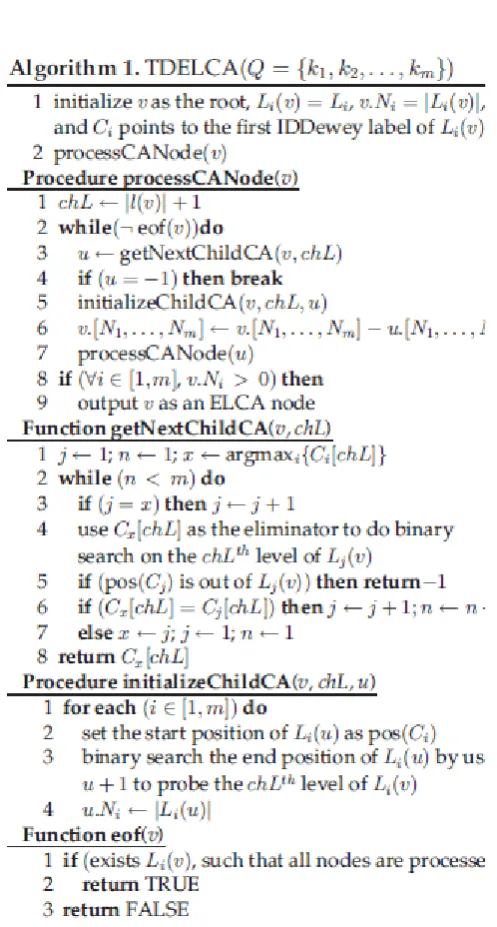
Based on the above description, Algorithm 1
recursively gets all CA nodes in a top-down
way. For each CA node v, it finds out the
number of occurrences of each query keyword
in its subtree, i.e., the length of each of its child
list, then gets v’s child CA nodes by
intersecting v’s child lists
using binary search operation. After that, it
checks the satisfiability of v by Lemma 1. To
do so, each inverted list Li is associated with a
cursor Ci pointing to some IDDewey label of
Li, Ci½x_
denotes the xth component of the IDDewey
label that Ci points to, and posðCiÞ is used to
denote Ci’s position in Li. Given a node v, we
use lðvÞ to denote the IDDewey label of v,
v:Ni denotes the number of keyword
occurrences w.r.t. ki in the subtree rooted v. As
shown in Algorithm 1, it firstly initializes the
subtree rooted at the root node of the given
XML tree in line 1, then calls the procedure
processCANodeðÞ to recursively get all CA
The procedure processCANodeðÞ works as
follows. Itfirstly gets the depth of v’s child
nodes in line 1. In lines 2-7, it repeatedly gets
all child CA nodes of v. For each child CA
node u got in line 3, it firstly gets the values of
variables associated with v in line 5; in line 6,
it excludes the occurrences of all query
keywords under u from that under v. In line 7,
it calls processCANodeðÞ to recursively
process u. After processing all childCA nodes
of v, if 8i 2 ½1;m_; v:Ni > 0, according to
Lemma 1, v is an ELCA node and outputted in
line
4. THE HASH SEARCH BASED
ALGORITHMS
Even though TDELCA-L reduces the time
complexity compared with TDELCA, it relies
on the probe operation (implemented by binary
search) to align the cursors of inverted lists. To
further improve the overall performance, we
consider the existence of additional hash
indexes [4], [11], [17] on inverted lists, such
that each probe operation takes time without
using binary search operation. the first hash
table HF records the number of nodes in each
Li, which is used to choose the shortest LList.
For each Li, another hash table Hi records, for
each node of Li, the number of its child nodes
that contain ki. Note that Hi in our methods is
different with that of [4], [11], [17], where Hi
records, for each node v, the number of v’s
descendant nodes that directly contain ki., we
know that the number of nodes of L1 is 11,
which can be denoted as HF ½k1_ ¼ 11.
According node 1 has three child nodes
containing k1(“Tom”), which can be denoted
as H1½1_ ¼ 3. Node 5 does not have child
nodes containing k1, thus H1½5_ ¼ 0.
Similarly, node 3 does not contain k1, which is
4.1 The Baseline Hash Search Algorithm Assume that jL1j _ jL2j _ __ _ _ jLmj, the
main idea of our baseline hash search
algorithm is: take the shortest LList L1 as the
working list and recursively process all CA
nodes in top-down way. For each CA node v,
sequentially check whether each of its child
nodes in L1 is a CA node, then output v if it is
an ELCA result.
Algorithm 2 shows the detailed description of
the TDELCA-H algorithm. Compared with
TDELCA and TDELCA-L, for a given query
Q, TDELCA-H only needs to process all CA
nodes and their child nodes in L1. For each
processed node v in L1, TDELCA-H checks
whether v is a CA node by hash probe
operations, rather than set intersection
operations on a set of child lists9 5
CONCLUSIONS
Considering that the key factors resulting in the
inefficiency for existing XML keyword search
algorithms are the CAR and VUN problems,
we proposed a generictop-down processing
strategy that visits all CA nodes only once, thus
avoids the CAR problem. We proved that the
satisfiability of a node v w.r.t. the given
semantics can be determined by v’s child
nodes, based on which our methods avoid the
VUN problem. Another salient feature is that
our approach is independent of query
semantics. We proposed two efficient
algorithms that are based on either traditional
inverted lists or our newly proposed LLists to
improve the overall performance. Further, we
proposed three hash search-based methods to
reduce the time complexity. The experimental
results demonstrate the performance
advantages of our proposed methods over
existing ones. One of our future work is
studying disk-based index to facilitate XML
keyword query processing when the size of
indexes becomes too large to be completely
loaded into memory.
REFERENCES
[1] S. Cohen, J.Mamou, Y. Kanza, and Y. Sagiv,
“XSEarch: A semantic search engine for XML,” in
Proc. 29th Int. Conf. Very Large Data Bases, 2003,
pp. 45–56.
[2] L. Guo, F. Shao, C. Botev, and J.
search over XML documents,” in Proc. ACM
SIGMOD Int. Conf. Manage. Data, 2003, pp. 16–
27.
[3] Y. Xu and Y. Papakonstantinou, “Efficient LCA
based keyword search in XML data,” in Proc. 11th
Int. Conf. Extending Database Techn.: Adv.
Database Technol., 2008, pp. 535–546.
[4] R. Zhou, C. Liu, and J. Li, “Fast ELCA
computation for keyword queries on XML data,” in
Proc. 13th Int. Conf. Extending Database Technol.,
2010, pp. 549–560.
[5] Y. Xu and Y. Papakonstantinou, “Efficient
keyword search for smallest LCAS in XML
databases,” in Proc. ACM SIGMOD Int. Conf.
Manage. Data, 2005, pp. 537–538.
[6] Y. Li, C. Yu, and H. V. Jagadish, “Schema-free xquery,” in Proc. 13th Int. Conf. Very Large Data
Bases, 2004, pp. 72–83.
[7] L. J. Chen and Y. Papakonstantinou,
“Supporting top-K keyword search in XML databases,” in Proc. 26th Int. Conf. Data Eng.,
2010, pp. 689–700.
[8] C. Sun, C. Y. Chan, and A. K. Goenka,
“Multiway SLCA-based keyword search in XML data,” in Proc. 16th Int. Conf. World Wide Web,
2007, pp. 1043–1052.
[9] Z. Liu and Y. Chen, “Reasoning and identifying
relevant matches for XML keyword search,” J.
Proc. Very Large Data Bases Endowment, vol. 1,
no. 1, pp. 921–932, 2008.
[10] G. Li, J. Feng, J. Wang, and L. Zhou,
“Effective keyword search for valuable LCAS over XML documents,” in Proc. 16th ACM Conf. Conf.
Inform. Knowl. Manage., 2007, pp. 31–40.
[11] W. Wang, X. Wang, and A. Zhou,
“Hash-search: An efficient SLCA-based keyword search
algorithm on XML documents,” in Proc. 14th Int.
Conf. Database Syst. Adv. Appl., 2009, pp. 496–
510.
[12] Y. Chen, W. Wang, and Z. Liu,
“Keyword-based search and exploration on databases,” in
Proc. IEEE 27th Int. Conf. Data Eng., 2011, pp.
1380–1383.
[13] B. Q. Truong, S. S. Bhowmick, C. E. Dyreson,
and A. Sun, “MESSIAH: Missing
element-conscious SLCA nodes search in XML data,” in
Proc. SIGMOD, 2013, pp. 37–48.
[14] L. Kong, R. Gilleron, and A. Lemay,
“Retrieving meaningful relaxed tightest fragments
for XML keyword search,” in Proc. 12th Int. Conf.
Extending Database Technol.: Adv. Database
Technol., 20 pp. 815–826.
[15] V. Hristidis, N. Koudas, Y. Papakonstantinou,
and D. Srivastava, “Keyword proximity search in
XML trees,” IEEE Trans. Knowl. Data Eng., vol.
18, no. 4, pp. 525–539, 2006.
[16] J. Zhou, Z. Bao, W. Wang, T. W. Ling, Z.
Chen, X. Lin, and J. Guo, “Fast SLCA and ELCA
computation for XML keyword queries based on
set intersection,” in Proc. 28th Int. Conf. Data Eng.,
2012, pp. 905–916.
[17] J. Zhou, Z. Bao, W. Wang, J. Zhao, and X.
Meng, “Efficient query processing for XML keyword queries based on the idlist index,” Int. J.
Very Large Data Bases, vol. 23, no. 1, pp. 25–50,