Satellite Image Enhancement using DWT – SWT Method
S.N.V.Vijayalakshmi & G.V.Vinod
M.Tech Department of ECE (DECS) GIER, Rajahmundry Assistant Professor Department of ECE GIER, Rajahmundry
ABSTRACT— In the area of image processing, Satellite imaging is one of the challenging assignments for the analysts. The diverse satellite sensors are accessible in the low range to high range for information gathering. In our paper, a satellite image enhancement algorithm based on interpolation of the high-frequency subbands acquired by discrete wavelet transform (DWT) and the low resolution input image is proposed. This technique utilizes a DWT and high frequency subband image interpolation into the low resolution input images. The sharpness of image is acquired by the estimation of high frequency subband. we have combined DWT with SWT and improve the quality of the image. Inverse DWT is performed to recreate the resultant image. The visual and mathematical outcomes are exhibited and talked about on LANDSAT 8 information by comparing the proposed method over conventiossnal and condition of resolution enhancement methods.
Keywords: Discrete wavelet transform, Interpolation, LANDSAT Imagery, Remote sensing, Stationary wavelet transform
I.
INTRODUCTION
The application of satellite imagery increases day by day due the change in the sensor advancements in weather forecasting, astronomy, geographical information et cetera. There is a need of have high resolution satellite images. These images are impacted by many components, for instance, absorption scattering
adjustments et cetera. The truthful and geometric data clearly removed from the information imagine itself, while transform domain technique input image is changed into other transformations, for instance, DFT, DCT and discrete wavelet transform (DWT) to achieve the image resolution enhancement. To enhance immense number of image purposes a band adaptive contrast change is used and moreover noise amplification is kept up a vital separation from. The high resolution image is gained by cycle spinning algorithm nearby the multi wavelet change from low resolution input images. Subsequently processing the satellite image for remote identifying application enhancement is basic. The data received through the different sensor have distinctive resolutions. The high resolution data isn't available freely. However the low resolution data is uninhibitedly available and downloadable yet the classification accuracy isn't good. It impacts the execution of classification result. In this manner there is a need of resolution enhancement for satellite images. The proposed paper uses DWT and SWT in first stage, interpolation as intermediate stage and IDWT as final stage which in all enhances quality of the image.
II.
INTERPOLATION
One of the normally utilized techniques for image resolution enhancement is Interpolation. It has been generally utilized in many image processing applications, for example, facial recreation, multiple description coding, and super resolution. There are three understood interpolation systems, specifically nearest neighbor interpolation, bilinear interpolation, and bi-cubic interpolation. It is the ways toward utilizing known data values to esteem assess unknown data values. Different interpolation techniques are regularly utilized in atmospheric sciences.
III. DISCRETE WAVELET
TRANSFORM
into the wavelet filters. These wavelet filters includes both the high-pass and low-pass channel. At that point, these filters will isolate the high frequency substance and low frequency substance of the signal. Be that as it may, with DWT the quantities of samples are diminished by dyadic scale. This procedure is known as the sub-sampling. Sub-sampling implies decreasing the samples by a given factor. Because of the hindrances forced by CWT which requires high processing power the DWT is chosen due its simplicity and ease of operation in handling complex signal.
IV.
Implementation of Proposed
Method
Essentially there are two steps engaged with this image enhancement operation. In the first step, we do resolution enhancement. Resolution enhancement utilizes the combination of DWT and SWT. After that IDWT is connected to interpolated sub bands, IDWT yield is the high resolution image.
Image Resolution Enhancement Utilizing DWT and SWT in image edges assume a most vital part. The principle loss is in high frequency components that are edges on utilizing interpolation in image resolution enhancement, which is because of the smoothing caused by interpolation. Preserving the edges is basic to get high resolution of an
Interpolation with factor 2 L
H Input Image
SWT DWT
L
L L
H H
L H
H L
L
H
L H
H
+
+
+
Estimated LH, HL
IDWT
High Resolution Image
Interpolation with 2 Interpolation
Block Diagram for DWT and SWT-based Resolution Enhancement Algorithm
The SWT high frequency sub bands and interpolated high frequency sub bands have the same size hence that can be added with each other. After correlation new high frequency
sub bands are obtained. These correlated high frequency sub bands and input image are again interpolated by interpolation factor for further enlargement. In wavelet domain, the low resolution image is obtained by low pass filtering of the high resolution image. Hence instead of using Low resolution sub bands, we are using input image for the interpolation of low frequency subband image, this increases the quality of image. After interpolation Inverse Discrete Wavelet Transform (IDWT) is applied to all the interpolated sub bands. The IDWT output is final output image, which is high resolution image.
V. SIMULATION RESULTS
shown in table1. It shows that the PSNR values of conventional interpolation, wavelet zero padding (WZP) and DWT-RE with proposed method and in proposed method we combined DWT with SWT and improved he quality of the image
PSNR is characterised as follows:
𝑃𝑆𝑁𝑅 = 10𝑙𝑜𝑔10 255
2
𝑀𝑆𝐸
Where,
𝑀𝑆𝐸 = 1
𝑀 × 𝑁 𝐼 − 𝐼
′ 2 𝑁−1
𝑦=0 𝑀−1
𝑥=0
Table 1 PSNR values of different methods
METHOD/IMAGE PSNR
Bilinear 51.3830
Bicubic 53.4240
WZP 58.7463
DWT 59.2990
DWT-SWT 65.8545
Fig 1 Original low resolution image
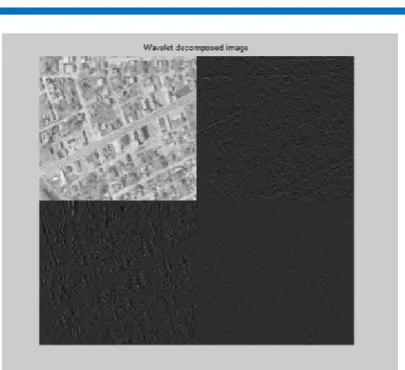
Fig 2 Wavelet decomposed image
Fig 3 WZP Method
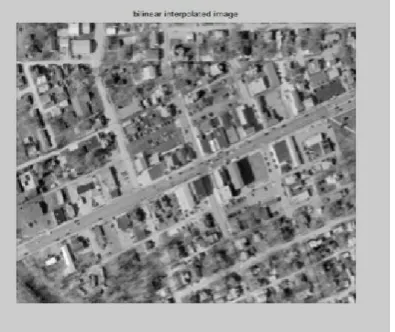
Fig 5 Bilinear interpolated image
Fig 6 Bicubic interpolated image
Fig 4 Enhanced image using DWT-SWT method
VI. CONCLUSION
A review on several Ariel image enhancement techniques has been implemented, also compared the simulation results with the conventional interpolation and the wavelet techniques. By observing the resultants we can conclude that the proposed enhancement has given better performance than the existed methods. Furthermore, have extended the method DWT with combination of SWT and observed better image quality. And we calculated the PSNR values of various methods in dB for Bilinear 51.38, Bi-cubic 53.42, WZP 58.74,DWT method 59.299.Finally in DWT-SWT method we achieve a 65.8545dB PSNR in enhanced image.
REFERENCES
[1] Goetz J. A. H. F.,G. Vane, J.E. Solomon, B.N. Rock, “Imaging Spectrometry for Earth Remote Sensing,” Science, 1985, vol. 228, pp.1147-1153.
[2] Eunjungchae, Wonseokkang, Joonkipaik, “Spatially Adaptive Antialiasing for Enhancement of Mobile Imaging System Using Combined Wavelet-Fourier Transform,” IEEE transaction on consumer
electronics vol 59, 4Nov 2013.
[3] N.Kundeti, H.K.Kalluri, S.V.Krishna,”Image Enhancement Using DT-
CWT Based Cycle Spinning Methodology,” IEEE Conference On Computational Intelligence and Computing Research, 2013. [4] H. Demirel and G. Anbarjafari, “satellite image resolution enhancement using complex wavelet transform,” IEEE Transactions on Geoscience
and Remote Sensing Letters, Vol. 7, pp. 123– 126, 2010.
[5] A.Temizel and T.Vlachos, “Wavelet Domain Image Resolution Enhancement Using Cycle Spinning,” Electronics Letters, vol.41.pp119-
121, 2005.
[6] X. Li and M. Orchard, “New edge-directed interpolation,” IEEE Trans.Image Process., vol. 10, no. 10, pp. 1521–1527, Oct. 2001. [7] L. Zhang and X. Wu, “An edge-guided image interpolation algorithm via directional filtering and data fusion,” IEEE Trans. Image Process., vol. 15, no. 8, pp. 2226–2238, Aug. 2006.
[8] Y. Piao, I. Shin, and H. W. Park, “Image resolution enhancement using inter-sub-band correlation in wavelet domain,” in Proc. Int. Conf.
Image Process., 2007, vol. 1, pp. I-445–448. [9] J. W. Wang and W. Y. Chen, „„Eye detection based on head contour geometry and wavelet sub-band projection,‟‟ Opt. Eng., vol. 45, no.
5, pp. 057001-1--057001-12, May 2006. [10] J. L. Starck, E. J. Candes, and D. L. Donoho, „„The curvelet transform for image de-noising,‟‟ IEEE Trans. Image Process., vol. 11, no. 6,