Available online: https://edupediapublications.org/journals/index.php/IJR/ P a g e | 257
Design & Development Of A Suitable Framework Using Recursive
Random Search For Enormous Dimensional Parameter Streamlining
Mohammed Rahmat
1, Prof.Dr.G.Manoj Someswar
2Research Scholar, VBS Purvanchal University, Jaunpur, U.P., India
Reearch Supervisor, VBS Purvanchal University, Jaunpur, U.P., India
ABSTRACT
Execution examination strategies are fundamental to the technique of framework custom game
plan and operations. A collection of systems have been used by investigators in different settings:
investigative models (eg: TCP models, web models, self-indistinguishable models, topology models),
duplication stages (eg: ns-2, SSFnet, GloMoSim, Genesis), prototyping stages (eg: MIT Click
Router gadget compartment, XORP), gadgets for consider blueprint of-examinations and breaking
down parameter state spaces (eg: Recursive Random Search, STRESS), exploratory mimicking
stages (eg: Emulab), certifiable overlay sending stages (eg: Planetlab), and genuine estimation and
instructive records (eg: CAIDA, Rocket fuel).
The unusual state motivation driving the usage of these gadgets is principal: to increment changing
degrees of subjective and quantitative vitality about the lead of the system under-test. This
anomalous state reason changes over into different specific lower-level destinations, for instance,
support of tradition layout and execution for a sweeping mix of parameter qualities (parameter
affectability), vitality about custom security and fragments, and taking a gander at highlight joint
attempts between traditions. Absolutely, we may harden the objective as an ordeal for general
invariant connection between structure parameters and tradition improvement.
To address these basics, we developed an examination arrange deal with that will connect with us
to presumably show up and heuristically search for upgrading tradition response. Generally
Available online: https://edupediapublications.org/journals/index.php/IJR/ P a g e | 258 in a tremendous dimensional parameter space (perhaps several no less than thousands
estimations).
We store our repeating design handle an equipped request figuring (called Recursive Random
Search) for enormous dimensional parameter streamlining, and trial showing up of custom
execution qualities especially in amazing regions of the parameter state space. The conceivable
consequence of this work cements a bound together interest; observational showing up and change
framework with demonstrated ability to act imperative wide scale coordinate setup areas and give
magnificent models rapidly.
Keywords:
of Kernel Processes (KPs), Rensselaer's Optimistic Simulation System (ROSS), Performance Tuning Parameters, Recursive Random Search, STRESS, Initial PCS Performance DataIntroduction
This segment focuses on the motivation for the
examination, diagrams the degree of the
proposition and exhibits the essential duties.
Motivation
Before we can send new framework traditions
or changes to enormous scale organizations,
certain confirmations of plan, adaptability and
execution must be met. The frameworks
organization aggregate needs execution
examination instruments that will enable us
design, to separate, configure and work sorting
out traditions on a huge scale and in
heterogeneous sending settings. Three reasons
why reproducing the gigantic scale frameworks
is troublesome are: scale, heterogeneity and fast
change. Regardless of the way that gadgets like
ns-2 and SSFnet are notable for little scale
execution examination, joined with tried
workplaces like Emu lab and Planet lab, we
assume that quick execution examination on the
considerable scale will require versatile
multiplication merged with meta-reenactment
mechanical assemblies for broad scale break
down layout and test showing of tradition lead.
In context of the size and level of such gigantic
Available online: https://edupediapublications.org/journals/index.php/IJR/ P a g e | 259 showing new system conventions or blueprints
can be unsafe. Issues may create working out as
expected because of unforeseen part joint
endeavors. Pre-occupation acknowledge a basic
part in enabling system draftsmen to coordinate
experimentation tries particular things with new
customs and setups before affiliation.
Meta-reenactment goes well past by giving a structure
to seeing the more vital issues that ascent up out
of the relationship among new and old
advances. Meta-reenactment relies upon best of
expansion experimentation by making game
plans of tests which prompt greater identity
boggling fundamental considering.
Multiplication outlines the explanation behind
testing and change of new framework
advancements. In any case, reenactment has
been hampered by a nonappearance of
versatility. Reenactment of sweeping scale
frameworks may require reproducing a few
thousands to a colossal number of free PCs
running diverse applications and traditions.
Because of their size, these frameworks are
rarely statically chosen. Or, on the other hand
possibly, they are relentlessly changing,
encountering gear frustrations, tradition glitches
and physical association power outages. Scaling
the amusement test is only a solitary estimation
of the issue; past scale, we also require models
of the dynamic method for such huge scale
frameworks.[1]
Late work in framework amusement has
focused generally on scale while overlooking
snappy change. General models executing in
polynomial memory every now and again
experience exponential in-wrinkles in memory
usage when quick change is shown. Past
stimulation, we also require mechanical
gatherings for understanding the baffling
technique for wide scale systems from an
uncommon state perspective. Picking union
rates, throughput, relate blockage and bundle
deferrals and structure layer achieve capacity
data are on the whole ordinary examples of
execution estimations.
Past estimation of these estimations, a more
point by point examination combines how much
certain structure convention parameters have on
these impacts. Regardless of key parameter
Available online: https://edupediapublications.org/journals/index.php/IJR/ P a g e | 260 impacts between parameters transversely
finished customs and applications.
We have created experimentation orchestrate
called "ROSS.Net" to manage huge amounts of
these issues. ROSS.Net empowers, in the area
of reenactment appearing, (i) a cheerful parallel
stimulation motor that use memory-reasonable
reversible calculation as opposed to utilizing
consistent state-sparing to help rollback
recuperation (ii) foundational
memory-profitable hypothesis for demonstrate headway
utilizing a blend of library interfaces to key
information structure figuring's.
An authoritative objective is for a specialist to
join topology, parameter setup data and
especially make a set out of examinations that
execute space and time capable models
accomplishing exact responses to the demand
postured by the model producer.
To address the issues of clarification of results,
we developed tremendous scale break down
arrangement gadgets that empowered us to
show and overhaul tradition response. All
things considered the tradition response is a
component of a gigantic vector of parameters,
i.e., is a response surface in a tremendous
dimensional parameter space. We utilize late
work at Rensselaer on a beneficial chase count
(called Recursive Random Search) for generous
dimensional parameter progression.[2] The
eventual outcome of this work will consolidate
flourish together demand, change and
demonstrating structure with showed capacity
to posture basic expansive scale configuration
locations and give "fantastic" models quickly.
The general target is to give a suitable
configuration that certainly redesigns the way
we consider sort out customs. The stage is fit
for imitating full custom and bundle level
stream of massive structures on things such as
uni-processor or multiprocessor outfit.
Major obligations are made in two critical
areas: adaptable reenactment and wide scale
endeavor mastermind. This work in like way
has an induce affect in applications broadly in
the region of PC structures where extensive
scale game plan is essential (eg: working
frameworks passed on frameworks, PC
planning). Notwithstanding, we in addition
assume affect in zones a long way from PC
Available online: https://edupediapublications.org/journals/index.php/IJR/ P a g e | 261 For instance, the enormous scale analyze
mastermind systems could be related with
districts as various as present quality control,
developing, protein separating (bioinformatics)
and hypothetical programming building. These
future applications began from the smart figure
and indicating parts of our techniques. We
watch that this theory interfaces its degree to
just the PC extend.
Contributions
Three basic obligations are shown in this
recommendation. Each dedication completes a
gigantic walk around towards the twofold
objectives of versatile framework duplication
and immense scale isolate blueprint and
examination. These objectives address the more
noticeable explanations behind scale,
heterogeneity and smart change. The superior
commitment is in the region of far reaching
scale isolate layout and examination or,
metareenactment. This dedication gives an
examination instrument, called ROSS.Net,
which productively figures and structures
distinctive reenactment isolates in the mission
of the general invariant relationship among
parameters and custom execution response.
ROSS.Net joins the four vital zones of
framework ask about: energy, custom setup,
design appearing and estimation, and
examination plan. ROSS.Net would like to give
inconceivable results keen. ROSS.Net depends
upon the second true blue obligation of this
recommendation, ROSS: Rensselaer's
Optimistic Simulation System. ROSS exhibits
unusually bound together pursue, streamlining
and demonstrating structure with showed
capacity to act fundamental impressive scale
course of action areas and give "remarkable"
models quickly.
The general target is to give instruments that by
and large overhaul the way we consider plan
conventions. The stage is fit for recreating full
convention and bundle level segments of huge
systems on thing uni-processor or
multiprocessor equipment.
Principal obligations are made in two
imperative zones: adaptable reenactment and
wide scale explore outline. This work likewise
has an incite affect in applications
Available online: https://edupediapublications.org/journals/index.php/IJR/ P a g e | 262 frameworks where broad scale configuration is
essential (eg: working structures, scattered
frameworks, PC building).
Regardless, we in like way theorize affect in
locales a long way from PC orchestrating. For
instance, the critical scale analyze plot
structures could be related with ranges as
shifting as present day quality control,
development, protein disintegrating
(bioinformatics) and theoretical programming
building. These future applications start from
the quick estimation and demonstrating parts of
our strategies.[2] We watch that this
recommendation relates its degree to just the PC
sort out zone.
Three essential responsibilities are displayed in
this hypothesis. Each dedication completes a
vital walk forward towards the twofold
destinations of versatile framework amusement
and immense scale investigates plan and
examination. These goals address the greater
purposes of scale, heterogeneity and quick
change. The first responsibility is in the region
of significant scale attempt diagram and
examination or, meta-generation. This
dedication gives an examination instrument,
called ROSS.Net, which proficiently makes
sense of and sorts various reenactment tests in
the voyage of the general invariant associations
among parameters and tradition execution
response. ROSS.Net joins the four essential
areas of framework examine: reenactment,
tradition design, arranges showing and
estimation, and test layout. ROSS.Net expects
to give great comes to fruition speedy.
ROSS.Net depends on the second genuine duty
of this proposition, ROSS: Rensselaer's
Optimistic Simulation System. ROSS shows for
the ¯1st time Basic responsibilities are made in
two essential zones: flexible reenactment and
broad scale investigate design. This work
moreover has an incite impact in applications.
extensively in the scope of PC systems where
far reaching scale design is basic (eg: working
Available online: https://edupediapublications.org/journals/index.php/IJR/ P a g e | 263 In any case, we similarly presume impact in
regions far from PC sorting out. For example,
the considerable scale investigate diagram
frameworks could be associated with ranges as
contrasting as current quality control,
agriculture,[3] protein falling (bioinformatics)
and theoretical programming designing. These
future applications originate from the snappy
estimation and exhibiting segments of our
methods. We observe that this proposition
relates its degree to only the PC mastermind
region.
The third genuine duty exhibits another passed
on GVT executed inside ROSS, delicately
named the Seven O'clock GVT count. We
formalize the likelihood of a framework atomic
operation (NAO), which engages a zero-cost cut
instrument which colossally reworks GVT
computations in a bundle figuring condition.
We show its lessened unusualness by stretching
out Fujimoto's shared memory count to work
appropriated over a gathering of
shared-memory multiprocessors.
The postulation is organized as takes
after:
Diagrams the establishment of tremendous scale
test design and net-work diversion asks about
which therefore shows the establishment for this
hypothesis. A chart of examination blueprint
and disclosure progression is given.
Furthermore, an audit of current work in
framework exhibiting and diversion is given.
This is trailed by an evaluation of energy
research and completes up with a trade in
framework tradition feature correspondences.
Area 3 demonstrates the diagram and use of
meta-reenactment instrument, called ROSS.Net.
ROSS.Net licenses sort out examiners to
versatile survey the execution of different
framework traditions and topologies inside a
meta-amusement structure. ROSS.Net
empowers pros to quantitatively and
subjectively examine broad scale, dynamic
frameworks. Inside this framework is the
versatile Subscription demonstrate which takes
into consideration various levels of adaptability
convention5.
It shows an important sub-portion of the
ROSS.Net device, Rensselaer's Optimistic
Simulation System (ROSS). ROSS is a parallel
Available online: https://edupediapublications.org/journals/index.php/IJR/ P a g e | 264 framework which enables the broad scale
showing and reenactment of steady strategies.
The target of this system is to derive as much
execution as is possible from product (o® the
rack) enrolling equipment. ROSS is a tip top
test framework in light of its specific
arrangement and unimportant usage of memory.
Especially we focus on the generation of Kernel
Processes (KPs) to energize fossil social event
while in the meantime displaying at any rate
rollback overhead. The segment closes with an
execution ponder which depicts the capability
of the blueprint.
It exhibits an essential sub-portion of the
ROSS.Net mechanical assembly, Rensselaer's
Optimistic Simulation System (ROSS). ROSS is
a parallel and assignment discrete event test
framework which engages the broad scale
showing and reenactment of steady techniques.
The goal of this structure is to gather as much
execution as is possible from product (o® the
rack) enrolling equipment. ROSS is a world
class test framework in light of its specific
arrangement and unimportant use of memory.
Especially we focus on the generation of Kernel
Processes (KPs) to energize fossil social affair
while in the meantime exhibiting at any rate
rollback overhead. The segment closes with an
execution ponder which portrays the capability
of the diagram. Segment 5 shows another
overall virtual time (GVT) estimation called the
Seven O'clock computation. This figuring is
unique since it is makes a successively solid
passed on memory show in perspective of the
synchronization of CPU cycle counters.
This synchronization is then used to
design the theory of a Network Atomic
Operation (NAO)
Seven O'clock estimation utilizes a NAO to
make a zero-cost unsurprising cut when
synchronizing the parallel and dispersed
reenactment system. This area closes with an
execution examination of the computation
which demonstrates the capability of the count.
The shrouded begin of trial design is that every
examination (eg: an amusement run, or an Emu
lab, Planet lab trial) has a non-unimportant cost.
Available online: https://edupediapublications.org/journals/index.php/IJR/ P a g e | 265 with a vector of parameters when all is said in
done will have a dark surface topology,
generally called "response surface". The target
of correct exhibiting and examination design is
to pick a base number investigations to test and
include a twist cutting the dark response
surface. Watch that there are two levels of
insecurity in this issue: a) find where to test in
the dark response surface and b) how to best cut
a model to the cases that is furthermore
illustrative of the main response surface.
Fundamental layouts like "best-figure" or
"one-ascertain on the double" plans are less
supported in complex conditions since they
don't give information about the response
effects of the interchanges between parameters.
The accompanying step is to consider models
that consider straight parameter collaboration's
(i.e., acknowledge an immediate model
structure). Plans like full-factorial (eg: 2n) and
halfway factorial (eg: 2n¡p) (furthermore called
orthogonal blueprints), reasonably subjected to
replication, randomization and blocking fall in
this arrangement and are jumped at the chance
to clear one-figure on the double frameworks.
The standard genuine goal of arranging
backslide models is to beneficially (i.e., with a
base number of tests) watch the effects of both
individual parameters and direct parameter
associations. Frameworks like blocking and
examination of covariance are used to explicitly
manage quantifiable, however wild (a.k.a.
annoyance") factors. Changes on data (eg:
Box-Cox control law gathering of changes) can
satisfactorily help in conveying a gathering of
non-straight backslide we have co-illustrated
another heuristic interest figuring, Recursive
Random Search (RRS) , for enormous scale
arrange parameter progression, relies upon the
fundamental high-capability feature of sporadic
looking at (i.e., the outcomes of self-assertive
testing improves rapidly in the midst of early
specimens). RRS keeps up this hidden
high-adequacy feature by continually restarting
Available online: https://edupediapublications.org/journals/index.php/IJR/ P a g e | 266 case spaces. In the investigate organize, RRS
takes N tests (N depends on a conviction level,
eg: 95%) and a short time later continuously
restarts and rescales the chase in the area of the
best found result ("abuse" arrange) to zoom into
and a close-by perfect. As showed up in Figure
2, the best neighborhood perfect is then used
with future randomized investigate" tests to
pick where to re-scale (i.e., experience) and
look for new close-by optima.
The RRS count outmaneuvered traditional
chase techniques in various benchmarks and has
been adequately associated in various
framework organization conditions using
on-line amusement (eg: OSPF, BGP, RED as
uncovered). For instance, RRS is attempted on
Schwefel work (which is showed up in Figure
3-an), and beat frameworks like Multi-start
Pattern Search and Controlled Random Search
as showed up in Figure 3-b. The figures exhibit
the typical change (more than a couple of
continues running, with tight conviction
between times) in the best close-by optima (i.e.,
most insignificant metric regard) found as a
component of the total number of examinations
consumed.
ROSS: A High-Performance, Low Memory,
Modular Time
Warp System
We present another Time Warp framework
called ROSS: Rensselaer's Optimistic
Simulation System. ROSS is an amazingly
measured bit that is fit for accomplishing
occasion rates as high as 1,250,000 occasions
for each second while reenacting a remote
phone arrange display (PCS) on a quad
processor PC server. In a no holds barred
correlation, we watch that ROSS out plays out
the Georgia Tech Time Warp (GTW)
framework by up to 180% on a quad processor
PC server and up to 200% on the SGI Origin
2000.[4] ROSS just requires a little steady
measure of memory cushions more noteworthy
than the sum required by the consecutive
reproduction for a consistent number of
processors. ROSS shows for the first time that
steady, exceptionally effective execution
utilizing little memory above what the
successive model would require is workable for
Available online: https://edupediapublications.org/journals/index.php/IJR/ P a g e | 267 The main thrust behind these elite and low
memory usage comes about is the coupling of a
productive pointer-based execution structure,
Fujimoto's quick GVT calculation for shared
memory multiprocessors, turn around
calculation and the presentation of Kernel
Processes (KPs).[5] KPs bring down fossil
accumulation overheads by amassing prepared
occasion records. This viewpoint enables fossil
gathering to be finished with more prominent
recurrence, along these lines bringing down the
general memory important to support steady,
productive parallel execution. These attributes
make ROSS a perfect framework for use in
substantial scale organizing reproduction
models. The standard conclusion drawn from
this investigation is that the execution of an
idealistic test system is generally dictated by its
memory utilization.
The Time Warp Protocol
For Time Warp conventions there is no
agreement in the PDES people group on how
best to actualize them. One can isolate Time
Warp execution structures into two classes:
solid and particular in view of what usefulness
is straightforwardly contained inside the
occasion scheduler. It is trusted that the solid
way to deal with building Time Warp pieces is
the favored execution strategy if unquestionably
the most astounding execution is required. The
superior solid Time Warp portion is Georgia
Tech Time Warp (GTW). One just needs to take
a gander at GTW's 1000 line \C" code
Scheduler capacity to see that all usefulness is
specifically implanted into the planning circle.
This circle incorporates worldwide virtual time
(GVT) counts, rollback, occasion cancelation,
and fossil accumulation. No subroutines are
utilized
to play out these operations. The focal subject
of this execution is execution at any cost. This
execution approach, in any case, presents
various issues for engineers. Initially, this
approach confounds the including of new
elements since doing as such may involve code
inclusions at many focuses all through the
scheduler circle.[6] Second, the comprehensive
Available online: https://edupediapublications.org/journals/index.php/IJR/ P a g e | 268 process since one needs to consider the whole
scheduler just like a potential wellspring of
framework blunders.
At the flip side of the range, there are secluded
executions which separate the usefulness of the
scheduler into little pieces utilizing a question
arranged outline approach. SPEEDES is the
most generally utilized Time Warp framework
executed in this structure. Executed in C++,
SPEEDES sends out an attachment and-play
interface which enables engineers to effortlessly
explore different
avenues regarding new time administration,
information circulation and need line
calculations.[5]
The majority of this usefulness and °exibility
comes at an execution cost. In a current report
led on the productivity of Java, C++ and C, it
was resolved that \C programs are generously
quicker than the C++ programs". Besides, a
recreation of the National Airspace System
(NAS), as depicted, was initially executed
utilizing SPEEDES, yet a moment usage was
acknowledged utilizing GTW. Today, just the
GTW usage is in operation. The explanation
behind this move is generally credited further
bolstering GTW's execution good fortune on
shared-memory multiprocessors. Subsequently,
doubtlessly on the off chance that you need
most extreme execution, you can't utilize the
measured approach in your usage.
Another wellspring of worry with Time Warp
frameworks is memory use. The essential unit
of memory can be summed up to a solitary
protest called a support. support contains all the
important occasion and state information for a
specific LP at a specific case in virtual time.
Since the hopeful instrument commands support
of the\undo" operation, these cradles can't be
instantly recovered. There have been a few
systems created to lessen the quantity of cradles
and in addition to decrease the measure of
cushions required to execute a Time Warp
reproduction. These procedures incorporate
occasional sparing, incremental
state-sparing, and most as of late turn around
Available online: https://edupediapublications.org/journals/index.php/IJR/ P a g e | 269 Rollback-based conventions have exhibited that
Time Warp frameworks can execute in no more
memory than the comparing successive
reenactment, for example, Articial Rollback and
Cancel back, however execution endures.
Versatile methods, which modify the measure
of memory progressively, have been appeared
to enhance execution under \rollback whipping"
conditions and lessen memory utilization to
inside a steady factor of successive.
Nonetheless, for little occasion granularity
models (i.e., models that require just a couple of
microseconds to process an occasion), these
versatile systems are seen as being too
substantial weight.
In light of these endings, Time Warp programs
ordinarily designate considerably more memory
than is required by the consecutive reenactment.
In a current execution contemplate in
retrofitting an extensive consecutive Ada test
system for parallel execution, SPEEDES
expended 58 MB of memory where the relating
successive just devoured 8 MB. It is not known
whether this additional 50 MB is a fixed
consistent or a development factor.
We present another Time Warp framework
called ROSS: Rensselaer's Optimistic
Simulation System. ROSS is a particular,
C-based Time Warp framework that is equipped
for outrageous execution. On a quad processor
PC server ROSS is fit for handling more than
1,250,000 occasions for every second for a
remote correspondences show. Also, ROSS just
requires a little steady measure of memory
cradles more noteworthy than the sum required
by the consecutive recreation for a consistent
number of processors. The key advancement
driving these elite and low memory use comes
about is the joining of the accompanying
advances:
² pointer-based, measured execution
structure,
² Fujimoto's GVT calculation,
² reverse calculation, and
Available online: https://edupediapublications.org/journals/index.php/IJR/ P a g e | 270 Processes(KPs).
KPs bring down fossil accumulation overheads
by conglomerating handled occasion records.
This perspective enables fossil gathering to be
finished with more noteworthy recurrence,
consequently bringing down the general
memory important to manage steady,
productive parallel execution.
As a showing of ROSS' superior and low
memory usage, we put ROSS under a
magnifying glass in a straight on examination
against one of the quickest Time Warp
frameworks to date, GTW.
ROSS
tw_event
message recv_ts dest_lp
tw_messa ge
user_dat a
tw_lp
pe kp cur_eve nt type
tw_kp
pe pevent_qh pevent_qt
tw_pe
Available online:
https://edupediapublications.org/journals/index.php/IJR/ P a g e | 271
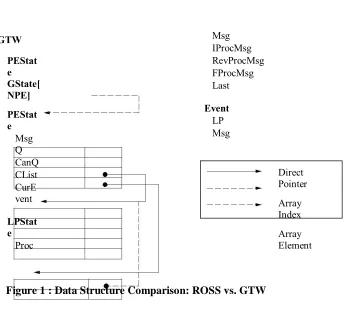
GTW
PEStat e GState[ NPE]
PEStat e
Msg Q CanQ CList CurE vent
LPStat e
Proc
Msg IProcMsg RevProcMsg FProcMsg Last
Event
LP Msg
Direct Pointer
Array Index
Array Element
Available online: https://edupediapublications.org/journals/index.php/IJR/ P a g e | 272 Algorithm and Implementation
Framework
GTW is designed to exploit the
availability of shared-memory in a multi
processor systems. With that view in mind, a
global structure called GState is the
backbone of the system as shown in Figure 1.
This array represents all the data used by a
particular instantiation of a Scheduler thread,
which is executed on a distinct processor.
Inside each GState element is a statically
defined array of LP pointers, locks for
synchronizing the transfer of events between
processors, pointers to manage the \free-list" of
buffers, and timers for performance monitoring.
To obtain the pointer for LP i, the follow access
is required:
LP P tr = GState[T W LP [i]:M ap]:CList[LP N um[i]];
where, i is the LP number, T W LP [i]:M ap is
the processor on which the LP resides and LP N
um[] array specifies to which slot within a
processor's CList array the LP's pointer was
located (see Figure 1).
Now, using these data structures, GTW
implements an optimistic time management
algorithm that throttles execution based on the
availability of memory. On each processor, a
separate pool of memory is created for each
remote processor. When the application
requests a free memory buffer, the owning
processor will use the LP destination
information provided in the TWGetMsg routine
to determine which processor's pool to allocate
from. If that pool is empty, the abort buffer is
returned and no event is scheduled. When the
current event has completed processing, the
Scheduler will rollback (i.e., abort) that event
and attempt to reclaim memory by computing
GVT. This arrangement is called partitioned
buffer pools.. The key properties of this
approach are that over-optimism is avoided
since a processor's forward execution is
Available online: https://edupediapublications.org/journals/index.php/IJR/ P a g e | 273 and the false sharing of memory pages is
lessened since a memory buffer is only shared
between a pair of processors.
To implement GVT, GTW uses an
extremely fast asynchronous GVT algorithm
that fully exploits shared memory. To mitigate
fossil collection overheads, an \on-the-°y"
approach was devised. Here, events, after being
processed, are immediately threaded into the
tail of the appropriate free-list along with being
placed into the list of processed events for the
LP. To allocate an event, the TWGetMsg
function must test the head of the appropriate
free-list and make sure that the time stamp of
the event is less than GVT. If not, the abort
buffer is re-turned and the event that is currently
being processed will be aborted. As we will
show in this research paper, on-the-°y" fossil
collection plays a crucial roll in determining
GTW's performance.
ROSS' data structures, on the other hand, are organized in a bottom-up hierarchy, as shown on the left
panel of Figure 1. Here, the core data structure is the tw event. Inside every tw event is a pointer to its
source and destination LP structure, tw lp. Observe, that a pointer and not an index is used. Thus, during
the processing of an event, to access its source LP and destination LP data only the following accesses
are required:
my source lp = event¡ > src lp;
my destination lp = event¡ > dest lp;
Additionally, inside every tw lp is a pointer to the owning processor structure,
Available online: https://edupediapublications.org/journals/index.php/IJR/ P a g e | 274 my owning processor = event¡ > dest lp¡ > pe;
This bottom-up approach reduces access
overheads and may improve locality and
processor cache performance. Note that prior to
adding Kernel Processes (KPs), the tw kp
structure elements were contained within the tw
lp. The role of KPs will be discussed.
Like GTW, ROSS' tw scheduler function is
responsible for event processing (including
reverse computation support), virtual time
coordination and memory management.
However, that functionality is decomposed
along data structure lines. This decomposition
allows the tw scheduler function to be
compacted into only 200 lines of code. Like the
scheduler function, our GVT computation is a
modular implementation of Fujimoto's GVT
algorithm.
ROSS also uses a memory-based approach to
throttle execution and safeguard against
over-optimism. Each processor allocates a single
free-list of memory buffers. When a processor's
free-list is empty, the currently processed event
is aborted and a GVT calculation is
immediately initiated. Unlike GTW, ROSS
fossil collects buffers from each LP's processed
event-list after each GVT computation and
places those buffers back in the owning
processor's free-list. We demonstrate that this
approach results in significant fossil collection
overheads, however these overheads are then
mitigated through the insertion of Kernel
Processes into ROSS' core implementation
framework.
Performance Tuning Parameters
GTW underpins two classes of parameters: one
set to control how memory is assigned and
divided. The other set decides how oftentimes
GVT is computed. The aggregate sum of
memory to be allotted per processor is specified
in a configuration ¯le. How that memory is
apportioned for a processor is dictated by the
TWMemMap[i][j] exhibit and is determined by
Available online: https://edupediapublications.org/journals/index.php/IJR/ P a g e | 275 TWMemMap[i][j] determines a rationed
measure of memory that processor j's free-list
on processor i will be assigned. To clear up,
assume we have two processors and processor
0's TWMemMap cluster has the qualities 50 and
25 in openings 0 and 1 separately. This implies
of the aggregate memory distributed, 50 buffers
out of each 75 will be doled out to processor 0's
free-list on processor 0 and just 25 buffers out
of each 75 buffers dispensed will be doled out
to processor 1's free-list on processor 0.
To control the recurrence with which GVT is
ascertained, GTW utilizes clump and GV
Tinterval parameters. The group parameter is
the quantity of occasions GTW will process
before coming back to the highest point of the
headliner booking circle and checking for the
entry of remote occasions and hostile to
messages. The GV Tinterval parameters
indicates the quantity of cycles through the
headliner booking circle preceding starting a
GVT calculation. In this manner, by and large,
bunch £ GV Tinterval is the quantity of
occasions that will be prepared between
progressive GVT calculations.[8]
ROSS, as GTW, shares a cluster and GVT
internal parameter. Along these lines, all things
considered, bunch ¤ GV Tinterval occasions
will handled between GVT ages. In any case,
since ROSS utilizes the quick GVT calculation
with a regular way to deal with fossil gathering,
we tentatively confirmed that ROSS can
execute a reproduction demonstrate proficiently
in:
C £ N umP E £ batch £ GV Tinterval
more memory cushions than is required by a
consecutive recreation. Here, N umP E is the
quantity of processors utilized and C is a
Available online: https://edupediapublications.org/journals/index.php/IJR/ P a g e | 276 measure of memory required for efficient
parallel execution just develops as the quantity
of processors is expanded. The sum per
processor is a little steady number.
The instinct behind this trial wonder depends on
the past perception that memory can be
partitioned into two classifications: successive
and optimistic. Consecutive memory is the base
measure of memory required to manage
successive execution. Each parallel test system
must apportion this memory. Optimistic
memory is the additional memory used to
maintain hopeful execution. Presently,
accepting every processor expends bunch £GV
Tinterval memory buffers between successive GVT figuring’s, all things considered that is a
similar measure of memory buffers that can be
fossil gathered toward the finish of each GVT
age. The multiplier factor, C, enables every
processor to have some save memory to plan
new occasions into the future and proceed with
occasion preparing amid the offbeat GVT
calculation. The net effect is that the measure of
idealistic memory apportioned associates to
how efficient GVT and fossil gathering can be
proficient. The speedier these two computations
execute, the all the more much of the time they
can be run, consequently lessening the measure
of idealistic memory required for efficient
execution. Tentatively, values ranging from C =
2 to C = 8 seem to yield the best execution for
the PCS display contingent upon the processor
configuration.
GTW can't work efficiently under the above
memory imperatives be-reason for \on-the-°y"
fossil accumulation. This angle will be talked
about in more thoroughly.[10]
Performance Study
Benchmark Applications
There are two benchmark applications utilized
as a part of this execution examine. The first is
an individual interchanges administrations
(PCS) organize display as portrayed. Here, the
administration range of the system is populated
with an arrangement of topographically
circulated transmitters and beneficiaries called
radio ports. An arrangement of radio channels
Available online: https://edupediapublications.org/journals/index.php/IJR/ P a g e | 277 in the scope zone sends and gets telephone calls
utilizing the radio stations. At the point when a
client moves starting with one cell then onto the
next amid a telephone call a hand-o® is said to
happen. For this situation the PCS organize
endeavors to allot a radio divert in the new cell
to permit the telephone call association with
proceed. On the off chance that all directs in the
new cell are occupied, at that point the
telephone call is compelled to end. For all
analyses here, the compact started PCS
demonstrate was utilized, which rebates
occupied lines in the general call blocking
measurements. Here, cells are demonstrated as
LPs and PCS supporters are displayed as
messages that go among LPs. PCS supporters
can go in one of 4 bearings: north, south, east or
west. The determination of bearing depends on
a uniform circulation. For both, GTW and
ROSS, the state measure for this application is
80 bytes with a message size of 40 bytes and the
base look ahead for this model is zero because
of the exponential dispersion being utilized to
figure call between entries, call consummation
and portability. The occasion granularity for
PCS is little (i.e., under 4 microseconds for
every occasion). PCS is seen just like an agent
case of how a \real-world" reenactment model
would practice the rollback flow of an idealistic
test system framework.
The second application is a subordinate of the
rPHOLD manufactured work-stack demonstrate
called rPHOLD. Here, the standard rPHOLD
benchmark is modified to help
\reverse-calculation". We configure the benchmark to
have a negligible state, message measure and
null" occasion calculation. The forward
calculation of every occasion just involves the
era of two irregular numbers; one for the time
stamp and the other for the goal LP. The time
stamp conveyance is exponential with a mean
of 1.0 and the LP appropriation is uniform,
implying that all LPs are similarly similar to be
the destination" LP. Since the irregular number
generator (RNG) is impeccably reversible, the
turn around calculation \undoes" a LP's RNG
seed state by processing the ideal backwards
work as
Available online: https://edupediapublications.org/journals/index.php/IJR/ P a g e | 278 is 16. Our objective was to make an obsessive
benchmark which has a negligible occasion
granularity, yet delivers a huge quantities of
remote messages (75% in the 4 processor case),
which can bring about an expansive number of
\thrashing" rollbacks. To date, we are
uninformed of whenever Warp framework
which can get a positive speedup (i.e., more
noteworthy than 1) for this specific
configuration of rPHOLD.
Computing Test bed and Experiment
Setup
Our registering test bed comprises of two
different processing stages. The first is a
solitary quad processor Dell PC. Every
processor is a 500 MHz Pentium III with 512
KB of level-2 store. The aggregate sum of
accessible RAM is 1 GB. Four processors are
utilized as a part of each trial. All memory is
gotten to by means of the PCI transport, which
keeps running at 100 Mhz. The stores are keep
steady utilizing a snoopy, transport based
convention.
The memory subsystem for the PC server is
executed utilizing the Intel NX450 PCI chipset.
This chipset can possibly convey up to 800 MB
of information for every second.
Notwithstanding, early experimentation decided
the greatest obtainable data transmission is
restricted to 300 MB for each second. This
execution corruption is credited to the memory
configuration itself. The 1 GB of RAM
comprises of 4, 256 MB DIMMs. With 4
DIMMs, just a single bank of memory is
accessible. Accordingly, \address-bit-
permuting" (ABP), and bank interleaving
procedures are not accessible. The net outcome
is that a solitary 500 MHz Pentium III processor
can immerse the memory transport. This angle
will play an essential come in our execution
comes about.
The second registering stage is a SGI Origin
2000 with 12, 195 Mhz R10000 processors.
This engineering, dissimilar to the PC server, is
conveyed memory and has non-uniform
memory get to times, yet is still reserve sound
by means of a catalog based convention. To
Available online: https://edupediapublications.org/journals/index.php/IJR/ P a g e | 279 memory get to delays, every processor has a 4
MB level-2 reserve. For first arrangement of
PCS explores, every PCS cell is configured with
16 starting supporters or portables, making the
aggregate occasion populace for the recreation
16 times the quantity of LPs in the framework.
The quantity of cells in the framework was
changed from 256 (16x16 case) to 65536
(256x256 case) by a factor of 4.
Here, GV Tinterval and group parameters were
set at 16 each. Accordingly, up to 256 occasions
will be handled between GVT ages for the two
frameworks. These settings where resolved to
yield the most elevated amount of execution for
the two frameworks on this specific processing
testbed. For ROSS, the C memory parameter
was set to 2. In the best case, GTW was given
around 1.5 times the measure of memory
buffers required by the successive reproductions
for vast LP configurations and 2 to 3 times for
little LP configuration. This measure of
memory was resolved tentatively to bring about
the most brief execution time (i.e., best
execution) for GTW. Bigger measures of
memory brought about longer execution times.
This performance debasement is credited to the
memory subsystem being a bottleneck. Littler
measures of memory came about longer
execution times because of an expansion in the
quantity of prematurely ended occasions.
(Review, that when the present occasion being
prepared can't plan another occasion into the
future because of a deficiency of free memory
buffers, that occasion is prematurely ended (i.e.,
moved upheld) and re-executed just when
memory is accessible).
GTW and ROSS utilize unequivocally a similar
need line calculation (Calendar Queue),
irregular number generator and related seeds for
every LP. The benchmark application's
execution is indistinguishable over the two
Time Warp systems. Subsequently, the main
execution advantage that one framework has
over the other must be ascribed to algorithmic
and usage differences in the administration of
virtual time and memory buffers.
Initial PCS Performance Data
The data for our initial performance comparison
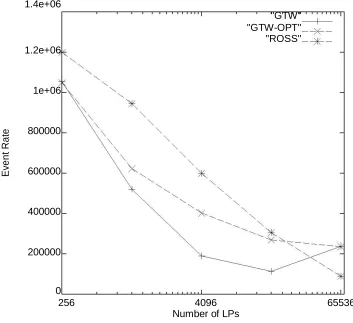
Available online: https://edupediapublications.org/journals/index.php/IJR/ P a g e | 280 processor PC server is presented in Figure 4.2.
Here, the event rate as a function of the number
of LPs is shown for ROSS, GTW and
GTW-OPT. \GTW" represents the Georgia Tech Time
Warp system without proper settings of the
TWMemMap array (i.e., T W M emM ap[i][j] =
18i; j). \GTW-OPT" uses the experimentally
determined optimal settings for TWMemMap.
For GTW-OPT, this setting was determined to
be 50 when i and j are equal and 5 for all other
cases. This allocation strategy is very much
inline with what one would expect for this
self-initiated simulation model. This ratio for
Available online: https://edupediapublications.org/journals/index.php/IJR/ P a g e | 281 1.4e+06
"GTW" "GTW-OPT"
1.2e+06
"ROSS"
1e+06
E
ve
n
t
R
a
te 800000
600000
400000
200000
0
256 4096 65536
Number of LPs
Figure 2: Quad PC Server Performance Comparison: GTW vs. ROSS. The \GTW" line
indicates GTW's performance without optimized memory pool
partitioning. \GTW-OPT" indicates GTW's performance with optimized
Available online: https://edupediapublications.org/journals/index.php/IJR/ P a g e | 282 We observe that in the comparison, GTW-OPT
out performs GTW in all cases. In the 64x64
case, we see a 50% performance gap between
GTW-OPT (400,000 events per second) and
GTW (200,000 events per second). These
results underscore the need to find the proper
parameter settings for any Time Warp system.
In the case of GTW, the local processor's
free-list (i.e., TWMemMap[i][i] was not given
enough memory to schedule events for itself
and a number of aborted events resulted. This
lack of memory caused a severe performance
degradation.
Mem Usage in Bu®ers Amt Relative to Seq
GTW-OPT 16x16 case 11776 287%
ROSS 16x16 case 6144 150% (seq + 2048)
GTW-OPT 32x32 case 31360 190%
ROSS 32x32 case 18432 113% (seq + 2048)
GTW-OPT 64x64 case 93824 143%
ROSS 64x64 case 67584 103% (seq + 2048)
GTW-OPT 128x128 case 375040 143%
ROSS 128x128 case 264192 100.8% (seq + 2048)
Available online: https://edupediapublications.org/journals/index.php/IJR/ P a g e | 283
GTW-OPT 256x256 case 1500032 143%
ROSS 256x256 case 1050624 100.2% (seq + 2048)
Table 1: Event Buffer Usage: GTW-OPT vs. ROSS. The buffer size for both GTW and
ROSS is 132 bytes
Now, when GTW-OPT is compared to ROSS, it
is observed that ROSS out performs GTW-OPT
in every case except one: the 64K LP case. For
ROSS, the biggest win occurs in the 4K LP
case. Here, a 50% performance gap is observed
(600,000 events per second for ROSS and
400,000 for GTW-OPT). However, in the 16K
LP case, the gap closes and in the 64K LP cases
GTW-OPT is outperforming ROSS by almost a
factor of 4. Two major factors are attributed to
this performance behavior.
For both GTW-OPT and ROSS, the under
powered memory subsystem is a critical source
of performance degradation as the number of
LPs increase. The reason for this is because as
we increase the number of LPs, the total
number of pending events increase by a factor
of 16. This increase in memory
utilization forms a bottleneck as the memory
subsystem is unable to keep pace with processor
demand. The 4K LP case appears to be a break
point in memory usage. ROSS, as shown in
Table 1 uses significantly less memory than
GTW.[12]Consequently, ROSS is able to ¯t
more of the free-list of events in level-2 cache.
In terms of overall memory consumption,
GTW-OPT is configured with 1.5 to 3 times the
memory buffers needed for sequential execution
depending on the size of the LP configuration.
As previously indicated, that amount of
memory was experimentally determined to be
optimal for GTW. ROSS, on the other hand,
only allocates an extra 2048 event buffers (512
buffers per processor) over what is required by
Available online: https://edupediapublications.org/journals/index.php/IJR/ P a g e | 284 number of LPs. In fact, we have run ROSS with
as little as 1024 extra buffers (C = 1:0, 256
buffers per processor) in the 256 LP case. In
this configuration, ROSS generates an event
rate of over 1,200,000. These performance
results are attributed to the coupling of
Fujimoto's GVT algorithm for shared memory
multiprocessors with memory efficient data
structures, reverse computation and a
conventional fossil collection algorithm, as
discussed.
However, this conventional approach to fossil
collection falls short when the number of LPs
becomes large, as demonstrated by 64K LP
case. Here, GTW-OPT is 4 times faster than
ROSS. The culprit for this sharp decline in
performance is attributed to the overwhelming
overhead associated with searching through
64,000 processed event-lists for potential
free-event buffers every 256 times though the main
scheduler loop. It is at this point where the low-
overhead of GTW's on-the-°y" approach to
fossil collection is of benefit. To summarize,
ROSS executes efficiently so long as the
number of LPs per processor is kept to a
minimum. This aspect is due to the ever
increasing fossil collection overheads as the
number of LPs grow. To mitigate this problem,
\on-the-°y" fossil collection was considered as a
potential approach. However, it was discovered
to have a problem that results in a increase in
the amount of memory required to efficiently
execute parallel simulations.
The problem is that a processors ability to
allocate memory using the \on-the-°y" approach
is correlated to its rollback behavior. Consider
the following example: suppose we have LP A
and LP B that have been mapped to processor i.
Assume both LPs have processed events at T S
= 5; 10 and 15. With GTW, processor i's
free-list of event buffers for itself (i.e.,
GState[i].PFree[i]) would be as follows (with
Available online: https://edupediapublications.org/journals/index.php/IJR/ P a g e | 285 5:0A; 5:0B; 10:0A; 10:0B; 15:0A; 15:0B
Note how the free-list is ordered with respect to virtual time. Suppose now LP B is rolled back and
re-executes those events. The free-list will now appear as follows:
Ab
o
rt
e
d
Eve
n
ts
Figure 3: The impact of aborted events on GTW event rate for the 1024
(32x32 cells) LP case
500000
450000
400000
350000
300000
250000
200000
150000
Available online: https://edupediapublications.org/journals/index.php/IJR/ P a g e | 286 50000
0
Available online: https://edupediapublications.org/journals/index.php/IJR/ P a g e | 287 5:0A; 10:0A; 15:0A; 5:0B; 10:0B; 15:0B
Watch that since LP B has moved back and
re-executed forward, the free-list is currently
unordered as for virtual time. Review that in the
wake of preparing an occasion it is re-strung
into the tail of the list. This unordered
free-list makes GTW carry on as though there are no
free buffers accessible, which brings about
occasions being erroneously prematurely ended.
This wonder is caused by the occasion at the
leader of the free-list not being not as much as
GVT, yet more profound in the free-list are
occasions with a timestamp not as much as
GVT.
On-the-°y fossil accumulation under tight
memory requirements can prompt expansive
varieties in GTW execution, as appeared in
Figure 3. Here, the occasion rate as it connects
to the quantity of prematurely ended occasions
for the 1024 LP case is appeared. We watch the
occasion rate may fluctuate by as much as 27%.
This conduct is credited to the rollback conduct
expanding the on-the-°y" fossil gathering
overheads as the free-list turns out to be
progressively out-of-arrange, which prompts
precariousness in the framework. To keep away
from this vast fluctuation in execution, GTW
must be given considerably more memory than
is required for successive execution. This
enables the free-rundown to be sufficiently long
to such an extent that the effect of it being
out-of-arrange does not bring about prematurely
ended occasions and permits steady,
unsurprising execution.
An answer is to look further into the
free-list. Notwithstanding, this is like
prematurely ending occasions in that it presents
a heap lopsidedness among processors who are
moving back more than others (i.e., the more
out-of-arrange a rundown turns into, the more
drawn out the look for nothing buffers). To put
it plainly, the fossil accumulation overheads
Available online: https://edupediapublications.org/journals/index.php/IJR/ P a g e | 288 rollback conduct. This perception lead us to the
production of what we call Kernel Processes
(KPs).
Kernel Processes
A Kernel Process is a common information
structure among an accumulation of LPs that
deals with the handled occasion list for those
LPs as a solitary, consistent rundown. The net
effect of this approach is that the tw scheduler
work executes forward on a LP by LP premise,
yet rollbacks and all the more significantly
fossil gathers on a KP by KP premise. Since
KPs are many less in number than LPs, fossil
gathering overheads are significantly
diminished.
The result of this plan change is that all rollback
and fossil accumulation usefulness moved from
LPs to KPs. To impact this change, another
information structure was made, called tw kp
(see Figure 1). This information structure
contains the accompanying things: (i)
identification field, (ii) pointer to the owning
processor structure, tw pe, (iii) head and tail
pointers to the common handled occasion
rundown and (iv) KP particular rollback and
occasion preparing measurements.
At the point when an occasion is handled, it is
strung into the prepared occasion list for a
common KP. Since the LPs for any one KP are
altogether mapped to a similar processor, shared
avoidance to a KP's information can be ensured
without locks or semaphores.
Notwithstanding diminishing fossil gathering
overheads, this approach decreases memory use
by sharing the above information things over a
gathering of LPs. For a substantial
configuration of LPs (i.e., millions), this
diminishment in memory can be very
significant.[13] For the trials done in this
investigation, a run of the mill KP will benefit
between 16 to 256 LPs, contingent upon the
quantity of LPs in the framework. Mapping of
LPs to KPs is expert by making sub-segments
inside a gathering of LPs that would be mapped
to a specific processor.
Available online: https://edupediapublications.org/journals/index.php/IJR/ P a g e | 289 points over either \on-the-°y" fossil
accumulation or standard LP-based fossil
gathering, a potential disadvantage with this
approach is that \false rollbacks" would debase
execution. A \false rollback" happens when a
LP or gathering of LPs is \falsely" moved back
in light of the fact that another LP that offers a
similar KP is being moved back. As we will
appear for this PCS display, this marvel was not
watched. Truth be told, an extensive variety of
KP to LP mappings for this application were
found to bring about the best execution for a
specific LP design.
Revised PCS Performance Data
Like the past arrangement of tests, ROSS uses
similar settings. Specifically, for all outcomes
displayed here, ROSS again just uses 2048
buffers above what might be required by the
consecutive test system.
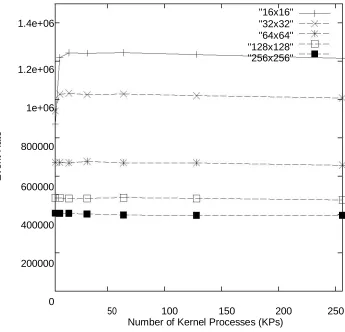
In Figure 4, we demonstrate the effect of the
quantity of piece forms allotted for the whole
framework on occasion rate. This arrangement
of tests differs the aggregate number of KPs
from 4 to 256 by a factor of 2. In the 4 KP case,
there is one \super KP" per processor, as our
testbed stage is a quad processor machine. We
watch that lone the 256 (16x16) and the 1024
(32x32) LP cases are contrarily affected for few
KPs. All different cases display next to no
variety in occasion rate as the quantity of KPs is
shifted. These °at comes about are not what we
anticipated.
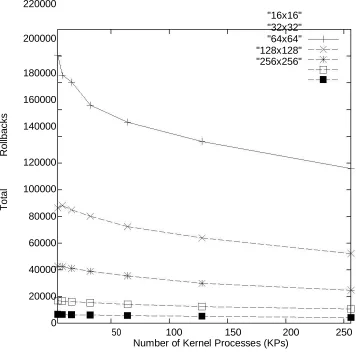
On the off chance that we take a gander at the
total number of moved back occasions, as
appeared in Figure 5, for the different LP
configurations, we watch an emotional decrease
in the quantity of moved back occasions as the
quantity of KPs is expanded from 4 to 64.
Things being what they are, at that point why is
execution °at? The appropriate response lies in
Available online: https://edupediapublications.org/journals/index.php/IJR/ P a g e | 290 1.4e+06
"16x16" "32x32" "64x64" "128x128"
1.2e+06
"256x256"
1e+06
R
a
te
800000
Eve
n
t
600000
400000
200000
0
50 100 150 200 250
Number of Kernel Processes (KPs)
Figure 4: Impact of the number of kernel processes on ROSS' event rate
Over heads for fossil collection overheads.
Clearly as we increase the number of KPs, we
increase fossil collection overheads since each
Available online: https://edupediapublications.org/journals/index.php/IJR/ P a g e | 291 Likewise, we are also reducing the number of
\false rollbacks". This trade-o® appears to be
fairly equal for KP values between 16 and 256
across all LP configurations. Thus, we do not
observe that ending the absolute best KP setting
being critical to achieving maximum
performance as was ending the best
TWMemMap setting for GTW. We believe this
aspect will allow end users to more quickly
realize top system performance under ROSS.
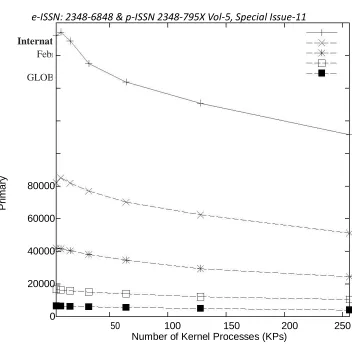
Looking deeper into the rollback behavior of
KPs, we and that most of the rollbacks are
primary, as shown in Figures 6 and 7.
Moreover, we and that as we add KPs, the
average rollback distance appears to shrink. We
attribute this behavior to a reduction in the
number of \falsely" rolled back events as we
increase the number KPs.[14]
5e+06
"16x16"
4.5e+06
"32x32" "64x64" "128x128"
4e+06
"256x256"
B
a
ck 3.5e+06
3e+06
Rolled
2.5e+06
Eve
n
ts
2e+06
Available online: https://edupediapublications.org/journals/index.php/IJR/ P a g e | 292 1.5e+06
1e+06
500000
0
50 100 150 200 250
Number of Kernel Processes (KPs)
Figure 5: Impact of the number of kernel processes on events rolled back
As a side note, we observe that as the
number of LPs increase from 256 (16x16 case)
to 64K (256x256 case), the event rate degrades
by a factor of 3 (1.25 million to 400,000), as
shown in Figure 4. This performance
degradation is due to the sharp increase in
memory requirements to execute the large LP
configurations. As shown in Table 4.1, the 64K
LP case consumes over 1 million event buffers,
where the 256 LP case only requires 6,000
event buffers. This increase in memory
requirements results in higher cache miss rates,
placing a higher demand on the under-powered
memory subsystem, and ultimately degrades
simulator performance.
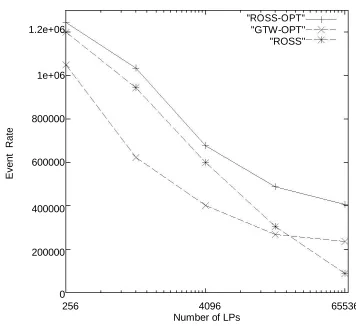
The performance of ROSS-OPT (best
KP configuration) is now compared to that of
GTW-OPT and ROSS without KPs in Figure 8.
We observe that ROSS-OPT outperforms
GTW-OPT and original ROSS across all LP
configurations, thus under scoring the