Available online: https://edupediapublications.org/journals/index.php/IJR/ P a g e | 313
Building a Face Recognition Technique for Encryption by
MATLAB
Priyanka Kaushik
1,Hitika Kaushik
2,,Harendra Singh
3 Department of Electronics & Communication Engineering,MVN University, Palwal, Haryana, India
Abstract—
In this paper, a face recognition system is designed; implemented and tested that utilizes a combination of techniques in two phases; face detection and recognition. The face detection is performed on live acquired images without any application field in mind and processes utilized in the system are white balance correction, skin like region segmentation, facial feature extraction and face image extraction on a face candidate. After that face classification method that uses Feed Forward Neural Network is integrated in the system and the system is tested with a database generated in the laboratory, with 6 people. The tested system has acceptable performance to recognize faces within intended limits and also capable of detecting and recognizing multiple faces in live acquired images.Keywords:
— Face recognition system, detection, skin segmentation, facial feature extraction, Feed Forward Neural Network, multiple face detection and recognition, MATLAB1.
Introduction - The identity of an individual is considered as a fundamental approach for authentic purposes. So there are three approaches that are available to prove a person‟s identity. Something you have like identity card, something you know like password, something you are-Biometrics. Since the biometrics are difficult to share, steal or forge and cannot be forgotten or lost therefore we have implemented It. In this paper a face recognition system is designed; implemented and tested that utilizes a combination of techniques in two phases; face detection and recognition.1.1 Biometric System
A biometric system is essentially a pattern-recognition system that involves three aspects: data acquisition and pre-processing, data representation, and decision making. It can thus compare a specific set of physiological or behavioural characteristics extracted from a person with a template/model acquired beforehand, and recognize the individual. After that a digital representation recorded in a database as a description of a physical trait is defined as a template and is obtained by feature extraction algorithms.
1.2 Face recognition systems
Face recognition systems is a combination of face detection and recognition techniques in image analysis and usually applied and preferred for people and security cameras in metropolitan life for crime prevention, video surveillance, person verification, and similar security activities. Face recognition systems are the part of facial image processing
applications and it can use biometric information of the humans and are applicable easily instead of fingerprint, iris, signature etc., because these types of biometrics are not much suitable for non-collaborativepeople.
Basic steps involves in face recognition system are acquiring images to computer from camera and computational medium is the first step in face recognition system after that acquire image is converted into digital form and processed by face detection algorithm for extracting each face. After detection of faces, it should be recognized to identify the persons in the face images.
Figure 1.1 Steps of Face Recognition System
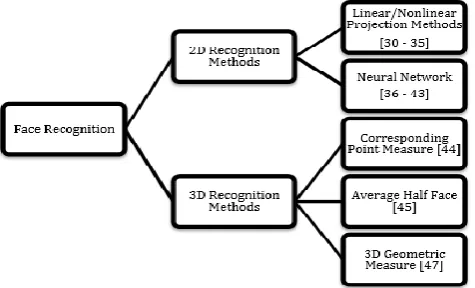
Figure 1.2 Methods for Face Detection
Available online: https://edupediapublications.org/journals/index.php/IJR/ P a g e | 314
2. Proposed Methodology
2.1 Design of face Recognition system:
For development of face recognition system we use a combination of knowledge-based methods for face detection part and neural network approach for face recognition part. Our face recognition system approach is given in Figure 2.1.
Figure 2.1 face recognition system approach
2.1.1 Input Part: Input part is prerequisite for face recognition system. Image acquisition operation is performed in this part. Live captured images are converted to digital data for performing image-processing computations. These captured images are sent to face detection algorithm.
2.1.2 Face Detection Part: Face detection system, Performs
locating and extracting the face image operations for face recognition system as shown in figure 2.2..
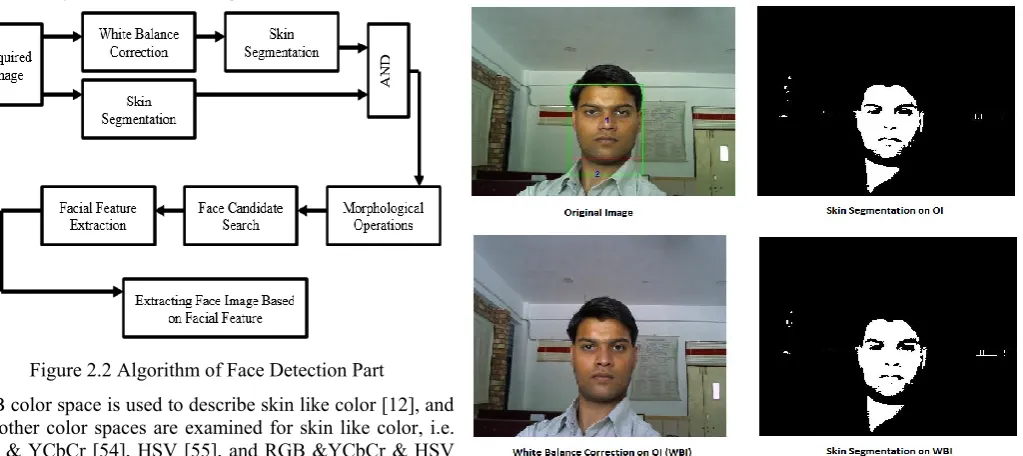
Figure 2.2 Algorithm of Face Detection Part
RGB color space is used to describe skin like color [12], and also other color spaces are examined for skin like color, i.e. HSV & YCbCr [54], HSV [55], and RGB &YCbCr & HSV [56]. However, best results give RGB color space skin segmentation.
r>95
g>40
b>20
max(r,g,b)-min(r,g,b)>15
|r-g|>15
r>g
r>b
“r”, “g”, and “b” parameters are red, green and blue channel values of pixel. If these seven conditions are satisfied, then pixel is said to be skin color and binary image is created from satisfied pixels. To avoid the white balance problem for non-skin objects due to change in lighting conditions a white balance algorithm is implemented that makes image hotter if image is cold (blue), and makes colder if image is hot (Red or orange).
Calculate average value of red channel (Rav), green channel (Gav), and blue channel (Bav).
Calculate average gray
Grayav= (Rav+Gav+Bav)/3.
Then, KR=Grayav/Rav, KG=Grayav/Gav, and KB=Grayav/Bav.
Generate new image (New I) from original image (OrjI) by New(R) =KR*Orj(R),
New (G)=KG*Orj(G), and New(B)=KB*Orj(B).
In lighting conditions, if the image is not balanced then some part of the wall will be taken as skin color. So, To get rid of unwanted skin color a logical “AND operation” is applied on both segmented original image and white balance corrected that will eliminate change of color value due to change of lighting condition.
Figure 2.3 Example of taken/white balance corrected image and skin color segmentation
Available online: https://edupediapublications.org/journals/index.php/IJR/ P a g e | 315
Figure 2.4 Results of Segmentation on Uncorrected (Left) and Corrected Image (Right)
Instead of Laplacian of Gaussian (LoG) Filter, binary thresholding is applied and Result of filtering operations on face candidate is given in Figure 2.5.
Figure 2.5 Result of filtering operations on face candidate Criteria checking are applied on each label to determine left and right eyes. Criteria are listed below:
1. Width denotes width of face candidate image and height denotes height of face candidate image. 2. y position of left/right eye should be less than
0.5*height.
3. x position of right eye should be in region of 0.125*width to 0.405*width.
4. x position of left eye should be in region of 0.585*width to 0.875*width.
5. Area should be greater than 100 pixels square. 6. Bounding Box ratio of label should be in the region
of 1.2 to 4.
Figure 2.6 Regions of Filtered Image Property vector is created by using the distances:
Label number of the mouth candidate
Absolute difference between left-distance and right-distance (error1)
Absolute difference between eye-distance and centre-distance (error2)
Summation of error1 and error2 (error-sum)
If error1 and error2 are smaller than 0.25*eye-distance, then candidate is possibly a mouth. Required facial features are found which are right eye, left eye and mouth. Face image can be extracted which covers two eyes and mouth. Face covering is created with a rectangle in which corner positions are:
Right up corner: 0.3*eye-distance up and left from right eye label centroid.
Left up corner: 0.3*eye-distance up and right from left eye label centroid.
Right down corner: 0.3*eye-distance from left from right eye label centroid and down from mouth label centroid.
Left down corner: 0.3*eye-distance from right from left eye label centroid and down from mouth label centroid.
Available online: https://edupediapublications.org/journals/index.php/IJR/ P a g e | 316
Figure 2.7 Facial Feature Extractions (Left) and Face Image (Right)
2.1.3. Face Recognition Part
Modified face image which is obtained in the Face detection system, should to be classified to identify the person in the database. Face recognition part is composed of pre-processing face image, vectorizing image matrix, database generation, and then classification. The classification is achieved by using Feed forward Neural Network (FFNN) [39]. Face recognition part algorithm is given in Figure 2.8.
Figure 2.8 Algorithm of Face Recognition Part
Neural Network is a mathematical model that is inspired from biological neural network system. Neural network consists of neurons, weights, inputs and output. A simple neuron model is given in Figure 2.9. Inside neuron, summation (∑) and activation function (f) operations are applied. „x‟ denotes input of neuron, „w‟ denotes weight of input, „I‟ denotes output of summation operation, and „y‟ denotes output of neuron or output of activation function.
I = ∑ (x1*w1+x2*w2+…+xn*wn) y = f (I)
Figure 2.9 Neuron Model
Figure 3.10 Multi layer Network structure
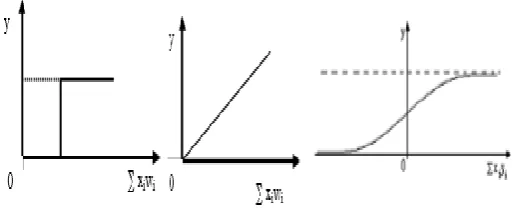
Output value range shows a difference with respect to selected activation function. Common activation functions are threshold, linear and sigmoid functions.
Figure 2.11 Activation Functions (threshold, linear, and sigmoid)
2.1.4 Output Part
This part is final step of face recognition system. Person name is determined with respect to output of face recognition. Output vector of neural network is used to identify person name.
3. Results & Discussion
3.1. System HardwareSystem has three main hardware parts. They are computer, frame grabber, and camera. Computer is brain of system, which processes acquired image, analyzes image and determines the person‟s name. The computer used in the test is a typical PC with the following specifications:
Intel Core i5 2.5 GHz
Available online: https://edupediapublications.org/journals/index.php/IJR/ P a g e | 317 On Board Graphic Card
3.2. Face Detection
Based on RGB [12], HSV & YCbCr [54], HSV [55], and RGB & YCbCr & HSV [56] color channels skin like segmentation are tested on acquired images and best results are taken from RGB color space. RGB & YCbCr & HSV are not performed well, based on our acquired images. Results of performed skin like segmentation are given in Figure 3.1 to 3.3.
Figure 3.1 Original Images (Left) & RGB Skin Segmentation (Right )
Figure 3.2 Skin Segmentation on Original Image with HS (Left) and CbCr Channel (Right)
Figure 3.3 Skin Segmentation on Original image with HCbCr Combinations
3.3 Due to white balance value of camera unwanted skin like color regions can affect detection and distort face shape. This color problem can be eliminated by white balance correction of acquired image
Figure 3.4 an Image without (Left) and With (Right) White Balance Correction
Figure 3.5 Skin Segmentation Results on Acquired (Left) & Corrected Image (Right)
Black-White image to find facial feature:
Sobel Edge detection (because they are nearly insensitive to light change):
Available online: https://edupediapublications.org/journals/index.php/IJR/ P a g e | 318
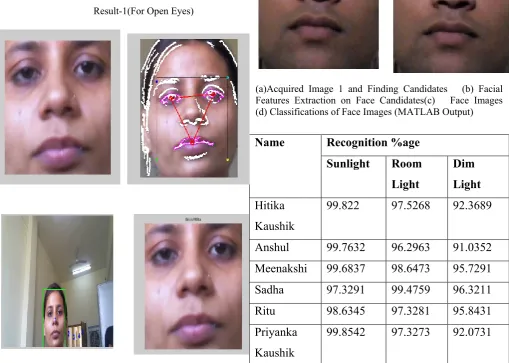
3.4. Face Recognition System: System finally, faces detection and recognition parts are merged to implement face recognition system. System can also handle more than one faces in the acquired image. Code is generated on MATLAB environment. Results are shown below.
Result-1(For Open Eyes)
(a)Acquired Image 1 and Finding Candidates (b) Facial Features Extraction on Face Candidates(c) Face Images (d) Classifications of Face Images (MATLAB Output)
Result-2 (For closed eyes)
(a)Acquired Image 1 and Finding Candidates (b) Facial Features Extraction on Face Candidates(c) Face Images (d) Classifications of Face Images (MATLAB Output)
Name
Recognition %age
Sunlight
Room
Light
Dim
Light
Hitika
Kaushik
99.822
97.5268
92.3689
Anshul
99.7632
96.2963
91.0352
Meenakshi 99.6837
98.6473
95.7291
Sadha
97.3291
99.4759
96.3211
Ritu
98.6345
97.3281
95.8431
Priyanka
Kaushik
99.8542
97.3273
92.0731
Available online: https://edupediapublications.org/journals/index.php/IJR/ P a g e | 319
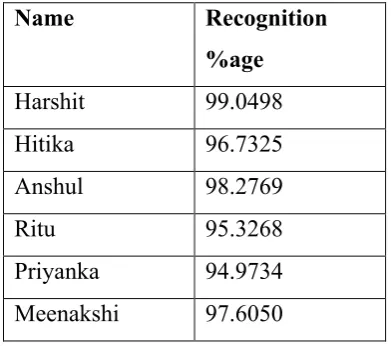
Name
Recognition
%age
Harshit
99.0498
Hitika
96.7325
Anshul
98.2769
Ritu
95.3268
Priyanka
94.9734
Meenakshi
97.6050
Table 3.2 Recognition with Closed eye
4. Conclusion
Face recognition systems are part of facial image processing applications and mostly used for crime prevention, video surveillance, person verification, and similar security activities. Main goal of thesis is to design and implement face recognition system in the Robot Vision Laboratory of the Department of Mechatronics Engineering. The goal is reached by face detection and recognition methods. Knowledge-Based face detection methods are used to find, locate and extract faces in acquired images. Implemented methods are skin color and facial features. Neural network is used for face recognition.
RGB color space is used to specify skin color values, and segmentation decreases searching time of face images. Facial components on face candidates are appeared with implementation of LoG filter. LoG filter shows good performance on extracting facial components under different illumination conditions.
FFNN is performed to classify to solve pattern recognition problem since face recognition is a kind of pattern recognition. Classification result is accurate. Classification is also flexible and correct when extracted face image is small oriented, closed eye, and small smiled. Proposed algorithm is capable of detect multiple faces, and performance of system has acceptable good results.
Proposed system can be affected by pose, presence or absence of structural components, facial expression, imaging condition, and strong illumination.
In this project, it is clear that the degree close to 1 will indicate that the objects are round. Thus semi circular and half circular objects can be found out by this algorithm for any input image. This algorithm can be used in the Development of an Artificial Intelligent system which will identify the objects according to its shape without prior knowledge or storage. Biomedical Application may be the detection of Tumor (May be circular of Rigid) in any part of body using MRI images or DICOM Images.
5. REFERENCES:
[1] L. Zhi-fang, Y. Zhi-sheng, A.K.Jain and W. Yun-qiong, 2003, “Face Detection And Facial Feature Extraction In Color Image”, Proc. The Fifth International Conference on Computational Intelligence and Multimedia Applications (ICCIMA‟03), pp.126-130, Xi‟an, China.
[2] K. Seo, W. Kim, C. Oh and J. Lee, 2002, “Face Detection And Facial Feature Extraction Using Color Snake”, Proc. ISIE 2002 - 2002 IEEE International Symposium on Industrial Electronics, pp.457-462, L 'Aquila, Italy.
[3] J. Ruan and J. Yin, 2009, “Face Detection Based On Facial Features And Linear Support Vector Machines”, Proc. 2009 International Conference on Communication Software and Networks, pp.371-375, Macau, China. [4] L. Zhao, X. Sun and X. Xu, 2006, “Face Detection Based On Facial Features”, Proc. ICSP2006, Guilin, China. [5] C. Lin, 2005, “Face Detection By Color And Multilayer Feedforward Neural Network”, Proc. 2005 IEEE International Conference on Information Acquisition, pp.518-523, Hong Kong and Macau, China.
[6] M. A. Berbar, H. M. Kelash and A. A. Kandeel, 2006, “Faces And Facial Features Detection In Color Images”, Proc. Geometric Modeling and Imaging― New Trends (GMAI'06), pp.209-214, London, UK.
[7] S. Kherchaoui and A. Houacine, 2010, “Face Detection Based On A Model Of The Skin Color With Constraints And Template Matching”, Proc. 2010 International Conference on Machine and Web Intelligence, pp. 469 - 472, Algiers, Algeria.
[8] D. Huang, T. Lin, C. Ho and W. Hu, 2010, “Face Detection Based On Feature Analysis And Edge Detection Against Skin Color-like Backgrounds”, Proc. 2010 Fourth International Conference on Genetic and Evolutionary Computing, pp.687-690, Shenzen, China.
[9] J. Qiang-rong and L. Hua-lan, 2010, “Robust Human Face Detection in Complicated Color Images”, Proc. 2010 The 2nd IEEE International Conference on Information Management and Engineering (ICIME), pp.218 – 221, Chengdu, China.
[10] Z. Li, L. Xue and F. Tan, 2010, “Face Detection In Complex Background Based On Skin Color Features And Improved Adaboost Algorithms”, Proc. 2010 IEEE International Conference on Progress in Informatics and Computing (PIC), pp.723 – 727, Shanghai, China.
[11] C. Aiping, P. Lian, T. Yaobin and N. Ning, 2010, “Face Detection Technology Based On Skin Color Segmentation And Template Matching”, Proc. 2010 Second International Workshop on Education Technology and Computer Science, pp.708-711, Wuhan, China.
[12] P. Peer, J. Kovac and F. Solina, 2003, “Robust Human Face Detection in Complicated Color Images”, Proc. 2010 The 2nd IEEE International Conference on Information Management and Engineering (ICIME), pp. 218 – 221, Chengdu, China.
Available online: https://edupediapublications.org/journals/index.php/IJR/ P a g e | 320
IEEE International Conference on Information Acquisition, pp.1253-1257, Weihai, Shandong, China.
[14] H. Guo, Y. Yu and Q. Jia, 2010, “Face Detection With Abstract Template”, Proc. 2010 3rd International Congress on Image and Signal Processing (CISP2010), pp.129-134, Yantai, China.
[15] M. Ş. Bayhan and M. Gökmen, 2008, “Scale And Pose Invariant Real-Time Face Detection And Tracking”, Proc. 23rd International Symposium on Computer and Information Sciences ISCIS '08, pp.1-6, Istanbul, Turkey. [16] C.C. Tsai, W.C. Cheng, J.S. Taur and C.W. Tao,
2006, “Face Detection Using Eigenface And Neural Network”, Proc. 2006 IEEE International Conference on Systems, Man, and Cybernetics, pp.4343-4347, Taipei, Taiwan.
[17] A.R. Mohan and N. Sudha, 2009, “Fast Face Detection Using Boosted Eigenfaces”, Proc. 2009 IEEE Symposium on Industrial Electronics and Applications (ISIEA 2009), pp.102-1006, Kuala Lumpur, Malaysia. [18] D. Anijiantis, E. Dernzatas and G. Kukkinakis, 1999,
“A Neural Network Method For Accurate Face Detection On Arbitrary Images”, Proc. The 6th IEEE International Conference on Electronics, Circuits and Systems, pp. 109 - 112 vol.1, Pafos, Cyprus.
[19] C. Anagnostopoulos, I. Anagnostopoulos, D. Vergados, I. Papaleonidopoulos, E. Kayafas, V. Loumos and G. Stasinopoulos, 2002, “A Probabilistic Neural Network For Face Detection On Segmented Skin Areas Based On Fuzzy Rules”, Proc. IEEE MELECON 2002, pp.493-497, Cairo, Egypt.
[20] X. Liu, G. Geng and X. Wang, 2010, “Automatically Face Detection Based On BP Neural Network And Bayesian Decision”, Proc. 2010 Sixth International Conference on Natural Computation (ICNC 2010), pp.1590-1594, Shandong, China.
[21] Ye-Zhengchun and Lin-Hongji, 2007, “Face Detection Based On SCNN And Wavelet Invariant Moment In Color Image”, Proc. 2007 International Conference on Wavelet Analysis and Pattern Recognition, pp. 783-787, Beijing, China.
[22] K. A. A. Aziz and R. A. Ramlee, 2009, “Face Detection Using Radial Basis Function Neural Networks With Variance Spread Value”, Proc. 2009 International Conference of Soft Computing and Pattern Recognition, pp.399- 403, Malacca, Malaysia.
[23] C. Shavers, R. Li and G. Lebby, 2006, “An SVM-Based Approach To Face Detection”, Proc. 38th Southeastern Symposium on System Theory, pp.362-366, Tennessee Technological University, Cookeville, TN, USA. [24] H. Jee, K. Lee and S. Pan, 2004, “Eye And Face
Detection Using SVM”, Proc. ISSNIP 2004, pp.577-580, Melbourne, Australia.
[25] H. Jin, Q. Liu and H. Lu, 2004, “Face detection using one-class-based support vectors”, Proc. Sixth IEEE International Conference on Automatic Face and Gesture Recognition (FGR‟04), pp.457 - 462, Seoul, Korea.
[26] Y. Song, Y. Kim, U. Chang and H. B. Kwon, 2006, “Face Recognition Robust To Left-Right Shadows Facial
Symmetry”, Pattern Recognition Vol.39 (2006), pp.1542– 1545.
[27] F. Wang, J. Wang, C. Zhang and J, Kwok, 2007, “Face Recognition Using Spectral Features”, Pattern Recognition Vol.40 (2007), pp.2786–2797.
[28] A.H.Boualleg, Ch.Bencheriet and H.Tebbikh, 2006, “Automatic Face Recognition Using Neural Network-PCA”, Proc. 2nd Information and Communication Technologies ICTTA '06, pp. 1920 – 1925, Damascus, Syria.
[29] J. Youyi and L. Xiao, 2010, “A Method For Face Recognition Based On Wavelet Neural Network”, Proc. 2010 Second WRI Global Congress on Intelligent Systems, pp.133-136, Wuhan, China.
[30] K. Youssef and P. Woo, 2007, “A New Method for Face Recognition Based on Color Information and a Neural Network”, Proc. Third International Conference on Natural Computation (ICNC 2007), pp.585 – 589, Hainan, China. [31] M.R.M. Rizk and A. Taha, 2002, “Analysis Of Neural Networks For Face Recognition Systems With Feature Extraction To Develop An Eye Localization Based Method”, Proc. 9th International Conference on Electronics, Circuits and Systems, pp. 847 - 850 vol.3, Dubrovnik, Croatia.
[32] Z. Mu-chun, 2008, “Face Recognition Based On FastICA And RBF Neural Networks”, Proc. 2008 International Symposium on Information Science and Engineering, pp.588-592, Shanghai, China.
[33] W. Wang, 2008, “Face Recognition Based On Radial Basis Function Neural Networks”, Proc. 2008 International Seminar on Future Information Technology and Management Engineering, pp.41-44, Leicestershire, UK. [34] T. S. M. Rasied, O. O. Khalifa and Y. B. Kamarudin, 2005, “Face Recognition Based On Singular Valued Decomposition And Back Propagation Neural Network”, Proc. 1st International Conference on Computers, Communications, & Signal Processing with Special Track on Biomedical Engineering CCSP 2005, pp.304 – 309, Kuala Lumpur, Malaysia.
[35] X. Wang, Q. Ruan and Y. Ming, 2010, “3D Face Recognition Using Corresponding Point Direction Measure And Depth Local Features”, Proc. ICSP 2010, pp.86-89, Beijing, China.
[36] J. Harguess, S Gupta and J. K. Aggarwal, 2008, “3D Face Recognition With The Average-Half-Face”, Proc. 19th International Conference on Pattern Recognition ICPR 2008, pp.1-4, Florida, USA.
[37] E. Elyan and H. Ugail, 2009, “Automatic 3D Face Recognition Using Fourier Descriptors”, Proc. 2009 International Conference on CyberWorlds, pp.246-252, Bradford, UK.
[38] D. Lee and J. Liang, 2010, “A Face Detection And Recognition System Based On Rectangular Feature Orientation”, Proc. 2010 International Coriference on System Science and Engineering, pp.495-499, Taipei, Taiwan.
Available online: https://edupediapublications.org/journals/index.php/IJR/ P a g e | 321
Acoustics, Speech, and Signal Processing, ICASSP '99, pp.3553 - 3556 vol.6, Arizona, USA.
[40] H. M. El-Bakry, M. A. Abo-ElSoud and M. S. Kamel, 1999, “Automatic Face Recognition Using Neural Networks”, Proc. The Eleventh International Conference on Microelectronics ICM '99, pp.105 – 108, Kuwait.
[41] R. Xu, B. Li and B. Wang, 2003, “Face Detection And Recognition Using Neural Network And Hidden Markov Models”, Proc. IEEE Int. Conf. Neural Networks & Signal Processing, pp.228-231, Nanjing, China.
[42] P. Zhang, 2007, “A Video-based Face Detection and Recognition System using Cascade Face Verification Modules”, Proc. 37th IEEE Applied Imagery Pattern Recognition Workshop AIPR '08, pp.1-8, DC, USA. [43] T. Sawangsri, V. Patanavijit, and S. Jitapunkul, 2005,
“Face Segmentation Based On Hue-Cr Components And Morphological Technique”, Proc. IEEE International Symposium on Circuits and Systems, ISCAS 2005, pp.5401 - 5404 Vol. 6, Kobe, Japan.
[44] X. Zhang, J. Jiang, Z. Liang, and C. Liu, 2010, “Skin Color Enhancement Based on Favorite Skin Color in HSV Color Space”, IEEE Transactions on Consumer Electronics, Vol. 56, No. 3, pp.1789-1793.
[45] N. A. bin A. Rahman, K. C. Wei, and J. See, 2006, “RGB-H-CbCr Skin Colour Model for Human Face Detection”, Proc. MMU International Symposium on Information & Communications Technologies, M2USIC 2006, PJ, Malaysia.