Verifying Deduplication and Authenticating User Using multiple
clouds and Attribute-Based Encryption
G. Sai Ram
Under the Guidance of S.Sandhya Rani,Assistant Professor, MREC(A) M.Tech, Department of Computer Science and Engineering Malla Reddy Engineering College, Hyderabad, Telangana, India. ABSTRACT
Attribute-based encryption (ABE) has been
generally utilized as a part of distributed
computing where an information supplier
outsources his/her scrambled information
to a cloud specialist provider and can impart
the information to clients having particular
accreditations (or attributes). Be that as it
may, the standard ABE framework does not
bolster secure deduplication, which is vital
for disposing of copy duplicates of
indistinguishable information with a specific
end goal to spare storage room and system
transmission capacity. In this paper, we
show an attribute-based capacity
framework with secure deduplication in a
crossover cloud setting, where a private
cloud is in charge of copy discovery and an
open cloud deals with the capacity.
Contrasted and the earlier information
deduplication frameworks, our framework
has two points of interest. Right off the bat,
it can be utilized to privately impart
information to clients by determining access
approaches as opposed to sharing decoding
keys. Besides, it accomplishes the standard
thought of semantic security for information
classification while existing frameworks just
accomplish it by characterizing a weaker
security idea. Also, we set forth an approach
to adjust a ciphertext more than one access
arrangement into ciphertexts of the same
plaintext however under different access
strategies without uncovering the hidden
plaintext.
1. INTRODUCTION
Cloud registering extraordinarily facilitates
information suppliers who need to
outsource their information of the cloud
without uncovering their touchy
information on outside gatherings What's
more might want clients for certain
accreditations with have the ability with
right those information. This obliges
information to make saved to encrypted
such-and-such nobody but clients with
qualities (or credentials) for particular
structures could unscramble the encrypted
information. A encryption procedure that
meets this prerequisite will be known as
attribute-based encryption (ABE), the place
An user’s private fact that connected with a
trait set, a message may be encrypted
under an right strategy or get structure) In
An situated for attributes, What's more An
client could unscramble a ciphertext for
his/her private key Assuming that his/her
situated from claiming qualities fulfills those
entry strategy connected with this
ciphertext. However, those standard ABE
framework neglects on attain secure
deduplication, which is a system will spare
storage room Also system data transfer
capacity by eliminating excess duplicates of
the encrypted information saved in the
cloud. On the different hand, of the best of
our knowledge, existing constructions to
secure deduplication are not based on
attribute-based encryption. By since ABE
Also secure deduplication need been
generally connected for cloud computing, it
might make alluring to plan An cloud
capacity framework possessing both
properties.
2. OVERVIEW OF THE SYSTEM 2.2 EXISTING SYSTEM:
Over an ordinary capacity framework
with secure deduplication, will store a
document in the cloud, an information
supplier generates a tag and An
ciphertext. The information supplier
uploads the tag and the ciphertext of the
cloud. Upon getting an outsourcing
demand starting with An information
supplier to uploading An ciphertext Also
a connected tag, those cloud runs a
purported equity checking algorithm,
which checks In those tag in the
approaching solicitation will be
indistinguishable twin will whatever tags
in the stockpiling framework. If there is
a match, that point the underlying
plaintext of this approaching ciphertext
need generally been saved and the new
ciphertext may be disposed of. It may be
clear that such an arrangement with An
tag appended of the ciphertext doesn't
gatherings give the standard idea from
claiming semantic security for
However, enriching such a tag checking
capability of the private cloud will be
not addition with accomplish
deduplication in the attribute-based
stockpiling framework which utilizes
CP-ABE for information encryption. In
the suggested attributed-based system,
the same record Might make encrypted
with different ciphertexts connected with
diverse right policies, storing special
case ciphertext of the document implies
that clients whose qualities fulfill the
entry approach of a disposed of
ciphertext (but not that of the saved
ciphertext) will be precluded to right the
information that they need aid qualified
for.
2.3 DISADVANTAGES OF EXISTING
SYSTEM:
Present traits for comfy deduplication
aren't based totally on great primarily
based encryption.
If the plaintexts may be expected from
their labels, a foe can without a doubt
make a proper parent by way of
processing the tag of a plaintext and
after that trying out it in opposition to
the tag in the take a look at degree
within the semantic safety entertainment.
2.4 PROPOSED SYSTEM:
On this mission, we show a satisfactory
based stockpiling framework which
utilizes ciphertext-arrangement
characteristic based totally encryption
(cp-abe) and backings cozy
deduplication. Our fundamental
commitments can be compressed as
takes after.
Firstly, the framework is the number one
that accomplishes the standard idea of
semantic security for statistics
privateness in characteristic-primarily
based deduplication frameworks with the
aid of relying on the hybrid cloud
engineering.
Secondly, we set forth a strategy to alter
a ciphertext a couple of get admission to
arrangement into ciphertexts of the equal
plaintext but below some different get
admission to approaches without
uncovering the hidden plaintext. This
method may be of self sustaining
enthusiasm for growth to the application
within the proposed stockpiling
framework of self sustaining enthusiasm
for growth to the application within the
proposed stockpiling framework.
SYSTEM:
We displayed a singular manner to
address understand a satisfactory based
stockpiling framework supporting secure
deduplication.
Our stockpiling framework is worked
underneath a hybrid cloud design, in
which a personal cloud controls the
calculation and an open cloud offers with
the capacity.
It accomplishes the standard idea of
semantic safety even as current
deduplication conspires simply
accomplish it beneath a weaker
protection concept.
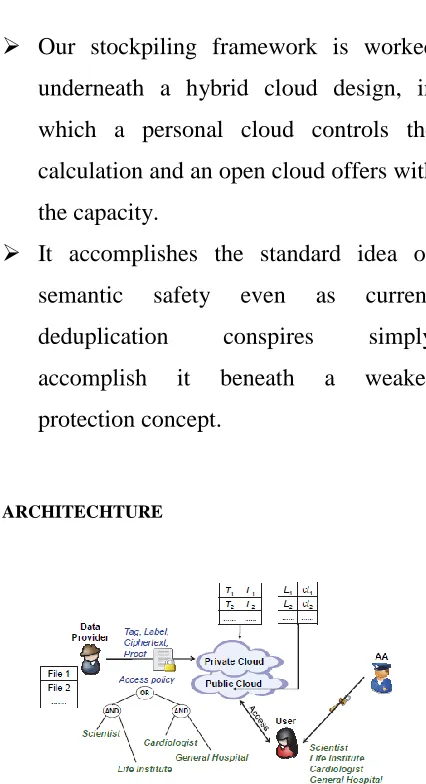
ARCHITECHTURE
Fig 3.1 Architecture of accessing cloud 4. MODULES
1. User Module
2. Data Provider
3. Private Cloud
4. Public Cloud
5. Attribute Autority
MODULES DESCSRIPTION:
Data Provider:
• An information supplier needs to
outsource his/her information to the
cloud and offer it with clients having
certain qualifications.
• When sending a document stockpiling
demand, every datum supplier right off
the bat makes a label T and a mark L
related with the information, and after
that encode the information under an
entrance structure over an arrangement
of traits. Likewise, every datum
supplier creates a proof pf on the
relationship of the label T, the name L,
and the scrambled message ct3,
however, this confirmation won't be put
away anyplace in the cloud and is just
utilized amid the checking stage for any
recently produced capacity ask.
At the client side, every client can
download a thing, and unscramble the
ciphertext with the property based
private key produced by the AA if this
present client's characteristic set fulfills
the entrance structure. Every client
checks the accuracy of the unscrambled
message utilizing the name, and
acknowledges the message on the off
chance that it is reliable with the name.
Private Cloud:
The cloud comprises of a private cloud
which plays out the certain calculation,
for example, tag checking.
After getting a capacity ask for, the
private cloud first checks the legitimacy
of the verification pf and after that tests
the uniformity of the new label T with
existing labels in the framework. On the
off chance that there is no counterpart
for this new label T, the private cloud
includes the label T and the name L to a
tag-name rundown and advances the
mark and the scrambled information, (L,
ct) to general society cloud for capacity.
Otherwise, let ct0 be the ciphertext
whose tag coordinates the new tag and
L0 be the mark related with ct0, and
after that, the private cloud executes as
takes after. _ If the entrance strategy in
ct is a subset of that in ct0, the private
cloud essentially disposes of the new
stockpiling demand; else, if the entrance
arrangement in ct0 is a subset of that in
ct, the private cloud requests that people
in general cloud supplant the put away
combine (L0, ct0) with the new match
(L, ct) where L = L0. _ If the entrance
arrangements in ct and ct0 are not
commonly contained, the private cloud
runs the ciphertext recovery calculation
to yield another ciphertext for the same
hidden plaintext document and
connected with an entrance structure
which is the association of the two
access structures, and advances the first
name and the subsequent ciphertext to
general society cloud.
Public Cloud:
The cloud consists of a public cloud
which is in charge of data storage.
Attribute Autority:
The AA issues every user a decryption key
Fig: Data Provider Login
Fig: File Upload to Cloud
Fig: Cloud login
6. CONCLUSION
Attribute-based encryption (ABE) has been
broadly utilized as a part of distributed
computing where information suppliers
outsource their scrambled information to
the cloud and can impart the information to
clients having indicated accreditations.
Then again, deduplication is a critical
method to spare the storage room and
system transmission capacity, which wipes
out copy duplicates of indistinguishable
information. In any case, the standard ABE
frameworks don't bolster secure
deduplication, which makes them expensive
to be connected in some business
stockpiling administrations.
In this paper, we displayed a novel way to
deal with understand a characteristic based
stockpiling framework supporting secure
deduplication. Our capacity framework is
worked under a half and half cloud
engineering, where a private cloud controls
the calculation and an open cloud deals
with the capacity. The private cloud is given
a trapdoor key related with the comparing
ciphertext, with which it can exchange the
ciphertext more than one access strategy
into ciphertexts of the same plaintext under
some other access arrangements without
monitoring the basic plaintext. In the wake
of getting a capacity asks for, the private
transferred thing through the appended
evidence. On the off chance that the
verification is legitimate, the private cloud
runs a label coordinating calculation to see
whether similar information basic the
ciphertext has been put away. Provided
that this is true, at whatever point it is
important, it recovers the ciphertext into a
ciphertext of the same plaintext over an
entrance approach which is the association
set of both access strategies. The proposed
stockpiling framework appreciates two
noteworthy points of interest. Right off the
bat, it can be utilized to secretly impart
information to different clients by
determining an entrance approach as
opposed to sharing the unscrambling key.
Furthermore, it accomplishes the standard
idea of semantic security while existing
deduplication conspire sonly accomplish it
under a weaker security thought.
7. REFERENCES
[1] D. Quick, B. Martini, and K. R. Choo,
Cloud Storage Forensics.
[2] K. R. Choo, J. Domingo-Ferrer, and L.
Zhang, “Cloud cryptography:Theory, practice and future research directions,”.
[3] K. R. Choo, M. Herman, M. Iorga, and
B. Martini, “Cloud forensics:State-of-the-art and future directions,”
[4] Y. Yang, H. Zhu, H. Lu, J.Weng, Y.
Zhang, and K. R. Choo, “Cloudbased data
sharing with fine-grained proxy
re-encryption,”
[5] D. Quick and K. R. Choo, “Google drive: Forensic analysis of dataremnants,” [6] A. Sahai and B. Waters, “Fuzzy identity-based encryption,”
[7] B. Zhu, K. Li, and R. H. Patterson,
“Avoiding the disk bottleneckin the data domain deduplication file system,”
[8] M. Bellare, S. Keelveedhi, and T.
Ristenpart, “Message-lockedencryption and