© 2014, IJCSMC All Rights Reserved
477
Available Online at www.ijcsmc.com
International Journal of Computer Science and Mobile Computing
A Monthly Journal of Computer Science and Information Technology
ISSN 2320–088X
IJCSMC, Vol. 3, Issue. 11, November 2014, pg.477 – 488
RESEARCH ARTICLE
AN EFFICIENT FIXED NOISE REMOVAL
METHOD FROM IMAGES USING DUAL
TREE COMPLEX WAVELET TRANSFORM
Miss. DHADBHANJAN REKHA
1, Mr. CH SRINIVASULU
2, Mr. P PRAKASH
31
M.TECH (Software Engineering), J.B. Institute of Engineering & Technology E-Mail: [email protected]
2
Associate Professor (IT), Department of Information Technology, J.B. Institute of Engineering & Technology. E-Mail: [email protected]
3
Assistant Professor (IT), Department of Information Technology, J.B. Institute of Engineering & Technology. E-Mail: [email protected]
Abstract: This paper presents a unique thanks to cut back noise introduced or exacerbated by image sweetening strategies. Output images of spray-based strategies tend to exhibit noise with unknown distribution. In order to avoid assumptions that are made inappropriately on the applied mathematics characteristics of noise, a special one is formed.. In fact, the enhanced image is taken into account to be either free from noise or laid low with non-perceivable levels of noise. Taking advantage of the upper sensitivity of the human sensory system to changes in brightness, the analysis is restricted to the luma channel of each of the non-enhanced and enhanced image. Unlike the separate riffle remodel, the DTCWT permits for distinction of knowledge radial asymmetry within the remodel house. For every level ofthe remodel, the qualitydeviation of the non-enhanced image coefficients is computed across the six orientations and then it's normalized. Then result's a map of the directional structures. Same map is then taken to shrink the coefficients of the improved image. Finally, a noise-reduced version of the improved image is computed via the inverse transforms. A radical numerical analysis of the results has been performed so as to verify the validity of the projected approach.
© 2014, IJCSMC All Rights Reserved
478
1. INTRODUCTION
The Present scenario of rapid growth of Internet increases the usability of digital media in the
form of digital image, audio, video. DIGITAL images are subject to a wide variety of distortions
during image processing, transmission, compression, acquisition, reproduction and storage, any of which may lead to the degradation of visual quality. The only “correct” method of quantifying
visual image quality is through subjective assessment of the performance, for those applications
in which images are viewed by human beings in an ultimate manner. Practically, however,
subjective evaluation is usually too inconvenient, time-consuming and expensive. Images are
often corrupted by noise during acquisition and transmission, which will lead to significant
degradation of image quality for human interpretation and post-processing tasks. The main goal
of image denoising is to reduce the noise, while preserving the image features. The goal of
research in objective image quality assessment is to develop quantitative measures that can
automatically predict perceived quality of the image. In image processing applications objective
image quality metric plays a variety of roles. It can be first used to monitor dynamically and
adjust image quality. Image enhancement techniques are the algorithms which improve the
quality of images by removing blurring and noise, increasing contrast and sharpness of digital
medical images. There are various approaches (theories) for image enhancement, like
Normalization, Histogram flattening, Range compression, and noise smoothing. A certain amount
of trial and error usually is required before a particular image enhancement approach is selected.
For image enhancement there is no general theory. When an image is under the process of visual
interpretation, it is the viewer who will ultimately judge about the working of a particular method.
The Process of Visual evaluation of image quality is highly subjective.
Image
An image is a two-dimensional picture, similar to some subject usually a physical object or a
person. A two-dimensional image is a photograph or a screen display. Also a statue can be
referred to as a three-dimensional image. The images can be captured by optical devices such as
cameras and mirrors. Lenses, telescopes, microscopes are few other optical devices. In a broader
sense, image can be also referred to as a two-dimensional figure such as a map or an abstract
painting. It can be represented by a graph or in the form of a pie chart. The word image can also
be used in a wider sense, where images can be rendered manually by drawing, or in the form of a
painting, carving. Thus these can be automatically rendered by printing or computer graphics
© 2014, IJCSMC All Rights Reserved
479
Fig 1: gray and color images
An image is a rectangular grid of pixels that has a definite height and width. These pixel's are square‟s and have a fixed size on a given display. Different computer monitors may use different
sized pixels. The pixels together form an image and are ordered as a grid in the form of rows and
columns. Each pixel consists of numbers representing magnitudes of brightness and color. Thus
pixel has a color, which is a 32-bit integer. The redness of the pixel is determined by the first
eight bits, whereas the next eight bits determine the greenness, and the preceding eight bits
determine the blueness, and the transparency of the pixel is determined by the remaining eight
bits.
Image File Sizes
Image increases in Image file size is expressed as the number of bytes that increases with the
number of pixels, by composing an image, and the color depth of the pixels.
Fig 2: Planes of Color image
.
Increase in the number of rows and columns, increases the image resolution and file size. Also,
each pixel of an image increases in size when its color depth increases, an 8-bit pixel (1 byte)
stores 256 colors, a 24-bit pixel (3 bytes) stores 16 million colors, the latter known as true color.
Digital image is represented and manipulated as matrices containing the light intensity or color
information at each sampled point (pixel). Color image contains three planes such as Red, Green
and Blue. The combinations of the intensities of these RGB represent the color and intensity at
each pixel. Thus a color image can be represented by 3 dimensional matrices.
© 2014, IJCSMC All Rights Reserved
480
If „f‟ represents an image, „x‟ represents number of rows, „y‟ represents number of columns and „z‟ represents the RGB plane, then to represent at position (x, y, z) this f(x, y, z) is used. If we use
8 bits to represent intensity of each color, then we can represent 28 intensities (levels), i.e. from 0
to 255 levels. Therefore the value of f(x, y, z) falls between 0 to 255(L-1), where L represents
number of levels.
The Previously mentioned technique is effective only in one form. But these techniques are
highly effective. Independently of the precise remodel used, the overall assumption in
multi-resolution shrinkage is that image information provides rise to thin coefficients within the
remodel house. Thus, American state noising is achieved by compression (shrinking) those
coefficients that compromise information inadequacy. Such method is sometimes improved by
associate degree elaborate applied mathematics analysis of the dependencies between coefficients
at totally different scales. Yet, whereas effective, ancient multi- resolution strategies area unit
designed to solely take away one explicit style of noise (e.g. mathematician noise).
PDE
A partial differential equation (PDE) is a differential equation that contains unknown multi
variable functions and their partial derivatives. This varies from ordinary differential equations,
since ordinary differential equations deal with functions of a single variable and their derivatives.
To formulate problems, various functions of several variables are involved for which PDEs are
used and are either solved manually. To create a relevant computer model PDEs are used.. PDEs
can also be used to describe a wide variety of phenomena such as sound, heat, electrostatics,
electro dynamics, fluid flow, elasticity, or quantum mechanics. Thus these physical phenomena
can be formalized similarly in terms of PDEs. Ordinary differential equations often model
one-dimensional dynamical systems, whereas, partial differential equations, model multione-dimensional
systems.
A Partial differential equation (PDE) is an equation involving functions and their partial derivatives for example, the wave equation
+
+
=
In general, partial differential equations are much more difficult to solve analytically than are
© 2014, IJCSMC All Rights Reserved
481
may also be solved using, integral transform, Green's function or by numerical methods such as
finite differences.
Wavelet
Transform
Wavelets are the mathematical functions defined over a finite interval. These have an average
value of zero that transform data into different frequency components. Each component
represents a resolution matched to its scale accordingly. The basic idea of the wavelet transform
is to represent any arbitrary function as a superposition of a set of such wavelets or basis
functions. The baby wavelets or the basic functions are obtained from a single prototype wavelet
called the mother wavelet, by dilation's or contractions (scaling) and translations (shifts). They
have advantages over traditional Fourier methods in analyzing physical situations where the
signal contains sharp spikes and discontinuities. Many new wavelet applications such as image
compression, turbulence are developed in recent years, which also include human vision, radar,
and earthquake prediction. In wavelet transform the basic functions are wavelets. These Wavelets
tend to be irregular and symmetric. All wavelet functions, w (2kt - m), are derived from a single
mother wavelet, w (t). This wavelet is a small wave or pulse like the one shown in Figure
.
Fig 3: Mother wavelet w (t)
To avoid inappropriate assumptions on the applied mathematical characteristics of noise, a
special one is formed. In fact, the non-enhanced image [7] is taken into account to beeither freed
from noise or laid low with non-perceivable levels of noise. Taking advantage of the upper
sensitivity of the human sensory system to changes in brightness, the analysis is restricted to the
luma channel of each the non-enhanced and enhanced image. The analysis is performed through
the dual-tree advanced riffle remodel due to the importance of directional content in human
vision. Unlike the separate riffle remodel, the DTCWT permits for distinction of knowledge
radial asymmetry within the remodel house. For every level of the remodel, the quality deviation
of the non-enhanced image coefficients is computed across the six orientations of the DTCWT,
and then it's normalized
.
Then result's a map of the directional structures within the non-enhancedimage [9]. Same map is then taken to shrink the coefficients of the improved image. The shrinked
© 2014, IJCSMC All Rights Reserved
482
keeping with information radial asymmetry. Finally, a noise-reduced version of the improved
image is computed via the inverse transforms.
DTCWT
A new implementation of the Discrete Wavelet Transform is presented, that is suitable for a range
of applications. These applications include signal and image processing. In order to obtain the
real and imaginary parts of complex wavelet coefficients, it employs a dual tree of wavelet filters.
This introduces limited redundancy (4:1 for 2-dimensional signals) and allows the transform to
provide approximate shift invariance and directionally selective filters (properties lacking in the
traditional wavelet transform) while preserving the usual properties of perfect reconstruction and
computational efficiency. Thus in order to solve certain problems that arise with the traditional
Discrete Wavelet Transform (DWT) as well as other more advanced methods such as the
Steerable Pyramid Transform (SPT), Kingsbury developed the Dual Tree Complex Wavelet
Transform(DTCWT). An application to texture synthesis is presented Although the Discrete Wavelet Transform (DWT) in its maximally decimated form (Mallet‟s dyadic filter tree) has
established an impressive reputation as a tool for image compression, yet it has been hampered by
two main disadvantages in its use for other signal analysis and reconstruction tasks, which lead to
small shifts in the input, that fell Lack of shift invariance. This DTCWT has added the
characteristic of perfect reconstruction property.
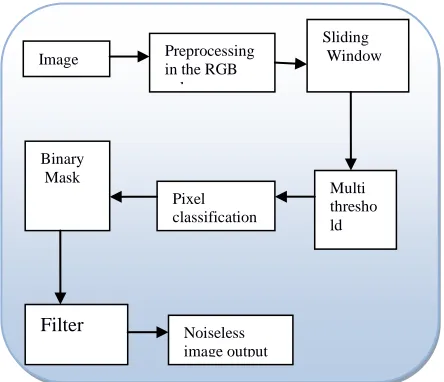
Fig 4: Block Diagram
Image Preprocessing in the RGB color space
Sliding Window
Multi thresho ld Pixel
classification Binary
Mask
© 2014, IJCSMC All Rights Reserved
483
The Existing system usually generates the output images in black and white format, since the
input is also taken in the same manner. Thus the system does not work out to accept colored input
images. Therefore Gaussian noise is removed and output is generated in black and white color
format. However the projected system is helpful in obtaining the output images in grey color
format, even if the input image taken is black and white in color. Thus the system works well to
accept any kind of input and noise removal process is carried out with the perfect reconstruction
property. This system is very much advantageous, since the salt and pepper noise is being
removed using both the PDE and DTCWT techniques through the use of C#.Net language being
linked with the MATLAB. DTCWT performance is high when compared to PDE
implementation. This system produces sensible quality output by removing noise without altering
the underlying structure of the image. Also, verified effective on compression and latent noise
delivered to the surface by bar graph exploit. It is economical, very efficient and also provides
security.
© 2014, IJCSMC All Rights Reserved
484
Fig 6: Graphical Representation of noise removal using both
PDE&DTCWT
2. LITERATURE SURVEY
Dual-tree complex wavelet transform based denoising for random spray image
enhancement methods
This work introduces a novel way of using the Random Spray sampling approach to reduce
point-wise noise introduced or exacerbated by image enhancement methods. Due to the sampling
structure used and the nature of the spray, output images for such methods tend to exhibit noise
with unknown distribution. This proposed method of noise reduction is based on the assumption
that the non-enhanced image is either free of noise or contaminated by various levels of noise.
For both the non-enhanced and enhanced image the dual-tree complex wavelet transform is
applied on the luma channel. The standard deviation of the energy for the non-enhanced image
across the six orientations is computed and normalized. Thus to shrink the real coefficients of the
enhanced image decomposition the obtained normalized map is used. A noise reduced version of
the enhanced version can then be computed via the inverse transform. Therefore in order to
confirm the validity of the proposed approach, a thorough numerical analysis of the results has
© 2014, IJCSMC All Rights Reserved
485
Random spray retinex: A new retinex implementation to investigate the local
properties of the model
This work presents a new implementation, in order to investigate the local filtering behavior of
the Retinex model. This implementation derives a method known as random spray Retinex, in
which paths are replaced by 2-D pixel sprays. The way its parameters being controlled in order to
perform spatial investigation is a peculiar feature of this implementation. The parameters' tuning
is accomplished by an unsupervised method based on quantitative measures. Making use of user
panel tests, this procedure has been validated. Furthermore, the spray approach is more efficient
than the path-wise one. Further discussion is made, tests are carried out and results are presented.
A spatially variant white patch and gray-world method for color image
enhancement driven by local contrast
Starting from the revolutionary Retinex by Land and McCann, further development has been
made on several perceptually inspired color correction models, with different aims, e.g.
enhancement of color images, reproduction of color sensation, robust features recognition. Such
models have a differential, variant and non-linear nature. These can coarsely be distinguished
between white-patch (WP) and gray-world (GW) algorithms. This paper shows that the
combination of a pure WP algorithm (Random Spray Retinex (RSR) and an essentially GW one
(Automatic Color Equalization (ACE)) leads to a more robust and better performing model
(RACE). For both algorithms RSR and ACE the choice of these follows from the recent
identification of a unified spatially-variant approach. Mathematically, differential mechanisms of
RSR and ACE and the originally distinct non-linear and have been fused using the local average
operations and the spray technique. The investigation of RACE allowed us to put in evidence a
common drawback of corruption of uniform image areas, differential models. To overcome this
intrinsic defect, a local and global contrast-based and image-driven regulation mechanism has
been devised, which has a general applicability to perceptually inspired color correction
algorithms. Further tests, comparisons and discussions are presented.
Spatio-temporal retinex-inspired envelope with stochastic sampling: A framework
for spatial color algorithms
The authors present a new framework for algorithms for a wide range of image enhancement and
reproduction applications, such as Stress Spatio Temporal Retinex-inspired Envelope with
Stochastic Sampling. The working of the algorithms is done by recalculating each pixel for local
upper and lower bounds in the image using envelopes. The envelopes are obtained can be
© 2014, IJCSMC All Rights Reserved
486
approach is derived from a computational simplification of previous spatial color algorithms,
such as ACE or Retinex. With the proposed method, various tasks such as high dynamic range
image render, spatial color gamut mapping, local contrast stretching and color to gray scale
conversion, automatic color correction can be performed with good results. With some aspects of
the human visual system, the algorithm exhibits behaviors in line e.g., simultaneous contrast.
3. IMPLEMENTATION
MODULES DESCRIPTION
Image Capturing:
Here the image is introduced using image enhancement methods, Random spray method which
produces two-dimensional collection of points with a given spatial distribution around the origin.
The analysis can be limited to the luma channel of both the non-enhanced and enhanced
image.
Converting Process:
In this step the plane separation process takes place. The proposed method first converts the
image in a space where the chroma is separated from the luma and operates on the wavelet space
of the luma channel. Making a choice to use only the luma channel does not lead to any visible
color artifact. The input image is considered to be either free of noise or contaminated by various
levels of noise. If such an assumption holds, the input image contains the information needed for
successful noise reduction.
Image Identification:
After the plane separation process, the input image is identified by the type of noise. The image is
considered to be contaminated by non perceivable level of noise. With the advantage of human
visual system the content of noise in the image is easily identified. Thus noisy image is obtained
on which further transformations techniques are applied
.
Comparing Each Transform:
With the importance given to the directional content in human vision, an analysis is carried out
through the dual-tree complex wavelet transform (DTCWT). Unlike the discrete wavelet
transform, the DTCWT allows for distinction of data directionality in the transform space. For
© 2014, IJCSMC All Rights Reserved
487
these non-enhanced image coefficients is computed across the six orientations of the DTCWT,
and then it is normalized.
Coefficient Shrinkage:
Some of the most commonly used transforms for shrinkage-based noise reduction are the Wavelet
Transform. This Produces map of the directional structures present in the non enhanced image.
This map is then used to shrink the coefficients of the enhanced image. These shrunk coefficients
and the coefficients from the non-enhanced image are then mixed according to data directionality.
Resulting
Image:
The output image is then computed by inverting the Dual Tree Complex Wavelet
transform and the color transform with complete reconstruction property.
4. CONCLUSION
This work presents a noise reduction method based on Dual Tree Complex Wavelet Transform
coefficients shrinkage. The main point of uniqueness is represented by its application in
post-processing on the output of an image enhancement method and the lack of assumptions on the
statistical distribution of noise. To achieve pleasant denoising, the proposed method exploits the
data orientation discriminating power of the Dual Tree Complex Wavelet Transform to shrink
coefficients from the enhanced, noisy image. Always according to data directionality, the
coefficients which are shrunk are mixed with those from the non-enhanced, noise-free image. The
output image is then computed by inverting the Dual Tree Complex Wavelet Transform and the
colour transform. Therefore in order to carry out a safe and secured data transmission process in a
successful manner, this proposed method is very much advantageous. Thus information can be
exchanged in the form of images in a very efficient and effective way without any change in the
original structure of the image.
REFERENCES
[1] M. Fierro, W.-J. Kyung and Y.-H. Ha, “Dual-tree complex wavelet transform based denoising for random spray image enhancement methods,” in Proc. 6th Eur. Conf. Color Graph., Imag. Vis., 2012, pp. 194–199.
[2] E. Provenzi, M. Fierro, A. Rizzi, L. De Carli, D. Gadia, and D. Marini, “Random spray retinex: A new retinex implementation to investigate the local properties of the model,” vol. 16, no. 1, pp. 162–171, Jan. 2007.
[3] E. Provenzi, C. Gatta, M. Fierro, and A. Rizzi, “A spatially variant whitepatch and gray-world method for color image enhancement driven by local contrast,” vol. 30, no. 10, pp. 1757–1770, 2008.
© 2014, IJCSMC All Rights Reserved
488
A framework for spatial color algorithms,” J. Imag. Sci. Technol., vol. 55, no. 4, pp. 1–10, 2011.
[5] H. A. Chipman, E. D. Kolaczyk, and R. E. McCulloch, “Adaptive bayesian wavelet shrinkage,” J. Amer. Stat. Assoc., vol. 92, no. 440, pp. 1413–1421, 1997.
[6] A. Chambolle, R. De Vore, N.-Y. Lee, and B. Lucier, “Nonlinear wavelet image Processing: Variational problems, compression, and noise removal through wavelet shrinkage,” IEEE Trans. Image Process., vol. 7, no. 3, pp. 319–335, Mar. 1998.
[7] D. Cho, T. D. Bui, and G. Chen, “Image denoising based on wavelet shrinkage using neighbor and level dependency,” Int. J. Wavelets, Multiresolution Inf. Process., vol. 7, no. 3, pp. 299–311, May 2009.
[8] E. P. Simoncelli and W. T. Freeman, “The steerable pyramid: A flexible architecture for multi-scale derivative computation,” in Proc. 2nd Annu. Int. Conf. Image Process. Oct. 1995, pp. 444–447.
[9] F. Rooms, W. Philips, and P. Van Oostveldt, “Integrated approach for estimation and restoration of photon-limited images based on steerable pyramids,” in Proc. 4th EURASIP Conf. Focused Video/Image Process. Multimedia Commun., vol. 1. Jul. 2003, pp. 131–136.
[10] H. Rabbani, “Image denoising in steerable pyramid domain based on a local laplace prior,” Pattern Recognit., vol. 42, no. 9, pp. 2181–2193, Sep. 2009.
BIOGRAPHY
Miss. Dhadbhanjan Rekha - is Pursuing M.Tech (SE) at J.B. Institute of
Engineering & Technology, Yenkalapally, Moinabad, Telangana. She has
completed graduation (B.Tech) from VMR Institute of Technology and Management Sciences, Andhra Pradesh. Her current research interests include design and analysis of image processing, digital computing, multidimensional systems and Computer Networks.
Mr. CH Srinivasulu - is presently Associate Professor in Information
Technology at J.B. Institute of Engineering & Technology, Yenkalapally,
Moinabad, Telangana. He has nearly17 years of experience in industry as
well as a faculty of Computer Science and Information Technology Departments. He is pursuing his PhD from JNTU kakinada. His areas of interests are: image Processing, Computer Architecture, Parallel Computing and Software Engineering,
Mr. P Prakash - is presently Assistant Professor in Information
Technology at J.B. Institute of Engineering & Technology,
Yenkalapally, Moinabad, Telangana. He has more than 4 years of