International Journal in IT and Engineering
http://www.ijmr.net
CMM OR CMMI, WHICH IS MORE
APPROPRIATE FOR A SOFTWARE INDUSTRY?
*Monika Yadav
**Kaushik Kumar
ABSTRACT
It is not easy to improve software quality by relying on conformance to industry standards by
continuously upgrading from one standard or model to another standard or model because
this exercise is complicated for some software organizations. Many multinational companies,
developed internal standards based on the military standards, and then sought to improve the
standard even further as their software development processes matured. The software
development systems based on these internal, commercial standards, and improved over the
years have proved to be good systems. This paper shows how to adopt an efficient, workable
system from basic principles that can improve the output of a software organisation by using
CMM, CMMI.
Keywords: Analogy, Capability Maturity Model , Capability Maturity Model Integration,
Exemplification.
*
Research Scholar, Department of Management, Birla Institute of Technology, Mesra,
Ranchi, India
**Associate Professor, Department of Mechanical Engineering, Birla Institute of
International Journal in IT and Engineering
http://www.ijmr.net
1.I
NTRODUCTIONA huge number of software standards, methodologies, practices, models and guidelines are
introduced to current era of software engineering. These standards tend to be one size fits all
approach that may be optimum for some projects but is often times ill-suited for others [1]
because they are continually changing, which has become a complicated exercise for
software industries, however, many companies developed internal standards based on the
military standards, and then improved the process as their software development processes
matured. The software development systems based on these internal, commercial standards,
and improved over the years have proved to be good systems [2]. Carnegie Mellon developed
Capability Maturity Model (CMM) as a process maturity model. Implementation of CMM
raised many challenges that led to development of Capability Maturity Model Integration
(CMMI) as an improvement. CMMI however does not replace CMM and the effectiveness
depends on the specific area of application.
1.1
C
APABILITYM
ATURITYM
ODELThe very first CMM was developed and released in August of 1990. The CMM for Software
was developed by the Software Engineering Institute (SEI). The SEI CMM has been the
standard set of quality guidelines for companies developing software for the U.S.
Government i.e. usually the Department of Defense and it was initially developed as an
assessment model for software engineering management capabilities of software providers
.Companies wishing to develop software under these standards are evaluated according to
five capability levels, ranging from uncontrolled development processes to consistently
effective organization-wide implementation. This maturity model presents a growth theory
according to which the quality level of a systems development organization can grow along
a given growth path. The gist of the model is that several quality levels for the systems
development process can be recognized. As a result of this deeper understanding, new
practices in process-based software engineering have emerged in the last decade. This model
came in picture due to aid the US government in evaluating software providers’ abilities to
handle large projects. Prior to the development of the model, many of the companies
accomplished projects with considerable flaws in scheduling and budgeting. The model
International Journal in IT and Engineering
http://www.ijmr.net
Development and Maintenance. CMM Maturity Levels are discussed in many articles and
case studies which can be depicted as shown in the table 1.
Table 1: Capability maturity model levels
S.NO Level Description
Level 0
Incomplete Processes:
Absence of processes or general failure to achieve process objectives. No process to product realization. Level 1 The Initial Level: Performed Processes
The first and the lowest level in CMM is the Initial level. At this point organizations have few or no processes. Successes are mainly due to individual initiative and effort and processes that may exist are given a go-bye in crisis. The outcome of a project is therefore unpredictable. Level 2 The Repeatable Level: Managed Processes.
At repeatable level, the processes are followed at the project level for various software project management functions and their performance is planned and tracked through a documented process. At this level, since the project management processes are in place, the organization is ‘disciplined’ and processes are expected to repeat successful practices as done in similar projects. Level 3 The Defined Level: Established Processes
At this level, the organization defines processes for software engineering and management are standardized across the organization. Tailoring guidelines are developed to create project defined software processes and activities become stable and repeatable for implementing them organization-wide. Level 4 The Managed Level: Predictable Processes.
It is reached when the organization uses
quantitative goals for managing.
Quantitative goals are set for software
products and processes, using an
organization-wide measurement program.
The level involves a quantitative
understanding of process capability and using this to manage processes. Variation in process performance is tracked and risks are identified and managed.
Level 5
The
Optimizing Level:
International Journal in IT and Engineering
http://www.ijmr.net
Optimized Processes
and responding to new technologies and challenges. Processes are cost-effective and are improved over time to meet the organization needs. At this highest level, the process performance is measured for continuous process improvement to verify whether the changes in the processes are providing the expected benefits.
1.2
CAPABILITY MATURITY MODEL INTEGRATIONCurrently, there are several maturity models, standards, methodologies, and guidelines that
can help an organization improve the way it does business. However, most available
improvement approaches focus on a specific part of the business and do not take a systemic
approach to the problems that most organizations are facing. For example, maturity models
such as the Software Engineering Institute’s (SEI’s) Capability Maturity Model for Software
(SW-CMM), which focuses on improving software, and the Electronic Industries Alliance’s
(EIA’s) Systems Engineering Capability Model (SECM), which focuses on systems
engineering are available. By focusing on improving only one area of a business, these models
have unfortunately perpetuated the barriers that exist in organizations [3].
Capability Maturity Model Integration (CMMI) provides an opportunity to avoid or eliminate
these barriers through integrated models that transcend disciplines. CMMI consists of best
practices in software companies. It addresses practices that cover the product’s life cycle from
conception through delivery and maintenance. There is an emphasis on both systems
engineering and software Engineering and the integration necessary to build and maintain the
total product [4]. It is an integrated model of many CMMs intended to achieve process
improvement. CMMI has two representations Staged representation, Continuous
representation [5-6].
Staged Representation CMMI pushes to increase the maturity of the processes, focuses
improvement on the process capability an organization can expect to attain; however, this
expected capability or ability to function in a mature manner is contained within maturity
levels or stages. This representation provides a roadmap for sequencing the implementation of
groups of process areas. There are five maturity levels, ranges from level 1 to 5 as shown in
International Journal in IT and Engineering
http://www.ijmr.net
Fig 1: Staged representation of maturity levels in CMMI
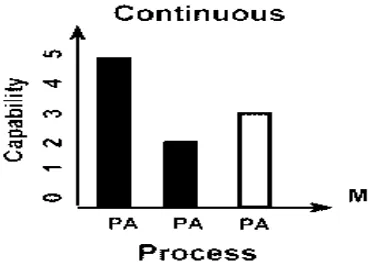
Continuous Representation it has the same basic information as the staged representation,
which arranged differently, provides maximum flexibility. In this each process capability
level ranges from 0 to 5 which are depicted in figure 2.The continuous representation
provides flexibility for selecting processes fit for achieving business goal of the organization
[7].
CMMI provides 25 process areas means a cluster of related practices in these areas which
are implemented collectively, satisfies a set of goals considered important for making
significant improvement [8]. The CMMI model is a process that focuses on what to do, not
how to do it or who does it. Gist of CMMI is to provide guidance for improving
organization’s processes and ability to manage the development, acquisition, and
maintenance of products or services.
International Journal in IT and Engineering
http://www.ijmr.net
2.
EXEMPLIFICATION
OFCMM
ANDCMMI
CMMI was developed to build on the best practices of CMM. It has been felt by some that
CMMI will be successful where CMM could not because most organization that
implemented CMM used while still entrenched in a default waterfall mentality. Both
Software CMM and CMMI models are based on the pretext that organization will follow
process improvement journey in small incremental steps rather than bringing radical change
through large scale sweeping changes. Quality improvement through reengineering can be
bought through department wise small evolutionary steps and by repeating small wins
successively across the organization As asserted by Paulk and others [4, 9-10] that software
CMM and CMMI (staged) quality improvement models provide a baseline for incremental
SPI by defining five maturity levels that lay down a framework with measurement and
assessment criteria for an organization’s software process maturity and for assessing its SPI
capability. CMM and CMMI both are supported by case studies and data that they promote
Return on Investment [11]. According to some researchers CMM is a logical approach and
common sense for Software engineering and quality improvement practices [3, 6]. Software
engineering should be done to achieve business and organizational goals one should not get
into the debate that which model is better.
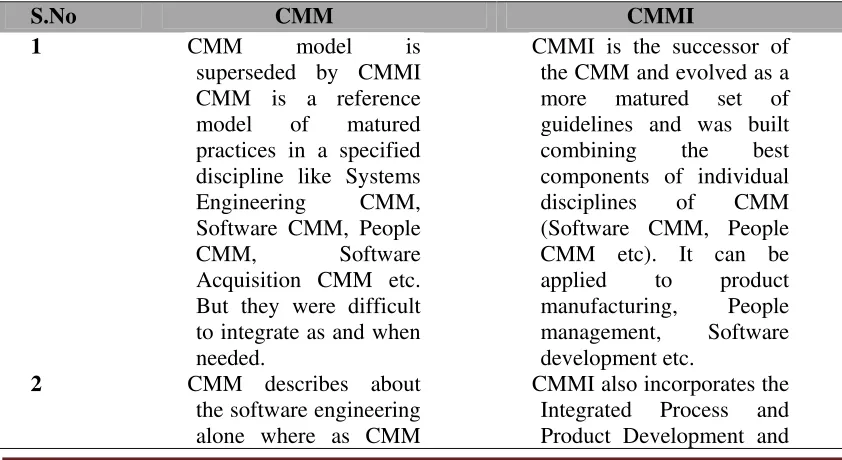
Table 2:Mapping of capability maturity model CMM /capability maturity model integration CMMI
S.No CMM CMMI
1 CMM model is
superseded by CMMI CMM is a reference
model of matured
practices in a specified discipline like Systems
Engineering CMM,
Software CMM, People
CMM, Software
Acquisition CMM etc. But they were difficult to integrate as and when needed.
CMMI is the successor of the CMM and evolved as a
more matured set of
guidelines and was built
combining the best
components of individual
disciplines of CMM
(Software CMM, People CMM etc). It can be
applied to product
manufacturing, People
management, Software
development etc.
2 CMM describes about
the software engineering alone where as CMM
CMMI also incorporates the
Integrated Process and
International Journal in IT and Engineering
http://www.ijmr.net
Integrated describes
both software and
system engineering.
the supplier sourcing.
3 The CMM model proved
useful to many
organizations, but its application in software
development has
sometimes been
problematic.
The Capability Maturity Model Integration (CMMI) project was formed to sort out the problem of using multiple CMMs.
4 CMM measures the
maturity level of an
organization by
determining if an
organization completes the specific activities
listed in the Key
Performance Areas
(KPA), oblivious to
whether the completion of such activity leads to the desired result.
CMMI is also an activity based approach but the major difference is that CMMI takes a more result-oriented approach when defining and measuring Key Performance Areas.
5 CMM KPA concentrates
on the completion of
specific tasks or
processes and does not
motivate the
organization to focus on
process architecture.
CMMI, on the other hand has an iterative lifecycle that integrates the latest best practices from the industry and attacks risks in process architecture at an early stage.
6 CMM is still relevant and
appropriate for
sequential,
activity-based management
paradigm.
CMMI supersedes CMM in
software development
processes.
7 CMM is concerned at
recording processes.
CMMI documentation and meetings focus on strategic goals of the organizations.
8 Initially, CMM describes
specifically about
software engineering.
CMMI describes integrated processes and disciplines as it applies both to
software and systems
engineering.
9 CMM has a defined path
for over all
organizational improvement
International Journal in IT and Engineering
http://www.ijmr.net
the risk
10 CMM focuses on set of
processes to achieve SPI
by defined Maturity
Levels
CMMI Continuous enables increased foresight into
process area capability
improvement
11 CMM controls the pace
of improvement based on maturity level
CMMI allows improvement in different processes at different rates and gives cost and time flexibility to organization
3.
A
NALOGY OF CAPABILITY MATURITY MODEL I AND CAPABILITYMATURITY MODEL INTEGRATION
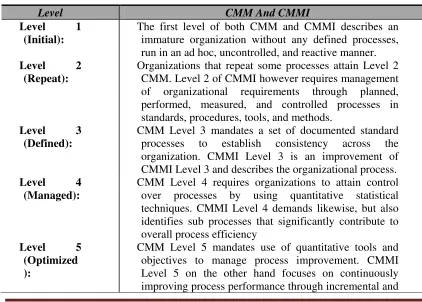
As we know that CMM and CMMI is designed specifically for software industry there is
some features are common in between these quality standards which are depicted in the table
no 3.The common feature in these two is that they gave importance to paperwork and
meetings that distract management’s time and effort from actual work process.
Table 3: Analogy of CMMcapability maturity model/capability maturity model integration CMMI.
Level CMM And CMMI
Level 1 (Initial):
The first level of both CMM and CMMI describes an immature organization without any defined processes, run in an ad hoc, uncontrolled, and reactive manner. Level 2
(Repeat):
Organizations that repeat some processes attain Level 2 CMM. Level 2 of CMMI however requires management of organizational requirements through planned, performed, measured, and controlled processes in standards, procedures, tools, and methods.
Level 3 (Defined):
CMM Level 3 mandates a set of documented standard
processes to establish consistency across the
organization. CMMI Level 3 is an improvement of CMMI Level 3 and describes the organizational process. Level 4
(Managed):
CMM Level 4 requires organizations to attain control over processes by using quantitative statistical techniques. CMMI Level 4 demands likewise, but also identifies sub processes that significantly contribute to overall process efficiency
Level 5 (Optimized ):
International Journal in IT and Engineering
http://www.ijmr.net
innovative technological improvements .
4.
C
ONCLUSIONSo it can be observed that although the levels of both CMM and CMMI are similar but the
difference lies in perception of these. CMM is a standard where as CMMI integrates
different CMM models and creates an integrated CMM customised for the specific
organisation. Hence the CMMI has provided significant value for many organizations that
have used it as a guide for improving the way they do their engineering work. It has helped
them to gain control over their processes—Management, Engineering, and supporting
processes to assure that those processes serve the needs of the organization. Since CMMI is
a customised standard hence by following the same more consistent success in the
engineering projects can be achieved by putting the organization on the road to more
effective processes. Most software organizations can start with CMM then add CMMI.
When a software organization aims to achieve software process improvement, it is
necessary to address more aspects, likes CMMI.
REFERENCES
1. Software Quality Professional: VOL. 8, Issue Two/© March 2006, ASQ publication:
Page.28, “Are Standards the Answer?”
2. Handbook of Software Quality Assurance edited by G. Gordon Schulmeyer and
James I. McManus. – 3rd ed-1998. : Page.104, “Standardization of Software Quality
Assurance – Conclusion”
3. Royee ,walker vice president and general manager of strategic services of rational
software corporation ,the rational edge,CMMvs CMMI from conventional to modern
software management feb 2002.
4. Mary Beth Chrissis, Mike Konrad, Sandy Shrum. ”CMMI: Guidelines for Process
International Journal in IT and Engineering
http://www.ijmr.net
5. Software Engineering Institute (SEI). ”CMMI version 1.1 CMU/SEI-2002-TR- 012”.
2002.
6. Richard Basque. ”CMMI un itin´eraire fl´ech´e vers le Capability Maturity Model
Integration”. 2004. Dunod.
7. B. Mutafelija and H. Stromberg, Systematic Process Improvement Using ISO
9001:2000 and CMMI, Artech H.
8. M. B. Chrissis, M. Konrad and S. Shrum, CMMI Guidelines for Process Integration
and Product Improvement, Addison-Wesley, 2003.
9. Mark C. Paulk & ldquo. A Comparison of ISO 9001 and the Capability Maturity
Model for Software,&rdquo, Tech. Report CMU/SEI-94-TR-12, Software Eng.
Inst., Pittsburgh, July 1994.
10.Herbsleb, J., Carleton, A., Rozum, J. Siegel, j, and Zubrow, D. Benefits of
CMM-based software process improvement: Initial results. Software Engineering Institute,
Carnegie Mellon University, Pittsburgh, PA CMU/SEI-94-TR- 13, Aug. 1994.
11.Carnegie mellon software engineering instittute.http://www.sei.cmu.edu. “upgrading