1
Phthalate Toxicity
Arjun Suresh
*and Tanu Jindal
Amity Institute of Environmental Toxicology and Safety Management
Amity University, Noida, India
Corresponding Author: Arjun Suresh
Email:[email protected]
Abstract: Phthalates are esters of Pthalic acid, compounds mainly used as plasticisers.
Phthalates are widely used chemicals which are of significant research interest as their exposure
causes various consequences for human health. There are several categories of phthalates
extensively used in many commercial productions with diverse uses, physicochemical
properties and toxicological effects. This chapter discusses the toxicity of Phthalates and its
potential risks to human health.
Keywords: Phthalate; toxicity; DEHP; health
1.1 Introduction
Some commonly used phthalates are DEHP used as sealants, solvent fragrance , detergents,
pharmaceuticals, cosmetics, paints and Butyl Benzyl Phthalate (BBzP) used as adhesives in
vinyl materials (K. M. Rodgers, 2014). The widespread use of phthalates leads to its
distribution in general environment as well as in raw food materials, contamination can also
occur during processing of food. Larger volume of phthalates are used in edible products
(above 40%) in order to get high plasticizing effect. Some toxicologically relevant phthalates
in food industry are DEHP, BBP, DnBP, DiBP etc. Another source of phthalates is paper and
cardboard materials generated from recycled fibre (O. Kappenstein, 2012). The major cause of
exposure of phthalates in human occurs through inhalation and ingestion, DEHP is the major
phthalate that is present in hygienic materials such as shampoo, conditioners etc. Phthalates are
cancerous for animals and can lead to fatal death and particularly reproductive toxicity in
animals ( G. Latini, 2005). In this chapter an effort has been made to analyse the phthalates
toxicity in various sources.
2
In recent decades, belief over the adverse impacts of phthalates on human beings has been
taken into consideration by the researchers despite the fact phthalate toxicity is already
acknowledged since 1950s. Studies performed on animals have revealed the fundamental side
effects including reproductive system toxicity. The physical and chemical properties of
phthalates differ with the molecular structure which may comprise of a vapour phase with a
low vapour pressure. Phthalates are typically fat soluble, which affect their leaching and
segmentation. The exposure of phthalate in human can also arise as a result of materials
encompassing phthalates across one product to other as can happen with food packaging
material or intra cutaneous fluids, or through surrounding environment. Phthalate assimilation
can occur through food comprising pharmaceuticals and other nutritional supplement (Ted
Schettler, 2005). DEHP is one of the most common plasticizers used to make plastic flexible.
DEHP having chemical formula of C24H38O4 and molecular weight equal to 390.56gmol-1
consists of a pair of eight carbon esters linked to a benzene carboxylic acid ring.
3
1.2.1 Reproductive and Developmental Toxicity of Phthalates
Phthalates acquires endocrine-disrupting properties and their exposure to high concentrations
will lead to fatal death, cancer, deformations, liver and kidney damage and reproductive
toxicity in animals. In human beings, major problem have been arisen related to detrimental
effects. Consequent exposure to phthalates during their development, phthalates can be
transferred from maternal blood to developing foetus and into infants through breast milk and
these exposures may impact the endocrine system which is critical for various biological
functions involving reproductive functions. In addition phthalates were also found in breast
milk, seminal fluid and placenta. Phthalates may also unfavourably affect other functions such
as metabolic processes, thyroid signalling and immune system. (Jan L. Lyche et al, 2016)
1.2.2 Phthalate Toxicity in Food
Food is the major source of exposure of phthalates in humans, European Food Safety Authority
(EFSA) through speculations of scientists on food preservatives, additives and materials has
determined the tolerable daily doses (TDI) for some major phthalates and evaluated that
exposure of phthalates in human through dietary products is within the estimated TDI set
between 0.03 to 0.2 mg/kg of body weight. Generally phthalates used in food material such as
tubes, conveyer belt and disposable material have been found as a major source of phthalate
contamination. (European Food Safety Authority; 2005, Pasquale Ventrice, 2013)
1.2.3 Phthalate Toxicity in Water
The aquatic environment is a significant reservoir of phthalates receiving the waste water
discharge, landfill leachate and rainfall. There has not been any estimation available regarding
the presence of Phthalates at a national scale for recognizing their hazardous risk levels. In
China the Environmental Quality Standards for Surface Water and Standards for Drinking
Water Quality have regulated the limit values for phthalates (Xiaowie Lie, 2013).
Plastic bottles manufactured from Poly Vinyl Chloride (PVC) containing Phthalates used as
plasticisers are used globally for packing drinking water; the usage of water bottles has been
4 1.2.4 Phthalate Toxicity in Cosmetics
Phthalates are widely used in many applications such as skin care products (skin moisturizer,
skin softeners), nail polish and sealants. There are number of phthalates reported to be found
in cosmetics for example, DEHP, DEP(diethyl phthalate), DBP and DBB (dibutylbenzyl
phthalate). Diethyl phthalate was noted to be present in 67 skin care products. 309 patents have
been held including 120 nail polishes and enamels and 27 manicuring formations. These
products may have adverse health impacts on human body through direct contact with skin,
hair, nails and mucous membrane (Hyun Jung Koo, 2004).
1.2.5 Phthalate Toxicity in Soil
The main sources of phthalates in soil are waste water irrigation, pesticides, insecticides and
other industrial productions. There are many pathways where phthalates are distributed in soil.
The retention and transport of phthalates in soil is dependent upon the type of soil,
anthropogenic actions and land usage whereas other weather factors (temperature, humidity)
are also likely to affect the soil by the degradation and percolation of phthalates through soil
profile. Phthalates contamination in soil also impact microbial population which is crucial for
nutrient recycling, controlling pests and preservation of soil structure(Lizhi He, 2014).The
lysimeter studies showed the presence of DEHP in both soil and leachate samples indicating
that it could migrate to deeper soil layers causing groundwater contamination (Suresh, 2019).
1.2.6 Phthalates Toxicity in Indoor Air and Dust
People used to spend long time indoors and indoor source of contamination associated with
constrained ventilation and slower contaminant degradation process leads to high pollutant
levels. Polluted Indoor Air is found to be the most consequential environmental hazard to
human health. Many endocrine-disrupting compounds (EDCs) such as plastics, detergents and
other domestic products are reported as critically indoor contaminants (less studies has been
done). Various researches have been done on many phthalates and are found to dominate indoor
air. Diethyl phthalate (DEP) and di-n-butyl phthalate were reported at a high concentration in
5
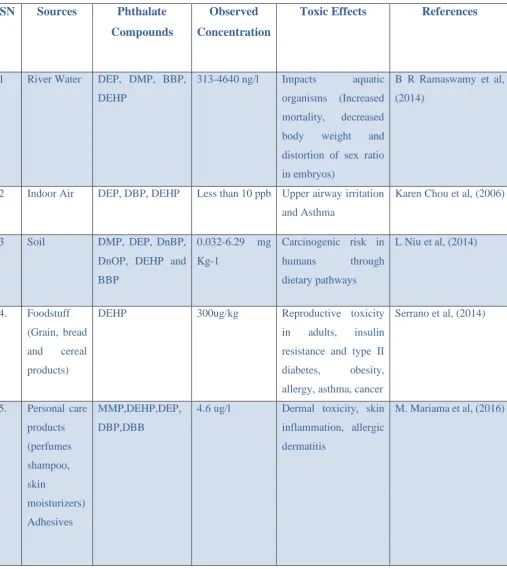
Table 1.1Concentrations of phthalates in Environment and their toxic effects on human health.
SN Sources Phthalate
Compounds
Observed
Concentration
Toxic Effects References
1 River Water DEP, DMP, BBP,
DEHP
313-4640 ng/l Impacts aquatic
organisms (Increased
mortality, decreased
body weight and
distortion of sex ratio
in embryos)
B R Ramaswamy et al,
(2014)
2 Indoor Air DEP, DBP, DEHP Less than 10 ppb Upper airway irritation
and Asthma
Karen Chou et al, (2006)
3 Soil DMP, DEP, DnBP,
DnOP, DEHP and
BBP
0.032-6.29 mg
Kg-1
Carcinogenic risk in
humans through
dietary pathways
L Niu et al, (2014)
4. Foodstuff
(Grain, bread
and cereal
products)
DEHP 300ug/kg Reproductive toxicity
in adults, insulin
resistance and type II
diabetes, obesity,
allergy, asthma, cancer
Serrano et al, (2014)
5. Personal care
products (perfumes shampoo, skin moisturizers) Adhesives MMP,DEHP,DEP, DBP,DBB
4.6 ug/l Dermal toxicity, skin
inflammation, allergic
dermatitis
6
Presence of phthalates in the environment is hazardous for human health and ecosystem. Over
the past decades, researches have indicated that phthalates can leach into the ecosystem from
varying sources and affect human health and environment. Measures of phthalate toxicity vary
widely according to phthalate type and its molecular structure. Leaching of Phthalate can lead
to contamination of food, air, soil and water etc. which ultimately disturbs human health and
environment. Various studies available on human health impact of phthalate are showing
evidence of a wide range of adverse effects in the urinary tract, semen, pregnancy, reproductive
tract, kidneys, lungs, foetus, and heart. Further studies have to be carried to understand the
detailed pathway of Pthalate degradation to develop regulatory measures.
1.4. References
1. K. M. Rodgers and R. A.Rudel (2014), Toxicants in Food Packaging and Household
Plastics,Molecular and Integrative Toxicology, DOI: 10.1007/978-1-4471-6500-22
2. O. Kappenstein et al (2012). A. Luch (ed.), Molecular, Clinical and Environmental
Toxicology, DOI 10.1007/978-3-7643-8340-44
3. G. Latini (2005), Monitoring phthalate exposure in humans; Clinica Chimica Acta ,
doi:10.1016/j.cccn.2005.05.003
4. Pasquale Ventrice, (2013).Phthalates: European regulation, chemistry,
pharmacokinetic and related toxicity; Environmental Toxicology and Pharmacology, 88–96
5. Ted Schettler. (2005), Human exposure to phthalates via consumer products ; Science and
Environmental Health Network, doi:10.1111/j.1365-2605.2005.00567
6. Jan L. Lyche et al. (2016), Reproductive and Developmental Toxicity of Phthalates;Journal
of Toxicology and Environmental Health, DOI: 10.1080/10937400903094091
7. Xiaowie Lie. (2013),Occurrence of phthalic acid esters in source waters: a nation widesurvey
in China during the period of 2009-2012; Environmental Pollution,184 262-270
8. Imran Al-saleh et al, ( 2011), Phthalates Residues in Plastic bottled water; The Journal of
7
9. Hyun Jung Koo, Byung Mu Lee.( 2004), Estimated Exposure to Phthalates in Cosmetics
and Risk Assessment; Journal of Toxicology and Environmental Health, Part A, 67:1901–1914,
DOI: 10.1080/15287390490513300
10. Lizhi He & Gerty Gielen & Nanthi S. Bolan & Xiaokai Zhang & Hua Qin & Huagang
Huang & Hailong Wang, (2014). Contamination and remediation of phthalic acid esters in
agricultural soils in China: a review, DOI 10.1007/s13593-014-0270-1
11. Ruthan A. Rudel et al, (2003). Phthalates, Alkylphenols, Pesticides, Polybrominated
Diphenyl Ethers,and Other Endocrine-Disrupting Compounds in Indoor Air and Dust;
Environmental Science & Technology, Vol 37, No. 20
12. Karen Chou, Robert O. Wright, (2006). Phthalates in food and medical devices; Journal of
Medical Toxicology, Volume 2, Issue 3, pp 126–135
13. Lili Niu, Yang Xu, Chao Xu, Lingxiang Yun, Weiping Liu, (2014). Status of phthalate
esters contamination in agricultural soils across China and associated health risks;
Environmental Pollution 195 16-24
14. Krishna Kumar Selvaraj, Gomathy Sundaramoorthy ,Praveen Kumar Ravichandran , Girish
Kumar Girijan , Srimurali Sampath ,Babu Rajendran Ramaswamy, (2014). Phthalate esters in
water and sediments of the Kaveri River, India: environmental levels and ecotoxicological
evaluations; Environ Geochem Health, doi:10.1007/s10653
15. Samantha S Serrano, Joseph Braun, Leonardo Trasande, Russell Dills, Sheela
Sathyanarayana, (2014). Phthalates and diet: a review of the food monitoring and
epidemiology data; Environmental health, doi: 10.1186/1476-069X-13-43)
16. Melissa Mariana, Joana Feiteiro, Ignacio Verde, Elisa Cairrao, (2016). The effects of
phthalates in the cardiovascular and reproductive systems: A review; Environment
International 94 758–776
17.Tai-Long Pan, Pei-Wen Wang , Ibrahim A. Aljuffali, Yi-Yun Hung , Chwan-Fwu Lin
f,Jia-You Fang, (2014). Dermal toxicity elicited by phthalates: Evaluation of skin absorption,
immune histology, and functional proteomics; Food and Chemical Toxicology 65 105–114
18. Suresh, A., Jindal, T., & Khan, S. A. (2019). An integrated approach for risk assessment of
8
transport in hydrogeological profile. Ecology, Environment and Conservation, 25, S102–S105.
Abbreviations
Benzylbutyl phthalate BzBP
Dimethyl phthalate DMP
Di-n-butyl phthalate DnBP
Diethyl phthalate DEP
Di-2-ethylhexyl phthalate DEHP
Di-isononyl phthalate DnOP
Di-n-butyl phthalate DnBP