• No results found

CHEMICAL REACTION EFFECT ON MHD FLOW PAST A MOVING PLATE WITH VARIABLE MASS DIFFUSION AND HALL CURRENT

N/A
N/A
Protected

Academic year: 2020

Share "CHEMICAL REACTION EFFECT ON MHD FLOW PAST A MOVING PLATE WITH VARIABLE MASS DIFFUSION AND HALL CURRENT"

Copied!
11
0
0

Loading.... (view fulltext now)

Full text

(1)

Double-Blind Peer Reviewed Refereed Open Access International e-Journal - Included in the International Serial Directories

Aryabhatta Journal of Mathematics and Informatics

http://www.ijmr.net.in

email id- [email protected]

Page 729 CHEMICAL REACTIONEFFECT ON MHD FLOW PAST A MOVING PLATE WITH VARIABLE MASS

DIFFUSION AND HALL CURRENT

U. S. Rajput1, Neetu Kanaujia2,

1,2

Department of mathematics, Lucknow University, India

ABSTRACT

Chemical reaction effect on unsteady MHD flow past a moving vertical plate with variable mass diffusion and Hall current is studied here. The wall temperature is kept constant. The fluid considered is viscous, incompressible and electrically conducting. The model under consideration is solved by Laplace

transform method. The velocity profile for different parameters has been studied. This study is usefull in magnetic field controlled materials processing systems, planetary systems and MHD induction machine energy generators, etc.

Keywords: Chemical reaction; Hall current; MHD flow; and Skin fraction.

1. INTRODUCTION

The magneto hydrodynamic flow with Hall effect plays important role in engineering and astrophysics. Some applications are in the field of MHD generators, MHD bearings, ion propulsion, stellar and solar structure, inter planetary and inter stellar matter, solar storms and the three-dimensional channel flow MHD pumps etc. Some articles are worth mentioning. Deka [5] has discussed Hall effects on MHD flow over an accelerated plate. Watanabe et al. [7] have studied Hall effects on MHD boundary layer flow on a continuous moving plate. Katagiri [9] has discussed the effect of Hall current on the MHD boundary layer flow past a semi-infinite plate. Unsteady Hartmann flow with heat transfer has been studied by Attia [6]. Further, mass diffusion effects on infinite vertical plate with heat flux have been studied by Deka et al [8]. Raptis et al. [4] have analysed viscous flow on stretching sheet with chemical reaction. Ibrahim et al. [3] have studied MHD boundary layer flow on moving vertical plate. Rajput and Sahu [2] have studied effects of chemical reaction on MHD flow between two vertical parallel plates. H. Kumar [1] has studied MHD free convection flow on a stretching porous sheet with heat source. We are consideringChemical reaction effect on unsteady MHD flow on a plate with Hall current. The results are shown with tables and some graphs.

2. MATHEMATICAL MODELING

(2)

Double-Blind Peer Reviewed Refereed Open Access International e-Journal - Included in the International Serial Directories

Aryabhatta Journal of Mathematics and Informatics

http://www.ijmr.net.in

email id- [email protected]

Page 730

A vertical moving electrically non-conducting plate with constant wall temperature is considered here. A uniform magnetic field B is takenon the flow. Using the relation B0,

Bx By Bz

B , , , we obtain By(sayB0) = constant, i.e.B

0,B0,0

, where B0is externally applied

transverse magnetic field. Due to Hall effect, there will be two components of the momentum equation. With usual assumptions the fluid model is as under:

( ),

) 2 1 (

2 0 )

( * ) (

2 2

mw u m B C

C g T T g y

u t

u

    

  

    

  

 (1)

( ),

) 2 1 (

2 0 2

2

mu w m B

y w t

w

      

 

 (2)

( ),

2 2

  

    

C C c K y

C D t C

(3)

, 2 2

y T k t T p C

    

 (4)

(3)

Double-Blind Peer Reviewed Refereed Open Access International e-Journal - Included in the International Serial Directories

Aryabhatta Journal of Mathematics and Informatics

http://www.ijmr.net.in

email id- [email protected]

Page 731

. y as T , , 0 , 0 0, y at 2 0 , , 0 , 0 : 0 y, of values the all for , , , 0 , 0 : 0                          T C C w u t u C w C C C w T T w u u t T T C C w u t

 (5)

Definition of symbols:

u – fluid velocity along x, w – fluid velocity along z, m -Hall parameter, g - gravity, 𝛽 - coefficient of thermal expansion, 𝛽* - coefficient of concentration expansion, t - time, C∞ - the species concentration away from the plate, C - species concentration in the fluid, Cw - species concentration at the plate, D - mass diffusion, T∞ - fluid temperature near the plate, Tw - plate temperature, T - fluid temperature, k - the thermal u v y, υ - k v s s y, ρ - the fluid density, Kc -chemical reaction

p , σ - u v y, μ - the magnetic permeability, CP- specific heat at constant pressure.

Here mee with e- cyclotron frequency of electrons and e- electron collision time.

To transform the equations (1) - (4) in dimensionless from, the following non - dimensional quantities are used: . 2 0 u c υK 0 K , , 3 0 3 0 2 0 2 0 2 0 0 0 0                         ) T w T ( ) T T ( C w C C C C , u ) T w T ( g Gr , u ) C w C ( g Gm , tu t , u B M , k P C Pr , D Sc , yu y , u w w , u u u           (6)

The symbols in dimentionless form are: u - v y, w - velocity, θ - temperature, C - concentration, Gr

- thermal Grashof number, Gm - mass Grashof number,

- the coefficient of viscosity, Pr - the Prandtl number, Sc - the Schmidt number, M - the magnetic parameter K0 - the chemical reaction parameter. The dimensionless forms of equations (1), (2), (3) and (4) are as follows

(4)

Double-Blind Peer Reviewed Refereed Open Access International e-Journal - Included in the International Serial Directories

Aryabhatta Journal of Mathematics and Informatics

http://www.ijmr.net.in

email id- [email protected]

Page 732

0C, 2 2 1 K y C Sc t C      (9) . 2 2 Pr 1 y t      (10)

The corresponding boundary conditions are:

. y as 0 , 0 , 0 , 0 0, y at , 1 , 0 , 1 , 0 y, of values the all for , 0 , 0 , 0 , 0 , 0                 

C w u t C w u t C w u t (11)

Dropping the bars and combining the equations (7) and (8), we get

(1 ) ,

1 2 2 2 q mi m M GmC Gr y q t q                (12) 0 , 2 2 1 C K y C Sc t C      (13) . 2 2 Pr 1 y t      (14) Here quiw. The corresponding boundary conditions become

. y as 0 , 0 , 0 0, y at , 1 , 1 , 0 y, of values the all for , 0 , 0 , 0 , 0              

C q t C q t C q t (15)

The solution of the above equations is obtained by the Laplace transform method, which is an under

(5)

Double-Blind Peer Reviewed Refereed Open Access International e-Journal - Included in the International Serial Directories

Aryabhatta Journal of Mathematics and Informatics

http://www.ijmr.net.in

email id- [email protected]

Page 733 )]. Sc K Sc K y e A Sc K y e ( ) Sc K ) A Sc K y e A Sc K y e (( t y [ Sc K y e ] Sc )[ A Sc Sc K a y e A yA e ( Sc Sc tK yA Sc at e Sc y ] Sc t )[ A Sc K y e A Sc K y e ( Sc K y e Sc y ) A Sc K y e A Sc K y e ( Sc K y ae K ( Sc yGm ) Sc K a ( Gr ]) t Pr y [ Erfc ) A Pr Pr a y e A ( Pr at y Pr at e ( a ) Sc K ) ay e A ( ay e a ] tK [ Sc ) A ay e A ay e ( ay e y ] Sc )[ A yA e A yA e ( yA Sc Sc tK Sc at e y ) A y a e A ( y a e a ) a ( y A y a e ( yGm ) Sc K a ( Gr )) A Pr at y e A ( Pr at y Pr at e ) A ( y a e ( a ) A ( y a e q 0 0 2 20 0 2 1 0 21 0 2 20 0 2 1 2 1 0 1 23 1 0 2 22 17 2 1 10 17 1 2 1 1 21 0 2 20 0 2 1 0 2 1 21 0 2 20 0 2 1 0 0 1 2 0 4 1 2 2 19 1 2 18 1 1 1 2 1 0 2 0 1 0 1 12 2 11 1 2 1 1 16 17 2 15 17 2 1 17 10 1 2 1 12 2 0 0 1 01 2 2 0 4 1 14 1 2 13 1 1 0 2 1 0 2 1                                                                                             

2. 1SKIN FRACTION

The dimensionless skin friction at the plate y = 0 is computed by

x i z

0 y dy dq           

2.2 SHERWOOD NUMBER

The dimensionless Sherwood number at the plate y = 0 is computed by

(6)

Double-Blind Peer Reviewed Refereed Open Access International e-Journal - Included in the International Serial Directories

Aryabhatta Journal of Mathematics and Informatics

http://www.ijmr.net.in

email id- [email protected]

Page 734 ).

ScK t Sc ( B e )) ScK t Sc ( e

) ScK t Sc ( e ( t Sc

) ScB e

ScB ( e ScK )) ScK t Scy ( B ( e ) ScK t Scy ( B ( e Sh

ScK y ScK

y B B

ScK y ScK

y ScK

y ScK

y

0 12

2 0 2

0

12 2

11 0

0 12

2 0 11

2 2

2 2

4 1 2

2 4

1

0 0

2 12 2

11

0 0

0 0

 

 

  

 

 

  

 

 

3. INTERPRETATION OF RESULTS

The velocity, skin friction and Sherwood number computed for different parameters.

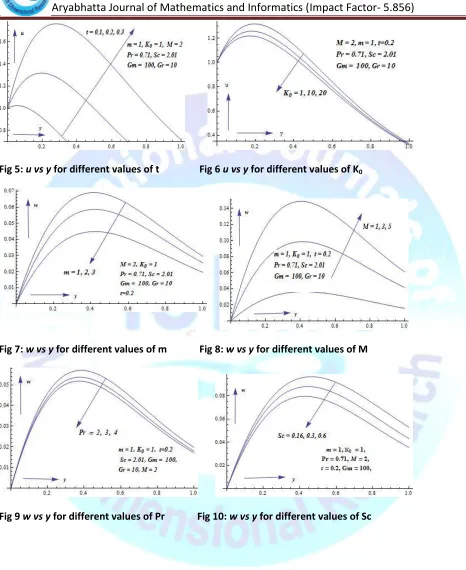
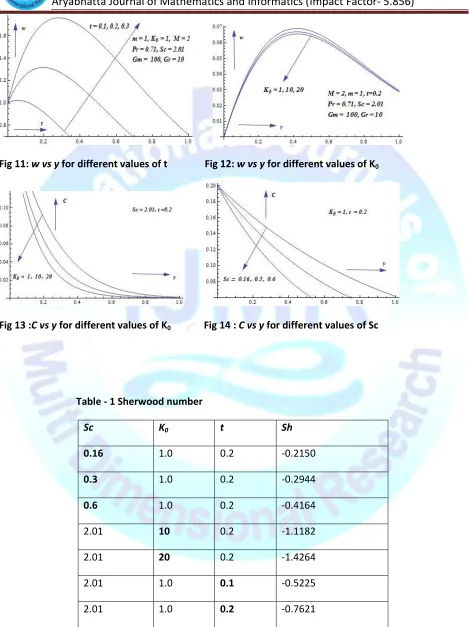
Figures 1 and 5 show that u increases when m, and t are increased. Figures 2, 3, 4, and 6 show that u decreases when M, Sc, Pr and, K0 are increased. Further, it is deduced from figures 8 and 11 that w increases when M, and t are increased. Figures 7, 9, 10 and 12 show that w decreases when m, Pr, Sc

and K0 are increased. Further, Figures 13 and 14 show that concentration decreases when K0, and Sc are increased. These results are in agreement with the actual flow of the fluid. From table – 1 it is deduced that Sherwood number decreases with increase in Sc, K0, and t. From table - 2 it is deduced that

x

decreases with increase in Pr, M, Sc and K0, and it increases with increase in m, Gm, Gr, and t. The value of

z increases with increase in Gr, t, Gm, and M. Further, it decreases when Sc, Pr, K0 and m are increased. Effectively it is as per the expectations of the boundary layer theory.

Fig 1: u vs y for different values of m Fig 2: u vs y for different values of M

(7)

Double-Blind Peer Reviewed Refereed Open Access International e-Journal - Included in the International Serial Directories

Aryabhatta Journal of Mathematics and Informatics

http://www.ijmr.net.in

email id- [email protected]

Page 735

Fig 5: u vs y for different values of t Fig 6 u vs y for different values of K0

Fig 7: w vs y for different values of m Fig 8: w vs y for different values of M

(8)

Double-Blind Peer Reviewed Refereed Open Access International e-Journal - Included in the International Serial Directories

Aryabhatta Journal of Mathematics and Informatics

http://www.ijmr.net.in

email id- [email protected]

Page 736

Fig 11: w vs y for different values of t Fig 12: w vs y for different values of K0

Fig 13 :C vs y for different values of K0 Fig 14 : Cvs y for different values of Sc

Table - 1 Sherwood number

Sc K0 t Sh

0.16 1.0 0.2 -0.2150

0.3 1.0 0.2 -0.2944

0.6 1.0 0.2 -0.4164

2.01 10 0.2 -1.1182

2.01 20 0.2 -1.4264

2.01 1.0 0.1 -0.5225

(9)

Double-Blind Peer Reviewed Refereed Open Access International e-Journal - Included in the International Serial Directories

Aryabhatta Journal of Mathematics and Informatics

http://www.ijmr.net.in

email id- [email protected]

Page 737

Table – 2 Skin fraction

m Gr Gm M Sc K0 Pr t

x

z

1.0 10 10 2 2.01 1.0 0.71 0.2 1.3939 0.3315

1.0 10 20 2 2.01 1.0 0.71 0.2 1.6614 0.3357

1.0 5 100 2 2.01 1.0 0.71 0.2 2.4815 0.3239

1.0 10 100 2 2.01 1.0 0.71 0.2 3.8014 0.3695

2.0 10 100 2 2.01 1.0 0.71 0.2 4.0317 0.3079

3.0 10 100 1 2.01 1.0 0.71 0.2 4.1129 0.2341

1.0 10 100 3 2.01 1.0 0.71 0.2 3.6056 0.5357

1.0 10 100 5 2.01 1.0 0.71 0.2 3.2202 0.8345

1.0 10 100 2 2.01 1.0 2.00 0.2 3.1942 0.3320

1.0 10 100 2 2.01 1.0 3.00 0.2 2.9636 0.3204

1.0 10 100 2 0.16 1.0 0.71 0.2 5.7437 0.4533

1.0 10 100 2 0.30 1.0 0.71 0.2 5.3035 0.4304

1.0 10 100 2 2.01 1.0 0.71 0.1 0.9034 0.2139

1.0 10 100 2 2.01 1.0 0.71 0.2 3.8014 0.3695

1.0 10 100 2 2.01 10 0.71 0.2 3.3781 0.3598

1.0 10 100 2 2.01 20 0.71 0.2 3.0806 0.3531

4. CONCLUSION

(10)

Double-Blind Peer Reviewed Refereed Open Access International e-Journal - Included in the International Serial Directories

Aryabhatta Journal of Mathematics and Informatics

http://www.ijmr.net.in

email id- [email protected]

Page 738

in m, Gm, Gr, and t. The value of

z increases with the increase in Gr, t, Gm, and M. But it decreases

when Sc, Pr, K0and m are increased. Concentration decreases with increase in Sc and K0. Sherwood number decreases with increase in Sc, K0and t.

REFERENCES

[1] Kumar H., Radiative Heat Transfer with MHD free convection flow over a stretching porous sheet in

presence of heat source subjected to power law heat flux, Journal of Applied Fluid Mechanics.

2013,Vol.6,No.4, pp.563-569.

[2] Rajput U. S., Sahu P. K., Effects of chemical reactions on transient free convection MHD flow

between two long vertical parallel plates through a porous medium with constant temperature and

mass diffusion, proceedings of the NSAVTF. 2011, ISBN-978-81-921323-0-3.

[3] Ibrahim S. Y., and Makinde O. D., Chemically reacting MHD boundary layer flow of heat and mass

transfer over a moving vertical plate with suction, Scientific Research and Essays. 2010, 5(19), pp.

2875-2882.

[4] Raptis A., and Perdikis C., Viscous flow over a non-linearly stretching sheet in the presence of a

chemical reaction and magnetic field, International Journal of Non- Linear Mechanics, 2006, 41,

527-529.

[5] D k R. K., H s MHD w p s p ” T . App . M ., 2008 V .35,

No.4, pp. 333-346, Belgrade,

[6] Attia H. A., The effect of variable properties on the unsteady Hartmann flow with heat transfer

considering the Hall effect, Appl. Math. Model, 2003, 27 (7) 551–563.

[7] Pop I., and Watanabe T., Hall effects on magnetohydrodynamic boundary layer flow over a

continuous moving flat plate, Acta Mech. 1995 Vol. 108, pp. 35–47.

(11)

Double-Blind Peer Reviewed Refereed Open Access International e-Journal - Included in the International Serial Directories

Aryabhatta Journal of Mathematics and Informatics

http://www.ijmr.net.in

email id- [email protected]

Page 739

[9] Katagiri M., The effect of Hall current on the magneto hydrodynamic boundary layer flow past a semi-infinite fast plate. Journal of the Physical Society of Japan, 1969, Vol. 27 (4), pp. 1051-1059.

APPENDIX 1 12,

2 11

0 A e A

A    ay 1 2 12,

11 2

01 e A e A

A   ay  ay

}, 2 2 { 11 t y t a Erf

A   },

2 2 { 12 t y t a Erf

A   },

2 ) Pr 1 1 1 ( 2 { 13 t a t y Erf

A  

   }, 2 ) Pr 1 1 1 ( 2 { 14 t a t y Erf

A  

   }, 2 ) 1 ) ( 2 { 0 15 t Sc Sc K a y t y Erf

A  

    }, 2 ) 1 ) ( 2 { 0 16 t Sc Sc K a y t y Erf

A  

    ), 1 ) ( 0 17 Sc Sc K a A     }, 2 Pr Pr 1 2 { 18 t y a t Erf A     }, 2 Pr Pr 1 2 { 19 t y a t Erf A     }, 2 2 { 0 20 t Sc y K t Erf

A   },

2 2 { 0 21 t Sc y K t Erf

A   },

2 1 2 { 0 22 t Sc y Sc K a t Erf A      }, 2 1 2 { 0 22 t Sc y Sc K a t Erf A      }, 2 2 { 0 11 t K t y Sc Erfc

B   },

2 2 { 0 12 t K t y Sc Erfc

B   1 ,

1 2 im

m M

a

Figure

Fig 5: u vs y for different values of t                Fig 6 u vs y for different values of K0
Fig 11: w vs y for different values of t               Fig 12: w vs y for different values of K0

References

Related documents

This means that even though expenses such as rent are higher in the Jordanian communities relative to Zaatari Camp, with reintegration there were some families that were able

This study was designed to evaluate the prevalence of caregiving burden and its association with patient and caregiver-related variables and also level of perceived social support in

Using enzymatic assay and kinetic analysis, we demonstrated that 100 µM calix[4]arene c-956 (5,11,17,23-tetra(trifluoro)methyl-(phenylsulfonylimino)

Intensive blood glucose control with sulphonylureas or insulin compared with conventional treatment and risk of complications in patients with type 2 diabetes UKPDS 33.. Ohkubo

Substance abuse treatment counselors can help clients adhere to antiviral treatment by: • Explaining intended effects and side effects of medication.. • Paying attention to

If a hair specimen was used for testing, a patient could test positive for drug use, even if he or she has not used the substance for weeks. Segmenting a hair specimen is useful

The modulation index, h, is selected to be equal to the optimum value, 1.0/ 2π Fig.10 and 11 illustrates the BER performance of the proposed system, the