MODELLING OF A BULK QUEUE SYSTEM IN TRIANGULAR FUZZY NUMBERS USING Α- CUT Meenu Mittal1, T.P. Singh2, Deepak Gupta3
1. Research Scholar (Mathematics), M. M. University, Mullana
2. Professor, Deptt.of Maths, Yamuna Institute of Engg. &Tech.,Gadholi, Yamunanagar 3. Professor & Head, Deptt. of Mathematics, M. M. University, Mullana
ABSTRACT
In this paper we study to model the queue system with batch arrival. The arrival and service rates both are considered fuzzy in nature. The performance measures of the model have been analysed in triangular fuzzy numbers. α – cut and Zadeh extension principle has been applied to transfer the fuzzy queue measures into crisp measures. The numerical example has been given to deduce the efficiency of the model.
Key Words: Membership function, Poisson and exponential probability distribution, triangular fuzzy numbers,
α – cut interval analysis, threshold effect, queue characteristics etc.
1. INTRODUCTION
Uncertainty affects decision making and appears in a number of different forms. The concept of information is fully connected with the concept of uncertainty. The general frame work of fuzzy reasoning allows handling much of this uncertainty on employing fuzzy sets, which represent uncertainty in the range [0, 1]. The concept of fuzzy sets was first introduced by Zadeh (1965, 1975). Fuzzy queue model was first of all introduced by Li & Lee (1989). The model further developed by J.J. Buckley (1990), Negi and Lee (1992), S. P. Chenn (2006), Pourdarwish & Shokry (2009), T.P. Singh etal (2011, 2012, 2013), Kusum & T. P.Singh(2012) R. Shrinivasan (2014) etc. under different augmentations and parametric constraints.Recently Meenu etal (2015) analysed fuzzy queue model on batch arrival with threshold effect. The objective of the paper is to model a bulk queue system with FCFS discipline in triangular fuzzy numbers using α – cut representation through DSW algorithm. The evaluation of threshold effect has also been observed.
2. TECHNIQUE HOW TO APPLY 𝛂-CUT:
Let us consider a classical single server queueing model infinite calling source and first come first served discipline.
The inter arrival time A and the service time S are described by the following fuzzy sets A = a,μA (a) : a ϵ X
S = s,μS (s) : s ϵ Y
Here X is the classical set of the inter arrival time and Y is the classical set of the service time. μA(a) is the membership function of the inter arrival time.
μS(s) is the membership function of the service time.
The α – cut of inter arrival time and service time are represented as A(α) = a ϵ X ∶ μA(a) ≥α
S(α) = s ϵ Y ∶ μS(s) ≥α
Using α – cuts we have to define the membership function μP (A,S) as follows
μP (A,S) x =
x − a1
a2− a1 , a1≤ x ≤ a2 a3− x
a3− a2, a2≤ x ≤ a3
0, otherwise 2.1 INTERVAL ANALYSIS ARITHMETIC
Let I1 and I2 be two interval numbers defined by ordered of real numbers with lower and upper bounds.
I1= [a, b], a ≤ b & I2 = [c, d], c ≤ d.
Define a general arithmetic property with the symbol
* = [+, -, ×, ÷] symbolically the operation I1 * I2 = [a, b] * [c, d] represents another interval.
The interval calculation depends on the magnitudes and signs of the elements a, b, c, d. 𝑎, 𝑏 + 𝑐, 𝑑 = 𝑎 + 𝑐, 𝑏 + 𝑑
𝑎, 𝑏 − 𝑐, 𝑑 = 𝑎 − 𝑑, 𝑏 − 𝑐
𝑎, 𝑏 × 𝑐, 𝑑 = min 𝑎𝑐, 𝑎𝑑, 𝑏𝑐, 𝑏𝑑 , 𝑚𝑎𝑥 𝑎𝑐, 𝑎𝑑, 𝑏𝑐, 𝑏𝑑
𝑎, 𝑏 ÷ 𝑐, 𝑑 = 𝑎, 𝑏 × 1 𝑑,
1
𝑐 , 𝑝𝑟𝑜𝑣𝑖𝑑𝑒𝑑 0 ∉ 𝑐, 𝑑
𝛼 𝑎, 𝑏 = 𝛼𝑎, 𝛼𝑏 𝑓𝑜𝑟 𝛼 > 0 𝛼𝑏, 𝛼𝑎 𝑓𝑜𝑟 𝛼 < 0 2.2 DSW ALGORITHM:
The DSW algorithm consists of the following steps:
Select a 𝛼 𝑐𝑢𝑡 𝑣𝑎𝑙𝑢𝑒 𝑤ℎ𝑒𝑟𝑒 0 ≤ 𝛼 ≤ 1.
Using standard binary interval operations compute the interval for the output membership function for the selected α cut level.
Repeat above steps for different values of α to complete α cut representation of the solution.
3. MODEL DESCRIPTION:
Considering a single service channel with Poisson input of batch size x and fuzzified exponential inter-arrival service model of a queue system with infinite capacity and FCFS service discipline i.e. in notation form the model is of M[x]/M/1/∞/FCFS type. Let 𝜆𝑥 be arrival rate of Poisson Process of batch size x and
𝑐𝑥 be assigned probability. The number of customers in any arrival is a random variable x where 𝑐𝑥 = 𝜆𝑥
𝜆, where 𝜆 is composite arrival rate of all the batches of size x i. e. 𝜆 = 𝜆𝑖
∞
𝑖=1 .
Figure 1: Bulk Queue Model with Single Service Channel
Define 𝑃𝑛(𝑡) probability that there are n units in the system at any instant t. The differential difference equations governing the model can be derived easily using general Birth Death arguments.
𝑃𝑛′ 𝑡 = − 𝜆 + 𝜇 𝑃
𝑛 𝑡 +𝜇 𝑃𝑛+1(t) +𝜆 𝑛𝑘=1𝑃𝑛−𝑘(t)ck , n≥1
𝑃0′ 𝑡 =-𝜆 𝑃
0(t) +𝜇 𝑃1(t) n=0
IN STEADY STATE:
The steady state condition is reached when the behaviour of the system becomes independent of the time. When t→∞ the steady state equations are
0=-(𝜆 + 𝜇) 𝑃𝑛+ 𝜇𝑃𝑛+1+ 𝜆 𝑛𝑘=1𝑃𝑛−𝑘ck n≥1
0 = - 𝜆 𝑃0+ 𝜇 𝑃1 n=0
The various performance measures of this model are derived by Meenu Mittal etal (2015). 1. The steady state Probability Pn is given by
Pn = 1 −ρ α+ 1 −α ρ n−1 1 −α ρ ; n ≥ 0 where ρ=μ(1−λα) 2. Expected batch size E(x) for two parameters 𝜆1 & 𝜆2 is given by
E x =(λ1+2λ2)
λ
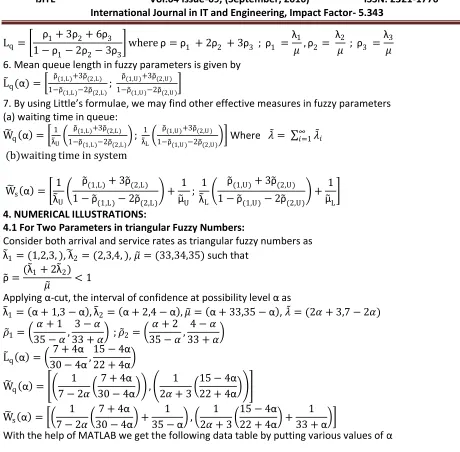
3. Expected queue length Lq for two parameters 𝜆1 & 𝜆2 is given by Lq = ρ1+ 3ρ2
1 −ρ1− 2ρ2 where ρ=ρ1 + 2ρ2 ; ρ1 = λ1
𝜇 ,ρ2=
λ2
𝜇 4. Expected batch size E(x) for three parameters 𝜆1 , 𝜆2 & 𝜆3 is given by
E x =(λ1+2λ2+3𝜆3)
λ
5. Expected queue length for three parameters 𝜆1 , 𝜆2 & 𝜆3 is given by
𝜆𝑥
𝜇
Lq = ρ1
+ 3ρ2+ 6ρ3
1 −ρ1− 2ρ2− 3ρ3 where ρ=ρ1 + 2ρ2 + 3ρ3 ; ρ1 = λ1
𝜇 ,ρ2 =
λ2
𝜇 ; ρ3 =
λ3
𝜇 6. Mean queue length in fuzzy parameters is given by
L q(α) = ρ(1,L)+3ρ(2,L)
1−ρ(1,L)−2ρ(2,L);
ρ(1,U )+3ρ(2,U )
1−ρ(1,U )−2ρ(2,U )
7. By using Little’s formulae, we may find other effective measures in fuzzy parameters (a) waiting time in queue:
Wq α = λ1 U
ρ(1,L)+3ρ(2,L)
1−ρ(1,L)−2ρ(2,L) ; 1 λL
ρ(1,U )+3ρ(2,U )
1−ρ(1,U )−2ρ(2,U ) Where 𝜆 = 𝜆 𝑖
∞
𝑖=1
(b)waiting time in system
Ws α = 1 λU
ρ(1,L)+ 3ρ(2,L)
1 −ρ(1,L)− 2ρ(2,L) +
1 μU;
1 λL
ρ(1,U)+ 3ρ(2,U)
1 −ρ(1,U)− 2ρ(2,U) +
1 μL 4. NUMERICAL ILLUSTRATIONS:
4.1 For Two Parameters in triangular Fuzzy Numbers:
Consider both arrival and service rates as triangular fuzzy numbers as λ1= (1,2,3, ),λ2= (2,3,4, ), 𝜇 = (33,34,35) such that
ρ =(λ1+ 2𝜇 λ2)< 1
Applying α-cut, the interval of confidence at possibility level α as
λ1= α+ 1,3 −α ,λ2= α+ 2,4 −α , 𝜇 = α+ 33,35 −α , 𝜆 = (2𝛼 + 3,7 − 2𝛼)
𝜌 1=
𝛼 + 1 35 − 𝛼,
3 − 𝛼
33 + 𝛼 ; 𝜌 2= 𝛼 + 2 35 − 𝛼,
4 − 𝛼 33 + 𝛼 L q α = 30 − 4α7 + 4α ,15 − 4α22 + 4α
Wq α = 1 7 − 2𝛼
7 + 4α 30 − 4α ,
1 2𝛼 + 3
15 − 4α 22 + 4α
Ws α = 1 7 − 2𝛼
7 + 4α 30 − 4α +
1 35 −α ,
1 2𝛼 + 3
15 − 4α 22 + 4α +
1 33 +α
With the help of MATLAB we get the following data table by putting various values of α
Table 1: The 𝛂 –cuts of 𝐋 𝐪 , 𝐖𝐪 𝛂 & 𝐖𝐬 𝛂 at 𝛂 values for two parameters
S. No. 𝛼 L q α
[Lqlower, L qupper ]
Wq α
[Wqlower, Wqupper ]
Ws α
[Ws lower, Ws upper ]
Figure 2: α –cuts of L q Figure 3: Threshold effect for L q
Figure 4: α –cuts of Wq Figure 5: Threshold effect for Wq
4.2 For Three Parameters in Triangular Fuzzy Numbers:
Considerλ1= 1,2,3, ,λ2= 2,3,4, , λ3= 3,4,5 , 𝜇 = (35,36,37)
Such that ρ =(λ1+2λ𝜇 2+3λ3)< 1 Applying α-cut, we get,
λ1= α+ 1,3 −α ,λ2= α+ 2,4 −α ,λ3= α+ 3,5 −α ,λ = 3α+ 6, 12 − 3α ,
μ = α+ 35,37 −α ρ1= 37 −α+ 1
α, 3 −α
35 +α ;ρ2= α+ 2 37 −α,
4 −α
35 +α ;ρ3= α+ 3 37 −α,
5 −α 35 +α L q α =
25 + 10α 23 − 7α ,
45 − 10α 7α+ 9 Ws α = 1
12 − 3α
25 + 10α 23 − 7α +
1 37 −α ,
1 3α+ 6
45 − 10α 7α+ 9 +
1 35 +α
With the help of MATLAB we get the following data table by putting various values of α
Table- 2: The 𝛂 –cuts of 𝐋 𝐪 & 𝐖𝐬 𝛂 at 𝛂 values for three parameters
S. No. 𝛂 𝐋 𝐪 𝛂 𝐖𝐪 𝛂 𝐖𝐬 𝛂
1 0 [1.0870, 5.0000] [0.0906,0.8333] [0.1176, 0.8619] 2 0.1 [1.1659, 4.5361] [0.0997, 0.7200] [0.1268, 0.7485] 3 0.2 [1.2500, 4.1346] [0.1096, 0.6265] [0.1368, 0.6549] 4 0.3 [1.3397, 3.7838] [0.1207, 0.5484] [0.1479, 0.5767] 5 0.4 [1.4356, 3.4746] [0.1329, 0.4826] [0.1603,0.5108] 6 0.5 [1.5385, 3.2000] [0.1465, 0.4267] [0.1739, 0.4548] 7 0.6 [1.6489, 2.9545] [0.1617, 0.3788] [0.1891,0.4069] 8 0.7 [1.7680, 2.7338] [0.1786,0.3375 ] [0.2061, 0.3655] 9 0.8 [1.8966, 2.5342] [0.1976, 0.3017] [0.2252, 0.3296] 10 0.9 [2.0359, 2.3529] [0.2189, 0.2705] [0.2466, 0.2983]
11 1 [2.1875, 2.1875] [0.2431, 0.2431] [0.2708, 0.2708]
Figure 10: α –cuts of Wq Figure 11: Threshold effect for Wq
Figure 12: α –cuts of Ws Figure 13: Threshold effect for Ws
5. ANALYTICAL STUDY OF THE MODEL:
6. CONCLUSION:
We find that when arrival rates λ1, λ2, λ3 and service rate 𝜇 are in triangular fuzzy numbers, the performance measures in the system are expressed by fuzzy number that completely conserve the fuzziness of input information. From the tables & diagrams, it is clear that as the values of α increase, the lower bound of queue length as well as waiting time in queue as well as in system increase and corresponding upper bound decreases and therefore, uncertainty decreases and the value becomes crisp value. The evaluation of threshold through α-cut avoid unnecessarily computations in order to eliminate small membership function (value).The effect of threshold creates dead zone and the α-cut thresh hold creates a sudden drop in evaluation of membership functions that is not desired. To avoid a sudden drop, we can suggest to a non linear threshold where the membership value goes down to zero in a slower pace. With these data the value of α=.4 can be considered as the most appropriate value where cut can be applied.
REFERENCES
1. (1963), Bhat, U. N., "Embedded Markov chain analysis of bulk queues", Journal of the Australian Mathematics Society 4, pp (244-263).
2. (1965)Zadah L.A.,“fuzzy sets and systems”, System theory Brooklyn N.Y.pp29-37.
3. (1975) Zadah L.A," The concept of Linguistic variable & its applications to Approximate Resoning-1" Journal of Information Science, vol.-8,pp(199-249).
4. (1978), Zadeh's, L.A.,"Fuzzy sets a basis for a theory of probability", Fuzzy sets and system 1,pp(3-28).
5. (1987), Pourdarvish, A.," On bulk arrivals in biseries channels linked in series with a common channel",Indian soc. Stat. Opres. Res.,vol.viii, pp(1-4).
6. (1889), Li, R.J. and Lee, E. S., "Analysis of fuzzy queues" Computers and Mathematics with Applications 17,pp(1143-1147).
7. (1992), Negi, D.S. and Lee, E.S.," Analysis and simulation of fuzzy queues", Fuzzy sets & systems 46, pp (321-330).
8. (2006) S. P. Chenn ," A Mathematics programming approach to the machine interference problem with fuzzy parameters" , Applied mathematics and computation, 174,374-387.
9. (2009), Pourdarvish A. & M. Shokry, "M[X]/M/1 Queuing System With Fuzzy Parameters", Pure & Applied Mathematika Sciences, vol.- LXIX, No.1-2, pp (13-21).
10. (2011), T. P. Singh & Kusum, " Trapezoidal fuzzy queue network with blocking", Aryabhatta Journal of Mathematics & Informatics, vol-3, No.-2,pp(185-192).
11. (2012)T.P. Singh, Kusum & Gupta Deepak, "Fuzzy queue model to interdependent communication system with bulk arrival", Aryabhatta Journal of Mathematics & Informatics, vol-4, No.-1,pp(41-48). 12. (2012),"Machine repairing queue mode under fuzzy environment", Aryabhatta Journal of
Mathematics & Informatics, vol-4, No.-2, pp (189-204).
13. (2013), Arti & T.P. Singh, "Analytical study of fuzzy queue model to interdependent communication system having voice packetized transmission", Aryabhatta Journal of Mathematics & Informatics, vol-5, No.-1,pp(175-182).
14. (2014) R. Shrinivasan," Fuzzy queueing model using DSW algorithm", International Journal of Advanced research in Mathematics and Application, Vol.-1(1),pp(57-62).
15. (2015)Meenu Mittal, T.P. Singh & Deepak Gupta ," Threshold effect on a fuzzy queue model with batch arrival ", Aryabhatta Journal of Mathematics & Informatics, vol-7, No.-1, pp (109-118).