CSEIT1833636 | Received : 05 April 2018 | Accepted : 20 April 2018 | March-April-2018 [ (3 ) 3 :1567-1571 ]
© 2018 IJSRCSEIT | Volume 3 | Issue 3 | ISSN : 2456-3307
Improvement in Deterministic Energy-Efficient Protocol in
Wireless Sensor Network
Rashmi Jatain
Research Scholar, CSE Department, Maharishi Dayanand University, Rohtak, Haryana, India
ABSTRACT
Energy saving is a vital issue while designing the Wireless Sensor Networks. The sensors are sensitive to energy consumption and cannot be recharged and replaced. The radio transmission and receiving data process of nodes consume more energy. Clustering is the technique based on node connectivity and splitting & merging of cluster performance provides more energy efficient network. DEC (Deterministic Energy-efficient Clustering) protocol is dynamic, distributive, self-organizing and more efficient in terms of energy than any other of the existing protocols. But DEC can be enhanced by multi level hierarchy. The fundamental concept of proposed protocol is that there is a pre-defined radius around the Base Station (located at centre), some nodes are inside the radius and others are outside the radius. Cluster Heads which are outside the radius find the nearest Cluster Head which is inside the radius and send data to it. Then these inside Cluster Heads aggregate the data and send it to the Base Station. The proposed scheme is compared against DEC protocol. The simulation result shows that the enhanced version of DEC improves the lifetime of the network as compared with DEC.
Keywords: Wireless sensor network, Sensing node, Battery, Clustering, Energy consumption, Heterogeneous network, Multi level hierarchy, Network lifetime, DEC protocol.
I.
INTRODUCTION
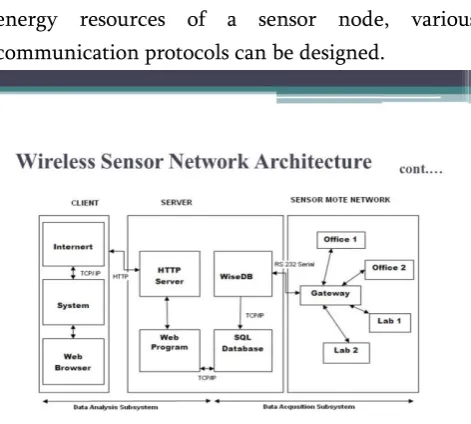
Wireless sensor networks (WSNs) have gained worldwide attention in recent years. A wireless sensor network consists of large number of sensor nodes which has the ability of sensing, computing and transmitting data from the harsh environment. These sensor nodes are randomly deployed in the field as shown in Figure 1. These sensors are small, with limited processing and computing resources, and they are inexpensive compared to traditional sensors. These sensor nodes can sense, measure, and gather information from the environment and, based on some local decision process, they can transmit the sensed data to the user. Sensors are spatially distributed to monitor physical or environmental conditions, such as temperature, sound, pressure etc. and to cooperatively pass their
data through the network to a main location. These sensor nodes equipped with limited battery resource and due to communication operation they deplete at a faster rate. For effective and efficient utilization of energy resources of a sensor node, various communication protocols can be designed.
The development of wireless sensor networks was motivated by military applications such as battlefield surveillance; today such networks are used in many areas. WSN applications are wide and used for military sensing, physical security, air traffic control, industrial and manufacturing automation, process control, weather sensing, environment monitoring, building and structure monitoring etc. The objectives of WSN are accuracy, cost effectiveness, ease of deployment, flexibility and reliability.
1.1 Why Energy Efficiency
One of the necessary constraints in WSN is energy potency. The sensor nodes are microelectronic devices use batteries and have limited power source. The sensing nodes are scattered with in geographical area. Once nodes are spread they are unapproachable. Now the necessary part is battery. The less power consumption provides the node for a long time period. When the sensing node gather information and send to the sink node, they consume battery energy. Therefore designing an energy efficient protocol that decrease the energy consumption of data transmissions and prolong the network life is important.
Energy efficiency is achieved in wireless sensor network in three ways.
Operation having low duty cycle.
Reduce the requirement for long range transmission by multipath networking.
Reduce the data volume and transmission time by local networking processing.
1.2 DEC Protocol
Deterministic Energy-efficient Clustering (DEC) Protocol is developed by Femi A. Aderohunmu,
Jeremiah D. Deng, Martin K. Purvis in
December,2011. DEC utilizes a simplified approach which minimizes computational overhead-cost to self-organize the sensor network. The DEC is one of the clustering protocols which use residual energy of the node to elect the cluster head and provide
efficient result in the network by increasing the stability period of the network. The uncertainties in the cluster-head elections have been minimized in DEC. In DEC, the setup phase used in LEACH is modified, but the steady-state phase is kept same as that of in LEACH protocol. The simulation result shows a better performance with respect to energy consumption, which is reflected in the network lifetime in both homogeneous and heterogeneous settings when compared with the existing protocols. It is worthy of note that this approach approximates an ideal solution for balanced energy consumption in hierarchical wireless sensor networks.
II.
EXISTING SYSTEM
Femi A. Aderohunmu, Jeremiah D. Deng, Martin K. Purvis proposed DEC (Deterministic Energy-Efficient Clustering) Protocol. It utilizes a simplified approach which minimizes computational overhead-cost to self-organize the sensor network. The simulation result shows a better performance with respect to energy consumption, which is reflected in the network lifetime in both homogeneous and heterogeneous settings when compared with the existing protocols. It is worthy of note that this approach approximates an ideal solution for balanced energy consumption in hierarchical wireless sensor networks.
[2] O. Younis and S. Fahmy proposed Hybrid Energy Efficient Distributed clustering Protocol (HEED) protocol in 2004. It extends the basic scheme of LEACH by using residual energy as primary parameter and network topology features (e.g. node degree, distances to neighbors) are only used as secondary parameters to break tie between candidate cluster heads, as a metric for cluster selection to achieve power balancing. Drawback in HEED is that it works with only with homogeneous wireless sensor network.
[3] Harneet Kour and Ajay K. Sharma proposed Heterogeneous Hybrid Energy Efficient Distributed clustering Protocol (HHEED) protocol in 2010. This protocol is basically used in heterogeneous wireless sensor network. H-HEED protocol is employed to extend the network life. The impact of heterogeneity in terms of node energy in wireless sensor network has been stated.
[4] G. Smaragdakis, I. Matta and A. Bestavros in 2004 proposed SEP protocol which is also modification to the LEACH protocol. It is heterogeneous protocol, up ported weighted election probabilities of every node to become cluster head according to their specific energy.
[5] In this approach, the cluster head election is arbitrarily selected and distributed based on the fraction of energy of every node. In this protocol, 2 types of nodes (two tier in-clustering) and 2 level hierarchies were considered.
[6] Drawback of this protocol is that the cluster head election is dynamic, which results the node far from the powerful node will die first. Himanshu Taneja and Parvinder Bhalla proposed the LEACH protocol improved with the use of multi level hierarchy. In LEACH protocol, some CHs will die at any time of transaction, because of their low energy and heavy workload. So in this, the CHs far from the BS send their information to the nearest CHs and the energy
consumption is reduced and provides efficient results. [22]
III.
PROPOSED WORK
In Wireless Sensor Network, the sensing nodes, also known as Sensors, are spread over the environmental area for gathering the information about physical and environmental condition of that area. When nodes gather the information, it will send to the base station. Generally the nodes consume energy for transmission purpose, which causes more energy consumption. So to make less energy consumption and to increase the energy efficiency we use DEC protocol. A deterministic energy-efficiency clustering protocol uses residual energy of each node in the cluster for election process of CH. DEC seems to be similar to an ideal solution. However, the uncertainties in the cluster-head elections have been minimized in DEC. The setup phase used in LEACH is modified, but the steady-state phase is kept same as that of in LEACH protocol. Since node’s energy can be determined apriority, the CH election process is reorganized by using the RE of each node. In DEC, the BS elects not cluster-heads around m for the network. The BS can only take part in the election of CHs if and only if m=1. The elected CHs advertise their role using CSMA MAC just as in LEACH. However, in DEC unlike in LEACH, the join-request message will contain CM-ID, CH-ID, CM-RE (cluster member-residual energy) and the header that indicates it as a request. This way the RE information of CMs is known to their respective CHs thus localized and it can be utilized for CH rotation in the subsequent rounds.
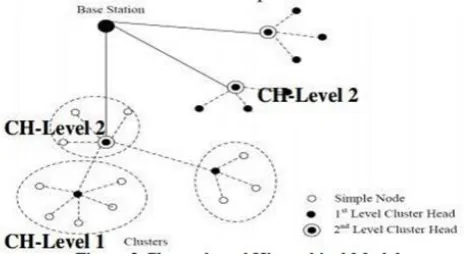
less no. of rounds as compared to other protocol. To make the DEC more efficient on the network, the multi level hierarchy is used. In the multi level hierarchy the transaction is done in given different three levels:
Cluster Nodes at Level 1 (responsible only for gathering data from environment and send it to the CH) Cluster Heads at Level 2 (the nodes which is located outside from a pre-defined radius to the Base Station) Cluster Heads at Level 3 (the nodes which is located inside a pre-defined radius to the Base Station)
Figure 2. Hierarchical Cluster-Based Model
IV.
CONCLUSION
Limiting energy consumption is one of the most pressing problems for many real-world deployments of wireless sensor networks. Unfortunately, energy-efficiency is often at the expense of performance. Since sensor nodes are batterypowered, energy optimization has been one of the main objectives for a robust protocol design. The energy issued due to data collection and transmission. The minimum use of energy increases the lifetime of network. This thesis work examined some energy optimization methods via, clustering schemes that have been employed in heterogeneous WSNs to improve the energy-efficiency in a hierarchically clustered deployment. We enhance the DEC by using multi level hierarchy. It increases the life time of the network, because the workload of the CHs far from the BS is reduced by sending the information to the nearest CHs from the BS. The nearest CHs send the information further to the BS. With this, the stability
of the network is reduced, because the workload of nearest CH’s is increased. It provides good life time for the network and provides good energy efficiency for the network if we increase the no. of rounds in the network. The multi level hierarchy provides one of good solution to enhance the life time of the network.
V.
REFERENCES
[1]. Prof. Femi A. Aderohunmu, Jeremiah D. Deng,
Martin K. Purvis, "A Deterministic Energy-efficient Clustering Protocol for Wireless Sensor Networks", Intelligent Sensors, Sensor Networks and Information Processing (ISSNIP) 2011 Seventh International Conference, pp. 341-346, December 2011.
[2]. W. R. Heinzelman , A. Chandrakasan, H.
Balakrishan, "Energy Efficient Communication Protocol for Wireless Micro Sensor Networks", System Sciences 2000, Proceedings of the 33rd
Annual Hawaii International Conference,
January 2000.
[3]. Amrinder kaur, Sunil Saini, "Simulation of Low
Energy Adaptive Clustering Hierarchy Protocol for Wireless Sensor Network", International Journal of Advanced Research in Computer Science and Software Engineering, Volume 3, pp. 1316-1320, July 2013.
[4]. Ossama Younis, Sonia, Fahmy, "Distributed
Clustering in Ad-hoc Sensor Networks: A Hybrid, Energy-Efficient Approach", INFOCOM 2004. Twenty-third Annual Joint Conference of the IEEE Computer and Communications Societies, Volume 1, March 2004
[5]. Harneet Kour, Ajay K. Sharma, "Hybrid Energy
Efficient Distributed Protocol for Heterogeneous Wireless Sensor Network", International Journal of Computer Applications, Volume 4, pp. 37-41, July 2010.
[6]. S. Lindsey, C. Raghavendra, "PEGASIS:
Power-Efficient Gathering in Sensor Information Systems", Aerospace Conference Proceedings, 2002.IEEE, Volume 3, pp. 1125-1130, 2002.
[7]. Rajesh Chaudhary, Dr. Sonia Vatta, "Review
Sensor Networks", IOSR Journal of Engineering (IOSRJEN), Vol. 4, pp. 1-7, February 2014.
[8]. Padmavati, T.C. Aseri, "Heterogeneous Cluster
Based routing Protocols In Wireless Sensor Network- A Survey", International Journal of Research in Advent Technology, Vol. 1, pp. 51-56, November 2013.
[9]. Meena Malik, Dr. Yudhvir Singh, Anshu Arora,
"Analysis of LEACH Protocol in Wireless Sensor Networks", International Journal of Advanced Research in Computer Science and Software Engineering, Vol. 3, pp. 178- 183, February 2013. [10]. Lalit Kumar Chourse, Deepa Chaurse, Priyanka
Chourse, "A Review on Energy Efficient of Clustering-based Routing Protocol in Wireless Sensor Network", International Journal of Computer Applications, Vol. 50, pp. 33- 39, July 2012.
[11]. I.F. Akyildiz, W. Su, Y. Sankarasubramaniam, E. Cayirci, "Wireless sensor networks: a Survey", Broadband and Wireless Networking Laboratory, School of Electrical and Computer Engineering, Georgia Institute of Technology, Atlanta, GA 30332, USA.
[12]. Seung Jun Baek, Gustavo de Veciana, Xun Su, "Minimizing Energy Consumption In Large-scale Sensor Networks Through Distributed Data Compression And Hierarchical Aggregation", Ieee Journal On Selected Areas In Communications 2004.
[13]. D. Kumar, T.C. Aseri, R.B. Patel, "EECDA: Energy Efficient Clustering and Data Aggregation Protocol for Heterogeneous Wireless Sensor Networks", Int. J. of Computers, Communications & Control, Vol. VI, pp. 113- 124, March,2011. [14]. Adwitiya Sinha, Daya Krishan Lobiyal,
"Performance evaluation of data aggregation for cluster-based wireless sensor network" Human-centric Computing and Information Sciences, A Springer Open Journal, pp. 1-17, 2013.
[15]. C.Divya1, N.Krishnan, P.Krishnapriya, "Distributed Data Aggregation Based Energy Efficient Cluster Algorithm for Heterogeneous Wireless Sensor Network", International Journal of Application or Innovation in Engineering &
Management (IJAIEM), Volume 2, Issue 4, pp. 126-131, April 2013
[16]. M. Madheswaran, R. N. Shanmugasundaram, "Enhancements Of Leach Algorithm For Wireless Networks: A Review", ICTACT Journal On Communication Technology, Volume: 04, Issue: 04, pp. 821-827, December 2013.
[17]. Ankit Gupta, Sangeeta Malik, Monika Goyal and
Pankaj Gupta, "Clustering Approach for
Enhancing Network Energy using LEACH Protocol in WSN", International Journal of Wired and Wireless Communications, Vol. 2, No. 1, pp. 20-25, 2012.
[18]. Tan R, Xu Y, Chen Z, Zha M and Tsou T, "Improving routing protocols of WSN in WHSN", Proceedings of 14th International Conference on Communication Technology, pp. 56-60, 2012. [19]. Jaime Lloret, Sandra Sendra, Miguel Ardid and
Joel J. P. C. Rodrigues, "Underwater Wireless Sensor Communications in the 2.4 GHz ISM Frequency Band", Sensors, pp. 4237-4264, 2012. [20]. Yunyue Lin, QishiWu, Xiaoshan Cai, Xiaojiang
Du, Ki-Hyeon Kwon, "On Deployment of Multiple Base Stations for Energy-Efficient Communication inWireless Sensor Networks", International Journal of Distributed Sensor Networks, Volume 2010, pp. 1-8, 2010.