International Journal of Scientific Research in Computer Science, Engineering and Information Technology
© 2018 IJSRCSEIT | Volume 3 | Issue 4 | ISSN : 2456-3307
Fifth Generation (5G) in Wireless Mobile Communication
Systems
O. Govardhan Reddy1, G Raghavendra2
1Department of MCA Sree Vidyanikethan Institute of Management, Sri Venkateswara University, Tirupati,
Andhra Pradesh, India
2Assistant Professor, Department of MCA, Sree Vidyanikethan Institute of Management, Tirupati, Andhra
Pradesh, India
ABSTRACT
Since from the most recent couple of years examine innovation will open another time in mobile communication frameworks the innovation goes delicate and straightforward for the general population to utilize different capacities with a solitary keen gadget. Extraordinary compared to other illustrations is the wireless portable interchanges. The advancements of mobile communications are quickly changing from 1G to 5G. Is the communication frameworks has been a move from landline to cell mobile communication, bringing about Network design Planning and Optimization related administrations coming in to sharp core interest. The paper is especially intended to present the key wireless mobile interchanges for future or cutting edge Technology. It gives a review of present and future patterns in the regions of wireless mobile communications with various applications.
Keywords : LTE (Long Time Evolution),WWWW (World-Wide Wireless Web), IMT-Advance, IP (Internet protocol), RAT (Radio Access Technology).
I.
INTRODUCTION
Wireless communication began from 1970s and it was persistently moved up to 5G.That is in next four decades, a mobile wireless innovation has developed from 1G to 5G ages. Fifth era wireless mobile communication frameworks offer high data transfer capacity that client never experienced and it gives new propelled highlights which makes it most intense and in tremendous request later on . The present patterns of various wireless and portable interchanges innovations are available, for example, third era mobile systems (UMTS-Universal Mobile Telecommunication framework with CDMA2000), fourth era mobile innovation LTE (Long Time Evolution), WiMAX, and sensor and individual zone systems (e.g. Bluetooth). Figure 1 demonstrates the development of portable communication frameworks
with more administrations, information, utilizes and advantages to the forthcoming age more than 4G.5G will be more quick witted innovation without any limits and to interconnect the entire world unbounded.
The future wireless communication framework is fifth era wireless mobile sight and sound web systems can be totally wireless communication without impediment, which makes consummate wireless genuine – World Wide Wireless Web (WWWW). That fifth era depends on 4G innovations. The fifth wireless mobile web systems are genuine wireless world which might be bolstered by LAS-CDMA (Large Area Synchronized Code-Division Multiple Access), Network-LMDS (Local Multipoint Distribution Service), OFDM (Orthogonal recurrence division multiplexing), MCCDMA (Multi-Carrier Code Division Multiple Access), UWB (Ultra-wideband), and IPv6. Fifth era advances offers enormous information abilities and unlimited assemble volumes and endless information communicate inside most recent portable working framework. Fifth era should have an essential effect and add more administrations and advantages to the world over fourth era. Fifth era ought to be more astute innovation that interconnects the whole world unbounded. This age is required to be discharged around 2020. The universe of general, continuous access to data, stimulation and communication will open new measurement to our lives and change our way of life altogether.
II.
EVOLUTION
First Generation: Wireless mobile communication framework has turned out to be more prevalent because of quick changes in portable innovation. Quick advancement of wireless communication frameworks are because of high increment in telecoms clients. The insurgency of portable communications is from 1G-the original, 2G-the second era, 3G-the third era, 4G-the fourth era, 5G-the fifth era. Original (1G) The original of mobile communication innovation developed in 1980s. The original mobile communication framework utilized simple transmission of discourse flag administrations. In the year 1979, the main cell framework on the planet worked by Nippon Telephone and Telegraph
(NTT) in Tokyo, Japan. Around then the most famous simple frameworks were Nordic Mobile Telephones (NMT) and Total Access Communication Systems (TACS), some other simple frameworks additionally presented in 1980s over the Europe. The principle downside of the original is those frameworks offered handover and wandering capacities however cell systems were not able transmission. In this age utilizes Frequency Division Multiple Access (FDMA), channel transmission capacity is 30 KHz.
Second Generation (2G) Second era empowered to give the administrations, for example, instant messages, picture messages and Multimedia messages (MMS) for different cell phone systems. The second era media transmission systems were industrially propelled on the Global framework for Mobile interchanges (GSM) standard in 1991.Three essential objectives and advantages of 2G organizes over their ancestors were that telephone discussions were
carefully encoded; 2G frameworks were
Third Generation (3G) Third era innovation is completed by the International Telecommunication Union (ITU) in the year 1980. 3G communication recurrence range between 400 MHz to 3GHz. 3G innovation affirmed by both the administration and communication organizations collectively. 3G specialized determinations were made accessible to general society joined the name International Mobile Telecommunications-2000 (IMT-2000). The primary business 3G innovation was propelled by NTT DoCoMo in Japan on 1 October 2001 of W-CDMA. It was at first to some degree constrained in scope; more extensive accessibility of the framework was postponed by obvious worries over its unwavering quality. Third era is an arrangement of principles utilized for cell phones and portable media transmission administrations and systems that conform to the IMT-2000. Favorable circumstances of utilizing third era in settled Wireless Internet Access, Wireless Voice Telephony, Video calls, Mobile Internet Access and Mobile TV.
A large number of the broadcast communications organizations showcase wireless portable Internet benefits as 3G, demonstrating that the publicized administration is given over a 3G wireless system. Administrations promoted as 3G are required to meet IMT-2000 specialized norms, including principles for unwavering quality and speed (information exchange rates). To meet the IMT-2000 gauges, a framework is required to give crest information rates of no less than 200 Kbps (around 0.2 Mbps). Nonetheless, numerous administrations promoted as 3G give higher speed than the base specialized prerequisites for a 3G benefit. Late 3G discharges regularly indicated 3.5G and 3.75G likewise give portable broadband access of a few Mbps to advanced cells and mobile modems in smart phones. CDMA innovation can offer foundation to the IS-95 2 Gstandard. The cell phones are ordinarily CDMA-2000 and IS-95 half and halves.
or enduring IP deliver to the particular wireless interface at the portable terminal, A straightforward IP sending administration that is available over the sensible end of the IP layer at the mobile terminal and at least one doors at the wireless access organize framework. IMT-Advanced 4G measures will introduce another time of mobile broadband interchanges, as per the ITU-R. IMT-Advanced gives a worldwide stage on which to work next ages of intuitive portable administrations that will give quicker information get to, upgraded wandering abilities, brought together informing and broadband interactive media. As indicated by ITU, "ICTs and broadband systems have turned out to be crucial national foundation like transport, vitality and water organizes however with an effect that guarantees to be significantly more capable and expansive. These key upgrades in wireless broadband can drive social and monetary improvement, and quicken advance towards accomplishing the United Nations' Millennium Development Goals, or MDGs." .The present concurrences on the prerequisites for IMT-Advanced are
Regarding idleness, in the Control plane the change time from Idle to Connected ought to be lower than 100ms. In the dynamic express, a lethargic client should take under 10ms to get synchronized and the scheduler ought to decrease the User plane inactivity at most extreme.
In a similar situation with 10 clients, cell edge client phantom proficiency will be 0.06 in DL 4 × 2. In the UL, this cell edge client ghostly productivity must be 0.03 with MIMO 2 × 4. Mobility up to 350 km/h in IMT-Advanced. IMT-Advanced framework will bolster
adaptable transfer speed and range accumulation with transmission data transmissions more than 40MHz in DL and UL. Backward similarity and between working
with heritage frameworks.
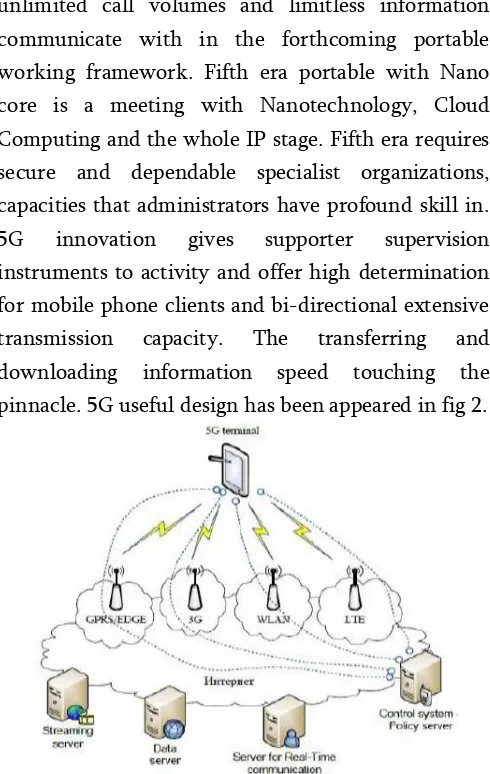
Fifth Generation (5G) Fifth era innovation is quick and dependable to be another portable upset in mobile market. Every one of the administrations of the systems and applications will be gotten to by the single IP as communication, gaming and numerous other interactive media applications. Through this 5G innovation, overall cell innovation goes under one umbrella.5G systems bearers' uncommon information capacities and has capacity to entwine unlimited call volumes and limitless information communicate with in the forthcoming portable working framework. Fifth era portable with Nano core is a meeting with Nanotechnology, Cloud Computing and the whole IP stage. Fifth era requires secure and dependable specialist organizations, capacities that administrators have profound skill in. 5G innovation gives supporter supervision instruments to activity and offer high determination for mobile phone clients and bi-directional extensive transmission capacity. The transferring and downloading information speed touching the pinnacle. 5G useful design has been appeared in fig 2.
Figure 2. Practical engineering for 5G.
important to raise the fitting web attachment extraordinarily controlled by the utilization of the customer and server. This implies in the event of interoperability between heterogeneous systems and for the vertical handover between the separate radio advances, the neighbourhood IP address and goal IP address will be settled and unaltered. All the radio access innovation that is accessible to the client in accomplishing network with the applicable radio access is given proper IP interface. Because of presentation of a fifth era radio framework is conceivable in which distinctive radio advancements will have a similar range. It is conceivable to give expansive telecom of information in GBPS which supporting very nearly 65000 associations. In the fifth era expected prerequisites are expanded most extreme throughput and different incorporates:
Very low battery power consumption. Worldwide wireless web (WWWW).
Cheaper traffic fees due to low infra structure deployment costs.
High data rate
Better coverage at cell end. Multiple data transfer paths.
Every mobile in a 5G technology will have an IP (IPV6) address (IPV6) according to the location and network being used.
III.
CONCLUSION
Looking at the present and past execution of the wireless portable communication framework, it was found that they are as yet unfit to take care of the
unending issues of poor scope, awful
interconnectivity, adaptability and low quality of administration. The primary preferred standpoint of fifth generation will changes the field of wireless interchanges area to a totally new highlights and administrations making the world a littler place to live. For the future age the 5G innovation advances more grounded interfaces between individuals working in various fields making future ideas of
portable communications, nanotechnology, distributed computing and web access. In 5G innovations expecting more data transmission would not be the appropriate response but rather using the current transfer speed through imaginative system configuration is need of great importance. In 5G expecting the system administration modules need to wiser i.e., intellectual programming will make the errand of radio asset booking more straightforward.
IV.
REFERENCES
[1]. Kamarularifin AbdJalil, Mohd HanafiAbd. Latif, Mohamad Noorman Masrek, "Looking into the 4G features", MASAUM Journal of Basic and Applied Sciences vol.1, no.2 Sep 2009.
[2]. B.F. Gessler, O. Queseth, R. Stridth, M.Unbehaun, J.Zendler, "4th Generation wireless infrastructures: Scenarios and Research Challenges", IEEE Personal Communications, 8(2), 2010
[3]. Andrea Goldsmith, Wireless Communications, Standford University
[4]. ArogayaswamiPaulraj, RohitNabar, Dhananjay Gore, Introduction To Space Time Wireless Communications, Prentice Hall of India 15 A. V. Geramita and J. Seberry, Orthogonal Designs, Quadratic Forms and Hadamard Matrices, Lecture Notes in Pure and Applied Mathematics, vol. 5New York and Basel: Marcel Dekker, 1979.
[5]. A. Wittneben, "Base station modulation diversity for digital SIMULCAST," in Proc. IEEE VTC, May 1991.
[6]. B. Hassibi and B. Hochwald, "high-rate codes that are linear in space and time", IEEE Trans. Inform. Theory, April 2001.
[7]. J. Winters, J. Salz, and R. D. Gitlin, "The impact of antenna diversity on the capacity of wireless communication systems," IEEE Trans. Communication.
[8]. L. Stuber, Principles of Mobile
[9]. Siddiqui, MohdMaroof. "Vision of 5G
Communication."High Performance
Architecture and Grid Computing.Springer Berlin Heidelberg, 2011.252-256.
[10]. Mohd. Maroofsiddiqui "Vision of 5G Communications" , A. Mantri et al. (Eds.): HPAGC 2011, CCIS 169, Springer-Verlag Berlin Heidelberg, pp:252-256, 2011.
[11]. AkileshkumarPachuri, Ompal Singh, "5G
Technology- Redefineing Wireless
Communications in upcoming years", IJCSMR vol 1 Issue 1 Aug 2012.
[12]. Chen, Yue (2003). "Soft Handover Issues in Radio Resource Management for 3G WCDMA Networks", Queen Mary, University of London,
Online] Available:
www.elec.qmul.ac.uk/research/thesis/ -YueChen2003.pdf
[13]. ITU-R PDNR WP8F. "Vision, Framework and Overall Objectives of the Future Development of IMT-2000 and Systems beyond IMT2000", 2002.
[14]. Toh, C. K. "Ad Hoc Mobile Wireless Networks: Protocols and Systems", Prentice Hall, New Jersey, USA, 2002.
[15]. Pereira, Vasco & Sousa, Tiago. "Evolution of Mobile Communications: from 1G to 4G", Department of Informatics Engineering of the University of Coimbra, Portugal 2004.
[16]. ITU (2010). "Measuring the
InformationSociety, 2010".Online]Availab -le:http://www .itu.int/ ITUD/ict/statistics/ material/graphs/2010/Global_ICT_Dev_00-10.jpg 8 UMTS World (2009). "UMTS / 3G History and Future Milestones"Online] Available:http://www.u
mtsworld.com/umts/history.htm
ABOUT AUTHORS:
Mr. O.Govardhan Reddy is currently pursuing his
Master of Computer Applications, Sree
Vidyanikethan Institute of Management, Tirupati,
He received his Master of Computer Applications from Sri Venkateswara University, Tirupati