Probing for gene specificity in epithelial development
TRUDI SCHÜPBACH* and ERIC WIESCHAUS
Howard Hughes Medical Institute, Department of Molecular Biology, Princeton University, Princeton NJ, USA
ABSTRACT We surveyed a total of 228 random insertions of a P[GawB] element to determine the fraction of regulatory regions in the Drosophila genome that activate gene expression specifically in follicle cells versus producing more complex patterns of expression. We monitored the GAL4 expression encoded by this construct in the ovarian follicle cells by crossing the lines to a strain containing a lacZ reporter construct. Sixty four per cent of the insertions showed ovarian expression. To assess the specificity of this expression, 124 of the 228 lines were crossed to strains containing either an activated form of Armadillo, the Drosophila homolog of β-catenin, or an activated form of Torpedo/Egfr, the Drosophila homolog of the Epidermal Growth Factor receptor, under the control of GAL4 target sites. The lethality and imaginal disc phenotypes observed in these crosses suggest that most random insertions cause GAL4 expression in a variety of tissues. Very few insertions appear to drive expression only in follicle cells. Although the activated form of Armadillo produced higher frequencies of lethality and disk phenotypes, expression in the follicle cell epithelium at later stages of oogenesis did not lead to a visible phenotype. This contrasts with the dorsalized phenotypes observed in the combination of the same GAL4 lines with the activated Torpedo construct.
KEY WORDS:
Drosophila, epidermal growth factor receptor,
β
-catenín, GAL-4, enhancertraps
0214-6282/97/$10.00 © UBC Press
Printed in Spain
*Address for reprints: Howard Hughes Medical Institute, Department of Molecular Biology, Princeton University, Princeton, New Jersey, 08544, USA. FAX: (609) 258-1547.e-mail:[email protected]
Both authors contributed equally to the experimental results and discussion.
Introduction
Regulatory regions that control transcription in higher eukaryotes are frequently large and consist of multiple motifs that bind various transcription factors. Their complexity reflects the fact that most gene products are used in a wide variety of tissues and organs. Genes specific for epithelial morphology and adhesive behavior, for example, may be expressed in all epithelial cells. In addition, both epithelial and nonepithelial cells in a particular organ might express genes specific for that organ, or for its position along the body axis. Lastly, the cells within a given epithelium may differ in the expression of patterning genes that also control spatial differ-entiation in other epithelia.
In the following study we have focused on regulatory regions capable of driving GAL4 expression in the follicle cell epithelia of the Drosophila ovary. We wanted to know how common such sites are, the frequency with which expression is restricted to specific regions within the follicle cell epithelium, and whether sites that drive expression in follicle cells also drive expression in other epithelial and non-epithelial cell types. To address these ques-tions, we used the GAL4 system developed by Brand and Perrimon (1993). In this system, a transgene encoding the yeast GAL4 transcription factor is mobilized such that it leaves its initial chromo-somal location and inserts at various new sites in the genome. If the
new site is capable of driving transcription in a tissue of interest, the resultant GAL4 expression can be characterized by crossing the flies to lines carrying a reporter gene under the corresponding UAS control.
In the first step of our experiments, we tested newly derived GAL4 insertions for the ability to drive expression of a βGAL reporter construct in follicle cells. To determine whether the GAL4 expression in these lines was restricted to follicle cells, we then crossed them to two different tester stocks carrying activated forms of Armadillo (the Drosophila homolog of β-catenin, Riggleman et al., 1990; Peifer et al., 1992) and the Drosophila homolog of the EGF receptor (Egfr, also designated torpedo = top or DER; Price et al., 1989; Schejter and Shilo, 1989). Both arm and Egfr are expressed in a wide variety of cell types and play essential roles at all stages of development and during oogenesis. Ectopic or inap-propriate activation of Arm or Egfr leads to lethality, adult abnor-malities and/or sterility (Zecca et al., 1996; Pai et al., 1997; Queenan et al., 1997). The cumulated lethality and visible adult phenotypes produced in these crosses provide a simple assay for whether a particular integration site was able to drive GAL4 expression in cells outside the follicle cell epithelium. These experiments also allowed us to compare the effect of disrupting the
Top and Arm signaling in the follicle and imaginal disc epithelia and potentially to identify cell types in which the activated forms of Top and Arm have similar and /or opposing effects on cell fate.
This paper describes the first experiments of our 1997 sabbati-cal year at Princeton. They also represent our first collaborative effort since the mutagenesis screens for female sterile and mater-nal effect loci (Schüpbach and Wieschaus, 1986,1989, 1991). The topic and experimental approach seem appropriate for a volume honoring Antonio García-Bellido, given his long term interest in genomic organization and the specificity of genes for developmen-tal pathways. It was also Antonio’s compartmendevelopmen-talization studies that established the Drosophila wing disc as one of the best studied systems for studying epithelial patterning. Both Top and Arm signaling play significant roles in wing disc patterning; Top plays a particularly important role in wing venation (Clifford and Schüpbach, 1989; Diaz-Benjumea and García-Bellido, 1990). Over the years, Antonio’s work in wing disc patterning has challenged all develop-mental biologists to relate specific signaling pathways and gene activities to the global patterning events that occur in epithelia. That challenge continues to orient much of today’s research in cellular and developmental biology.
Results
Most random GAL4 insertions show expression in specific patterns at various stages of development
A collection of 228 newly established lines carrying a GAL4 insertion were crossed to a UAS-lacZ containing reporter con-struct, and the ovaries of the F1 progeny females were stained for βGAL activity. None of the ovaries showed expression in nurse cells or oocytes, consistent with previous findings that GAL4 does not activate transcription in germ line derivatives (Brand and Perrimon, 1993; Manseau et al., 1997). Of the 228 lines, 147 (= 64%) showed some expression of the lacZ reporter in the follicle cell epithelium. This result confirms that follicle cells are sensitive to GAL4 activation and suggests that sites in the genome causing expression in follicle cells may be fairly common. The range of lacZ expression varied from occasional patches of staining in the columnar follicle cell epithelium at late stages, to three lines that exhibited strong staining in all follicle cells. Four additional lines that did not express in the epithelia showed lacZ expression in the terminal filament cells.
To estimate how many of these GAL4 lines were also expressed in other tissues and at other stages of the life cycle, a sample of 94 lines which caused βGAL expression in ovarian follicle cells, as well as a sample of 30 lines which did not lead to βGAL expression in the ovary, were crossed to two tester constructs. The tester constructs encoded either an activated form of Armadillo (= ∆Arm; Zecca et al., 1996), or an activated form of Egfr (λTop, Queenan et al., 1997). The crosses were maintained at 25°C, and the progeny was scored for lethality and for phenotypes visible in the adult cuticle. Of the inserts that drove βGAL expression in the ovary, 50 caused F1 lethality with at least one of the tester constructs; an additional 17 allowed some F1 survival with each tester construct, but the surviving flies showed visible phenotypes in adult struc-tures. Because follicle cells are not essential for viability, these results suggest that at least two thirds of the insertions drive GAL4 expression in tissues other than follicle cells. Similar frequencies of lethality and adult phenotypes were observed in the 30 lines that
did not show GAL4 activity in the ovary (12 were lethal with either of the tester constructs, and an additional 6 showed visible adult phenotypes). The observation that these frequencies are only slightly lower than those obtained with lines that expressed in ovaries, suggests that preselection for expression in follicle cell epithelium may not significantly enrich for expression in other structures. The overall high fraction of insertions which drive expression in at least some cell type (as judged by staining for βGAL activity, adult phenotypes, or lethality) suggest that the GAL4 construct is very sensitive to genomic enhancers, such that the majority of random insertion sites (>87%) lead to expression in at least some tissue. This value is somewhat higher than those estimated in previous studies (61%, Brand and Perrimon, 1993; 47%, Calleja et al., 1996) and may reflect the greater sensitivity of the assays based on misexpression of activated forms of Arm and Top.
The 85 lines that showed effects when crossed to λTop or ∆Arm affect a variety of developmental stages and developmental proc-esses. Of the 62 lethal lines, 7 caused lethality in the F1 embryo and 29 appeared to allow at least some of the lethal individuals to survive to pupal stages, judging from the increased lethality ob-served at those stages. The F1 individuals from the remaining 40% of the crosses apparently died as larvae. The stage at which lethality occurred was influenced by the temperature, consistent with the previously observed increased transcriptional activation of GAL4 at higher temperatures. Of the 62 lines that had shown lethality with at least one of the tester constructs at 25°C, 20 were viable at 18°C with both testers. In addition, of the 23 lines that showed adult phenotypes at 25°C, 16 were phenotypically normal at 18°.
In general, Drosophila cells appear to be more sensitive to misexpression of ∆Arm than to misexpression of the activated λTop construct. The GAL4; ∆Arm F1 individuals were more fre-quently lethal than the GAL4; λTop progeny (62/124= 50% vs. 36/ 124= 29% for λTop); only one GAL4 line was lethal with λTop but viable with ∆Arm. Many of the crosses that showed adult pheno-types with λTop were lethal with ∆Arm. In a few of these cases where the GAL4; ∆Arm progeny survived to late pupal stages, the pharate adults were examined and found to show severe defects in the wings as well as pattern duplications and other abnormalities in legs, head, and abdomen. There were also 13 lines where GAL4; ∆Arm showed phenotypes in adults whereas the GAL4; λTop individuals were essentially normal.
Fertility and sterility effects of λTop and
∆
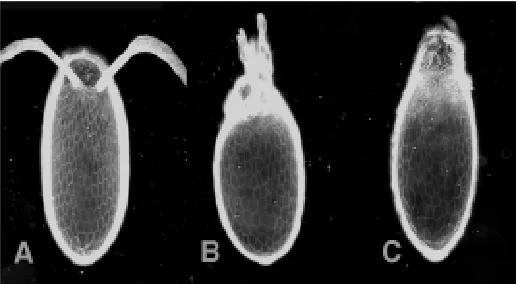
Armprogeny exhibited dorsalized posterior ends. Eleven additional lines were lethal with λTop at 25°C, but produced viable females at 18°C; four of these gave rise to dorsalized eggs after the females had been shifted to 25°C. In general, GAL4 lines which showed the strongest phenotypes induced high levels of lacZ expression in follicle cells at stage 9. Females from one GAL4 line did not lay any eggs at either temperature. Their ovaries showed a novel pheno-type in that the follicle cells remained cuboidal all around the egg chambers, even at late stages. Most of the egg chambers eventu-ally degenerated, but in a few cases oogenesis progressed to late stages and chorion material was deposited all around the egg chambers, even over the nurse cells. This phenotype is consistent with a posteriorization of the follicle cell epithelium, induced by the activated λTop construct at earlier stages of oogenesis. In this line, βGAL activity was detected in the follicle cell epithelium starting at stage 3/4 of oogenesis.
Arm is expressed in both germ cells and follicle cells during oogenesis. Removal of Arm activity in germ line clones leads to a mislocalization of bicoid RNA and to spatial abnormalities in the posterior positioning of the oocyte (Peifer et al., 1993). Because many of the GAL4 lines cause lethality when crossed to ∆Arm, our examination of the fertility effects were limited to the 62 lines that
produced viable females at 25°C, and an additional 22 lines that produced at least a few viable adults at 18°C. All of these lines produced at least some normal eggs, although at least two of these lines showed reduced egg production. The eggs from these two lines were of normal morphology, however, and the ovaries of the females contained normal egg chambers. The 14 lines that pro-duced sterility and dorsalized phenotypes when crossed to the λTop stock provide an interesting test case for ∆Arm activity in the ovary, since when crossed to UAS lacZ, all 14 lines drove relatively high levels of gene expression around stage 8-10 in the follicle cell epithelium. Seven of these lines produced viable F1 progeny when crossed to ∆Arm at 25°C; in all cases the F1 females were completely fertile. An additional three of the 14 lines produced some females with ∆Arm at 18°C; when shifted to 25°C these females were also fertile. Although the GAL4 expression levels were sufficient to produce a dorsalization of the chorion when the lines were crossed to λTop, they had no effect when crossed to ∆Arm. Thus, expression of ∆Arm in the follicle cell epithelium at these stages apparently has no effect on patterning or cell fate.
Comparison of λTop and
∆
Arm in other epitheliaSeven of the GAL4 lines caused embryonic lethality with both tester constructs. Expression of ∆Arm produced the previously described transformation of the cuticle to a uniform naked pheno-type (Fig. 2, see also Zecca et al., 1996; Pai et al., 1997). The embryonic phenotypes produced when these lines were crossed to λTop were less dramatic. Although all lines showed subtle effects on head morphology, only two showed a visible alteration in the patterning of the epidermis. In both cases the denticle bands were broader and extended to the posterior (Fig. 2C). The ontogeny of this phenotype is not clear but it may reflect the postulated late role for the Egfr pathway in countering the effects of the arm/wingless pathway (Szüts et al., 1997). Under certain circumstances this would lead to an increase in denticle producing cells.
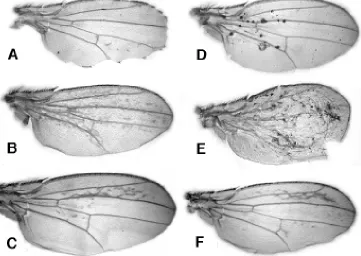
Since both arm and Egfr play important roles in the development and patterning of imaginal discs, it is not surprising that misexpresion of both constructs caused striking phenotypes in adult structures. Because wing disc derivatives were affected by both λTop and ∆Arm, the wing provides an opportunity to compare the conse-quences of inappropriate activation of these constructs in the same cell types (Fig. 4). The most common phenotype in the wing of GAL4; λTop individuals was ectopic veins, consistent with the
Fig. 2. Embryonic phenotypes produced by misexpression of the activated forms of Armadillo and Top. (A) Wild type cuticle showing normal pattern of denticle belts and na-ked cuticle. (B) Naked cuticle phenotype in em-bryos heterozygous for ∆Arm and the GAL4 inser-tion GQ2. (C) Cuticle phenotype of embryos heterozygous for λTop and the GAL4 insertion GQ2. Note the somewhat expanded width and number of denticles in each denticle belt.
Fig. 1.GAL4 lines that cause misexpresison of lTop during oogenesis cause a dorsalization of the egg shell pattern. (A) Normal chorion pattern
known role of the gene in establishing veination pattern (Clifford and Schüpbach, 1989; Diaz-Benjumea and García-Bellido, 1990). Three of the GAL4 lines that did not induce ectopic veins showed scalloping along the wing margin, a phenotype that has not been observed in mutations affecting Egfr signaling before. The pre-dominant wing phenotype associated with GAL4; ∆Arm was the formation of ectopic patches of bristles. These were similar to the ectopic bristles reported for clones homozygous for zw3 (Simpson et al., 1988; Couso et al., 1994 ), a result consistent with the known role of the Zw3 kinase in down regulating Arm signaling and protein levels. Certain lines that produced low levels of ectopic bristles also showed scattered distribution of necrotic balls of cuticles suggest-ing that Arm levels not high or consistent enough to produce
changes in epidermal cell fate may lead to cell death or necrosis. Given the differential sensitivity to ∆Arm and λTop, only one GAL4 line produced wing phenotypes of comparable intensity with both ∆Arm and λTop. This line (HV1) showed a highly regionalized effect with λTop and ∆Arm, inducing ectopic veins largely restricted to the area between the second and third wing veins (Fig. 4C,F). This phenotype argues for an overlap in the two pathways in the generation of wing vein pattern. Since many of the GAL4 lines that caused ectopic wing veins when crossed with λTop were lethal when crossed to ∆Arm, it is possible that additional lines which died at pupation when crossed to ∆Arm, would have caused similar wing transformations, that were not detected because the animals died before adults stages. There must be, however, some specificity in ∆Arm’s ability to induce ectopic veins since other GAL4 lines that cause ectopic veins in λTop produce ectopic bristles in ∆Arm.
Rough eyes were produced in 8 of the 62 crosses that yielded adults with ∆Arm at 25°C, and in 16 of the 88 that produced adults in combination with λTop. The phenotypes ranged from mild roughening to severe reductions in size, associated with a glassy texture. The phenotypes may be complex and even when both constructs produce phenotypes with a given GAL4 line, they may not necessarily affect the same cell types or same developmental stage. Among lines that produced surviving adults with both of the tester constructs, 4 produced eye defects with ∆Arm but not with λTop, and 2 with λTop but not with ∆Arm.
Ectopic expression of ∆Arm caused pattern duplications sug-gestive of a misregulation of positional information governing cell fates in imaginal discs. Many of these were reminiscent of what has been described for misexpression of wingless, for instance, dupli-cations of distal legs in individuals that had died as pharate adults. One line produced viable adults with pattern duplications in the adult head, where eye tissue had been replaced with duplicated antennal tissue. Two GAL4 lines produced an enlargement of the Fig. 3.Abdominal phenotype associated with misexpression of ∆Arm.
(A) In adults heterozygous for ∆Arm and GAL4 insertion GF1, the abdomi-nal sternites are enlarged at the expense of the adjacent pleural mem-brane. (B) No effect on sternite size is observed in the GF1 heterozygotes
Fig. 4.Wing phenotypes associ-ated with misexpression of acti-vated Top or actiacti-vated Arm. In λTop heterozygotes carrying various GAL4 insertions, the most common phenotypes were ectopic wing veins
(A) or wing notching (B). In the ∆Arm heterozygotes carrying various GAL4 lines, the wings frequently showed ectopic bristles (C) or tiny necrotic balls of cuticle (D). One βGAL line (HVI) showed similar wing pheno-types in combination with both λTop
sternites and a consequent reduction in the intervening membra-nous cuticle (Fig. 3). This phenotype may reflect the postulated role of wg signaling in patterning abdominal sternites and the adjacent pleura (Shirras and Couso, 1996).
Discussion
A continually striking feature of the GAL4 system and indeed of the earlier enhancer trap screens is the high frequency with which unselected insertions result in expression (Bier et al., 1989; Grossniklaus et al., 1989). Insertion sites may not be random and instead preferentially targeted to sites of active transcription. It is also possible that the high frequency of insertions that drive GAL4 expression reflects the nature of higher eukaryote control sites, in that their complexity and large size requires that they exert effects over great distances. This feature allows such enhancers to drive expression of any GAL4 reporter construct that has inserted in their vicinity. The modular nature of regulatory sites in higher eukaryotes may allow them to evolve by addition and modification of DNA segments capable of binding regulatory proteins characteristic of the new tissue. Such changes can occur relatively rapidly during evolution and may thus allow rapid divergence of body plans by subtle changes in regulatory sites. A small set of original genes can thus be utilized in different combinatorial patterns.
This view predicts that most gene products would be expressed in a variety of tissues and cell types in Drosophila and that patterns of gene expression may be complex and overlapping even within tissues. Most of the regulatory sites detected with the help of the GAL4; ∆Arm or GAL4; λTop system do in fact cause expression of GAL4 in multiple tissues, and few of the lines appeared to produce a very restricted effect. Given that eyes, wings, and follicle cells represent tissues that can be abnormal, or even largely absent, and still allow the survival of adults, they served as our sample tissues and allowed us to ask how many of the GAL4 lines would cause specific expression in only this tissue. Of the 124 tested lines, 90 showed some phenotype (lethality or visible phenotype, or sterility) in combination with either or both of the tester constructs at 25°C. Of these, 20 produced eye phenotypes with either λTop or ∆Arm at 25°C, but only four of these did not show effects in other tissues (lethality, sterility, wing phenotypes), and of these four, only one did not produce βGAL expression in the ovary in combination with the UAS lacZ construct. Of the 29 lines with wing phenotypes, only 8 had no additional phenotype, and of these, only one line did not lead to the expression of βGAL activity in the ovary. Finally, of the 14 lines that produced an egg phenotype with λTop, only five had no other phenotype. It therefore appears that among the regulatory sites that were sampled by our experiments, fewer than 10% are candidates to be relatively specific for one particular tissue and this number is certainly an overestimate, given that our phenotypic tests demanded that expression was high enough to cause lethality or a visible abnormality in combination with one of the tester constructs.
All 145 of the GAL4 lines that induced βGAL activity in the ovary were expressed in the follicle cell epithelium, and not in the oocyte or nurse cells. This observation is consistent with previous finding (Brand and Perrimon, 1993; Manseau et al., 1997) that GAL4 does not function as a transcriptional activator in the germ line during oogenesis. Because most genes are in fact expressed in the germ line during oogenesis, the GAL4 system provides a unique strategy
for characterizing gene activities specifically in the follicle cell epithelium during oogenesis. Our results confirm the overall impor-tance of Top/EGFR signaling in patterning the follicle cell epithe-lium. The strongest sterility effects were produced in the combina-tion with λTop, and those combinations produced the only unam-biguous effects on follicle cell patterning. As expected, several of the GAL4 lines produced dorsalized egg and embryo phenotypes in combination with the activated λTop construct (Queenan et al., 1997). In several of the lines GAL4 is only expressed after stage 8 of oogenesis, as judged by βGAL expression. It is therefore sufficient to activate the Egfr pathway in stage 9 of oogenesis to cause a dorsalization of the follicle cell epithelium. Lines that expressed βGAL only after stage 10 of oogenesis did not cause dorso-ventral abnormalities when tested in combination with the λTop construct. In addition to effects on dorsal ventral polarity, we also identified a line that causes a λTop dependent effect on earlier follicle cell patterning. This line drives expression of βGAL (and presumably λTop) beginning at stages 3-4 of oogenesis. When crossed to λTop, it produced an abnormal egg chamber phenotype that is consistent with a reprogramming of the anterior follicle cells into a posterior cell fate. This would be the expected phenotype of ectopic activation of Egfr at earlier stages of oogenesis, given that grk/Egfr signaling is required at this stage to induce follicle cells to adopt a posterior follicle cell fate (Gonzalez-Reyes et al., 1995; Roth et al., 1995).
Both Egfr and Arm play essential roles in well characterized signaling pathways during development. In general, these path-ways do not overlap with respect to the developmental instructions conferred by activation. The two genes are, however, frequently expressed in the same cell type and at least in the embryo the two pathways have been reported to counteract each other’s effects (Szüts et al., 1997). In vertebrates moreover, phosphorylation of Arm is one of many downstream consequences observed after activation of the EGF receptor (Hoschuetzky et al., 1994). Our work identifies relatively few cases in which Top and Arm have compa-rable phenotypes. The two pathways thus appear to be generally used in parallel rather than in sequence. Further studies using the exceptional lines where the two activated proteins had similar phenotypes may however allow us to address the possibility of interactions more directly.
Materials and Methods
The new GAL4 lines were isolated after re-mobilization of an original GAL4 insertion P[GawB], Brand and Perrimon (1993), with the help of the ∆2-3 transposase insertion P[ry+;∆2-3] Laski et al., 1986; Cooley et al., 1988). In an initial experiment the GAL4 insertion was moved off of the X chromosome. After a new insertion on a CyO balancer chromosome had been isolated, this GAL4 insertion was mobilized in the subsequent experiments, such that new insertions into all three major chromosomes of Drosophila could be obtained. To test GAL4 expression in the follicle cell epithelium, the GAL4 containing lines were crossed to a line carrying a UAS-lacZ reporter gene (Brand and Perrimon, 1993) and the ovaries of the F1 progeny females were stained for β-galactosidase activity as described in Ashburner (1989), after fixation in 2.5% glutaraldehyde for 10-15 min. The activated armadillo construct, ∆Arm, has been described by Zecca et al., (1996), the activated Egfr construct λ-top by Queenan et al. (1997). All test crosses and the ensuing progeny were kept at 25°C throughout the tests. The crosses were also performed at 18°C. For fertility tests, F1 females were initially tested for production of viable progeny in vials, the females were later transferred to egg laying blocks which allowed a more precise scoring of egg and embryonic abnormalities (Wieschaus and Nüsslein-Volhard, 1986). F1 females from the 18°C series were also transferred to 25°C and were tested after they had been kept at the higher temperature for at least five days. Eggs and embryonic cuticles were prepared as described in Wieschaus and Nüsslein-Volhard (1986). Imagi-nal structures such as wings, heads, and abdomens were first cooked in 10% NaOH for 10 min, rinsed extensively with water, and mounted in Faure’s solution.
Acknowledgments
We would like to express our thanks and appreciation to Antonio García -Bellido for the challenges and for the inspiration he provided to both of us at earlier stages of our careers. We thank Gary Struhl for providing the Arm line, Liz Gavis for comments on the manuscript and Julie Wen for help with the lacZ staining. We would also like to thank Princeton University for aggreeing to the joint sabbatical year that made it possible for us to carry out these experiments. Our work is supported by funds from the Howard Hughes Medical Institute and the National Institutes of Health.
References
ASHBURNER, M. (1989). Drosophila, a laboratory manual. Cold Spring Harbor Laboratory Press.Cold Spring Harbor.
BIER, E., VASSIN, H., SHEPHERD, S., LEE, K., MCCALL, K., BARBEL,S., ACKERMAN, L., CARRETTO, R., UEMURA, T., GRELL, E., JAN, L.Y. and JAN, Y.N. (1989). Searching for pattern and mutation in the Drosophila genome with a P-lacZ vector. Genes Dev. 3: 1273-1287.
BRAND, A. and PERRIMON, N. (1993). Targeted gene expression as a means of altering cell fates and generating dominant phenotypes. Development 118: 401-415.
CALLEJA, M., MORENO, E., PELAZ, S. and MORATA, G. (1996). Visualizing of Gene expression in Living Adult Drosophila. Science 274: 252-255.
CLIFFORD, R.J. and SCHÜPBACH, T. (1989). Coordinately and differentially muta-ble activities of torpedo, the Drosophila melanogaster homolog of the vertebrate EGF receptor gene. Genetics 123: 771-787.
COOLEY,L., KELLEY, R. and SPRADLING, A. (1988). Insertional mutagenesis of the Drosophila genome with single P elements. Science 239: 1121-1128. COUSO, J.P., BISHOP, S.A and MARTINEZ ARIAS, A. (1994). The wingless
signaling pathway and the patterning of the wing margin in Drosophila. Develop-ment 120: 621-636.
DIAZ-BENJUMEA, F.J. and GARCIA-BELLIDO, A. (1990). Behaviour of cells mutant for an EGF receptor homologue of Drosophila in genetic mosaics. Proc. R. Soc. Lond. Biol. 242: 36-44.
GONZALEZ-REYES, A., ELLIOTT,H. and ST JOHNSTON, D. (1995). Polarization of both major body axes in Drosophila by gurken-torpedo signalling. Nature 375: 654-658.
GROSSNIKLAUS, U., BELLEN, H.J., WILSON, C. and GEHRING, W.J. (1989). P-element mediated enhancer trap detection applied to the study of oogenesis in Drosophila. Development 107: 189-200.
HOSCHUETZKY, H., ABERLE, H. and KEMLER, R. (1994). β-catenin modulates the interaction of the cadherin-catenin complex with epidermal growth factor receptor. J. Cell. Biol. 127: 1375-1380.
LASKI, F.A., DIO, D.C. and RUBIN, G.M. (1986). Tissue specificity of Drsosophila P element transposition is regulated at the level of mRNA splicing. Cell 44: 7-19. MANSEAU, L., BARADARAN, A., BROWER, D., BUDHU, A., ELEFANT, F., PHAN,
H., PHILP, A.V., YANG, M., GLOVER, D., KAISER, K., PATLER, K. and SELLECK, S. (1997). GAL4 enhancer traps expressed in the embryo, larval brain, imaginal discs, and ovary of Drosophila. Dev. Dynamics 209: 310-322.
ORSULIC, S. and PEIFER, M. (1996). An in vivo structure function study of Armadillo, the β-catenin homologue reveals both separate and overlapping regions of the protein required for cell adhesion and for wingless signaling. J. Cell Biol. 134: 1283-1300.
PAI, L. M., KIRKPATRICK,C., BLANTON, J., ODA, H. TAKEICHI, M. and PEIFER, M. (1996). Drosophila α-catenin and E-Cadherin bind to disctict regions of Drosophila armadillo. J. Biol. Chem 271:1-10.
PAI, L.M., ORSULIC, S., BEJSOVEC, A and PEIFER, M. (1997). Negative regulation of Armadillo, a Wingless effector in Drosophila. Development 124: 2255-2266. PEIFER, M., MCCREA, P., GREEN, K.J., WIESCHAUS, E. and GUMBINER, B.
(1992). The vertebrate adhesive junction proteins β-catenin and plakoglobin and the Drosophila segment polarity gene armadillo form a multigene family with similar properties. J. Cell Biol. 118: 681-691.
PEIFER, M., ORSULIC, S., SWEETON, D. and WIESCHAUS, E. (1993). A role for the Drosophila segment polarity gene armadillo in cell adhesion and cytoskeletal integrity during oogenesis. Development 118: 1191-1207.
PRICE, J.V., CLIFFORD, R.J. and SCHÜPBACH, T. (1989). The maternal ventralizing locus torpedo is allelic to faint little ball, an embryonic lethal, encodes the Drosophila EGF receptor homolog. Cell 56: 1085-1092.
QUEENAN A.M., GHABRIAL, A. and SCHÜPBACH, T. (1997). Ectopic activation of torpedo/Egfr, a Drosophila receptor tyrosine kinase, dorsalizes both the eggshell and the embryo. Development. 124:3871-3880.
RIGGLEMAN, R., SCHEDL, P. and WIESCHAUS, E. (1990). Spatial expression of the Drosophila segment polarity gene armadillo is post-transcriptionally regulated by wingless. Cell 63: 549-560.
ROTH, S. and SCHÜPBACH, T. (1994). The relationship between ovarian and embryonic dorsoventral patterning in Drosophila. Development 120: 2245-2257.
ROTH, S., NEUMAN-SILBERBERG, F.S., BARCELO, G. and SCHÜPBACH, T. (1995). cornichon and the EGF receptor signaling process are necessary for both anterior-posterior and dorsal-ventral pattern formation in Drosophila. Cell 81: 967-978.
SCHEJTER, E.D. and SHILO, B-Z. (1989). The Drosophila EGF receptor homolog (DER) gene is allelic to faint little ball, a locus essential for embryonic development. Cell 56: 1093-1104.
SCHÜPBACH, T. and WIESCHAUS, E. (1986). Maternal-effect mutations altering the anterior-posterior pattern of the Drosophila embryo. Roux Arch. Dev. Biol. 195: 302-317.
SCHÜPBACH, T. and WIESCHAUS, E. (1989). Female sterile mutations on the second chromosome of Drosophila melanogaster. I. Maternal effect mutations. Genetics 121: 101-117.
SCHÜPBACH, T. and WIESCHAUS, E. (1991). Female sterile mutations on the second chromosome of Drosophila melanogaster: Mutations blocking oogenesis or altering egg morphology. Genetics 129: 1119-1136.
SHIRRAS. A.D. and COUSO, J.P. (1996). Cell fates in the adult abdomen of
Drosophila are determined by wingless during pupal development. Dev. Biol. 175:24-36.
SIMPSON, P., EL MESSAL, M., MOSCOSO DEL PRADO, J. and RIPOLL, P. (1988). Stripes of positional homologies across the wing blade of Drosophila melanogaster. Development 103: 391-401.
SZÜTS, D., FREEMAN, M., and BIENZ, M. (1997). Antagonism between EGFR and Wingless signalling in the larval cuticle of Drosophila. Development 124: 3205-3219.
WIESCHAUS, E. and NÜSSLEIN-VOLHARD, C. (1986). Looking at embryos. In Drosophila: A Practical Approach, (ed. D. B. Roberts), IRL Press. Oxford. pp. 199-227.