CSEIT1172692 | Received : 10 Jan 2018 | Accepted : 25 Jan 2018 | January-February-2018 [(3) 1 : 477-479 ]
International Journal of Scientific Research in Computer Science, Engineering and Information Technology © 2018 IJSRCSEIT | Volume 3 | Issue 1 | ISSN : 2456-3307
477
A Vision, Architectural Elements, and Future direction of
Internet of Things (IoT)
Dr. I. Lakshmi
Department of Computer Science, Stella Maris College, Chennai, Tamil Nadu, India
ABSTRACT
Universal detecting empowered by Wireless Sensor Network (WSN) advances cuts crosswise over numerous zones of current living. This offers the capacity to quantify, induce and comprehend ecological pointers, from sensitive ecologies and normal assets to urban situations. The expansion of these gadgets in a conveying impelling system makes the Internet of Things (IoT), wherein, sensors and actuators mix flawlessly with nature around us, and the data is shared crosswise over stages to build up a typical working picture (COP). Fuelled by the current adjustment of an assortment of empowering remote advances, for example, RFID labels and implanted sensor and actuator hubs, the IoT has ventured out of its early stages and is the following progressive innovation in changing the Internet into a completely incorporated Future Internet. As we move from www (static pages web) to web2 (informal communication web) to web3 (pervasive processing web), the requirement for information on-request utilizing complex instinctive inquiries increments essentially. This paper introduces a Cloud driven vision for overall execution of Internet of Things. The key empowering advancements and application spaces that are probably going to drive IoT look into sooner rather than later are talked about. A Cloud execution utilizing Aneka, which depends on collaboration of private and open Clouds, is exhibited. We close our IoT vision by developing the requirement for merging of WSN, the Internet and dispersed processing coordinated at innovative research group.
Keywords: Internet of Things; Ubiquitous sensing; Cloud Computing; Wireless Sensor Networks; RFID; Smart Environments
I.
INTRODUCTION
The following wave in the time of registering wills a chance to be outside the domain of the customary desktop. In the web from claiming things (IoT) paradigm, numerous of the Questions that encompass us will be on the organize On particular case type or in turn. Radio recurrence ID number (RFID) and sensor organize innovations will Ascent will help this new challenge, clinched alongside which data and correspondence frameworks would invisibly installed in the nature's domain around us. These brings about those era from claiming gigantic sums from claiming information which must make stored, transformed and introduced Previously, a seamless,
assets may be a vital and only IoT. For the developing vicinity from claiming Wi-Fi What's more 4G-LTE remote web access, the advancement to universal data What's more correspondence networks will be at that point apparent. However, to the web of things dream to effectively emerge, the registering standard will requirement should try Past universal portable registering situations that utilization advanced mobile phones What's more portables, and develop under interfacing commonplace existing Questions Furthermore embedding discernment action under our nature's domain. To innovation organization on vanish from the cognizance of the user, those web of things demands: (1) An imparted comprehension of the circumstances for its clients Also their appliances, (2) programming architectures Furthermore pervasive correspondence networks to methodology and pass on the relevant data with the place it will be relevant, and (3) the analytics instruments in the web from claiming things that point for self-sufficient Also keen conduct. With these three key fact previously, place, advanced mobile connectivity What's more context-aware calculation might make refined. Those expression web for things might have been 1st coined by Kevin ashton to 1999 in the connection of supply chain oversaw economy [1]. However, in the secret word decade, those definition need been All the more comprehensive coating extensive variety from claiming requisitions like healthcare, utilities, transport, and so forth [2]. In spite of those definition from claiming web from claiming things need changed Likewise innovation evolved, those fundamental objective of settling on machine sense data without the support from claiming human mediation remains the same. A radical Development of the current web under a organize about interconnectedness Questions that not best harvests majority of the data from nature (sensing) Furthermore interacts for those physical globe (actuation/command/control), as well as employments existing web guidelines should give administrations to majority of the data transfer, analytics, applications, What's more interchanges. Fuelled Toward those predominance of gadgets
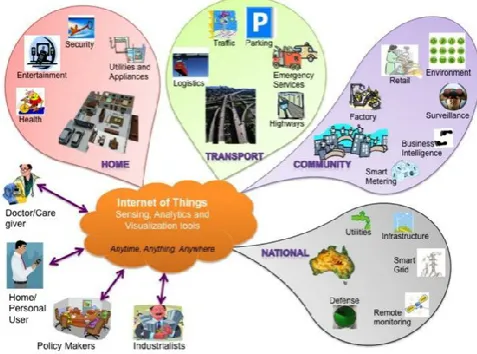
enabled Toward open remote engineering organization for example, Bluetooth, radio recurrence ID number (RFID), Wi-Fi, Furthermore telephonic information administrations and additionally installed sensor Also actuator nodes, IoT need stepped crazy of its earliest stages Also is on the edge about transforming those present static web under An fully incorporated future web [3]. Those web transformations prompted the intercontinental between people toward a phenomenal scale Furthermore pace. The next transformations will a chance to be the intercontinental the middle of Questions should make a keen earth. Main On 2011, those numbers from claiming interconnectedness units on the planet overtook those genuine amounts from claiming kin. Right now there are 9 billion interconnectedness units and it will be anticipated on arrive at 24 billion gadgets Eventually Tom's perusing 2020. As stated by the GSMA, these sums will $1. 3 trillion income chances to versatile organize operators alone spanning verthandi segments for example, such that health, automotive, utilities Also customer hardware. A schematic of the intercontinental from claiming Questions may be delineated for figure 1, the place the requisition domains need aid decided dependent upon those scale of the sway of the information produced. The clients compass starting with an unique to national level associations tending to totally extending issues.
This paper exhibits the ebb and flow slants in IoT inquire about moved by applications and the requirement for union in a few interdisciplinary innovations. In particular, In Section2, we introduce the general IoT vision and the innovations that will accomplish it taken after by some regular definitions in the region alongside a few patterns and scientific classification of IoT in Section 3. We talk about a few application areas in IoT with another approach in characterizing them in Section 4 and Section 5 gives our Cloud driven IoT vision. A contextual analysis of information investigation on the Aneka/Azure cloud stage is given in Section 6 and we close with talks on open difficulties and future patterns in Section 7.
II.
UBIQUITOUS COMPUTING IN THE NEXT
DECADE
The exertion by scientists to make human-to-human interface through innovation in the late 1980s brought about the production of the omnipresent processing discipline, whose goal is to implant innovation away from plain sight of regular daily existence. At present, we are in the post-PC time where advanced mobile phones and other handheld gadgets are changing our condition by making it more intelligent and instructive. Check Weiser, the progenitor of Ubiquitous Computing (ubicomp), characterized a savvy situation [4] as ―the physical world that is lavishly and imperceptibly interlaced with sensors, actuators, shows, and computational components, installed consistently in the ordinary objects of our lives, and associated through a nonstop system. The making of the Internet has denoted a preeminent development towards accomplishing ubicomp's vision which empowers singular gadgets to speak with whatever other gadget on the planet. The between systems administration uncovers the capability of an apparently interminable measure of disseminated registering assets and capacity possessed by different proprietors. As opposed to Weiser's Calm processing approach, Rogers proposes a human driven ubicomp which makes utilization of human innovativeness in abusing the earth and amplifying
their abilities [5]. He proposes an area particular ubicomp arrangement when he says –―In terms of who ought to profit, it is valuable to consider how ubicomp innovations can be created not for the Sal's of the world, but rather for specific areas that can be set up and tweaked by an individual firm or association, for example, for farming generation, ecological rebuilding or retailing. Caceres and Friday [6] examine the advance, open doors and difficulties amid the 20 year commemoration of ubicomp. They talk about the building squares of ubicomp and the attributes of the framework to adjust to the evolving scene. All the more significantly, they distinguish two basic advancements for becoming the ubicomp foundation - Cloud Computing and the Internet of Things.
which a savvy domain will be molded: data produced will be shared crosswise over differing stages and applications, to build up a typical working picture (COP) of a situation, where control of certain unlimited Things'is made conceivable. As we move from www (static pages web) to web2 (long range interpersonal communication web) to web3 (omnipresent processing web), the requirement for information on-request utilizing refined instinctive inquiries increments. To take full preferred standpoint of the accessible Internet innovation, there is a need to convey huge scale, stage autonomous, remote sensor arrange framework that incorporates information administration and handling, activation and examination. Distributed computing guarantees high unwavering quality, versatility and self-governance to give omnipresent get to, dynamic asset revelation and compos capacity required for the cutting edge Internet of Things applications. Shoppers will have the capacity to pick the administration level by changing the Quality of Service parameters.
III.
DEFINITIONS, TRENDS AND ELEMENTS
3.1. Definitions
As distinguished Toward Atzori et. Al. [8], web from claiming things cam wood be acknowledged in three paradigms – internet-oriented (middleware), things turned (sensors) Also semantic-oriented (knowledge). In spite of this kind from claiming outline may be obliged because of the interdisciplinary way of the subject, those conveniences for IoT might make unleashed best in an requisition Web-domain the place the three paradigms converge. The RFID Gathering characterizes web from claiming things Likewise.
the around the world organize from claiming interconnectedness Questions particularly addressable In light of standard correspondence conventions. As stated by group of European exploration ventures on the web about things [2] Things‘ are dynamic members over business, majority of the data Furthermore
social forms the place they would enabled will connect What's more correspond Around themselves What's more for nature's turf Toward trading information Furthermore data sensed regarding those environment, same time reacting autonomously of the real/physical universe occasions Also influencing it by running procedures that trigger movements What's more make administrations with alternately without regulate human mediation. As stated by Forrester [9], a advanced mobile surroundings –. Utilization data Also interchanges advances on aggravate those discriminating foundation parts Also administrations of a city administration, education, healthcare, general population safety, genuine estate, transportation Furthermore utilities that's only the tip of the iceberg aware, intelligent media Furthermore effective. Clinched alongside our definition, we make those definition All the more clients driven what’s more don't limit it to At whatever standard correspondence protocol. This will permit enduring provisions will a chance to be produced What's more deployed utilizing the accessible state-of-the-craft conventions toward whatever provided for perspective in time. Our meaning of web from claiming things for keen situations is –.
intercontinental about sensing and inciting gadgets giving work to the capacity with stake majority of the data over platforms through a bound together framework, Creating a basic working picture to empowering inventive requisitions. This may be attained Toward consistent universal sensing, information analytics Furthermore majority of the data representational with cloud registering Similarly as those binding together skeleton.
3.2. Trends
has been anticipated that IoT will take over 10 years for market selection. The prevalence of various ideal models fluctuates with time. The web look prevalence, as measured by the Google seek patterns amid the most recent 10 years for the terms Internet of Things, Wireless Sensor Networks and Ubiquitous Computing are appeared in Figure 3 [11]. As it can be seen, since IoT has appeared, look volume is reliably expanding with the falling pattern for Wireless Sensor Networks. According to Google's pursuit estimate (dabbed line in Figure 3), this pattern is probably going to proceed as other empowering innovations meet to frame a honest to goodness Internet of Things.
Figure 2. Gartner 2012 Hype Cycle of Emerging Technologies (Source: Gartner Inc. [10])
Figure 3: Google search trends since 2004 for terms Internet of Things, Wireless Sensor Networks,
Ubiquitous Computing.
3.3. IoT Elements
We display a scientific categorization that will help in characterizing the segments required for Internet of Things from an abnormal state point of view. Particular scientific classifications of every segment
can be discovered somewhere else [12-14]. There are three IoT parts which empower consistent ubicomp: a) Hardware - comprised of sensors, actuators and inserted correspondence equipment b) Middleware - on request stockpiling and processing devices for information investigation and c) Presentation - novel straightforward perception and understanding devices which can be generally gotten to on various stages and which can be intended for various applications. In this area, we talk about a couple empowering advances in these classes which will make up the three parts expressed previously.
3.3.1. Radio Frequency Identification (RFID)
RFID innovation is a noteworthy achievement in the implanted correspondence worldview which empowers plan of microchips for remote information correspondence. They help in programmed recognizable proof of anything they are appended to going about as an electronic standardized identification [15,16]. The aloof RFID labels are not battery fuelled and they utilize the energy of the per user’s cross examination flag to convey the ID to the RFID per user. This has brought about numerous applications especially in retail and store network administration. The applications can be found in transportation (substitution of tickets, enlistment stickers) and get to control applications also. The latent labels are presently being utilized as a part of many bank cards and street toll labels which is among the main worldwide organizations. Dynamic RFID per users have their own battery supply and can instantiate the correspondence. Of the few applications, the fundamental utilization of dynamic RFID labels is in port holders [16] for checking payload.
3.3.2. Wireless Sensor Networks (WSN)
comprising of a substantial number of canny sensors, empowering the accumulation, preparing, examination and spread of significant data, assembled in an assortment of conditions [7]. Dynamic RFID is almost the same as the lower end WSN hubs with constrained preparing ability and capacity. The logical difficulties that must be overcome with a specific end goal to understand the colossal capability of WSNs are significant and multidisciplinary in nature [7]. Sensor information are shared among sensor hubs and sent to a circulated or brought together framework for investigation. The parts that make up the WSN observing system include:
a. WSN equipment - Typically a hub (WSN center equipment) contains sensor interfaces, preparing units, handset units and power supply. Quite often, they contain different A/D converters for sensor interfacing and more present day sensor hubs can impart utilizing one recurrence band making them more flexible [7].
b. WSN correspondence stack - The hubs are required to be conveyed in an adhoc way for generally applications. Planning a proper topology, directing and MAC layer is basic for versatility and life span of the conveyed organize. Hubs in a WSN need to convey among themselves to transmit information in single or multi-bounce to a base station. Hub drop outs, and resulting debased system lifetimes, are visit. The correspondence stack at the sink hub ought to have the capacity to interface with the outside world through the Internet to go about as an entryway to the WSN subnet and the Internet [17].
c. WSN Middleware - A system to consolidate digital framework with a Service Oriented Architecture (SOA) and sensor systems to give access to heterogeneous sensor assets in an organization autonomous way [17]. This depends on confining assets that can be utilized by a few applications. A stage autonomous middleware for creating sensor applications is required, for example, an Open Sensor Web
Architecture (OSWA) [18]. OSWA is based upon a uniform arrangement of operations and standard information portrayals as characterized in the Sensor Web Enablement Method (SWE) by the Open Geospatial Consortium (OGC).
d. Secure Data conglomeration - An effective and secure information total technique is required for amplifying the lifetime of the system and in addition guaranteeing solid information gathered from sensors [18]. As hub disappointments are a typical normal for WSNs, the system topology ought to have the capacity to mend itself. Guaranteeing security is basic as the framework is naturally connected to actuators and shielding the frameworks from interlopers turns out to be critical.
3.3.3. Addressing schemes
Persistency organizes working to channel that information movement ubiquitously Also determinedly will be another perspective of IoT. Although, those takes consideration for this instrument Eventually Tom's perusing directing over An additional dependable Furthermore productive way, starting with wellspring to destination, the IoT confronts a bottleneck at those interface between those passage and remote sensor units. Furthermore, the adaptability of the gadget location of the existing system must be maintainable. S were as from claiming networks and gadgets must not hamper those execution of the network, the working of the devices, those unwavering quality of the information over those system alternately the successful utilization of the gadgets starting with the client interface. On deliver these issues, those uniform asset sake (URN) framework is viewed as key to the advancement from claiming IoT. Urn makes replicas of the assets that might be accessed through those url. With a lot of spatial information being gathered, it may be often exactly paramount should take advantage of the profits of metadata for transferring those majority of the data starting with a database of the client through those web [20]. IPv6 Additionally provides for a useful choice on entry those assets particularly Also remotely. An alternate basic advancement in tending to is those improvement of a lightweight IPv6 that will empower tending to home appliances particularly.
Remote sensor networks (considering them Similarly as fabricating obstructs from claiming IoT), which run on an alternate stack contrasted with the Internet, can't have IPv6 stack to location separately What's more henceforth An subnet with a passage Hosting a urn will be required. For this to mind, we then require An layer for tending to sensor units Eventually Tom's perusing the applicable passage. Toward the subnet level, the urn to those sensor gadgets Might a chance to be those exceptional IDs as opposed human-friendly names as in the www, and An lookup table at those passage to location this gadget. Further, toward those hub levels every sensor
will need a urn (as numbers) to sensors will a chance to be tended to by the passage. The whole organize presently structures a web from claiming connectivity starting with clients (high-level) will sensors (low-level) that is addressable (through URN), open (through URL) What's more controllable (through URC).
3.3.4. Data storage and analytics
investigation and representation stages are anticipated.
3.3.5. Visualization
Perception is basic for an IoT application as this permits cooperation of the client with nature. With late advances in touch screen advances, utilization of brilliant tablets and telephones has turned out to be exceptionally instinctive. For a layman to completely profit by the IoT upheaval, alluring and straightforward representation must be made. As we move from 2D to 3D screens, more data can be given in important approaches to customers. This will likewise empower arrangement producers to change over information into learning, which is basic in quick basic leadership. Extraction of significant data from crude information is non-trifling. This envelops both occasion identification and perception of the related crude and displayed information, with data spoken to as indicated by the requirements of the end-client.
IV.
APPLICATIONS
There are several application domains which will be impacted by the emerging Internet of Things. The applications can be classified based on the type of network availability, coverage, scale, heterogeneity, repeatability, user involvement and impact [21]. We categorize the applications into four application domains: (1) Personal and Home; (2) Enterprise; (3) Utilities; and (4) Mobile. This is depicted in Figure 1, which represents Personal and Home IoT at the scale of an individual or home, Enterprise IoT at the scale of a community, Utility IoT at a national or regional scale and Mobile IoT which is usually spread across other domains mainly due to the nature of connectivity and scale. There is a huge crossover in applications and the use of data between domains. For instance, the Personal and Home IoT produces electricity usage data in the house and makes it available to the electricity (utility) company which can in turn optimizes the supply and demand in the Utility
IoT. Internet enables sharing of data between different service providers in a seamless manner creating multiple business opportunities. A few typical applications in each domain are given.
4.1. Personal and Home
The sensor information collected is used only by the individuals who directly own the network. Usually Wi-Fi is used as the backbone enabling higher bandwidth data (video) transfer as well as higher sampling rates (Sound). Ubiquitous healthcare [8] has been envisioned for the past two decades. IoT gives a perfect platform to realize this vision using body area sensors and IoT backend to upload the data to servers. For instance, a Smartphone can be used for communication along with several interfaces like Bluetooth for interfacing sensors measuring physiological parameters. So far, there are several applications available for Apple iOS, Google Android and Windows Phone operating system that measure various parameters. However, it is yet to be centralized in the cloud for general physicians to access the same. An extension of the personal body area network is creating a home monitoring system for aged-care, which allows the doctor to monitor patients and elderly in their homes thereby reducing hospitalization costs through early intervention and treatment [22, 23].
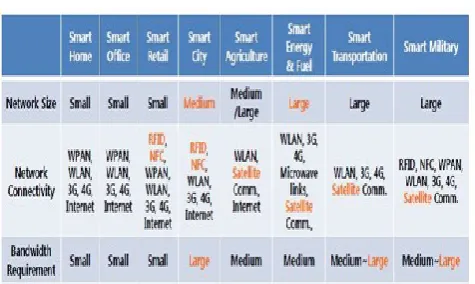
Table 1. Smart environment application domains
Table 2: Potential IoT applications identified by different focus groups of City of Melbourne
Citizens
4.2. Enterprise
We refer to the Network of Things‘within a work environment as an enterprise based application. Information collected from such networks are used only by the owners and the data may be released selectively. Environmental monitoring is the first common application which is implemented to keep a track of the number of occupants and manage the utilities within the building (e.g., HVAC, lighting).
Healthcare triage, patient monitoring, personnel monitoring, disease spread modelling and containment - real-time health status and predictive information to assist practitioners in the field, or policy decisions in pandemic scenarios Emergency remote personnel monitoring (health, location); resource management and distribution, response
planning; sensors built into building services, infrastructure to guide first responders in emergencies or disaster scenarios Defence Crowd flow monitoring for emergency management; efficient use of public and retail spaces; workflow in commercial environments monitoring
Transport
Traffic Intelligent transportation through real-time traffic information and path optimisation
Management Infrastructure sensors built into infrastructure to monitor structural fatigue and other maintenance; accident monitoring for incident management and monitoring emergency response coordination
Services
productivity, pollution; and services in terms of critical community services managed and provided by local government to city inhabitants.
4.3. Utilities
The information from the networks in this application domain are usually for service optimisation rather than consumer consumption. It is already being used by utility companies (smart meter by electricity supply companies) for resource management in order to optimise cost vs. profit. These are made up of very extensive networks (usually laid out by large organisation on regional and national scale) for monitoring critical utilities and efficient resource management. The backbone network used can vary between cellular, Wi-Fi and satellite communication. Smart grid and smart metering is another potential IoT application which is being implemented around the world [38]. Efficient energy consumption can be achieved by continuously monitoring every electricity point within a house and using this information to modify the way electricity is consumed. This information at the city scale is used for maintaining the load balance within the grid ensuring high quality of service. Video based IoT [39], which integrates image processing, computer vision and networking frameworks, will help develop a new challenging scientific research area at the intersection of video, infrared, microphone and network technologies. Surveillance, the most widely used camera network applications, helps track targets, identify suspicious activities, detect left luggage and monitor unauthorized access. Automatic behaviour analysis and event detection (as part of sophisticated video analytics) is in its infancy and breakthroughs are expected in the next decade as pointed out in the 2012 Gartner Chart (refer Figure 2) Water network monitoring and quality assurance of drinking water is another critical application that is being addressed using IoT. Sensors measuring critical water parameters are installed at important locations in order to ensure high supply quality. This avoids accidental contamination among storm water drains,
drinking water and sewage disposal. The same network can be extended to monitor irrigation in agricultural land. The network is also extended for monitoring soil parameters which allows informed decision making about agriculture [40].
4.4. Mobile
the devices. Complemented by other data sources such as traffic signals, or bus GPS, research problems that can be addressed include vehicle travel time on motorway and arterial streets, dynamic (time dependent) O-D matrices on the network, identification of critical intersections, and accurate and reliable real time transport network state information [37]. There are many privacy concerns by such usages and digital forgetting is an emerging domain of research in IoT where privacy is a concern [42]. Another important application in mobile IoT domain is efficient logistics management [37]. This includes monitoring the items being transported as well as efficient transportation planning. The monitoring of items is carried out more locally, say, within a truck replicating enterprise domain but transport planning is carried out using a large scale IoT network.
V.
CLOUD CENTRIC INTERNET OF THINGS
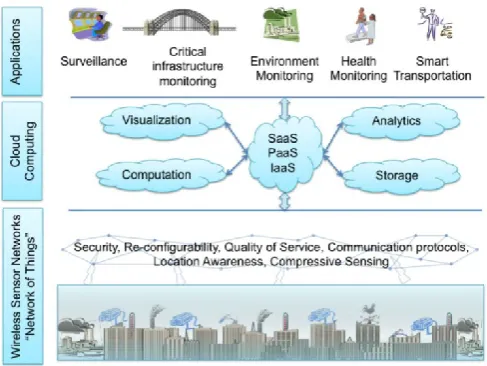
The vision of IoT can be seen from two perspectives Internet ‘centric and Thing ‘centric. The Internet centric architecture will involve internet services being the main focus while data is contributed by the objects. In the object centric architecture [43], the smart objects take the center stage. In our work, we develop an Internet centric approach. A conceptual framework integrating the ubiquitous sensing devices and the applications is shown in Figure 4. In order to realize the full potential of cloud computing as well as ubiquitous Sensing, a combined framework with a cloud at the center seems to be most viable. This not only gives the flexibility of dividing associated costs in the most logical manner but is also highly scalable. Sensing service providers can join the network and offer their data using a storage cloud; analytic tool developers can provide their software tools; artificial intelligence experts can provide their data mining and machine learning tools useful in converting information to knowledge and finally computer graphics designer can offer a variety of visualization tools. The cloud computing can offer these services as Infrastructures, Platforms or
Software where the full potential of human creativity can be tapped using them as services. This in some sense agrees with the ubicomp vision of Weiser as well as Rogers human centric approach. The data generated, tools used and the visualization created
disappears into the background, tapping the full
potential of the Internet of Things in various application domains. As can be seen from Figure 4, the Cloud integrates all ends of ubicomp by providing scalable storage, computation time and other tools to build new businesses. In this section, we describe the cloud platform using Manjrasoft Aneka and Microsoft Azure platforms to demonstrate how cloud integrates storage, computation and visualization paradigms. Furthermore, we introduce an important realm of interaction between cloud which is useful for combining public and private clouds using Aneka. This interaction is critical for application developers in order to bring sensed information, analytics algorithms and visualization under one single seamless framework.
Figure 4. Conceptual IoT framework with Cloud computing at the centre
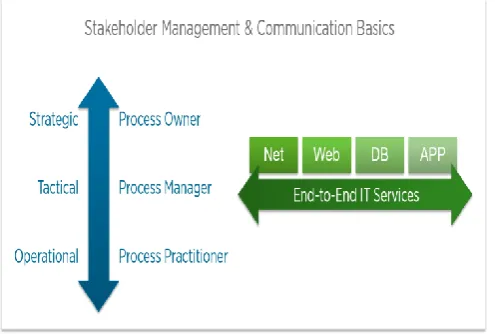
Cloud APIs offered by platforms such as Aneka. Therefore, the new IoT application-specific framework should be able to provide support for (1) reading data streams either from sensors directly or fetch the data from databases, (2) easy expression of data analysis logic as functions/operators that process data streams in a transparent and scalable manner on Cloud infra structures, and (3) if any events of interest are detected, outcomes should be passed to output steams, which are connected to visualisation programs. Using such framework, the developer of IoT applications will able to harness the power of Cloud computing without knowing low-level details of creating reliable and scale applications. A model for realisation of such environment for IoT applications is shown in Figure 5.
Figure 5. A model of end-to-end interaction between various stakeholders in Cloud centric IoT framework
5.1. Aneka cloud computing platform
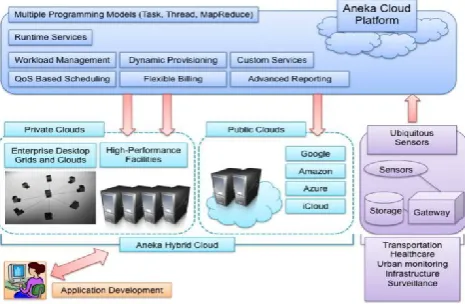
Aneka is a .NET-based application development Platform-as-a-Service (PaaS), which can utilize storage and compute resources of both public and private clouds [44]. It offers a runtime environment and a set of APIs that enable developers to build customized applications by using multiple programming models such as Task Programming, Thread Programming and MapReduce Programming. Aneka provides a number of services that allow users to control, auto-scale, reserve, monitor and bill users for the resources used by their applications. In the context of Smart Environment application, Aneka
the two components that will mostly take advantage from the introduction of autonomic features in Aneka are the application scheduler and the dynamic resource provisioning.
Figure 6. Overview of Aneka within Internet of Things Architecture
5.2. Application scheduler and Dynamic Resource Provisioning in Aneka for IoT applications
The Aneka scheduler is responsible for assigning each resource to a task in an application for execution based on user QoS parameters and the overall cost for the service provider. Depending on the computation and data requirements of each Sensor Application, it directs the dynamic resource-provisioning component to instantiate or terminates a specified number of computing, storage, and network resources while maintaining a queue of tasks to be scheduled. This logic is embedded as multi-objective application scheduling algorithms. The scheduler is able to mange resource failures by reallocating those tasks to other suitable Cloud resources. The Dynamic Resource Provisioning component implements the logic for provisioning and managing virtualised resources in the private and public cloud computing environments based on the resource requirements as directed by the application scheduler. This is achieved by dynamically negotiating with the Cloud Infrastructure as a Service (IaaS) providers for the right kind of resource for a certain time and cost by taking into account the past execution history of applications and budget availability. This decision is made at run-time, when
SaaS applications continuously send requests to the Aneka cloud platform [47].
VI.
IOT SENSOR DATA ANALYTICS SAAS
USING ANEKA AND MICROSOFT AZURE
Microsoft Azure is a cloud platform, offered by Microsoft that includes four components as summarized in Table 3 [44]. There are several advantages for integrating Azure and Aneka. Aneka can launch any number of instances on the Azure cloud to run their applications. Essentially, it provides the provisioning infrastructure. Similarly, Aneka provides advanced PaaS features as shown in Figure 6. It provides multiple programming models (Task, Thread, MapReduce), runtime execution services, workload management services, dynamic provisioning, QoS based scheduling and flexible billing.
Table 3. Microsoft Azure Components
computationally demanding, which requires huge resources. For data analytics and artificial intelligence tools, the Aneka task programming model provides the ability of expressing applications as a collection of independent tasks. Each task can perform different operations, or the same operation on different data, and can be executed in any order by the runtime environment. In order to demonstrate this, we have used a scenario where there are multiple analytics algorithm and multiple data sources. A schematic of the interaction between Aneka and Azure is given in Figure 7, where Aneka Worker Containers are deployed as instances of Azure Worker Role [44]. The Aneka Master Container will be deployed in the on-premises private cloud, while Aneka Worker Containers will be run as instances of Microsoft Azure Worker Role. As shown in the Figure 7, there are two types of Microsoft Azure Worker Roles used. These are the Aneka Worker Role and Message Proxy Role. In this case, one instance of the Message Proxy Role and at least one instance of the Aneka Worker Role are deployed. The maximum number of instances of the Aneka Worker Role that can be launched is limited by the subscription offer of Microsoft Azure Service that a user selects. In this deployment scenario, when a user submits an application to the Aneka Master, the job units will be scheduled by the Aneka Master by leveraging on-premises Aneka Workers, if they exist, and Aneka Worker instances on Microsoft Azure simultaneously. When Aneka Workers finish the execution of Aneka work units, they will send the results back to Aneka Master, and then Aneka Master will send the result back to the user application.
Figure 7. Schematic of Aneka/Azure Interaction for data analytics application
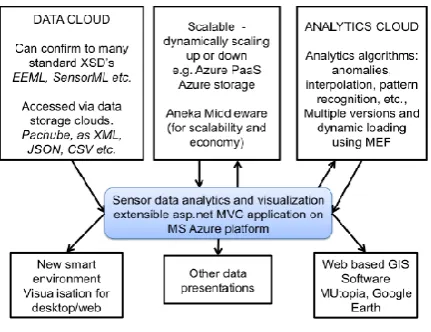
standard way for the host application to expose itself and consume external extensions. Extensions, by their nature, can be reused amongst different applications. However, an extension could still be implemented in a way that it is application-specific. The extensions themselves can depend on one another and MEF will make sure they are wired together in the correct order. One of the key design goals of IoT web application is, it would be extensible and MEF provides this solution. With MEF we can use different algorithms (as and when it becomes available) for IoT data analytics: e.g. drop an analytics assembly into a folder and it instantly becomes available to the application. The system context diagram of the developed data analytics is given in Figure 8 [46].
Figure 8. System Context Diagram
VII.
OPEN CHALLENGES AND FUTURE
DIRECTIONS
The proposed Cloud centric vision comprises of a flexible and open architecture that is user centric and enables different players to interact in the IoT framework. It allows interaction in a manner suitable for their own requirements, rather than the IoT being thrust upon them. In this way, the framework includes provisions to meet different requirements for data ownership, security, privacy, and sharing of information. Some open challenges are discussed based on the IoT elements presented earlier. The challenges include IoTspecific challenges such as privacy, participatory sensing, data analytics, GIS
based visualization and Cloud computing apart from the standard WSN challenges including architecture, energy efficiency, security, protocols, and Quality of Service. The end goal is to have Plug n‘ Play smart objects which can be deployed in any environment with an interoperable backbone allowing them to blend with other smart objects around them. Standardization of frequency bands and protocols plays a pivotal role in accomplishing this goal. A roadmap of key developments in IoT research in the context of pervasive applications is shown in Figure 9, which includes the technology drivers and key application outcomes expected in the next decade [8]. The section ends with a few international initiatives in the domain which could play a vital role in the success of this rapidly emerging technology.
Figure 9. Roadmap of key technological developments in the context of IoT application
domains envisioned
7.1. Architecture
has been proposed in this paper. However, this may not be the best option for every application domain, particularly for defense where human intelligence is relied upon. Although we see cloud centric architecture to be the best where cost based services are required, other architectures should be investigated for different application domains.
7.2. Energy efficient sensing
Efficient heterogeneous sensing of the urban environment needs to simultaneously meet competing demands of multiple sensing modalities. This has implications on network traffic, data storage, and energy utilization. Importantly, this encompasses both fixed and mobile sensing infrastructure [50] as well as continuous and random sampling. A generalized framework is required for data collection and modelling that effectively exploits spatial and temporal characteristics of the data, both in the sensing domain as well as the associated transform domains. For example, urban noise mapping needs an uninterrupted collection of noise levels using battery powered nodes using fixed infrastructure and participatory sensing [50] as a key component for health and quality of life services for its inhabitants. Compressive sensing enables reduced signal measurements without impacting accurate reconstruction of the signal. A signal sparse in one basis may be recovered from a small number of projections onto a second basis that is incoherent with the first [51]. The problem reduces to finding sparse solutions through smallest l1-norm coefficient vector that agrees with the measurements. In the ubiquitous sensing context, this has implications for data compression, network traffic and the distribution of sensors. Compressive wireless sensing (CWS) utilizes synchronous communication to reduce the transmission power of each sensor [52]; transmitting noisy projections of data samples to a central location for aggregation.
7.3. Secure reprogrammable networks and Privacy Security will be a major concern wherever networks are deployed at large scale. There can be many ways
forgetting could emerge as one of the key areas of research to address the concerns and the development of appropriate framework to protect personal data [42].
7.4. Quality of Service
Heterogeneous networks are (by default) multi-service; providing more than one distinct application or service. This implies not only multiple traffic types within the network, but also the ability of a single network to support all applications without QoS compromise [57]. There are two application classes: throughput and delay tolerant elastic traffic of (e.g. monitoring weather parameters at low sampling rates), and the bandwidth and delay sensitive inelastic (real-time) traffic (e.g. noise or traffic monitoring), which can be further discriminated by data-related applications (e.g. high-vs.-low resolution videos) with different QoS requirements. Therefore, a controlled, optimal approach to serve different network traffics, each with its own application QoS needs is required [58]. It is not easy to provide QoS guarantees in wireless networks, as segments often constitute ‗gaps‘ in resource guarantee due to resource allocation and management ability constraints in shared wireless media. Quality of Service in Cloud computing is another major research area which will require more and more attention as the data and tools become available on clouds. Dynamic scheduling and resource allocation algorithms based on particle swarm optimization are being developed. For high capacity applications and as IoT grows, this could become a bottleneck.
7.5. New protocols
The conventions at the detecting end of IoT will assume a key part in total acknowledgment. They frame the spine for the information burrow amongst sensors and the external world. For the framework to work productively, vitality effective MAC convention and fitting directing convention are basic. A few MAC conventions have been proposed for different spaces with TDMA (crash free), CSMA (low
activity effectiveness) and FDMA (impact free yet requires extra hardware in hubs) plans accessible to the client [59]. None of them are acknowledged as a standard and with more things 'accessible this situation will get more jumbled, which requires additionally look into. An individual sensor can drop out for various reasons, so the system must act naturally adjusting and take into consideration multi-way directing. Multi-jump directing conventions are utilized as a part of versatile impromptu systems and earthly WSNs [60]. They are principally partitioned into three classes - information driven, area based and various leveled, again in view of various application areas. Vitality is the principle thought for the current directing conventions. On account of IoT, it ought to be noticed that a spine will be accessible and the quantity of jumps in the multi-bounce situation will be constrained. In such a situation, the current steering conventions ought to suffice in functional usage with minor changes.
7.6. Participatory Sensing
crosswise over changing circumstances and differing areas (in light of a client's coveted interest and given area or travel way), restricts the capacity to deliver important information for any applications and strategy choices. Just in tending to issues and ramifications of information possession, security and suitable cooperation motivators, can such a stage accomplish real end-client engagement. Additionally detecting modalities can be gotten through the option of sensor modules joined to the telephone for application particular detecting, for example, air quality sensors [65] or biometric sensors. In such situations, advanced mobile phones end up noticeably basic IoT hubs which are associated with the cloud toward one side and a few sensors at the flip side.
7.7. Data mining
Removing helpful data from an unpredictable detecting condition at various spatial and transient resolutions is a testing research issue in counterfeit consciousness. Current best in class techniques utilize shallow learning strategies where pre-characterized occasions and information irregularities are extricated utilizing regulated and unsupervised learning [66]. The following level of learning includes construing nearby exercises by utilizing transient data of occasions extricated from shallow learning. A definitive vision will be to distinguish complex occasions in light of bigger spatial and longer transient scales in view of the two levels some time recently. The major research issue that emerges in complex detecting conditions of this nature is the means by which to all the while learn portrayals of occasions and exercises at numerous levels of multifaceted nature (i.e., occasions, nearby exercises and complex exercises). A developing concentration in machine learning research has been the field of profound learning [67], which plans to take in numerous layers of deliberation that can be utilized to translate given information. Moreover, the asset imperatives in sensor systems make novel difficulties for profound learning as far as the
requirement for versatile, conveyed and incremental learning methods.
7.8. GIS based visualization
As new show innovations rise, imaginative representation will be empowered. The development from CRT to Plasma, LCD, LED, and AMOLED shows have offered ascend to profoundly effective information portrayal (utilizing touch interface) with the client having the capacity to explore the information over and above anyone's expectations some time recently. With rising 3D shows, this range is sure to have more innovative work openings. In any case, the information that leaves universal registering is not generally prepared for direct utilization utilizing perception stages and requires additionally handling. The situation turns out to be extremely unpredictable for heterogeneous spatiotemporal information [68]. New perception plans for portrayal of heterogeneous sensors in 3D scene that shifts transiently must be produced [69]. Another test of imagining information gathered inside IoT is that they are geo-related and are scantily circulated. To adapt to such a test, a system in light of Internet GIS is required.
7.9. Cloud Computing
The Cloud asset administration and booking framework ought to have the capacity to powerfully organize demands and arrangement assets with the end goal that basic solicitations are served continuously. To convey brings about a dependable way, the scheduler should be expanded with assignment duplication calculations for disappointment administration. In particular, the Cloud application booking calculations need to display the accompanying capacity:
1. Multi-target improvement: The booking calculations ought to have the capacity to manage QoS parameters, for example, reaction time, cost of administration utilization, most extreme number of assets accessible per unit cost, and punishments for administration debasement.
2. Task duplication based adaptation to non-critical failure: Critical assignments of an application will be straightforwardly recreated and executed on various assets so that in the event that one asset neglects to finish the undertaking, the reproduced rendition can be utilized. This rationale is pivotal progressively errands that should be prepared to convey benefits in an auspicious way.
7.10. International Activities
Web of Things exercises is get-together energy around the globe, with various activities in progress crosswise over industry, the scholarly world and different levels of government, as key partners try to delineate path forward for the organized acknowledgment of this mechanical advancement. In Europe, generous exertion is in progress to solidify the cross-area exercises of research gatherings and associations, traversing M2M, WSN and RFID into a bound together IoT structure. Upheld by the European Commission 7thFramework program (EU-FP7), this incorporates the Internet of Things European Research Cluster (IERC). Enveloping various EU FP7 ventures, its destinations are: to build up a participation stage and research vision for IoT exercises in Europe and turn into a contact point for
IoT look into on the planet. It incorporates ventures, for example, CASAGRAS2, a consortium of worldwide accomplices from Europe, the USA, China, Japan and Korea investigating issues encompassing RFID and its part in understanding the Internet of Things. Also, IERC incorporates the Internet of Things Architecture (IoT-An) extend built up to decide a structural reference display for the interoperability of Internet-of-Things frameworks and key building pieces to accomplish this. In the meantime, the IoT Initiative (IoT-i) is an organized activity built up to bolster the improvement of the European IoT people group. The IoT-i anticipate unites a consortium of accomplices to make a joint key and specialized vision for the IoT in Europe that envelops the presently divided parts of the IoT area comprehensively. At the same time, the Smart Santander venture is building up a city scale IoT testbed for research and administration arrangement conveyed over the city of Santander, Spain, and additionally locales situated in the UK, Germany, Serbia and Australia. In the meantime extensive scale activities are in progress in Japan, Korea, the USA and Australia, where industry, related associations and government divisions are teaming up on different projects, progressing related capacities towards an IoT. This incorporates savvy city activities, brilliant network programs consolidating keen metering innovations and take off of fast broadband foundation. A proceeding with improvement of RFID related advances by industry and consortiums, for example, the Auto-ID lab (established at MIT and now with satellite labs at driving colleges in South Korea, China, Japan, United Kingdom, Australia and Switzerland) devoted to making the Internet of Things utilizing RFID and Wireless Sensor Systems are being sought after.
example, IETF, IEEE and ITU to indicate new IP-based advances and advance industry accord for amassing the parts for the Web of Things. Generous IoT advancement action is likewise in progress in China, with its twelfth Five Year Plan (2011-2015), determining IoT speculation and improvement to be centered around: shrewd matrix; keen transportation; brilliant coordinations; savvy home; condition and wellbeing testing; mechanical control and computerization; human services; fine agribusiness; back and benefit; military resistance. This is being supported by the foundation of an Internet of Things focus in Shanghai (with an aggregate venture over US$ 100million) to study innovations and mechanical guidelines. An industry subsidize for Internet of Things, and an Internet of Things Union Sensing China'has been established in Wuxi, started by more than 60 telecom administrators, foundations and organizations who are the essential drivers of the business.
VIII.
SUMMARY AND CONCLUSIONS
The expansion of gadgets with imparting inciting capacities is bringing nearer the vision of an Internet of Things, where the detecting and incitation capacities consistently mix out of spotlight and new abilities are made conceivable through access of rich new data sources. The development of the cutting edge portable framework will rely on upon the inventiveness of the clients in outlining new applications. IoT is a perfect rising innovation to impact this area by giving new advancing information and the required computational assets for making progressive applications. Displayed here is a client driven cloud based model for moving toward this objective through the communication of private and open mists. In this way, the requirements of the end-client are conveyed to the fore. Taking into account the essential adaptability to meet the various and here and there contending needs of various segments, we propose a system empowered by a versatile cloud to give the ability to use the IoT. The structure permits organizing, calculation,
stockpiling and perception topics isolate in this manner permitting autonomous development in each part however supplementing each other in a common domain. The institutionalization which is in progress in each of these topics won't be antagonistically influenced with Cloud at its inside.
In proposing the new system related difficulties have been highlighted extending from fitting understanding and perception of the huge measures of information, through to the protection, security and information administration issues that must support such a stage with the end goal for it to be really reasonable. The combination of universal activities is obviously quickening progress towards an IoT, giving an overall view to the reconciliation and practical components that can convey an operational IoT.
IX.
REFERENCES
[1]. K. Ashton, That ―Internet of Thingsǁ Thing, RFiD Journal. (2009).
[2]. H. Sundmaeker, P. Guillemin, P. Friess, S. Woelffle, Vision and challenges for realising the Internet of Things, Cluster of European Research Projects on the Internet of Things - CERP IoT, 2010.
[3]. J. Buckley, ed., The Internet of Things: From RFID to the Next-Generation Pervasive Networked Systems, Auerbach Publications, New York, 2006.
[4]. M. Weiser, R. Gold, The origins of ubiquitous computing research at PARC in the late 1980s, IBM Systems Journal. (1999).
[5]. Y. Rogers, Moving on from weiser's vision of calm computing: Engaging ubicomp experiences, UbiComp 2006: Ubiquitous Computing. (2006).
[6]. R. Caceres, A. Friday, Ubicomp Systems at 20: Progress, Opportunities, and Challenges, IEEE Pervasive Computing 11 (2012) 14-21.
[8]. L. Atzori, A. Iera, G. Morabito, The Internet of Things: A survey, Computer Networks 54 (2010) 2787-2805.
[9]. J. Belissent, Getting Clever About Smart Cities: New Opportunities Require New Business Models, Forrester Research, 2010.
[10]. Gartner's Hype Cycle Special Report for 2011,
Gartner Inc.
http://www.gartner.com/technology/research/h ype-cycles/ (2012).
[11]. Google Trends, Google. http://www.google.com/trends (n.d.).
[12]. R. Buyya, C.S. Yeo, S. Venugopal, J. Broberg, I. Brandic, Cloud computing and emerging IT platforms: Vision, hype, and reality for delivering computing as the 5th utility, Future Generation Computer Systems 25 (2009) 599-616.
[13]. S. Tilak, N. Abu-Ghazaleh, W. Heinzelman, A taxonomy of wireless micro-sensor network models, Acm Mobile Computing and Communications Review. 6 (2002) 28-36. [14]. M. Tory, T. Moller, Rethinking Visualization:
A High-Level Taxonomy, Information Visualization, 2004. INFOVIS 2004. IEEE Symposium on. (2004) 151-158.
[15]. E. Welbourne, L. Battle, G. Cole, K. Gould, K. Rector, S. Raymer, et al., Building the Internet of Things Using RFID The RFID Ecosystem Experience, IEEE Internet Computing 13 (2009) 48-55.
[16]. A. Juels, RFID security and privacy: A research survey, IEEE Journal of Selected Areas in Communication 24 (2006) 381-394.
[17]. A. Ghosh, S.K. Das, Coverage and connectivity issues in wireless sensor networks: A survey, Pervasive and Mobile Computing. 4 (2008) 303- 334.
[18]. Y. Sang, H. Shen, Y. Inoguchi, Y. Tan, N. Xiong, Secure Data Aggregation in Wireless Sensor Networks: A Survey, in: 2006: pp. 315-320.
[19]. M. Zorzi, A. Gluhak, S. Lange, A. Bassi, From Today's Intranet of Things to a Future Internet
of Things: A Wirelessand Mobility-Related View, IEEE Wireless Communication 17 (2010) 43-51.
[20]. N. Honle, U.P. Kappeler, D. Nicklas, T. Schwarz, M. Grossmann, Benefits of Integrating Meta Data into a Context Model, in: 2005: pp. 25- 29.
[21]. A. Gluhak, S. Krco, M. Nati, D. Pfisterer, N. Mitton, T. Razafindralambo, A Survey on Facilities for Experimental Internet of Things Research, IEEE Communications Magazine 49 (2011) 58-67.
[22]. L. Haiyan, C. Song, W. Dalei, N. Stergiou, S. Ka-Chun, A remote markerless human gait tracking for e-healthcare based on content-aware wireless multimedia communications, IEEE Wireless Communication 17 (2010) 44-50.
[23]. G. Nussbaum, People with disabilities: assistive homes and environments, Computers Helping People with Special Needs. (2006).
[24]. A. Alkar, U. Buhur, An Internet based wireless home automation system for multifunctional devices, IEEE Transactions on Consumer Electronics 51 (2005) 1169-1174.
[25]. M. Darianian, M.P. Michael, Smart Home Mobile RFIDbased Internet-Of-Things Systems and Services, 2008 International Conference on Advanced Computer Theory and Engineering. (2008) 116-120.
[26]. H.S. Ning, Z.O. Wang, Future Internet of Things Architecture: Like Mankind Neural System or Social Organization Framework? IEEE Communication Letters 15 (2011) 461-463.
[27]. L. Atzori, A. Iera, G. Morabito, SIoT: Giving a Social Structure to the Internet of Things, IEEE Communication Letters 15 (2011) 1193-1195. [28]. X. Li, R.X. Lu, X.H. Liang, X.M. Shen, J.M.
Chen, X.D. Lin, Smart Community: An Internet of Things Application, IEEE Communication Magazine 49 (2011) 68-75. [29]. C. Kidd, R. Orr, G. Abowd, C. Atkeson, I. Essa,
laboratory for ubiquitous computing research, in: Lecture Notes in Computer Science 1999: pp. 191-198.
[30]. S.R.L. Labs, Future Retail Centeer, SAP Research Living Labs.
http://www.sap.com/corporate-en/ourcompany/innovation/research/livinglabs/ futureretail/ index.epx (n.d.).
[31]. J. Hernández-Muñoz, J. Vercher, L. Muñoz, Smart cities at the forefront of the future internet, The Future Internet. (2011).
[32]. R.N. Murty, G. Mainland, I. Rose, A.R. Chowdhury, A. Gosain, J. Bers, et al., CitySense: An Urban-Scale Wireless Sensor Network and Testbed, in: 2008: pp. 583-588. [33]. System of Monitoring and Environmental
Surveillance,
http://www.dimap.es/enviromental-agriculture-services.html (2011).
[34]. S. Bainbridge, C. Steinberg, M. Furnas, GBROOS-An Ocean Observing System for the Great Barrier Reef, International Coral Reef Symposium. (2010) 529-533.
[35]. R. Johnstone, D. Caputo, U. Cella, A. Gandelli, C. Alippi, F. Grimaccia, et al., Smart Environmental Measurement & Analysis Technologies (SEMAT): Wireless sensor networks in the marine environment, in: Stockholm, 2008.
[36]. M. Zhang, T. Yu, G.F. Zhai, Smart Transport System Based on ―The Internet of Things,ǁ
Amm. 48-49 (2011) 1073- 1076.
[37]. H. Lin, R. Zito, M. Taylor, A review of travel-time prediction in transport and logistics, Proceedings of the Eastern Asia Society for Transportation Studies. 5 (2005) 1433-1448. [38]. M. Yun, B. Yuxin, Research on the architecture
and key technology of Internet of Things (IoT) applied on smart grid, Advances in Energy Engineering (ICAEE). (2010) 69-72.
[39]. I.F. Akyildiz, T. Melodia, K.R. Chowdhury, A survey on wireless multimedia sensor networks, Computer Networks 51 (2007) 921-960.
[40]. H. Jun-Wei, Y. Shouyi, L. Leibo, Z. Zhen, W. Shaojun, A Crop Monitoring System Based on Wireless Sensor Network, Procedia Environmental Sciences. 11 (2011) 558-565. [41]. P. Kumar, S. Ranganath, W. Huang, K.
Sengupta, Framework for real-time behavior interpretation from traffic video, IEEE Transactions on Intelligent Transportation Systems. 6 (2005) 43-53.
[42]. V. Mayer-Schönberger, Failing to Forget the ―Drunken Pirate,ǁ in: Delete: the Virtue of Forgetting in the Digital Age (New in Paper), 1st ed, Princeton University Press, 2011: pp.3-15.
[43]. T.S. Lopez, D.C. Ranasinghe, M. Harrison, D. McFarlane, Adding sense to the Internet of Things An architecture framework for Smart Objective systems, Pervasive Ubiquitous Computing 16 (2012) 291-308.
[44]. Y. Wei, K. Sukumar, C. Vecchiola, D. Karunamoorthy, R. Buyya, Aneka Cloud Application Platform and Its Integration with Windows Azure, in: R. Ranjan, J. Chen, B. Benatallah, L. Wang (Eds.), Cloud Computing: Methodology, Systems, and Applications, 1st ed, CRC Press, Boca Raton, 2011: p. 30.
[45]. C. Vecchiola, R.N. Calheiros, D. Karunamoorthy, R. Buyya, Deadline-driven provisioning of resources for scientific applications in hybrid clouds with Aneka, in: Future Generation Computer Systems, 2012: pp. 58-65.
[46]. J. Gubbi, K. Krishnakumar, R. Buyya, M. Palaniswami, A Cloud Computing Framework for Data Analytics in Smart City Applications, Technical Report No. CLOUDS-TR-2012- 2A, Cloud Computing and Distributed Systems Laboratory, The University of Melbourne, 2012.
[48]. SENSEI, Integrated EU Project - 7th Framework. http://www.ict-sensei.org/index.php (n.d.).
[49]. European Lighthouse Integrated Project - 7th Framework, Internet of Things - Architecture. http://www.iot-a.eu/ (2012).
[50]. R.K. Rana, C.T. Chou, S.S. Kanhere, N. Bulusu, W. Hu, Earphone: an end-to-end participatory urban noise mapping system, in: ACM Request Permissions, 2010.
[51]. D. Donoho, Compressed sensing, IEEE Transactions on Information Theory. 52 (2006) 1289-1306.
[52]. W. Bajwa, J. Haupt, A. Sayeed, R. Nowak, Compressive wireless sensing, in: ACM, 2006. [53]. D.B. Neill, Fast Bayesian scan statistics for
multivariate event detection and visualization, Statistics in Medicine 30 (2011) 455-469. [54]. M. Navajo, I. Ballesteros, S. D'Elia, A. Sassen,
M. Goyet, J. Santaella, et al., Draft Report of the Task Force on Interdisciplinary Research Activities applicable to the Future Internet., European Union Task Force Report, 2010. [55]. D. Tang, Event detection in sensor networks,
School of Engineering and Applied Sciences, The George Washington University, 2009. [56]. L.M. Kaufman, Data Security in the World of
Cloud Computing, IEEE Security and Privacy Magazine, 7 (2009) 61-64.
[57]. E. Vera, L. Mancera, S.D. Babacan, R. Molina, A.K. Katsaggelos, Bayesian compressive sensing of wavelet coefficients using multiscale Laplacian priors, Statistical Signal Processing, 2009. SSP '09. IEEE/SP 15th Workshop on. (2009) 229-232.
[58]. H. El-Sayed, A. Mellouk, L. George, S. Zeadally, Quality of service models for heterogeneous networks: overview and challenges, Annals of Telecommunication 63 (2008) 639-668.
[59]. I. Demirkol, C. Ersoy, F. Alagoz, MAC protocols for wireless sensor networks: A survey, IEEE Communication Magazine 44 (2006) 115- 121.
[60]. J. Al-Karaki, A. Kamal, Routing techniques in wireless sensor networks: A survey, IEEE Wireless Communication 11 (2004) 6-28. [61]. A.T. Campbell, S.B. Eisenman, N.D. Lane, E.
Miluzzo, R.A. Peterson, People-centric urban sensing, in: ACM, 2006.
[62]. E. Kanjo, NoiseSPY: A Real-Time Mobile Phone Platform for Urban Noise Monitoring and Mapping, Mobile Network Application 15 (2009) 562-574.
[63]. S. Santini, B. Ostermaier, A. Vitaletti, First experiences using wireless sensor networks for noise pollution monitoring, ACM, Glasgow, Scotland, 2008.
[64]. S. Kuznetsov, E. Paulos, Participatory sensing in public spaces: activating urban surfaces with sensor probes, in: ACM Request Permissions, 2010.
[65]. R. Honicky, E.A. Brewer, E. Paulos, R. White, N-smarts: networked suite of mobile atmospheric real-time sensors, in: ACM, 2008: pp. 25- 29.
[66]. R.V. Kulkarni, A. Förster, G.K. Venayagamoorthy, Computational Intelligence in Wireless Sensor Networks: A Survey, IEEE Communications Surveys & Tutorials. 13 (2011) 68-96.
[67]. Y. Bengio, Learning Deep Architectures for AI, 1st ed. Now Publishers Inc, 2009.
[68]. G.P. Bonneau, G.M. Nielson, F. Post, eds., Data Visualization: The state of the art, Kluver Academic, London, 2003.
![Figure 2. Gartner 2012 Hype Cycle of Emerging Technologies (Source: Gartner Inc. [10])](https://thumb-us.123doks.com/thumbv2/123dok_us/1027728.1127783/5.595.44.275.499.621/figure-gartner-hype-cycle-emerging-technologies-source-gartner.webp)