Improving Reference Selection
Within Bid Processes
A Master Thesis Within The Sales
Department Of Capgemini Outsourcing
Improving Reference Selection
Within Bid Processes
A Master Thesis Within The Sales
Department Of Capgemini Outsourcing
V. den Ouden s0020079
Capgemini Outsourcing Netherlands
Master Industrial Engineering & Management Track Information Technology & Management School of Management and Governance University of Twente
September 2008
Supervisory Committee
Management summary
During the last global knowledge management meeting of Capgemini Outsourcing, several spearheads are determined to make the bid process more efficient and more effective. Reference selection is one of these spearheads. A reference is a description of services delivered to an existing customer. When a potential customer wants to outsource (parts of) his information technology, he asks for references that show that Capgemini owns the desired capabilities. Reference selection is the process of finding suitable references that satisfy the customer requirements.
In the past reference selection was done ad hoc: there is no procedure how to select appropriate references and no clear overview of the available references, so the selection depended entirely on the knowledge of the sales employees involved. Reference selection cost a lot of time and effort and often did not result in an optimal choice of references: often the references did not fully satisfy the customer demands.
During this graduation assignment a reference selection system based on case-based reasoning is designed and developed, that assists sales employees in selecting suitable references within bid processes. This Reference Tracking System improves both the efficiency and the effectiveness of the reference selection process.
The major conclusions of this graduation assignment are:
The Reference Tracking System provides a single point of entry to references at diverse locations, which saves time and effort during the reference selection.
The Reference Tracking System facilitates sales employees in selecting references, which leads to a better substantiated reference selection and reduces time and effort.
This graduation research shows that case-based reasoning can improve knowledge selection processes.
The results of this research study lead to some practical recommendations for Capgemini and some suggestions for further research.
For Capgemini to fully grasp the benefits of the Reference Tracking System, this graduation assignment results in the following recommendations:
Ensure that both the users and senior management support the Reference Tracking System. Users from all regions and disciplines of Capgemini should support the reference selection system to make it a success.
Input from all regions and disciplines of Capgemini is needed to fill the reference library with all references available at Capgemini.
Sufficient human as well as financial resources are necessary to further improve the Reference Tracking System and fill the reference library with all references available in the diverse regions and disciplines of Capgemini.
Future research should focus on:
The impact of intelligent systems founded on case-based reasoning on the efficiency and effectiveness of knowledge selection in situations where the alternatives cannot be clearly defined and described.
The impact of intelligent systems founded on case-based reasoning on the efficiency and effectiveness of knowledge selection in situations where the selection criteria are not unambiguous.
The impact of other methodologies on the efficiency and effectiveness of knowledge selection.
Management samenvatting
Tijdens de laatste wereldwijde kennismanagement vergadering van Capgemini Outsourcing zijn er diverse speerpunten bepaald om aanbiedingsprocedures efficiënter en effectiever te maken. Één van deze speerpunten is referentieselectie. Een referentie is een beschrijving van diensten die geleverd worden aan een bestaande klant. Als een potentiële klant (delen van) zijn informatie technologie wil uitbesteden, dan vraagt deze om referenties die laten zijn dat Capgemini over de gewenste capaciteiten beschikt. Referentieselectie is het proces om geschikte referenties te vinden die voldoen aan de gestelde eisen.
In het verleden was er geen vaststaande procedure voor referentieselectie. Bovendien was er geen overzicht van de aanwezige referenties. Het resultaat van de selectie hing volledig af van de kennis van de betrokken salesmedewerkers. Referentieselectie kostte veel tijd en moeite en vaak resulteerde het niet in een optimale keuze van referenties: de referenties voldeden vaak niet volledig aan de eisen van de klant.
Tijdens deze afstudeerstage is er een referentieselectiesysteem ontworpen en ontwikkeld, dat gebaseerd is op case-based reasoning en salesmedewerkers assisteert bij het selecteren van geschikte referenties binnen aanbiedingstrajecten. Dit Reference Tracking System verbetert zowel de efficiëntie als de effectiviteit van het referentieselectieproces.
De belangrijkste conclusies van deze afstudeeropdracht zijn:
Het Reference Tracking System biedt één ingang voor de salesmedewerker om eenvoudig referenties te bereiken die op diverse locaties staan. Dit bespaart tijd en moeite bij de referentieselectie.
Het Reference Tracking System assisteert salesmedewerkers bij het selecteren van geschikte referenties. Dit leidt tot een beter beargumenteerde referentieselectie en ook dit bespaart tijd en moeite .
Dit afstudeeronderzoek toont aan dat case-based reasoning geschikt is om kennisselectie processen te verbeteren.
De resultaten van deze onderzoeksopdracht leiden tot enkele praktische aanbevelingen voor Capgemini en enige suggesties voor verder onderzoek.
Capgemini dient de volgende aanbevelingen in acht te nemen voor het volledig benutten van het Reference Tracking System:
Zorg voor draagvlak voor het Reference Tracking System bij zowel de gebruikers als het hogere management. Gebruikers vanuit alle regio’s en disciplines van Capgemini moeten het systeem steunen om van het systeem een succes te maken.
Een belangrijke verbetering aan het Reference Tracking System zou de toevoeging van een trefwoordengids zijn, die gebruikers assisteert bij het kiezen van trefwoorden.
Verder onderzoek moet zich richten op:
De gevolgen van intelligente systemen gebaseerd op case-based reasoning op de efficiëntie en de effectiviteit van kennisselectie in situaties waar de alternatieven niet duidelijk gedefinieerd en beschreven kunnen worden.
De gevolgen van intelligente systemen gebaseerd op case-based reasoning op de efficiëntie en de effectiviteit van kennisselectie in situaties waar de selectiecriteria niet eenduidig zijn.
De gevolgen van andere methodologieën op de efficiëntie en de effectiviteit van kennisselectie.
Table of contents
1. Problem statement & research question ... 12
1.1 Scientific importance ... 13
4. Design of the Reference Tracking System ... 27
4.1 Bid processes ... 27
4.2 Case-based reasoning in reference selection ... 30
4.3 Basic idea of the system ... 31
4.4 Requirements ... 32
5. Development of the Reference Tracking System ... 49
5.1 The reference library ... 49
5.2 The matching mechanism ... 50
5.3 Reference library content management ... 53
5.4 User management ... 55
6. Implementation of the Reference Tracking System ... 56
6.1 The reference library ... 56
6.2 Level 0 application: basic functionality ... 57
6.2.1 The Search field ... 58
6.2.3 Basic functionality illustrated: Cobol and AS400 ... 61
6.3 Level 1 application: advanced functionality ... 63
6.3.1 Adding new references ... 64
6.3.2 Deleting and modifying references ... 65
7. Impact evaluation ... 67
7.1 Hypotheses & theoretical model ... 67
7.2 Action planning ... 68
7.3 Action taking ... 68
7.3.1. Pre-implementation measurement ... 68
7.3.2. Post-implementation measurement ... 70
7.4. Impact of the system ... 71
7.5. Refinements of Reference Tracking System ... 73
Conclusions ... 75
Practice ... 75
Science ... 76
Limitations ... 77
Recommendations ... 78
Practice ... 78
Organizational ... 78
Technical ... 79
Further research ... 80
References ... 81
Websites ... 85
Appendix A – Descriptors used in Reference Tracking System... 86
Appendix B – Entity-Relationship Diagram ... 88
Table of illustrations
Figures
Figure 1: Knowledge activities framework (Holsapple & Joshi, 2002b; adapted) ... 14
Figure 2: Model of Knowledge Transfer (Szulanski, 1996) ... 16
Figure 3: Organizational Knowledge Management Model (Arthur Anderson & APQC, 1996) ... 17
Figure 4: KPMG Knowledge Management Process (Alavi, 1997) ... 17
Figure 5: Knowledge Reuse Process (Markus, 2001) ... 17
Figure 6: Knowledge Evolution Cycle (Zollo & Winter, 2002) ... 18
Figure 7: Knowledge Management Activities Framework (Holsapple & Joshi, 2002b) ... 18
Figure 8: Case-based reasoning activities (Watson, 1999; adapted) ... 21
Figure 9: Design science stages (Vaishnavi & Kuechler, 2005; adapted) ... 23
Figure 10: Action research stages (Baskerville, 1999) ... 24
Figure 11: Graduation research stages ... 25
Figure 12: Bid trajectory phases ... 28
Figure 13: Request response process ... 29
Figure 14: Case-based reasoning in reference selection ... 30
Figure 15: Problems with keyword ... 34
Figure 16: ARIS methodology (Heib et al, 1996; Scheer, 1994) ... 36
Figure 17: Hierarchy diagram of the functions within the Reference Tracking System ... 37
Figure 18: Entity-Relationship Diagram of the content of the reference library ... 39
Figure 19: Organizational chart of Capgemini Outsourcing Netherlands ... 41
Figure 20: Organizational chart of the Sales department ... 42
Figure 21: Event-driven process chain diagram of the reference selection process ... 44
Figure 22: Event-driven process chain diagram of add reference process ... 45
Figure 23: Event-driven process chain diagram of modify reference process ... 46
Figure 24: Event-driven process chain diagram of delete reference process ... 48
Figure 25: Keyword ontology ... 53
Figure 26: Keyword taxonomy ... 54
Figure 27: Start screen of the Reference Tracking System ... 58
Figure 28: Problem field of the Search tab of the Reference Tracking System ... 58
Figure 29: Result tab of the Reference Tracking System ... 60
Figure 30: Search example for Cobol and AS400 references: ... 61
Figure 31: Overview of ABN AMRO Verzekeringen including Cobol and AS400 ... 62
Figure 32: The Result tab of the Reference Tracking System with advanced user rights ... 63
Figure 33: Mandatory fields when adding a reference ... 64
Figure 34: Modifying a reference in the Reference Tracking System ... 65
Figure 35: References protected against illegitimate deletion ... 66
Figure 36: Impact model to test the impact of the artifact created using design science ... 67
Tables
Table 1: Knowledge management activities in diverse knowledge management frameworks15
Table 2: Knowledge selection as part of diverse knowledge management frameworks ... 19
Table 3: Relationships used in the Entity-Relationship Diagram ... 39
Table 4: Data dictionary regarding the Entity-Relationship Diagram ... 40
Table 5: Disciplines involved in the references in the reference library ... 56
Table 6: Origin and annual contract value of the references in the reference library ... 57
Table 7: Weights of search criteria within Reference Tracking System ... 59
Table 8: Satisfaction of requirements ... 72
Glossary
Best and final offer (BAFO): a request sent out by a potential customer in which he demands final information about the required services. A BAFO is only part of large and complex tender trajectories and is the continuation of a RFP.
Bid process or bid trajectory: the tender process in which a vendor responses to a customer’s request for information about certain services that the customer wants to subcontract. Confidentiality level: to what extent a reference could be published and used. For a list of the
different confidentiality levels and an explanation, see Appendix A.
Discipline: a key area of focus of Capgemini. For a list of the different disciplines, see Appendix A.
Hit rate: the match between the details of a reference and the search criteria inserted by the user expressed in percents.
Offer: a service line of Capgemini Outsourcing. For a list of the different offers, see Appendix A.
Reference: the description of certain services delivered to a referent. Reference document: a document that contains a reference.
Reference library: the database consisting of all
Reference Tracking System (RTS): the intelligent system designed and developed during this graduation assignment. This system facilitates sales employees of Capgemini in selecting suitable references for bid processes.
Referent: a customer to which Capgemini delivers services. Request: a RFI, RFP or BAFO.
Request for information (RFI): a request sent out by a potential customer in which he demands some basic information regarding the required services. A RFI is usually the first step in a bid trajectory.
Request for proposal (RFP): a request sent out by a potential customer in which he demands further information about the required services. A RFP is usually the second and last step in a bid trajectory.
Response: an answer to a RFI, RFP or BAFO.
Selection criterion: a search criterion inserted by the user that a suitable reference should satisfy.
Preface
This Master thesis is the closure of my Master’s Degree studies in Industrial Engineering & Management – track Information Technology & Management – at the University of Twente. It is the product of a Master’s research on the design and development of an intelligent system that assists employees of the Sales department of Capgemini Outsourcing Netherlands in the selection of suitable references for bid processes.
First, I would like to thanks Capgemini Outsourcing Netherlands for giving me the opportunity to do my Master’s assignment at their office in Utrecht. Capgemini Outsourcing provided me with an interesting graduation topic and gave me insight in the ins and outs of European tenders and other bid processes and the services Capgemini Outsourcing delivers to its customers.
In particular, I would like to thank Peter Koning – the knowledge manager of the Sales department of Capgemini Outsourcing Netherlands – who was my supervisor at Capgemini Outsourcing. Peter gave me insight in knowledge management at Capgemini and taught me how to operate the different knowledge management systems used within Capgemini. Furthermore, Peter has programmed the Reference Tracking System that I designed.
My gratitude is also going to my colleagues at the Sales department of Capgemini Outsourcing – especially the bid support employees – who have given me a useful and pleasant six months in their company. Without their input this graduation would not have been a success.
Next, I would like to thank my supervisors at the University of Twente for their feedback, input and support during my graduation. They provided me with the necessary theories, modeling techniques and scientific articles that have shaped my ideas and actions and finally resulted in this graduation report.
At last, I would like to thank my family and friends for all their support, advice and joy during the more than seven years that my study took. Even after some crazy times, they were there for me. I consider myself lucky with family and friends like them, so: thank you very much and I hope that we will keep a whale of a time in the future!
1. Problem statement & research question
The task of the Sales department of Capgemini Outsourcing Netherlands is responding to requests for information, requests for proposal and best and final offers from all kinds of organizations – both governmental, public and private organizations – that want to outsource (parts of) their information technology.
During the last few years, the Sales department tried to make the bid process more efficient. By improving the bid process they try to save time, hereby reducing costs and achieving deadlines easier. Furthermore, the quality of the replies to the requests for information, requests for proposal and best and final offers should improve, which should result in a higher win rate of more profitable contracts, ultimately improving the margin of Capgemini Outsourcing.
One of the issues that Capgemini Outsourcing is facing is the selection of suitable references. A reference is a piece of information describing a project currently or previously performed at a certain organization. It describes the problems encountered, the activities performed and the technologies used. A suitable reference has to match the requirements as laid down in the request to get a high score from the subcontracting organization.
At the start of this graduation project, the selection of references is done ad hoc. There is no procedure how to select appropriate references. Although there are descriptions available of a lot of outsourcing contracts in the Netherlands and of some major ones originating from other countries, there is no overview of all projects that are going on. Due to this lack of overview, the reference selection depends mainly on the knowledge of the sales employees about previous and current projects, which results in the frequent use of a limited number of references. Other little-known projects are not taken into account, although they may completely satisfy the requirements, while the selected references do not. This subjective reference selection does not only result in a non optimal selection of references, but it also costs a lot of time and effort, especially when references that satisfy the requirements are hard to find.
Reference selection is currently an important topic at Capgemini Outsourcing Netherlands and worldwide. At the last global knowledge management meeting several spearheads are determined. Reference selection was one of them. Reference selection can be seen as knowledge selection. Case-based reasoning is a methodology for problem-solving (Watson, 1999) that probably is useful in knowledge selection. The problem statement above leads to my research question:
The solution of this research question can improve the proposal process at the Sales department of Capgemini Outsourcing, reducing time and effort needed for reference selection and improving the match between reference requirements and reference characteristics. Therefore, the research has practical importance.
Next to this practical importance, the research has also scientific importance.
1.1 Scientific importance
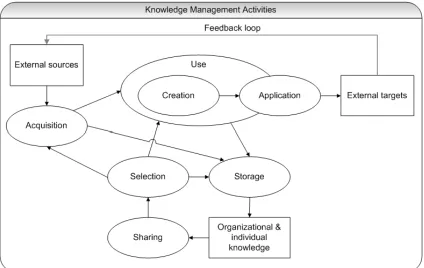
Knowledge management is a common topic in scientific research in diverse disciplines like sociology, management science and economics (Davenport et al, 1998). Several research directions, like organizational learning, management of technology and managerial cognition, focus on knowledge (Grant, 1996a). In knowledge management literature six knowledge management activities can be distinguished:
Knowledge acquisition: the gathering of potentially suitable knowledge from external knowledge sources (Holsapple & Joshi, 2000);
Knowledge sharing: making internal knowledge available for further reuse and application (Inkpen & Dinur, 1998);
Knowledge selection: the assessment of internal knowledge to see if it is appropriate for further reuse and application (Zollo & Winter, 2002);
Knowledge creation: the combination of different types of knowledge into new knowledge (Holsapple & Joshi, 2002a);
Knowledge application: the integration of knowledge in the output of the organization, such new and improved products and services (Grant, 1996a);
Knowledge storage: changing the organization’s knowledge resources by the retention of new, useful knowledge (Bloodgood & Salisbury, 2001).
These knowledge activities are graphically represented in Figure 1. All these knowledge activities are important for the efficiency of an organization’s knowledge management. In contrast to what is commonly believed by practitioners, the major challenge of managing knowledge is not the creation of knowledge, but more its selection (Alavi & Leidner, 1999; Grant, 1996b). This emphasizes the importance of knowledge selection.
Figure 1: Knowledge activities framework (Holsapple & Joshi, 2002b; adapted)
But to the best of our knowledge, there has been no research to methodologies improving knowledge selection. This gap in knowledge management research is addressed in my graduation assignment. Moreover, as Orlikowski and Iacono (2001) concluded from their review of the full sets of articles published in ten years of Information System Research journals, there is a lack of research that focuses on the information technology artifact. This graduation also addresses that gap.
2. Background
In this chapter knowledge selection and case-based reasoning are introduced.
2.1 Knowledge selection
Some scholars have investigated the type of knowledge most useful for tasks with certain characteristics (for example Choudhury & Sampler, 1997; Pisano, 1994). Other scholars have researched ways to skip knowledge selection by transform raw data directly into useful knowledge by means of data warehousing, data mining and statistical analysis (for example Datta & Thomas, 1999; Shaw et al, 2001). But to the best of our knowledge, little is written about knowledge selection technologies and methodologies.
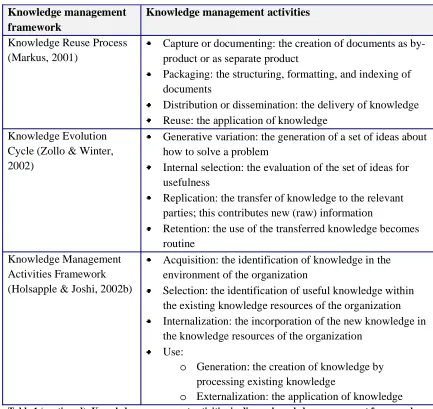
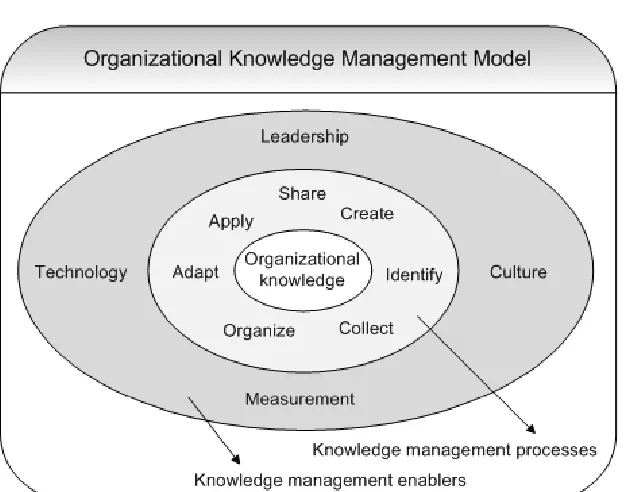
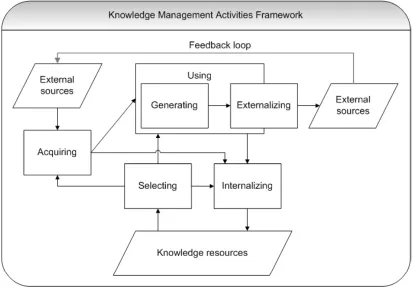
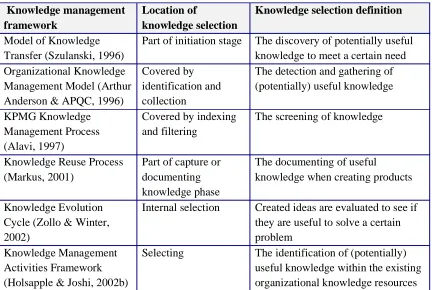
Knowledge selection is part of diverse knowledge management frameworks, although often it is not directly clear that knowledge selection is part of these frameworks due to the use of different names (Holsapple & Joshi, 1999). In Table 1 the knowledge management activities of several knowledge management frameworks are identified and explained. These frameworks are shown in Figure 2 to Figure 7.
Knowledge management framework
Knowledge management activities
Model of Knowledge Transfer (Szulanski, 1996)
Initiation: the discovery of a need and potential solutions Implementation: the knowledge transfer between the source and the recipient
Ramp-up: the use the transferred knowledge
Integration: the use of the transferred knowledge becomes routine
Collection: the gathering of (potentially) useful knowledge Adaptation: the modification of existing knowledge to meet a certain need
Acquisition: the creation and development of knowledge Library management activities (indexing, filtering, linking): the screening, classification, cataloging, integrating and interconnecting of knowledge
Distribution: the packaging and delivery of knowledge Application: the use of knowledge
Knowledge management framework
Knowledge management activities
Knowledge Reuse Process (Markus, 2001)
Capture or documenting: the creation of documents as by-product or as separate by-product
Packaging: the structuring, formatting, and indexing of documents
Distribution or dissemination: the delivery of knowledge Reuse: the application of knowledge
Knowledge Evolution Cycle (Zollo & Winter, 2002)
Generative variation: the generation of a set of ideas about how to solve a problem
Internal selection: the evaluation of the set of ideas for usefulness
Replication: the transfer of knowledge to the relevant parties; this contributes new (raw) information
Retention: the use of the transferred knowledge becomes routine
Knowledge Management Activities Framework (Holsapple & Joshi, 2002b)
Acquisition: the identification of knowledge in the environment of the organization
Selection: the identification of useful knowledge within the existing knowledge resources of the organization Internalization: the incorporation of the new knowledge in the knowledge resources of the organization
Use:
o Generation: the creation of knowledge by processing existing knowledge
o Externalization: the application of knowledge
Table 1 (continued): Knowledge management activities in diverse knowledge management frameworks
Figure 3: Organizational Knowledge Management Model (Arthur Anderson & APQC, 1996)
Figure 4: KPMG Knowledge Management Process (Alavi, 1997)
Figure 6: Knowledge Evolution Cycle (Zollo & Winter, 2002)
Figure 7: Knowledge Management Activities Framework (Holsapple & Joshi, 2002b)
Knowledge management
Part of initiation stage The discovery of potentially useful knowledge to meet a certain need
Internal selection Created ideas are evaluated to see if they are useful to solve a certain problem
Table 2: Knowledge selection as part of diverse knowledge management frameworks
And in the Knowledge Reuse Process of Markus (2001) capturing and documenting is synonym for knowledge selection. Only in the Knowledge Evolution Cycle (Zollo & Winter, 2002) and the Knowledge Management Activities Framework (Holsapple & Joshi, 2002b) it is directly clear that knowledge selection is part of the model: respectively called internal selection and selecting. In Table 2 it is summarized where knowledge selection is placed within the discussed knowledge management frameworks.
Furthermore, in Table 2 the definition of knowledge selection as used in the diverse frameworks is given. These definitions can be combined into the following definition of knowledge selection: knowledge selection is the activity of identifying the requested knowledge within the organization’s internal knowledge resources (Holsapple & Joshi, 2002b).
knowledge into an appropriate representation (Alavi, 1997; Holsapple & Joshi, 2002a; 2002b; Markus, 2001).
These different sub-activities encounter numerous issues. Some organizations rely heavily on the tacit knowledge owned by their organizational members. But this knowledge can only be accessed, if the organization owns one or more directories that identify the existence, location, and means of the knowledge held by the individuals (Anand et al, 1998). These directories are known as ‘knowledge yellow pages’ (Grover & Davenport, 2001). The same applies for organizations that rely on explicit knowledge stored in repositories. Without a good and effective search engine, users are discouraged from searching and reusing knowledge, especially in large collections of knowledge (Alavi & Leidner, 2001). Classification and cataloguing of the content of the internal knowledge resources that reside in the organization’s repositories can facilitate the screening of these resources (Alavi, 1997). When knowledge is scattered over various knowledge resources it is hard to identify and retrieve suitable knowledge. This can be facilitated using diverse tools and techniques like knowledge yellow pages and search engines. One major issue concerning knowledge selection is what tool or technique should be used to make the selection activity effective and efficient for each of the main types of knowledge resources, like individuals and repositories (Holsapple & Joshi, 2002b). Case-based reasoning is used to solve problems in diverse disciplines, like the legal domain (a judge coming to a verdict by referring to other similar trials) (Kolodner, 1992), health care (a doctor coming to a possible diagnosis seeing a familiar combination of symptoms) (Kolodner & Kolodner, 1987) and customer service (a service desk employee solving a customer’s call by using a problem resolution system) (Acorn & Walden, 1992). Moreover, case-based reasoning is also used extensively in day-to-day common sense, for example when making a choice in a restaurant taking into account previous experiences with the offered dishes (Kolodner, 1992).
reasoning the solutions to old problems can be used straightforward by solving a new problem, while with interpretive case-based reasoning not the solution, but the reasoning can be used in the new situation (Kolodner, 1992).
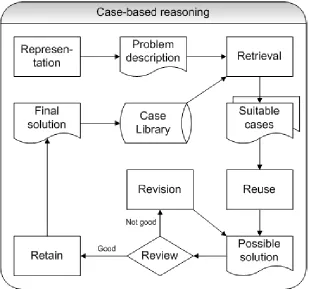
Within case-based reasoning six activities can be distinguished. These activities are shown in Figure 8. In this figure four types of building blocks can be distinguished: a rectangle, a rectangle with an undulating bottom, a diamond and a cylinder. A rectangle represents a case-based reasoning activity. A rectangle with an undulating bottom represents a document. Two overlapping rectangles with undulating bottoms represent several documents. A diamond represents a decision moment. The cylinder represents a repository, where documents are stored.
The six case-based reasoning activities are (Aha, 1998; Allen, 1994; Kolodner, 1992; Watson, 1999):
Representation: the creation of a problem description. This is the input of the person or the intelligent system performing case-based reasoning.
Retrieval: the reasoner retrieves similar old cases to the new problem description from the case library. This case library could be the memory of the reasoner or a knowledge repository.
Reuse: the application of one or more of the retrieved old cases, perhaps by combining them with each other or with other knowledge sources.
Review: the evaluation of the outcome when applying the revised old solution to the new problem. The case needs further revisions if the outcome is not acceptable.
Revision: the modification of a potential solution if necessary to better fit the new problem.
Retention: when the new solution gets a positive review, it can be stored in the case library (the knowledge repository or someone’s memory). A reasoner can become more efficient by remembering more old cases.
Case-based reasoning has some common problems. First, there is the indexing problem. The indexing problem is the problem of retrieving applicable old cases with appropriate response, despite the different features and situations of the old cases. The second common problem is the ballpark problem. The ballpark problem is the problem that old cases may be quite extended, while only a part is important for the new problem. The third problem is caused by the fact that old cases rarely match new problems completely. Old cases must thus be adapted to fit the new situation. In the fourth place, there is the problem if the chosen case is the best available case. Finally, there is the storage problem. How should the new case be stored in the case library and be catalogued to make sure that the case is searchable in the future, but does not return at every search (Kolodner, 1992).
3. Research method
Natural research or behavioral science is the traditional scientific approach (Hevner et al, 2004; March & Smith, 1995). It is science concerned with explaining how and why things are or in other words about understanding reality. Natural science and behavioral science consist of two main activities: discovery and justification. Discovery is the process of generating scientific claims, like theories and laws. These hypotheses are tested in the justification phase of natural research (March & Smith, 1995). Examples of natural research and behavioral science are action research, case studies and experiments.
In this graduation assignment the focus is not on understanding reality, but on changing reality. Therefore, natural research is not a suitable research method. The research method used to change reality is design science.
3.1 Design science
Unlike natural science and behavioral science, design science is not about creating and testing hypotheses. Design science is about creating things that serve human purpose and change reality. Design science consists of two main activities: designing, developing and building the artifact and evaluating the impact of the artifact (March & Smith, 1995).
Design science can result in four different research outputs: constructs, models, methods and instantiations. A construct is a vocabulary of a domain to characterize phenomena. A model is a set of propositions or statements expressing
relationships among constructs. A method is a set of steps used to perform a task. Methods are used in, but not produced by natural science. An instantiation is a realization of an artifact in its environment (March & Smith, 1995). The ultimate goal of this research graduation is creating an instantiation, a prototype of the reference selection system and testing its impact. Five stages can be distinguished in design science (Vaishnavi & Kuechler, 2005). These stages are shown in Figure 9.
Design science starts with the awareness of a problem. To solve this problem an artifact should be created. During the suggestion stage a basic idea about the potential solution is created. By developing the artifact the suggestion is elaborated. During this development stage a prototype of the suggestion is actually build. The suggestion stage and the development stage enclose the first main activity of design science. When a prototype of the artifact is developed and built, an evaluation is needed to see if the artifact has the desired result. This is the second
major design science activity. During this graduation study action research is used as evaluation method. Action research is discussed in the next section.
Both the development and the evaluation of the artifact create new insights. These insights can result in new problem boundaries or in other words a circumscription of the problem. During design science some iteration can occur in which the problem awareness, the suggestion and the development of the artifact are reconsidered.
When the assessment of the prototype of the artifact results in a satisfactory evaluation, the design research is finished. Next to the prototype of the artifact the research results in some conclusions. Both the conclusions and the artifact change the reality, which could result in new problems. Furthermore, the conclusions add to the available scientific knowledge. Design science can result in new insights how to tackle a certain problem. New design science loops are possible.
3.2 Action research
Natural research is not suitable to create an artifact, but it can be used to evaluate the impact of the artifact. During my graduation, I use action research to evaluate the impact of the created artifact using design science. Action research is described here as the evaluation method used in a design science study.
I have chosen for an action research approach as evaluation method, because this method produces highly relevant research results, because it is
grounded in practice (Baskerville, 1999). It is more reliable than a survey approach, because in action research the emphasis is on what practitioners really do, instead of what they say they do, which is often the case with surveys (Avison et al, 1999). A quite obvious research method is the case study approach. However, this approach is not appropriate, because it not suitable to measure the impact of a created situation – like the case with the implementation of the artifact. A case study is meant to describe a situation. During the evaluation the impact of the artifact should be evaluated. This is possible with a qualitative research method like action research.
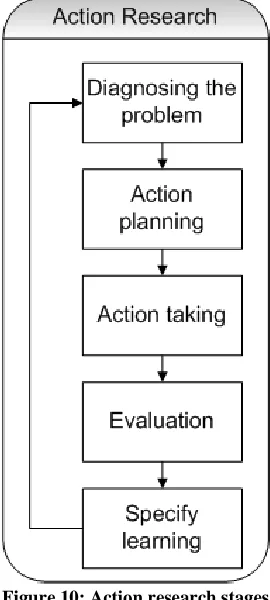
In action research five stages can be distinguished (Baskerville, 1999). These stages are shown in Figure 10. The first and last stages of action research – diagnosing the problem and specify learning – are similar to the problem awareness stage and conclusion stage of design science. The other three stages are the logical consequence of each other. First, the researcher has to determine how to assess the impact on the current situation of the created artifact. After this, these assessment actions should be performed. Finally, the results should be evaluated to see if the artifact fulfils its purpose.
The results from the action research evaluation of the artifact could result in reconsiderations for the created artifact. A new design science cycle would occur.
In the next section design science and action research are combined to visualize the approach used in this graduation study.
3.3 Graduation research method
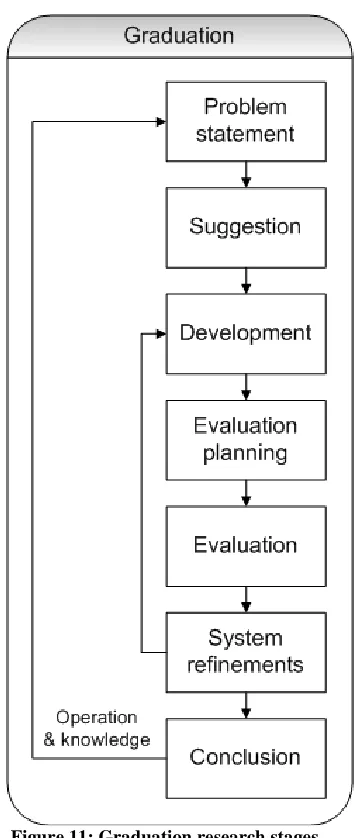
During this graduation study a combination of design science and action research is used. Design science is the main research method, while action research is used to evaluate the impact of the artifact built on the real world. The different stages of the graduation research approach are shown in Figure 11.
The graduation research started with a problem statement. This problem statement is equivalent to the problem awareness stage of design science. This stage is discussed earlier in Chapter 1 of this graduation report.
To solve this problem an artifact should be created. During the suggestion stage a basic idea about the potential solution is created. This suggestion is based on scientific literature about case-based reasoning and knowledge selection. Case-based reasoning is a methodology that seems to offer a suitable way to select appropriate references during bidding processes. This stage is discussed in Chapter 4 of this graduation report.
This suggestion is further elaborated during the development stage of this graduation. This stage is discussed in Chapter 5. During this stage a prototype of the suggestion is developed. In Chapter 6 a prototype of the created artifact is presented.
When a prototype of the artifact is developed and built, an evaluation is needed to see if the artifact has the desired result. This is done during the action research part of this graduation. The three sub stages of the action research part are discussed in Chapter 7. First, an impact model is created that shows the expected evaluation results. These expectations are expressed in several hypotheses. Furthermore, a plan is set up how to measure the impact of the created
prototype of the artifact. The hypotheses are tested using the action research method. This evaluation results in some system refinements.
4. Design of the Reference Tracking System
As stated in Section 3.1, the ultimate goal of this graduation research is creating an instantiation, a prototype of the reference selection system and testing its impact. The reference selection system is named Reference Tracking System by Capgemini colleagues in India. This chapter deals with the requirements and design of the instantiation. The result of this chapter is a series of models that show multiple views on the reference selection system. First, an introduction to bid processes is presented. After that, this chapter zooms in at reference selection, which is viewed as a case-based reasoning cycle. Thirdly, a basic idea of the system is presented. After that the requirements that the system should satisfy are discussed. At last, the system is examined from the four views that are part of the ARIS methodology.
4.1 Bid processes
This graduation assignment takes place at the Sales department of Capgemini Outsourcing Netherlands. In a lot of consultancy and outsourcing organizations, delivery (the execution of the assignment) and sales are not separated. At Capgemini Outsourcing Netherlands, there is a single department that focuses on responding to service requests.
A typical bid process follows the central path in the figure and omits the market consultation and the best and final offer. The phases of typical bid process are (Schouten et al, 2007):
Selection phase: during the selection phase the contracting party sends out a request for information. By setting minimum requirements the contracting party filters the vendors. All vendors that do not achieve the minimum requirements drop out. The selection phase focuses mainly on the vendor details and results in a ranking. Allotment phase: during the allotment phase the contracting party sends out a request for proposal to the parties that have achieved the highest rankings in the previous phase. This phase focuses more on the details of the assignment and less on the vendor details. This phase usually results in one vendor that should execute the assignment. In large bid processes, there is sometimes a second allotment phase in which the contracting party sends out a best and final offer.
Contracting: in this phase the selected vendor and the contracting party elaborate on the details of their future relationship. This is the end of the bid process. When the contracting phase is finished, the execution of the assignment can start.
The phases above sketch a typical bid process. However, variation is possible. When organizations want to know what possibilities the market has to offer they can start a market consultation. Furthermore, several question
rounds or a demonstration of the offered solution can be part of the bid trajectory (Schouten et al, 2007).
When you zoom in at the response process to a certain request, several activities can be distinguished. For the bid process it does not matter, whether the request to be answered is a request for information, a request for proposal or a best and final offer. Therefore, in the
remainder of this graduation report the term request is used instead of request for information, request for proposal and best and final offer.
The different activities within a request response process are illustrated in Figure 13. In the figure, the square represents an activity,
while a diamond is a decision moment. When a certain request is received, the sales team has to decide whether they would respond to the request. Some of the considerations are the value of the request and the chance to win the service request (due to competition).
When the sales team has decided to respond to the request, the content of the request is evaluated. Some questions and parts of the request could be answered by reusing a piece from an old response to a request (a so called nugget) from the knowledge repository of the sales department. Other questions cannot be answered using a nugget and a new answer has to be created.
When the answers are ready they are reviewed by other members of the sales team. When the questions are answered well and the answers are good enough, the answers are combined to create the response to the request. If this is not the case, the answer is adapted until it is satisfactory.
The response to the request is send to the contracting party, who evaluates the response. Besides, it is stored in the knowledge repository of the sales department.
One of the questions asked in a request is whether the vendor can show its capabilities regarding the assignment by presenting some references. Reference selection is the next topic that is
4.2 Case-based reasoning in reference selection
Case-based reasoning is well suitable for knowledge management applications (Aha, 1998). All the case-based reasoning activities discussed in Section 2.2 can be recognized in the reference selection process at the Sales department of Capgemini Outsourcing. The six case-based reasoning activities applied to the reference selection process within the Sales department of Capgemini Outsourcing are shown in Figure 14.
First a request is received by the Sales department. This problem representation is created by the customer. The request is the input of the Sales department. The request consists of a description of the tasks to be outsourced and diverse questions concerning these tasks. Furthermore, the request sketches the requirements that the references must satisfy.
The sales employee selects some references that meet the requirements. The reference selection is done ad hoc: no procedure how to select appropriate references is available. The sales employee uses his knowledge about old references and the knowledge of his team members. The sales employees retrieve specific reference documents created during previous bid trajectories or general reference documents created by the service managers – responsible for all activities performed for a client. Pieces of these documents that respond to questions of the client are reused.
During a first review by the sales employee gaps in the new reference document are noticed and filled in if possible. The new reference document is send to the service manager, who fills in the remaining gaps and checks if all content is correct. After this review and revision, the reference becomes part of the response to the request. The last evaluation takes place at the client, but this evaluation does not result in a revision, but in a score and a ranking. When the final document is sent to the client, the separate references are placed in the knowledge repository of Capgemini Outsourcing.
At the start of this graduation project, most activities described above are performed manually. But case-based reasoning can also be used for building an intelligent system (Kolodner, 1992). When building an intelligent system based on case-based reasoning, it may use any appropriate technology (Watson, 1999). In the remainder of this chapter, the system based on case-based reasoning is further designed.
This intelligent system targets at reducing the common case-based reasoning problems discussed in Section 2.2 (the indexing problem, the ballpark problem and the storage problem) by automating the processes and centralizing the references.
4.3 Basic idea of the system
During this graduation research an artifact should be build that assist case-based reasoners in selecting appropriate references. There are several possible systems that can help in selecting references.
The second option is a system that contains the entire reference documents. In such system the documents are part of the system and cannot be accessed without using the system. An example is the global knowledge management system used within Capgemini, KM2.0. Every user can upload its documents, so other users can reuse these. All the documents are at one location that is available to all users. Such system has also some disadvantages. One of the problems is the same as the last problem concerning the sole search engine. Multiple reference documents concerning the same referent can be stored in the system and are returned as result of a search task. This limits the convenient arrangement of the search result. Moreover, the amount of content in the system increases fast. The large amount of content is hard to manage. This implies the risk that right references are not traceable due to the amount of old content in the system, a problem also encountered with the old knowledge management system of Capgemini – Knew. Finally, when the system does not work, all reference documents are unavailable, because they are in a database part of the system. Capgemini has the demand that the reference documents should be accessible even if the system is unavailable, so this is an undesirable dependency. This option is also not suitable to build a reference selection system.
The third possibility is a sort of shell around the reference documents that contains the keywords and facts describing the references and some search functionality. Examples of such systems are the scientific literature search engines Scopus and Web of Science (Scopus, 2008; Web of Science, 2008). These systems contain the author, article title, journal title, year of publishing, keywords and abstract of many articles from scientific journals. A user searches for articles about a certain topic and the article library returns potentially suitable articles. The article itself is available on the website of the publisher. The third system seems the most appropriate option, because the disadvantages of the other options do not trouble this system. The system can be independent of reference document type. The language and keywords can be prescribed independent of the language and terms used in the reference documents. Not much effort is needed for including new references, because only some keywords and a link to the reference document have to be placed in the system. Because the system only contains keywords and links to reference documents, the documents are available even if the system breaks down. Only the search possibility is not available in case of a system break down. The Reference Tracking System designed and created during this graduation should be a shell around the reference documents that contains the keywords and facts describing the references and some search functionality.
4.4 Requirements
Moderating and adapting old cases to new requirements is an activity that requires human intelligence and cannot be done by an intelligent system. The other three aspects can be facilitated by a system by satisfying several functional and nonfunctional requirements. These requirements and the performance requirements are discussed in this section.
4.4.1 Functional requirements
The Reference Tracking System should assist users in selecting suitable references for responses to customer’s requests. It should provide an overview and a library of available reference documents.
The ability of the case-based reasoner to translate old cases into new situations can be supported by calculating the match between the requirements and the different references that are in the reference library and presenting the best matching results. Two common problems with matching are the indexing problem and the ballpark problem.
The indexing problem is the problem of retrieving applicable old cases with appropriate response, despite the different features and situations of the old cases (Kolodner, 1992). No two organizations are the same. So when searching for references to respond to a new request, there is a large possibility that none of the available references match all requirements. For example, when a university in the Netherlands wants to outsource its network management, Capgemini searches for other universities within the Netherlands for which Capgemini manages the LAN facilities. But when Capgemini only takes care of network management for high schools, the reference library contains no reference that matches all statements. The high school references should also be presented, because they may be suitable due to the similarity between universities and high schools. The reference selection system should thus provide a mechanism that indexes the match (hit rate) between the different references and the requirements and present the best matching references. The ballpark problem is the problem that old cases may be quite extended, while only a part is important for the new problem (Kolodner, 1992). Often, a reference describes diverse activities performed for an organization within a certain contract. But a new customer request can demand for only one or a few of these activities. In that case, the reference is appropriate, although it comprises more activities than asked. Take for example the reference of a financial organization in the Netherlands. Capgemini performs for this organization both application management and infrastructure management. Capgemini takes care of their desktop management, hosts their servers and mans the service desk. When a third organization wants to outsource its desktop management, this financial organization is a suitable reference, although the contract contains more than only desktop management. The reference selection system should thus provide a way to select references that comprise more than the requested service.
in the case library. When a very low level of detail is used, there is a very rough reference classification. Many less useful references are returned when a search is performed. When the level of detail is too high, the complexity of the system increases and therefore the usefulness decreases. To create a useful system the description of the references in the system should have the right level of detail. Furthermore, many keywords have synonyms and abbreviations and can be expressed in multiple languages. These problems are visualized in Figure 15. In this figure is illustrated that the entity
keywords has two relationships with itself. Many keywords have synonyms –
Summarizing, the functional requirements of the reference selection system are:
The system should provide a mechanism that indexes the match between the different references and the requirements (hit rate) and present the best matching references. The system should provide a way to select references that comprise more than the requested service.
The system should contain a means to enter new references. The system should contain a means to manage the keywords used. 4.4.2 Nonfunctional requirements
One of the purposes of the Reference Tracking System is to provide an overview of the globally available references and to support the reference selection within bid processes all over the world. To be used by Capgemini employees from all regions, it should be supported by the users all around the world.
The experience of the human case-based reasoner consists of all the knowledge in his memory. The experience of an intelligent system is made of the knowledge in the database of the intelligent system. This knowledge is combined with the knowledge of the user of the system. In the case of the reference selection system, the amount of available references in the case library is the experience and determines partly the quality of the solution. The more references are inserted in the case library the higher the average match between the references and the requirements. To give a better overview of the available references, the system should contain references from all regions of Capgemini. The reference selection system should thus contain as much references as possible originating from all regions of Capgemini. Moreover, the system should provide a single point of access to all references worldwide.
The references in the case library of the system are confidential. This confidential knowledge should be protected against unauthorized access. Moreover, not all users are allowed to change, alter and insert references. The system should thus contain some security measures
that protect the knowledge in the case library of the system and in which user rights can be assigned.
Additional nonfunctional requirements can be deduced from Section 4.3 about the basic idea of the system. To increase the flexibility, the system should be independent of document format and document location. One nonfunctional requirement that is a logical result of the keyword problem discussed in Paragraph 4.4.1 is that one language should be determined to use in the system. The use of only one language reduces the number of potential keywords. Summarizing, the nonfunctional requirements of the reference selection system are:
The system should be supported by the users worldwide.
The system should contain as much references as possible from all over the world. The system should provide a single point of access to all references worldwide. The system should contain some security measures.
The system should be independent of reference document format. The system should be independent of reference document location. The system should be in one single language.
4.4.3 Performance requirements
Performance requirements indicate what qualities a delivered service should have. The standard performance requirements are (Thiadens, 2005; Yang et al, 2005):
Effectiveness of the system: it should be able to link the system to the existing information systems. Furthermore, the system should guarantee secure knowledge exchange.
Adequacy of knowledge: the system should guarantee reliable and complete knowledge exchange without faults.
Practicability or usability: the system should be easy to operate (user friendly), there is no need for special equipment at the user and there is no or a minimal need for training to learn to work with the system. Descriptions of new references should be easily added to the system’s reference library and updating should be simple.
Efficiency: the system should have no delays in processing the requested and offered knowledge. It should efficiently help the user in deciding which references are most suitable for the proposal.
Reliability of the system: the system should be always available.
Maintainability: the system should need minimal maintenance and it should be feasible to correct possible errors in the system as easy as possible. The user rights should be easy to manage.
4.5 Four descriptive views: ARIS
The objective of the ARIS (Architecture of Integrated Information System) methodology is to facilitate the specification and implementation of information systems that support business processes. This methodology is thus well suitable to overlook the Reference Tracking System. The ARIS methodology consists of four different views (function, data, organization and control view) and three levels (requirement definition, design and implementation) (Heib et al, 1996). This is shown in Figure 16.
In this section the system is viewed from the four views that are part of the ARIS methodology: function, data, organization and control. This is done using a function tree for the function view, an Entity-Relationship Diagram for the data view, organizational charts for the organization view and event-driven process chain diagrams for the control view.
4.5.1 Function view
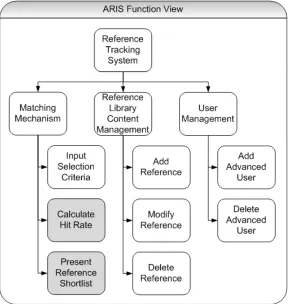
The functionality of the Reference Tracking System can be divided into three groups: the matching mechanism, content management of the reference library and user management. These three function groups and their sub functionality are illustrated in Figure 17. The rounded rectangles represent the different functions of the Reference Tracking System. Three sub activities can be distinguished within the matching mechanism: the input of selection criteria, the calculation of the hit rate and the presentation of the shortlist with suitable references. The user of the system has to insert the selection criteria the reference he is looking for should satisfy. This is an interaction of the user with the Reference Tracking System. When the user has inserted all search criteria, the system starts calculating the hit rate of all references in the reference library. The hit rate of a reference indicates the match between that reference and the search criteria inserted by the user. When all hit rates are calculated, the references are sorted and the references with the highest hit rates are presented to the user in the form of a reference shortlist. The last two sub activities – that are colored gray in Figure 17 – are automatic functions, although the result of the last sub activity is presented to the user.
The reference library contains all the details regarding the references. Three separate reference library content management activities can be distinguished: a new reference can be added to the reference library, some details of a reference can be modified and an old reference can be deleted from the reference library.
Only advanced users are allowed to add, alter and delete references. Some user management is needed to assign advanced user rights to users and to delete advanced users when they have become obsolete. Basic users are not registered in the system: all users within the Capgemini network can use the system.
4.5.2 Data view
The reference library contains all keywords and other terms describing the different contracts (hereinafter called descriptors) and the links to the reference documents. The content of this reference library determines largely the possibilities of the reference selection system and the result of a search task. Two factors influence the possibilities of the reference selection system: the number of references in the library (the number of rows in the database table) and the different descriptors that describe a certain reference and can be defined during a search task (the number of columns in the database table).
In this paragraph the different descriptors in the reference library are discussed. These descriptors determine largely how well a suitable reference can be found. The demands that references should comply with are quite diverse, depending on the customer’s wishes. Furthermore, the sales team can determine further search criteria to get a better match between the situation at the client’s and the situation described in the reference. All these descriptors should be covered in the reference library. The different descriptors in the reference library form an interconnected whole.
This can be illustrated using an Entity-Relationship Model. An Entity-Relationship Diagram is an abstract conceptual representation of structured data. In an Entity-Relationship Diagram three types of blocks can be distinguished: rectangles, diamonds and ellipses. A rectangle represents an entity. An entity can be defined as a thing that exists independently of other things and that can be uniquely identified. A diamond represents a relationship between two entities. An ellipse represents an attribute, a property of an entity or relationship (Romney & Steinbart, 2003). The Entity-Relationship Diagram regarding the data fields in the reference library is shown in Figure 18. For a better view, a full page version of this diagram is included in Appendix B.
The numbers near the lines between an entity and a relationship represent the cardinality of the relationship. Cardinality defines the numeric relationship between the entities on either end of the relationship line (Data Model, 2005; Romney & Steinbart, 2003). In the Entity-Relationship Model four types of relationships can be distinguished. These are explained in Table 3.
In the Entity-Relationship Model several entities are shown. These entities and their attributes are explained in the data dictionary in Table 4.
Figure 18: Entity-Relationship Diagram of the content of the reference library
Relationship Explanation
One-to-Many (1:N) relationship An offer (service line) is part of exactly one discipline, but a discipline may contain zero, one or many offer lines
One-to-Many (1:N) relationship A reference description deals with the contract of exactly one client, but a client can be part of one or more reference descriptions
Many-to-Many (M:N) relationship A client operates in at least one industry sector, but a sector can contain zero, one or more clients of Capgemini
Many-to-Many (M:N) relationship A reference description is managed by one or more service managers and each contact person is responsible for one or more reference descriptions
Entity with attributes Explanation
A unit in the reference library describing a contract
A unique number identifying the referent in the reference library
The contract value (excluding VAT) during the total contract period
The contract value (excluding VAT) during one year of the contract
The date the provision of services starts The date the contract is reviewed and renewed The date the provision of services ends
The client has to give permission to use the reference: this field indicates the permission level
The amount of people that become an employee of Capgemini as part of the contract
The main technologies (both hardware, software and programming languages) that are used during the contract Other keywords that describe the activities performed during the contract, customer’s targets
Client
Client Name
The referent that hired Capgemini to take care of (a part of) the information technology
Parent
Parent Name
If the referent is part of a greater group, the name of that group Sector The sector the client is active in
Industry A sector is divided in several industries
Region The region of Capgemini that is contract owner
Alliance Partner Sometimes Capgemini collaborates with other organizations to deliver the requested services to the referent
Contact Person A service manager responsible for the contract; he can provide contract information
Document Link A link to a knowledge repository, web page or folder that contains reference documents
Reference Document Language
An extensive description of a reference
The languages in which reference documents are available Discipline A key area of Capgemini that is involved in the service provision
to the referent
Offer A delivery department of Capgemini Outsourcing that is involved in the service provision to the referent
Sub Offer A sub department of a delivery department of Capgemini
Outsourcing that is involved in the service provision to the referent
4.5.3 Organization view
The Reference Tracking System is a system that should be used within the Sales departments of the different regions of Capgemini Outsourcing. The ultimate goal is that its use is extended to the Technology and Consultancy disciplines of Capgemini, but within this graduation research study only Capgemini Outsourcing Netherlands is taken into account. The organizational chart of Capgemini Outsourcing Netherlands is shown in Figure 19. Capgemini Outsourcing Netherlands consists of four departments and some support departments. Three of these departments (Application Management, Infrastructure Management and Retail Solutions) are delivery departments, also called service lines or offers. They are responsible for the service provision towards customers. The Infrastructure Management service line can be divided into Data Center Services and Desktop & Distributed Services. Retail Solutions is the result of the recent acquisition of Maxeda ITS (the information technology department of former Vendex KBB) and is a separate department of Capgemini Outsourcing Netherlands. The service managers that provide information about referents are members of the delivery departments. The Sales department is responsible for winning bid trajectories to secure new customers. In this department the reference selection system will be mainly used. Therefore, the focus is on the employees of the Sales department. The Sales department is further explored in Figure 20.
The Sales department consists of two main groups of employees: the sales force and sales support. The sales force consists of sales managers, responsible for customer contact. Sales support employs personnel that support bidding trajectories. Knowledge management is a supporting group within sales support. The users of the reference selection system are the employees of the sales force and sales support.
Figure 20: Organizational chart of the Sales department
When the common tasks of the different users are taken into account, the users can be divided into two user roles: basic users and advanced users. The basic users only have to search for references. They have no rights to add, modify or delete references. The advanced user role has the right to add, alter and delete references. They are responsible for the references that origin from their region. The advanced user group consists of the bid support employees and knowledge management. All other personnel of the sales department get the basic user role, but mostly the sales managers and pursuit managers will use the system.
4.5.4 Control view
The main functionality of the Reference Tracking System is the reference selection functionality (matching mechanism, see Figure 17). The other functions are support functions meant to update the reference library and add or delete users. In this paragraph event-driven process chain diagrams of the reference selection process and the three reference library content management processes are presented.
In an event-driven process chain diagram three building blocks can be distinguished: rounded rectangles, hexagons and XOR circles. Just like in the function chart (Figure 17), the rounded rectangles represent functions. Functions are the active elements of the event-driven process chain diagram. When a function is finished an event occurs. These events are represented in an event-driven process chain diagram by hexagons. An event is a passive element that describes a certain circumstance at which