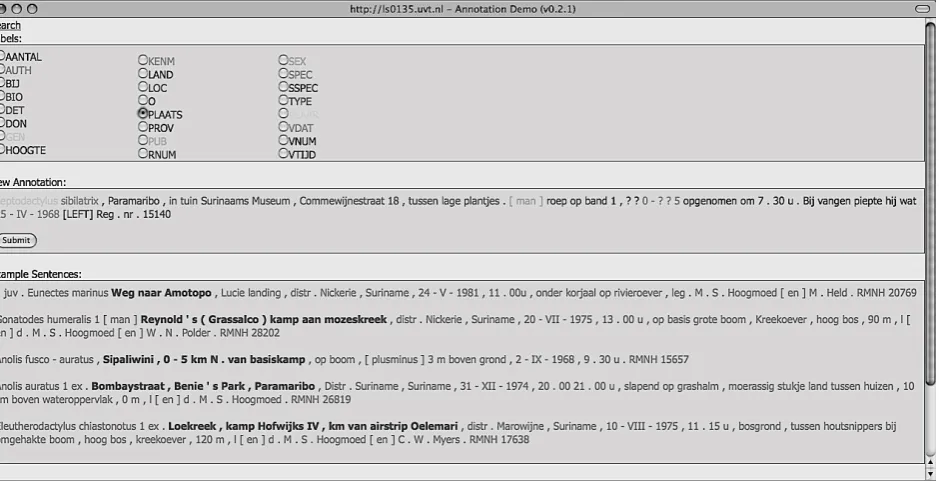
Figure 2: Interface for semi-automatic post-processing of segmentation and labelling errors on field notes. ThePLACElabel is selected.
The user is shown a field book entry as tagged by MBT. The span of words assigned to various labels (i.e., database columns) are displayed in distinct colours. Hovering above a word with the mouse displays the name of the assigned label.
If correction of the sentence in focus is necessary, the new column’s button is to be selected in the upper section of the interface. Then, clicking on incorrecly labelled words as-signs these the selected new label. In the bottom section of the screen the user can observe already manually vali-dated sentences (the selected label in boldface) that provide examples to facilitate labelling decisions. When the dis-played focus sentence is judged correct, the Submit button is clicked, and the validated sentence is added to the train-ing data.
3.1. The Alignment-Based Learning algorithm
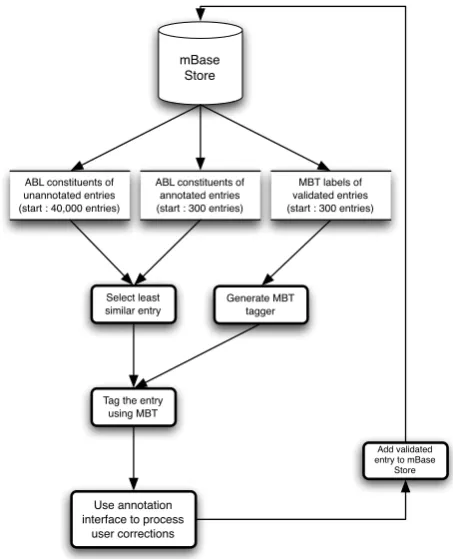
The alignment-based learning algorithm (ABL) is an un-supervised, symbolic, structure bootstrapping system (van Zaanen, 2001). ABL finds the grammar that underlies a corpus of plain text sentences, without using any external sources of information. It aligns the sentences in an input corpus and creates hypotheses where unequal parts of sen-tences are syntactic constituents, clustered and judged in-terchangeable in their given context. Constituents are found based on parametric string edit distance metrics, in a pro-cedure that can be likened to bracketing spans of words in each sentence, after comparing it to every other sentence in the corpus. In the current study ABL is used with default settings4. We run ABL in a standalone procedure before the selective sampling loop, and store the induced constituents for each sentence.
4ABL is available from
http://www.ics.mq.edu.au/∼menno/research/software/abl/
3.2. Sampling
During the segmentation and labelling of field note entries, MBT performs a multi-label classification task, drawing on as little as 300 annotated sentences in its memory. Due to data sparseness, the tagger will experience difficulty in classifying unseen words and constructions. By adding au-tomatically tagged and manually validated sentences to the set of training data, as they gradually become available, the classification model can improve.
The implemented sampling procedure selects most dissim-ilar sentences from the unannotated sentences, based on longest common substrings. Since the pool of unannotated sentences is in the magnitude of tens of thousand sentences, at the beginning of the sampling procedure many of these score equally dissimilar. To differentiate between these, we search for sentences that do share a minimal amount of syntactic components with the memory examples, in terms of ABL’s hypothesis space. Minimally overlapping con-stituents between the examples in memory and the most dissimilar candidate sentences from the unannotated pool are dynamically identified, using frequency-based ranking.
4.
Inducing Metadata
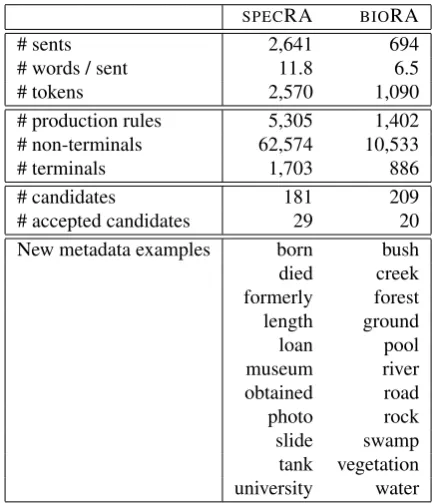
The next goal is to introduce more structure into the knowl-edge base. Our approach is to create new metadata, based on already existing metadata (i.e., the column names in the database). We extract a secondary layer of metadata from free text columns in a process we callfield expansion, ex-plained in (Lendvai, 2008).
4.1. Database Field Expansion
Free text fields of a database – such asSPECIALREMARKS
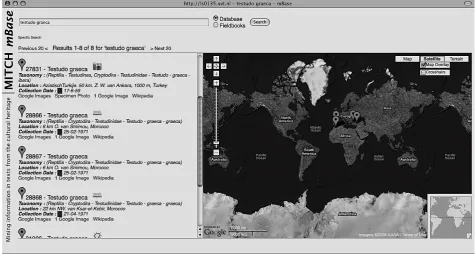
Figure 3: The search and visualisation display of the knowledge base.
Modifier Head Modifier Hebrew University
Stanford University Kansas University South Australian Museum British Museum Natural History Museum
forest of Quercus ilex forest in moss cushions forest on loamy soil road through cultivation
road under fallen Cecropia leaves road after heavy rain
rock surface of hill under stones rock boulder near road
rock in savanna
Table 3: Metadata candidates with assigned values (left or right modification) from the SPECIALREMARKS and
BIOTOPEcolumns.
track of changes; it is thus possible to browse revisions and to search only particular versions of the knowledge base. The interface supports linking to various other resources such as online geocoding SPECIALREMARKS and photo collections. Visualisation in this way allows for more in-tuitive browsing of specimens. This may also help high-lighting erroneous entries in the dataset: e.g., spotting a specimen collected in a different continent than all other examples might suggest inconsistent data. Figure 3 shows a screenshot of the search and visualisation display. When presenting query results, the system uses icons to signal if a particular record is linked to a fieldbook entry, a photo, or has a potentially erroneous field value in the database. Going to the record view of the mBase interface (see Figure
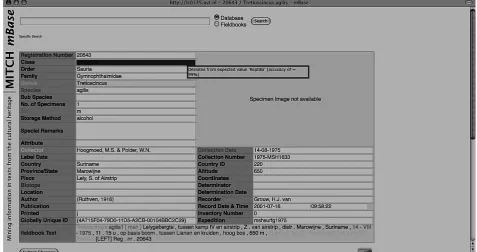
4) lets the user inspect all details of a record. It is also used to display the segmented field note associated to the given record (if any), alongside the structured database. The la-bels appearing in the segmented field notes are linked to their predicted database columns. This information is used to provide a convenient method for entering new database entries by a couple of mouse clicks.
When browsing for and displaying records, the mBase in-terface alerts the user to anomalous entries marked as such by Timpute, a perl wrapper around TiMBL, which uses a database’s own features to spot errors and offer corrections in database cells (cf. (Sporleder et al., 2006)). The con-fidence of the error detections is displayed together with suggested corrections for the user to review.
6.
Concluding remarks
We described the process of converting cultural heritage text into a searchable knowledge base, using machine learn-ing. This includes segmentation of large amounts of texts into database fields, training a classifier on a small set of labelled examples. To postprocess the results, an annota-tion tool based on selective sampling (drawing on unsuper-vised grammar induction) is implemented. We explained a database field expansion method to create metadata, the results of which are integrated in the knowledge base. The interface to the knowledge base allows for interactively im-porting automatically tagged field notes to records, and dis-plays query results using maps and specimen photos. In follow-up work within our project we plan to report on the design of the ontology underlying the knowledge base.
7.
Acknowledgements
Figure 4: The record view of the knowledge base.
8.
References
S. Canisius and C. Sporleder. 2007. Bootstrapping information extraction from field books. InProc. of EMNLP-CoNLL. W. Daelemans, J. Zavrel, A. van den Bosch, and K. van der Sloot.
2003. MBT: Memory-Based Tagger, version 2.0, Reference guide. Technical report, ILK research group technical report series 03-13, Tilburg.
I. Dagan and S. Engelson. 1995. Selective sampling in natural language learning. InProc. of IJCAI-95 Workshop.
J. Lafferty, A. McCallum, and F. Pereira. 2001. Conditional ran-dom fields: Probabilistic models for segmenting and labeling sequence data. InProc. of ICML-01.
P. Lendvai. 2008. Alignment-based expansion of textual database fields. In A. Gelbukh, editor,CICLing 2008. LNCS, vol. 4919. Springer Berlin / Heidelberg.