truthing of test data. All of these capabilities ride on top of the IML data model, described above.
4.1
IMAC
The Adjudication tool, IMAC, provides a user-friendly web-based environment for name matching adjudicators to create ground truth data sets. IMAC can be installed as a servlet completely separately from the Name Matching Evaluation Lab, along with the name matches that need to be judged. This way, remote adjudicators can participate in the adjudication process as long as they have an internet connection, without having to be connected to the lab’s internal network. In the screen shot in Figure 1, we can see that the adjudicator has chosen the three items in the bottom right-hand corner of the screen as good matches for the query “Mhd Ayman Zahabi.”
Figure 1: IMAC Adjudication tool
4.2
Ground Truth Compilation
After the raw adjudication data is collected, it must be reconciled into a single version of ground truth. We accomplish this in one of two ways. First, we may have "reconciliation meetings" at which adjudicators who were in disagreement as to the matching status of particular records will discuss their points of view and arrive at a single common judgment. These discussions are guided by a set of adjudication guidelines that were developed at the start of the adjudication effort and that reflect the task context.
4.3
R Scripts
Within the R statistical programming environment, we have developed modules for analyzing and graphing the performance of name matching technologies against these ground truth data sets. One sample graph can be seen in Figure 2, which displays the performance of three name matching engines in terms of their precision-recall curve. In this graph, the point of optimal F-score is indicated by an open circle on the P/R curve.
In addition, since the tuning and performance evaluation of the name matching systems depends crucially on the
Figure 2: Performance Graphs in R
quality of the ground truth data upon which these operations are based, and since the construction of ground truth in the context of name matching is a somewhat subjective process, we have also developed statistical modules to evaluate the quality of our ground truth data, in terms of agreement achieved between expert judges during the adjudication process. We are also currently conducting some research into the relative importance of achieving absolute consensus among adjudicators versus using an adjudication pool that is constructed in such a way as to eliminate bias toward any particular adjudicator. That research is described (Arehart et al, 2008).
4.4
MINERVA
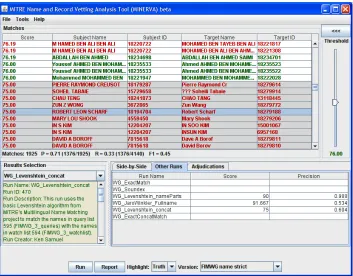
In addition to getting the high level view of name matching effectiveness mentioned above, we have also developed tools that enable us to take a “deep dive” look at the actual results being produced by each individual name matching system, and to easily compare results across systems – or of different settings of the same system – at a low level of granularity. MINERVA highlights results using selectable truth, based on human adjudication, to quickly distinguish the desirable from undesirable results. Figure 3 shows a snapshot of a MINERVA session with true positives in green, false positives in red and false negatives (given a certain threshold: 76 in this case) in red text, shaded gray.
Using MINERVA, results from multiple name matching systems can be combined into a “virtual cocktail” of name matching systems that may produce better results than any of the contributing systems alone. The interface
for this is shown in Figure 4, where the F-Score for the “cocktail” (0.6054) surpasses that of either system that contributed to the cocktail (0.5946 and 0.4503).
Figure 4: MINERVA – joining results from multiple name matching systems
4.5
GenV
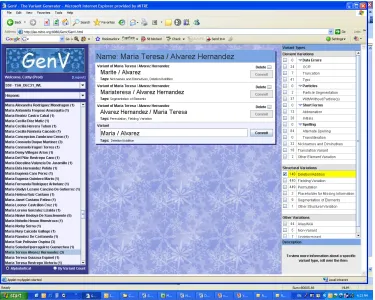
In order to test the limits of the types of linguistic variation a name matching system can handle, we have also developed a tool (called GenV) through which expert users can generate motivated variants of base name data, to be included in test set name lists. During the variant creation process, users of GenV tag each
variant with one or more “variant types” according to the taxonomy of name variation, which has been iteratively developed through many hours of interaction with naturally occurring data. The name variation taxonomy can be seen on the right side of the application pictured in Figure 5, with a larger version of the taxonomy in Figure 6.