CSEIT1726276 | Received : 25 Nov 2017 | Accepted : 26 Dec 2017 | November-December-2017 [(2)6: 1050-1054]
International Journal of Scientific Research in Computer Science, Engineering and Information Technology © 2017 IJSRCSEIT | Volume 2 | Issue 6 | ISSN : 2456-3307
1050
Multipath Routing Protocol for Wireless Sensor Networks
Nidhi Soni
1, Shankar Sharan Tripathi
2 1,2Department of Computer Science & Engineering, Shri Shankaracharya Engineering College, Bhilai, Durg, Chhattisgarh, India
ABSTRACT
A wireless sensor network is a wireless network system consisting of scattered self-governing sensor nodes to observe physical circumstances. In WSN’s, sensor nodes have limited amount of residual energy as well as data communication ability. Sensor node does not have the rechargeable battery that’s why utilization of energy is also very important in the wireless sensor network. In WSN, sensor nodes are fully responsible for data communication from source to sink node. Due to this routing protocol also play an important role in the wireless sensor network. Routing algorithms helps to improve the overall performance of the networks. In this paper we tried to discuss about multiple routing protocol which help to improve the network performance and energy utilization of sensor network. Keywords: Wireless Communication System, Wireless Sensor Network, Residual Energy, Network Lifecycle.
I.
INTRODUCTION
Now a day’s wireless sensor network is very popular, flexible, reliable and fastest communication medium. In the wireless sensor network, sensor nodes are strongly connected with each other. Each sensor node is capable to communicate, sensing and receiving the data packet. Sensor nodes are also participating as an intermediate node.
As we know that the sensor nodes have limited residual energy and they don’t have any recharge option. So when the sensor node acts as an intermediate node it also lost their residual energy. Routing algorithm also plays an important role to improve the overall performance of the network and it also saves the residual energy of the sensor node. In the wireless network, we use many topologies like star, tree, and mesh. According to that, we chose the routing algorithms.
In WSN, the sensor node is to collect and sense the data and then send it to the sink node. Sink and sensor nodes are capable to directly communicate with each other. This process required a lot of residual energy. An intermediate sensor node sends their data to sink node through multiple hopes or through multipath. However, selection of routing algorithm is also very important for
the overall performance of the network. There are few algorithms for wireless sensor networks i.e. location-based routing algorithms, distributed algorithms and centralized algorithms.
II.
MULTIPATH ROUTING PROTOCOLS
1. Maximum existence routing in Wireless Sensor
Networks
2. Chronological Assignment Routing
3. Energy Aware Routing in Wireless Sensor Networks
4. Interconnect Multipath Routing
III.
RELATED WORK
In 2002, Jason Lester Hill design System Architecture for Wireless Sensor Networks they present an operating system and three generations of a hardware platform designed to address the needs of wireless sensor networks. Their operating system, called Tiny OS uses an event based execution model to provide support for fine grained concurrency and incorporates a highly efficient component model. Tiny OS enables us to use a hardware architecture that has a single processor time shared between both application and protocol processing.
In 2004, Raquel A.F. Mini, Antonio A.F. Loureiro, Badri Nath develops The distinctive design characteristic of a wireless sensor network: the energy map in which the key challenge in the design of a wireless sensor network is maximizing its lifetime. This is a fundamental problem and new protocol engineering principles needing to be established in order to achieve this goal. The information about the amount of available energy in each part of the network is called the energy map and can be useful to increase the lifetime of the network. They propose using the energy map as a protocol engineering principle for this kind of network.
In 2005, Daniele Puccinelli and Martin Haenggi studied about Wireless Sensor Networks: Applications and Challenges of Ubiquitous Sensing, in which Sensor networks offer a powerful combination of distributed sensing, computing and communication. They lend themselves to countless applications and, at the same time, offer numerous challenges due to their peculiarities, primary the stringent energy constraints to which sensing nodes are typically subjected. The distinguishing traits of sensor networks have a direct impact on the hardware design of the nodes at at least four levels: power source, processor, communication hardware, and sensors. Various hardware platforms have already been designed to test the many ideas spawned by the research community and to implement applications to virtually all fields of science and technology. They are convinced that CAS will be able to provide a substantial contribution to the development of this exciting field.
In 2006, Ye Ming Lu and Vincent W. S. Wong about an energy efficient multipath routing protocol for
wireless sensor networks in which the energy consumption is a key design criterion for the routing protocols in wireless sensor networks. Some of the conventional single path routing schemes may not be optimal to maximize the network lifetime and connectivity. In this paper, they proposed a distributed, scalable and localized multipath search protocol to discover multiple node-disjoint paths between the sink and source nodes. They also proposed a load balancing algorithm to distribute the traffic over the multiple paths discovered. They compare our proposed scheme with the directed diffusion, directed transmission, N-to-1 multipath routing, and the energy-aware routing protocols. Simulation results show that their proposed scheme has a higher node energy efficiency, lower average delay and control overhead than those protocols.
In 2007 Prabhudutta Mohanty, Sangram Panigrahi Nityananda Sarma, Siddhartha Sankar Satapathy they explored general security threats in wireless sensor network and made an extensive study to categorize available data gathering protocols and analyze possible security threats on them.
In 2008 Zoran S. Bojkovic, Bojan M. Bakmaz, and Miodrag R. Bakmaz deals with some security issues over wireless sensor networks (WSNs). A survey of recent trends in general security requirements, typical security threats, intrusion detection system, key distribution schemes and target localization is presented. In order to facilitate applications that require packet delivery from one or more senders to multiple receivers, provisioning security in group communications is pointed out as a critical and challenging goal. Presented issues are crucial for future implementation of WSN.
In 2010, Shio Kumar Singh, M P Singh and D K Singh, Routing Protocols in Wireless Sensor Networks – A Survey, in which Advances in wireless sensor network (WSN) technology has provided the availability of small and low-cost sensor nodes with capability of sensing various types of physical and environmental conditions, data processing, and wireless communication. Variety of sensing capabilities results in profusion of application areas. However, the characteristics of wireless sensor networks require more effective methods for data forwarding and processing. In WSN, the sensor nodes have a limited transmission range, and their processing and storage capabilities as well as their energy resources are also limited. Routing protocols for wireless sensor networks are responsible for maintaining the routes in the network and have to ensure reliable multi-hop communication under these conditions. In this paper, they give a survey of routing protocols for Wireless Sensor Network and compare their strengths and limitations.
In 2011, R. Devisri and R.J.Archchana Devy, Reliable and Power Relaxation Multipath Routing Protocol for Wireless Sensor Networks, Routing in sensor network is very challenging task for wireless sensor networks. Generally the ideal sensor networks should provide reliable, power consumption, multipath routing, less delay efficient path discovery and long lifetime node. Therefore in this paper, relax multipath routing protocol is proposed for wireless sensor network successfully. The proposed relax protocol utilizes the LWFEC technique by adding the data redundancy. The relax protocol increase the protocol reliability and is able to recover from the path failure.
In 2012, S. Saqaeeyan and M. Roshanzadeh, Improved Multi-Path and Multi-Speed Routing Protocol in Wireless Sensor Networks, in which they proposed a optimum routing protocol, in some of Quality of Service achieved improvements in the field of reliability in data sending to destination and load balancing in wireless sensor network. In our proposed protocol, to ensure that a data packet correctly send to the destination, it used of an improved hybrid method based on multipath data sending. The routing decisions in this method are by considering the remaining energy of nodes that are in neighbors of sender nodes. Simulation results shows that release rate of data packets in this method is reduced and reliability in data
sending to destination is increased. Also, the energy efficiency of sensor nodes effectively improved and thus increase the overall lifetime of wireless sensor networks.
In 2013, Yash Arora and Himangi Pande, Energy Saving Multipath Routing Protocol for Wireless Sensor Networks, The Wireless sensor networks have many characteristics such as limited energy resources, low bandwidth and unreliable links. Due to these characteristics there are many challenges in the design of sensor networks. Routing in WSN is very challenging task. Multipath establishes several path for data transmission rather than single path. Due to this data delivery is high. They proposed energy saving multipath routing protocol (ESMRP). ESMRP make use of load balancing algorithm to transfer the data. ESMRP calculates node strength to discover its next best hop. Our protocol uses two versions, in the first version, data is transmitted through single path, if some path failure occurs or discovered path node strength goes below 15% of alternative path node strength then it will switch to next alternative path. In the second version of ESMRP, message is split into various segments and some correction codes are added to these segments. After that these segments are transmitted across multiple paths. Simulation results shows that the proposed protocol is more energy saving than previous protocol in providing efficient resource utilization.
In 2013,Guimin Huang, Wujin Tao, Pingshan Liu and Siyun Liu, Multipath ring Routing in Wireless Sensor Networks ,In the past years, the routing problems of wireless sensor network (WSN) have attracted great interest, and many routing protocols for WSN have being proposed. However, these routing protocols pay little attention to the transmission reliability. Therefore, this paper proposed a new multipath ring routing algorithm for WSNs. The proposed algorithm utilizes ring level to separate sensor nodes into several sections, which can improve the reliability of the data transmission. Using the multipath ring routing data delivery improves as an average of 27.58% to leach routing and 113.06% to directing routing.
routing, power management, and data dissemination protocols have been specifically designed for WSNs where energy consumption is an essential parameter to be considered. Since wireless sensor network protocols are application specific, the focus has been given to the routing protocols that might differ depending on the application and network architecture. In this piece of work, the study of various routing protocols for Wireless Sensor Networks presents a broad outlook of existing routing protocols for Wireless Sensor Network applications. Routing protocols for wireless sensor networks are responsible for maintaining the path from source to destination and have to ensure reliable multi-hop communication in a harsh environment. Further, the aim is to identify the various types of multipath routing protocols and to analyze the strength and limitations involved in it.
In 2015, Suraj Sharma and Sanjay Kumar Jena, Cluster based Multipath Routing Protocol for Wireless Sensor Networks in which Wireless Sensor Network (WSN) consists of low power sensor nodes. Energy is the main constraint associated with the sensor nodes. In this paper, they proposed a cluster based multipath routing protocol, which uses the clustering and multipath techniques to reduce energy consumption and increase the reliability. The basic idea is to reduce the load of the sensor node by giving more responsibility to the base station (sink). They have implemented and compared the protocol with existing protocols and found that it is more energy efficient and reliable.
In 2015, K Renuka and G. Murali, providing security for multipath routing protocol in wireless sensor networks, Wireless Sensor Network (WSN) is a combined group of sensors form a network. WSN will monitor the changes in physical conditions and it will forward the data via multi hop network. Sensors are dynamic in nature so the lifetime of sensors and providing security for the data transmitted by the nodes are the major problems faced by the Wireless Sensor Networks (WSN). Ad hoc On-demand Multipath Distance Vector (AOMDV) routing protocol is used for generating multiple paths between source and destination. Route discovery and route maintenance are main services of AOMDV. By having, Multipath routing protocol increases the lifetime of the sensors by distributing the traffic load among all the paths instead of single path in a network. The malicious node
introduces many attacks on WSN because the network is dynamic in nature.
In 2017, N. Vijayarani and and A. Senthilkumar, Multipath Routing Protocols in Wireless Sensor Networks: A Retrospective Review, To review the basic principles of Multi-path Routing Protocols (MRPs) design and its performance metrics. To discuss the assortment of MRPs overview for Wireless Sensor Networks (WSNs) based on its arrangement and delivery. Methods/Statistical Analysis: The enhanced reliability, load balance and security promote the multi- path routing as an appropriate tool in the domain of Wireless Sensor Networks (WSNs). In order to obtain simultaneous data transfer with reduced delay period, critical review is made based on the performance metrics, taxonomy of MRPs, and qualitative comparison.
IV.
MULTIPATH ROUTING PROTOCOL
We design an algorithm for the wireless sensor network. In which first we find the neighbor node which helps for data transmission. After this process, we search the routing path i.e. primary route or secondary route then finally we transmit our data into the networks. We are also calculating the residual energy of the sensor nodes during data transmission.
If sensor node is a data collector node then Search primary and secondary route Else
If sensor node is a primary then
Search primary and secondary route Else
If sensor node is a secondary then Search primary route Endif
Repeat same until sensor node is not equal to the receiver node
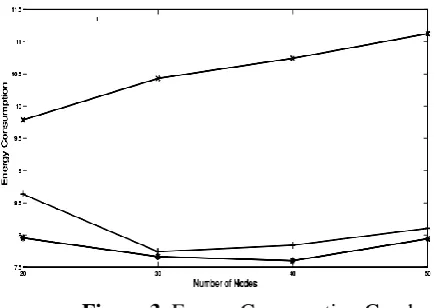
Figure 3. Energy Consumption Graph.
V.
CONCLUSION & FURTHER DEVELOPMENT
Wireless networks are one of the famous technologies and fastest growing technology. It is reliable, quick accessible as well as flexible. Routing in the wireless networks is very important because it direct affects the efficiency, throughput and energy consumption. In this paper we discuss about various algorithms and try to introduce a multipath routing algorithm for WSN. We are also discussed about the various problems related to routing algorithms in the wireless sensor network.
VI.
REFERENCES
[1]. Hongmei Deng, Wei Li, and Dharma P. Agrawal, Routing Security in Wireless Ad Hoc Networks, IEEE Communications Magazine, Pp: 70-75, October 2002.
[2]. Daniele Puccinelli and Martin Haenggi, "Wireless Sensor Networks: Applications and Challenges of Ubiquitous Sensing ",IEEE circuits and systems magazine third quarter 2005.
[3]. Ye Ming Luand Vincent W. S. Wong, "an energy efficient multipath routing protocol for wireless sensor networks" international journal of communication systems, 2007; 20:747-766, in
Wiley Inter Science
(www.interscience.wiley.com).
[4]. Zoran S. Bojkovic, Bojan M. Bakmaz, and Miodrag R. Bakmaz, "Security Issues in Wireless Sensor Networks", International journal of communications Issue 1, Volume 2, 2008. [5]. Shio Kumar Singh, M P Singh and D K Singh,
Routing Protocols in Wireless Sensor Networks - A Survey International Journal of Computer
Science & Engineering Survey (IJCSES) Vol.1, No.2, November 2010.
[6]. R. Devisri and R.J.Archchana Devy, Reliable and Power Relaxation Multipath Routing Protocol for Wireless Sensor Networks, 2011 International Conference on Advancements in Information Technology With workshop of ICBMG 2011, IPCSIT vol.20 (2011) (2011) IACSIT Press, Singapore.
[7]. S. Saqaeeyan and M. Roshanzadeh, "Improved Multi-Path and Multi-Speed Routing Protocol in Wireless Sensor Networks", Published Online March 2012 in MECS (http://www.mecs-press.org/), 2012, 2, 8-14.
[8]. Yash Arora and Himangi Pande, Energy Saving Multipath Routing Protocol for Wireless Sensor Networks , Journal of Engineering Research and Applications, Vol. 3, Issue 5, Sep-Oct 2013, pp.152-156.
[9]. Guimin Huang, Wujin Tao, Pingshan Liu and Siyun Liu, "Multipath ring Routing in Wireless Sensor Networks", 2nd International Symposium on Computer, Communication, Control and Automation (ISCCCA-13), 2013.
[10]. Swati Lipsa, "An Empirical Study of Multipath Routing Protocols in Wireless Sensor Networks", International Journal of Computer Science and Information Technologies, Vol. 5 (4) , 2014, 5375-5379.
[11]. Suraj Sharma and Sanjay Kumar Jena, "Cluster based Multipath Routing Protocol for Wireless Sensor Networks", ACM SIGCOMM Computer Communication Review, Volume 45, Number 2, April 2015, Pp.:15-20.
[12]. K Renuka and G. Murali, "providing security for multipath routing protocol in wireless sensor networks", International Journal of Research in Engineering and Technology, eISSN: 2319-1163 | pISSN: 2321-7308.