Coreference Resolution to Support IE from Indian Classical Music
Forums
Joe Cheri Ross Pushpak Bhattacharyya Department of Computer Science and Engineering
Indian Institute of Technology Bombay
{joe,pb}@cse.iitb.ac.in
Abstract
Efficient music information retrieval (MIR) require to have meta information about music along with content based information in the knowledge base. Dis-cussion forums on music are rich sources of information gathered from a wider audience. Taking into consideration the nature of text in these web resources, the yield of relation extraction is quite depen-dent on resolving the entity references in the document. Among the few music fo-rums dealing with Indian classical music,
rasikas.org (rasikas, 2015) having rich information about artistes, raga and other music concepts is taken for our study. The forum posts generally contain anaphoric references to the main topic of the thread or any other entity in the discourse. In this paper we focus on coreference resolution for short discourse noisy text like that of forum posts. Since grammatical roles capture relation between mentions in a discourse, those features extracted from dependency parsing are widely explored along with semantic compatibility feature. On investigation of issues, the need for integrating known dependencies between features emerged. A Bayesian network with predefined network structure is evaluated, since a Bayesian belief network enacts a probabilistic rule based system. To the extent possible the superior be-haviour of Bayesian network over SVM is analysed.
1 Introduction
Information extraction from music repositories in-volves analysis of music audio. Efficient extrac-tion of music informaextrac-tion require meta-data along
with content based information. The need for metadata led to information extraction from blogs and forums related to music. This should con-tain information about artistes, performances, mu-sic concepts etc. Apart from the available litera-ture about Indian classical music, there are a few forums and blogs having rich metadata. Extract-ing information from these sources help to aug-ment music ontology for Indian classical music with meta information along with content based information. Among the two main divisions in In-dian classical music, Carnatic music community is more involved in web based discussions and
infor-mation dissemination.Rasikas.org(rasikas, 2015)
is one among the prominent discussion forums where they have discussions pertaining to Carnatic music topics comprising ragas, talas, artistes etc.
Extracting information from unstructured noisy text in websites of this kind is quite challenging. Efficient extraction of relations also require reso-lution of entities in the documents. Apart from re-solving the entities with the real world entities, the intra-relations between the entities within the dis-course have to be resolved. Identification of enti-ties is a critical step in information extraction fol-lowed by identification of relations between them. Posts in most forums are written in informal language with pronominal and alias mentions re-ferring to the main topic of discussion or to an-other related entity mentioned in the discourse. Effecient extraction of relation is dependent on finding the exact antecedent of pronominal and nominal mentions, when it refers to another entity. It is commonly observed that the main topic of a post is referred by pronominal or alias mention. Following is a post from the forum. Coreferent mentions are marked with the same color.
Sri Ragam is
the asampoorna mela equivalent of K Priya acc to MD’s school. Thyagaraja gave life to K.Priya
with his excellent compos, where as MD never touched this raga. In Sri ragam we have plenty of compos by the trinity incl the famous Endaro Sri Ranjani is a lovely janya of K Priya with plenty of compos by both T & MD.
The presence of a large number of such sen-tences containing potential relations present, make coreference resolution unavoidable for informa-tion extracinforma-tion from these forums. The process of checking whether two expressions are coreferent to each other is termed as coreference resolution (Soon et al., 2001). The well-known discussion
forum on Carnatic musicRasikas.org, is taken for
our study. Enrolled with a good number of mu-sic loving users, the forum discusses many rel-evant topics on Carnatic music providing valued information. Sordo et al. evaluated information extraction from the same forum using contextual information (Sordo et al., 2012). Integration of natural language processing methods yields better coverage for the extracted relations. Largely the entities are mentioned using pronominal and nom-inal mentions in this forum. Resolution of these coreferences is crucial in increasing recall of rela-tion extracrela-tion from forums. Coreference resolu-tion identifies the real world entity, an expression is referring to (Cherry and Bergsma, 2005).
Though a widely researched area, coreference resolution will have to be applied differently con-sidering the characteristics of the text in these fo-rums. Forum posts are generally short discourse of text where the entities mentioned are limited to the scope of a few sentences. Supervised ap-proach has been widely used in coreference reso-lution (Rahman and Ng, 2009; Soon et al., 2001; Aone and Bennett, 1995; McCarthy and Lehnert, 1995). We examine the commonly used conven-tional features and its variants that suits this do-main of text. Soon et al. and Vincent et al. have in-vestigated an exhaustive list of features for coref-erence resolution. Most of these methods model this problem as classification of mention-pair as coreferent or non-coreferent. Research on coref-erence resolution for similar domains of text are reported. Ding et al. has discussed features for supervised approach to coreference resolution for opinion mining where the discourse of text is short as in forum posts (Ding and Liu, 2010). Hendrickx et al. experimented their coreference resolution
with unstructured text in news paper articles, user comments and blog data targeting opinion min-ing (Hendrickx and Hoste, 2009). Coreference resolution in this domain is restricted to resolve coreferential relations between entities within a discourse of a post. We follow a supervised ap-proach with mention-pair model, learning to iden-tify two mentions are coreferent or not. Mention pairs are constructed from the annotated mentions from the posts. Along with standard set of proven features, grammatical role features and its pro-posed variants are found to contribute to increase in accuracy. Grammatical role features (Kong et al., 2010; Ng, 2007; Uryupina, 2006) extracted from the dependency parse are intended to capture the characteristics of the human process of coref-erence resolution, getting the grammatical role of a mention in the corresponding sentence and thus obtaining the relation between the mentions in the pair. Semantic compatibility is a crucial feature in coreference resolution, exploiting named entity (NE) class of mentions. To satisfy the require-ments of our domain, NE classes are extended to raga, music concept, music instrument, song.
We have analyzed the importance of depen-dency parse based grammatical role features, its variants and other features with the limited anno-tated music forum data available. A rule based chunking implementation is deployed for mention detection. To deal with data insufficiency we have also tried the performance of Bayesian network against SVM in the mention pair classification. This is evaluated with a defined network structure designed to capture some basic known dependen-cies between features. In this paper we employ a simple network structure with the intention to im-prove, based on the observations. In our experi-ments, we observe that Bayesian network has bet-ter performance compared to SVM with most of the evaluation metrics.
2 Knowledge Source for Coreference Resolution
match-ing to bypass spellmatch-ing differences. Same sentence (SAME SENT) feature checks if both the men-tions are in the same sentence and sentence dis-tance gets the number of sentences in between the mentions(SENT NO). The check for proper noun and pronoun is done for second mention in the pair (PRPN2, PRN2). Features include check for whether a mention is definite (DEF NP) or demonstrative (DEM NP).
2.1 Grammatical Role Features
Though the discussed features are significant for showing the coreferent characteristics of a men-tion pair, the grammatical role of a menmen-tion in a discourse and its relation with other mentions are prime features in coreference identification. In a short discourse where the mentions lie in close vicinity, the grammatical role is an impor-tant player in deciding coreference when com-pared to long discourse having coreferent men-tions far apart. Apart from analyzing whether a mention in the pair is a subject or object of a sen-tence, we also analyze the role of other mentions coming in between the mentions of the pair un-der consiun-deration. This helps to figure out the ex-istence of any other potential antecedent for the
anaphora in the mention pair (mi,mj). The
ex-istence of a potential antecedent should decrease the probability of the mention pair considered, to be coreferent. The grammatical role of a mention is determined with the help of dependency parse of a sentence obtained from Stanford dependency parser (De Marneffe and Manning, 2008)
These features take into consideration the rele-vance of a mention with respect to the grammatical role. The coreferent relation between two men-tions is dependent on other menmen-tions occurring around the mentions under consideration. So we designed a few other features to capture the be-havior of other mentions around, inorder to sup-plement or weaken the coreferent relation between the mentions in the pair.
Subject mention between(SUBJ BET): This fea-ture is true when there is another mention in
be-tweenmi andmj, having subject dependency
re-lation to a verb in the occurring sentence. This feature is intended to reduce the probability of a mention pair becoming coreferent when there is a potential candidate present in between.
Subject mention associated with root verb be-tween(ROOT SUBJ BET): This feature is a
com-plement to the previous one, checking for
exis-tence of a mention between mi and mj having
subject dependency relation with the root verb of the sentence. Such a mention has higher proba-bility of being antecedent to the current anaphoric mention.
First mention subject of root verb
(MEN1 ROOT SUBJ): This feature checks for whether the first mention in the pair is associ-ated with the root verb in the occurring sentence. This increases the chance of this mention being referred in the subsequent sentences.
2.2 Named Entity (NE) Class Feature
Semantic compatibility between the mentions is a critical feature while resolving coreferences (Ng, 2007), making other syntactic features irrelevant on semantic incompatibility. While commonly used NE classes are restricted to person, location, organization etc., in Indian classical music domain it is important to have NE classes like raga, music instrument, music concept, song along with the ex-isting ones.
We follow a dictionary based approach for iden-tification of mention’s NE class with the help of
entities from Musicbrainz1. The mentions are
compared against the entities in the dictionary us-ing fuzzy strus-ing matchus-ing to alleviate the impact of spelling discrepancies. Apart from this, certain heuristics are incorporated (ex. mentions starting with ’Shri’ or ’Smt’ are person names). Named entity class identification is made offline inorder to support manual curation.
3 Modeling
Since mention-pair model is followed training and testing requires mentions pairs to be formed from the corpus. In a supervised approach training requires positive instances created from mention pairs formed from within a coreferent cluster and negative mention pair instances contain mentions from different clusters. These instances are taken from annotated corpus. While forming mention pairs, the first mention in the pair is chosen to be a non-pronominal mention. An anaphoric mention can never be coreferent with a pronominal mention considering the nature of this corpus. Since the number of negative mention pair far exceeds the number of positive mention pair instances, nega-tive instances are randomly selected from a forum
Feature Description
First mention subject (SUBJ1) True, whenmiis a subject of any verb in the sentence
Second mention subject (SUBJ2) True, whenmj is a subject of any verb in the sentence
First mention object (OBJ1) True, whenmiis an object of any verb in the sentence
Second mention object (OBJ2) True, whenmj is an object of any verb in the sentence
Table 1: Basic grammatical role features
post to cap the margin between positive and nega-tive instances.
Test instances are formed from the test file hav-ing automatically detected mentions. The racy of the system is also dependent on the accu-racy of mention detection.
4 Experiment Setup
4.1 Database
Forum #Posts #Sent. #M #P #N Raga &
Alapana 143 893 2091 642 1829
Vidwans &
Vidushis 180 1219 2749 1247 2742
Table 2: Details of annotated posts. (#Posts= No. of posts #Sent= No. of sentences in the forum.
#M= No. of annotated mentions #P= positive mention pairs formed #N= negative mention pairs
formed)
The corpus contains coreference annotated
fo-rum posts from 2 fofo-rums in rasikas.org. Raga
& Alapana has discussions about Carnatic ragas and related concepts andVidwans & Vidushis dis-cusses about Carnatic artistes. Each thread has a title and the posts in the thread discuss the title of the thread. Table 2 shows statistics of annotated forum posts. The annotated data is made available in CoNLL format. Test CoNLL files for validation are also created from the same content by automat-ing mention detection.
4.2 Mention Detection
Mention detection identifies entity boundaries. A rule based chunker is deployed to extract men-tions limiting the extraction to predefined part-of-speech tag patterns which are identified from observations on annotated mentions. We depend on Stanford POS tagger for getting POS tags of the corpus(Toutanova et al., 2003). But the POS tagging produced is inaccurate due to noisy text
which demands post processing to extract more relevant mentions. Certain proper nouns which are Indian names or Indian classical music terms categorized as nouns by the POS tagger are iden-tified through a dictionary check. Possessive end-ings marked with different tags are also identified in this step.
Identification of accurate boundaries is chal-lenging due to noisy text with grammatical issues. Making use of knowledge base from web can help in better identification of mention boundaries.
4.3 Evaluation
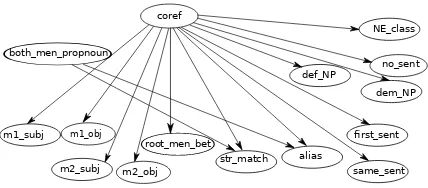
As explained before training instances are gener-ated from annotgener-ated corpus and testing instances from corpus having mentions detected automati-cally. Experiments are carried out with SVM lin-ear classifier and Bayesian network with prede-fined network structure. In these domains where the annotated data is scarce and the text is noisy, a Bayesian network with defined structure can work better(Antal et al., 2004). The network structure can incorporate the knowledge available along with the statistical information. Here the Bayesian network will integrate the benefits of both rule based and statistical approaches. A basic network structure is made use as described in fig 1.
We conducted 5-fold cross validation. As the mentions identified through automated mention detection are different from the annotated men-tions, the train and test CoNLL content are dif-ferent in terms of mention boundaries. Still dur-ing cross validation the posts considered for train-ing are not included in the testtrain-ing fold. Durtrain-ing 5-fold validation the test mention pairs are clas-sified as coreferent/not coreferent, which are then clustered to form the resultant CoNLL output. We applied best-first clustering(Ng, 2005), where the mention with highest likelihood value is selected as antecedent for an anaphoric mention.
per-Experiments MUC B3 CEAF-M
P R F P R F P R F
A 33.61 37.44 35.37 42.72 50.82 46.36 36.65 52.58 43.18
B 35.77 54.78 43.19 39.14 58.78 46.98 41.86 60.16 49.35
C 38.16 52.9 44.0 40.02 58.38 47.44 40.84 58.73 48.16
Table 3: Results (P:precision R:recall F:F-measure)
Experiments A: SVM without grammatical role features B: SVM with all features C: Bayes network with all features.
coref
m1_subj m1_obj
root_men_bet
str_match alias
first_sent def_NP
dem_NP no_sent NE_class
both_men_propnoun
same_sent m2_subj m2_obj
Figure 1: Bayesian network structure depicting dependencies between features
forming features and the most weakly performing 3 features are removed.
5 Results and Discussion
Results are reported in coreference evaluation
metrics MUC, B3 and CEAF-M. Experiment A
is without grammatical role features and exp. B clearly indicates the improvement with the gram-matical features. Experiment B and C uses all the selected features, using classifiers SVM and Bayes net respectively. As mentioned in section 4.3 the weakly performing features are removed using ab-lation testing and the results using these features are shown in table 3. The problems with men-tion detecmen-tion is one major cause for low accuracy. Even among identified mentions, the mismatch in boundaries is a concern. Analysis of the errors bring forth the major shortcomings and advantages of evaluated classification methods. The prob-lem of semantic incompatible mentions are coref-erent with SVM as classifier is almost absent with Bayesian network. Though it contributes well to precision, the recall is seen low compared to SVM because of the relative low importance given to the string matching and alias features.
There are common problems observed with both the classifiers. Despite the hypothesis we had about MEN1 ROOT SUBJ feature, it is ob-served that the introduction of this feature reduces
accuracy. There are instances of deictic phrases, where the phrase refers to an entity outside the scope of mentions defined in the discourse(Pinkal, 1986). Isolation of deictic phrases can alleviate many false alarms. Certain misclassification oc-curs at the clustering phase, where the wrong an-tecedent get selected instead of the correct one even when mention pair with the correct mention is classified as coreferent. Some mentions which are supposed to be singleton are clustered with other clusters because of their linkage with one of the mentions in the cluster.
6 Conclusion and Future Work
This paper focuses on coreference resolution in short discourse of text in Indian classical music. The evaluated mention pair features are expected to capture the specificities of coreferent mentions in short discourses. The devised methods are ex-pected to work well with similar nature forum texts.
Lack of annotated data poses serious problem to classification inspite of the prominent features. Bayesian network exhibits significant improve-ment in precision despite the small reduction in recall. Bayesian network assures the dominance required for the NE class feature, even though it leads to a few false alarms. The present network structure encodes limited dependencies. A more accurate network structure is evolving based on observations.
to different cluster based on likelihood values be-tween the mention and all the mentions in a clus-ter, instead of a single mention in the cluster.
References
Peter Antal, Geert Fannes, Dirk Timmerman, Yves Moreau, and Bart De Moor. 2004. Using litera-ture and data to learn Bayesian networks as clinical models of ovarian tumors. Artificial Intelligence in Medicine, 30:257–281.
Chinatsu Aone and Scott William Bennett. 1995. Evaluating automated and manual acquisition of
anaphora resolution strategies. In Proceedings of
the 33rd annual meeting on Association for Com-putational Linguistics, pages 122–129. Association for Computational Linguistics.
Colin Cherry and Shane Bergsma. 2005. An expecta-tion maximizaexpecta-tion approach to pronoun resoluexpecta-tion. InProceedings of the Ninth Conference on Compu-tational Natural Language Learning, pages 88–95. Association for Computational Linguistics.
Marie-Catherine De Marneffe and Christopher D Man-ning. 2008. The stanford typed dependencies
rep-resentation. In Coling 2008: Proceedings of the
workshop on Cross-Framework and Cross-Domain Parser Evaluation, pages 1–8. Association for Com-putational Linguistics.
Xiaowen Ding and Bing Liu. 2010. Resolving ob-ject and attribute coreference in opinion mining. In
Proceedings of the 23rd International Conference on Computational Linguistics, pages 268–276. Associ-ation for ComputAssoci-ational Linguistics.
Iris Hendrickx and Veronique Hoste. 2009. Corefer-ence resolution on blogs and commented news. In
Anaphora Processing and Applications, pages 43– 53. Springer.
Fang Kong, Guodong Zhou, Longhua Qian, and
Qiaoming Zhu. 2010. Dependency-driven
anaphoricity determination for coreference resolu-tion. InProceedings of the 23rd International Con-ference on Computational Linguistics, pages 599– 607. Association for Computational Linguistics. Joseph F McCarthy and Wendy G Lehnert. 1995.
Us-ing decision trees for coreference resolution. arXiv preprint cmp-lg/9505043.
Vincent Ng. 2005. Machine learning for corefer-ence resolution: From local classification to global
ranking. In Proceedings of the 43rd Annual
Meet-ing on Association for Computational LMeet-inguistics, pages 157–164. Association for Computational Lin-guistics.
Vincent Ng. 2007. Semantic class induction and coref-erence resolution. InACL, pages 536–543.
Manfred Pinkal. 1986. Definite noun phrases and the
semantics of discourse. InProceedings of the 11th
coference on Computational linguistics, pages 368– 373. Association for Computational Linguistics. Altaf Rahman and Vincent Ng. 2009. Supervised
models for coreference resolution. InProceedings
of the 2009 Conference on Empirical Methods in Natural Language Processing: Volume 2-Volume 2, pages 968–977. Association for Computational Lin-guistics.
rasikas. 2015. Rasikas.org. http://www.
rasikas.org.
Wee Meng Soon, Hwee Tou Ng, and Daniel Chung Yong Lim. 2001. A machine learning ap-proach to coreference resolution of noun phrases.
Computational linguistics, 27(4):521–544.
Mohamed Sordo, Joan Serr`a Juli`a, Gopala Krishna Ko-duri, and Xavier Serra. 2012. Extracting semantic information from an online carnatic music forum. In
Gouyon F, Herrera P, Martins LG, M¨uller M. ISMIR 2012: Proceedings of the 13th International Society for Music Information Retrieval Conference; 2012 Oct 8-12; Porto, Portugal. Porto: FEUP Edic¸oes; 2012. International Society for Music Information Retrieval (ISMIR).
Kristina Toutanova, Dan Klein, Christopher D. Man-ning, and Yoram Singer. 2003. Feature-rich part-of-speech tagging with a cyclic dependency network. InProceedings of the 2003 Conference of the North American Chapter of the Association for Computa-tional Linguistics on Human Language Technology - Volume 1, NAACL ’03, pages 173–180, Strouds-burg, PA, USA. Association for Computational Lin-guistics.
Olga Uryupina. 2006. Coreference resolution with
and without linguistic knowledge. InProceedings