Sentiment Classification of Arabic Documents: Experiments
with multi-type features and ensemble algorithms
Amine Bayoudhi
Lamia Hadrich Belguith
Hatem Ghorbel
ANLP Group, MIRACL
ANLP Group, MIRACL
ISIC Lab, HE-Arc
FSEGS, Sfax University
FSEGS, Sfax University
Applied Science University
3018, Sfax, TUNISIA
3018, Sfax, TUNISIA
CH-2610, Switzerland
[email protected] [email protected] [email protected]
Abstract
Document sentiment classification is of-ten processed by applying machine learn-ing techniques, in particular supervised learning which consists basically of two major steps: feature extraction and train-ing the learntrain-ing model. In the literature, most existing researches rely on n-grams as selected features, and on a simple basic classifier as learning model. In the context of our work, we try to improve document classification findings in Ara-bic sentiment analysis by combining dif-ferent types of features such as opinion and discourse features; and by proposing an ensemble-based classifier to investi-gate its contribution in Arabic sentiment classification. Obtained results attained 85.06% in terms of macro-averaged F-measure, and showed that discourse fea-tures have moderately improved F-measure by approximately 3% or 4%.
1
Introduction
With the expanding growth of social networks services, user generated content web has emerged from being a simple web space for peo-ple to express their opinions and to share their knowledge, to a high value information source for business companies to discover consumer feedbacks about their products or even to decide future marketing actions. Therefore, opinion mining is becoming a potential research domain interesting more and more researchers who at-tempt to improve current results and to solve more advanced and complex issues in the do-main. Typically, mining opinions is viewed as a
classification problem called sentiment classifi-cation. Sentiment classification aims to determine whether the semantic orientation of a text is posi-tive, negative or neutral. It can be tackled at many levels of granularity: expression or phrase level, sentence level, and document level. Expression sentiment classification aims to determine the pri-or sentiment class pri-or valence of an expression. As for sentence level, the objective is to calculate the contextual polarity of a sentence. Concerning document level, which is our focus in this re-search, the main goal is to mine the overall polari-ty of a document with the hypothesis that is ex-pressed by a single author towards a single target. Document sentiment classification is often processed by applying machine learning tech-niques, in particular supervised learning which consists basically of two major steps: feature ex-traction and training the learning model. In the literature, most existing researches rely on n-grams as selected features, and on a simple basic classifier as learning model. The limit of these two choices is revealed when shifting from one domain to another. As a matter of fact, in one hand, each domain has generally his specific vo-cabulary. So, n-grams features produced from one domain fail to be discriminative in another. In the other hand, numerous studies showed that the performance of classification algorithms is domain dependent (Xia et al., 2011).
In the context of our work, we try to improve document classification findings in Arabic sen-timent analysis by (i) combining different types of features such as opinion and discourse fea-tures; and by (ii) proposing an ensemble-based classifier consisting of a set of accurate basic classifiers to investigate its contribution in Ara-bic sentiment classification similarly to some other languages such as Chinese (Wang et al., 2014).
196
The rest of the paper is organized as follows. In section 2, we review a selection of related work to document sentiment classification for English and Arabic languages. In section 3, we detail our proposed approach and focus on the feature extraction and the classification model selection steps. In section 4, we describe the conducted experiments and discuss the obtained results. Finally, we summarize our conclusions and provide some perspectives.
2
Related Work
2.1 English Sentiment classification
In English sentiment classification, various strat-egies have been proposed, (Liu, 2012). The most effective ones are related to machine-learning paradigm, viewing the opinion and polarity de-tection as text classification tasks. These tech-niques vary from supervised to unsupervised learning, typically probabilistic methods such as Naïve Bayes (NB) and Maximum Entropy (MaxEnt), and linear discrimination methods such as Support Vector machine (SVM). As other pos-sible classification schemes, we mention non-parametric classifiers such as k-Nearest Neighbor (KNN), as well as similarity scores methods (i.e. phrase pattern matching, distance vector, frequen-cy counts and statistical weight measures).
Nevertheless, to get a good accurate classifier, we need to select the most effective set of textual predictors (Liu and Motoda, 2008). In sentiment classification, n-grams (Pang et al., 2002) are the most used features, however, there are some re-searches where other semantic features are tested such us opinion words and phrases, opinion op-erators such as negation (Mejova et al., 2011), parts of speech (Wang et al., 2014), and syntactic dependencies (Nakagawa et al., 2010). Some other researches attempt to integrate discourse features and report a significant added value of rhetorical roles in sentiment classification (Chardon et al., 2013). For instance, So-masundarun et al. (SoSo-masundarun et al., 2009) proposed a supervised and unsupervised methods employing Discourse relations to improve senti-ment classification. This is performed by adopt-ing relational feature that exploit discourse and neighbor opinion information.
In general, most of adopted features tend to be domain specific (e.g., the term television has a negative polarity in a movie review, but may have a positive one in a book review). This prob-lem can be solved by the second approach: the lexicon based approach.
Lexicon-based approach relies on a sentiment lexicon to calculate orientation for a document from the semantic orientation of words or phrases in the document (Taboada et al., 2011). Sentiment lexicon is a collection of classified opinion terms that can be compiled according to three approaches: dictionary-based approach, corpus-based approach, or combined approach.
In dictionary based approach, we attempt to find a set of opinion seed words and then enrich them by retrieving their synonyms and antonyms from dictionaries such WordNet and Thesaurus. For instance, Hu and Liu (Hu and Liu, 2004) and Esuli and Sebastiani (Esuli and Sebastiani, 2005) classify polarity using emotion words and se-mantic relations from WordNet, WordNet Gloss, WordNet-Affect and SentiWordNet respectively. However, in corpus-based approach, we use patterns in particular syntactic ones to mine large domain specific corpora and extract opinion terms. Among well-known researches in lexicon-based approach, we mention those of Taboada et al. (Taboada et al., 2011) who developed a se-mantic orientation calculator called SO-CAL. They started by manually creating a sentiment lexicon by annotating a large corpus of reviews extracted from Epinions website. The lexicon was enhanced by positive and negative words from the General Inquirer dictionary. To calcu-late the semantic orientation of each review, the authors took in consideration intensification by multiplying intensifier words by a percentage, and they incorporated Negation by shifting the semantic orientation toward the opposite polarity by a fixed amount.
Note that some researches combined the ma-chine learning and the lexicon based approaches by exploiting a sentiment lexicon in the frame-work of a supervised learning method (Mejova et al., 2011) (Maynard et al., 2011).
2.2 Arabic Sentiment Classification
Most of the work in sentiment analysis was de-voted to the English language, an important number of resources and tools have been elabo-rated accordingly. When addressing the same issue to other target languages such as Arabic, several difficulties come out as potential chal-lenges, including the lack of standard lexical and sentiment resources and of good accurate linguis-tic analyzers and parsers. That’s why, we consid-er that Arabic sentiment classification is still lim-ited compared to English.
classifica-tion of Arabic documents. These researches have been the object of some surveys (Korayem et al., 2012) (Al-Twairesh et al., 2014). For example, we cite Abbasi et al. (Abbasi et al., 2008) who proposed a machine learning method based on entropy weighted genetic algorithms to classify movie reviews and forum comments in English and Arabic. Conducted experiments based main-ly on stylistic features yielded an accuracy of 93.62% but with a high computational cost.
Rushdi-Saleh et al. (Rushdi-Saleh et al., 2011) have introduced in their research a new collected corpus of movie reviews called OCA (Opinion Corpus for Arabic). They reported as well as some experiments based on n-grams words and carried out with SVM and NB classifiers. The best F-measure attained 90.73% with SVM classifier.
Mountassir et al. 2013 (Mountassir et al., 2013) investigated three classification settings in an n-grams framework based on three classifiers namely NB, SVM and KNN. The tested settings are stemming type, term frequency thresholding and term weighting. Experiments are performed on two data collections: OCA and ACOM (col-lected by the authors). Best results in terms of F-measure attained 93% on OCA with KNN classi-fier and 87.5% and 76.4% respectively on ACOM DS1 and ACOM DS2 with NB classifier.
El-Halees (El-Halees, 2011) followed an hy-brid sequential approach by applying lexicon-based method with a seed word list enriched from online dictionaries. Classified documents were then used to train a MaxEnt based classifi-er. Classified documents of the two previous steps were finally used to train a KNN based classifier. Experiments were conducted on a mul-ti-domain corpus consisting of 1143 documents. Achieved accuracy was around of 80%.
3
Proposed Approach
In this section, we present our approach proposed for the sentiment classification of Arabic docu-ments. This approach, based on multi-type fea-tures, is using a set of publicly available linguis-tic resources and tools. It takes as input an Ara-bic review about a given target and predicts its polarity which can be Positive or Negative. The approach consists chiefly of three sequential phases which are composed of one or more steps. The three phases are: document pre-processing, feature extraction, and sentiment classification.
3.1 Data Description
In Arabic language, sentiment resources are in general rare. However, in the task of document sentiment classification, there are many used da-ta collections since they are easy to collect and to annotate. In fact, we remark that each researcher has collected his own datasets and used in the evaluation of his classification approach, which does not allow comparing properly the obtained results. Therefore, we have decided to use in our experiments existent datasets that have been widely used by the NLP research community.
According to the literature, there are few pub-licly available sentiment corpora for document sentiment classification. They are derived from different domain such as social networks (Abdullah et al., 2013), product reviews (Abbasi et al., 2008) (Rushdi-Saleh et al., 2011) (Mountassir et al., 2013) and news (Ahmad et al., 2006) (Almas et al., 2007). Among these corpo-ra, the most used one is OCA (Rushdi-Saleh et al., 2011) and the largest one is ACOM (Mountassir et al., 2013). That’s why, we have chosen these two corpus to evaluate our ap-proach and to compare our results.
OCA (Opinion Corpus for Arabic) consists of 500 documents divided equally into positive and negative (Table 1). The corpus was collected by extracting reviews about movies from Arabic web pages and blogs. After that, many pro-cessing steps on each review were carried out in order to obtain a formatted document. The main steps were removing HTML tags and special characters, correcting spelling mistakes, filtering out nonsense and nonrelated comments, fixing Romanized comments and comments in different languages. The classification of documents into positive and negative were automatically per-formed by exploiting the review rating score giv-en by the user. This annotation strategy avoids wasting time in manual annotation, but, it does not always succeed to assign the right class to the an-notated review. In fact, reviewers can mention much more negative feedbacks than positive ones, but give a weak positive rating score to the movie.
Property Neg. Pos.
Total documents 250 250
Total tokens 94,556 121,392
Avg. tokens in each file 378 485
Total sentences 4,881 3,137
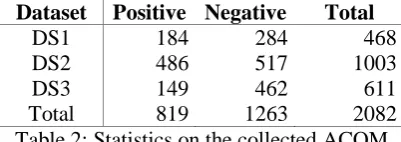
ACOM (Arabic Corpus for Opinion Mining) is a multi-genre corpus collected from Aljazeera polls and forums. It consists of three datasets of different domains. The first dataset DS1 consists of 594 documents and falls within movie review domain. The second dataset DS2 is sport-specific dataset and consists of 1492 comments about 18 sport topics. The third dataset DSP2 is a collec-tion of 1082 comments about a political issue titled “Arab support for the Palestinian affair”. ACOM were manually annotated according to four classes: positive, negative, neutral and dia-lectal. Then, neutral and dialectal categories were eliminated since the authors were interested in classification by polarity of documents written only in Modern Standard Arabic (Table 2).
Dataset Positive Negative Total
DS1 184 284 468
DS2 486 517 1003
DS3 149 462 611
Total 819 1263 2082
Table 2: Statistics on the collected ACOM
In addition, the authors proceeded to eliminate a number of negative comments from each da-taset in a way to equalize the number of docu-ments for each category (Mountassir et al., 2013). The final number of documents used in experiments is 1368 documents: 698 negative and 670 positive (Table 3).
Property Negative Positive
Total documents 698 670
Total tokens 45697 38819
Avg. tokens in each file 65.46 57.93 Table 3: Statistics on the datasets of ACOM
used in experiments
3.2 Document preprocessing
Before going on with the classification task, some preprocessing steps are necessary to pre-pare the raw documents to the feature extraction step. This step requires to search and to identify a set of lexical cue words and markers. To this end, three main steps are required: segmentation, stemming and stop-word removal.
Segmentation: This step, which we carried out using Stanford word segmenter (Monroe et al. , 2014), includes text normalization and word segmentation. Normalization aims to normalize the spelling of some Arabic characters which can be written in different ways. Arabic text can be vowelized, non-vowelized, or even partially vowelized. To ensure the detection and extrac-tion of all orthographic word forms, we decided
to eliminate discretization from the reviews. Normalization is also applied to some characters such as alef by transforming all his forms (Alef Hamza above "أ" and Alef Hamza below "إ") into bare Alef "ا". This process is applied because many reviewers omit or confuse these similar letters and use them interchangeably.
Stemming: MADAMIRA (Pasha et al., 2014) is used to apply a light stemming on the reviews. Light stemming aims, to transform nouns in sin-gular and to conjugate verbs with the third per-sonal pronoun. In fact, stemming, which reduces words to their roots, is not convenient in Arabic language, because it may affect the word sense. Light stemming will be helpful to detect all mor-phological variations of the word.
Stop-word removal: To accelerate the detec-tion process of the lexical cues, we have profited from the stop-word list of Khoja stemmer tool (Khoja and Garside, 1999) and revised it. In fact, this Stop-word list was established to serve in-formation retrieval applications. However, in sentiment classification task, a more reduced list is required, because many non-informative bear-ing words (such as negation operators and dis-course markers) can be helpful cues in sentiment classification.
3.3 Extraction of classification features
In English language, several features ranging from lexical to deep analysis features were tested in the sentiment classification task. However, in Arabic, research works were focused on lexical or statistical features in particular n-grams. This is due to many reasons basically the lack of sen-timent resources (i.e. lexicons, standard annotat-ed corpora) and high accurate linguistic tools (i.e. syntactic parser, segmenter). That’s why, we propose to adopt a set multi-type features. Our selected features are: opinion features, discourse markers, stylistic features, domain dependent features and morpho-lexical features. In feature extraction step, a set of linguistic resources and tools are required.
Stylistic features: consist mainly of:
Punctuation marks: three punctuation marks are considered in our research: period (full stop), question mark and exclamation mark. Comma is not taken into account since it is not often used in Arabic writing.
Number of words per document.
Polarities of the first and last expressed opinion words: based on the assumption that the first and last sentences of a document are the most informative sentences, we added to our sty-listic features the polarity of the first expressed opinion word and the polarity of the last ex-pressed opinion word.
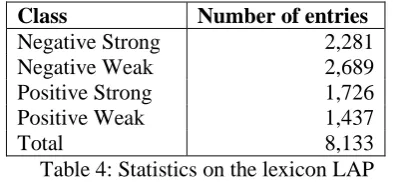
Domain dependent features: n-grams are widely used as features in text classification and sentiment classification for their capacity to en-code word order information and substantially the context of the document (Pang et al., 2002). However, these features are domain dependent; they cause a big decrease in the performance of the classifier when testing it with other data col-lections. Therefore, we have decided to minimize the effect of domain dependent features by ex-cluding unigrams and relying only on bigrams and trigrams. Choosing bigrams and trigrams is explained also by the fact that the lexicon LAP does not contain compound words. Hence, to feed the classifier with compound words, we se-lected a set of bigrams and trigrams based on their frequency.
Morpho-lexical features: Since adjectives and adverbs are the most morphological forms expressing opinions, and since the lexicon LAP do not include Part-of-speech information, we propose to consider, as additional features, the number of positive adjectives and adverbs and also the number of negative adjective and ad-verbs in each document.
3.4 Feature transformation
Feature transformation step determines the nu-merical representation used in the classification process. It’s performed by applying a weighting scheme on the extracted textual data of the cor-pus. We distinguish three weighting schemes: binary, term frequency and TF-IDF representa-tion. Binary schema takes into account presence or absence of a term in a document. Term fre-quency considers the number of times a term oc-curs in a document (Li et al., 2009). TF-IDF (Term Frequency - Inverse Document Frequen-cy) considers not only term frequencies in a
docu-ment, but also the relevance of a term in the entire collection of documents (Manning et al., 2008).
Many researches confirm that the most suita-ble representation for sentiment classification is binary since overall sentiment may not usually be highlighted through repeated use of the same terms. In fact, Pang et al. (Pang et al., 2002) showed in their experiments that better perfor-mance is obtained using presence rather than fre-quency, that is, binary-valued feature vectors in which the entries merely indicate whether a term occurs or not formed a more effective basis for review polarity classification. Whereas, Mountassir et al. (Mountassir et al., 2013) point out that TF-IDF is also a suitable weighting for SVM and KNN.
3.5 Attribute selection
Attribute selection aims to evaluate the effective-ness of features by identifying relevant features ones to be considered in the learning process. This is allows performing an intense dimensionality re-duction without losing on the classifier accuracy.
There are many algorithms for attribute selec-tion such as informaselec-tion gain (Abbasi et al., 2008), mutual information, and chi-square (Li et al., 2009). None of them has been widely accept-ed as the best feature selection method for senti-ment classification, despite the fact that infor-mation gain has often been competitive: it ranks terms by considering their presence and absence in each class (Moraes et al., 2013).
3.6 Learning Algorithm
The proposed solution for this problem is adopting the ensemble technique. This technique consists in combining, in an efficient way, the outputs of several classification models to form an integrated output. We distinguish in the litera-ture many combination types such as sum, vot-ing, weighted combination and meta-classifier (Xia et al., 2011). In the context of our research, we are focusing on four well-known ensemble al-gorithms namely Bagging (Breiman, 1996), Boost-ing (Schapire et al., 1998), VotBoost-ing (Kuncheva, 2004) and Stacking (Syarif et al., 2012).
4
Experiments and discussion
In this section, we carried out two types of exper-iments. The first type of experiments focus on evaluating a set of base learning algorithms ver-sus a set of ensemble based classifiers. The ob-jective is to find the combination configuration that ensures the best and stable performance across different domains. The second type of ex-periments concentrates on the feature set used in the classification process. The objective is to evaluate, in particular, the effectiveness of dis-course features in Arabic sentiment classifica-tion.
All results reported in this section are obtained by applying an evaluation method based on 10-folds cross validation. Attribute transformation, attribute selection and learning algorithms are applied using the Weka data mining software (Hall et al., 2009). Binary representation is used for opinion features, and the TF-IDF representa-tion for bigrams and trigrams.
4.1 Base Classifier evaluation
In this first type of experiments, we conducted a comparative evaluation of three well-known classification algorithms namely SVM, MaxEnt and ANN. The objective is to determine the best accurate base algorithm in each dataset. Many attempts with different parameters are made to achieve the best performance. These experiments were performed on the following data collec-tions: OCA, ACOM DS1, ACOM DS2, ACOM DS3, ACOMB (ACOM Balanced data), ACO-MA (ACOM All data).
Obtained results are expressed in terms of F-measure (Table 6). But, since we are applying our model to several sets of data, we need an av-eraging evaluation metric to get an idea about the best performance in the overall experiments. There are two types of averaging methods: mac-ro-averaged and micro-averaged.
Macro-averaging gives equal weight to each dataset, whereas micro-averaging gives equal weight to each document. Because the F-measure ignores true negatives and is mostly determined by the number of true positives, large datasets dominate small datasets in micro-averaging. Micro-averaged results are therefore really a measure of effectiveness on the large datasets in a test col-lection (Van Asch, 2013). Hence, we have used in Table 6 macro-averaged F-measure to com-pare the performance of the three algorithms on the different datasets.
Compared to earlier work, our results overstep state of the art existing performances. Indeed, MaxEnt classifier tested in OCA has achieved 95% of F-measure, which exceed 93% reported by Mountassir et al. with KNN classifier (Mountassir et al., 2013) and 90.73% reported by Rushdi-Saleh et al. with SVM classifier (Rushdi-Saleh et al., 2011). Similarly, our obtained re-sults in ACOM DS1 and ACOM DS2 which are respectively 89.3% and 80.1% exceed Mountas-sir et al. reported results (87.5% and 76.4%). Concerning ACOM DS3, ACOMA and ACOM, these data collections are not yet evaluated by any earlier work.
Dataset SVM MaxEnt ANN
OCA 91.8 95 90.6
ACOM DS1 86 87.5 89.3
ACOM DS2 80.1 80 76.2
ACOM DS3 89.5 86.2 86.8
ACOMB 80.5 80.1 77.8
ACOMA 79.6 75.7 76.1
Macro-avg 84.58 84.08 82.8
Table 6: Results of the base classifiers
According to our experiments, SVM seems to be the most stable classifier among the three classifiers. In fact, it achieved the best results on ACOM DS2, ACOM DS3, ACOMB and on ACOMA.
docu-ments discuss only one political issue, which explain why the classification results were good. Concerning ACOMA and ACOMB, as expected, results were better in ACOMB in which the num-ber of documents is much less than ACOMA.
4.2 Ensemble classifier evaluation
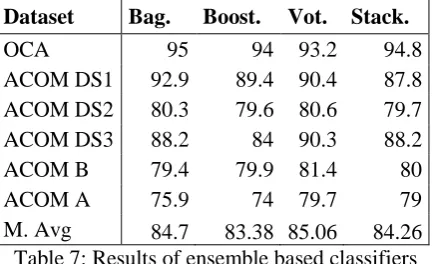
In addition to the evaluation of base classifiers, we conducted another set of experiments to eval-uate ensemble classifiers with the same datasets and evaluation metrics. The combination of the classifiers is performed according to the four methods: boosting, bagging, voting and stacking. Several experiments are performed to choose the base classifiers and the combination method that reach the best performance. At the end, we have maintained these four experiments: (i) bagging MaxEnt, (ii) boosting MaxEnt, (iii) majority vot-ing with SVM, MaxEnt and ANN as base classi-fiers, (iiii) stacking SVM and MaxEnt with Line-ar regression as meta-classifier. The results achieved in each experiment are illustrated in terms of measure and macro-averaged F-measure in Table 7.
Dataset Bag. Boost. Vot. Stack.
OCA 95 94 93.2 94.8
ACOM DS1 92.9 89.4 90.4 87.8
ACOM DS2 80.3 79.6 80.6 79.7
ACOM DS3 88.2 84 90.3 88.2
ACOM B 79.4 79.9 81.4 80
ACOM A 75.9 74 79.7 79
M. Avg 84.7 83.38 85.06 84.26
Table 7: Results of ensemble based classifiers
Compared to Table 6, Table 7 indicates that most of the selected ensemble classifiers have exceeded the results yielded by base classifiers in terms of macro-averaged F-measure. In particu-lar, majority voting of MaxEnt, SVM and ANN has achieved the best results with a macro-averaged F-measure of 85.06%. In five among six datasets, this ensemble classifier has per-formed better results than the best base classifiers.
4.3 Discourse feature evaluation
In order to evaluate the effectiveness of the dis-course features, we have reapplied the best accu-rate base algorithms on our datasets with remov-ing discourse features. This was performed with respecting all pre-mentioned constraints of at-tribute transformation and atat-tribute selection steps. Table 8 presents the new achieved F-measure in each dataset with the best accurate
algorithm obtained according to the experiments described in section 4.1.
Dataset Best classifier
F-meas. (%)
Diff (%)
OCA MaxEnt 92.6 -2.4
ACOM DS1 ANN 85.3 -4
ACOM DS2 SVM 79.7 -0.4
ACOM DS3 SVM 89.2 -0.3
ACOMB SVM 80.5 0
ACOMA SVM 79.82 0
Table 8: Discourse feature evaluation Obtained results show that discourse features are more efficient with OCA and ACOM DS1 derived from movie review domain. In fact, re-moving discourse features with OCA and ACOM DS1 has respectively decreased F-measure by 2.4% and 4%. This can be explained by the fact that in movie review domain in particular, dis-course markers are frequently employed.. Never-theless, regarding ACOM DS2 and ACOM DS3, the results were not very altered by removing discourse features since F-measure has decreased only by 0.3% and 0.4%. So, this type of features is not very efficient for sport or political domain. Concerning the two last experiments, removing discourse features while evaluating ACOMA and ACOMB has not revealed any impact on the classification results.
5
Conclusion
In this paper, we have proposed a supervised classification approach of Arabic documents. The proposed approach is based on multi-type feature set including opinion features, discourse markers, stylistic features, domain dependent features and morpho-lexical features. In addition, we have carried out a comparative study between some well-known base classifiers and some en-semble-based classifier with different combina-tion methods. Obtained results showed that MaxEnt, SVM and ANN combined with majori-ty voting rules have achieved the best results with a macro-averaged F1-mesaure of 85.06%. Furthermore, experiments showed that discourse features have improved F-measure by approxi-mately 3% or 4%.
References
Abbasi A., Chen H., Salem A. 2008. Sentiment analy-sis in multiple languages: Feature selection or opin-ion classificatopin-ion in Web forums. ACM Transactopin-ions on Information Systems 26(3):12.
Abdul-Mageed M., Diab M. 2012. AWATIF: A Multi-Genre Corpus for Modern Standard Arabic Subjec-tivity and Sentiment Analysis. In Proc LREC 2012, pp. 3907-3914.
Ahmad K., Cheng D., Almas Y. 2006. Multi-lingual sentiment analysis of financial news streams. In Proc. of the 1st International Conference on Grid in Finance.
Almas Y., Ahmad K. 2007. A note on extracting sen-timents in financial news in English, Arabic & Urdu. In Proc of Workshop on Computational Approaches to Arabic Script-based Languages.
Al-Saif A., Markert K. 2010. The Leeds Arabic dis-course treebank: Annotating disdis-course connectives for Arabic. In Proc of LREC, 17-23 May, Malta.
Al-Twairesh N., Al-Khalifa H., Al-Salman A. 2014. Subjectivity and Sentiment Analysis of Arabic: Trends and Challenges. In Proc. Of the 11th ACS/IEEE International Conference on Computer Systems and Applications (AICCSA' 2014), Doha, Qatar, 10-13 November.
Asher N. 1993. Reference to Abstract Objects in Dis-course. Kluwer Dordrecht.
Bayoudhi A., Koubaa H., Ghorbel H., Hadrich Bel-guith L. 2014. Vers un lexique arabe pour l’analyse des opinions et des sentiments, In Proc of the 5th In-ternational Conference on Arabic Language Pro-cessing CITALA’14, Oujda, Morocco, 26 – 27 No-vember.
Boudabous M.M., Chaâben Kammoun N., Khedher N., Hadrich Belguith L., Sadat F. 2013. Arabic Word-Net semantic relations enrichment through morpho-lexical patterns, in Proc. of the First International Conference on Communications, Signal Processing, and their Applications (ICCSPA’13), Sharjah, UAE, February 12-14.
Breiman L. 1994. Bagging predictors. Technical Report 421, Department of Statistics, University of Califor-nia, Berkeley.
Chardon B. 2013. Chaîne de traitement pour une ap-proche discursive de l'analyse d'opinion. Phd disser-tion UPS France.
Elarnaoty M., AbdelRahman S., Fahmy A. 2012. A machine learning approach for opinion holder ex-traction in Arabic, International Journal of Artificial Intelligence & Applications; March 2012, Vol. 3 Is-sue 2, p45.
El-Halees A. 2011. Arabic Opinion Mining Using Com-bined Classification Approach. In Proc of the interna-tional Arab Conference on Information Technology, 11-14 December, Riyadh, Saudi Arabia.
Esuli A., Sebastiani F. 2006. SentiWordNet: A Publicly Available Lexical Resource for Opinion Mining. In Proc of the fifth international conference on Lan-guage Resources and Evaluation, 22-28 May, Gen-oa, Italy.
Hall M., Frank E., Holmes G., Pfahringer B., Reute-mann P., Witten I.H. 2009. The WEKA data mining software: an update, ACM SIGKDD Explorations Newsletter, Volume 11 Issue 1, pp 10-18, June 2009.
Hu M., Liu B. 2004. Mining Opinions Features in Cus-tomer Reviews. Proc of 19th international conference on Artificial Intelligence AAAI, 25-29 July, San Jo-se, California, pp. 755-760.
Keskes I. 2015. Discourse Analysis of Arabic Docu-ments and Application to Automatic Summarization. PhD dissertion, UPS France.
Khoja S. and Garside R. 1999. Stemming Arabic Text, UK: Computing Department, Lancaster University.
Khalifa I., Feki Z., Farawila A. 2011. Arabic discourse segmentation based on rhetorical methods. In Elec-tric Computer Sciences 11.
Korayem M., Crandall D., Abdul-Mageed M. 2012. Subjectivity and Sentiment Analysis of Arabic: A Survey. in Advanced Machine Learning Technolo-gies and Applications AMLTA, 322.
Kuncheva L. 2004. Combining pattern classifiers: methods and algorithms. John Wiley & Sons.
Li S., Xia R., Zong C., Huang C.-R. 2009. A frame-work of feature selection methods for text categori-zation. In Proc of the 47th Annual Meeting of the Association for Computational Linguistics, 2-7 Au-gust, suntec, Singapore.
Liu B. 2009. Sentiment Analysis and Opinion Min-ing. Boca Raton: Morgan & Claypool Publishers.
Liu B. 2011. Web data mining: Exploring hyperlinks, New York: Springer, Lovins, J. B. (1968). Devel-opment of a stemming algorithm. Mechanical Trans-lation and Computational Linguistic.
Liu H., Motoda H. 2008. Computational Methods of Feature Selection, Boca Raton: Chapman & Hall.
Manning C.D., Raghavan P., Schtze H. 2008. Introduction to information retrieval. Cambridge University Press.
Medhat W., Hassan A., Korashy A. 20140. Sentiment analysis algorithms and applications: A survey. Ain Shams Engineering Journal 5, pp. 1093–1113.
Mejova Y., Srinivasan P. 2011. Exploring Feature Def-inition and Selection for Sentiment Classifiers. In Proc of the Fifth International AAAI Conference on Weblogs and Social Media ICWSM, 17-21 July, Barcelona, Spain.
Monroe W., Green S., Manning C.D. 2014. Word Segmentation of Informal Arabic with Domain Ad-aptation. In Proc of the 52nd Annual Meeting of the Association for Computational Linguistics, 22-27 June, Baltimore, USA.
Moraes R., Francisco Valiati J., Gavião Neto W.P. 2013. Document-level sentiment classification: An empirical comparison between SVM and ANN. Ex-pert Systems with Applications 40, pp. 621-633.
Mountassir A., Benbrahim H., Berrada I. 2013. Senti-ment classification on Arabic corpora: A prelimi-nary cross-study. Document Numérique 16(1): 73-96.
Nakagawa T., Inui K., Kurohashi S. 2010. Dependency Tree-based Sentiment Classification using CRFs with Hidden Variables, Human Language Technol-ogies, The 2010 Annual Conference of the North American Chapter of the ACL NAACL HLT, pp 786–794, 1-6 June, Los Angeles, California.
Palmer F. 1986. Mood and Modality. Cambridge Uni-versity Press.
Pang B., Lee L., Vaithyanathan S. 2002. Thumbs up? Sentiment Classification using Machine Learn-ing Techniques, In Proc of the Conference on Em-pirical Methods in Natural Language Processing EMNLP, 6-7 July, Philadelphia, PA, USA.
Pasha A., Al-Badrashiny M., Diab M.T., El-Kholy A., Eskander R., Habash N., Pooleery M., Rambow O., Roth R. 2014. MADAMIRA: A Fast, Comprehen-sive Tool for Morphological Analysis and Disam-biguation of Arabic. In Proc of the The 9th edition of the Language Resources and Evaluation Conference LREC, 26-31 May, Reykjavik, Iceland.
Rushdi-Saleh M., Martın-Valdivia M., Urena-Lopez L., Perea-Ortega J. 2011. OCA: Opinion corpus for Ar-abic. Journal of the American Society for Infor-mation Science and Technology 62(10).
Saurı R. 2008. A Factuality Profiler for Eventualities in Text. PhD dissertation.
Schapire R. E., Freund Y., Bartlett P., Lee W.S. 1998. Boosting the margin: A new explanation for the ef-fectiveness of voting methods. Annals of Statistics.
Somasundaran S., Namata G., Wiebe J., Getoor L. 2009. Supervised and unsupervised methods in em-ploying discourse relations for improving opinion polarity classification. In Proc of the conference on
Empirical Methods in Natural Language Processing EMNLP, 6-7 August, Suntec, Singapore.
Syarif I, Zaluska E., Prugel-Bennett A., Wills G. 2012. Application of bagging, boosting and stacking to in-trusion detection. In Proc of the 8th International Conference on Machine Learning and Data Mining MLDM, 13-20 Jul, Berlin, DE.
Taboada M., Brooke J, Tofiloski M., Voll K., Stede M. 2011. Lexicon-based methods for sentiment analy-sis. Computational Linguistics 37, pp 267 -307.
Van Asch V. 2013. Macro- and micro-averaged evalua-tion measures [[basic draft]].
Wang G., Sun J., Ma J., Xue K., Gud J. 2014. Senti-ment classification: The contribution of ensemble learning. Decision Support Systems 57, pp. 77–93.