Copyright 2012 by Yun Huang, Min Zhang, and Chew Lim Tan
Improved Constituent Context Model with Features
Yun Huang1,2 Min Zhang1 Chew Lim Tan2
[email protected] [email protected] [email protected] 1Human Language Department 2Department of Computer Science
Institute for Infocomm Research National University of Singapore 1 Fusionopolis Way, Singapore 13 Computing Drive, Singapore
Abstract
The Constituent-Context Model (CCM) achieves promising results for unsupervised grammar induction. However, its performance drops for longer sentences. In this paper, we describe a general feature-based model for CCM, in which linguistic knowledge can be easily integrated as features. Features take the log-linear form with local normalization, so the Expectation-Maximization (EM) algorithm is still applicable to estimate model parameters. The ℓ1-norm is used to control the model complexity, leading to sparse and compact grammar. We also propose to use a separated development to perform model selection and an additional test set to evaluate the performance. Under this framework, we could automatically choose suitable model parameters rather than setting them empirically. Experiments on the English treebank demonstrate that the feature-based model achieves comparable performance on short sentences but significant improvement on longer sentences.
1 Introduction
Unsupervised grammar induction, the task to in-duce hierarchical structures from plain strings, has attracted research interests for a long time. The induced grammars can be used to construct large treebanks (van Zaanen, 2000), study language ac-quisition (Jones et al., 2010), improve machine translation (DeNero and Uszkoreit, 2011), and so on. In general, most approaches either induce the constituency grammars (Klein and Manning, 2002;
Bod, 2006; Seginer, 2007; Cohn et al., 2009; Ponvert et al., 2011), or the dependency grammars (Klein and Manning, 2004; Headden III et al., 2009; Cohen and Smith, 2009; Spitkovsky et al., 2010; Blunsom and Cohn, 2010).
Among these approaches, the Constituent Context Model (CCM) (Klein and Manning, 2002; Klein, 2005) is a simple but effective generative model for unsupervised constituency grammar induction. Specifically, the sequences (the contents enclosed by spans) and contexts (the preceding and follow-ing words) are directly modelled in CCM. The Expectation-Maximization (EM) algorithm is used to estimate parameters to optimize the data likeli-hood. Although the CCM achieves promising re-sults on short sentences, its performance drops for longer sentences. There are two possible reasons: (1) CCM models all constituents under only single multinomial distributions, which can not capture the detailed information of span contents; and (2) long sequences only occur a few times in the training cor-pus, so the probability estimation highly depends on smoothing. Another problem of original CCM and following improved unsupervised models (Smith and Eisner, 2004; Mirroshandel and Ghassem-Sani, 2008; Golland et al., 2012) is the problematic evalu-ation framework. The previous approaches train and evaluate models on the same dataset, so there is no reasonable way to choose model parameters unless setting them empirically.
In this paper, we focus on CCM and present a general feature-based framework in which various overlapping features could be easily added. Pre-vious dependency induction approach (Cohen and
Smith, 2009) demonstrates enabling factored covari-ance between the probabilities of different derivation events could improve the induction results. The pro-posed feature-based model provides a simpler and more flexible way to share information between con-stituents, e.g. different sequences may share the same boundary words. Various features could cap-ture rich information about span contents, which alleviates the data sparsity problem and estimation problem of CCM mentioned above. In addition, fea-tures are combined in the log-linear form with local normalization, so the EM algorithm can be adopted to estimate model parameters with minor change, without increasing the computing complexity. To avoid overfitting, we use ℓ1-norm regularization to control the model complexity. Finally, we advocate to estimate model probabilities on training set, use a separated development set (a.k.a. the validation set) to perform model selection, and measure the gener-ative ability of trained model on an additional test set. Under this framework, we could automatically select suitable model and parameters rather than choosing them manually. We carry out experiments on the English treebank. Compared to original CCM, the proposed feature-based model achieves comparable performance on short sentences but sig-nificant improvement on longer sentences. After ex-amining the effect of grammar sparsity, we conclude that with good regularization parameter (tunned on the development set), the learned grammar could be both compact and accurate.
The main contributions of this paper can be sum-marized as follows:
(1) We present a general feature-based CCM, where knowledge can be easily incorporated.
(2) We useℓ1-norm to control the model complex-ity, leading to compact grammars.
(3) We propose to use separated development set to tune parameters instead of heuristically choosing parameters.
This paper is structured as follows. Section 2 gives an overview of the original CCM. Section 3 proposes the feature-based CCM and corresponding parameter estimation method. Section 4 lists the fea-ture templates used in experiments. Section 5 shows the experimental results. We compare our work to related approaches in Section 6 and conclude in Sec-tion 7.
2 Constituent Context Model
The Constituent-Context Model (CCM) (Klein and Manning, 2002) is the first model achieving better performance than the trivial right branching base-line in the unsupervised English grammar induction task. Unlike many models that only deal with con-stituent spans, the CCM defines generative proba-bilistic models over all spans of a sentence, no mat-ter whether they enclose constituents or distituents (a.k.a. the non-constituents).
In particular, letB be a boolean matrix with tries indicating whether the corresponding span en-closes constituent or distituent. Note that each tree could be represented by one and only one bracket-ing, but some bracketings are not tree-equivalent, since they may miss the full-sentence span or have crossing spans. Define sequence σ to be the sub-string enclosed by span, and contextγto be the pair of preceding and following terminals1. The CCM generate a sentence S in two steps: first choose a bracketing B according to prior distribution, then generate the sentence given the chosen bracketing:
P(S, B) =P(B)P(S|B).
The prior P(B) uniformly distributes its probabil-ity mass over all possible binary trees of the given sentence, and zero for non-tree-equivalent bracket-ings. The conditional probabilityP(S|B)is further decomposed to the product of generative probability of sequenceσand contextγ for each spanhi, ji:
P(S|B) = Y hi,ji
P(σhi,ji, γhi,ji|Bhi,ji)
=Y
hi,ji
P(σhi,ji|Bhi,ji)P(γhi,ji|Bhi,ji). (1)
From the above decomposition, we can see that givenB, the CCM fills each span independently and generates yield and context independently.
The Expectation Maximization (EM) algorithm is used to estimate the multinomial parameters θ. In the E-step, a cubic-time dynamic programming al-gorithm is used to calculate the expected counts for
1For example, in sequence “0RB
1DT2NN3”, we haveσh1,3i=
4 Feature Templates
4.1 Basic features
There are two kinds of features: constituent features, with prefix {c:}; and distituent features, with prefix {d:}. Features in the two categories are active only if the span enclose constituent or distituent respec-tively. The basic feature templates are listed as fol-lows with their names and descriptions. A running example, spanh1,3iin “0RB1DT2NN3”, is also shown for each feature template.
•const: This constant feature always takes value
1for any given span. We use this feature to measure the number of spans.
•seq[n]: This indicating feature is active for se-quence enclosed by span with sizen. Ifn= 0, then sequences with any lengths are considered.
seq2 . . . DT_JJ DT_NN RB_DT . . .
value . . . 0 1 0 . . .
• lx[n]/rx[n]: The indicating feature for the preceding/following nterminals (left/right context), where⋄represents sentence boundary.
lx2 . . . ⋄_⋄ ⋄_RB RB_DT . . .
value . . . 0 1 0 . . .
rx2 . . . DT_NN NN_⋄ ⋄_⋄ . . .
value . . . 0 0 1 . . .
• lb[n]/rb[n]: The left/right nboundary termi-nals inside given span. If the length of span is less thann, then this feature template is not activated.
lb2 . . . RB_DT DT_NN TO_VB . . .
value . . . 0 1 0 . . .
rb1 . . . RB DT NN . . .
value . . . 0 0 1 . . .
4.2 Composite features
Basic features can be composited to more compli-cated features. We define two composition opera-tors: join (.), and concatenation (+). For the join op-erator, the composited feature space is the Cartesian product of the feature spaces of the two operands. For the concatenation operator, the composited ture space is the concatenation of the operands’ fea-ture spaces.
Here we use an example to demonstrate the differ-ence between join operator and concatenation oper-ator. Assuming there are three possible values {⋄,
RB, DT} for feature lx1, and three possible values {DT,NN, ⋄} for feature rx1, then the joined feature space has3×3 = 9dimensions while the concate-nated feature space has3 + 3 = 6dimensions. The feature vectors of these two operators for spanh1,3i
in “0RB1DT2NN3” are shown as follows.
lx1.rx1
⋄.{DT,NN,⋄} RB.{DT,NN,⋄} DT.{DT,NN,⋄}
0 0 0 0 0 1 0 0 0
lx1 + rx1
⋄ RB DT DT NN ⋄
0 1 0 0 0 1
We restrict that only join followed by concate-nation is allowed. As an example, the original CCM could be represented as: {c:seq0, d:seq0, c:lx1.rx1,d:lx1.rx1}.
4.3 Summary
There are huge number of feature combinations that we can not try each of them in experiments. In ex-periments, we use following sets of features.
The first feature set includes the sequences with length up to5: {seq1,seq2,seq3,seq4,seq5}. Note that sequences with arbitrary lengths are modelled in the original CCM, while we restrict the maximal sequence length to be 5. Since most of the longer sequences occurs only once or twice in the training corpus, we discard them to speed up training proce-dure and reduce memory usage.
Boundary words have been proven useful for de-tecting phrase boundaries in supervised learning task (Xiong et al., 2010). We introduce this idea to unsupervised grammar induction. The features used in experiments are combinations of left bound-ary and right boundbound-ary words with lengths up to2: {lb1, lb2, rb1, rb2, lb1.rb1, lb1.rb2, lb2.rb1, lb2.rb2}.
The original CCM also considers the pair of pre-ceding one word and following one word as con-texts. We consider combinations of left context and right context words with lengths up to2: {lx1,lx2, rx1, rx2, lx1.rx1, lx1.rx2, lx2.rx1, lx2.rx2}. The special token⋄ is introduced to represent sen-tence boundaries.
The last feature used is the constant feature {const}. The constant feature always takes value
Overall, we define two constituent factors and two distituent factors. The first constituent/distituent fac-tors, denoted as Fc:s and Fd:s, are the concate-nation of sequence features, boundary features, and constant feature. The second constituent/distituent factors (Fc:x and Fd:x), are the concatenation of context features and constant feature.
5 Experiments
5.1 Datasets and Settings
We carry out experiments on the Wall Street Jour-nal portion of the Penn English Treebank (Marcus et al., 1993). We report the unlabeled F1 score (the harmonic mean of precision and recall) as evalua-tion metric. Constituents which could not be gotten wrong (single words and entire sentences) are dis-carded. These are standard settings used in previous work (Klein, 2005).
To perform model selection and parameter tun-ning, we split the treebank into three parts: sec-tion02-21as training set, section00as development set, and section23as test set. As standard machine learning pipeline, we perform EM on training set, tune parameters on development set, and report the result of selected model on test set. We remove punctuation and null elements in treebank, as the standard preprocessing step (Klein, 2005). For com-parison, we build various datasets with sentences lengths no more than10,20, 30,40words after re-moving punctuations. Table 1 gives the number of sentences for each dataset.
Dataset Train Dev Test
PTB10 5,899 265 398
PTB20 20,243 992 1,286
PTB30 32,712 1,573 2,028 PTB40 37,561 1,809 2,338
Table 1: Data statistics
We select regularization parameters from set
{0.03,0.1,0.3,1,3,10} for factorsFc:sandFd:s. No regularization is used for factor Fc:x and Fd:x, since the number of context types are almost fixed and relatively small in datasets with different lengths. Each combinations ofλc:s and λd:s are tested on the development set. The final values ofλ is the one with the highest development F1 score.
5.2 Induction Results
EM algorithm is sensitive to the initial condition. We adopt the same uniform-split initialization and the same smoothing values (2 for constituents and
8for distituents) as described in (Klein, 2005). For feature-based model (F-CCM), we still use uniform-split strategy to initialize probabilities in the first E-step, and set all weights to zero as the initial point of the gradient-based search algorithm in the M-step.
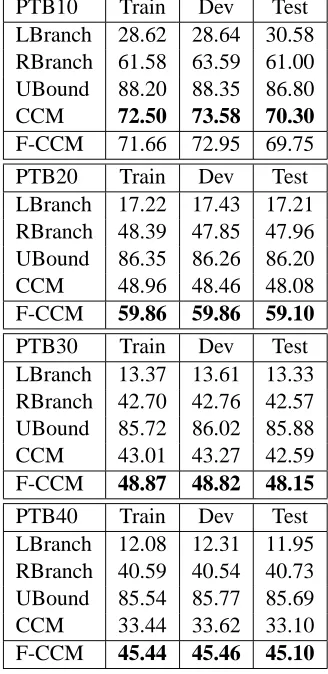
PTB10 Train Dev Test
LBranch 28.62 28.64 30.58 RBranch 61.58 63.59 61.00
UBound 88.20 88.35 86.80
CCM 72.50 73.58 70.30
F-CCM 71.66 72.95 69.75
PTB20 Train Dev Test
LBranch 17.22 17.43 17.21 RBranch 48.39 47.85 47.96
UBound 86.35 86.26 86.20
CCM 48.96 48.46 48.08
F-CCM 59.86 59.86 59.10
PTB30 Train Dev Test
LBranch 13.37 13.61 13.33 RBranch 42.70 42.76 42.57
UBound 85.72 86.02 85.88
CCM 43.01 43.27 42.59
F-CCM 48.87 48.82 48.15
PTB40 Train Dev Test
LBranch 12.08 12.31 11.95 RBranch 40.59 40.54 40.73
UBound 85.54 85.77 85.69
CCM 33.44 33.62 33.10
F-CCM 45.44 45.46 45.10
Table 2: Results on PTB10, PTB20, PTB30, PTB40
compared to previous reported results (Klein, 2005). The results of feature-based CCM are presented in the F-CCM rows.
From these results, we observe that the original CCM performs much better than the right branch-ing baseline on short sentences, but the performance decreases dramatically on longer sentences, even lower than the right branching baseline. In contrast, our feature-based CCM achieves comparable perfor-mance with original CCM on PTB10, and much bet-ter performance than the original CCM and the right branching baseline on longer sentences. These ex-perimental results demonstrate the effectiveness and robustness of the feature-based model.
5.3 Grammar sparsity
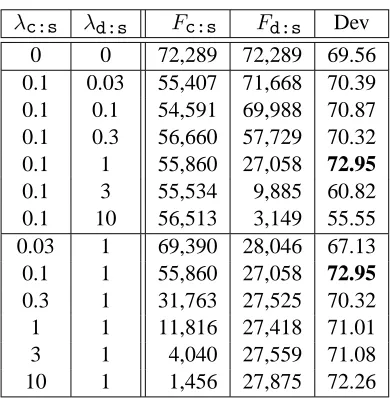
The regularization terms can serve as feature selec-tion mechanism. In this secselec-tion, we compare the sparsity of learned sequence grammars between var-ious regularization coefficients on PTB10.
λc:s λd:s Fc:s Fd:s Dev
0 0 72,289 72,289 69.56
0.1 0.03 55,407 71,668 70.39
0.1 0.1 54,591 69,988 70.87
0.1 0.3 56,660 57,729 70.32
0.1 1 55,860 27,058 72.95
0.1 3 55,534 9,885 60.82
0.1 10 56,513 3,149 55.55
0.03 1 69,390 28,046 67.13
0.1 1 55,860 27,058 72.95
0.3 1 31,763 27,525 70.32
1 1 11,816 27,418 71.01
3 1 4,040 27,559 71.08
10 1 1,456 27,875 72.26
Table 3: Number of non-zero weights for factorsFc:s
andFd:s. The corresponding F1 scores on the develop-ment set are shown in the last column.
As mentioned in section 5.1, we only tune regu-larization parameters λc:s and λd:s. We can not report results of all combinations since there are too many of them. Instead, we report results with ei-ther λc:s or λd:s fixed to the best tunned value. The number of active dimensions (i.e. with non-zero weight) and the development F1 score are examined in experiments.
Table 3 shows the results of these experiments. With the increasing of regularization parameters, the model becomes more and more sparser (as mea-sured by the number of non-zero weights). The tuned optimal parameter values are λc:s = 0.1
and λd:s = 1. It is interesting to observe that the optimal regularization value for distituent fac-tor is greater than the one for constituent facfac-tor. This fact can be explained that since there are more distituents than constituents, the distituent weights need to be penalized more heavily. The best devel-opment F1 is72.95, greater than the F1 score69.56
achieved without regularization, since the unregular-ized model may overfit the training data.
If we compare experiments with fixedλc:s, the development F1 score first increases and then de-creases with the increase ofλd:s. In contrast, with fixed λd:s, the performance varies little for differ-ent λc:s. These results somehow demonstrate the distituents modelled in CCM play a more important role than the constituents.
5.4 Discussion
Experiments show that we achieve better perfor-mance than original CCM while using compact grammars. There are some issues we want to dis-cuss here.
1. We only test a few feature templates. Other features such as words, stems may improve the results. Moreover, punctuations contain useful information in grammar induction (Spitkovsky et al., 2011b; Ponvert et al., 2011), while cur-rently punctuations are ignored in our model. 2. In previous unsupervised constituency
gram-mar induction, how to choose parameters is an art. While in the proposed model, we use de-velopment set to perform model selection. 3. EM algorithm could only find sub-optima. One
possible solution is the Lateen EM (Spitkovsky et al., 2011a), in which multiple objective func-tions are an alternative optimized. Another method is the annealing technique during prob-ability estimation process. We will investigate these in future work.
6 Related Work
The Constituent-Context Model (Klein and Man-ning, 2002; Klein, 2005) is the first unsuper-vised constituency grammar induction system that achieves better performance than the trivial right branching baseline for English. However, the per-formance of CCM degrades on long sentences. Fol-lowing approaches improve CCM in various aspects. Smith and Eisner (2004) propose to condition the yield feature on the length of the yield and use an-nealing techniques to estimate parameters. Anneal-ing techniques can be also used for the proposed F-CCM, which we plan to do in future work. Klein and Manning (2004) demonstrate the joint model of con-stituency and dependency could improve unsuper-vised grammar inference. Some other approaches also consider to use additional information such as the words (Headden III et al., 2009), the automatic induced tags (Headden III et al., 2008), or the par-ent information (Mirroshandel and Ghassem-Sani, 2008). These information could be easily incorpo-rated to the proposed model as features.
Feature-based models have been widely used in many supervised tasks such as parsing (Charniak, 2000), word alignment (Moore, 2005; Liu et al., 2006), machine translation (Koehn et al., 2003), etc. For the unsupervised learning tasks, the calculation of normalization part is usually time-consuming or even impossible. Existing approaches are mainly based on the contrastive estimation (Smith and Eis-ner, 2005; Smith and EisEis-ner, 2005; Dyer et al., 2011) to learn parameters. The local normalized feature-based model has been proposed in (Berg-Kirkpatrick et al., 2010), in which features are defined over gen-erative rules and the normalization is done locally. They use the ℓ2 regularization, while we apply the local-normalization model to CCM withℓ1 regular-ization and show improved performance could be achieved with sparse solution. Many unsupervised approaches aim to learn compact and sparse gram-mar, including the Bayesian models (Johnson et al., 2007; Cohn et al., 2010; Blunsom and Cohn, 2010) and posterior regularization (Ganchev et al., 2010). We use alternative (and simpler) regularization tech-nique to obtain sparse solution.
The most related work is (Golland et al., 2012), in which a similar feature-based model for CCM is
proposed. There are many differences between their work and our proposed model. (1) We useℓ1 reg-ularization to learn sparse model, while they do not mention sparsity problem. (2) We propose to use a separated development set to perform model selec-tion and an addiselec-tional test set to report final results, while they directly train and evaluate their model on the same dataset, which is problematic. (3) We eval-uate different feature sets from theirs. The limited lengths for sequences could reduce the memory us-age for long sentences.
7 Conclusion
The constituent-context model performs well on short sentences, but the performance degrades on longer sentences. We present a feature-based model for CCM, in which linguistic knowledge can be inte-grated as features. Features take the log-linear form with local normalization, so the EM algorithm is still applicable to estimate model parameters. To avoid overfitting, we use the ℓ1-norm regulariza-tion to control model complexity. We also pro-posed a reasonable model selection and evaluation framework. Experimental results demonstrate that the feature-based model achieves comparable per-formance on short sentences but significantly out-performs the original CCM on longer sentences.
Acknowledgments
We would like to thank Zhonghua Li for insightful discussion about the feature-based model and help on the numeric optimization toolkit. We also thank Xiangyu Duan for his help on the reimplementation of original CCM. Thank the anonymous reviewers for their helpful comments and suggestions.
References
Galen Andrew and Jianfeng Gao. 2007. Scalable train-ing of l1-regularized log-linear models. In
Proceed-ings of the 24th International Conference on Machine Learning, pages 33–40.
Taylor Berg-Kirkpatrick, Alexandre Bouchard-Côté, John DeNero, and Dan Klein. 2010. Painless unsu-pervised learning with features. In Human Language
in-Robert C. Moore. 2005. A discriminative framework for bilingual word alignment. In Proceedings of Human
Language Technology Conference and Conference on Empirical Methods in Natural Language Processing,
pages 81–88.
Elias Ponvert, Jason Baldridge, and Katrin Erk. 2011. Simple unsupervised grammar induction from raw text with cascaded finite state models. In Proceedings of
the 49th Annual Meeting of the Association for Com-putational Linguistics: Human Language Technolo-gies, pages 1077–1086.
Yoav Seginer. 2007. Fast unsupervised incremental pars-ing. In Proceedings of the 45th Annual Meeting of the
Association of Computational Linguistics, pages 384–
391.
Noah A. Smith and Jason Eisner. 2004. Annealing tech-niques for unsupervised statistical language learning. In Proceedings of the 42nd Meeting of the
Associ-ation for ComputAssoci-ational Linguistics (ACL’04), Main Volume, pages 486–493.
Noah A. Smith and Jason Eisner. 2005. Contrastive estimation: Training log-linear models on unlabeled data. In Proceedings of the 43rd Annual Meeting of the
Association for Computational Linguistics (ACL’05),
pages 354–362.
Valentin I. Spitkovsky, Hiyan Alshawi, and Daniel Juraf-sky. 2010. From baby steps to leapfrog: How “less is more” in unsupervised dependency parsing. In Human
Language Technologies: The 2010 Annual Conference of the North American Chapter of the Association for Computational Linguistics, pages 751–759.
Valentin I. Spitkovsky, Hiyan Alshawi, and Daniel Juraf-sky. 2011a. Lateen EM: Unsupervised training with multiple objectives, applied to dependency grammar induction. In Proceedings of the 2011 Conference on
Empirical Methods in Natural Language Processing,
pages 1269–1280.
Valentin I. Spitkovsky, Hiyan Alshawi, and Daniel Juraf-sky. 2011b. Punctuation: Making a point in unsu-pervised dependency parsing. In Proceedings of the
Fifteenth Conference on Computational Natural Lan-guage Learning, pages 19–28.
Menno van Zaanen. 2000. ABL: Alignment-based learn-ing. In Proceedings of the 18th International
Confer-ence on Computational Linguistics (Coling 2000),
vol-ume 2, pages 961–967.
Deyi Xiong, Min Zhang, and Haizhou Li. 2010. Learn-ing translation boundaries for phrase-based decodLearn-ing. In Human Language Technologies: The 2010 Annual
Conference of the North American Chapter of the As-sociation for Computational Linguistics, pages 136–