A LDA-Based Topic Classification Approach
from Highly Imperfect Automatic Transcriptions
Mohamed Morchid, Richard Dufour, Georges Linar`es
LIA - University of Avignon (France)
{mohamed.morchid, richard.dufour, georges.linares}@univ-avignon.fr
Abstract
Although the current transcription systems could achieve high recognition performance, they still have a lot of difficulties to transcribe speech in very noisy environments. The transcription quality has a direct impact on classification tasks using text features. In this paper, we propose to identify themes of telephone conversation services with the classical Term Frequency-Inverse Document Frequency using Gini purity criteria (TF-IDF-Gini) method and with a Latent Dirichlet Allocation (LDA) approach. These approaches are coupled with a Support Vector Machine (SVM) classification to resolve theme identification problem. Results show the effectiveness of the proposed LDA-based method compared to the classical TF-IDF-Gini approach in the context of highly imperfect automatic transcriptions. Fi-nally, we discuss the impact of discriminative and non-discriminative words extracted by both methods in terms of transcription accuracy.
Keywords:Speech analytics; Topic identification; Latent Dirichlet Allocation
1. Introduction
The application considered in this paper concerns the auto-matic analysis of telephone conversations between an agent and a customer in a customer care service of the Paris trans-portation system. The agent follows a conversation proto-col to address customer requests or complains. One pur-pose of the application is to identify themes that appear in the conversation. A conversation may contain more than one semantically related theme, but not all of them are rele-vant for the application task. For example, a customer may inquiry about an object lost on a transportation mean that was late. In such a case, the loss is a much more relevant theme than the traffic state. In this situation, agents anno-tate a conversation with what they consider the major theme of the customer request. This leads to annotate a theme for each conversation.
This paper presents a system for the automatic extraction of themes from conversations acquired during the daily opera-tion of a call centre in Paris. The system generates hypothe-ses about the most relevant theme of each conversation. The major difficulty of this classification task concerns the un-predictable behavior of the customers. Conversations may contain very noisy segments and are decoded by an Auto-matic Speech Recognition (ASR) component.
In the context of Information Retrieval (IR) tasks, the main feature used is theword term frequency. This specific fea-ture allows to obtain a subset of discriminative words for a considered class (a “theme” in this study). The term “dis-criminative” is associated to a word if it permits to discern a class from the others. Finally, this set of discriminative words should permit to compose a vector representation of conversation themes in the semantic space.
While the term frequency is a performant feature in the con-text of manually written con-texts, its application to automatic transcriptions seems to be more difficult since transcription errors are inevitable. Indeed, these errors would lead to an incorrect representation of the discriminative words. For this reason, the projection of the automatically transcribed
words in a more abstracted space could increase the robust-ness to the ASR errors.
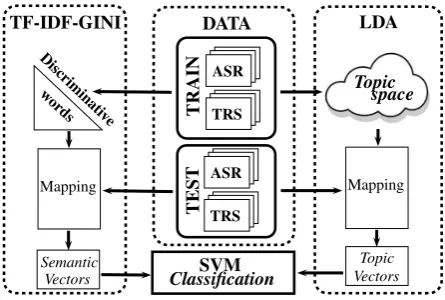
In this paper, we propose to compare two unsupervised rep-resentations of discriminative words to automatically iden-tify themes of telephone conversations in different config-urations of highly imperfect transcriptions. The classical Term Frequency-Inverse Document Frequency with Gini purity criteria (TF-IDF-Gini) method (Robertson, 2004) is firstly applied to extract discriminative words for each theme to identify from transcriptions. We secondly pro-pose to explore a topic space representation of discrimina-tive words with the use of the Latent Dirichlet Allocation (LDA) approach (Blei et al., 2003). Each representation is finally used to train a Support Vector Machine (SVM) clas-sifier to automatically associate a theme to a conversation. We also propose in this article a discussion about the clas-sification performance impact of discriminative and non-discriminative words chosen by both methods in terms of transcription accuracy.
2. Related work
Recent reviews for spoken conversation analysis, speech analytics, topic identification and segmentation can be found in (Tur and De Mori, 2011), (Melamed and Gilbert, 2011), (Hazen, 2011) and (Purver, 2011) respectively. The classical Term Frequency-Inverse Document Frequency (TF-IDF) (Robertson, 2004) has been widely used for ex-tracting discriminative words from texts. Works also found improvements associating TF-IDF with the Gini purity cri-teria (Dong et al., 2011).
800 1600 2400 4800 8000 50
60 70 80 90
number of words (logscale)
Accurac
y
of
theme
classification
(%)
TRS→TRS ASR→ASR TRS+ASR→ASR
TRS→ASR
(a)TF-IDF-Gini
5 678 10 20 30 40 60 100 200 400600
50 60 70 80 90
number of topics (logscale)
TRS→TRS ASR→ASR TRS+ASR→ASR
TRS→ASR
(b)LDA
Figure 2: Theme classification performance by varying the number of discriminative words (a) and the number of topic spaces (b).
50 100 200 600 1000 3000
20 25 30 35
number of words (logscale)
W
ord
Error
Rate
(%)
WER baseline ASR→ASR TRS+ASR→ASR
TRS→ASR
(a)TF-IDF-Gini
50 100 200 600 1000 3000
20 25 30 35
number of words (logscale)
WER baseline ASR→ASR TRS+ASR→ASR
TRS→ASR
(b)LDA
Figure 3: Word Error Rate of thenmost discriminative words using TF-IDF-Gini (a) and LDA (b) approaches.
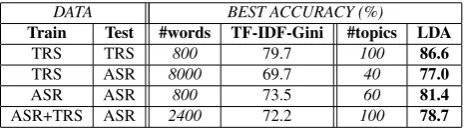
DATA BEST ACCURACY (%)
Train Test #words TF-IDF-Gini #topics LDA
TRS TRS 800 79.7 100 86.6
TRS ASR 8000 69.7 40 77.0
ASR ASR 800 73.5 60 81.4
ASR+TRS ASR 2400 72.2 100 78.7
Table 1: Theme classification accuracy (Confidence inter-val of±3.69%for the LDA system)
gain of 6.9 points with the LDA method. When comparing the training corpus types, we can also note that best perfor-mance on the ASR test is obtained with the ASR training data. A gain of 10.9 points is noted with the LDA method compared to the TF-IDF-Gini approach on the automatic transcriptions of conversations. It seems clear that using comparable training and testing configurations allows to achieve the best classification performance, whether it be on manual or on automatic transcriptions.
We can finally note that the LDA approach performance has a tendency to fluctuate when varying the number of
top-ics. This could be explained by the high Word Error Rate (WER) of the targeted corpus: indeed, the words chosen as discriminative in particular topic number conditions could be wrongly transcribed in a high proportion. We can sup-port this assumption by analyzing results obtained using 90 topics on the figure 2. An important performance drop is observed for the ASR training conditions (ASR → ASR and ASR → TRS) while a smaller performance lost is seen when including the reference transcriptions during the training process (ASR+TRS→ASR and TRS→TRS).
ap-learning-international workshop then conference, pages 200–209. Morgan Kaufmann Publishers, Inc.
S. Kim, S. Narayanan, and S. Sundaram. 2009. Acous-tic topic model for audio information retrieval. In Work-shop on Applications of Signal Processing to Audio and Acoustics (WASPAA), pages 37–40.
M. Lan, C.-L. Tan, H.-B. Low, and S.-Y. Sung. 2005. A comprehensive comparative study on term weighting schemes for text categorization with support vector ma-chines. InInternational Conference on World Wide Web, pages 1032–1033.
G. Linar`es, P. Noc´era, D. Massonie, and D. Matrouf. 2007. The lia speech recognition system: from 10xrt to 1xrt. In
Text, Speech and Dialogue, pages 302–308. Springer. A.K. McCallum. 2002. Mallet: A machine learning for
language toolkit.
I.D. Melamed and M. Gilbert. 2011. Speech analytics.
Spoken Language Understanding: Systems for Extract-ing Semantic Information from Speech, pages 397–416. M. Morchid, R. Dufour, and G. Linar`es. 2013a. Event
detection from image hosting services by slightly-supervised multi-span context models. InCBMI. IEEE. M. Morchid, G. Linar`es, M. El-Beze, and R. De Mori.
2013b. Theme identification in telephone service con-versations using quaternions of speech features. In
IN-TERSPEECH. ISCA.
K. M¨uller, A. Smola, G. R¨atsch, B. Sch¨olkopf, J. Kohlmor-gen, and V. Vapnik. 1997. Predicting time series with support vector machines.ICANN’97, pages 999–1004. M. Purver. 2011. Topic segmentation. Spoken Language
Understanding: Systems for Extracting Semantic Infor-mation from Speech, pages 291–317.
S. Robertson. 2004. Understanding inverse document fre-quency: on theoretical arguments for idf. Journal of Documentation, 60(5):503–520.
G. Salton. 1989. Automatic text processing: the transfor-mation. Analysis and Retrieval of Information by Com-puter.
J. I. Sheeba and K. Vivekanandan. 2012. Article: Im-proved keyword and keyphrase extraction from meeting transcripts. International Journal of Computer Applica-tions, 52(13):11–15.
S. Tang, J. Li, Y. Zhang, C. Xie, M. Li, Y. Liu, X. Hua, Y.-T. Zheng, J. Tang, and Y.-T.-S. Chua. 2009. Pornprobe: an lda-svm based pornography detection system. In Inter-national Conference on Multimedia, pages 1003–1004. G. Tur and R. De Mori. 2011. Spoken language
under-standing: Systems for extracting semantic information from speech. Wiley.
V. Vapnik. 1963. Pattern recognition using general-ized portrait method. Automation and Remote Control, 24:774–780.
G-X Yuan, C-H Ho, and C-J Lin. 2012. Recent advances of large-scale linear classification. 100(9):2584–2603. M. Zrigui, R. Ayadi, M. Mars, and M. Maraoui. 2012.