Statistical-based System for Morphological Annotation of Arabic
Texts
Nabil Khoufi ANLP Research Group
MIRACL Laboratory University of Sfax
Manel Boudokhane ANLP Research Group
MIRACL Laboratory University of Sfax
Abstract
In this paper, we propose a corpus-based method for the annotation of Arabic texts with morphological information. The proposed method proceeds in two stages: the segmentation stage and the morpho-logical analysis stage. The morphomorpho-logical analysis stage is based on a statistical method using an annotated corpus. In or-der to evaluate our method, we conducted a comparative analysis between the re-sults generated by our system AMAS (Arabic Morphological Annotation Sys-tem) and those carried out by a human expert. As input, the system accepts an Arabic text and generates as a result an annotated text with morphological infor-mation in XML format.
1 Introduction
In the linguistic field, morphology is the study of the word’s internal structure. It consists in identi-fying, analysing and describing the structure of morphemes and other units of meaning in a lan-guage.
Morphological annotation in Natural Language Processing (NLP) is considered as a preliminary step during any automatic language processing approach. It consists in attributing labels for each word in a text such as the part of speech (POS) (name, verb, adjective, etc.) the gender (femi-nine, masculine), the number (singular, dual, plu-ral), etc. Such data are useful in the most of ap-plications of NLP such as text analysis, error cor-rection, parsing, machine translation, automatic summarization, etc. Therefore, developing a ro-bust morphological annotation system is needed.
In this paper, we present a brief description of related Arabic morphological ambiguity. Then, we give an overview of the state-of-the-art. The description of the proposed method for annota-tion of the Arabic text is thereafter introduced. The following section describes our morphologi-cal analysis. An example of analysis is then pre-sented with a brief description of AMAS inter-face. Finally, we provide the evaluation of our system and a discussion of the obtained results.
2 Arabic Morphological Ambiguity
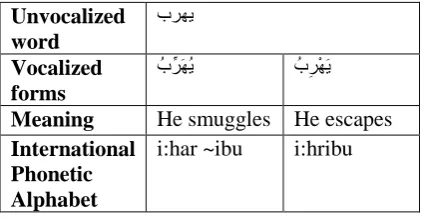
Like all Semitic languages, Arabic is charac-terised by a complex morphology and a rich vo-cabulary. Arabic is a derivational, flexional and agglutinative language. In fact, an Arabic word is the result of a combination of a trilateral or quad-rilateral root with a specific schema. Moreover, there are many verbal and nominal lemmas that can be derived from an Arabic root. Furthermore, from a verbal or nominal lemma, many flexions are possibly indicating variations in tense (for verbs), in case (for nouns), in gender (for both), etc. Agglutination in Arabic is another specific phenomenon. In fact, in Arabic, articles, preposi-tions, pronouns, etc. can be affixed to adjectives, nouns, verbs and particles to which they are re-lated. Derivational, flexional and agglutinative aspects of the Arabic language yield significant challenges in NLP. Thus, many morphological ambiguities have to be solved when dealing with Arabic language. In fact, many Arabic words are homographic: they have the same orthographic form, though the pronunciation is different (At-tia, 2006). In most cases, these homographs are due to the non vocalization of words. This means that a full vocalization of words can solve these ambiguities, but most of the Arabic texts like books, web pages, news, etc are not vocalized.
We present, in the following, some of these homographs:
Unvocalized word
ح
Vocalized forms
ْحُ َ ٌح ْ َ َحِ َ
Meaning so, go Marriage Was
happy
International Phonetic Alphabet
farho farhU fariħa
Table 1 Homographs due to absence of short vowels
In Arabic some conjugated verbs or inflected nouns can have the same orthographic form. Adding short vowels to those words makes dif-ferences between them.
Unvocalized word
ب
Vocalized forms
ُبﱢ َ ُ ُبِ ْ َ
Meaning He smuggles He escapes
International Phonetic Alphabet
i:har ~ibu i:hribu
Table 2: Homographs due to the absence of the character chadda “ّ◌”
The presence of chadda inside a particular word changes its meaning.
3 State-of-the-art
The annotation task is an important step in NLP. In fact its accuracy strongly influences the results of the following modules in an NLP proc-ess such as parsing. Annotation is also used to create a knowledge base such as annotated cor-pora, which are helpful for the conception of ef-fective NLP software, especially those based on machine learning techniques. Regarding Arabic text annotation, we identify several methods that can be used. All these methods use the same in-formation to annotate a particular word in a given text: its context and its morphology. What differs is the way to represent these elements and prioritise information. In this section, we focus on morphological analysis which is the main task in a morphological annotation system. The over-view of the state of the art of Arabic
computa-tional morphology shows that there are two main approaches: the knowledge-based approach and the statistical-based approach (Saoudi et al. 2007).
The knowledge-based approach uses symbolic rules and linguistic information. The designer handles all the labelling rules and the linguistic information (such as Root-base, Lexeme-base, Stem-base…) to perform morphological analysis. Some morphological analysers using knowledge-based methods for Arabic have been developed such as Xerox two-level morphology system (Beesley, 2001) ; Sebawai system (Darwish, 2002) for shallow parsing ; Araparse system (Ouersighni, 2002) ; Buckwalter Arabic morpho-logical analyser (Buckwalter, 2004) ; Attia mor-phological analyser (Attia, 2006) ; ElixirFM ana-lyser(Smrz, 2007) and Abouenour morphological analyser (Abouenour, 2008).
Statistical-based methods utilize machine learning techniques to extract linguistic knowl-edge from natural language data directly. In fact, the aim of these methods is to learn how to bal-ance between alternative solutions and how to predict useful information for unknown entities through rigorous statistical analysis of the data. Statistical-based analysers can be grouped in two main families: unsupervised learning analysers and supervised learning analysers. Unsupervised learning analysers learn from a raw corpus with-out any additional information; they use a distri-butional analysis to automatically group words into classes or groups of words (grammatical categories). This learning method is not being frequently used (Clark, 2003). On the other hand, supervised learning analysers learn from a pre-labelled corpus, which allows the preparation of all the necessary data for annotation. These data are created from dictionaries in order to assign to each word of the corpus a set of information: category, lemma, average frequency of occur-rence, etc. To the best of our knowledge, among the systems using supervised learning we can mention the morphological analyser developed by Boudlal (Boudlal et al., 2008) ;TBL Analyser (AlGahtani et al., 2007); MADA morphological analyser (Habash et al., 2009) ;(Mansour et al., 2009) analyser, which is an adaptation of MorphTagger to Arabic language, and Diab ana-lyser (Diab, 2010) which is a part of the AMIRA tool kit for Arabic processing.
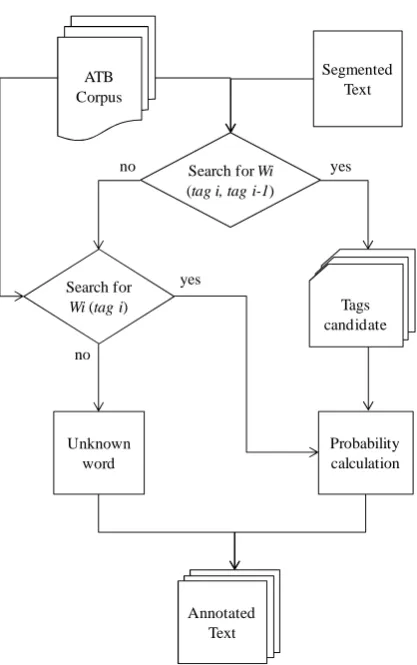
Figure 2: The morphological analysis stage.
Our learning corpus, the Penn Arabic Treebank (ATB), was developed by the LDC at the Uni-versity of Pennsylvania (Maamouri et al., 2004). It consists of data from linguistic sources written in modern standard Arabic. The corpus consists of 599 unvowelled texts of different stories from a Lebanese news agency publication.
To achieve the morphological annotation of Ara-bic text, we adopt a statistical method. We use the ATB annotated corpus to extract all possible annotations for a word then we choose the most probable one using the N-gram model, more pre-cisely the first and second order known as uni-gram and bi-uni-gram. Indeed, (Mustafa and Al-Radaideh, 2004) found that a bi-gram method offers higher overall effectiveness values than the tri-gram method for text processing.
The principle of this model states that the cal-culation of the probability of occurrence for a given label depends on the label that precedes it. The frequency of the words and the labels will be calculated from the annotated corpus ATB. Probabilities are generated by the conditional probability formula:
P (t_i/t_i-1)=P(t_i-1,t_i)) / P(t_i-1) Where t_i is the tag of the word i and t_i-1 is the tag of the previous word i-1. P(t_i-1, t_i) is the sequence frequency of the two words tag i and i-1 . P (1) is the frequency of the tag t_i-1.
The analysis process is as follows: We perform a search in the learning corpus for oc-currences of the word i (Wi in figure 2). We then extract all the morphological tags of this word from the ATB. Probabilities are then distributed to these tags according to the conditional prob-ability formula. The tag that have the highest probability will be used as the annotation of the word i. There is an exception in the use of the formula for the first word of each sentence and also for each word preceded by an unknown word. If the word is not found in the training corpus, the user has the option to manually anno-tate the unfound word or to keep it as an un-known word. This process occurs in a sequential mode until the annotation of the whole text. We use the same tag set used in the ATB.
We apply our method to a sentence to show the different results.
ق ھذ ةأ ا
The woman’s gold was stolen
In this sentence we have three words; the word ق is a verb; this annotation is obtained using the frequency calculation (Case of the first word in a sentence). The ambiguity lies in the word ھذ which has two possibilities to be annotated: verb or noun according to our learning corpus. To choose the right annotation, we take into con-sideration the annotation of the previous word (i.e verb). Probabilities are then calculated and we obtain P (verb/verb) =0.2 and P (noun/verb) =0.8. So ھذ as noun is selected because it has the highest probability. The word ةأ ا is anno-tated as a noun because it’s the only annotation found in the learning corpus. The sentence will be annotated as follows:
ق ھذ ا ةأ
Noun Noun Verb
no Search for Wi yes
(tag i, tag i-1) ATB
Corpus
Annotated Text Search for
Wi (tag i)
Tags candidateTags candidateTags candidate
Unknown word
Probability calculation Segmented
Text
yes
5 The AMAS System
The method that we proposed for the morpho-logical annotation of Arabic texts has been im-plemented through the AMAS (Arabic Morpho-logical Annotation System) system. In this sec-tion, we present the implementation details. The implementation of this method has been done using the Java programming language.
5.1 Used Linguistic Data
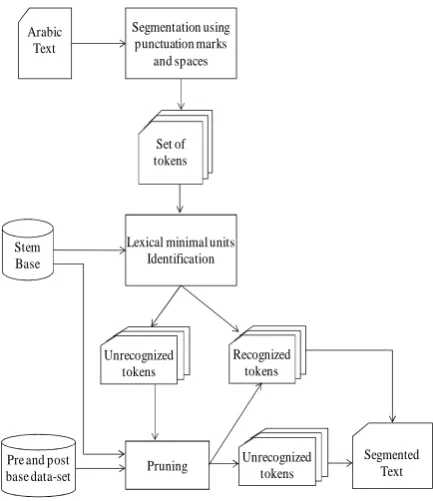
The stem database: During the segmentation
phase, we used the stem base of the morphologi-cal analyser AraMorph1, which is the Java port of the homonym product developed in Perl by Tim Buckwalter. This stem database contains a large number of stems with a lot of other information such as possible vocalized forms, labels, etc. The entire database is written with the Tim Buckwal-ter transliBuckwal-teration. We made some changes to its structure, which consists in:
• First, removing unhelpful data such as English translation, syntactic tags and keeping only the stems,
• And second, transliterating the stems from Buckwalter form to the Modern Standard Arabic form.
Pre- and post-base lists: In order to segment
agglutinated tokens, a pre- and post-base list is necessary to identify them. The creation of this list was inspired from Abbes’s (Abbes, 2004) works. These lists were adapted to our segmenta-tion process. Indeed only pre- and post-bases used in the training corpus were considered in the segmentation process.
5.2 AMAS Interface
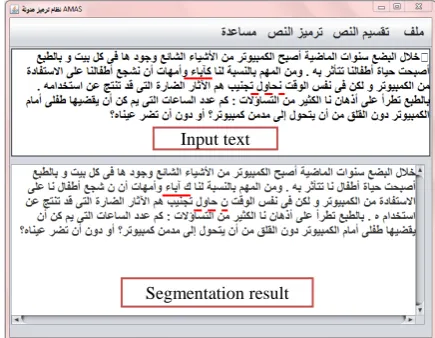
As input, the system accepts an Arabic text. Then, the user can segment the text via the seg-mentation menu. The system then displays the results in a text area as shown in the screen-shot presented in figure 3. The user has the possibility to modify the results if it is necessary to correct some mistakes.
Once the text is segmented and saved in a text file, we proceed to the annotation step using the annotation menu. The user must specify if the analysis should be fully automatic or semi-automatic. If the user chooses the semi automatic option, he must indicate the right annotation to unknown words. The system will be updated
1
http://www.nongnu.org/aramorph/english/index.html, free software licensed under GPL.
with the user annotations. This information can be taken into consideration through the annota-tion process for the rest of the text. Otherwise, there is no need for the user’s contribution and the process will be conducted automatically. The result is presented in the form of a well-structered XML file. Each Arabic word is pre-sented with its original form, its Buckwalter transliteration, its most probable morphological annotation and its probability (see figure 4).
Figure 3: AMAS’s segmentation interface.
6 Obtained Results
In order to evaluate our system, we used the EASC corpus (The Essex Summaries Arabic Corpus) proposed by (El-Hdj et al., 2010). It contains 153 texts covering different areas such as art, health, politics, tourism, etc. we performed the evaluation on 22 texts containing 10148 segmented words. We then conducted a com-parative study between the results generated by our system (automatic annotation process) and those presented by a linguist.
The evaluation operation consists in calculating the recall and precision measures for each do-main in the corpus. The average of those meas-ures is then calculated. The average measmeas-ures for Precision, Recall and F-score are respectively 89.01%, 80.24% and 84.37%.
These results are encouraging and represent a good start for the application of statistical ap-proach for annotation of Arabic texts. Our results are better than Ouersigni and Abouenour systems results which confirm our hypothesis. The differ-ence in performance between our system and state of the art statistical systems is due to the following:
• The propagation of segmentation errors to the morphological analysis involves annotation errors. For example, there is a problem in the segmentation of the agglutination of the article “لا” and the preposition “ل”(e.g ا + ل ).
• Unknown words annotation during the morphological analysis, which is likely to influence the annotation of the fol-lowing word and may decrease the ac-curacy of the system,
• The way to choose annotation for the first word of a sentence is not precise enough.
Another reason for these results is that the ATB doesn’t contain all words. Some words like “!" #$ا” or “ ﺗ%&' ( ا” do not exist in the ATB. There is also a difference between the word’s spelling in the ATB and the test corpus. For ex-ample, the same word is written “ما+, إ” in the test corpus and “ما+, ٱ” in the ATB. These two words have the same meaning and same morpho-logical annotation but “ما+, ٱ” is annotated as unknown word by our system.
Neverthless, our annotation system produces good results and annotate the majority of the words.
Figure 4: Annotation results.
7 Conclusion and Perspectives
In this paper, we outlined some problems of computational Arabic morphology. Then, we proposed our method for morphological annota-tion of Arabic texts. We also presented our Ara-bic morphological annotation system AMAS based on the proposed method. AMAS is imple-mented using the Java programming language
and has been evaluated using EASC corpus. The obtained results are very encouraging (i.e. preci-sion = 89.01% ; recall = 80.24% ; F-measure = 84.37% ). As a perspective, we intend to add a stem database to reduce the number of unknown words in the morphological analysis. In addition, we plan to expand n-gram model from 2 to 4. Indeed, It is shown (McNamee and Mayfield, 2004) that the use of n-grams of length 4 is most effective and stable for European languages.
Acknowledgments
The authors would like to thank Mr. Chafik Aloulou and Mrs. Lamia Hadrich Belguith for their valuable comments and participation in the progress of this work within the ANLP-MIRACL laboratory.
References
Ramzi Abbes. 2004. La conception et la réalisation
d'un concordancier électronique pour l'arabe,
Ph.D thesis, ENSSIB/INSA, Lyon, France.
Lahsen Abouenour, Said El Hassani, Tawfiq Yazidy, Karim Bouzouba and Abdelfattah Hamdani. 2008. Building an Arabic Morphological Analyzer as part of an Open Arabic NLP Platform. In Workshop on
HLT and NLP within the Arabic world: Arabic Language and local languages processing Status Updates and Prospects At the 6th Language Re-sources and Evaluation Conference (LREC’08),
Marrakech, Morocco.
Shabib AlGahtani, William Black, and John Mc-Naught. 2009. Arabic part-of-speech-tagging using transformation-based learning. In Proceeedings of
the 2nd International Conference on Arabic Lan-guage Resources and Tools, Cairo, Egypt.
Mohammed Attia. 2006. An Ambiguity controlled Morphological Analyzer for Modern Standard Arabic Modelling Finite State Networks. In The
challenge of Arabic for NLP/MT conference, the British Computer Society Conference, pages 48-67,
London.
Kenneth Beesley. 2001. Finite-State Morphological Analysis and Generation of Arabic at Xerox Re-search: Status and Plans in 2001. In Proceedings of
the Arabic Language Processing: Status and Pros-pect-39th Annual Meeting of the Association for Computational Linguistics, Toulouse, France.
Abderrahim Boudlal, Rachid Belahbib, Abdelhak Lakhouaja, Azzeddine Mazroui, Abdelouafi Meziane and Mohamed Ould Abdallahi Ould Be-bah. 2008. A Markovian Approach for Arabic Root Extraction. In The International Arab Conference
Tim Buckwalter. 2004. Issues in Arabic Orthography and Morphology Analysis. In The Workshop on
Computational Approaches to Arabic Script-based Languages, COLING, Geneva.
Alexander Clark. 2003. Combining Distributional and Morphological Information for Part of Speech In-duction. In Proceedings of the tenth Annual
Meet-ing of the European Association for Computational Linguistics EACL 2003, pages 59-66.
Kareem Darwish. 2002. Building a Shallow Arabic Morphological Analyzer in One Day. In
Proceed-ings of the ACL-02 workshop on Computational approaches to semitic languages, Stroudsburg, PA,
USA.
Mona Diab. 2009. Second Generation Tools (AMIRA 2.0): Fast and Robust Tokenization, POS tagging, and Base Phrase Chunking, MEDAR 2nd
Interna-tional Conference on Arabic Language Resources and Tools, Cairo, Egypt.
Mahmoud El-Haj, Udo Kruschwitz, and Chris Fox. 2010. Using Mechanical Turk to Create a Corpus of Arabic Summaries. In the Language Resources
and Human Language Technologies for Semitic Languages workshop held in conjunction with the 7th International Language Resources and Evalua-tion Conference, pages 36-39, Valletta, Malta.
Nizar Habash, Owen Rambow and Ryan Roth. 2009. MADA+TOKAN: A Toolkit for Arabic Tokeniza-tion, DiacritizaTokeniza-tion, Morphological Disambigua-tion, POS Tagging, Stemming and Lemmatization. In Proceedings of the 2nd International
Confer-ence on Arabic Language Resources and Tools (MEDAR), Cairo, Egypt.
Mohamed Maamouri, Ann Bies, Tim Buckwalter, and Wigdan Mekki. 2004. The Penn Arabic Treebank: Building a Large-Scale Annotated Arabic Corpus. In NEMLAR International Conference on Arabic
Language Resources and Tools.
Saib Mansour, Khalil Sima'an and Yoad Winter. 2007. Smoothing a Lexicon-based POS tagger for Arabic and Hebrew. In proceedings of ACL 2007
Workshop on Computational Approaches to Se-mitic Languages: Common Issues and Resources.
Prague, Czech Republic.
Paul McNamee, James Mayfield. 2004. Character N-Gram Tokenization for European Language Text Retrieval. In Journal Information Retrieval, vol-ume 7, issue 1-2, pages 73 – 97.
Suleiman H. Mustafa and Qacem A. Al-Radaideh. 2004. Using N-grams for Arabic text searching. In
Journal of the American Society for Information Science and Technology archive, Volume 55, Issue
11, Pages 1002-1007 John Wiley & Sons, Inc. New York, USA.
Riadh Ouersighni. 2002. La conception et la
réalisa-tion d'un système d'analyse morpho-syntaxique ro-buste pour l'arabe : utilisation pour la détection et le diagnostic des fautes d'accord. Ph.D. thesis,
Lumiere-Lyon2 university, France.
Abdelhadi Soudi, Gunter Neumann and Antal Van den Bosch. 2007. Arabic Computational Morphol-ogy: Knowledge-based and Empirical Methods. In
Arabic Computational Morphology, pages 3-14,
Springer.
Otakar Smrz. 2007. ElixirFM — Implementation of Functional Arabic Morphology. In Proceedings of