Tackling interoperability issues within UIMA workflows
Nicolas Hernandez
LINA (CNRS - UMR 6241) – University of Nantes
2 rue de la Houssinière – B.P. 92208, 44322 NANTES Cedex 3, France [email protected]
Abstract
One of the major issues dealing with any workflow management frameworks is the components interoperability. In this paper, we are concerned with the Apache UIMA framework. We address the problem by considering separately the development of new components and the integration of existing tools. For the former objective, we propose an API to generically handle TS objects by their name using reflexivity in order to make the components TS-independent. In the latter case, we distinguish the case of aggregating heterogeneous TS-dependent UIMA components from the case of integrating non UIMA-native third party tools. We propose a mapper component to aggregate TS-dependent UIMA components. And we propose a component to wrap command lines third party tools and a set of components to connect various markup languages with the UIMA data structure. Finally we present two situations where these solutions were effectively used: Training a POS tagger system from a treebank, and embedding an external POS tagger in a workflow. Our approch aims at providing quick development solutions.
Keywords:UIMA, interoperability, type system, data serialization format, software component integration
1.
Introduction
Over the last few years, there has been growing interest in theApache Unstructured Information Management Archi-tecture1 (UIMA) (Ferrucci and Lally, 2004) as a software
solution to manage unstructured information. In compar-ison with GATE2 (Cunningham, 2002), its probable
ma-jor difference is that it was initiated more recently and not by researchers but by industrials (IBM) with stronger en-gineering and design skills. GATE presents the interests of being used for long in the Natural Language Processing (NLP) community and of offering a wide range of analysis components and tools. NLTK3remains also an interesting framework in particular because of the availability of nu-merous integrated third party tools and data resources, and because of its programming language –Python– which is well-adapted for handling text material and quick develop-ment.
From the NLP researcher point of view, Apache UIMA is an attractive solution for at least two reasons4: First, it
dissociates the engineering middleware problems from the NLP issues and takes in charge many of the engineering needs like the workflow deployment, the data transmission or the data serialization; Second, it offers a programming framework for defining and managing NLP objects present in analysis tasks (such as creating or getting the annotations of a given type).
One of the major issues dealing with any workflow man-agement frameworks is the components interoperability. UIMA components only exchange data. So the data struc-ture of the shared data is important since it ensures the in-teroperability. UIMA offers mechanisms to freely define its own data structure and the means to handle it afterwards. This may lead to some interoperability problems since
any-1http://uima.apache.org 2
http://gate.ac.uk
3
http://www.nltk.org
4
See (Hernandez et al., 2010) for more reasons.
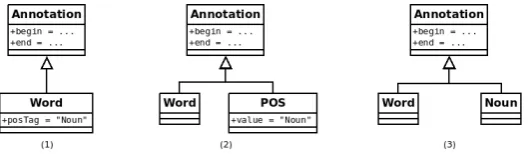
one can design its own domain model to represent the same concepts. For example,word,motortokencan be different names to mean the same type of information. In addition, as shown in Figure 1, an information, such as the part-of-speech (POS) valueNounof a word, can be represented in several ways. In (1), it is the value of a POS feature of a word annotation. In (2), it is the value of a whatever feature of a POS annotation at the same offset of a word annotation. And in (3), it corresponds itself to a type of an annotation covering the desired text offsets of a word. In the UIMA jargon, the definition of the data structure is called the type system (TS).
In this paper, we address the interoperability issue by con-sidering separately the development of new components and the integration of existing software instruments. For the former objective, we propose an API to generically handle TS objects by their name using reflexivity in order to make the components TS-independent (Section 3.1.). In the latter case, we distinguish the case of aggregating heterogeneous TS-dependent UIMA components from the case of inte-grating non UIMA-native third party tools. We propose a mapper component to aggregate TS-dependent UIMA components (Section 3.2.). And we propose a component to wrap command lines third party tools (Section 3.3.) and a set of components to connect various markup languages with the UIMA data structure (Section 3.4.). Finally we present two situations where these solutions were effec-tively used: Training a POS tagger system from a treebank (Section 4.1.), and embedding an external POS tagger in a workflow (Section 4.2.).
Figure 1: Various data model definitions.
2.
Background
The question of interoperability for sharing language re-sources and technology is the concern of several related ini-tiatives such as the CLARIN5project and the META-NET6
network. Various kinds of related interoperability aspects can be considered: the «domain models» which provide definitions of the types of the data elements that constitute a domain as well as the description of how these types are structured in the domain, the «data serialization formats» which are used to store or to remotely transmit the primary data and its associated metadata, the «metamodels» which are abstractions of domain models. . .
2.1. UIMA concepts
In March 2009, the UIMA metamodel was voted as a stan-dard by the OASIS consortium7. «The specification
de-fines platform-independent data representations and inter-faces for text and multi-modal components or services. The principal objective of the UIMA specification is to support interoperability among components or services.»
The Common Analysis Structure (CAS) is the data struc-ture which is exchanged between the UIMA components. It includes the data, subject of analysis and called the Arte-fact, and the metadata, in general simply called the Anno-tations, which describe the data. The annotations are struc-tured inViews(e.g. an HTML document can have the fol-lowing views: the HTML structure, the extracted text, and a translation of the latter) where they are directly associ-ated to. The annotations are made of a feature structure and are stored in CAS index. The definition of an annotation structure is called theType System(TS) and consists of an implementation of a domain model.
A UIMA workflow is made of three types of components: theCollection Reader(CR) which imports the data to pro-cess (for example from the Web or from the file system...) and turns it into a CAS. TheAnalysis Engines(AE) which literally process the data (including but not restricted to NLP analysis tasks); The annotations result from AE pro-cessing. And lastly theCAS Consumer(CC) which exports the annotations (for example to a database or to an XML representation of the analysis results).
The UIMA framework handles the effective transmission of the data either as objects between components deployed on a same computer or as XML streams by (a)synchronous web services. In addition, the UIMA framework comes with components which offer the possibility to serialize the
5
http://www.clarin.eu
6
http://www.meta-net.eu
7www.oasis-open.org/committees/uima
exchanged data into the XML Model Interchange8 (XMI)
format which is the OMG’s XML standard for exchanging Unified Model Language (UML) metadata.
2.2. Serialization formats for exchanging data between third party tools
As part of the ISO’s TC37 SC4, (Ide and Suderman, 2009) defend the idea that the GrAF (Graph Annotation Frame-work) format, which is the xml serialization of the LAF (Linguistic Annotation Framework) metamodel (Romary and Ide, 2004), can serve primarily as a «pivot» for trans-ducing serialization formats. They show that it is possible to convert the information from the GrAF to a UIMA CAS. This is mainly made possible since both underlying meta-models are based on a graph structure. Nevertheless the conversion is not straightforward; Since the UIMA CAS defines typed feature structures, the process requires the use of external knowledge sources to be able to specify the types of the UIMA features. Neither the outcome is not completely bijective; The process requires the defini-tion of UIMA addidefini-tional features for being able to explicit the graph structure of the GrAF and consequently to reverse the process. As a consequence, any UIMA CAS cannot be transduced into a GrAF without an adaptation of its struc-ture.
As a matter of fact the XMI format remains an appealing solution to store and exchange UIMA CAS.
2.3. Main trend for tackling the type system interoperability problem
The proposed solutions to tackle the domain model (i.e. type system) interoperability problems were similar to the solutions proposed for tackling the XML languages interoperability problems. The main trend was to define a common tool- and domain-free TS. In fact, several TS emerged: The CCP metamodel’s TS (Verspoor et al., 2009), the DKPro’s TS at the Darmstadt University9(Gurevych et
al., 2007), the Julie lab’s TS (Hahn et al., 2007)10 and the
U-Compare project’s TS (Kano et al., 2009; Thompson et al., 2011)11. The former consists of a simple annotation
hierarchy where the domain semantics is captured through pointers into external resources. The others roughly con-sist of an abstract hierarchy of NLP concepts covering the
8http://www.omg.org/spec/XMI
9http://www.ukp.tu-darmstadt.de/software/
dkpro
10https://www.julielab.de/Resources/
Software.html
annotations, both havebegin,endandcoveredText features. This AE offers a way to process the XML structure of any XML document without having to define new UIMA types. In practice, we use theuima-mapper afterwards, to turn the generic types into the specific input annotation types of another following AEs.
4.
Examples of use cases
Below we present two real uses cases where we used the components presented in the previous section.
4.1. Mapping annotations: From FTB to HMMPOSTaggerTrainer
In this section we present a situation where it is useful to use a mapping AE to connect two AEs which handles distinct annotations for the same concept. We illustrate this use case on the task of building a statistic model for a Tagger sys-tem from the French Treebank (FTB) corpus (Abeillé and Barrier, 2004). We use the Apache HMM tagger trainer
16 (apache-addons:HMMPOSTaggerTrainer) to
build an HMM model from the data. The workflow is rep-resented in Figure 2.
Figure 2: Mapping annotations: From FTB to HMM-POSTaggerTrainer.
The FTB is available for research purpose in an XML for-mat. Figure 3 shows an example of annotations at various analysis levels. For this use case, we are interested by the XMLwelement which marks the words. The XMLcat, lemmaandmphattributes describe respectively the POS, the lemma and some morphological information about the words. Thewelement is used for simple words and multi-word expressions; Embeddedwelements do not have acat attribute but acatintattribute (See the first occurrence of thewelement).
The uima-connectors’s XML2CAS AE allows to process XML content and to produce annotations for the specified XML nodes. As described in Sec-tion 3.4., this AE defines its own TS. Indeed, for each word XML annotation, the AE will create a CAS annotation XMLElementAnnotation for the el-ementwand anXMLAttributeAnnotationfor each one of the attributes. For instance, the following XML annotation <w cat="A" mph="A-qual-fp" lemma="petit">petites</w> will produce three XMLAttributeAnnotation annotations; Detail for
<SENT nb="8000">
<w cat="ADV" mph="ADV" lemma="tout au plus"> <w catint="ADV">Tout</w> <w catint="P">au</w> <w catint="D"/> <w catint="ADV">plus</w> </w>
<NP>
<w lemma="un" cat="D" mph="D-ind-fp">des</w> <w cat="A" mph="A-qual-fp" lemma="petit">petites</w> <w cat="N" mph="N-C-fp" lemma="chose">choses</w> </NP>
<VPinf>
<w cat="P" mph="P" lemma="à">à</w> <VN>
<w cat="V" mph="V--W" lemma="changer">changer</w> </VN>
<PP>
<w cat="P" mph="P" lemma="sur">sur</w> <NP>
<w cat="D" mph="D-def-fs" lemma="le">l‘</w> <w cat="N" mph="N-C-fs"
lemma="intégration">intégration</w> </NP>
</PP> </VPinf>
<w cat="PONCT" mph="PONCT-S" lemma=".">.</w> </SENT>
Figure 3: Example of annotations from the lmf3_08000_08499ep.xd.cat.xml file of the FTB. Some attributes have been removed or renamed for readability purpose.
the XMLElementAnnotation is not given here. The table 1 shows the feature names (first line) and the corresponding values of each of the three created XMLAttributeAnnotationannotations. beginand endfeatures and values are not shown to make the table simpler. All the three annotations share the same begin andendvalues.
elementName attributeName attributeValue coveredText
w cat A petites
w lemma petit petites
w mph A-qual-fp petites
Table 1: Features names and values of the three XMLAttributeAnnotation annota-tions created for the attributes of the XML an-notation <w cat="A" mph="A-qual-fp" lemma="petit">petites</w>. The begin and end features and values are not shown for readability purpose.
<rule id="XMLAttributeAnnotationW2ApacheTokenAnnotation"
description="In the FTB, select the w elements which are simple words or parts of a multiword but not one"> <pattern>
<patternElement type="fr.univnantes.lina.uima.connectors.types.XMLAttributeAnnotation"> <constraint>.[(@elementName=’w’) and ((@attributeName=’cat’) or (@attributeName=’catint’))
and not(contains(@coveredText,’ ’))]</constraint> <create type="org.apache.uima.TokenAnnotation" >
<setFeature name="posTag" value="normalize-space(./@attributeValue)"/> </create>
</patternElement> </pattern> </rule>
Figure 4: Example of anuima-mapper’s rule for mapping UIMA annotations.
constraintis satisfied, then it will imply the creation of a TokenAnnotation at the same offsets and set its posTag feature with a value resulting from another XPath processing on the matched annotation. This exam-ple gives an idea of the expressive power of XPath which allows to express constraints with many kinds of operators (e.g. boolean, comparison, regular expression. . . ) and func-tions (e.g. string, mathematical. . . ).
4.2. Integrating a third party tool: TreeTagger
In this section we show how to process UIMA CAS ele-ments with command line tools and how to set the UIMA CAS elements with the produced results. In particular we describe how to integrate a command line tool with CSV-like input and output formats. We illustrate this use case by setting the POS and the lemma features of some CAS token annotations with the processing results of an external POS tagger.
As a third party tool example, we use the (Schmid, 1994)’s POS tagger (also named «TreeTagger») which takes a word per line and produces POS and lemma annotations as tabu-lated values aside of each input word (i.e.petites ADJ petit). Both input and output formats can be considered as CSV-like formats; The input format being a special case with a single column. We also use the Apache whitespace tokenizer 16 (apache-addons:wst) which segments text into word token annotations.
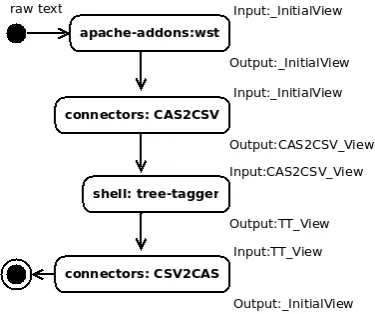
The workflow is represented in Figure 5. Each component works on a specified input view and stores its result in a specified output view. The raw text of a document is present in the view_InitialViewat the beginning of the pro-cessing. TheCAS2CSVand theCSV2CASAEs are part of theuima-connectorsproject. They take in charge the conversion from/to CSV-like formats to/from UIMA CAS elements. TheshellAE refers to theuima-shellAE and allows the integration of TreeTagger.
The processing proceeds like this: The Apache whites-pace tokenizer performs the segmentation and stores the token annotations (i.e. TokenAnnotation) in its working input view _InitialView. The POS tag and the lemma features are not yet set. The CAS2CSV AE takes in parameters the names of an annotation type (i.e. TokenAnnotation) and of the features (i.e. coveredText) to process. For each annota-tion instances present in the given _InitialView, it creates a CSV-formatted line with the values of the specified features at a specified column rank. The result is stored in the CAS2CSV_View. The
Figure 5: Integrating a third party tool: TreeTagger.
uima-shell AE is set with the following parameters values: The EnvironmentVariable parameter de-claresTT_HOME=/path/to/application/home/tree-tagger, and the PreCommand and the PostCommand parameters declare respectively the following values:catand
| ${TT_HOME}/bin/tree-tagger ${TT_HOME}/lib/french.par
-token -lemma -sgml. The CSV2CAS AE parses the
TT_View. Thanks to the given name of an annotation type (i.e. TokenAnnotation) and the associations of column ranks with feature names specified by parameters (e.g. 1 -> posTag ; 2 -> lemma), the process updates each annotation instance from the given_InitialViewwith information coming from the CSV-formatted content; Each line corresponds to an annotation. The POS tag and the lemma features are so set.
It is interesting to note that the apache-addons:wst and theCAS2CSVcomponents can simply be removed and functionally replaced by a command line token such as
| perl -ne ’chomp; s/(\p{IsAlnum})(\p{IsPunct})/$1 $2/g;
s/(\p{IsPunct})(\p{IsAlnum})/$1 $2/g; s/ /\n/g; print’ in the PostCommand parameter before the TreeTagger command.
5.
Conclusion
and Manfred Stede, editors,Proceedings of the Biennial GSCL Conference 2009, 2nd UIMA@GSCL Workshop, pages 233–240. Gunter Narr Verlag.
Frédéric Meunier, Philippe Laval, Gaëlle Recourcé, and Sylvain Surcin. 2009. Kwaga : une chaîne uima d’analyse de contenu des mails. In First French-speaking meeting around the framework Apache UIMA at the 10th Libre Software Meeting, University of Nantes, July.
Sébastien Paumier. 2003. A Time-Efficient Token Rep-resentation for Parsers. pages 83–90. Proceedings of the EACL Workshop on Finite-State Methods in Natu-ral Language Processing.
Laurent Romary and Nancy Ide. 2004. International Stan-dard for a Linguistic Annotation Framework. Natural Language Engineering, 10(3-4):211–225, September. Helmut Schmid. 1994. Probabilistic part-of-speech
tag-ging using decision trees. InProceedings of the Confer-ence on New Methods in Language Processing, Manch-ester, UK.
Dhaval Thakker, Taha Osman, and Phil Lakin. 2009. Gate jape grammar tutorial, February 27.
Paul Thompson, Yoshinobu Kano, John McNaught, Steve Pettifer, Teresa Attwood, John Keane, and Sophia Ana-niadou. 2011. Promoting interoperability of resources in meta-share. InProceedings of the Workshop on Lan-guage Resources, Technology and Services in the Shar-ing Paradigm, pages 50–58, Chiang Mai, Thailand, November. Asian Federation of Natural Language Pro-cessing.