The AVLaughterCycle Database
J´erˆome Urbain
∗, Elisabetta Bevacqua
†, Thierry Dutoit
∗, Alexis Moinet
∗Radoslaw Niewiadomski
†,Catherine Pelachaud
†,Benjamin Picart
∗,Jo¨elle Tilmanne
∗Johannes Wagner
‡∗Universit´e de Mons, Facult´e Polytechnique, TCTS Lab
20, Place du Parc - 7000 Mons, Belgium
jerome.urbain, thierry.dutoit, alexis.moinet, benjamin.picart, [email protected]
†CNRS - LTCI UMR 5141, Institut TELECOM - TELECOM ParisTech
37/39, rue Dareau - 75014 Paris, France niewiado, bevacqua, [email protected]
‡Institut f¨ur Informatik, Universit¨at Augsburg
Universit¨atsstr. 6a - 86159 Augsburg, Germany [email protected]
Abstract
This paper presents the large audiovisual laughter database recorded as part of the AVLaughterCycle project held during the eNTER-FACE’09 Workshop in Genova. 24 subjects participated. The freely available database includes audio signal and video recordings as well as facial motion tracking, thanks to markers placed on the subjects’ face. Annotations of the recordings, focusing on laughter description, are also provided and exhibited in this paper. In total, the corpus contains more than 1000 spontaneous laughs and 27 acted laughs. The laughter utterances are highly variable: the laughter duration ranges from 250ms to 82s and the sounds cover voiced vowels, breath-like expirations, hum-, hiccup- or grunt-like sounds, etc. However, as the subjects had no one to interact with, the database contains very few speech-laughs. Acted laughs tend to be longer than spontaneous ones and are more often composed of voiced vowels. The database can be useful for automatic laughter processing or cognitive science works. For the AVLaughterCycle project, it has served to animate a laughing virtual agent with an output laugh linked to the conversational partner’s input laugh.
1.
Introduction
Laughter is an essential signal in human communications. It conveys information about our feelings and helps to cheer up our mood. Moreover, it is communicative, eases social contacts and has the potential to elicit emotions to its lis-teners. It is thus a very important signal to detect for appli-cations dealing with the users’ moods, as well as a crucial signal to synthesize if one wants to design a machine with human expressive capabilities.
In consequence, automatic laughter processing has gained in popularity during the last decades. If a few systems able to distinguish between laughter and speech have recently been built on the recognition side (e.g. (Truong and van Leeuwen, 2007; Knox and Mirghafori, 2007; Petridis and Pantic, 2009)), automatic laughter synthesis is still ineffi-cient. Interesting approaches have been explored to gener-ate human-like laughs (e.g. (Lasarcyk and Trouvain, 2007; Sundaram and Narayanan, 2007)), but perceptive tests have shown that the resulting laughs do not sound natural. They miss an important characteristic of human laughs: variabil-ity.
The AVLaughterCycle project, launched during the eN-TERFACE’09 Workshop held in Genova, aims at devel-oping an audiovisual laughing machine, capable of record-ing the laughter of a user and to respond to it with a vir-tual agent’s laughter linked with the input laughter. This goal implies three tasks: laughter detection, laughter anal-ysis/classification (to link the output laugh with the in-put) and audiovisual laughter (copy-)synthesis. To perform
theses tasks, an audiovisual laughter database has been recorded. The aim of this database is to provide a broad cor-pus for studying the acoustics of laughter, the facial move-ments involved, and the synchronization between these two signals. During the Workshop, the laughter database has been used to drive the facial movements of a 3D humanoid virtual character, Greta (Niewiadomski et al., 2009), si-multaneously with the audio laughter signal. This paper presents the database itself.
2.
Goal and organisation of the paper
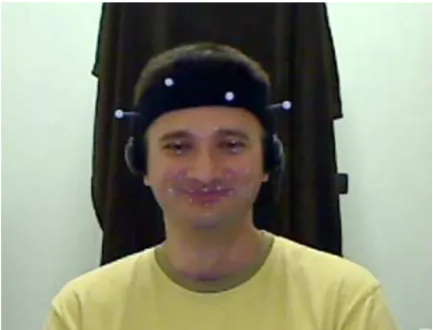
Figure 1: Markers drawn for facial motion tracking using ZignTrack
Figure 2: Infrared markers placed for facial motion tracking using OptiTrack
session, the instructor started the face motion acquisition system, left the room and the subject clapped for synchro-nisation with the other signals. At the end of each session, the subject was again instructed to clap, so that the instruc-tor would enter the room and stop the face motion track-ing. The microphone and webcam recorded the experiment from the beginning of the first session to the end of the third session, without interruption.
7.
Database annotation
The recorded data have been labeled by one annotator, us-ing SSI. A hierarchical annotation protocol was designed: segments receive the label of one main class (laughter, breath, verbal, clap or trash; silence being the default class) and “sublabels” can be concatenated to give further details about the segment. Laughter sublabels characterize both:
• The laughter temporal structure, following the 3 seg-mentation levels presented in (Trouvain, 2003). These sublabels indicate whether theepisode (i.e. the full laughter utterance) contains:
– severalbouts(i.e. parts separated by inhalations),
Figure 3: Desktop setup for database recording. Optitrack cameras are highlighted by circles.
it is then annotated with the sublabel “episode”;
– only one syllable, labeled as “monosyllabic’;
– several syllables but only one bout - default cate-gory (no particular sublabel).
These sublabels are mutually exclusive.
• The laughter acoustic contents, through labels describ-ing the type of sound: vowel, breathy (oral exhala-tion), nasal exhalation, grunt-like, hum-like, “hiccup-like”, speech-laughs or laughter that are mostly visual (quasi-silent). These sublabels can be combined to re-flect content changes during the laughter episode.
For example, a laughter episode composed of several bouts, starting by grunt-like sounds and followed by hiccup-like sounds is annotated:laugh episode grunt hiccup. To cope with exceptional conflicts that might influence the classes models when training a classifier (for example when there is a strong noise in the middle of a laughter episode), a “discard” main class has been added.
The annotation primarily relies on the audio, but the video is also looked at, to find possible neutral facial expres-sions at the episode boundaries or annotate silent laughs. In addition, laughs are often concluded by an audible inspi-ration, sometimes several seconds after the laughter main part. When such an inhalation, obviously due to the pre-ceding laughter, can be found after the main audible part, it is included in the laughter segment.
8.
Database contents
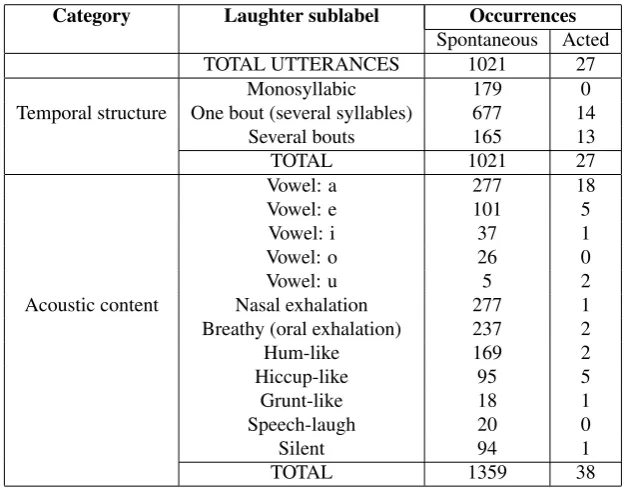
Category Laughter sublabel Occurrences
Spontaneous Acted TOTAL UTTERANCES 1021 27
Monosyllabic 179 0
Temporal structure One bout (several syllables) 677 14
Several bouts 165 13
TOTAL 1021 27
Vowel: a 277 18
Vowel: e 101 5
Vowel: i 37 1
Vowel: o 26 0
Vowel: u 5 2
Acoustic content Nasal exhalation 277 1 Breathy (oral exhalation) 237 2
Hum-like 169 2
Hiccup-like 95 5
Grunt-like 18 1
Speech-laugh 20 0
Silent 94 1
TOTAL 1359 38
Table 2: Occurrences of the laughter sublabels for the spontaneous and acted laughs
laughter. Finally, the database contains some acted laughs, recorded by the same subjects at the end of the experiment.
10.
Applications
In the AVLaughterCycle project, the database has been used to endow a virtual agent, Greta, with the capability of laughing. In a nutshell, the application consists in acous-tically detecting incoming laughter, compare the laugh with the utterances of the AVLaughterCycle Database to select an appropriate answering laughter (so far, spectral features are computed and the closest vector in the database is se-lected) and animate Greta with the facial movement of that selected laughter, synchronously with the audio playing. More details can be found in the eNTERFACE Project re-port (Urbain et al., 2009).
Following this application, the AVLaughterCycle will be used to improve acoustic laughter detection/recognition and classification/clustering as well as the animation of a laugh-ing avatar. Other signal processlaugh-ing potential uses include laughter synthesis, studies on the synchronisation between audio and facial movements while laughing, etc.
The database could also interest people working on laugh-ter or humour from cognitive science points of view: study-ing how different persons react to humour, how laughs fol-low each other, whether there are periods where the subject is particularly prone to laugh, comparing spontaneous and acted laughs, etc.
11.
Conclusion
A large laughter database had been recorded and presented in this paper. 24 subjects participated and produced more than 1000 spontaneous laughs, elicited by a funny stimu-lus. The main drawback of the database is the absence of speech-laughs. On the other hand, the presence of fa-cial motion data in addition to the acoustic signal makes this database unique. The corpus covers a broad variety of
laughter kinds. Regarding the laughter duration and struc-ture, laughs composed of one single bout but several syl-lables are the most frequent, but the corpus contains nu-merous examples of monosyllabic or longer episodes. Re-garding the acoustic contents, the annotations are spread over all the categories, led by voiced vowels, nasal and oral breath-like sounds. The database can be used for various research purposes: audio and/or visual laughter recogni-tion or synthesis, etc. The corpus is freely available from http://www.tcts.fpms.ac.be/∼urbain/.
Acknowledgments
The authors would like to thank all the database partici-pants.
This project was partly funded by the European IP 6 project CALLAS and by the Ministry of R´egion Wallonne un-der the Numediart research program (grant N0716631). J.Tilmanne receives a PhD grant from the Fonds de la Recherche pour l’Industrie et l’Agriculture (F.R.I.A.), Bel-gium.
12.
References
N. Campbell. 2007. Whom we laugh with affects how we laugh. InProceedings of the Interdisciplinary
Work-shop on The Phonetics of Laughter, pages 61–65,
Saar-brucken, Germany, August.
J. Carletta. 2007. Unleashing the killer corpus: expe-riences in creating the multi-everything AMI Meeting Corpus. Language Resources and Evaluation Journal, 41(2):181–190.
E. Douglas-Cowie, N. Campbell, R. Cowie, and P. Roach. 2003. Emotional speech: Towards a new generation of databases. Speech Communication, 40:33–60.
In 2003 IEEE International Conference on Acoustics,
Speech, and Signal Processing (ICASSP), Hong-Kong,
April.
L. Kennedy and D. Ellis. 2004. Laughter detection in meetings. In NIST ICASSP 2004 Meeting Recognition
Workshop, Montreal, May.
M. T. Knox and N. Mirghafori. 2007. Automatic laugh-ter detection using neural networks. InProceedings of
Interspeech 2007, pages 2973–2976, Antwerp, Belgium,
August.
E. Lasarcyk and J. Trouvain. 2007. Imitating conversa-tional laughter with an articulatory speech synthesis. In
Proceedings of the Interdisciplinary Workshop on The
Phonetics of Laughter, pages 43–48, Saarbrucken,
Ger-many, August.
Natural Point, Inc. 2009. Optitrack - optical motion track-ing solutions. http://www.naturalpoint.com/optitrack/, Consulted on October 20,.
Zign Creations. 2009. Zign track - the af-fordable facial motion capture solution. http://www.zigncreations.com/zigntrack.html, Con-sulted on October 20,.
Radoslaw Niewiadomski, Elisabetta Bevacqua, Maurizio Mancini, and Catherine Pelachaud. 2009. Greta: an in-teractive expressive ECA system. In Carles Sierra, Cris-tiano Castelfranchi, Keith S. Decker, and Jaime Sim˜ao Sichman, editors,8th International Joint Conference on Autonomous Agents and Multiagent Systems (AAMAS
2009), Budapest, Hungary, May 10-15, 2009, Volume 2,
pages 1399–1400. IFAAMAS.
Stavros Petridis and Maja Pantic. 2009. Is this joke really funny? judging the mirth by audiovisual laughter anal-ysis. InProceedings of the IEEE International
Confer-ence on Multimedia and Expo, pages 1444–1447, New
York, USA, June.
S. Sundaram and S. Narayanan. 2007. Automatic acoustic synthesis of human-like laughter. Journal of the
Acous-tical Society of America, 121(1):527–535, January.
Jurgen Trouvain. 2003. Segmenting phonetic units in laughter. In Proceedings of the 15th International
Congress of Phonetic Sciences, pages 2793–2796,
Barcelona, Spain, August.
K. P. Truong and D. A. van Leeuwen. 2007. Automatic dis-crimination between laughter and speech. Speech
Com-munication, 49:144–158.
J´erˆome Urbain, Elisabetta Bevacqua, Thierry Dutoit, Alexis Moinet, Radoslaw Niewiadomski, Catherine Pelachaud, Benjamin Picart, Jo¨elle Tilmanne, and Jo-hannes Wagner. 2009. AVLaughterCycle: An audio-visual laughing machine. In Proceedings of
eNTER-FACE’09 (To appear).
Johannes Wagner, Elisabeth Andr´e, and Frank Jung. 2009. Smart sensor integration: A framework for multimodal emotion recognition in real-time. InAffective Computing
and Intelligent Interaction (ACII 2009).
Janneke Wilting, Emiel Krahmer, and Marc Swerts. 2009. Real vs. acted emotional speech. In Proceedings of the Ninth International Conference on Spoken Language
Processing (Interspeech 2006 ICSLP), pages 805–808,