Using Punctuations and Lengths for Bilingual Sub-sentential Alignment
Wen-Chi Hsien, Kevin Yeh, Jason S. Chang
Department of Computer Science National Tsing Hua University 101, Kuangfu Road, Hsinchu, 300, Taiwan, ROC {g904307, jschang )@cs.nthu.edu.tw
Thomas C. Chuang
Department of Computer Science Van Nung Institute of Technology 1 Van-Nung Road, Chung-Li, Taiwan, ROC
Abstract
We present a new approach to aligning bilingual English and Chinese text at sub-sentential level by interleaving alphabetic texts and punctuations matches. With sub-sentential alignment, we expect to improve the effectiveness of alignment at word, chunk and phrase levels and provide finer grained and more reusable translation memory.
1. Introduction
Recently, there are renewed interests in using bilingual corpus for building systems for statistical machine translation (Brown et al. 1988, 1991), including data-driven machine translation (2002), computer-assisted revision of translation (Jutras 2000) and cross-language information retrieval (Kwok 2001). It is therefore useful for the bilingual corpus to be aligned at the sentence level and even sub-sentence level with very high precision (Moore 2002; Chuang, You and Chang 2002, Kueng and Su 2002). Especially, for further analyses such as phrase alignment, word alignment (Ker and Chang 1997; Melamed 2000) and translation memory, high precision and quality alignment at sentence or sub-sentential levels would be very useful. Furthermore, alignment at sub-sentential level has the potential of improving the effective-ness of alignment at word, chunk and phrase levels and providing finer grained and more reusable transla-tion memory.
Punctuations based approach (Yeh, Chuang and Chang 2003 ) for sentence alignment produces high accuracy rates as same as length based approach and was independent of languages. Although the ways different languages around the world use punctuations vary, symbols such as commas and full stops are used in most languages to demarcate writing, while question and exclamation marks are used to show emphasis. However, for sub-sentential alignment, punctuation-based approach has the same problem as length-based approach — no enough information in sub-sentence since sub-sentence might be very short and just include one or two punctuations within it.
Yeh, Chuang and Chang (2003) examined the results of punctuation-based sentence alignment and ob-served:
“Although word alignment links do cross one and other a lot, they general seem not to cross the links between punctuations. It appears that we can obtain sub-sentential alignment at clause and phrase levels from the alignment of punctuation.”
Building on their work, we develop a new approach to sub-sentential alignment by interleaving the alignment of text and punctuations. In the following, we first give an example for bilingual sub-sentential alignment in Section 2. Then we introduce our probability model in Section 3. Next, we describe experi-mental setup and results in Section 4. We conclude in Section 5 with discussion and future work.
2. Example
Consider a pair of aligned sentences in a parallel corpus as below:
“My goal is simply this - to safeguard Hong Kong's way of life. This way of life not only produces impressive material and cultural benefits; it also incorporates values that we all cherish. Our prosperity and stability under-pin our way of life. But, equally, Hong Kong's way of life is the foundation on which we must build our future stability and prosperity.”
我的目標很簡單,就是要保障香港的生活方式。這個生活方式,不單在物質和文化方面為我們帶來了 重大的利益,而且更融合了大家都珍惜的價值觀。香港的安定繁榮是我們生活方式的支柱。同樣地, 我們未來的安定繁榮,亦必須以香港的生活方式為基礎。
We can observe that although word alignment links might cross one and other a lot, there exist some text-blocks as follow that general seem not to cross the links between punctuations:
“My goal is simply this –“ “我的目標很簡單,”
“to safeguard Hong Kong's way of life.” “就是要保障香港的生活方式。”
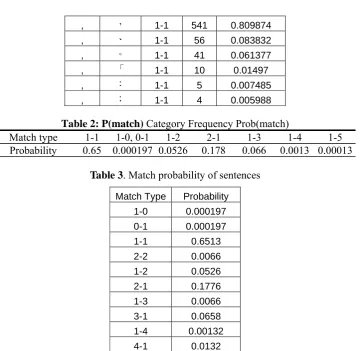
, , 1-1 541 0.809874
, 、 1-1 56 0.083832
, 。 1-1 41 0.061377
, 「 1-1 10 0.01497
, : 1-1 5 0.007485
, ; 1-1 4 0.005988
Table 2: P(match) Category Frequency Prob(match)
Match type 1-1 1-0, 0-1 1-2 2-1 1-3 1-4 1-5
Probability 0.65 0.000197 0.0526 0.178 0.066 0.0013 0.00013
Table 3. Match probability of sentences
Match Type Probability
1-0 0.000197 0-1 0.000197 1-1 0.6513 2-2 0.0066 1-2 0.0526 2-1 0.1776 1-3 0.0066 3-1 0.0658 1-4 0.00132 4-1 0.0132
After aligning by our model, we got 94 parallel records from the ten articles, and had precision rate at 92.55%. To calculate precision rate, we count English and Chinese sub-sentences isolated, so were the error records. For detail, refer to Appendix. Following table show the result:
Article # of sub-sentence errors Prec(%)
Official record of proceed-ings of Hong Kong
Legisla-tive Council
188 14 92.55
5. Discussion and future work
or three text-blocks within it than a sentence do. An inverted sentence causes the second problem here, no matter length-based or punctuation-based approach you used; they cannot solve this kind of problem. We might add lexical information in it to solve this kind of problem in the future.
References
Brown, P. F., J. C. Lai and R. L. Mercer (1991), 'Aligning sentences in parallel corpora', in 29th Annual Meeting of the Associa-tion for ComputaAssocia-tional Linguistics, Berkeley, CA, USA. pp. 169-176.
Chen, Stanley F. (1993), Aligning Sentences in Bilingual Corpora Using Lexical Information. In Proceedings
Chuang, T., G.N. You, J.S. Chang (2002) Adaptive Bilingual Sentence Alignment, Lecture Notes in Artificial Intelligence 2499, 21-30.
Gale, William A. & Kenneth W. Church (1993), A program for aligning sentences in bilingual corpus. In Computational Linguistics, vol. 19, pp. 75-102.
Jutras, J-M 2000. An Automatic Reviser: The TransCheck System, In Proc. of Applied Natural Language Processing, 127-134. Ker, Sue J. & Jason S. Chang (1997), A class-based approach to word alignment. In Computational Linguistics, 23:2, pp.
313-344.
Kueng, T.L. and Keh-Yih Su, 2002. A Robust Cross-Domain Bilingual Sentence Alignment Model, In Proceedings of the 19th International Conference on Computational Linguistics.
Kwok, KL. 2001. NTCIR-2 Chinese, Cross-Language Retrieval Experiments Using PIRCS. In Proceedings of the Second NTCIR Workshop Meeting, pp. (5) 14-20, National Institute of Informatics, Japan.
Melamed, I. Dan (1997), A portable algorithm for mapping bitext correspondence. In The 35th Conference of the Association for Computational Linguistics (ACL 1997), Madrid, Spain.
Piao, Scott Songlin 2000 Sentence and word alignment between Chinese and English. Ph.D. thesis, Lancaster University. Kevin C. Yeh, Thomas C. Chuang, Jason S. Chang (2003), Using Punctuations for Bilingual Sentence Alignment - Preparing
Appendix
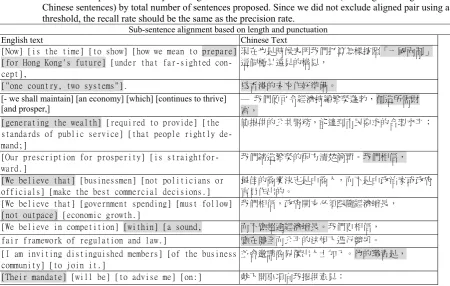
Table A. all incorrect alignments of this experiment. Shaded parts indicate imprecision in alignment results. We calculated the precision rates by dividing the number of unshaded sentences (counting both English and Chinese sentences) by total number of sentences proposed. Since we did not exclude aligned pair using a threshold, the recall rate should be the same as the precision rate.
Sub-sentence alignment based on length and punctuation English text Chinese Text
[Now] [is the time] [to show] [how we mean to prepare] [for Hong Kong's future] [under that far-sighted con-cept],
現在也是時候表明我們打算怎樣按照「一國兩制」 這個極具遠見的構思,
["one country, two systems"]. 為香港的未來作好準備。
[- we shall maintain] [an economy] [which] [continues to thrive]
[and prosper,] ─ 我們便可令經濟持續繁榮蓬勃,創造所需財富, [generating the wealth] [required to provide] [the
standards of public service] [that people rightly de-mand;]
使提供的公共服務,能達到市民要求的合理水平;
[Our prescription for prosperity] [is straightfor-ward.]
我們締造繁榮的配方清楚簡單。我們相信,
[We believe that] [businessmen] [not politicians or officials] [make the best commercial decisions.]
最佳的商業決定是由商人,而不是由政治家或政府 官員作出的。
[We believe that] [government spending] [must follow] [not outpace] [economic growth.]
我們相信,政府開支必須跟隨經濟增長,
[We believe in competition] [within] [a sound, 而不應超逾經濟增長。我們更相信,
fair framework of regulation and law.] 應在健全而公平的法規下進行競爭。
[I am inviting distinguished members] [of the business community] [to join it.]
並會邀請商界傑出人士加入。他的職責是,