Variability in vowel formant frequencies of children with cerebral
palsy
Li-mei Chen
Department of Foreign Languages and Literature, National Cheng Kung University [email protected]
Yung-Chieh Lin
Department of Pediatrics, National Cheng Kung University
Wei Chen Hsu and Fang-hsin Liao
Department of Foreign Languages and Literature, National Cheng Kung University
摘要
腦性麻痺為發展性運動神經障礙,而研究腦性麻痺語言特徵及其發展模式對於幼童 早期語言發展的了解相當重要。母音在初期語言發展就已出現並且是了解語音聲學特性 的關鍵。本研究旨在檢視五位腦性麻痺嚴重程度不同以及年齡層介於三到七歲的腦性麻
痺幼童之母音共振峰頻率的差異。測量F1和F2的變化、母音空間分佈、母音空間面積。
本研究結果顯示:1)三歲到七歲之間沒有發現F2明顯的下降;2) 母音橢圓形軌跡都有
明顯的重疊;3)母音分佈沒有顯著的擴張,研究結果顯示這五位腦性麻痺小朋友有語言 運動神經不協調和發音發展遲緩的情形。
關鍵字: 母音共振峰頻率、母音空間、腦性麻痺、學習國語幼童
Abstract
Cerebral palsy (CP) is a developmental motor disorder and the study of the speech characteristics and developmental speech patterns may provide valuable information on early speech development. Vowels appear early in speech development and they are central to the understanding of the acoustic properties of speech. Therefore, the current study aimed to examine the differences of vowel formant frequencies among five children with cerebral palsy in different severity ranging from ages 3 to 7. First and second vowel formants (F1 and F2) were measured to investigate: 1) the changes of the F1 and F2 values, 2) vowel space, and 3) the vowel space area in CP children of different ages and severity. The major findings are: 1) There was no obvious decline in F2 values from 3 to 7 years old, which indicated delayed speech development; 2) The overlapping ellipses of all vowel spaces illustrated unstable motor control in all the five children; and 3) The five CP children had centralized corner vowels and there was no expansion of vowel spaces at different ages. This indicated their limited motor control.
children
1. Introduction
Cerebral palsy is regarded as the most common cause of severe motor disability in children who are attributed to non-progressive disturbances that occurred in the developing infant brain [ 1]. Estimation from several different developed countries reported that 1.2-3.0 per 1000 children were diagnosed with cerebral palsy [2][3]. Vowels are central to the understanding of the acoustic properties for speech, and vowels appear early in speech development. Children achieve high degree of accuracy in producing vowels by the age of 36 months [4]. Therefore, the current study focused on vowel acoustical characteristics in five CP children of different ages.
2.Methodology
2.1.The participants
Five children with cerebral palsy participated in current study for investigating the differences of vowel formant in their speech production. General background
information is described as follows.
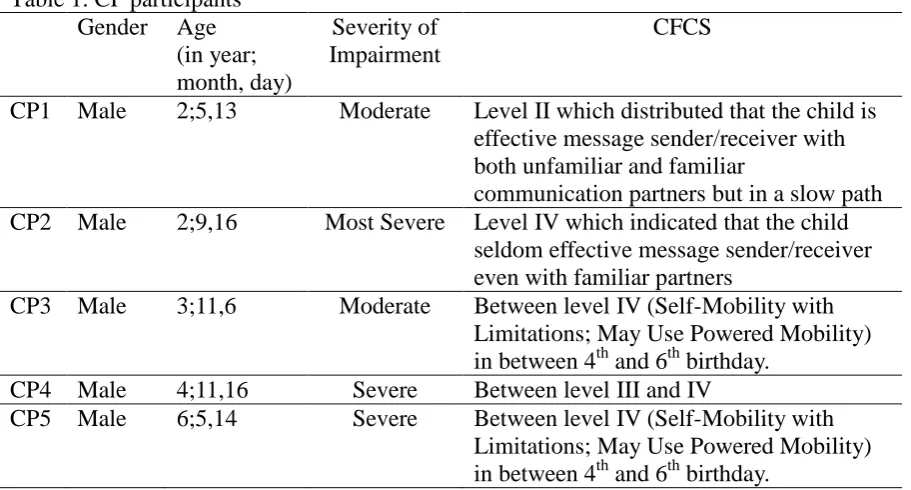
Table 1. CP participants Gender Age
(in year; month, day)
Severity of Impairment
CFCS
CP1 Male 2;5,13 Moderate Level II which distributed that the child is effective message sender/receiver with both unfamiliar and familiar
communication partners but in a slow path CP2 Male 2;9,16 Most Severe Level IV which indicated that the child
seldom effective message sender/receiver even with familiar partners
CP3 Male 3;11,6 Moderate Between level IV (Self-Mobility with Limitations; May Use Powered Mobility) in between 4th and 6th birthday.
CP4 Male 4;11,16 Severe Between level III and IV
CP5 Male 6;5,14 Severe Between level IV (Self-Mobility with Limitations; May Use Powered Mobility) in between 4th and 6th birthday.
Five participants were observed individually by the Communication Function Classification System (CFCS) [5] as shown in Table 1. CP2 child, in 33 months, was diagnosed with hydrocephalus which caused severe brain damage and speech disorder.
2. 2 Data collection and analysis
CP2 (severe) showed the opposite outcome in which vowels /i/ and /a/ appeared only 14% (6%+8%) and vowels /o/ and /ə/ appeared 77% (39%+38%). This may due to the limited spontaneous speech production that the child produced.
Table 4. The frequency of occurrence of each vowel
/ɪ/ /ɛ/ /ʊ/ /a/ /o/ /ə/
CP1 (2;5,13) 25% 7% 16% 24% 14% 14%
CP2 (2;9,16) 6% 8% 1% 8% 39% 38%
CP3 (3;11,6) 23% 8% 12% 26% 15% 16%
CP4 (4;11,16) 24% 9% 7% 26% 21% 13%
CP5 (6;5,14) 22% 15% 16% 11% 25% 12%
3.2. Overall vowel space
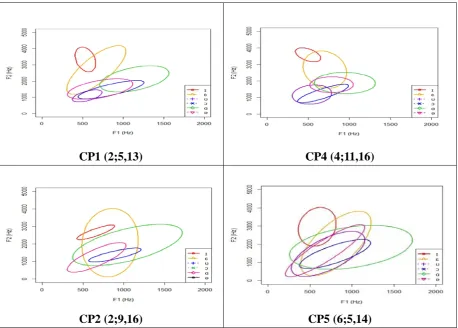
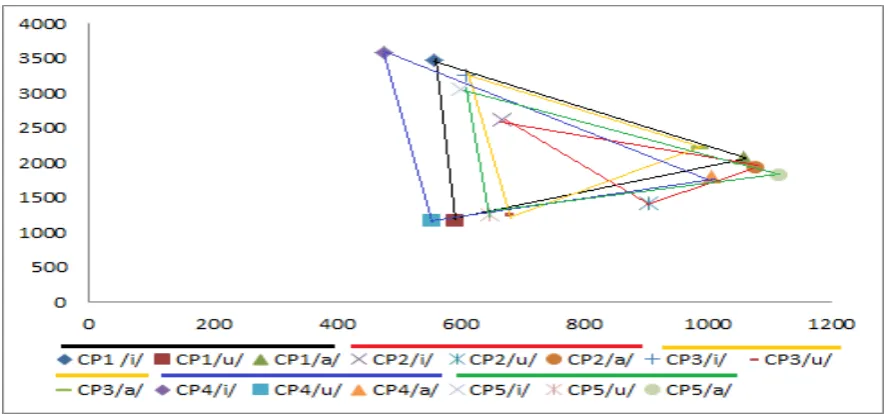
The vowel space for all vowels is illustrated in the following figures. Figure 1 shows that the child at 29 months had not yet developed mature vowel production. The ellipses of vowel space were overlapping and centralized. CP2 had very unstable vowel production in which the ellipses are large. That is, the range of individual vowel was big. The vowel space for CP3 showed overlapping ellipses, which also indicated unstable vowel production. Even in the oldest child (6 years and 5 months of age) in this study, the production of vowels still appeared to be immature.
CP1 (2;5,13) CP4 (4;11,16)
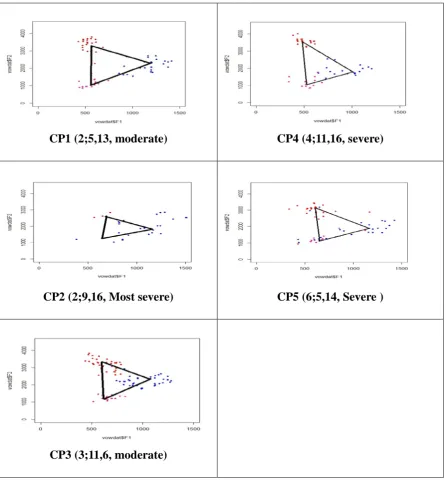
CP1 (2;5,13, moderate) CP4 (4;11,16, severe)
CP2 (2;9,16, Most severe) CP5 (6;5,14, Severe )
CP3 (3;11,6, moderate)
Figure 3. Vowel space for all participants. CP1 (black); CP2 (red); CP3 (yellow); CP4 (blue)
and CP5 (green)
The vowel space with three corner vowels produced by the 5 children with different ages revealed no obvious trend of expansion or concentration of vowel spaces. However, the results indicated that, first, the major difference among participants appeared on F1 formant values, especially for vowel /i/ and /u/. Second, vowel /a/ appeared to be stable with no obvious changes by severity and age differences. Table 6 shows the corner vowel space area for each child. The results indicated that the vowel space tended to be larger in early ages, and then became smaller in older ages.
Table 6. Corner vowel space area (Hz²)
CP1 CP2 CP3 CP4 CP5
Severity Moderate Severe Moderate Severe Severe
Age 2;5,13 2;9,16 3;11,6 4;11,16 6;5,14
Area 556655 Hz² 278985 Hz² 345718 Hz² 572422 Hz² 439234 Hz²
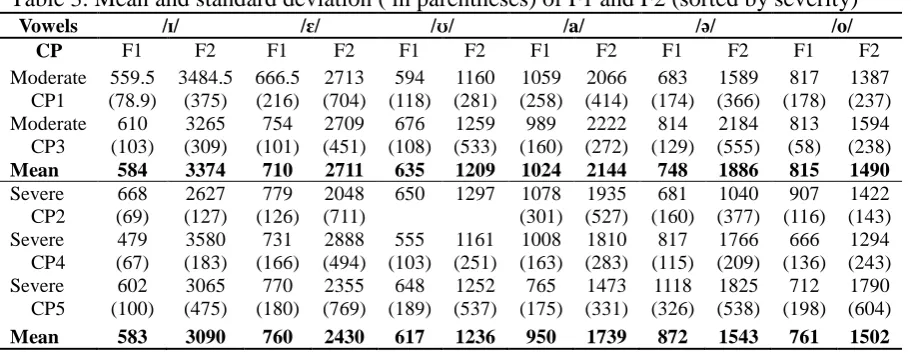
Previous study of children’s developmental changes in vowel production suggested that typically-developing children tended to have high F2 values in vowel /i/ at age 1 and decreased by process of age [8]. The result in current study showed that the F2 value of vowel /i/ in CP1 (29 months) had reached up to 3000 Hz. However, the F2 values of vowel /i/ did not decline with the process of age. CP4 appeared to have more than 3000 Hz of F2 values in vowel /i/ at age of 4. The data in the current study indicated unstable development in vowel production in terms of age difference in respect of F1 and F2 values. The findings are similar to the description in [9] which indicated that the abnormality in vowel development may provide valuable information in the understanding of early speech characteristics and speech development in CP.
severity, F1 and F2 values, vowel space, and vowel space area.
Due to the deficit of speech-motor control, children with cerebral palsy showed no obvious differences in speech production based on the comparison of vowel formant values in CP with different severities and ages. Regarding vowel space, all five CP children had scattered and non-uniform formant values, which reflected that children with CP had limited ability to coordinate and control tongue movement in vowel productions.
4. Acknowledgement
This investigation was supported through funds from National Science Council in Taiwan (NSC101-2410-H-006-082, NSC102-2410-H-006-060). A special thank you is extended to the families of the children in this study for their support of this project.
References
[1] C. Lepage, L. Noreau, P. Bernard and P. Fougeyrollas. “Profile of handicap situation in children with cerebral palsy,” Scandinavian Journal of Rehabilitation Medicine,”vol. 30, pp. 263-272, 1998.
[2] E. Odding, M.E. Roebroeck and H.J. Stam. “The epidemiology of cerebral palsy: Incidence, impairments and risk factors.” Disability and Rehabilitation,” vol. 28, pp. 183-191, 2006.
[3] N. Paneth, T. Hong and S. Korzeniewski. “The descriptive epidemiology of cerebral palsy,” Clinics in Perinatology, vol. 33, pp. 251-267, 2006.
[4] K. Pollock. “Idntification of vowel errors: methodological issues and preliminary data from the Memphis vowel project,” In Ball, M.J. and Gibbon, F. (Eds.). Vowel Disorders. London: Butterworth-Heinemann, pp. 83-113, 2002.
[5] M.J.C. Hidecker, N. Paneth, P.L. Rosenbaum, R.D. Kent, J. Lillie, J.B. Eulenberg, K. Chester, B. Johnson, L. Michalse, M. Evatt, and K. Taylor. “Developing and validating the Communication Function Classification System (CFCS) for individuals with cerebral palsy,” Developmental Medicine and Child Neurology, vol. 53(8), 704-710, 2011.
[6] A. Smith and L. Goffman. “Stability and patterning of speech movement sequences in children and adults,” Journal of Speech, Hearing and Language Research, vol. 41, pp. 18-30, 1998.
[7] J.R. Green, C.A. Moore, M. Higashikawa and R.W. Steeve. “The physiologic
development of speech motor control: Lip and jaw coordination,” Journal of Speech,
Language and Hearing Research, vol. 43, pp. 239-225, 2000
[8] H.K. Vorperian and R.D. Kent. “Vowel acoustic space development in children: a synthesis of acoustic and anatomic data,” Journal of Speech, Language, and Hearing
Research, vol.50, pp. 1510-1545, 2007.
[9] J. Lee. “Development of vowels and their relationship with speech intelligibility children with cerebral palsy,” (Doctoral Dissertation). University of Wisconsin-Madison,