Getting more data – Schoolkids as annotators
Jirka Hana, Barbora Hladk´a
Charles University in Prague Faculty of Mathematics and Physics
Czech Republic
{hana, hladka}@ufal.mff.cuni.cz
Abstract
We present a new way to get more morphologically and syntactically annotated data. We have developed an annotation editor tailored to school children to involve them in text annotation. Using this editor, they practice morphology and dependency-based syntax in the same way as they normally do at (Czech) schools, without any special training. Their annotation is then automatically transformed into the target annotation schema. The editor is designed to be language independent, however the subsequent transformation is driven by the annotation framework we are heading for. In our case, the object language is Czech and the target annotation scheme corresponds to the Prague Dependency Treebank annotation framework.
Keywords:annotated corpora, morphology, syntax, crowdsourcing
1.
Introduction
The classic quote“the more (annotated) data, the better” is being examined every time when the supervised learning techniques are applied, regardless the language in questions (e.g., (Brantset al., 2007). Textual data annotation is a task expensive in terms of time, expertise, and money. Thus new alternative ways of annotation are searched for at present. Games With A Purpose(von Ahn and Dabbish, 2008) rep-resent the most popular alternative way of annotation. They exploit the capacity of Internet users who like to play on-line games. Moreover, the players work simply by playing the game – the data are generated as a by-product of the game. The game popularity brings more game sessions and thus more annotated data.
The GWAP methodology was formulated in parallel with design and implementation of on-line games with images, which enjoy enormous popularity. So far, a number of GWAP with texts have been designed (e.g., (Hladk´aet al., 2011) but they do not enjoy popularity as great as games with images mainly because reading a text is less fun than observing images.
Our novel approach to “cheaper” annotation involves the idea of including school children (and teachers, if inter-ested) into the annotation process. We provide them with a simple annotation editor and very basic training (few min-utes). Apart from that, we do not teach them the usual anno-tation guidelines and instead we rely on their knowledge of syntax and morphology as taught in school. Their analyses are transformed into the desired annotation scheme auto-matically.
Obviously, we do not expect that they will do it so enthu-siastically as they play on-line games. On the other hand, they have to (or at least should) practice grammar of lan-guage anyway so we can expect some annotation.
2.
Parsing sentences at schools
In the Czech Republic, children at the elementary and high-school level are required to parse sentences into depen-dency trees. They are trained in sentence diagramming
that is based on dependency syntax of ˇSmilauer ( ˇSmilauer, 1972), see Figure 1. Since the Slovak education curriculum has the same roots as the Czech one, Slovak school children undertake a similar training.
Figure 1: Sample of the Czech diagram
We did research based on personal communication to see whether there are similar requirements on children in other countries, that is, eventually, whether we could broaden our methodology to other languages. We asked mostly our col-leagues at universities and we can see that the schoolchil-dren are not trained in such activity in most countries. If they are, it is usually limited to marking phrases such as subject or object, without identifying their hierarchical structure. The initiative by Richard Hudson (Hudson, 1992) is devoted to the same research.1
In some English speaking countries, the so-called Reed-Kellogg sentence diagraming (Reed-Kellogg and Reed, 1899) was fairly common in the past. However, it has mostly disappeared from the current curricula (even though there have been some attempts to reintroduce recently). Czech sentence diagrams (trees) look graphically different from Reed-Kellogg’s scheme, but formally they are very similar, compare Figure 1 and 2.
1http://www.phon.ucl.ac.uk/home/dick/ec/
Figure 2: Reed-Kellogg sentence diagramming
3.
Computational linguistics goes to Czech
schools
We have developed a suite of applications (see Figure 3) aimed at those who want to learn about Czech grammar, whether Czech is their native or second language. The STYX system (Hladk´a and Kuˇcera, 2008) is and electronic exercise book of Czech morphology and syntax based on the Prague Dependency Treebank (PDT).2
exercise book PDT
more annotated
data CharonCharon
exercises
Styx
Styx practicing
sentences by schoolkids Morphologically and syntactically
annotated corpora
Čapek
Čapek
transformationČapek
transformationStyx
sentences by schoolkids
Figure 3: The STYX system
The STYX system consists of
• a database of 11,000 sentences with their morpho-logical and syntactic analyses. The PDT data an-notated on all annotation layers, i.e. on morpho-logical, syntactic and semantic layers (49,442 sen-tences) constituted the candidate set of sentences from which the sentence database was composed. Then sentences from the candidate set unsuitable for schoolchildren because of too complex phenomena were discarded. This resulted in 11,718 sentences, the annotations of which were consequently transformed
(seetransf ormationStyx) into the school annotation
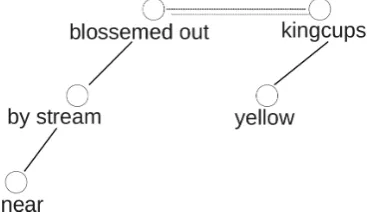
scheme - compare sentence3 annotation in Figure 4 and Figure 5. In the school annotation scheme, a sen-tence is represented as a tree-like structure with the labeled nodes which corresponds to the representation of dependency-based syntax. Unlike a tree structure,
2
http://ufal.mff.cuni.cz/styx 3
The white kingcups have blossomed out by near stream. U [by] nedalek´eho [near] potoka [stream] uˇz [already] rozkvetly [blossemed out] ˇzlut´e [yellow] blatouchy [kingcups].
this structure has no root node or, from another point of view, it has two roots: a subject and a predicate.
• a user interface
– Charonto select sentences from the database, i. e. to compose the exercises. Because it would be time-consuming to go over all the 11,000 sen-tences, it is possible to select sentences with par-ticular phenomena.
– Styxto analyze the selected sentences both mor-phologically and syntactically, and to check the analyses. The morphological analysis comprises part-of-speech tag assignment; the syntactic anal-ysis comprises tree-like structure building and syntactic tag assignment.
Figure 4: Sample of PDT annotation
Figure 5: Sample of the Czech school annotation scheme
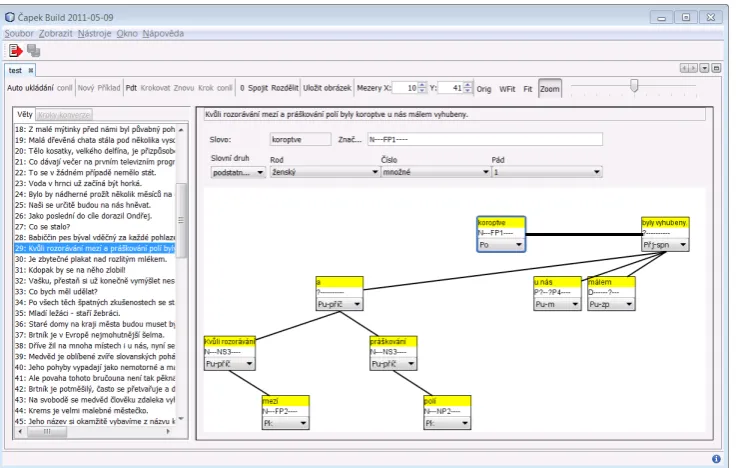
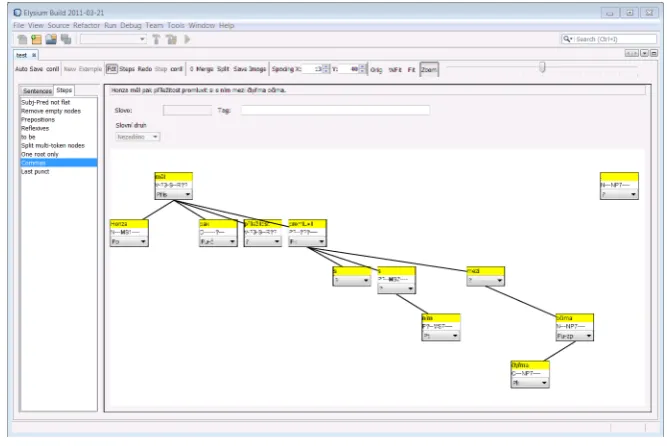
Another part of the Styx system isCapekˇ , an editor which can be used to annotate arbitrary sentences morphologically and syntactically following the school annotation scheme (see Figure 6). Once the sentences are read, they are tok-enized and the user can proceed with practicing4 morphol-ogy and syntax. The editor exists in two versions: (1) as a
4When speaking about language classes, we prefer to use the
Figure 8: Subject-predicate transformation
3. Tagset translation: The syntactic tagset is translated using a simple dictionary. The PDT tagset contains tags not present in the school system, but they are not present at this stage, as they are used mainly with aux-iliary words (see below) which do not have their nodes in the school system. These tags are introduced by later transformations as each of these phenomena is handled.
4. Dropping PRO subject: The school system intro-duces nodes for dropped subjects, which are common in Czech, while the PDT system does not represent them explicitly. We simply drop them from the struc-ture.
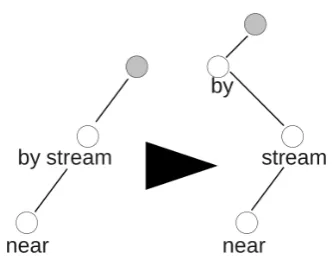
5. Splitting multi-token nodes. As mentioned above, the school system operates on multi-word units. Aux-iliary words do not have their own nodes, but instead they are considered to be some kind of inflection on content words. For example, the phrase have been sleepingandsleepsare both considered to be inflection of the verbsleepand thus both act as single units in the structure. Auxiliary verbs, all prepositions, modals, certain verbs such as start,become, etc. are all con-sidered to be part of so called analytical morphology. We have to split these multi token units, as the PDT system treats all these words as separate items. This is done by a sequence of transformations:
(a) preposition + words:The preposition is consid-ered to be the head while the other word (usually a noun) is the dependent. All dependents of the unit will depend on the noun.
Figure 9: Splitting multi-token nodes with preposition
(b) reflexives: As other Slavic languages, Czech uses reflexives extensively to express several functions (regular reflexive, passive, mutuality),
in addition, reflexive-tantum verbs are always accompanied with a reflexive (sm´at se ‘laugh’ lit: ‘laugh oneself’). These functions are distin-guished in the PDT system. Currently we simply separate the reflexive pronoun from the verb and mark it as a part of a reflexive-tantum verb as this is the case in 65% of the cases (at least in the PDT data). In the future, we are planning to use VALLEX ( ˇZabokrtsk´y and Lopatkov´a, 1972), a valency lexicon, to separate the reflexive-tantum and other uses. We can also use the label sug-gested by a parser or to train a dedicated classi-fier.
(c) ‘to be’: Forms of the verb b´yt ‘to be’ are used in several complex verbal forms (future, past, conditional, nominal predicates). The PDT scheme distinguishes between auxiliary and non-auxiliary use, but since the distinction is rather subtle and the auxiliary use is by far the more common, we mark all such uses of the verb ‘to be’ as auxiliary.
certainly
Friends will be angry
with us
Friends
angry
will with be
us certainly
Figure 10: Splitting multi-token nodes with reflexive
(d) Remaining multi-token units are arbitrarily split into a right branching sequence of nodes.
Examples of untreated phenomena:
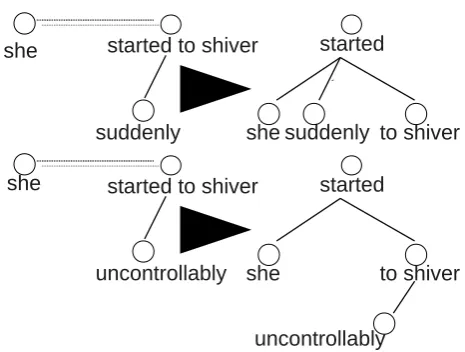
1. All complex predicates beyond ’to be’ + full verb (st´at se uˇcitelem ‘become a teacher’, zaˇc´ıt se tˇr´ast ‘start to tremble’, etc.) are handled by a very simple rule. First the predicate itself is split into right branching sequence of nodes, which is correct in the vast ma-jority of cases. However, the main problem is in the distribution of dependents to the new nodes. In many cases, this cannot be done on purely syntactic grounds. For example, adverbs modifying the phrase to start to shivercan modify either the verbstartor the verb shiver. Without considering semantics one cannot re-ally decide which is the correct analysis as Figure 11 shows. Our procedure assigns all such dependents (ex-cept the subject) to the most embedded verb.
Figure 12: Transformation from the school system to the PDT system within the editor
Third Workshop on Innovative Use of NLP for Build-ing Educational Applications, pp. 36-43, The Ohio State University, Columbus, Ohio, USA.
Brainerd Kellogg and Alonzo Reed. 1899. Title Higher Lessons in English. A work on English grammar and composition.
Richard E. Hudson. 1992. Teaching Grammar: A Guide for the National Curriculum (Language in Education). Vladim´ır ˇSmilauer 1972. Nauka o ˇcesk´em jazyku.
Praha:St´atn´ı pedagogick´e nakladatelstv´ı.