The Pronouncing Dictionary of Austrian German and the other Major Varieties
of German – A Phonetic Resources Database on the Pronunciation of German
Rudolf Muhr
(1)
, Robert Höldrich
(2)
, Eva Wächter-Kollpacher
(3)
(1) Projekt Österreichisches Deutsch, Institut f. Germanistik der Universität Graz, Heinrichstrasse 22/2, A-8010 Graz, Austria ([email protected]) (2) Institut für elektronische Musik und Akustik, Musikuniversität Graz, Innfeldgasse 10,
8010 Graz, Austria ([email protected])
(3) ORF, Österreichischer Rundfunk, Am Küniglberg, 1021 Wien ([email protected])
Abstract
The paper gives a comprehensive overview on the project “Varieties of Austrian German - Standard pronunciation and varieties of standard pronunciation” whose primary goal is the creation of a pronouncing dictionary of Austrian German and the creation of a large data base of audio samples for research on spoken language and different forms of pronunciation in Austria. The contents of the dictionary and the database are described in detail. The project is based on the idea that German is a pluricentric language which means that German and Swiss model speaker realisations will be also included in the database alongside with the Austrian model speakers. A corpus of 86.000 words spoken by 6 model speakers and a large number of texts will be published together with the dictionary on CD-ROM in 2003. The paper also gives an overview on the theoretical and methodological foundations of the project which is supported by the Austrian national broadcasting corporation and funded by the Austrian national bank. Finally the database and the user-interface is described in detail which allows a number of different queries and will have a built-in tool for the acoustic analysis of sound files chosen by the user.
1.
Introduction
This presentation intends to give a report on the results of the project „Varieties of Austrian German – Standard pronunciation and varieties of standard pronunciation“ which started in January 2000 and will be finished during 2003. It is financed by the research fund of the Austrian national bank and supported by the national Austrian broadcasting corporation which is keen on getting reliable information about pronunciation and spoken language in Austria.
2.
Goal of the paper
The main objective of the paper is give an overview on the project which is to provide Austria with a pronuncia-tion dicpronuncia-tionary providing reliable informapronuncia-tion about the so called „standard pronunciation“ and other common pro-nunciations prevailing in Austria.
The project is on the one hand a large scale codifica-tion attempt of standard forms of pronunciacodifica-tion in Austria - the so called „model pronunciation“ and on the other hand an attempt to differentiate this level of pronunciation from other forms which are eventually common through-out the country but not acknowledged as model pronun-ciation. As non-codified forms of pronunciation often function as a „standard“ in certain domains, regions or speech situations, the dictionary intends to provide reli-able information on their forms and usage too, making users of the dictionary understand that in modern societies there are different levels of the so called „standard lan-guage“. This additional information is also intended to support software development in the speech recognition area as well in other areas like educational software for the pronunciation training etc.
3.
The language situation of German and its
impact on language studies and speech
recognition
German is according to Kloss (1978) and Clyne (1984,
1995) a “pluricentric language” which describes the fact that the language is spreading over several independent countries which have norms of its own. This fact is mostly ignored as there is a strong asymmetry between the three major varieties of German which is based on the fact that 85% of all speakers of German are inhabitants of Germany. Usually, German German (GG) is therefore considered to be the “standard” and Austrian German (AG) and Swiss German (SG) as some kind of “deviation” from the GG norm. Ever since the middle of the nineties a change of this standpoint which is now considered untenable occurred in two areas: There were significant developments in the fields of sociolinguistics1 and in speech recognition which showed that a differentiation between “national” and “regional” variation has to be made in order to be able to cope with the question of “identity” associated with language and the fact that GG phonetic rules are not very efficient in speech recognition of Austrian speakers. Unlike to English were the differentiation into national varieties is an accepted fact it is only recently that this idea has been adopted in respect to German. Most research on the German language is therefore based on data from GG and ignoring the two other national varieties of German (NAVG). This has been supported by the fact that until recently there has been very little research on the specific linguistic and communicative features of AG. The research situation has also been handicapped by the lack of a representative corpus of spoken language of AG and the predominant language model still supported by many linguists which pretends that the “standard pronunciation” of German should be the identical in all German speaking countries. The presented project is to change this and other shortcomings connected with the codification of the standard pronunciation of AG. It is firmly based on the pluricentric concept which means that the other NAVG are included in the description too.
1
4.
Research on national varieties of
pluricentric languages in linguistics and ASR
Although there are more than 20 or even more pluricentric languages in the world only the varieties of English have been dealt with extensively in linguistics and in the field of speech recognition.2 Other pluricentric languages which have been investigated in respect to the specific features of their NAV are Dutch, Portuguese and to some extend French (Canadian French). Due to the very recent acknowledgement of the pluricentric character of German most research has focused on so called “regional variation” within Germany or on small regional dialects in AG or SG. However the German Verbmobil-Project yielded a large number of papers and rules which describe GG regionalised everyday speech under certain controlled conditions of speech production (read language in a defined dialogue framework).3
For Austria similar attempts are made in the Speech and More project of the Vienna Telecommunication Research Centre (FTW) which tries to find specific pronunciation rules for AG on the basis of the Austrian SPEECH-DAT corpus of 2000 untrained speakers which were collected via telephone or mobile phone.4 The corpus predominantly consists of read speech. In a sub-project, a substantial number of speakers were transcribed in a narrow transcription at the Project Austrian German (Graz) in order to get reliable data on the phonetic substance of AG which are to serve as a basis for the creation of adapted HMMs for AG.5
A review on the literature about standard pronunciation of AG yielded about 35 publications dealing with this topic.6 They are showing some 30 observations on phonetic characteristics which the authors felt were specific to AG. However, a close look on these observations also showed that a) there is very little correspondence between the observations of different authors and b) the empirical basis for the observations are either not disclosed or the findings are not based on a controlled and sufficiently large corpus. From there it was evident that standard pronunciation of AG is not properly described and that it was necessary to create a pronouncing dictionary of AG which would be based on a controlled corpus and a sound theoretical concept taking the pluricentric character of German into account.
5.
The project “Varieties of Austrian
German - Standard Pronunciation and
Varieties of Standard Pronunciation” in
detail
2
e.g. Trudgill/Hannah (1994), Schneider (1997ff) 3 e.g. Burger/Draxler (1997), Beringer/Neff (2000),
Ber-inger/Schiel (2000), Beringer et.al. (1997), Burger/Oppermann (1999) etc.
4
See Baum/Erbach/Kubin (2000). A similar project has been started by the Swiss telecommunication company. The pronunciation of the standard variety of SG is dealt with by Hove (1998).
5
Baum/Muhr/Kubin (2001) 6
Major works are Lipold (1988), Stubkjaer (1995), Moosmüller (1988, 1996), Takahashi (1996), Bürkle (1997), Muhr (2000) etc.
5.1.
The participating institutions
The project is co-ordinated by the “Austrian German Project” at the Department of German of Graz University. Partners in the project are the “Institute of Electronic Music and Acoustics” at Graz University for Musik and Arts and the ORF - Austrian National Broadcasting Company - which is interested in getting a solid basis for the orthoepical training of journalists and news readers working at the company.
The project started in 2000 and will be finished by the end of 2003.
5.2.
Objectives of the project
The project is to achieve the following objectives: 1) Building a representative pronouncing dictionary of AG comprising information on AG pronunciation contrastive to the other NAV;
2) Building a phonetic database which contains: a) 86.000 sound files (2x14.000 for each NAV of German) of a selected wordlist read by 3 male and 3 female model speaker); b) 9432 sound files of a phonetically rich word list containing 393 items read by 8 additional model speakers for SG and GG and 27 for AG; c) a literary text (1014 words) read by 14 speakers and d) a news text (914 words) read by 14 speakers of the 3 NAVG; e) 100 sound files, 2-3 minutes in length, containing fluent speech of both model speakers and untrained speakers speaking on Austrian radio or television. These sound files are intended to provide information on features of pronunciation of fluent speech. Altogether the phonetic database will contain about 95560 sound files and give a thorough documentation of all levels of pronunciation in Austria (and in many cases also on the pronunciation of the other German speaking countries).
5) Providing a user-friendly interface for searching the database, listening to the soundfiles and analysing the sound files with a tool for acoustic analysis.
6) Publication of the pronouncing dictionary in printed version.
7) Publication of the dictionary and the phonetic database on CD-ROM/DVD comprising additional features for research and training. The database will also be made available on Internet.
8) Creation of a handbook for the training of professional news-readers, TV-presenters and actors.
“Media presentation language” and its pronunciation forms can be produced by any professionally trained speaker or untrained speaker speaking in the electronic media. This is the first distinction which has to be made in the codification process. It is based on the assumption that any individual speaker knowing that a large audience is listening will try to reproduce some kind of language form which is thought to be generally accepted. By doing so speakers are trying to reproduce their individual “model-standard”. Whether the individual pronunciation is exem-plary has to be decided in a second run by hearer judge-ments. It is therefore necessary to distinguish between “model speakers” who are exemplary for the speech community and “other speakers” who are producing non-exemplary forms of pronunciation (which can be wide-spread but not considered to have model status).
This leads to the conclusion that the codification and description process has to be controlled on two sides: 1) On the side of the chosen model speakers and 2) on the side of the conditions under which a given form of pro-nunciation has been or is produced.
For controlling the speaker input usually only profes-sionally trained speakers are chosen for the codification of a model-pronunciation as their standard pronunciation is closely linked to the acoustic reproduction of written lan-guage. Model speakers also have gained the necessary steadiness and control over their voice which ensures in-variable pronunciations across a large corpus. (Our research shows however that there is an unexpected amount of variation in pronunciation even among profes-sional speakers. This makes hearer judgements indispen-sable when it comes to the selection of model speakers.)
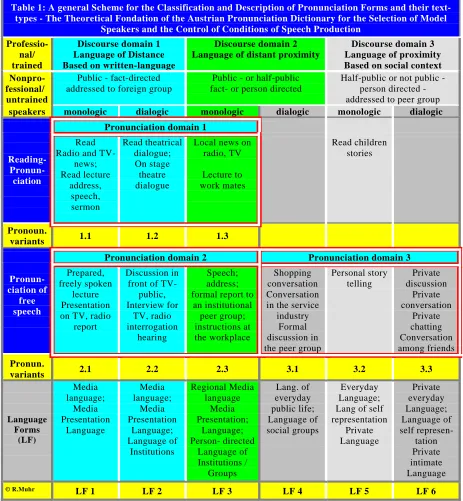
For the control of the conditions under which a given form of pronunciation is produced a complex scheme was developed by R. Muhr which is presented in table 1. It is based on three criteria: 1) Discourse domains (1-3) which are ranging from public to private and are linked to lan-guage forms which signal social distance or social prox-imity; 2) The basic interaction types monologic or dia-logic; 3) The speech production types reading (bound production) or free speech (unbound production). The combination of these factors results in the definition of 3 pronunciation domains: 1) Reading pronunciation on radio and TV usually produced by professional speakers or in a more local context by speakers who show an affiliation to the region from where they come. These pronunciation forms are firmly based on written language which in most cases serves as input for the speech production in this area of media communication. 2) Domain 2) comprises the pronunciation of free speech which is produced when a lecture or a presentation or a discussion is held on radio or on TV. Contrary to the monologic speech events which are based on prepared texts, discussions and interviews usually are unprepared and completely free of a formal control by a text underlying the speech production. 3) The third pronunciation domain puts together the large field of free everyday speech which is produced spontaneously and face to face in private or semi-private situations.
For the ongoing codification of a model standard pro-nunciation of AG the propro-nunciation variants 1.1, 1.2, 2.1 and 2.2 are central. All other variants serve to distinguish written-language based pronunciation forms and
nationally accepted ones from non-written language based and more regionalised forms.
5.4.
The single steps of the codification process of
AG pronunciation
The codification process was split into six stages: Stage 1) dealt with the selection of model speakers of AG and the other NAVG. Stage 2) was devoted to the recording and processing of the acoustic model corpus which was produced by one male and one female speaker for each NAVG. Stage 4) which is presently ongoing, is concentrating on the phonetic and acoustic description of the pronunciation forms produced by the model speakers. Stage 4) is to complete the data of pronunciation variants 2.1 and 2.2 which are gained by direct recordings from the media. The data are also completed by recordings of a phonetically rich corpus of 400 words of an additional number of professional speakers from the three NAVG. These data will serve to support or rectify the findings of the phonetic analysis of the corpuses produced by the 6 main model speakers. Stage 5) will be devoted to the transformation of the lexical entries of the pronunciation dictionary into the correct AG phonetic forms and add additional information to it when there are differences in the model pronunciation of the other NAVG. Stage 6) which has already started is dealing with the creation of the database and the programming of the user interface (see pt. 5.7).
5.5.
The model-speaker selection process
The controlled selection of the model speakers is a necessary prerequisite for the codification of a standard pronunciation. This was done in four steps.
In step 1) a complex scheme about the so called “me-dia formats” (text genres) was developed. This scheme was used for the selection of potential model speakers.
In step 2) 40 model speakers out of a potential of 500 were selected and asked to record a phonetically rich cor-pus of 400 words, a short text and a freely spoken short description of their curriculum vitae. The speakers were representing all relevant media formats (news, sports, culture, science, entertainment etc.) and also representing the regional structure of the Austrian national broadcast-ing company.
In step 3) 17 of the 40 potential speakers were chosen by the co-ordinators of the project in several rounds of close listening to the texts of the 40 speakers.
The selection of the German and the Swiss model speakers had to be left to the nomination of “speakers in charge” at German and Swiss broadcasting corporations. his is a shortcoming which we are well aware of. However our funding did not allow a similarly complex and time consuming process of model-speaker selection for the other two NAVG too. We had to rely on the judgements of managerial staff of the broadcasting companies which were willing to co-operate with us in the project. This was the case with the Swiss radio DRS and the Südwestfunk in Stuttgart.7 According to the criteria named by us a male and a female speaker representing the German and the Swiss variety of media presentation language came to Graz and recorded the corpus.
5.6.
The selection of the model corpus of the
Aus-trian pronunciation dictionary
The model corpus which was read by the model speakers comprises 13343 single words and two coherent texts. Text 1) is the short story “The Sphinx” by the fa-mous Austrian writer Ingeborg Bachman. It is supposed to represent literary language. Text 2) is a news text taken from September 12th 2002 which was taken from the vid-eotext pages of the ORF website. It is intended to repre-sent the language of news as they are prerepre-sented every hour on radio.
The wordlist for the audio recordings with the model speakers should fulfil several requirements: 1) It should represent the most frequent and communicative useful words to allow the AG pronouncing dictionary to be used in educational contexts both for the teaching of German as first and foreign language. 2) It should also include frequent word forms and not only citation forms. This part of the word list should allow the checking of the pronunciation of difficult words and word forms which are often neglected in traditional pronunciation dictionaries.
3) A list of the most common foreign words/loan words used in German as they usually cause a lot of
7
We would like to thank Mr. Witschi from Swiss radio and Mr. Klein from the Südwestfunk for the nomination of model speakers for SG and GG.
difficulties for non native speakers of German.
For the selection of the wordlist several sources were used. The words of list 1) were derived from the “Öster-reichisches Sprachdiplom Deutsch -Lernzielkataloge Deutsch als Fremdsprache” [Austrian Language Diploma German - A catalogue of language skills for the teaching and learning of German as a foreign language”] which is a catalogue of language skills and contains a list of 5500 words which were considered to be relevant in 13 the-matic areas of communication. It is a “basic vocabulary list” which was selected according to communicative ne-cessity, frequency, structural usefulness and semantic range of the lexical items. This basic list was supple-mented by list 2) which came from the “Projekt Deutscher Wortschatz” [Project German Lexicon] situated at the University of Leipzig and the only one which freely avail-able at the moment and based on a corpus of 200 mio. run-ning words. The first 10.000 most frequent word forms were included in list 1) and all double entries removed. Finally 3000 common loan words were selected from the “Duden Fremdwörterbuch” [Duden Dictionary of Foreign words] and added to the list. Together with the phoneti-cally rich word list the final version included 13343 words which was recorded by the 6 model speakers.
5.7.
The phonetic database and the user interface
For the monitoring of the pronunciation items the software will allow to choose between several options: a) Listening to male/female speakers or a mix of both; b) Continuos listening to all words which are available on the CD; c) Selective listening according to a choice of pho-netic, lexical or grammatical features; d) Selective listen-ing plus a presentation of selected acoustic and phonetic data which are also included on the CD. This latter part will include a selected number of sonograms, data on F0 and formant characteristics, accentuation etc.6.
Conclusions
The paper presented the ongoing work for the creation of a pronouncing dictionary for Austrian German and a large phonetic database which is to supply users and re-searchers with a range of different speakers and different types of pronunciations. The theoretical foundations of the project are based on the sociolinguistic concept of pluri-centric languages and explained in detail. A lot of detailed work still remains to be done. This is particularly the case in respect to the analysis of the phonetic substance of the three varieties and the differences between them.
References
Ammon, U., 1995. Die deutsche Sprache in Deutschland, Österreich und in der Schweiz. Berlin. Das Problem der nationalen Varietäten des Deutschen. Berlin/New York. de Gruyter.
Baum, M., Erbach, G., Kubin G., 2000. A telephone speech database for Austrian German. In Proceedings of LREC 2000 workshop Very Large Telephone Speech Databases (XL-DB).
Baum, M., Muhr, R., Kubin G., 2001. A Phonetic Lexicon for Adaptation in ASR for Austrian German. In Pro-ceedings of the ISCA Workshop "Adaptation Methods for Speech Recognition", pp. 135-138, Sophia-Antipo-lis, France.
Baum, M., Erbach, G., Kommenda, M., Niklfeld, G., Puig-Waldmülle, E., 2001. Speech and Multimodal Dialogue Systems for Telephony Applications based on a Speech Database of Austrian German. ÖGAI Journal 20/1, pp. 29-34.
Becker, Th., 2001. Zur Repräsentation der Vokallänge in der deutschen Standardsprache. ZS f. Sprachwissen-schaft. H 15/I+II, 1996 Heft 20/I.
Beringer N., Neff M., 2000. Regional pronunciation vari-ants for automatic segmentation. In Proc. of the Second International Conference on Language Resources and Evaluation. Athens, Greece.
Beringer, N., Schiel, F., 2000. The Quality of Multilingual Automatic Segmentation Using German MAUS . In
Proc. of the International Conference on Spoken Lan-guageProcessing. Beijing, China.
Beringer, N., Schiel, F., Brietzmann, P., 1997. German Regional Variants - A Problem for Automatic Speech Recognition? In Proceedings of the ESCA Tutorial and Research Workshop on ’Modelling Pronunciation Variation for Automatic Recognition’. Kerkrade, Neth-erlands.
Burger, S., Draxler, C., 1997. Identifying Dialects of German from Digit Strings”, In Proceedings of Euro-speech 97, Rhodes, Greece.
Burger, S., Oppermann, D., 1999. Regional Variants of German: Categories of Pronunciation from Standard German. In Proceedings ICPhs 1999, San Francisco. Burger, S., Draxler, C., 1997. Identifying Dialects of
German from Digit Strings”. In Proceedings of Euro-speech 97, Rhodes, Greece.
Burger, S., Oppermann, D., 1999. Categories of Pronun-ciation Deviation from Standard German. In Proc. ICPhS 1999. San Francisco.
Bürkle, M. 1995. Zur Aussprache des Österreichischen Standarddeutschen. Die unbetonten Nebensilbe. Peter Lang Verlag, Frankfurt/M.
Clyne, M. 1984. Language and Society in the German-Speaking Countries. Cambridge. CUP.
Clyne, M. 1992. Pluricentric Languages. Different Norms in different Nations. Berlin/New York. de Gruyter. Clyne, M. 1995. The German language in a changing
Europe. Cambridge. CUP.
Hove, I., 1998. Die Aussprache der Standardsprache in der deutschen Schweiz. Diss. Freiburg (Schweiz). Kloss, H. 1978. Die Entwicklung neuer germanischer
Kultursprachen seit 1800. 2. enl. ed.. Düsseldorf: Schwann.
Kumpf, K., King, R., 1996. Automatic Accent Classi-fication for Foreign accented Australian English Speech. In Proceedings of the ICSLP 1996.
Philadelphia.
Lipold, Günter, 1988. Die österreichische Variante der deutschen Standardaussprache. In Wiesinger, P. (ed.).
Das österreichische Deutsch. Wien/Köln/Graz, p. 31-54.
Moosmüller, S., 1991. Hochsprache und Dialekt in Österreich. Soziophonologische Untersuchungen zu ihrer Abgrenzung in Wien, Graz, Salzburg und Innsbruck. Wien et.al. Böhlau.
Moosmüller, Sylvia 1996: Die österreichische Variante der Standardsprache. In Krech, E.-M./Stock, E. (eds.).
Beiträge zur deutschen Standardaussprache. Hanau/ Halle, Werner Dausien Verlag. p.204-213.
Muhr, R., 2000. Chapter 4.1 of Österreichisches Sprachdiplom Deutsch. Lernzielkataloge zu Basis-formulierungen, Lexik, Sprechhandlungen, Höflich-keitskonventionen, Diskurs und Diskursstrukturen, Deutsch als plurizentrische Sprache. Wien, öbv&hpt. Muhr, R./Schrodt, R. (eds.) 1997. Österreichisches
Deutsch und andere nationale Varietäten plurizen-trischer Sprachen in Europa. Wien. Verlag öbv&hpt. Muhr, R./Schrodt, R./Wiesinger, P. (eds.) 1995.
Öster-reichisches Deutsch. Linguistische, sozialpsycho-logische und sprachpolitische Aspekte einer nationalen Variante der Deutschen. Wien. Verlag öbv&hpt. Schaeffler, F.; Summers, R., 1999. Recognizing German
Dialects by Prosodic Features alone. Proc. ICPhS 1999. San Francisco. August.
Schneider, E. W. (ed.), 1997. Englishes around the world.
Vol. 1. Amsterdam/Philadelphia. Benjamins.
Stubkjaer, F. T., 1995. Überlegungen zur Standardaus-sprache in Österreich. In Muhr, R. et. al. (eds.), 1995.
Österreichisches Deutsch. S.248-268.
Takahashi, H., 1996. Die richtige Aussprache des Deutschen in Deutschland, Österreich und der Schweiz nach Maßgabe der kodifizierten Normen. Peter Lang Verlag, Frankfurt/M..
Trojan, F., 1957. Österreichisches Beiblatt zu Siebs Deutsche Hochsprache - Bühnensprache. Wien. Trudgill, P., Hannah, J., 1994. International English. A
Guide to the Varieties of Standard English. London. Arnold.