Comparative Evaluation of Collocation Extraction Metrics
Aristomenis Thanopoulos, Nikos Fakotakis, George Kokkinakis
Wire Communications Laboratory
Electrical & Computer Engineering Dept., University of Patras 265 00 Rion, Patras, Greece
{aristom,fakotaki,gkokkin}@wcl.ee.upatras.gr
Abstract
Corpus-based automatic extraction of collocations is typically carried out employing some statistic indicating concurrency in order to identify words that co-occur more often than expected by chance. In this paper we are concerned with some typical measures such as the t-score, Pearson’s χ-square test, log-likelihood ratio, pointwise mutual information and a novel information theoretic measure, namely mutual dependency. Apart from some theoretical discussion about their correlation, we perform comparative evaluation experiments judging performance by their ability to identify lexically associated bigrams. We use two different gold standards: WordNet and lists of named-entities. Besides discovering that a frequency-biased version of mutual dependency performs the best, followed close by likelihood ratio, we point out some implications that usage of available electronic dictionaries such as the WordNet for evaluation of collocation extraction encompasses.
1.
2.
Introduction
Collocational information is important not only for second language learning but also for many natural language processing tasks. Specifically, in natural language generation and machine translation it is necessary to ensure generation of lexically correct expressions; for example, “strong”, unlike “powerful”, modifies “coffee” but not “computers”. From the other hand, in automatic construction of thesauri and ontologies, identification of multiwords representing characteristic entities and concepts of the domain, such as “General Motors” or “general relativity”, is an obvious necessity. These two types of collocations are quite different in terms of both compositionality and offset (signed distance between constituents in text). In this paper we are concerned with the latter type of collocations; that is multiwords the meaning of which is not compositionally derivable.
Collocations are abundant in language and vary significantly in terms of length, syntactic patterns and offset. They are also domain-dependent and language-dependent; therefore their automatic extraction from domain specific corpora is of high importance, as far as portability of NLP systems is concerned. Therefore, in this paper we will focus on purely corpus-based automatic extraction of collocations, assuming that other available knowledge sources, such as in (Justeson and Katz, 1995) or in (Pearce, 2001), can be employed additionally.
Corpus-based Collocation Extraction
Collocations are recurrent in texts and express lexical selectivity. Therefore two or more words that co-occur in text corpora (much) more often than expected by chance (most) possibly constitute a collocation. In order to test this hypothesis ofdependence, several metrics have been adopted by the corpus linguistics community. Typical statistics are the t-score (TSC), Pearson’s χ-square test (χ2),
log-likelihood ratio (LLR) and pointwise mutual information (PMI). However, usually no systematic comparative evaluation is accomplished. For example, Kita et al. (1993) accomplish partial and intuitive comparisons between metrics, while Smadja (1993) resorts to lexicographic evaluation of his approach. However, it is obvious that an objective and automated evaluation process offers repeatability, allowing for comparison among different collocation extraction measures and techniques.
The aforementioned metrics estimate lexical selectivity on bigrams. Smadja (1993) proposes an algorithm for joining significant bigrams together to construct significant n-grams. However, since his target task is NLG and therefore he is interested in collocations not necessarily non-compositional, he keeps the larger produced n-grams, while conceptually-oriented tasks such as automatic construction of ontologies and thesauri, require identification of the minimal semantic constituents. For example, “the president of United States” is a collocation but it can be decomposed in two minimal lexico-semantic units of which the straightforward combination produces its meaning: “president” and “United States”. However, extraction of significant bigrams is an important task for both applications. In order to eliminate the factor of offset and exploit available recourses for evaluation we focus on sequential collocations (multi-words).
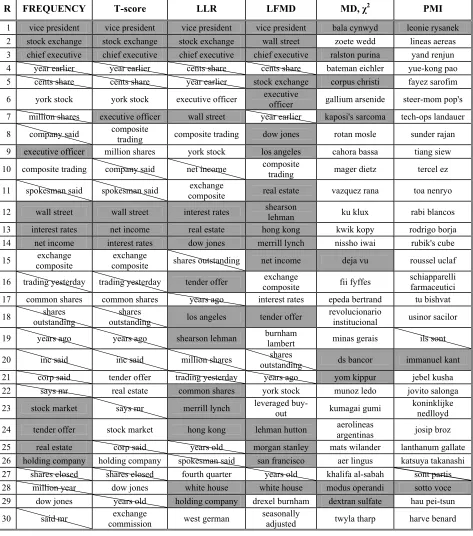
R FREQUENCY T-score LLR LFMD MD, χ2 PMI
1 vice president vice president vice president vice president bala cynwyd leonie rysanek 2 stock exchange stock exchange stock exchange wall street zoete wedd lineas aereas 3 chief executive chief executive chief executive chief executive ralston purina yand renjun 4 year earlier year earlier cents share cents share bateman eichler yue-kong pao 5 cents share cents share year earlier stock exchange corpus christi fayez sarofim
6 york stock york stock executive officer executive officer gallium arsenide steer-mom pop's
7 million shares executive officer wall street year earlier kaposi's sarcoma tech-ops landauer
8 company said composite trading composite trading dow jones rotan mosle sunder rajan
9 executive officer million shares york stock los angeles cahora bassa tiang siew
10 composite trading company said net income composite trading mager dietz tercel ez
11 spokesman said spokesman said composite exchange real estate vazquez rana toa nenryo
12 wall street wall street interest rates shearson lehman ku klux rabi blancos
13 interest rates net income real estate hong kong kwik kopy rodrigo borja 14 net income interest rates dow jones merrill lynch nissho iwai rubik's cube
15 composite exchange composite exchange shares outstanding net income deja vu roussel uclaf
16 trading yesterday trading yesterday tender offer composite exchange fii fyffes schiapparelli farmaceutici
17 common shares common shares years ago interest rates epeda bertrand tu bishvat
18 outstanding shares outstanding shares los angeles tender offer revolucionario institucional usinor sacilor
19 years ago years ago shearson lehman burnham lambert minas gerais ils sont
20 inc said inc said million shares outstanding shares ds bancor immanuel kant
21 corp said tender offer trading yesterday years ago yom kippur jebel kusha 22 says mr real estate common shares york stock munoz ledo jovito salonga
23 stock market says mr merrill lynch leveraged buy-out kumagai gumi koninklijke nedlloyd
24 tender offer stock market hong kong lehman hutton aerolineas argentinas josip broz
25 real estate corp said years old morgan stanley mats wilander lanthanum gallate 26 holding company holding company spokesman said san francisco aer lingus katsuya takanashi 27 shares closed shares closed fourth quarter years old khalifa al-sabah sont partis 28 million year dow jones white house white house modus operandi sotto voce 29 dow jones years old holding company drexel burnham dextran sulfate hau pei-tsun
30 said mr commission exchange west german seasonally adjusted twyla tharp harve benard
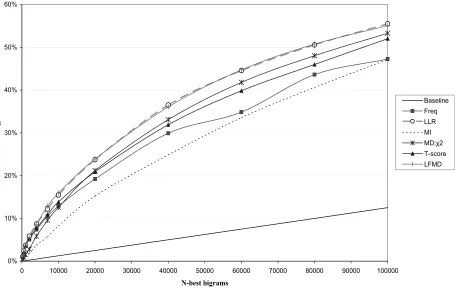
Figure 1: Comparative evaluation against WordNet entities. 0%
10% 20% 30% 40% 50% 60%
0 10000 20000 30000 40000 50000 60000 70000 80000 90000 100000 N-best bigrams
cove
rage
Baseline Freq LLR MI MD;χ2 T-score LFMD
0% 10% 20% 30% 40% 50% 60%
0 10000 20000 30000 40000 50000 60000 70000 80000 90000 100000
N-best bigrams
cov
era
ge
Baseline
Freq
LLR
MI
MD;χ2
T-score
LFMD
Since for a certain level of confidence different statistics may provide different numbers of suggestions, resulting in different levels of coverage and precision, we follow a simple but objective evaluation scheme: We rank bigrams according to every measure and we depict the percentage of pairs retrieved correctly among the N-best candidates, with N ranging from 200 to 100000. As we noted in Section 3, the performance of Pearson’s χ -square test is almost identical to that of Mutual Dependency. Baseline is drawn supposing random selection of bigrams.
The evaluation results show that LFMD and LLR outperform the other measures in both gold standard evaluations. It is interesting however that evaluation against WordNet favours not only the t-score but plain frequency as well, at the expense of information theoretic metrics. We argue that this demonstrates that employing straightforwardly WordNet as a “gold standard” multiword repository is not quite infallible for two reasons:
1. Many WordNet entities are rather analytical descriptions of lexical entities and therefore by no means non-compositional multiwords of interest. For example both “Japanese_capital” and “capital_of_Japan” are included in WordNet as well as many phrases of the same pattern. A preprocesing filter should probably be applied to exclude compositional expressions using the WordNet hypernym relations. Indeed, compositionality of “capital_of_Japan” can be easily identified as since there are numerous “capital_of_X” entities where X has the same hypernym as “Japan”. Moreover, the specific level of the hierarchy the entity occurs can be of assistance towards the same end. That is, the lower the level, the more possible the WordNet word sequence to be a non-compositional lexical entity rather than a synset description.
2. No systematic attempt to include (or omit) all named entities in WordNet (as probably in most dictionaries) have been done. Therefore only the most frequent named entities are included; introducing a preference to frequency-biased measures of association.
5.
6.
Conclusion
We have studied certain pairwise word association measures, typically applied for collocation extraction. We have discussed some associations among them, both analytically and experimentally. Although length and offset of collocations varies significantly, our study was restricted on bigrams in order to eliminate other intervening factors and to exploit available lexical resources for evaluation.
In specific, the strong bias of the t-score towards frequency, makes it incapable to
identify rare collocations, which comprise a large portion of terminology, as Zipf’s law suggests. From the other hand, the inverse-frequency bias of pointwise mutual information can be corrected taking into consideration the self-information of the co-occurrence. Introducing a slight bias towards frequency results in a top-performing measure, surpassing even likelihood ratio.
The evaluation procedure needs also special attention. Available lexical resources such as WordNet are both impure and incomplete regarding non-compositional collocations. Therefore, enrichment with terminological information and elaborated preprocessing for the exclusion of descriptive expressions seem necessary prior to evaluation experiments.
References
Church K. and Hanks P., 1990. Word Association Norms, Mutual Information, and Lexicography. Computational Linguistics, 16/1: 22-29.
Dunning T., 1993. Accurate methods for the statistics of surprise and coincidence. Computational Linguistics, 19/1: 61-74. Gallager R., 1968. Information theory and
reliable communication. John Wiley & Sons, Inc.
Justeson J., Katz S., 1995. Principled Disambiguation: Discriminating Adjective Senses with Modified Nouns. Computational Linguistics, 21/1: 1-27.
Kita K., Kato Y., Omoto T., Yano Y., 1993. “A Comparative Study of Automatic Extraction of Collocations from Corpora: Mutual Information vs. Cost Criteria. Journal of Natural Language Processing 1/1: 21-32.
Manning C. and Schütze H., 1999. Foundations of Statistical Natural Language Processing. Cambridge: MIT Press.
Miller G., 1990. WordNet: An on-line lexical database. International Journal of Lexicography, 34.
Pearce, D., 2001. Synonymy in collocation extraction. Proceedings of the NAACL'01 Workshop on WordNet and Other Lexical Resources: Applications, Extensions and Customizations. Pittsburgh, PA.
Smadja F., 1993. Retrieving Collocations from text: Xtract, Computational Linguistics, 19/1: 143-177.