CSEIT184689 | Published – 08 May 2018 | May-June 2018 [ (4 ) 6 : 475-480 ]
National Conference on Engineering Innovations and Solutions (NCEIS – 2018)
International Journal of Scientific Research in Computer Science, Engineering and Information Technology © 2018 IJSRCSEIT | Volume 4 | Issue 6 | ISSN : 2456-3307
475
CDA Generation and Integration for Efficient Health Record
on Cloud Computing System
Mrs. Pushpalatha R.
1, Mahesh C
21M.Tech Assistant Professor Department of Studies in CS&E VTU PG Center, Mysore, Karnataka, India
24TH Sem M.Tech Department of Studies in CS&E VTU PG Center, Mysore, Karnataka, India
ABSTRACT
Auspicious disposal on Electronic health record supports to develop patient protection and quality of care, but this obtain essential of interoperability between Health Information Exchange (HIE) on different hospitals. The Clinical Document Architecture (CDA) developed on Health Level7 (HL7) is a extract document standard to secure such interoperability, and circulation about this document format is risk for interoperability. Unlikely, hospitals represents, diffident towards approve interoperable Health Information System (HIS) due to its deployment cost excludes for in a few countries. A problem occurs even when more hospitals begin to using the CDA document format because the data confused in different documents on difficult to maintain. In this paper, we define our CDA document generation and integration open API service based on cloud computing system through which hospitals are facilitates to auspiciously to generate CDA document without having to buy a own software. Our CDA document integration system combines multiple CDA documents per patient by a single CDA document and physician and patient can browse the clinical data in sequential order. Our technique of CDA document generation and integration is found on cloud computing and the service provided on open API. The designer using different platforms consequently can use one system through enlarge interoperability.
Keywords: Cloud computing, Health information exchange, HL7, CDA, cloud computing, software as a service.
I.
INTRODUCTION
Cloud computing
Cloud computing is a model of functional and establish a technologies for handling collection of computing assets (resources).There is a turbulent technology that the ability to add participant, quickness, measuring and availability and gives a opportunities for cost reduce through adjusted and capable compute. The cloud computing envisages a world where components can be quickly orchestrated, provisioned, implemented and designation and increase or decrease to give a
required utility like model of distribution and consumption.
The aim of field is to build the basis that the ease of the document, on the reference are based on- To provide a common language and understanding of cloud computing for security professionals, and to begin highlights the difference between cloud computing and traditional computing to help guide security professionals towards accept in security benefits, rather of creating more.
Cloud computing exhibits several interesting uses for business and end users. Three of the main uses of cloud computing are:
1. Self-service condition: end user can revolves
to compute resources for almost any type of capacity on demand. This removes the traditional requires for IT executives to condition and maintain computer resources.
2. Flexibility: companies can measure as computing requires increase and scale down again as demand decrease. This removes are requires for huge assets in local foundation which may or may not stay active.
3. Stipend per use: compute resources are
calculated at a rough level, allowing users to stipend only for the resource and capacity they use.
Health Care
Health care is the care or development of health via the analysis, treatment, and prevention, of disease, illness, injury and other natural and mental distribution in human beings. Health care is delivered by health professionals (providers or participants) in associated health professions, chiropractic, physician, associates dentistry midwifery, nursing, medicine, optometry psychology, and other health professions. It comprises the work done in providing primary care, secondary care and system care, as good as public health.
Approach to health care changes over countries, groups, and individuals, heavily impact by social and reasonable situations as good as the health
approaches in place. Countries and authorities have distinct policies and plans in relation to the personal and population based health care goals within their community. Methods are associations introduced to converge the health needs of aim population. This imposes configuration changes between national and subnational subsistence. In some countries are controls, health care planning is appropriated between market participators, whereas in others, planning arises more conveniently between governments or other coordinating bodies. In all situations agree to the World Health Organization (WHO) a well-performance health care method exact a strong financing; a well-trained and sufficiently- paid capabilities; dependable information on which to establish choice and approaches; and well managed health facilities and coordination to rescue quality medicines and mechanism.
Motivation
Our project is to identifying the false information of the hospitals database. It reduces the manual work and gives the correct information of the patient records or reports. Which they treat and make a pdf form to refer the other prescribed doctor. The lab technician will send this pdf for the prescribed doctors to read a patient reports without false information. If the patient forgets their reports by carrying no worry about that reports that reports have already send to prescribed laboratory.
disease. It reduces the time and cost of the patient as well as doctor.
II.
BACKGROUND
PurposeThe purpose of introducing a CDA generation and integration for health information based on cloud computing system to avoid the false information of patient reports on the hospital database to store document recording the diagnosis is generated. The CDA document can be shared with other clinics if the patient agrees. The concept of family doctor does not exist in Korea; hence it is common for a patient to visit a number of different clinics. The exchange of CDA document is triggered in the following cases: when a physician needs to study a patient’s medical history; when referral and reply letters are drafted for a patient cared by multiple clinics; when a patient is in emergency and the medical history needs to be reviewed. It takes increasing amount of time for the medical personnel as the amount of exchanged CDA document increases because more documents means that data are distributed in different documents. This significantly delays the medical personnel in making decisions. Hence, when all of the CDA documents are integrated into a single document, the medical personnel is empowered to review the patient’s clinical history conveniently in chronological order per clinical section and the follow-up care service can be delivered more effectively. Unfortunately for now, a solution that integrates multiple CDA documents into one does not exist yet to the best of our knowledge and there is a practical limitation for individual hospitals to generation system that generates CDA documents on different developing platforms and (2) a CDA document integration system that integrates multiple CDA documents scattered in different hospitals for each patient. The benefits of adopting this system are as follows. First, the system is accessible through an Open API and developers can continue working on their developer platforms they specialize in such as Java, .NET, or C/Cþþ. Hospital systems can simply extend their existing system rather than completely replacing it with a new system. Second, it becomes unnecessary for hospitals to train their personnel to generate, integrate, and view standard-compliant CDA documents. The cloud CDA generation service produces documents in the CDA format approved by the National Institute of Standards and Technology (NIST). Third, if this service is provided for free at low price to hospitals, existing EHR are more likely to consider adoption of CDA documents and bear the cost as before.
2. Our service is readily applicable to various
developer platforms because an Open API is to drive our CDA document generation and integration system. Regardless of the type of the platform, CDA documents can be easily generated to support interoperability.
system based on cloud server is more useful over existing services for CDA document if the variety of CDA document increases.
IV.
MATERIALS IMPLEMENTED
In this section, we present the necessary techniques in detail for the design, and explain the implementation of our CDA generation and integration system based on cloud computing.
The CDA Document
American Nation Standards Institute approved the HL7 Clinical Document Architecture Release 2 (CDA R2) in May 2005, where CDA is an XML- based document markup standard that specifies the structure and semantics of clinical documents and its primary purpose is to facilitate clinical document exchanges between heterogeneous software systems.
A CDA document is divided into its header and body. The header has a defined structure and it includes information about the patient, hospital, physician, etc. The body part is flexible than the header and contains various clinical data. Each piece of clinical data is allocated a section and given a code as defined in the Logical Observation Identifiers Names and Codes (LOINC). Different subcategories are inserted in a CDA document depending on the purpose of the document, and we chose the Continuity of Care Document (CCD) because it contains the health summary data for the patient and it is also widely used for interoperability. We chose the Korean Standard for CDA Referral and Reply Letters (Preliminary Version) format for CDA integration system as the number of clinical documents generated when patients are referred and replies made, is large.
Cloud Computing
Cloud computing is defined as using a network of remote servers, hosted in the Internet that helps to store, manage, and process data, rather than a local
server or a personal computer. It refers to the applications delivered as services over the Internet and software in the data centres that provide those services. The user pays fee depending on the amount of resources allocated, such as network, server, storage, applications and services.
V.
METHODOLOGY
The objective of our system is to generate the PDF format for the generated and integrated CDA Documents for the use of Patients. This conversion takes places in the CDA Generation and Integration Interface located in the HIS systems of the hospitals. Also, we have included another attribute in the CDA Header like Aadhar number applicable in India to generate the unique ID in the cloud to create security of information residing in the cloud. Our cloud computing based CDA generation and integration system has a few pronounced advantages over other existing projects. First, hospitals do not have to purchase propriety software to generate and integrate CDA documents and bear the cost as before. Second, our service is readily applicable to various developer platforms because an Open API is to drive our CDA document generation and integration system. Regardless of the type of the platform, CDA documents can be easily generated to support interoperability. Finally, the integrated CDA Documents is converted to PDF format.
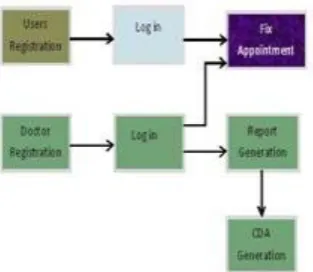
Registration and Appointment
Figure 1. Registration and Appointment
Patient Report Generation
Doctor view the patient information such as disease, symptoms etc. If it necessary patient is advised to take lab test. Lab Technician provides test result to patient. Based on test result, Doctor suggests prescription to the patient, and also patient health history should be maintained in appropriate hospital database. Doctor can view patient health history before he suggests prescription to the patient.
Figure 2. Patient Report Generation
CDA Generation
In this module patient health information’s are send to the cloud server. Now the cloud server will generate unique id for every users based on patient name, father name, date of birth and additionally Aadhar card number using PJW Hash Algorithm. If already id exists then the patient details will be appended with patient clinical history else new CDA document will be generated.
Figure 3. CDA Generation
Parsing CDA Document
In this module the new patient enter into hospital no need to give details about the disease and symptoms. The patient history already maintained in cloud server so we can get the patient histories by using key it is retrieve from patient personal details. The patient histories maintained in document which is contains patient clinical histories (hospital name, disease, prescription).
Converting CDA Document to PDF
The parsed CDA Documents are received at the HIS system where the documents are converted into PDF for the personal use of the patient. To do this, we need to add an application called PDF conversion interface. This can be simply extended with the existing software where the entities like CDA Document Generation and Integration resides.
VI.
CONCLUSION AND FUTURE
ENHANCEMENT
We establish an efficient way of generating the PDF format for the generated and integrated CDA Documents for the use of Patients. Our cloud computing based CDA generation and integration system has a few pronounced advantages over other existing projects. CDA documents increases, interoperability is achieved, but it also brings a problem where managing various CDA documents per patient becomes inconvenient as the clinical information for each patient is scattered in different documents. The CDA document integration service
support interoperability. Also, additionally the integrated CDA Documents of the patient is converted into the PDF format for the use by Patients. Thus, the time is saved for the doctors in taking medical decisions at emergency times and delivers the correct health care as the medical records are in chronological order.
Future enhancement
In our future work, we will explore the following points. First, we will make a concrete estimation of the reduction in cost when the EHR system becomes cloud-based. Establishing a reasonable fee system is an important issue for cloud computing. There is ample evidence that cloud computing is effective and efficient in cost reduction, and the medical field seems to be no exception . Security and stability is top priority for cloud computing resources as it is used by many users . Future work will attempt to enhance security while ensuring reasonable quality of service even with multiple users logged on the system at the same time.
VII.
REFERENCES
1. CDA Generation and Integration for Health Information Exchange Based On cloud Computing System. IEEE Transaction on Service Computing VOL. 9, NO. 2 March/April 2016. 2. Mobile Cloud for Aiding and Hard Wearing
Health Care. Volume 1, Issue 6, PP: 99-106, November 2014.
3. Mapping CDA Documents for Health
Information Exchange from Multiple Hospitals Using Cloud Computing System. VOLUME: 04 Issue: 02, FEB 2017.