Automatic Lexical Classification - Balancing between Machine
Learning and Linguistics
?Anna Korhonen
University of Cambridge, Computer Laboratory 15 JJ Thomson Avenue, Cambridge CB3 0GD, UK
Abstract. Verb classifications have been used to support a number of practical tasks and ap-plications, such as parsing, information extraction, question-answering, and machine trans-lation. However, large-scale exploitation of verb classes in real-world or domain-sensitive tasks has not been possible because existing manually built classifications are incomprehen-sive. This paper describes recent and on-going research on extending and acquiring lexical classifications automatically. The automatic approach is attractive since it is cost-effective and opens up the opportunity of learning and tuning lexical classifications for the application and domain in question. However, the development of an optimal approach is challenging, and requires not only expertise in machine learning but also a good understanding of the linguistic principles of lexical classification.
Keywords: lexical-semantic classification, verb classes, automatic lexical acquisition
1 Introduction
Verb classifications have attracted a great deal of interest in both linguistics and natural language processing (NLP). They have proved useful for various important tasks and applications, includ-ing e.g. computational lexicography, parsinclud-ing, word sense disambiguation, semantic role labelinclud-ing, information extraction, question-answering, and machine translation (Swier and Stevenson, 2004; Dang, 2004; Shi and Mihalcea, 2005; Kipper et al., 2008; Zapirain et al., 2008).
Particularly useful are classes which capture generalizations over a range of (cross-)linguistic properties, such as the ones proposed by Levin (1993). Being defined in terms of similar meaning and (morpho-)syntactic behaviour of words, these classes generally incorporate a wider range of properties than e.g. classes defined solely on semantic grounds (Miller, 1995).
For example, verbs which share the meaning component of ‘manner of motion’ (e.g. travel,
run, walk), behave similarly in terms of subcategorization (e.g. I travelled/ran/walked, I trav-elled/ran/walked to London, I travtrav-elled/ran/walked five miles) and usually have zero-related
nom-inals (e.g. a run, a walk) can be grouped to the same lexical class. Such verb classes can be identified across the entire lexicon and they can also apply across languages, since the basic mean-ing components they are comprised of are cross-lmean-inguistically applicable or overlappmean-ing.
While the classes do not provide means for full semantic inferencing, they can offer a powerful tool for generalization, abstraction and prediction which is beneficial for practical tasks. Funda-mentally, the classes are a critical component of any system which needs mapping from surface realization of arguments to predicate-argument structure. As the classes capture higher level ab-stractions they can be used as a principled means to abstract away from individual words when required. For example, they can be utilized to organize a default inheritance hierarchy which
?This work was funded by the Royal Society University Research Fellowship, the EPSRC grant EP/F030061/1 and
the British Council Alliance grant. The author would like to thank Lin Sun for his contribution to this paper.
effectively captures generalizations over words and predicts much of the syntactic/semantic be-haviour of a new word simply by associating it with an appropriate class. The predictive power of the classes can help compensate for lack of sufficient data. In addition, the classes have theo-retical benefits. For example, classified data can be used to evaluate empirical claims of different linguistic and psycholinguistic theories.
Although lexical classes have proved helpful for a number of (multilingual) tasks, their large-scale exploitation in real-world or highly domain-sensitive tasks has been limited because no fully accurate or comprehensive lexical classification is available. There is no such resource because manual classification of large numbers of words has proved very time-consuming. Class-based dif-ferences are typically manifested in difdif-ferences in the statistics over usages of syntactic-semantic features. This statistical information is difficult collect by hand as it is highly domain-sensitive, i.e. it varies with predominant word senses, which change across corpora and domains.
In recent years, automatic induction of verb classes from corpus data has become increasingly popular (Merlo and Stevenson, 2001; Schulte im Walde, 2006; Joanis et al., 2008; Sun et al., 2008; Li and Brew, 2008; Korhonen et al., 2008; ´O S´eaghdha and Copestake, 2008; Vlachos et al., 2009). This work is important as it opens up the opportunity of learning and tuning classifications for the application and domain in question. Automatic classification is not only cost-effective but it also gathers the important statistical information as side effect of the acquisition process and can easily be applied to new domains and usage patterns provided relevant corpus data is available.
To date, a variety of approaches have been proposed for verb classification and applied to general English and other languages. Both supervised and unsupervised machine learning (ML) methods have been used to classify a variety of features extracted from raw, tagged and/or parsed corpus data. Although the results have been generally encouraging, the accuracy of automatic classification shows room for improvement. After providing a short introduction to the basic prin-ciples of manual verb classification, this paper reviews recent research in automatic classification – particularly focussing on work conducted in English – and discusses then the various current challenges that need to be met for substantial further advances. Meeting these challenges requires solid expertise in both machine learning and (computational) linguistics.
2 Lexical Classification
The largest and most widely deployed verb classification in English is the classification of Levin (1993). This classification provides a summary of the variety of theoretical research done on lexical-semantic verb classification over the past decades. Verbs which display the same or a similar set of diathesis alternations in the realization of their argument structure are assumed to share certain meaning components and are organized into a semantically coherent class. Although alternations are chosen as the primary means for identifying verb classes, additional properties related to subcategorization, morphology and extended meanings of verbs are taken into account as well. For instance, the Levin class of “Break Verbs” (class 45.1), which refers to actions that bring about a change in the material integrity of some entity, is characterized by its participation (1-3) or non-participation (4-6) in the following alternations and other constructions (7-8):
1. Causative/inchoative alternation:
Tony broke the window↔The window broke 2. Middle alternation:
Tony broke the window↔The window broke easily
3. Instrument subject alternation:
Tony broke the window with the hammer↔The hammer broke the window 4. *With/against alternation:
Tony broke the cup against the wall↔*Tony broke the wall with the cup
5. *Conative alternation:
6. *Body-Part possessor ascension alternation: *Tony broke herself on the arm↔Tony broke her arm
7. Unintentional interpretation available (some verbs): Reflexive object: *Tony broke himself
Body-part object: Tony broke his finger
8. Resultative phrase:
Tony broke the piggy bank open, Tony broke the glass to pieces
VerbNet Kipper-Schuler (2005)1 – an extensive on-line lexicon for English verbs – provides detailed syntactic-semantic descriptions of Levin’s classes as well as additional classes organized into a refined taxonomy. The resulting taxonomy classifies over 5000 verbs into 274 first level classes. It has been used to support both the development and the evaluation of automatic verb classification.
3 Automatic Verb Classification - the State of the Art
To date, most work on automatic verb classification has focussed on English (Joanis et al., 2008; Sun et al., 2008; Li and Brew, 2008; ´O S´eaghdha and Copestake, 2008; Vlachos et al., 2009; Sun and Korhonen, 2009), although some work has also been done on other languages, in particular on German (Schulte im Walde, 2006), and recently also on sub-languages (Korhonen et al., 2008). In this section, we provide an overview of recent work mostly conducted on English (for other languages and domains, see section 5). We will first describe the features and techniques used for classification, and then evaluation and performance of current systems.
3.1 Features
As discussed above in section 2, the main feature of manual verb classification is a diathesis al-ternation which manifests at the level of syntax in alternating sets of subcategorization frames (SCFs). Since automatic detection of diathesis alternations is challenging (McCarthy, 2001), most work on automatic classification has focussed on syntactic features, exploiting the fact that similar alternations tend to result in similar syntactic behaviour. The syntactic features have been shal-low syntactic slots (e.g. NPs preceding or following the verb) extracted using a lemmatizer or a chunker, or verb SCFs extracted using a chunker or a parser. These both feature types have been refined with information about prepositional preferences (PPs) of verbs. Joanis et al. (2008) have reported better results using syntactic slots, while several others have obtained good results using SCFs, e.g. (Schulte im Walde, 2006; Li and Brew, 2008; Sun and Korhonen, 2009). While SCFs correspond better (than syntactic slots) with the features used in manual work, optimal results have required including inSCFs also additional information about adjuncts (not only arguments) of verbs (Sun et al., 2008) which are typically not used in manual classification.
Recent research has also experimented with replacing or supplementingSCFs with information about basic lexical context (co-occurrences (COs)) of verbs, or lexical preferences (LPs) in spe-cific grammatical relations (GRs) associated with verbs in parsed data (for example, the type and frequency of prepositions in the indirect object relation) (Li and Brew, 2008; Sun and Korhonen, 2009). Some experiments have also explored the usefulness of verb tense (e.g. the part-of-speech tags of verbs), voice (the knowledge whether the verb was used in active or passive) and/or aspect for verb classification (Joanis et al., 2008; Korhonen et al., 2008).
While most work has focussed on syntactic or lexical features, a few attempts have also been made to refine syntactic features with semantic information about verb selectional preferences (SPs). Following Merlo and Stevenson (2001), Joanis et al. (2008) used an simple ‘animacy’ feature which was determined by classifying e.g. pronouns and proper names in data to this single SP class. Joanis (2002) employed as SP models the top level WordNet (Miller, 1995) classes
1
(Schulte im Walde (2006) tried a similar approach for German). Recently, Sun and Korhonen (2009) experimented with automatically acquired SPs. The latter were obtained by clustering argument head data inGRs related to specific verbs.
Finally, combinations of lexical, syntactic, semantic and other features have been explored.
3.2 Classification
Both supervised and unsupervised machine learning (ML) methods have been used to classify features discussed in the above section. Supervised methods yield optimal performance where adequate and accurate training data are available. A wide range of methods have been employed, including the K Nearest Neighbours, Maximum Entropy, Support Vector Machines, Gaussian, Distributional Kernel methods, and Bayesian Multinomial Regression, among others (Joanis et al., 2008; Sun et al., 2008; Li and Brew, 2008; ´O S´eaghdha and Copestake, 2008).
Unsupervised methods have the benefit that they can be used to to discover novel informa-tion from corpus data. The latter is particularly useful for supplementing or improving existing classifications or learning new classifications for languages and domains where no manually built classifications are available. Again a range of methods have been explored, including e.g. the K means, Expectation-Maximization, spectral clustering, Information Bottleneck, Probabilistic La-tent Semantic Analysis, cost-based pairwise clustering (Brew and Schulte im Walde, 2002; Schulte im Walde, 2006; Korhonen et al., 2008; Sun and Korhonen, 2009; Vlachos et al., 2009). Both soft and hard clustering methods have been tried, but attempts to deal with polysemy (the fact that many verbs can be classified in more than one class) have not been successful yet (see section 4).
3.3 Evaluation
Research on automatic verb classification has typically been evaluated against a manually con-structed gold standard. The subsequent sections describe the most commonly used gold stan-dards, evaluation measures, and test sets, and compares the performance of the state-of-the-art approaches for English which have been evaluated using these test sets.
3.3.1 Gold standards The most common evaluation resource in English verb classification has
been that of Levin (1993) supplemented with additional information from VerbNet or WordNet. In particular, two gold standards based on (Levin, 1993) have been used to evaluate much of the recent research:
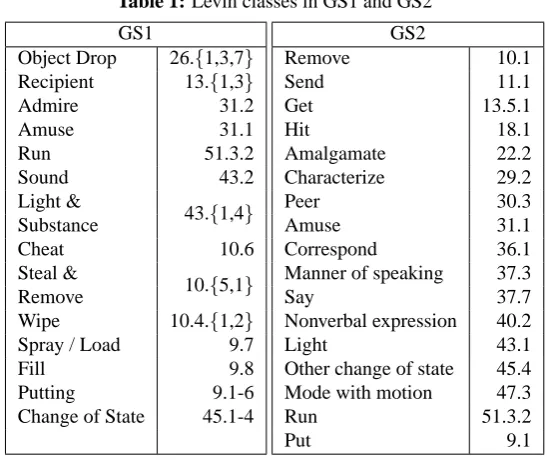
GS1 The gold standard of Joanis et al. (2008) provides a classification of 835 verbs into 15 (some
coarse, some fine-grained) Levin classes. We consider here the ‘14 way’ version of this resource because this corresponds the closest to the target (Levin’s fine-grained) classifica-tion2. When the frequency-based selection criteria of Joanis et al. (2008) is applied and the class imbalance is restricted to 1:1.5, GS1 provides a classification of 205 verbs in 10-15 classes.
GS2 The gold standard of Sun et al. (2008) classifies 204 medium-high frequency verbs to 17
fine-grained Levin classes, so that each class has 12 member verbs. Table 1 from (Sun and Korhonen, 2009) shows the classes in GS1 and GS2.
3.3.2 Data and evaluation measures The classification techniques have been typically applied
to large cross-domain corpora and evaluated (against a chosen gold standard) using various mea-sures. Although the measures have differed (e.g. for supervised or unsupervised approaches), the general tendency has been to prefer measures which are (i) applicable to all classification methods under comparison, (ii) deliver a numerical value easy to interpret and (ii) preferably do not intro-duce biases towards specific numbers of classes or class sizes. The measures mentioned here are
2
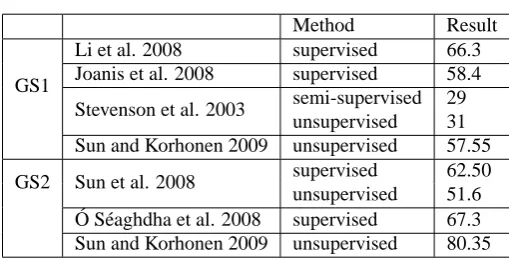
Table 2: Performance of recent approaches
Method Result
GS1
Li et al. 2008 supervised 66.3 Joanis et al. 2008 supervised 58.4
Stevenson et al. 2003 semi-supervised 29 unsupervised 31 Sun and Korhonen 2009 unsupervised 57.55
GS2 Sun et al. 2008 supervised 62.50 unsupervised 51.6 ´
O S´eaghdha et al. 2008 supervised 67.3 Sun and Korhonen 2009 unsupervised 80.35
integrating COs, SCFs and/or LPs were extracted from a large corpus using a lemmatizer and a grammatical parser. The combination ofCOs andSCFs gave the best result, shown in the table.
Joanis et al. (2008) have reported the second best supervised result on GS1, using Support Vec-tor Machines for classification. They compared various features derived from linguistic analysis and extracted using shallow syntactic processing (mainly chunking): syntactic slots, slot over-laps, tense, voice, aspect, and animacy of NPs. They concluded that syntactic information about core constituents occurring with a verb (syntactic slots) is most important to verb classification. Stevenson and Joanis (2003) reached a similar conclusion in their unsupervised experiment on GS1. A feature set similar to that of Joanis et al. (2008) was employed (features were selected in a semi-supervised fashion) and hierarchical clustering was used.
The recent unsupervised method of Sun and Korhonen (2009) performs better on GS1 than the unsupervised method of Joanis et al. (2008) and nearly as well as the supervised approach of Joanis et al. (2008). Sun and Korhonen used a variation of spectral clustering based on the MNCut algorithm (Meila and Shi, 2001) and experimented with a variety of features (e.g. COs, SCFs, LPs, voice, tense), including also semantic ones (SPs). The features were extracted using a SCFacquisition system which makes use of a grammatical parser. The SPs were obtained by clustering argument head data in relevant syntactic slots. The best result was obtained when using SCFs in conjunction withSPs.
On GS2, the best performing supervised method so far is that of ´O S´eaghdha and Copestake (2008) which employs a distributional kernel method to classify SCFfeatures parameterized for prepositions in the automatically acquired VALEX SCFlexicon. Using exactly the same data and feature set, Sun et al. (2008) obtained a slightly lower result when using a supervised method (Gaussian) and a notably lower result when using an unsupervised method (pairwise clustering). The recent unsupervised approach of Sun and Korhonen (2009) (discussed above with GS1) out-performs these both methods on this gold standard when SCFs are used in conjunction with auto-matically acquiredSPs.
4 Current Challenges
This section discusses the various challenges that need to be met in order to improve the state of the art further.
4.1 Features
Section 3.1 reviewed the features employed in verb classification so far. Section 3.3.3 showed that to date, syntactic features (syntactic slots andSCFs) have been the most useful features in verb clas-sification. Although semantic features play a key role in manual verb classification and could thus be expected to offer a considerable contribution to automatic classification, they have not proved equally successful. Until recently, no significant additional improvement was reported using verb SPs (Joanis, 2002; Schulte im Walde, 2006). This was surprising sinceSPs are strong indicators of diathesis alternations (McCarthy, 2001) and fairly precise semantic descriptions can be assigned to the majority of Levin classes (Kipper-Schuler, 2005). However, in their recent experiment, Sun and Korhonen (2009) obtained a considerable improvement using SPs in conjunction with syn-tactic features on both GS1 and GS2, although they used a fully unsupervised approach to both verb clustering andSPacquisition. This suggests thatNLPandMLtechniques have now developed to the point where the use of deeper, theoretically-motivated features is becoming feasible. Yet high accuracySPacquisition from undisambiguated corpus data is still an unmet challenge and is especially complex in the context of verb classification where SP models are needed for specific syntactic slots for which the data may be sparse. Recently a number of techniques have been pro-posed which may offer ideas for further improvement of the approach (Erk, 2007; Bergsma et al., 2008; Schulte im Walde et al., 2008). The number and type (and combination) ofGRs for which SPs can be reliably acquired, especially when the data is sparse, requires also further investigation. However, the main semantic features in manual classification are actually diathesis alternations. Some studies have attempted automatic alternation detection using WordNet classes asSPmodels (Lapata, 1999; McCarthy, 2001), but no recent large-scale work has been conducted, and no attepts have been made to detect alternations in a fully unsupervised fashion. The time may now be ripe for this research and its integration in verb classification. The development of an optimal approach will require a good understanding of the linguistic basis of verb classification as well as adequate NLP and ML expertise. The approach will need to be general enough to cover most types of alternations, efficient enough for a large scale use and resistant to the problems of sparse data.
4.2 Classification
4.3 Polysemy
Polysemy is frequent in language. In particular, many high frequency verbs have several senses and can therefore be members of several classes. Most work on automatic classification has by-passed this issue by assuming a single class for each verb – usually the one corresponding to its predominating (the most frequent sense) in language according to e.g. WordNet. This is not only unrealistic thinking of real-world application of verb classes but also the predominating sense is not static but varies across domains and sub-languages.
Few attempts have been made to address this problem. Korhonen et al. (2003) performed a clustering experiment with highly polysemous verbs. They constructed a polysemous gold stan-dard for c. 200 English verbs and examined whether a soft clustering method (Information Bottle-neck) could be used to assign these verbs to several classes. The clustering turned out hard, with the majority of verbs being assigned to one class only. Yet the investigation showed that polysemy has a considerable impact on verb classification: optimal results were obtained with when cluster-ing was evaluated against the polysemous gold standard, not the monosemous version of it which assumed the predominant sense according to WordNet.
Clearly polysemy is an issue that needs to be dealt with, and this amounts to both extending gold standards to capture non-predominant senses as well as finding a suitable ML method. Re-cently a multi-label classification method was used for supervised adjective classification Boleda
et al. (2007) which might yield useful results also with verbs. Also methods for modelling the
overlap between lexical categories might be of use.
4.4 Other languages and domains
Most work on verb classification has been conducted on English. Considerable research has also been done on German (Schulte im Walde, 2006), but only small scale experiments exist on other languages, e.g. Chinese, Italian (Merlo et al., 2002), Spanish (Ferrer, 2004) and Japanese (Oishi and Matsumoto, 1997). Evaluating the applicability of classification techniques to several lan-guages is critical for both theoretical and practical reasons; for 1) improving the accuracy, scalabil-ity and robustness of the techniques mainly developed for English or German, 2) advancing work in other languages, 3) gaining a better understanding of the language-specific / cross-linguistic components of lexical information (e.g. the extent to which the features used for English or Ger-man are also valid for other languages), and 4) in a long term, improving the perforGer-mance of such multilingual NLP applications (e.g. machine translation, information extraction) which can benefit from verb classes.
The same can be said also about different domains and sub-languages. The only work (which we are aware of) which has applied verb classification technology to a specific domain is that of Korhonen et al. (2008). This work focussed on the important domain of biomedicine for which no large verb classification was available. It involved learning a classification using clustering technology originally developed for general English. The experiment revealed interesting facts about automatic classification, e.g. the fact that domain-specific classifications can be very differ-ent from general classifications (even the shared verb classes may have a specialised, narrower meaning). Also, the features performed differently than in general language classification. The fact that many domains tend to be more uniform or conventionalized in terms of language use has many consequences for automatic classification which require further investigation.
4.5 Evaluation
not be fully comprehensive, it does offer a valuable larger resource for evaluation.
For many languages and domains, no evaluation resources are available. Both manual (Kipper
et al., 2008) and semi-automatic methods (Korhonen et al., 2008) have been proposed for building
gold standards from scratch. For example, in the recent work on biomedical verb classification, human experts (linguists and biologists) constructed a gold standard by examining verb classes formed on the basis on syntactic similarity and deciding which ones of them were also semantically related (Korhonen et al., 2008). However, such work requires not only clear guidelines but also adequate linguistic and/or domain expertise.
Some of the works have supplemented quantitative evaluation with qualitative analysis. This has required also linguistic (or domain) expertise, and interestingly, has not only helped to find error types but has often also shown that automatic classification can discover novel, valuable in-formation in data, e.g. classes which are actually related although distinct in a gold standard or classes which are distinct in a gold standard although ought to be related (Schulte im Walde, 2006; Sun et al., 2008; Korhonen et al., 2008; Vlachos et al., 2009). Qualitative evaluation can thus show the true potential of automatic classification and is therefore vital for further development of classification technology. Equally important is evaluation in the context of practical tasks and ap-plications. To the best of our knowledge, no approaches to automatic verb classification have been evaluated in this manner, although the work on automatic verb classification is largely motivated by the practical potential of accurate and relevant classifications.
5 Conclusion
During the past years, a lot has been achieved in automatic verb classification. Yet a lot remains to be done in terms of improving and extending current technology and applying it to larger data sets and novel (sub-)languages. This paper has discussed the various areas which require further improvement (ranging from features to evaluation techniques) and highlighted the fact that further improvements can only be obtained by combining the best available (computational) linguistic and MLexpertise.
References
Abney, S. 2008. Semisupervised Learning for Computational Linguistics. Chapman and Hall. Bergsma, S., D. Lin, and R. Goebel. 2008. Discriminative learning of selectional preference from
unlabeled text. In Proc. of EMNLP.
Boleda, G., S. Schulte im Walde, and T. Badia. 2007. Modelling polysemy in adjective classes by multi-label classification. In Proc. of EMNLP-CoNLL.
Brew, C. and S. Schulte im Walde. 2002. Spectral clustering for German verbs. In Proc. of
EMNLP.
Dang, H. T. 2004. Investigations into the Role of Lexical Semantics in Word Sense Disambiguation. PhD thesis, CIS, University of Pennsylvania.
Erk, K. 2007. A simple, similarity-based model for selectional preferences. In Proc. of ACL. Ferrer, E. E. 2004. Towards a semantic classification of spanish verbs based on subcategorisation
information. In Proceedings of the ACL 2004 Workshop on Student Research.
Joanis, E. 2002. Automatic Verb Classification Using a General Feature Space. Master’s thesis, University of Toronto.
Joanis, E., S. Stevenson, and D. James. 2008. A general feature space for automatic verb classifi-cation. Natural Language Engineering.
Kipper-Schuler, K. 2005. VerbNet: A broad-coverage, comprehensive verb lexicon.
Korhonen, A., Y. Krymolowski, and N. Collier. 2008. The Choice of Features for Classification of Verbs in Biomedical Texts. In Proc. of COLING.
Korhonen, A., Y. Krymolowski, and Z. Marx. 2003. Clustering polysemic subcategorization frame distributions semantically. In Proc. of ACL, pages 64–71.
Lapata, M. 1999. Acquiring lexical generalizations from corpora: A case study for diathesis alternations. In Proc. of ACL.
Levin, B. 1993. English verb classes and alternations: A preliminary investigation. Chicago, IL. Li, J. and C. Brew. 2008. Which Are the Best Features for Automatic Verb Classification. In Proc.
of ACL.
McCarthy, D. 2001. Lexical Acquisition at the Syntax-Semantics Interface: Diathesis Alternations,
Subcategorization Frames and Selectional Preferences. PhD thesis, University of Sussex, UK.
Meila, M. and J. Shi. 2001. A random walks view of spectral segmentation. AISTATS.
Merlo, P. and S. Stevenson. 2001. Automatic verb classification based on statistical distributions of argument structure. Computational Linguistics, 27:373–408.
Merlo, P., S. Stevenson, V. Tsang, and G. Allaria. 2002. A multilingual paradigm for automatic verb classification. In Proc. of ACL.
Miller, G. A. 1995. WordNet: A lexical database for English. Communications of the ACM. Oishi, A. and Y. Matsumoto. 1997. Detecting the organization of semantic subclasses of Japanese
verbs. In International Journal of Corpus Linguistics, volume 2, pages 65–89. ´
O S´eaghdha, D. and A. Copestake. 2008. Semantic classification with distributional kernels. In
Proc. of COLING.
Schulte im Walde, S. 2006. Experiments on the automatic induction of German semantic verb classes. Computational Linguistics.
Schulte im Walde, S., C. Hying, C. Scheible, and H. Schmid. 2008. Combining EM Training and the MDL Principle for an Automatic Verb Classification incorporating Selectional Preferences. In Proc. of ACL, pages 496–504.
Shi, L. and R. Mihalcea. 2005. Putting pieces together: Combining FrameNet, VerbNet and WordNet for robust semantic parsing. In Proc. of CICLING.
Stevenson, S. and E. Joanis. 2003. Semi-supervised verb class discovery using noisy features. In
Proc. of HLT-NAACL 2003, pages 71–78.
Sun, L. and A. Korhonen. 2009. Improving Verb Clustering with Automatically Acquired Selec-tional Preferences. In Proc. of EMNLP.
Sun, L., A. Korhonen, and Y. Krymolowski. 2008. Verb class discovery from rich syntactic data.
Lecture Notes in Computer Science, 4919:16.
Swier, R. and S. Stevenson. 2004. Unsupervised semantic role labelling. In Proc. of EMNLP. Vlachos, A., A. Korhonen, and Z. Ghahramani. 2009. Unsupervised and constrained dirichlet
process mixture models for verb clustering. In Proc. of the Workshop on Geometrical Models
of Natural Language Semantics.