Movie Review Classification Based on a Multiple Classifier
*Kimitaka Tsutsumia, Kazutaka Shimada a and Tsutomu Endoa
a
Department of Artificial Intelligence,
Kyushu Institute of Technology, Iizuka, Fukuoka 820-8502 Japan {k_tsutsumi, shimada, endo}@pluto.ai.kyutech.ac.jp
Abstract. In this paper, we propose a method to classify movie review documents into positive or negative opinions. There are several approaches to classify documents. The previous studies, however, used only a single classifier for the classification task. We describe a multiple classifier for the review document classification task. The method consists of three classifiers based on SVMs, ME and score calculation. We apply two voting methods and SVMs to the integration process of single classifiers. The integrated methods improved the accuracy as compared with the three single classifiers. The experimental results show the effectiveness of our method.
Keywords: Sentiment analysis, p/n classification, Integration, Movie reviews, WWW.
1.
Introduction
The World Wide Web contains a huge number of on-line documents that are easily accessible. Finding information relevant to user needs has become increasingly important. The most important information on the Web is usually contained in the text. We obtain a huge number of review documents that include user’s opinions for products. For example, buying products, users usually survey the product reviews. Movie reviews are likewise one of the most important information for users who go to a movie. More precise and effective methods for evaluating the products are useful for users.
Many researchers have recently studied extraction of evaluative expressions and classification of opinions (Kobayashi et al., 2005; Osajima et al., 2005; Pang et al., 2002; Turney, 2002). Studies of opinion classification are generally classified into three groups: (1) classifying documents into the positive (p) or negative (n) opinions, (2) classifying sentences into the positive or negative opinions, and (3) classifying words into the positive or negative expressions. In this paper, we focus on the classification of movie review documents. Pang et al. (2002) have reported the effectiveness of applying machine learning techniques to the p/n classification. They compared three machine learning methods: Naive Bayes, Maximum Entropy and Support Vector Machines. In their experiment, SVMs produced the best performance. Osajima et al. (2005) have proposed a method for polarity classification of sentences in review documents. The method is based on a score calculation process of word polarity and outperformed SVMs in the sentence classification task.
the better accuracy as compared with the single classifiers. This method, however, contained a problem for the determination of the final output, namely positive or negative. We needed to normalize the classifier’s outputs manually because the scale of the scoring method was different from that of SVMs.
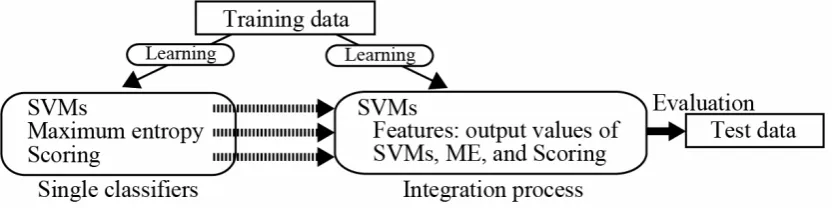
To solve this problem, we apply the 3rd machine learning method (Maximum Entropy) into the method based on the scoring and SVMs. Figure 1 shows the outline of the proposed method. In this paper, we compare three processes for the method: naive voting, weighted voting and determination with SVMs.
Figure. 1.The outline of our method.
2.
Classifiers
In this section, we explain classifiers for a multiple classifier that will be proposed in this paper. The 1st and 2nd classifiers are SVMs and Maximum Entropy respectively. These classifiers have been used in related work by Pang et al. (2002). In their paper, they reported that SVMs produced the best performance. The 3rd classifier is based on polarity scores of words in documents. The method is an expansion of Osajima et al. (2005).
2.1.SVMs
SVMs are a machine learning algorithm that was introduced by Vapnik (1999). They have been applied to tasks such as face recognition and text classification. An SVM is a binary classifier that finds a maximal margin separating hyperplane between two classes. The hyperplane can be written as:
b
x
w
Figure. 2.The integration process with SVMs.
4.
Experiment
In this section, we explain a dataset and basic feature selection for this experiment first. Then we evaluate our methods with the dataset and compare them with single classifiers.
4.1.Dataset and features for the classifiers
First we describe the data set for the experiment. We evaluated our method with movie review documents that were used in Pang et al. (2002). The dataset consists of 700 positive reviews and 700 negative reviews. We divided the data into three equal-sized folds in the same manner as the previous work (Pang et al., 2002). In other words, we tested our method with three-fold cross-validation.
We extracted basic features for classifiers in the same way the previous work did. The conditions of the previous work for the feature selection were as follows: (1) no stemming or stopword lists were used, (2) use of the negation tag, and (3) limitation of the frequency of words. For the 2nd condition, we added the tag “NOT_” to every word between a negation word (“not”, “isn’t”, “didn’t”, etc.) and the first punctuation mark following the negation word3. For the 3rd condition, we used words appearing at least four times in our 1400-document corpus.
We constructed the feature space for each classifier on the basis of the basic features. For the scoring method, we used features extracted with the conditions described in Section 2.3 (use of POS tags and χ 2-test). For the tagging, we used the Brill’s Tagger4. However, we used basic features for SVMs and ME5.
4.2.Experimental results
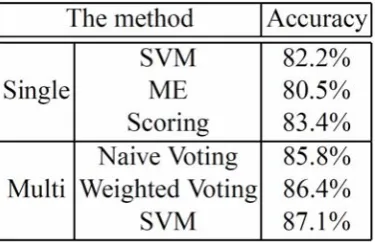
First, we compared six methods in this experiment: single classifiers (SVMs, ME and Scoring) and the proposed method based on naive voting, weighted voting and SVMs. Table 1 shows the experimental result6.
As a result, our methods, namely multiple classifiers, outperformed single classifiers. Even the naive voting produced higher accuracy than these methods. This result shows the effectiveness of our method consisting of some classifiers.
3 For example, the sentence “It is not good” is converted to “It is not NOT_good”. As a result, we can treat a polarity reversal correctly.
4 http://www.cs.jhu.edu/ brill/
5 The reason is that there was no significant difference between the methods with the conditions and without the conditions. The same tendency was reported in the previous work.
Table 1.The experimental result
In this experiment, the integration method with SVMs produced the best performance. For the weighted voting, we used the values computed beforehand from training data: l and m. If we
tuned up these values optimally, the accuracy was 87.5%. This result denotes that the weighting process was one of the most important processes in the multiple classifier. The weighting process in this paper was a very simple weighting method. It was based on the average of distance obtained from a tentative dataset.
One approach to improve the accuracy is refinements to the weighting for the voting process. Boosting is one of the most famous techniques in ensemble learning methods (Freund and Schapier, 1996). We applied the boosting algorithm to the integration process. In the method, SVMs, Scoring and ME are weak learners for the boosting. However the accuracy was lower than SVMs and the weighted voting method. To improve the accuracy, we need to add other machine learning methods as weak learners. Furthermore, we need to consider other ensemble learning methods, such as Bagging (Breiman, 1996) and Random Forests (Breiman, 2001). In this paper we used BOWs for the feature set of the classifiers. Matsumoto et al. (2005) have argued the significance of syntactic relations between words, that is frequent word sub-sequences and dependency sub-trees. For their experiment with the same dataset, using dependency sub-trees led to the improvement of the accuracy: the accuracy was 87.3%. Bai et al. (2004) have proposed a new method based on a two-stage Bayesian algorithm that is able to capture the dependencies among words. The accuracy of this method was 87.5%. Although the feature set for our method was very simple and naive (BOWs), the accuracy was equivalent as compared with these methods that used relations between words. Furthermore, since our method can incorporate other single classifiers flexibly, applying them as single classifiers boosts up the accuracy rate of our method.
We also need to handle the confidence of each classifier’s output appropriately. In this paper we regarded the confidence computed from the output of a classifier as a linear function. However, Platt (1999) has reported a method to convert the output of SVMs into probability by using the sigmoid function and showed the effectiveness as a probability function. We need to consider a method for converting the output to the best suited confidence.
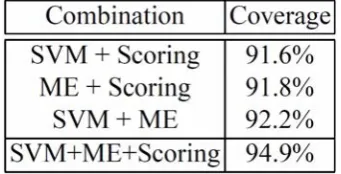
Next we explain a coverage rate of the proposed method. Our method can not classify a document into positive or negative correctly if every single classifier for the multiple classifier classifies it incorrectly. In other words, our method contains the possibility that it can classify a document correctly if a single classifier identifies the class label (p/n) of a document correctly. Therefore the coverage of our method for this dataset is computed as follows:
N CorrectNum Coverage=
87.1% (See Table 1). This result shows that our method, namely a multiple classifier, can improve the classification accuracy essentially.
Table 2.The Coverage
5.
Conclusion
In this paper, we proposed a method to classify movie review documents into positive or negative opinions. The method consisted of three classifiers based on SVMs, ME and score calculation. We compared two voting process, naive voting and weighted voting, and the integration with SVMs for the method. Our methods consisting of three classifiers outperformed single classifiers. Even the naive voting produced higher accuracy than these classifiers. In this experiment, SVMs in the integration process produced the best performance. If we tuned up the weights for the voting method optimally, it obtained the best accuracy. Our future work includes (1) evaluation with the ensemble learning methods, (2) addition of other single classifiers and (3) use of other feature sets, such as dependency trees, for classifiers
References
Bai, X., R. Padman, and E. Airoldi. 2004. Sentiment extraction from unstructured text using tabu search-enhanced markov blanket. Proceedings of the International Workshop on Mining for and from the Semantic Web (MSW2004).
Berger, A. L., S. A. Della Pietra, and V. J. Della Pietra. 1996. A maximum entropy approach to natural language processing. 22(1):39–71.
Breiman, L. 1996. Bagging predictors. Machine Learning, 24:123–140.
Breiman, L. 2001. Random forests. Machine Learning, 45:5–23.
Freund, Y. and R. E. Schapier. 1996. Experiments with a new boosting algorithm. Proceedings of ICML, pages 148–156.
Joachims, T. 1999. Transductive inference for text classification using support vector machines.
Proceedings of the Sixteenth International Conference on Machine Learning, pages 200–
209.
Kobayashi, N., R. Iida, K. Inui, and Y. Matsumoto. 2005. Opinion extraction using a learning-based anaphora resolution technique. Proceedings of the Second International Joint Conference on Natural Language Processing (IJCNLP- 05), pp. 175–180.
Matsumoto, S., H. Takamura, and M. Okumura. 2005. Sentiment classification using word sub-sequences and dependency sub-trees. Proceedings of the 9th Pacific-Asia International Conference on Knowledge Discovery and Data Mining (PAKDD-05), pp. 301–310.
Osajima, I., K. Shimada, and T. Endo. 2005. Classification of evaluative sentences using sequential patterns. Proceedings of the 11nd Annual Meeting of The Association for Natural Language Processing (in Japanese).
Pang, B., L. Lee, and S. Vaithyanathan. 2002. Thumbs up? sentiment classification using machine learning techniques. Proceedings of the Conference on Empirical Methods in Natural Language Processing (EMNLP), pp.79–86.
Advances in Large Margin Classifiers, pp. 61–74. MIT Press.
Tsutsumi, K., K. Shimada, and T. Endo. 2006. Sentiment classification using reliability of multiple classification results (in Japanese). In SIG-FPAI-A601, pp. 27–32.
Turney, P. D. 2002. Thumbs up? or thumbs down? semantic orientation applied to unsupervised classification of reviews. Proceedings of the 40th Annual Meeting of the Association for Computational Linguistics, pp. 417–424.