International Journal of Scientific Research in Computer Science, Engineering and Information Technology © 2018 IJSRCSEIT | Volume 4 | Issue 2 | ISSN : 2456-3307
Strong and Agitable Access Control with Multiple Feature
Authorities for Public Cloud Storage
Dildar Basha.K, Noorulla Baig
Rayalaseema Institute of information and Management Science, RIIMS, Tirupati, Andhra Pradesh, India
ABSTRACT
Information get to control is a testing issue out in the open distributed storage frameworks. Cipher text-Policy Attribute-Based Encryption (CP-ABE) has been received as a promising procedure to give flexible, fine-grained and secure information get to control for cloud storage with honest-however curious cloud servers. However, in the current CP-ABE plans, the single property expert must execute the tedious client authenticity verification and mystery key circulation, and subsequently it brings about a solitary point execution bottleneck when a CP-ABE plot is embraced in a huge scale distributed storage framework. Clients might be stuck in the sitting tight line for a long stretch to get their mystery keys, consequently bringing about low-efficiency of the framework. In spite of the fact that multi authority get to control plans have been proposed, these plans still can't defeat the downsides of single-point bottleneck and low efficiency, because of the way that every one of the specialists still freely deals with a disjoint property set. In this paper, we propose a novel heterogeneous structure to evacuate the issue of single-point execution bottleneck and give a more efficient get to control plot with an evaluating instrument. Our structure utilizes different credit experts to share the heap of client authenticity verification. In the interim, in our scheme, a CA(Central Authority)is introduced to generate mystery keys for authenticity verified clients. Dissimilar to other multi authority get to control conspires, every one of the experts in our plan deals with the entire characteristic set separately. To improve security, we additionally propose a reviewing system to recognize which AA (Attribute Authority) has erroneously or malignantly played out the authenticity verification technique. Investigation indicates that our system not only guarantees these curity requirements but additionally makes awesome execution change on key generation. Keywords: Cloud storage, Access control, Auditing, CPABE.
I.
INTRODUCTION
Cloud storage is a promising and important service paradigm in cloud computing. Benefits of using cloud storage include greater accessibility, higher reliability, rapid deployment and stronger protection, to name just a few. Despite the mentioned benefits, this paradigm also brings forth new challenges on data access control, which is a critical issue to ensure data security. Since cloud storage is operated by cloud service providers, who are usually outside the trusted domain of data owners, the traditional access control methods in the Client/Server model are not suitable
in cloud storage environment. The data access control in cloud storage environment has thus become a challenging issue.
frameworks. In CP-ABE plans, the entrance control is accomplished by utilizing cryptography, where a proprietor's information is encoded with an entrance structure over characteristics, and a client's mystery key is marked with his/her own qualities. Just if the characteristics related with the client's mystery key fulfill the entrance structure, can the client unscramble the comparing cipher text to get the plaintext. Up until now, the CP-ABE based access control plans for cloud storage have been developed into two complementary classes, to be specific, single-specialist situation, and multi authority situation. Albeit existing CP-ABE get to control plans have a ton of appealing highlights, they are neither strong nor efficient in key age. Since there is just a single specialist accountable for all properties in single-expert plans, offline/crash of this expert makes all mystery key solicitations inaccessible amid that period. The comparable issue exists in multi-specialist plans, since every one of various experts deals with a disjoint quality set. In single-specialist plots, the main expert must confirm the authenticity of clients' properties previously producing mystery keys for them. As the entrance control framework is related with information security, and the main certification a client have is his/her mystery key related with his/her traits, the procedure of key issuing must be mindful. Be that as it may, in reality, the qualities are different. For instance, to check whether a client can drive may require an expert to give him/her a test to demonstrate that he/she can drive. In this way he/she can get a characteristic key related with driving capacity. To manage the verification of different qualities, the client might be required to be available to confirm them. Besides, the procedure to check/allocate credits to clients is generally difficult with the goal that it regularly utilizes executives to physically deal with the verification, as has specified, that the validness of enlisted information must be accomplished by out-of-band (for the most part manual) implies. To settle on a watchful choice, the unavoidable cooperation of individuals makes the verification time consuming,
which causes a solitary point bottleneck. Particularly, for a vast framework, there are constantly expansive quantities of clients asking for mystery keys. The inefficiency of the expert's administration brings about single-point execution bottleneck, which will cause framework blockage to such an extent that clients frequently can't acquire their mystery keys rapidly, and need to hold up in the framework line. This will significantly lessen the fulfillment of clients experience to appreciate ongoing administrations.
botches have been made or malignant practices have been actualized during the time spent mystery key age and appropriation. For instance, an expert may erroneously disseminate mystery keys past client's honest to goodness quality set. Such frail point on security makes this direct thought hard to meet the security necessity of access control for open distributed storage. Our current work, TMACS , is a limit multi-expert CP-ABE get to control conspire for public cloud storage, where multiple authorities jointly manage a uniform property set. As a matter of fact it tends to the single-point bottleneck of execution and security, yet presents some extra overhead. Thusly, in this paper, we introduce an attainable arrangement which advances efficiency and heartiness, as well as ensures that the new arrangement is as secure as the first single-specialist plans. The comparable issue has been considered and halfway handled in other related zones, for example, open key foundation (PKI) for web based business. have a substantial certificate. After the verification, it approves the qualifications and advances the certificate demand to CA. At that point, CA will create a certificate for the client. Since the most overwhelming work of verification is performed by a chosen RA, the heap of CA can be to a great extent reduced. However, the security of the scheme with single CA/multi-RAs partly depends on the trustiness of multiple RAs. In order to achieve traceability, CA should store some information to confirm which RA has been responsible for verifying the legitimacy of a specific user.
In this paper, motivated by the heterogeneous design with single CA and numerous RAs, we propose a strong and auditable access control plot (named RAAC) for open distributed storage to advance the execution while keeping the flexibility and fine
granularity highlights of the current CP-ABE plans. In our plan, we seperate the technique of client legitimacy verification from these cret key generation, and assign these two sub-strategies to two various types of experts. There are different specialists (named quality experts, AAs), every one of which is responsible for the entire trait set and can lead client authenticity verification autonomously. Then, there is just a single worldwide put stock in specialist (alluded as Central Authority, CA) accountable for mystery key age and dissemination. Before playing out a mystery key age and dissemination process, one of the AAs is chosen to check the authenticity of the client's characteristics and afterward it produces a middle of the road key to send to CA. CA produces the mystery key for the client based on the got middle of the road key, with no need of any more verification. Along these lines, various AAs can work in parallel to share the heap of the time consuming authenticity verification and standby for each other in order to evacuate the character, and sends them to CA. With the assistance of moderate keys, CA can not just produce mystery keys for authenticity verified clients all the more efficiently yet additionally follow an AA's slip-up or pernicious conduct to improve the security.
The main contributions of this work can be summarized as follows.
legitimacy verification, while CA is only responsible for computational tasks. To the best of our knowledge, this is the first work that proposes the heterogeneous access control framework to address the low efficiency and single-point performance bottleneck for cloud storage.
2) We reconstruct the CP-ABE scheme to fit our proposed framework and propose a robust and high-efficient access control scheme, meanwhile the scheme still preserves the fine granularity, flexibility and security features of CPABE.
3) Our scheme includes an auditing mechanism that helps the system trace an AA’s misbehavior on user’s legitimacy verification.
II.
RELATED WORK
Cipher text-Policy Attribute-Based Encryption (CP-ABE) has so far been viewed as a standout amongst the most encouraging methods for information get to control in distributed storage frameworks. This innovation offers clients flexible, fine-grained and secure access control of outsourced information. It was first defined by Goyal et al. in. At that point the first CP-ABE conspire was proposed by Ben then court et al. in , however this plan was demonstrated secure just in the bland gathering model. In this enhance efficiency of this encryption strategy, Emura et al. proposed a CP-ABE plot with a consistent cipher text length. Not at all like the above plans which are just restricted to express monotonic access structures, Obtrovsky et al. proposed a more expressive CP-ABE conspire which can bolster non-monotonic access structures. As of late, Hohenberger and Waters proposed an on the web/offline ABE method for CPABE which empowers the client to do however much pre-calculation as could be expected
to spare online calculation. It's a promising system for asset restricted gadgets. All in all, there are two classifications of CP-ABE plans classified by the quantity of taking part experts in key conveyance process. One class is the single-specialist conspire, the other is multi-expert plan. In single authority plans, just a single specialist is included to deal with the widespread property set, produce and disperse mystery keys for all clients. In, the creators separately proposed CP-ABE plans with efficient quality denial ability for information outsourcing frameworks. Wu et al. proposed a Multi-message Cipher text-Policy Attribute Based Encryption(MCP-ABE) which encodes numerous messages inside one cipher text in order to authorize flexible attribute based access control on scalable media. The literatures contemplated the efficiency issue, however they primarily considered the calculation unpredictability inside the cryptography calculations as opposed to communication conventions between various substances in reality, for example, the system of client authenticity verification. To total up, in single-specialist conspires, the single-point execution bottleneck has not been broadly tended to up until this point.
by various masters without a central master. Ruj et al. associated Lewko's work for get the opportunity to control in appropriated capacity systems, and moreover proposed a repudiation procedure. Lin et al. proposed a decentralized access control plot in perspective of breaking point framework. In, the makers proposed two efficient multi-master CP-ABE gets ready for data get the chance to control in dispersed capacity structures, where a central master is simply required in system presentation organize. In light of the fundamental multi specialist building, some unique artistic works attempted to address the customer character security issue, methodology revive, and the obligation to neutralize key man taking care of . Regardless, in above multi-pro plots, different specialists freely manage disjoint quality sets. At the end of the day, for every trademark, only a solitary master could issue secret keys related with it. Along these lines ,in far reaching scale frameworks, the single-point execution bottleneck still exists in multi-master designs as a result of the property that each one of the different experts keeps up only a disjoint subset of properties. Starting late, we considered the single-point execution bottleneck of CP-ABE based plans and planned a cutoff multi-authority CP-ABE get the opportunity to control plot in our another work. Not exactly the same as other multi-master designs, in, different experts together manage a uniform characteristic set. Misusing (t,n) edge puzzle sharing, the pro riddle key can be shared among various specialists, and a genuine customer can make his/her secret key by working together with any t pros. This arrangement extremely kept an eye on the single-point bottleneck on both security and execution in CP-ABE based access control with no attempt at being subtle appropriated stockpiling. In any case, it isn't efficient, in light of the way that a customer needs to work together with in any occasion t specialists, and along these lines presents higher correspondence overhead. In this paper, we show an efficient heterogeneous framework with single CA/different AAs to address the issue of single-point execution bottleneck. The first idea of
our proposed plot is that the frustrated and monotonous client authenticity verification is executed just once by one chose AA. In this way our plan can expel the single-point execution bottleneck as well as have hearty, high-efficient, and secure access control for open distributed storage.
III.
PROPOSED SYSTEM ALGORITHM
SYSTEM MODEL AND SECURITY ASSUMPTIONS In this section, we give the definitions of the system model, the security assumptions and requirements of our public cloud storage access control.
A. System Model
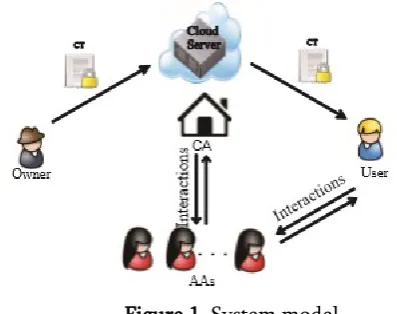
The system model of our design is shown in Fig. 1, which involves five entities: a central authority (CA), multiple attribute authorities (AAs), many data owners (Owners), many data consumers (Users), and a cloud service provider with multiple cloud servers(here, we mention it as cloud server.). •
Figure 1. System model
The central authority (CA)
director of the whole framework, CA has the ability to follow which AA has erroneously or vindictively verified a client and has allowed ill-conceived quality sets.
The attribute authorities (AAs)
These are in charge of performing client authenticity verification and creating halfway keys for authenticity verified clients. Not at all like a large portion of the current multi-specialist plans where every AA deals with a disjoint trait set separately, our proposed conspire includes numerous experts to share the obligation of client authenticity verification and every AA can play out this procedure for any client autonomously. At the point when an AA is chosen, it will confirm the clients' genuine traits by difficult work or verification conventions, and create a moderate key related with the properties that it has authenticity verified. Middle of the road key is another idea to help CA to produce keys.
The data owner (Owner)
Defines the entrance arrangement about who can gain admittance to each file, and encodes the file under the defined strategy. Above all else, every proprietor encodes his/her information with a symmetric encryption calculation. At that point, the proprietor defines get to arrangement over a quality set and encodes the symmetric key under the approach as indicated by open keys acquired from CA. From that point onward, the proprietor sends the entire encoded information and the scrambled symmetric key (indicated as figure content CT) to the cloud server to be put away in the cloud.
The data consumer (User)
It is relegated a worldwide client personality Uid by CA. The client has an arrangement of traits and is furnished with a mystery key related with his/her property set. The client can uninhibitedly get any intrigued scrambled information from the cloud server. Be that as it may, the client can unscramble the scrambled information if and just if his/her
quality set satisfies the entrance arrangement installed in the encoded information. The cloud server gives an open stage to proprietors to store and offer their encoded information. The cloud server doesn't lead information get to control for proprietors. The scrambled information put away in the cloud server can be downloaded uninhibitedly by any client.
B. Security Assumptions and Requirements
To guarantee secure access control in public cloud
Malicious users colluding with each other would not be able to combine their attributes to decrypt a cipher text which each of them cannot decrypt alone. AA accountability.
An auditing mechanism must be devised to ensure that an AA’s misbehavior can be detected to prevent AAs’ abusing their power without being detected. • No ultra vires for any AA. reformulating CPABE cryptographic method into our novel structure, our proposed conspire gives a fine-grained, powerful and efficient get to control with one-CA/multi-AAs for open distributed storage. Our plan utilizes numerous AAs to share the heap of the tedious authenticity verification and standby for serving fresh debuts of clients' solicitations. We additionally proposed an examining technique to follow a property expert's potential misconduct. We led point by point security and execution examination to confirm that our plan is secure and efficient. The security examination demonstrates that our plan could adequately oppose to individual and conspired malignant clients, and in addition the legitimate yet inquisitive cloud servers. Additionally, with the proposed inspecting and tracing scheme, no
AA could deny its misbehaved key distribution. Further performance analysis based on queuing theory showed the superiority of our scheme over the traditional CP-ABE based access control schemes for public cloud storage.
V.
REFERENCES
[1]. P. Mell and T. Grance, "The NIST definition of cloud computing," National Institute of Standards and Technology Gaithersburg, 2011. [2]. Z. Fu, K. Ren, J. Shu, X. Sun, and F. Huang,
"Enabling personalized search over encrypted outsourced data with efficiency improvement," IEEE Transactions on Parallel & Distributed Systems, vol. 27, no. 9, pp. 2546–2559, 2016. [3]. Z. Fu, X. Sun, S. Ji, and G. Xie, "Towards
efficient content-aware search over encrypted outsourced data in cloud," in in Proceedings of 2016 IEEE Conference on Computer Communications (INFOCOM 2016). IEEE, 2016, pp. 1–9.
[4]. K. Xue and P. Hong, "A dynamic secure group sharing framework in public cloud computing," IEEE Transactions on Cloud Computing, vol. 2, no. 4, pp. 459–470, 2014.
[5]. Y. Wu, Z. Wei, and H. Deng, "Attribute-based access to scalable media in cloud-assisted content sharing," IEEE Transactions on Multimedia, vol. 15, no. 4, pp. 778–788, 2013. [6]. J. Hur, "Improving security and efficiency in
attribute based data sharing," IEEE Transactions on Knowledge and Data Engineering, vol. 25, no. 10, pp. 2271–2282, 2013.
[7]. J. Hur and D. K. Noh, "Attribute-based access control with efficient revocation in data outsourcing systems," IEEE Transactions on Parallel and Distributed Systems, vol. 22, no. 7, pp. 1214–1221, 2011.
Communications Conference (GLOBECOM 2015). IEEE, 2015, pp. 6.
[9]. Y. Xue, J. Hong, W. Li, K. Xue, and P. Hong, "LABAC: A location-aware attribute-based access control scheme for cloud storage," in Proceedings of 2016 IEEE Global Communications Conference (GLOBECOM 2016). IEEE, 2016, pp. 1–6.