Evaluation of Machine Learning Methods for Natural Language Processing
Tasks
Walter Daelemans, V´eronique Hoste
CNTS Language Technology Group, University of Antwerp UIA, Universiteitsplein 1 (bldng A), B-2610 Antwerpen, Belgium
daelem,hoste @uia.ua.ac.be
Abstract
We show that the methodology currently in use for comparing symbolic supervised learning methods applied to human language technol-ogy tasks is unreliable. We show that the interaction between algorithm parameter settings and feature selection within a single algorithm often accounts for a higher variation in results than differences between different algorithms or information sources. We illustrate this with experiments on a number of linguistic datasets. The consequences of this phenomenon are far-reaching, and we discuss possible solutions to this methodological problem.
1.
Introduction
Symbolic supervised machine learning methods (e.g. Inductive Logic Programming (ILP), Decision Tree Induc-tion, Rule InducInduc-tion, Memory-Based Learning, etc.) have recently taken front stage in language technology. Most natural language processing (NLP) problems can be for-mulated as classification problems (given some object and its context, decide on the class of this object). Typical instances of this type of problem are part-of-speech tag-ging and word sense disambiguation. Supervised learn-ing methods work by extractlearn-ing regularities from a set of examples (e.g. collected from an annotated corpus). The reason why these methods are researched intensively is that, like statistical approaches, they are often reported to achieve higher efficiency, more robustness, and better coverage than handcrafting approaches. On top of this, they are reported to have a number of advantages com-pared to statistical approaches. E.g., ILP systems allow easy integration of linguistic background knowledge in the learning system, induced rule systems are interpretable, memory-based learning methods incorporate smoothing by similarity-based learning, etc.
Supervised symbolic machine learning methods differ in their bias, i.e. the built-in constraints they have in what can be represented as an induced hypothesis, and how the search for a hypothesis is heuristically guided1. Some ex-amples of bias are the fact that decision tree learners favor compact decision trees, and that ILP systems can represent hypotheses in terms of first order logic in contrast to most other learning methods which can only represent proposi-tional hypotheses. Given these widely differing biases, it is important to study which algorithm “has the right bias” for learning language.
Theoretical studies in Machine Learning (e.g. the no free lunch theorem (Wolpert and Macready, 1995)) have shown that no inductive algorithm is universally better than any other: generalization performance of any inductive al-gorithm is zero when averaged over a uniform distribu-tion of all possible classificadistribu-tion problems. In order to
1The same applies to unsupervised learning methods, but we
will not discuss these further in this paper.
know which learning algorithm has the right bias for lan-guage learning, it is therefore necessary to compare ma-chine learning methods experimentally on their behavior on some specific, typical, language processing task (e.g. POS tagging, discourse segmentation, etc.). A posteriori, we may be able to say something about the bias of a partic-ular class of algorithms being suited or not for a particpartic-ular class of problems. E.g., in (Daelemans et al., 1999) it is claimed that memory-based learning has the right bias for NLP disambiguation in context tasks because it does not abstract from exceptions and low-frequency events.
In NLP, this comparative approach has gained an enor-mous importance with the influence of competitive re-search evaluatons such as MUC, DUC, SENSEVAL, and the CoNLL shared tasks. Although in many cases also handcrafted and complex systems are entered in such a competition, a large part of this research is based on the comparison of machine learning algorithms for some sub-task, the type of experiment we are targeting in this paper.
In summary, for lack of a priori knowledge about which algorithm is suited for which task, the goal of a large part of current research in Machine Learning of Natural Lan-guage is to investigate which type of learning algorithm has the right bias for typical Natural Language Processing tasks (e.g. disambiguation in context). The approach used to achieve this are comparative machine learning experi-ments, for which a detailed experimental methodology has been developed. It is to this methodology and its limitations that we now turn.
2.
Comparative Machine Learning
Methodology
t-tests for determining the statistical significance of differ-ences between algorithms or between presence or absence of information sources. Although this methodology is not without its problems (Salzberg, 1997), it is generally ac-cepted and used both in Machine Learning and in most work in statistical NLP. A seminal paper on the compar-ison of the accuracy of different machine learning (ML) methods (Mooney, 1996) on the task of word sense disam-biguation (WSD) is a good example of best practice in this approach. Many more examples can be found in the re-cent NLP literature of similar studies and interpretations. He tested seven ML algorithms on their ability to disam-biguate the word line, and concluded that within the class of symbolic machine learning methods, decision lists are at an advantage for WSD because of their rule ordering bias. Analogous to decision trees and much like rule induction approaches, decision lists search for a minimal-size ordered set of high-accuracy rules, that disambiguate efficiently and effectively. This is as interesting and useful result, but we will show that interpretations like these are not necessarily reliable.
As an informal characterization of a comparative ma-chine learning experiment, we isolate the following com-ponents. The data set used (before cross-validation) is the sample selection, the selection of information sources used as input to the ML algorithm (the features chosen as pre-dictors for the output class) is the feature selection, these features are presented in some feature representation (e.g. binary, numeric, nominal), and the algorithm(s) chosen have a particular algorithm parameter setting2. In a typi-cal, methodologically correct, comparative machine learn-ing experiment, two algorithms (A and B) are compared for a fixed sample selection, feature selection, and feature rep-resentation over a number of trials (cross-validation), and if the measured differences are statistically significant, con-clusions are drawn about which algorithm is better suited and why (mostly in terms of algorithm bias). Most of the time, the algorithm parameter settings are kept fixed as well (mostly using the default settings), although sometimes the parameters are optimized on the training data.
Our hypothesis is that the accuracy differences which can be observed between different machine learning algo-rithms on some problem using standard methodology will in general be lower than the variability in accuracy resulting from interactions between sample selection, algorithm pa-rameter settings, and information source selection and rep-resentation. This makes many published results (and their interpretation) unreliable.
In Section 3., we describe an experiment to test that our hypothesis holds for the interaction between feature selec-tion and algorithm parameter setting on a series of bench-mark NLP tasks when comparing memory-based learning and rule induction. Section 4. shows that the effect of (pos-sible) algorithm bias on generalization accuracy is easily overwhelmed by the effect of algorithm parameter varia-tion, and the interaction between feature selection and al-gorithm parameter setting. In Section 6. we integrate our
2An additional dimension in a general model could be
combi-nation methods like bagging and boosting.
results with related research, and propose possible solutions to the problem.
3.
Experiments
To test our hypothesis, we analyzed the impact of algo-rithm parameter optimization, and the interaction between feature selection and algorithm parameter optimization on classifier accuracy in a comparative experiment.
Feature (subset) selection is the process in which a sub-set of the available predictor features defining the input of the classification task are removed if they can’t be shown to be relevant in solving the learning task (Kohavi and John, 1997). Often instead of removing features, the fea-tures are assigned relevance weights (Wettschereck et al., 1997). Without computational complexity restrictions, the ideal way to do feature selection would be to try all possible feature subsets and keep the one with the highest accuracy on some holdout set. In practice, a heuristic approach is the only feasible way, E.g., we start with each feature in-dependently as only feature, compute accuracy, then select the feature with highest accuracy and compute accuracy of pairs of features when each other feature is added, and so on, until no more accuracy increase is reported (forward selection). Alternatively we can start with all available fea-tures and look at the effect on accuracy of deleting one of the features, and continue deleting until no more accuracy increase is reported (backward selection).
Algorithm parameter optimization is the process in which parameters of a learning system (e.g. learning rate for neural networks, or the number of nearest neighbors in memory-based learning), are tuned for a particular prob-lem. Although most machine learning systems provide sen-sible default settings, it is by no means certain that they will be optimal parameter settings for some particular task.
In both cases (feature selection and parameter optimiza-tion), we are performing a model selection task which is well-known in Machine Learning. Whereas some pub-lished work in computational linguistics discusses either feature selection for some task, or algorithm parameter op-timization on training data, the effects of their interaction have as far as we know never been studied.
The general set-up of our experiments is the following. Each experiment is done using a 10-fold cross-validation on the available data. This means that the data is split in 10 partitions, and each of these is used once as test set, with the other nine as corresponding train set. For each dataset, we provide information about the accuracy of both ML systems:
1. Using their default settings.
2. When optimizing the algorithm parameters for each algorithm individually. Each “reasonable” parameter setting is used during training on each of the ten folds, and the best setting is used on the test set of that fold. (Optimization step 1).
optimiza-diminutive suffix to indicate “small size”, e.g. “boom-pje” stands for “little tree”. This diminutive suffix shows variation in its form: -tje, -etje, -pje, -kje. The task is to predict which suffix form is chosen for pre-viously unseen words on the basis of their form. For the three last syllables of the noun, four different fea-tures are collected: (i) whether the syllable is stressed or not (+ or -), (ii) the string of consonants before the vocalic part of the syllable, (iii) its vocalic part, (iv) its post-vocalic part. The sign “=” is used whenever a feature is not present. E.g. the following is a training instance for the word “bijbel” (Eng. “bible”, diminu-tive “bijbeltje”): = = = = + b K = - b @ l, T.
The part-of-speech data set is based on the TOSCA tagged LOB corpus of English. There are two ver-sions of the data, one version involved with predict-ing the part-of-speech for known words and one for the unknown words. The features in the known words data set represent information about the possible cate-gories of the focus word to be tagged and its context. For the unknown words, we have to rely on the context and the wordform only. In both data sets, the feature vector represents the coded POS tags of two words be-fore and two words after the focus word, the last three letters of the focus word and information about hy-phenation and capitalization. The known words data set has two extra features: the focus word itself and its ambiguity class. E.g. the following is a training in-stance for the word “house” (known words data set):
house Bn AU AN AE AA u s e 0 0, AN.
Now that we have introduced the approach we took to test our hypothesis, our data, and the learning algorithms to be compared, we can move to the results and their interpre-tation in the next Section.
4.
Results
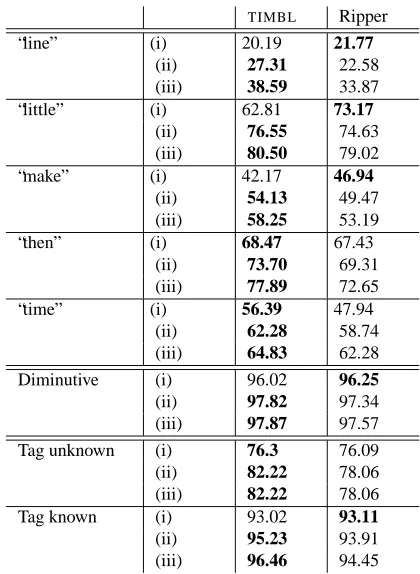
In Table 1, we show that it is indeed incorrect to con-clude that one algorithm is better than another for a certain classification problem merely on the basis of default algo-rithm parameter settings: for 5 data sets (“line”, “little”, “make”, diminutive and tag known),RIPPER outperforms
TIMBL when using default parameter settings. However, when optimizing the algorithm parameters, we observe that the algorithm which performed best with the standard set-tings, is not necessarily the best algorithm when doing the optimizations.
When looking at the variation for a single algorithm over the three conditions, we can see that parameter op-timization and combined feature selection with parameter optimization leads to major accuracy improvements com-pared to the results obtained with default parameter set-tings. These ’vertical’ accuracy differences are much larger than the ’horizontal’ algorithm-comparing accuracy differ-ences. The fact that we could observe large standard de-viations in the optimization experiments, also confirms the necessity of parameter optimization (only the best result is represented in Table1 for each optimization step).
TIMBL Ripper “line” (i) 20.19 21.77
(ii) 27.31 22.58 (iii) 38.59 33.87 “little” (i) 62.81 73.17
(ii) 76.55 74.63 (iii) 80.50 79.02 “make” (i) 42.17 46.94
(ii) 54.13 49.47 (iii) 58.25 53.19 “then” (i) 68.47 67.43
(ii) 73.70 69.31 (iii) 77.89 72.65 “time” (i) 56.39 47.94
(ii) 62.28 58.74 (iii) 64.83 62.28 Diminutive (i) 96.02 96.25
(ii) 97.82 97.34 (iii) 97.87 97.57 Tag unknown (i) 76.3 76.09 (ii) 82.22 78.06 (iii) 82.22 78.06 Tag known (i) 93.02 93.11
(ii) 95.23 93.91 (iii) 96.46 94.45
Table 1: Results ofTIMBLandRIPPERon the different nat-ural language data sets when using (i) default settings, (ii) parameter optimization and (iii) forward selection with pa-rameter optimization.
With respect to the selected parameter settings and fea-ture combinations, we found that those parameter settings which are selected after optimization cannot be generalized over the different data sets, not even within a single data set (parameter settings which are optimal when using all features are not necessarily optimal when performing fea-ture selection). Furthermore, we could observe for all data sets that the feature selection considered to be optimal for
TIMBLcould be different from the one optimal forRIPPER. We conclude that we can confirm our hypothesis that the accuracy differences between different machine learning al-gorithms using standard comparative methodology will in general be lower than the variability in accuracy resulting from interactions between algorithm parameter settings and information source selection.
4.1. Results on a hold-out test set
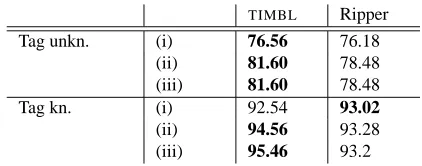
The best results in each of the optimization steps of Table 1 are no guarantee that these accuracies will also be achieved with independent test material. Optimization happened on each test fold in the 10-fold cross-validation (rather than using an additional cross-validation), which is methodologically acceptable as we were only interested in the variability of the results.
TIMBL Ripper Tag unkn. (i) 76.56 76.18
(ii) 81.60 78.48 (iii) 81.60 78.48 Tag kn. (i) 92.54 93.02
(ii) 94.56 93.28 (iii) 95.46 93.2
Table 2: Results ofTIMBLand Ripper on the tagging data sets when using (i) default settings, (ii) the optimal param-eter settings, and (iii) the optimal feature subset with the optimal parameter settings.
optimal after cross-validation on the train set. The results of these experiments are displayed in Table 2, and confirm the results of the validation experiments (Table 1).
5.
Solutions
Optimization problems of the type described in this pa-per are of course not unique to machine learning of lan-guage. Solutions like genetic algorithms (GAs) have been proposed as domain-independent techniques suitable for exploring large search spaces such as those described in this paper. GAs start with a collection of randomly initial-ized hypothesis solutions in the form of symbolic strings called chromosomes or individuals. The chromosome con-sists of a series of genes each of which represents a partic-ular feature-value combination. This population is evolved by selecting the fittest individuals and recombining them by means of mutation and crossover operators. Features can be easily represented as binary “genes” that can be on or off. A particular feature subset selection is then represented as those feature genes that are on. Different parameter settings of the learning algorithm can also be represented as genes (e.g., the value of k as a numeric gene with integer values). By combining these representations, we can make the GA search for an optimal combination of parameter settings and feature selection. The fitness measure for each individual is based on the accuracy of the classifier corresponding to its chromosome on a test set (or by cross-validation). This ap-proach can be extended to other aspects of the learning sit-uation such as feature representation and sample selection (at the cost of more computation).
In previous research, we have applied genetic algo-rithms to feature selection and combined feature selection and algorithm parameter setting. However, we found that GA feature selection does not significantly do better than the simple feature selection methods described above (Kool et al., 2000a), and that whereas GA combined parame-ter optimization and feature selection is feasible it does not always show performance gains (Kool et al., 2000b). These are prliminary results, however, merely scratching the surface of possible experiments, and further research is needed.
6.
Related Research and Conclusion
An argument similar to ours can be found in (Banko and Brill, 2001) for the effect of one aspect of sample se-lection (training set size). For the task of disambiguating
confusables (words like it’s and its which are easily con-fused in writing), increasing training data with a factor
has a significantly larger effect on generalization accuracy than the choice of algorithm on the “smaller” (still 1 million cases) training set, and the effect of algorithm bias becomes considerably smaller at these large training set sizes.
Our research shows that at the 1 million end of their learning curve, the isolated points (representing different machine learning method results) should actually be inter-preted as largely overlapping intervals. And that even there, comparative results are not reliable. It would be interest-ing to investigate whether the variability due to the interac-tion between feature selecinterac-tion and algorithm parameter op-timization decreases as the training set size increases. If this were not the case, then even at large training set sizes, we cannot be sure of differences found with default settings. Our computational resources didn’t allow us to investigate this.
In (Banko and Brill, 2001) it is concluded that “We have no reason to believe that any comparative conclusions drawn on one million words will hold when we finally scale up to larger training corpora”, and they therefore advise a switch of attention in the field from comparative experi-ments on “small” (1 million) datasets to techniques for effi-ciently collecting more training data. From our experiments we could add that there is also no reason to believe that any comparative conclusions drawn on the basis of standard comparative machine learning methodology will hold when sufficient optimalization of algorithm parameters and fea-ture selection is available. More attention should therefore also be given to efficient optimalization stratiegies where computationally feasible.
7.
References
D.W. Aha, D. Kibler, and M. Albert. 1991. Instance-based learning algorithms. Machine Learning, 6:37–66. Ethem Alpaydin. 1999. Combined cv F test for
comparing supervised classification learning algorithms. Neural Computation, 11(8):1885–1892.
R.H. Baayen, R. Piepenbrock, and H. van Rijn. 1993. The CELEX lexical data base on CD-ROM. Philadelphia: Linguistic Data Consortium.
M. Banko and E. Brill. 2001. Scaling to very very large corpora for natural language disambiguation. In Pro-ceedings of the 39th Annual Meeting of the Association for Computational Linguistics, pages 26–33. Association for Computational Linguistics.
W.W. Cohen. 1995. Fast effective rule induction. In Proc. 12th International Conference on Machine Learning, pages 115–123. Morgan Kaufmann.
W. Daelemans, A. van den Bosch, and T. Weijters. 1997. Igtree: Using trees for compression and classification in lazy learning algorithms. Artificial Intelligence Review, special issue on Lazy Learning, 11:407–423.
Walter Daelemans, Antal van den Bosch, and Jakub Za-vrel. 1999. Forgetting exceptions is harmful in language learning. Machine Learning, 34:11–41.
version 4.0, reference guide. Technical report, ILK Technical Report 01-04.
Thomas G. Dietterich. 1998. Approximate statistical tests for comparing supervised classification learning algo-rithms. Neural Computation, 10(7):1895–1923.
Ron Kohavi and George H. John. 1997. Wrappers for feature subset selection. Artificial Intelligence, 97(1– 2):273–323.
Anne Kool, Walter Daelemans, and Jakub Zavrel. 2000a. Genetic algorithms for feature relevance assignment in memory-based language processing. In Claire Cardie, Walter Daelemans, Claire N´edellec, and Erik Tjong Kim Sang, editors, Proceedings of the Fourth Conference on Computational Natural Language Learning and of the Second Learning Language in Logic Workshop, Lisbon, 2000, pages 103–106. Association for Computational Linguistics, Somerset, New Jersey.
Anne Kool, Jakub Zavrel, and Walter Daelemans. 2000b. Simultaneous feature selection and parameter optimiza-tion for memory-based natural language processing. In Ad Feelders, editor, Proceedings of the 10th BENE-LEARN meeting, pages 93–100. Tilburg, The Nether-lands.
Raymond J. Mooney. 1996. Comparative experiments on disambiguating word senses: An illustration of the role of bias in machine learning. In Eric Brill and Kenneth Church, editors, Proceedings of the Conference on Em-pirical Methods in Natural Language Processing, pages 82–91. Association for Computational Linguistics, Som-erset, New Jersey.
Steven L. Salzberg. 1997. On comparing classifiers: Pit-falls to avoid and a recommended approach. Data Min-ing and Knowledge Discovery, 1(3):317–327.
Sholom Weiss and Nitin Indurkhya. 1998. Predictive Data Mining: A Practical Guide. Morgan Kaufmann, San Francisco.
Sholom M. Weiss and Casimir A. Kulikowski. 1991. Com-puter Systems That Learn: Classification and Prediction Methods from Statistics, Neural Nets, Machine Learn-ing, and Expert Systems. Morgan Kaufmann, San Mateo, California.
Dietrich Wettschereck, David W. Aha, and Takao Mohri. 1997. A review and empirical evaluation of feature weighting methods for a class of lazy learning algo-rithms. Artificial Intelligence Review, 11(1-5):273–314. David H. Wolpert and William G. Macready. 1995. No free