A graphical view complements a compact format view where the results of linguistic cue checking are displayed, as we will explain below in more detail.
3.1.
AAILE compact format
AAILE’s goal is to assist lexicographers in the analysis of corpus data for deciding on the encoding of lexical items according to a particular linguistic classification. AAILE wants to offer an easy inspecting and compact view of the linguistic cues that the lexicographer wants to take into account for assigning such classes.
For example, adjacent should be given the class transitive because this class is the one assigned to adjectives that show the following syntactic characteristics: (i) they are to be found in pre-nominal, post-nominal and predicative positions, and (ii) they have a prepositional complement, in this particular case, headed by to. This is the information that the signature of adjacent should contain and that must show up clearly in the compact vector representation.5
Thus, in the AAILE platform, signatures are shown in tables that display the profiles of the vectors they are made of. Each profile is informed with its absolute and relative frequency information, as shown in Figure 2.
Figure 2: Profile information for the English adjective blind. The keyword referring to the linguistic cue value
can be retrieved by clicking on each component value
As shown in Table 2, profile components are located at the centre of the table. For easy interpreting the different components of each one, the keyword referring to the linguistic cues can be retrieved by clicking on each components value.
At the left hand side column of the profile compact representation, there is the information about similarity between different profiles. It offers a quantitative measure of the number of linguistic cues, that is components, shared by two vectors. In the example of Figure 2, Dist values show that the most similar profiles share the component referring to the predicative position and the presence of the preposition to. We will describe in detail
the functionalities regarding similarity calculations in the following section.
3.2.
5 The examples shown until now are simple cases where the
relation between the linguistic cues and the class assigned is almost straightforward. This is the case for adjectives, which have a very informative local context. For other grammatical categories, linguistic cues are less certain and specific combination of them have to be devised and put in relation with the linguistic classes in a n to 1 relation.
The most left column, under the header Freq, refers to the absolute (in parenthesis) and relative frequency of profiles in the signature.
Graphical format
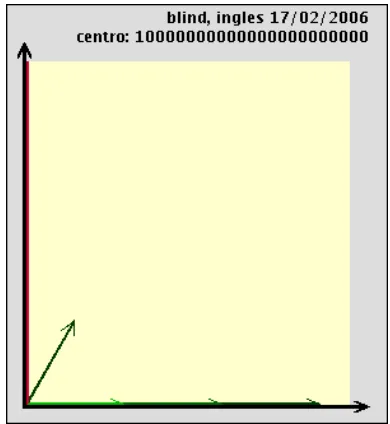
For the graphical representation of a signature, as shown in Figure 3, AAILE takes as reference the most frequent profile and computes the similarity of the other profiles with respect to it. Using cosine distance6 as the
similarity measure allows the plotting of different profiles in a 2-dimensional graphic.
Figure 3: blind 2D graphic using its most frequent profile as center.
By default, the most frequent profile is a red arrow on the y axis at the graphic display. The x axis is for the profiles whose cosine distance to the one chosen for reference is 0. The profiles that are similar in some measure to the reference are plotted accordingly. Arrow’s length represents frequency information. In case of resulting in equal similarity measures, the profiles are plotted sequentially, but in different green colored vectors.
The user can change the profile used as point of reference. the one shown in y axis. Thus, by clicking at the Cent sign (in the compact view) of another profile, the whole is re-calculated and plotted again. In Figure 4 we show the graphical display for the signature of blind again, but with the profile showing a pre-nominal location as the point of reference for similarity calculations. A comparison of the graphic displays allows to see quickly that there is more variance in the case of the predicative position.
In Figure 2 we can see that some invariant positive components, such as the one referring to its being after a predicative component and appearing together with the preposition to, indicates a consistent pattern that should be
6The closer to 0, the more significantly different, the closer to 1,
taken into account. We will refer again to that observation in the following section.
Figure 4: blind 2D graphic using pred profile as center.
4.
4.1.
4.2.
Additional information in AAILE
Syntactic Features assessment
AAILE incorporates a Knowledge Module (KM) that evaluates the syntactic behavior displayed in a word’s signature on the light of the possible syntactic features it can be said to hold. By syntacticfeatures we refer to the linguistic generalizations that can be drawn over the distributional characteristics a part of speech, that is, the potential contexts where a word can appear according to its grammatical category. This distributional information is the basis for deciding on the encoding of such a word, the goal of the lexicographer who has to compare empirical evidences, the linguistic cues with the syntactic features that a given class is supposed to display.
The quantitative information supplied by AAILE is intended to help the lexicographer to assess the degree of confidence that the information brought by linguistic cues deserves. It is beyond the scope of this paper to present how the KM works in detail, but we will explain now how it proceeds in a very intuitive way.
KM module calculates, on the basis of the linguistic cues captured, to what extent the behavior displayed in the signature corresponds to the one expected if the word could be said to hold a particular syntactic feature. For instance, the system can assess that the adjective blind, that displays the behavior reported in Figure 2, can be said to be predicative with enough confidence because there were linguistic cues confirming that feature. However, for the adjective countless, following the data in Table 2, should be considered no predicative, there are no cues that support such a consideration for countless.
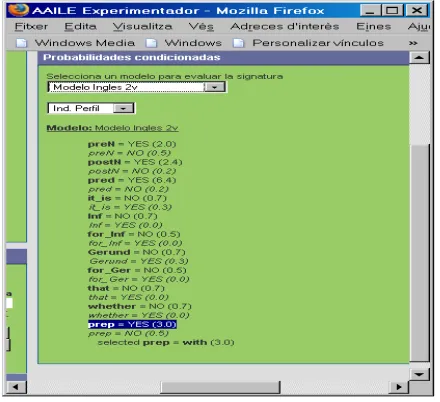
In Figure 5, we show the assessment of all linguistic cues for the adjective blind as currently displayed in AAILE. We see how KM returns a value for each linguistic cue and possible value yes and no. The indicator, that computes the conditional probability of the linguistic cues ones depending on the others, is also
sensitive to the invariant cues in different profiles. This means that the presence in different profiles raises the level of confidence on this linguistic cue.
Figure 5. Confidence on linguistic cues
Clustering with WEKA
AAILE has been provided with an interface to WEKA libraries (Witten, Frank, 2005.) It uses the Expectation Maximization (EM) algorithm a clustering analysis of the signatures on user demands. Figure 6 shows the results of a clustering exercise.
Figure 6: Clustering with WEKA EM.
5. Using AAILE platform for lexical
encoding
Along the preceding sections, we have provided details on how the system has been designed to assist the lexicographer when taking decisions about what are the relevant characteristics of a word. We should see now how is the intended use of the platform.
The lexicographer using AAILE has been asked to relate lemmas belonging to a particular grammatical category and the lexical classes defined on linguistic grounds, for instance for the use by Natural Processing Tools (Lenci et al. 2000.) The lexicographer should, instead of looking at texts, receive enough analytical information to determine the class of the word under study.
A typical encoding exercise is based on the observation of the profiles that conform a signature, their frequency and the selection of profiles that correspond to a given class.
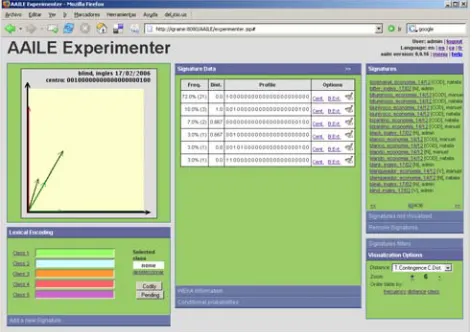
Figure 7: AAILE main window. At the left-bottom corner the lexicographer is assisted with completive writing for
consistency encoding
Figure 7 shows, at the bottom left hand corner, the encoding section of the AAILE main view. The lexicographer should use it when entering the class or classes assigned. The system asks the lexicographer to mark (in the Figure, in green color) those profiles that are related to the class selected. The system allows to create two different lexical entries out of a unique signature. This could be the case when encoding different bound prepositions, for instance.
The lexicographer enters the selected lexical class help by AAILE that shows him or her the possible classes with a completive writing facility.
In the most simple case, the encoding exercise should take just few minutes. Analytical information is mostly required when dealing with high frequency words, that present a large number of profiles, with high variation in the linguistic cues shown. Then the lexicographer might find useful to check whether there is a particular profile that shows to be a better point of reference because it
creates a big distance between two groups of profiles, for instance. This could be a sign that there is more than one lexical entry in the signature.
An example of such a case is the adjective consistent, where we could identify the consistent-with reading and the be-consistent one. Figure 8 shows the main view for consistent.
Figure 8: AAILE view for consistent
The most significant information comes from the clean cut between the three profiles with 0.5 distance, and the others going directly to 0. This is a sign that it is worth considering two different entries.
As already mentioned, invariant components across different signatures are very informative, specially for bound prepositions. We see in the example of Figure 8 that with is present in 3 profiles, while other prepositions like in or from are present only in 1. AAILE can also supply the lexicographer with a confidence measure on what are the relevant characteristics of the signature to classify the lexical entry. In the case of consistent, it shows a clear confidence on the bound character of preposition _with:
6.
7. References
Technical details
AAILE platform is divided into three tiers, following model view controller (MVC) pattern: user system interface, process management and database management. Database management tier is implemented using MySQL 4.1., MySQL JDBC driver and DAO pattern access to data.
Process management is performed in Java 5, and uses various open source libraries: Jakarta Commons DBUtils, Jakarta Commons FileUpload, Jakarta Log4j and Apache Axis 1.2.
The user interface tier is developed using AJAX, Javascript, CSS in the client side and Java Server Pages in the server side.
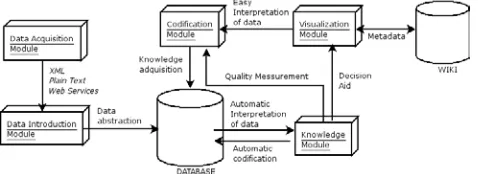
Logically, the architecture of the system can be divided as follows: A data acquisition and introduction module, a codification module, a visualization module and a knowledge module. These modules use data from a database and a wiki.
Figure 8: AAILE architecture
Bel, N. (2004). "Corpus representativeness for syntactic information acquisition" in Blache, Philipe; Rodríguez, Horacio [eds.] Companion Volume to the Proceedings of the 42nd Annual Meeting of the Association for Computational Linguistics. Barcelona: Association for Computational Linguistics. Pàg. 138-141.
Cabré, M. T; Bach, C. (2004). "El Corpus Tècnic del IULA: corpus textual especializado plurilingüe" in Panace@ - Boletín de Medicina y Traducción V(16): MedTrad. Pàg. 173-176.
Lenci, A.; Bel, N.; Busa, F.; Calzolari, N.; Gola, E.; Monachini, M.; Ogonowski, A.; Peters, I.; Peters, W.; Ruimy, N.; Villegas, M.; Zampolli, A. (2000). "SIMPLE: A General Framework for the Development of Multilingual Lexicons", International Journal of Lexicography 13(4). Oxford: Oxford University. Pàg. 249-263
Marimon, M.; Bel, N. (2004). "Lexical Entry Templates for Robust Deep Parsing" in LREC 2004 Fourth International Conference on Language Resources and Evaluation. Lisboa: European Languages Resources Association
Rosenfeld, R. (1997). A whole sentence maximum entropy language model. In Proc. of the IEEE Workshop on Automatic Speech Recognition and Understanding