UNIVERSAL QUANTUM COMPUTING AND THREE-MANIFOLDS
MICHEL PLANAT†, RAYMOND ASCHHEIM‡, MARCELO M. AMARAL‡AND KLEE IRWIN‡
Abstract. A single qubit may be represented on the Bloch sphere or similarly on the 3-sphereS3. Our goal is to dress this correspondence by converting the language of universal quantum computing (UQC) to that of 3-manifolds. A magic state and the Pauli group acting on it define a model of UQC as a positive operator-valued measure (POVM) that one recognizes to be a 3-manifold M3. More precisely, thed-dimensional POVMs defined from subgroups of finite index of the modular group P SL(2,Z) correspond tod-fold M3- coverings over the trefoil knot. In
this paper, one also investigates quantum information on a few ‘univer-sal’ knots and links such as the figure-of-eight knot, the Whitehead link and Borromean rings, making use of the catalog of platonic manifolds available on the software SnapPy. Further connections between POVMs based UQC andM3’s obtained from Dehn fillings are explored. PACS: 03.67.Lx, 03.65.Wj, 03.65.Aa, 02.20.-a, 02.10.Kn, 02.40.Pc, 02.40.Sf MSC codes: 81P68, 81P50, 57M25, 57R65, 14H30, 20E05, 57M12
Keywords: quantum computation, IC-POVMs, knot theory, three-manifolds, branch coverings, Dehn surgeries.
Manifolds are around us in many guises.
As observers in a three-dimensional world, we are most familiar with two-manifolds: the surface of a ball or a doughnut or a pretzel, the surface of a house or a tree or a volleyball net...
Three-manifolds may be harder to understand at first. But as actors and movers in a three-dimensional world, we can learn to imagine them as al-ternate universes, William Thurston [1].
1. Introduction
Mathematical concepts pave the way for improvements in technology. As far as topological quantum computation is concerned, non-abelian anyons have been proposed as an attractive (fault-tolerant) alternative to standard quantum computing which is based on a universal set of quantum gates [2, 3, 4, 5]. Anyons are two-dimensional quasiparticles with world lines forming braids in space-time. Whether non-abelian anyons do exist in the real world and/or would be easy to create artificially, is still open to dis-cussion. In this paper, we propose an alternative to anyon based universal quantum computation (UQC) thanks to three-dimensional topology. Our proposal relies on appropriate 3-manifolds whose fundamental group is used for building the magic states for UQC. Three-dimensional topological quan-tum computing would federate the foundations of quanquan-tum mechanics and
1
cosmology, a recurrent dream of many physicists. Three-dimensional topol-ogy was already investigated by several groups in the context of quantum information [6, 7], high energy physics [8, 9], biology [10] and consciousness studies [11].
Let us remind the context of our work and clarify its motivation. Bravyi & Kitaev introduced the principle of ‘magic state distillation’: universal quan-tum computation, the possibility to prepare an arbitrary quanquan-tum gate, may be realized thanks to the stabilizer formalism (Clifford group unitaries, preparations and measurements) and the ability to prepare an appropriate single qubit non-stabilizer state, called a ‘magic state’ [23]. Then, irrespec-tively of the dimension of the Hilbert space where the quantum states live, a non-stabilizer pure state was called a magic state [12]. An improvement of this concept was carried out in [13, 14] showing that a magic state could be at the same time a fiducial state for the construction of an informationally complete positive operator-valued measure, or IC-POVM, under the action on it of the Pauli group of the corresponding dimension. Thus UQC in this view happens to be relevant both to such magic states and to IC-POVMs. In [13, 14], a d-dimensional magic state follows from the permutation group that organize the cosets of a subgroup H of index d of a two-generator free group G. This is due to the fact that a permutation may be seen as a permutation matrix/gate and that mutually commuting matrices share eigenstates - they are either of the stabilizer type (as elements of the Pauli group) or of the magic type. In the calculation, it is enough to keep magic states that are simultaneously fiducial states for an IC-POVM and we are done. Remarkably, a rich catalog of the magic states relevant to UQC and IC-POVMs can be obtained by selecting G as the two-letter representation of the modular group Γ =P SL(2,Z) [15]. The next step, developed in this paper, is to relate the choice of the starting group G to three-dimensional topology. More precisely, G is taken as the fundamental group π1(S3\K)
of a 3-manifold M3 defined as the complement of a knot or link K in the 3-sphere S3. A branched covering of degree d over the selected M3 has a fundamental group corresponding to a subgroup of index d of π1 and may
be identified as a sub-manifold ofM3, the one leading to an IC-POVM is a model of UQC. In the specific case of Γ, the knot involved is the left-handed trefoil knot T1, as shown in Sec. 2.
More details are provided at the next subsections. The starting point consists of the Poincar´e and Thurston conjectures, now theorems [1].
1.1. From Poincar´e conjecture to UQC. The Poincar´e conjecture is the elementary (but deep) statement that every simply connected, closed 3-manifold is homeomorphic to the 3-sphere S3 [16]. Having in mind the correspondence between S3 and the Bloch sphere that houses the qubits ψ = a|0i +b|1i, a, b ∈ C, |a|2 +|b|2 = 1, one would desire a quantum
thread of the proof of Poincar´e conjecture. Thurston’s geometrization con-jecture, from which Poincar´e conjecture follows, dressesS3 as a 3-manifold not homeomorphic to S3. The wardrobe of 3-manifolds M3 is huge but al-most every dress is hyperbolic and W. Thurston found the recipes for them [1]. Every dress is identified thanks to a signature in terms of invariants. For our purpose, the fundamental group π1 of M3 does the job.
The three-dimensional space surrounding a knotK-the knot complement S3 \K- is an example of a three-manifold [1, 24]. We will be especially interested by the trefoil knot that underlies work of the first author [15] as well as the figure-of-eight knot, the Whitehead link and the Borromean rings because they are universal (in a sense described below), hyperbolic and allow to build 3-manifolds from platonic manifolds [25]. Such manifolds carry a quantum geometry corresponding to quantum computing and (possibly informationally complete) POVMs identified in our earlier work [15, 13, 14]. According to [29], the knotK and the fundamental groupG=π1(S3\K)
are universal if every closed and oriented 3-manifold M3 is homeomorphic to a quotient H/G of the hyperbolic 3-space H by a subgroup H of finite indexdofG. The figure-of-eight knot and the Whitehead link are universal. The catalog of the finite index subgroups of their fundamental groupGand of the corresponding 3-manifolds defined from the d-fold coverings [30] can easily been established up to degree 8, using the software SnapPy [27].
Figure 1. (a) The figure-of-eight knot: K4a1 =
otet0200001 = m004, (b) the Whitehead link L5a1 =
ooct0100001 = m129, (c) Borromean rings L6a4 =
ooct0200005=t12067.
In paper [15] of the first author, it has been found that minimal d-dimensional IC-POVMs (sometimes called MICs) may be built from finite index subgroups of the modular group Γ = P SL(2,Z). To such an IC (or MIC) is associated a subgroup of index d of Γ, a fundamental domain in the Poincar´e upper-half plane and a signature in terms of genus, elliptic points and cusps as summarized in [15, Fig. 1]. There exists a relationship between the modular group Γ and the trefoil knotT1 since the fundamental
groupπ1(S3\T1) of the knot complement is the braid groupB3, the central
are not universal [26] which forbids the relation of the finite index subgroups of B3 to all three-manifolds.
It is known that two coverings of a manifold M with fundamental group G=π1(M) are equivalent if there exists a homeomorphism between them.
Besides, a d-fold covering is uniquely determined by a subgroup of index d of the group G and the inequivalent d-fold coverings of M correspond to conjugacy classes of subgroups of G [30]. In this paper we will fuse the concepts of a three-manifold M3 attached to a subgroup H of index dand the POVM, possibly informationally complete (IC), found from H (thanks to the appropriate magic state and related Pauli group factory).
1.2. Minimal informationally complete POVMs and UQC. In our approach [14, 15], minimal informationally complete (IC) POVMs are de-rived from appropriate fiducial states under the action of the (generalized) Pauli group. The fiducial states also allow to perform universal quantum computation [13].
A POVM is a collection of positive semi-definite operators{E1, . . . , Em} that sum to the identity. In the measurement of a state ρ, the i-th outcome is obtained with a probability given by the Born rule p(i) = tr(ρEi). For a minimal IC-POVM (or MIC), one needs d2 one-dimensional projectors Πi =|ψii hψi|, with Πi =dEi, such that the rank of the Gram matrix with elements tr(ΠiΠj), is precisely d2. A SIC-POVM (the S means symmetric) obeys the relation|hψi|ψji|2 = tr(ΠiΠj) = dδdij+1+1, that allows the explicit recovery of the density matrix as in [33, eq. (29)].
New minimal IC-POVMs (i.e. whose rank of the Gram matrix is d2) and with Hermitian angles |hψi|ψji|i6=j ∈A={a1, . . . , al}have been discovered [15]. A SIC (i.e. a SIC-POVM) is equiangular with |A| = 1 and a1 =
1
√
d+1. The states encountered are considered to live in a cyclotomic field
F=Q[exp(2niπ)], withn= GCD(d, r), the greatest common divisor ofdand
r, for somer. The Hermitian angle is defined as|hψi|ψji|i6=j =k(ψi, ψj)k
1
deg, wherek.kmeans the field norm of the pair (ψi, ψj) inFand deg is the degree of the extension Fover the rational field Q[14].
The fiducial states for SIC-POVMs are quite difficult to derive and seem to follow from algebraic number theory [34].
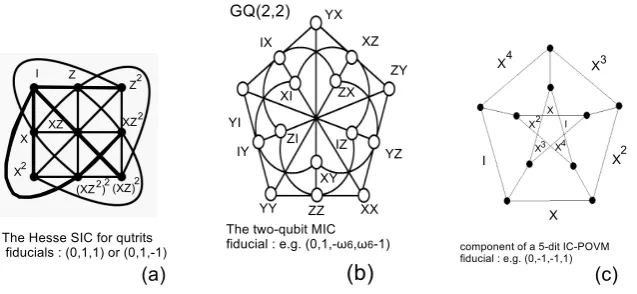
Except ford= 3, the IC-POVMs derived from permutation groups are not symmetric and most of them can be recovered thanks to subgroups of index d of the modular group Γ [15, Table 2]. The geometry of the qutrit Hesse SIC is shown in Fig 3a. It follows from the action of the qutrit Pauli group on magic/fiducial states of type (0,1,±1). Ford= 4, the action of the two-qubit Pauli group on the magic/fiducial state of type (0,1,−ω6, ω6−1) with
ω6 = exp(2iπ6 ) results into a minimal IC-POVM whose geometry of triple
products of projectors Πiturns out to correspond to the commutation graph of Pauli operators, see Fig. 3b and [15, Fig. 2]. For d= 5, the geometry of an IC consists of copies of the Petersen graph reproduced in Fig. 3c. For d = 6, the geometry consists of components looking like Borromean rings (see [15, Fig. 2] and Table 1 below).
Figure 2. Geometrical structure of low dimensional MICs:
(a) the qutrit Hesse SIC, (b) the two-qubit MIC that is the generalized quadrangle of order two GQ(2,2), (c) the basic conponent of the 5-dit MIC that is the Petersen graph. The coordinates on each diagram are the d-dimensional Pauli op-erators that act on the fiducial state, as shown.
UQC problem in the wider frame of Poincar´e conjecture, the Thurston’s geometrization conjecture and the related 3-manifolds. E.g. ICs may also follow from hyperbolic or Seifert 3-manifolds as shown in tables 2 to 5 of this paper.
1.3. Organization of the paper. The paper is organized as follows. Sec. 2 deals about the relationship between quantum information seen from the modular group Γ and from the trefoil knot 3-manifold. Sec. 3 deals about the (platonic) 3-manifolds related to coverings over the figure-of-eight knot, Whitehead link and Borromean rings, and how they relate to minimal IC-POVMs. Sec. 4 describes the important role played by Dehn fillings for describing the many types of 3-manifolds that may relate to topological quantum computing.
2. Quantum information from the modular group Γ and the related trefoil knot T1
In this section, we describe the results established in [15] in terms of the 3-manifolds corresponding to coverings of the trefoil knot complement S3\T1.
Let us introduce to the group representation of a knot complementπ1(S3\
K). A Wirtinger representation is a finite representation of π1 where the
relations are of the formwgiw−1 =gj wherewis a word in thekgenerators
{g1,· · ·, gk}. For the trefoil knot T1 = K3a1 = 31 shown in Fig. 2a, a
Wirtinger representation is [35]
π1(S3\T1) =hx, y|yxy=xyxi or equivalentlyπ1=
x, y|y2=x3
.
Figure 3. (a) The trefoil knot T1 = K3a1 = 31, (b) the
link L7n1 associated to the Hesse SIC, (c) the link L6a3 associated to the two-qubit IC.
ηd(T1) ={1,1,2,3,2, 8,7,10,18,28, . . .}.
Details about the corresponding d-fold coverings are in Table 1. As ex-pected, the coverings correspond to subgroups of indexdof the fundamental group associated to the trefoil knotT1.
Cyclic branched coverings over the trefoil knot. Let p, q, r be three positive integers (withp≤q ≤r), the Brieskorn 3-manifold Σ(p, q, r) is the intersec-tion in C3 of the 5-sphere S5 with the surface of equation z1p+z
q
2+z3r= 1.
In [37], it is shown that a r-fold cyclic covering over S3 branched along
a torus knot or link of type (p, q) is a Brieskorn 3-manifold Σ(p, q, r) (see also Sec 4.1). For the spherical case p−1 +q−1 +r−1 > 1, the group as-sociated to a Brieskorn manifold is either dihedral [that is the group Dr for the triples (2,2, r)], tetrahedral [that isA4 for (2,3,3)], octahedral [that
is S4 for (2,3,4)] or icosahedral [that is A5 for (2,3,5)]. The Euclidean
case p−1+q−1+r−1 = 1 corresponds to (2,3,6), (2,4,4) or (3,3,3). The remaining cases are hyperbolic.
The cyclic branched coverings with spherical groups for the trefoil knot [which is of type (2,3)] are identified in right hand side column of Table 1.
Irregular branched coverings over the trefoil knot. The right hand side col-umn of Table 1 shows the subgroups of Γ identified in [15, Table 1] as corresponding to a minimal IC-POVM. Let us give a few more details how to attach a MIC to some coverings/subgroups of the trefoil knot fundamen-tal group π1(T1). Columns 1 to 6 in Table 1 contain information available
d ty hom cp gens CS link type in [15]
2 cyc 13 + 1 1 2 -1/6
3 irr 1 + 1 2 2 1/4 L7n1 Γ0(2), Hesse SIC
. cyc 12 +12 + 1 1 3 . A4
4 irr 1 + 1 2 2 1/6 L6a3 Γ0(3), 2QB IC
. irr 12 + 1 1 3 . 4A0, 2QB-IC
. cyc 13 + 1 1 2 . S4
5 cyc 1 1 2 5/6 A5
. irr 13 + 1 1 3 . 5A0, 5-dit IC
6 reg 1 + 1 + 1 3 3 0 L8n3 Γ(2), 6-dit IC
. cyc 1 + 1 + 1 1 3 . Γ0, 6-dit IC
. irr 1 + 1 + 1 3 3 .
. irr 12+ 1 + 1 2 3 . 3C0, 6-dit IC
. irr 12+ 1 + 1 2 3 . Γ0(4), 6-dit IC
. irr 12+ 1 + 1 2 3 . Γ0(5), 6-dit IC
. irr 12 +12 +12+ 1 1 4 .
. irr 13 +13 + 1 1 3 .
7 cyc 1 1 2 -5/6
. irr 1 + 1 2 3 . NC 7-dit IC
. irr 12 +12 + 1 1 4 . 7A0 7-dit IC
8 irr 1 + 1 2 2 -1/6
. cyc 13 + 1 2 2 .
. cyc 13+ 1 + 1 2 3 .
. cyc 16 + 1 1 4 . 8A0,∼8-dit IC
Table 1. Coverings of degree dover the trefoil knot found
from SnapPy [27]. The related subgroup of modular group Γ and the corresponding IC-POVM [15] (when applicable) is in the right column. The covering is characterized by its type ty, homology group hom (where 1 means Z), the number of cusps cp, the number of generators gens of the fundamental group, the Chern-Simons invariant CS and the type of link it represents (as identified in SnapPy). The case of cyclic coverings corresponds to Brieskorn 3-manifolds as explained in the text: the spherical groups for these manifolds is given at the right hand side column.
For the irregular covering of degree 3 and first homology Z+Z, the fun-damental group provided by SnapPy is π1(M3) =
a, b|ab−2a−1b2
that, of course, corresponds to a representative H of one of the two conjugacy classes of subgroups of index 3 of the modular group Γ, following the theory of [30]. The organization of cosets of H in the two-generator group G =
a, b|a2, y3∼= Γ thanks to the Coxeter-Todd algorithm (implemented in the software Magma [32]) results into the permutation groupP =h3|(1,2,3),(2,3)i, as in [15, Sec. 3.1]. This permutation group is also the one obtained from the congruence subgroup Γ0(2)∼=S3of Γ (whereS3is the three-letter symmetric
of the permutation matrix in S3 of type (0,1,±1) serve as magic/fiducial
state for the Hesse SIC [15, 14].
A similar reasoning applied to the irregular coverings of degree 4, and first homology Z +Z and Z2 +Z leads to the recognition of congruence subgroups Γ0(3) and 4A0, respectively, behind the corresponding manifolds.
It is known from [15, Sec. 3.2] that they allow the construction of two-qubit minimal IC-POVMs. For degree 5, the equiangular 5-dit MIC corresponds to the irregular covering of homology Z
3+Zand to the congruence subgroup
5A0 in Γ (as in [15, Sec. 3.3]).
Five coverings of degree 6 allow the construction of the (two-valued) 6-dit IC-POVM whose geometry contain the picture of Borromean rings [15, Fig. 2c]. The corresponding congruence subgroups of Γ are identified in table 1. The first, viz Γ(2), define a 3-manifold whose fundamental group is the same than the one of the link L8n3. The other three coverings leading to the 6-dit IC are the congruence subgroups γ0, 3C0, Γ0(4) and Γ0(5).
3. Quantum information from universal knots and links
At the previous section, we found the opportunity to rewrite results about the existence and construction of d-dimensional MICs in terms of the three-manifolds corresponding to some degree dcoverings of the trefoil knot T1.
But neither T1 nor the manifolds corresponding to its covering are
hyper-bolic. In the present section, we proceed with hyperbolic (and universal) knots and links and display the three-manifolds behind the low dimensional MICs. The method is as above in Sec. 2 in the sense that the fundamen-tal group of a 3-manifold M3 attached to a degree d-covering is the one of
a representative of the conjugacy class of subgroups of the corresponding index in the relevant knot or link.
3.1. Three-manifolds pertaining to the figure-of-eight knot. The fundamental group for the figure-of-eight knot K0 is
π1(S3\K0) =
x, y|y∗x∗y−1xy=xyx−1yx
.
and the number of d-fold coverings is in the list
ηd(K0) ={1,1,1,2,4, 11,9,10,11,38, . . .}.
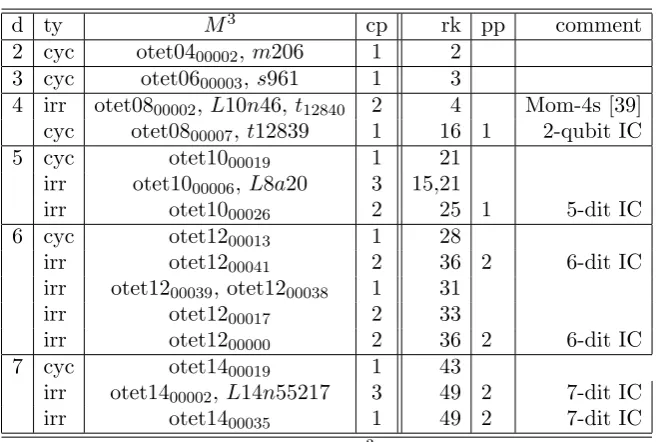
Table 2 establishes the list of 3-manifolds corresponding to subgroups of index d ≤ 7 of the universal group G = π1(S3 \K0). The manifolds
are labeled otetNn in [25] because they are oriented and built fromN = 2d tetrahedra, withnan index in the table. The identification of 3-manifolds of finite index subgroups of Gwas first obtained by comparing the cardinality listηd(H) of the corresponding subgroupH to that of a fundamental group of a tetrahedral manifold in SnapPy table [27]. But of course there is more straightforward way to perform this task by identifying a subgroup H to a degree dcovering of K0 [30]. The full list of d-branched coverings over the
d ty M3 cp rk pp comment
2 cyc otet0400002,m206 1 2
3 cyc otet0600003,s961 1 3
4 irr otet0800002,L10n46,t12840 2 4 Mom-4s [39]
cyc otet0800007,t12839 1 16 1 2-qubit IC
5 cyc otet1000019 1 21
irr otet1000006,L8a20 3 15,21
irr otet1000026 2 25 1 5-dit IC
6 cyc otet1200013 1 28
irr otet1200041 2 36 2 6-dit IC
irr otet1200039, otet1200038 1 31
irr otet1200017 2 33
irr otet1200000 2 36 2 6-dit IC
7 cyc otet1400019 1 43
irr otet1400002,L14n55217 3 49 2 7-dit IC
irr otet1400035 1 49 2 7-dit IC
Table 2. Table of 3-manifoldsM3 found from subgroups of
finite indexdof the fundamental groupπ1(S3\K0) (alias the
d-fold coverings ofK0). The terminology in column 3 is that
of Snappy [27]. The identified M3 is made of 2dtetrahedra and has cp cusps. When the rank rk of the POVM Gram matrix is d2 the corresponding IC-POVM showspp distinct values of pairwise products as shown.
Let us give more details about the results summarized in Table 2. Us-ing Magma, the conjugacy class of subgroups of index 2 in the fundamen-tal group G is represented by the subgroup on three generators and two relations as follows H =
x, y, z|y−1zx−1zy−1x−2, z−1yxz−1yz−1xy
, from which the sequence of subgroups of finite index can be found as ηd(M3) =
{1,1,5,6,8,33,21,32,· · · }.The manifoldM3corresponding to this sequence
is found in Snappy as otet0400002, alias m206.
The conjugacy class of subgroups of index 3 in G is represented as H =x, y, z|x−2zx−1yz2x−1zy−1, z−1xz−2xz−2y−1x−2zy,
withηd(M3) ={1,7,4,47,19,66,42,484,· · · }corresponding to the manifold otet0600003, aliass961.
As shown in Table 2, there are two conjugacy classes of subgroups of index 4 in G corresponding to tetrahedral manifolds otet0800002 (the
per-mutation group P organizing the cosets is Z4) and otet0800007 (the
permu-tation group organizing the cosets is the alternating group A4). The latter
group/manifold has fundamental group
H = x, y, z|yx−1y−1z−1xy−2xyzx−1y, zx−1yx−1yx−1zyx−1y−1z−1xy−1, with cardinality sequences of subgroups asηd(M3) ={1,3,8,25,36,229,435· · · }. ToHis associated an IC-POVM [14, 15] which follows from the action of the two-qubit Pauli group on a magic/fiducial state of type (0,1,−ω6, ω6−1),
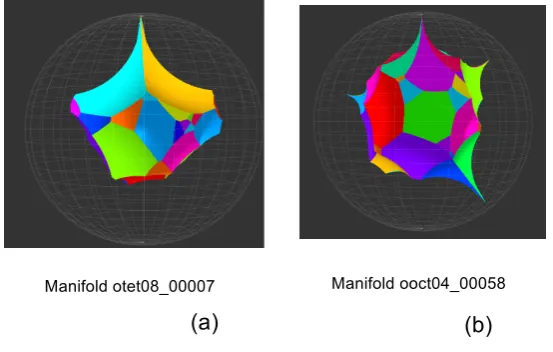
Figure 4. Two platonic three-manifolds leading to the
con-struction of the two-qubit MIC. Details are given in Tables 2 and 3.
For index 5, there are three types of 3-manifolds corresponding to the subgroups H. The tetrahedral manifold otet1000026 of cardinality sequence
ηd(M3) ={1,7,15,88,123,802,1328· · · },is associated to a 5-dit equiangu-lar IC-POVM, as in [14, Table 5].
For index 6, the 11 coverings define six classes of 3-manifolds and two of them: otet1200041and otet1200000are related to the construction of ICs. For
index 7, one finds three classes of 3-manifolds with two of them: otet1400002
(alias L14n55217) and otet1400035 are related to ICs. Finally, for index 7,
3 types of 3-manifolds exist, two of them relying on the construction of the 7-dit (two-valued) IC. For index 8, there exists 6 distinct 3-manifolds (not shown) none of them leading to an IC.
A two-qubit tetrahedral manifold. The tetrahedral three-manifold otet0800007
is remarkable in the sense that it corresponds to the subgroup of index 4 of G that allows the construction of the two-qubit IC-POVM. The corre-sponding hyperbolic polyhedron taken from SnapPy is shown in Fig. 4a. Of the 29 orientable tetrahedral manifolds with at most 8 tetrahedra, 20 are two-colorable and each of those has at most 2 cusps. The 4 three-manifolds (with at most 8 tetrahedra) identified in Table 2 belong to the 20’s and the two-qubit tetrahedral manifold otet0800007is one with just one cusp [40,
Table 1].
3.2. Three-manifolds pertaining to the Whitehead link. One could also identify the 3-manifold substructure of another universal object, viz the Whitehead link L0 [36].
The cardinality list corresponding to the Whitehead link group π1(L0) is
d ty M3 cp rk pp comment 2 cyc ooct0200003,t12066,L8n5 3 2 Mom-4s[39] cyc ooct0200018,t12048 2 2 Mom-4s[39] 3 cyc ooct0300011,L10n100 4 3
cyc ooct0300018 2 3
irr ooct0300014,L12n1741 3 9 1 qutrit Hesse SIC
4 irr ooct0400058 4 16 2 2-qubit IC
irr ooct0400061 3 16 2 2-qubit IC
5 irr ooct0500092 3 25 1 5-dit IC
irr ooct0500285 2 25 1 5-dit IC
irr ooct0500098,L13n11257 4 25 1 5-dit IC
6 cyc ooct0606328 5 36 2 6-dit IC
irr ooct0601972 3 36 2 6-dit IC
irr ooct0600471 4 36 2 6-dit IC
Table 3. A few 3-manifolds M3 found from subgroups of
the fundamental group associated to the Whitehead link. For d≥4, only theM3’s leading to an IC are listed.
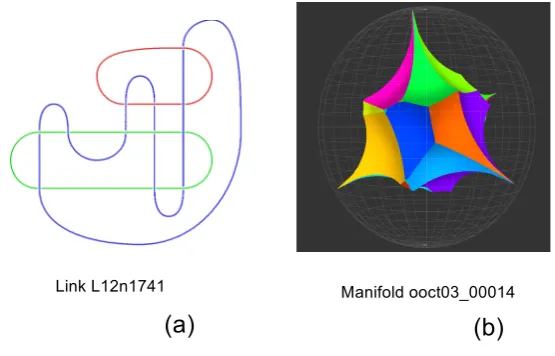
Figure 5. (a) The link L12n1741 associated to the qutrit
Hesse SIC, (b) The octahedral manifold ooct0300014
associ-ated to the 2-qubit IC.
Table 3 shows that the identified 3-manifolds for indexdsubgroups ofπ1(L0)
are aggregates ofdoctahedra. In particular, one finds that the qutrit Hesse SIC can be built from ooct0300014and that the two-qubit IC-POVM may be
buid from ooct0400058. The hyperbolic polyhedron for the latter octahedral
manifold taken from SnapPy is shown on Fig. 4b. The former octahedral manifold follows from the link L12n1741 shown in Fig. 5a and the corre-sponding polyhedron taken from SnapPy is shown in Fig. 5b.
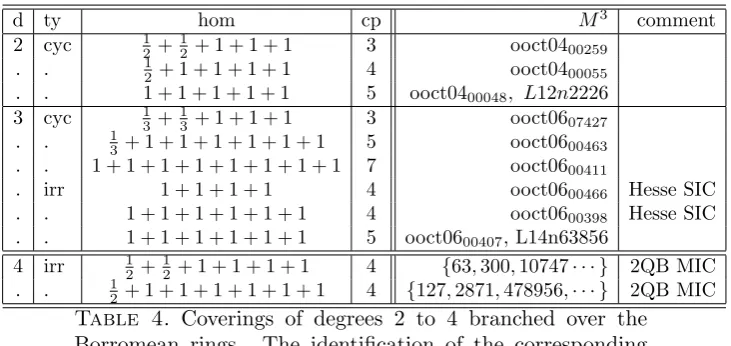
d ty hom cp M3 comment 2 cyc 12+12 + 1 + 1 + 1 3 ooct0400259
. . 12+ 1 + 1 + 1 + 1 4 ooct0400055
. . 1 + 1 + 1 + 1 + 1 5 ooct0400048, L12n2226
3 cyc 1
3+ 1
3 + 1 + 1 + 1 3 ooct0607427
. . 1
3+ 1 + 1 + 1 + 1 + 1 + 1 5 ooct0600463 . . 1 + 1 + 1 + 1 + 1 + 1 + 1 + 1 7 ooct0600411
. irr 1 + 1 + 1 + 1 4 ooct0600466 Hesse SIC
. . 1 + 1 + 1 + 1 + 1 + 1 4 ooct0600398 Hesse SIC . . 1 + 1 + 1 + 1 + 1 + 1 5 ooct0600407, L14n63856
4 irr 12+12+ 1 + 1 + 1 + 1 4 {63,300,10747· · · } 2QB MIC . . 12+ 1 + 1 + 1 + 1 + 1 + 1 4 {127,2871,478956,· · · } 2QB MIC
Table 4. Coverings of degrees 2 to 4 branched over the
Borromean rings. The identification of the corresponding hyperbolic 3-manifold M3 is at the 5th column. Only two
types of 3-manifolds allow to build the Hesse SIC. The two 3-manifolds of degree 4 allowing the construction of the two-qubit MIC are identified by the cardinality structure of their subgroups/coverings.
Borromean ringsL6a4 [that is a not a (3,3)-torus link but an hyperbolic link] (see Fig. 1c) are given in Table 4. The identified manifolds are hyperbolic octahedral manifolds of volume 14.655 (for the degree 2) and 21.983 (for the degree 3).
4. A few Dehn fillings and their POVMs
To summarize our findings of the previous section, we started from a building block, a knot (viz the trefoil knot T1) or a link (viz the figure-of-eight knot K0) whose complement in S3 is a 3-manifold M3. Then a d-fold covering of M3 was used to build a d-dimensional POVM, possibly an IC. Now we apply a kind of ‘phase surgery’ on the knot or link that transforms M3 and the related coverings while preserving some of the POVMs in a way to be determined. We will start with our friendT1 and arrive at a few standard 3-manifolds of historic importance, the Poincar´e homology sphere [alias the Brieskorn sphere Σ(2,3,5)], the Brieskorn sphere Σ(2,3,7) and a Seifert fibered toroidal manifold Σ0. Then we introduce the 3-manifold ΣY resulting from 0-surgery on the figure-of-eight knot [45]. Later
in this section, we will show how to use the {3,5,3} Coxeter lattice and surgery to arrive at a hyperbolic 3-manifold Σ120e of maximal symmetry whose several
T Name ηd(T)
T1 trefoil {1,1,2,3,2,8,7,10,10,28,27,88,134,171,354}
T1(−1,1) Σ(2,3,5) {1,0,0,0,1,1,0,0,0,1, 0,1,0,0,1}
T1(1,1) Σ(2,3,7) {1,0,0,0,0, 0,2,1,1,0, 0,0,0,9,3}
T1(0,1) Σ0 {1,1,2,2,1,5,3,2,4,1, 1,12,3,3,4}
K0(0,1) ΣY {1,1,1,2,2,5,1,2,2,4,3,17,1,1,2}
v2413(−3,2) Σ120e {1,1,1,4,1,7,2,25,3,10, 10,62,1,30,23}
Table 5. A few surgeries (column 1), their name (column 2) and the cardinality list ofd-coverings (alias conjugacy classes of subgroups). Plain characters are used to point out the possible construction of an IC-POVM in at least one the corresponding three-manifolds (see [15] and Sec. 2 for the ICs corresponding to T1).
of ADE correspondence. The acronym ADE refers to simply laced Dynkin diagrams that connect apparently different objects such as Lie algebras, binary polyhedral groups, Arnold’s theory of catastophes, Brieskorn spheres and quasicrystals, to mention a few [46].
4.1. A few surgeries on the trefoil knot.
The Poincar´e homology sphere. The Poincar´e dodecahedral space (alias the Poincar´e homology sphere) was the first example of a 3-manifold not the 3-sphere. It can be obtained from (−1,1) surgery on the left-handed trefoil knotT1[43].
Letp, q, rbe three positive integers and mutually coprime, the Brieskorn sphere Σ(p, q, r) is the intersection in C3 of the 5-sphere S5 with the surface of equation z1p+zq2+z3r = 1. The homology of a Brieskorn sphere is that of the sphere S3. A Brieskorn sphere is homeomorphic but not diffeomorphic to S3. The sphere Σ(2,3,5) may be identified to the Poincar´e homology sphere. The sphere Σ(2,3,7) [45] may be obtained from (1,1) surgery onT1. Table 5 provides the sequencesηd
for the corresponding surgeries (±1,1) onT1. Plain digits in these sequences point out the possibility of building ICs of the corresponding degree. This corresponds to a considerable filtering of the ICs coming fromT1.
For instance, the smallest IC from Σ(2,3,5) has dimension five and is precisely the one coming from the congruence subgroup 5A0in Table 1. But it is built from a non modular (fundamental) group whose permutation representation of the cosets is the alternating groupA5∼=h(1,2,3,4,5),(2,4,3)i(compare [14, Sec. 3.3]).
The smallest dimensional IC derived from Σ(2,3,7) is 7-dimensional and two-valued, the same than the one arising from the congruence subgroup 7A0 given in Table 1. But it arises from a non modular (fundamental) group with the permuta-tion representapermuta-tion of cosets as P SL(2,7)∼=h(1,2,4,6,7,5,3),(2,5,3)(4,6,7)i.
The smallest dimensional ICs built from Σ0 are the Hesse SIC that is obtained from the congruence subgroup Γ0(2) (as for the trefoil knot) and the two-qubit IC that comes from a non modular fundamental group [with cosets organized as the alternating groupA4∼=h(2,4,3),(1,2,3)i].
4.3. Akbulut’s manifold ΣY. Exceptional Dehn surgery at slope (0,1) on the
figure-of-eight knot K0 leads to a remarkable manifold ΣY found in [45] in the
context of 3-dimensional integral homology spheres smoothly bounding integral homology balls. Apart from its topological importance, we find that some of its coverings are associated to already discovered ICs and those coverings have the same fundamental group π1(ΣY).
The smallest IC-related covering (of degree 4) occurs with integral homologyZ and the congruence subgroup Γ0(3) also found from the trefoil knot (see Table 1). Next, the covering of degree 6 and homology Z
5+Zleads to the 6-dit IC of type 3C 0 (also found from the trefoil knot). The next case corresponds to the (non-modular) 11-dimensional (3-valued) IC.
4.4. The hyperbolic manifold Σ120e. The hyperbolic manifold closest to the
trefoil knot manifold known to us was found in [41]. The goal in [41] is the search of -maximally symmetric- fundamental groups of 3-manifolds. In two dimensions, maximal symmetry groups are called Hurwitz groups and arise as quotients of the (2,3,7)-triangle groups. In three dimensions, the quotients of the minimal co-volume lattice Γmin of hyperbolic isometries, and of its orientation preserving
subgroup Γ+min, play the role of Hurwitz groups. Let C be the {3,5,3} Coxeter group, Γmin the split extension Co Z2 and Γ+min one of the index two subgroups
of Γmin of presentation
Γ+min =x, y, z|x3, y2, z2,(xyz)2,(xzyz)2,(xy)5.
According to [41, Corollary 5], all torsion-free subgroups of finite index in Γ+min have index divisible by 60. There are two of them of index 60, called Σ60a and
Σ60b, obtained as fundamental groups of surgeries m017(−4,3) and m016(−4,3).
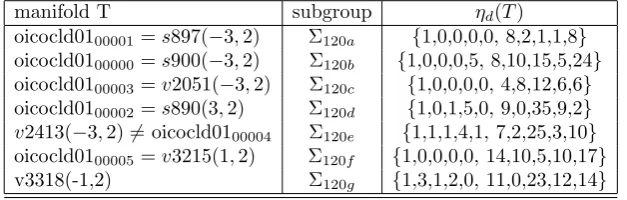
Torsion-free subgroups of index 120 in Γ+min are given in Table 6. It is remarkable that these groups are fundamental groups of oriented three-manifolds built with a single icosahedron except for Σ120eand Σ120g.
manifold T subgroup ηd(T)
oicocld0100001=s897(−3,2) Σ120a {1,0,0,0,0, 8,2,1,1,8}
oicocld0100000=s900(−3,2) Σ120b {1,0,0,0,5, 8,10,15,5,24}
oicocld0100003=v2051(−3,2) Σ120c {1,0,0,0,0, 4,8,12,6,6}
oicocld0100002=s890(3,2) Σ120d {1,0,1,5,0, 9,0,35,9,2}
v2413(−3,2)6= oicocld0100004 Σ120e {1,1,1,4,1, 7,2,25,3,10}
oicocld0100005=v3215(1,2) Σ120f {1,0,0,0,0, 14,10,5,10,17}
v3318(-1,2) Σ120g {1,3,1,2,0, 11,0,23,12,14}
Table 6. The index 120 torsion-free subgroups of Γ+min and their relation to the single isosahedron 3-manifolds [41]. The icosahedral symmetry is broken for Σ120e (see the text for details).
The group Σ120eis special in the sense that many small dimensional ICs may be
the two-qubit IC coming the congruence subgroup 4A0 and the 6-dit ICs coming from the congruence subgroups Γ(2), 3C0 or Γ
0(4) (see [15, Sec. 3 and Table 1]). Higher dimensional ICs found from Σ120e does not come from congruence
subgroups.
5. Conclusion
The relationship between 3-manifolds and universality in quantum computing has been explored in this work. Earlier work of the first author already pointed out the importance of hyperbolic geometry and the modular group Γ for deriving the basic small dimensional IC-POVMs. In Sec. 2, the move from Γ to the trefoil knot T1(and the braid groupB3) to non-hyperbolic 3-manifolds could be investigated by making use of thed-fold coverings ofT1 that correspond tod-dimensional POVMs (some of them being IC). Then, in Sec. 3, we went on to universal links (such as the figure-of-eight knot, Whitehead link and Borromean rings) and the related hy-perbolic platonic manifolds as new models for quantum computing based POVMs. Finally, in Sec. 4, Dehn fillings onT1were used to explore the connection of quan-tum computing to important exotic 3-manifolds [i.e. Σ(2,3,5) and Σ(2,3,7)], to the toroidal Seifert fibered Σ0, to Akbulut’s manifold ΣY and to a maximum symmetry
hyperbolic manifold Σ120e slightly breaking the icosahedral symmetry. It is
ex-pected that our work will have importance for new ways of implementing quantum computing and for the understanding of the link between quantum information and cosmology [47, 48, 49]. A subsequent paper of ours develops the field of 3-manifold based UQC with its relationship to Bianchigroups [50].
Author contributions statement
All authors contributed significantly to the content of the paper. M. P. wrote the manuscript and the co-authors rewiewed it.
Funding
The first author acknowledges the support by the French “Investissements d’Avenir” program, project ISITE-BFC (contract ANR-15-IDEX-03). The other ressources came from Quantum Gravity Research.
Competing interests
The authors declare no competing interests.
References
[1] W. P. Thurston, Three-dimensional geometry and topology (vol. 1), (Princeton Uni-versity Press, Princeton, 1997).
[2] A. Yu Kitaev, Fault-tolerant quantum computation by anyons, Annals Phys. 303 2-30 (2003).
[3] C. Nayak, S. H. Simon, A. Stern, M. Freedman and S. Das Sarma, Non-Abelian anyons and topological quantum computation,Rev. Mod. Phys.801083 (2008). [4] Z. Wang, Topological Quantum Computation, (American Mathematical Soc., Rhode
Island, Number 112, 2010).
[5] J K. Pachos, Introduction to Topological Quantum Computation (Cambridge Uni-versity Press, Cambridge, 2012).
[7] L. H. Kauffman, Knot logic and topological quantum computing with Majorana fermions, inLinear and algebraic structures in quantum computing, (J. Chubb, A. Eskandarian and V. Harizanov eds, Lecture notes in logic 45, Cambridge Univ. Press, 2016).
[8] N. Seiberg, T. Senthil, C. Wang and E. Witten, A duality web in 2 + 1 dimensions and condensed matter physics,Ann. Phys.374395-433 (2016).
[9] D. Gang, Y. Tachikawa and K. Yonekura, Smallest 3dhyperbolic manifolds via simple 3dtheories,Phys. Rev. D96 061701(R) (2017).
[10] N. C. Lim and S. E. Jackson, Molecular knots in biology and chemistry, J. Phys. Condens. Matter27354101 (2015).
[11] K. Irwin, Toward a unification of physics and number theory, https://www.researchgate.net/publication/314209738
Toward the Unification of Physics and Number Theory
[12] V. Veitch, S. A. Mousavian, D. Gottesman and J. Emerson, New J. of Phys. 16, Article ID 013009 (2014).
[13] M. Planat and R. Ul Haq, The magic of universal quantum computing with permu-tations,Advances in mathematical physics217, ID 5287862 (2017) 9 pp.
[14] M. Planat and Z. Gedik, Magic informationally complete POVMs with permutations, R. Soc. open sci.4170387 (2017).
[15] M. Planat, The Poincar´e half-plane for informationally complete POVMs, Entropy 2016 (2018).
[16] J. Milnor, The Poincar´e conjecture 99 years later: a progress report (The Clay Mathematics Institute 2002 Annual Report, 2003), http://www.math.sunysb.edu/∼ jack/PREPRINTS/poiproof.pdf, Retrieved 2018-01-01.
[17] M. Planat, On the geometry and invariants of qubits, quartits and octits, Int. J. Geom. Methods in Mod. Phys.8303-313 (2011).
[18] N. S. Manton, Connections on discrete fiber bundles, Commun. Math. Phys. 113 341-351 (1987).
[19] R. Mosseri and R. Dandoloff, Geometry of entangled states, Bloch spheres and Hopf fibrations, it J. Phys. A: Math. Gen.3410243 (2001).
[20] J. A. Nieto, Division-Algebras/Poincare-Conjecture Correspondence, J. Mod. Phys. (Scientific Research)432-36 (2013).
[21] F. Fang, D. Hammock and K. Irwin, Methods for calculating empires in quasicrystals, Crystals7304 (1997).
[22] A. Sen, R. Aschheim and K. Irwin, Emergence of an aperiodic Dirichlet space from the tetrahedral units of an icosahedral internal spaceMathematics529 (2017). [23] S. Bravyi and A. Kitaev, Universal quantum computation with ideal Clifford gates
and noisy ancillas,Phys. Rev.A71022316 (2005).
[24] C. C. Adams, The knot book, An elementary introduction to the mathematical theory of knots (W. H. Freeman and Co, New York, 1994).
[25] E. Fominikh, S. Garoufalidis, M. Goerner, V. Tarkaev and A. Vesnin, A census of tethahedral hyperbolic manifolds,Exp. Math.25466-481 (2016).
[26] H. M. Hilden, M. T. Lozano and J. M. Montesinoos, On knots that are universal, Topology24499-504 (1985).
[27] M. Culler, N. M. Dunfield, M. Goerner, and J. R. Weeks, SnapPy, a computer program for studying the geometry and topology of 3-manifolds, http://snappy.computop.org.
[28] A. D. Mednykh, A new method for counting coverings over manifold with finitely generated fundamental group,Dokl. Math.74498-502 (2006).
[29] H. M. Hilden, M. T. Lozano, J. M. Montesinos and W. C. Whitten, On universal groups and three-manifolds,Inventiones Mathematicae87441-45 (1987).
[30] A. D. Mednykh, A new method for counting coverings over manifold with finitely generated fundamental group,Dokl. Math.74498-502 (200
[31] S. Vijay and L. Fu, A generalization of non-abelian anyons in three dimensions, arXiv 1706.07070 (2017).
[33] Chris A. Fuchs, On the quantumness of a Hibert space,Quant. Inf. Comp.4467-478 (2004).
[34] M. Appleby, T. Y. Chien, S. Flammia and S. Waldron, Constructing exact sym-metric informationally complete measurements from numerical solutions, Preprint 1703.05981 [quant-ph].
[35] D. Rolfsen,Knots and links(Mathematics Lecture Series 7, Houston, 1990). [36] D. Gabai, The Whitehead manifold is a union of two Euclidean spaces,J. Topol.4
529-534 (2011).
[37] J. Milnor, On the 3-dimensional Brieskorn manifoldsM(p, q, r), inKnots, groups and 3-manifolds(ed. L. P. Neuwirth), Annals of Math. Study 84, Princeton Univ. Press, Princeton, 175-225 (1975).
[38] J. Hempel, The lattice of branched covers over the Figure-eight knot, Topol. Appl. 34183-201 (1990).
[39] R. C. Haraway, Determining hyperbolicity of compact orientable 3-manifolds with torus boundary, Arxiv 1410.7115 [math.GT].
[40] S. A. Ballas, J. Danciger and G. S. Lee, Convex projective structures on non-hyperbolic three-manifolds, Arxiv 1508.04794 [math.GT].
[41] M. Conder, G. Martin and A. Torstensson, Maximal symmetry groups of hyperbolic 3-manifoldsNew Zealand J. Math.353762 (2006).
[42] C. M. Gordon, Dehn filling: a survey, Knot Theory,Banach Center Publ.42129-144, Polish Acad. Sci., Warsaw (1998).
[43] R. C. Kirby and M. G. Scharlemann, Eight faces of the Poincar´e homology 3-sphere, in Geometric Topology (Acad. Press, New York, 1979) pp 113-146.
[44] Ying-Qing Wu, Seifert fibered surgery on Montesinos knots, Arxiv 1207.0154 [math.GT], to appear in Comm. Anal. Geom.
[45] S. Akbulut and K. Larson, Brieskorn spheres bounding rational balls, ArXiv 1704.07739 [math.GT].
[46] Saul-Paul Sirag, ADEX Theory, How the ADE Coxeter graphs unify mathematics and physics (World Scientific, Singapore, 2016).
[47] K. T. Chan, H. Zainuddin, K. A. M. Atan and A. A. Siddig, Computing Quantum Bound States on Triply Punctured Two-Sphere Surface, Chin. Phys. Lett.33090301 (2016).
[48] R. Aurich, F. Steiner and H. Then, Numerical computation of Maass waveforms and an application to cosmology, in Hyperbolic Geometry and Applications in Quantum Chaos and Cosmology (Jens Bolte and Frank Steiner eds, Cambridge Univ. Press, 2012), Preprint gr-qc/0404020.
[49] T. Asselmeyer-Maluga, Smooth quantum gravity: Exotic smoothness and Quantum gravity, inAt the Frontier of Spacetime Scalar-Tensor Theory, Bells Inequality, Machs Principle, Exotic Smoothness(Fundamental Theories of Physics book series (FTP), T. Asselmeyer-Maluga ed. (2016), pp 247-308).
[50] M. Planat, R. Aschheim, M. M. Amaral and K. Irwin, Quantum computing with Bianchi groups, Preprint 1808.06831 [math-GT].
†Universit´e de Bourgogne/Franche-Comt´e, Institut FEMTO-ST CNRS UMR 6174, 15 B Avenue des Montboucons, F-25044 Besanc¸on, France.
E-mail address: [email protected]
‡ Quantum Gravity Research, Los Angeles, CA 90290, USA E-mail address: [email protected]