International Journal of COPD 2018:13 183–187
International Journal of COPD
Dove
press
submit your manuscript | www.dovepress.com 183
P e r s P e C t I v e s
open access to scientific and medical research
Open Access Full text Article
russian guidelines for the management of COPD:
algorithm of pharmacologic treatment
Zaurbek Aisanov1
sergey Avdeev2
vladimir Arkhipov3
Andrey Belevskiy1
Alexander Chuchalin1
Igor Leshchenko4
svetlana Ovcharenko5
evgeny shmelev6
Marc Miravitlles7
1Department of Pulmonology, N.I.
Pirogov russian state National research Medical University, Healthcare Ministry of russia,
2Clinical Department, Federal
Pulmonology research Institute, Federal Medical and Biological Agency of russia, 3Clinical Pharmacology
Department, rUDN University,
4Department of Phthisiology,
Pulmonology and thoracic surgery, Ural state Medical University, Healthcare Ministry of russia, ekaterinburg, 5Internal Medicine
Department No.1, I.M. sechenov First Moscow state Medical University, Healthcare Ministry of russia, 6Department of Differential
Diagnostics, Federal Central research Institute of tuberculosis, Moscow, russia; 7Pneumology Department,
University Hospital vall d’Hebron, Ciber de enfermedades respiratorias (CIBeres), Barcelona, spain
Abstract: The high prevalence of COPD together with its high level of misdiagnosis and late diagnosis dictate the necessity for the development and implementation of clinical practice guidelines (CPGs) in order to improve the management of this disease. High-quality, evidence-based international CPGs need to be adapted to the particular situation of each country or region. A new version of the Russian Respiratory Society guidelines released at the end of 2016 was based on the proposal by Global Initiative for Obstructive Lung Disease but adapted to the characteristics of the Russian health system and included an algorithm of pharmacologic treat-ment of COPD. The proposed algorithm had to comply with the requiretreat-ments of the Russian Ministry of Health to be included into the unified electronic rubricator, which required a balance between the level of information and the simplicity of the graphic design. This was achieved by: exclusion of the initial diagnostic process, grouping together the common pharmacologic and nonpharmacologic measures for all patients, and the decision not to use the letters A–D for simplicity and clarity. At all stages of the treatment algorithm, efficacy and safety have to be carefully assessed. Escalation and de-escalation is possible in the case of lack of or insuf-ficient efficacy or safety issues. Bronchodilators should not be discontinued except in the case of significant side effects. At the same time, inhaled corticosteroid (ICS) withdrawal is not represented in the algorithm, because it was agreed that there is insufficient evidence to establish clear criteria for ICSs discontinuation. Finally, based on the Global Initiative for Obstructive Lung Disease statement, the proposed algorithm reflects and summarizes different approaches to the pharmacological treatment of COPD taking into account the reality of health care in the Russian Federation.
Keywords: COPD, clinical guidelines, Russia, treatment algorithm
Introduction
COPD is an important health care problem due to its high prevalence and impact in terms of morbidity and mortality. A recent study conducted in 12 regions of the Russian Federation observed a prevalence of COPD of 15.3% related to the high rates of smoking in the Russian population.1 In addition, other studies have demonstrated
the magnitude of the misdiagnosis of COPD in Russia and the particular characteristics of the COPD patients in this country. In a study of more than 1,500 Russian COPD patients, 53% had a forced expiratory volume in one second (% predicted) below 50% and up to 51% were frequent exacerbators.2 In a large survey in middle and Eastern
Europe, the Russian patients with COPD were among those with the highest preva-lence of frequent exacerbators.3 The high prevalence of the disease, the high rates
of misdiagnosis, and the level of severity of the patients attended in Russian centers indicate the need for the development and implementation of a national clinical practice guideline (CPG) to improve the management of this disease.
Correspondence: Zaurbek Aisanov N.I. Pirogov russian state National research Medical University, Healthcare Ministry of russia, ul. Ostrovityanova 1, 117997 Moscow, russia
tel +7 925 506 0697 Fax +7 495 965 1284 email [email protected]
Journal name: International Journal of COPD Article Designation: Perspectives
Year: 2018 Volume: 13
Running head verso: Aisanov et al
Running head recto: Russian guidelines for the management of COPD DOI: http://dx.doi.org/10.2147/COPD.S153770
International Journal of Chronic Obstructive Pulmonary Disease downloaded from https://www.dovepress.com/ by 118.70.13.36 on 22-Aug-2020
For personal use only.
Dovepress
Aisanov et al
The Global Initiative for Chronic Obstructive Lung Disease (GOLD) has published statements about the diagno-sis and treatment of COPD;4 similarly, international scientific
societies such as the European Respiratory Society and the American Thoracic Society have produced high-quality, evidence-based CPG.5 However, these GOLD
recommenda-tions need to be adapted to the particular situation of each country or region,6 taking into account the characteristics
of the patients, the health care system, and the availability of treatments.
Russian guidelines for the
management of COPD
The first national Russian guidelines on the diagnosis and management of COPD were developed and published in 1999 and have been updated several times thereafter. The most important update was published in 2014, when the Ministry of Health (MOH) of the Russian Federation pro-posed a standardized model for the development of CPG for all specialties and diseases according to the “International Statistical Classification of Diseases and Related Health Problems.”7 It was intended that CPGs had to become the
key documents to determine different aspects of disease management, including legal and disability issues. The definition of a CPG by the Russian MOH was an “… evidence-based document representing physician activity in terms of diagnosis, treatment, rehabilitation and prophy-laxis of the disease which helps to choose the right clinical decision.”7
Russian guidelines may serve as an example of revo-lutionary approach to guidelines, closing the gap between professional societies and regulatory authorities.
The new attitude of the Russian MOH to guidelines was based on the understanding that CPGs could not effectively function as an independent isolated document of any professional society with no connection to the real-ity and complexreal-ity of real clinical practice and health care (which is regulated by the number of laws, by-laws, and subordinate acts) and not complying with other regulating documents.
Initially, the MOH built the conception that a CPG should be a major document regulating not only clinical practice but also expert evaluation of medical service quality and occupational disability. The electronic rubricator proposed by the MOH makes it possible to standardize guidelines in several terms (size, parts and sections, algorithms, etc.) and integrate these with all regulatory documents and other guidelines by cross-links and cross-references.
According to MOH definition, the unified electronic rubricator is a universally hierarchically structured integrated database for all CPG which is systematically updated. The unified electronic rubricator initially was designed to include all available approved guidelines in a single format and structure. According to MOH policy, before final placement of newly developed CPG into the unified electronic rubricator they need two-stage approval: by national professional society and MOH itself.
All parts and chapters are typed in by completing special prespecified forms which allow to keep the size and struc-ture of the final document. Only documents complying with the structure, style, and other features can be placed into the rubricator. The whole database is equipped by search engine and cross-references.
The electronic rubricator also meant that the CPG must have a unified structure with the list of necessarily required and recommended sections. Among mandatory parts which seem to be important for COPD implementation in real life but which are not present in other available COPD guidelines are “COPD patient follow-up” and “criteria for evaluation of medical care quality.” In the first section, follow-up is specified according to severity and the level of the medical institution or health care provider (eg, 1st – local or 2nd – intermunicipal center) responsible for the follow-up of COPD patients with the number of visits per year and the list of examinations necessarily provided at any level in these medical institutions. In the medical care quality control section, evaluation criteria are listed for diagnostic and management procedures according to the severity of the disease and phase (stable condition or exacerbation).
Taking into account all these requirements and in con-cordance with them, an expert committee of the Russian Respiratory Society released a new version of the national COPD guidelines at the end of 2016.8 This update was based
on the proposal by GOLD but adapted to the characteristics of the Russian health system and included an algorithm of pharmacologic treatment following recently published algo-rithms for the treatment of COPD.9–11 We believe that this
proposal will contribute to the debate of the optimal treatment algorithm that combines strong scientific evidence with the reality of clinical practice for the treatment of COPD.
Algorithm of pharmacologic
treatment
The algorithm proposed had to comply with the requirements of the Russian MOH to be included in the electronic rubri-cator.7 Therefore, a balance was sought between the level of
International Journal of Chronic Obstructive Pulmonary Disease downloaded from https://www.dovepress.com/ by 118.70.13.36 on 22-Aug-2020
Dovepress russian guidelines for the management of COPD
information and the simplicity of the graphic design. First, the diagnostic process was excluded from the algorithm and it was assumed that patients already fulfilled the internationally accepted diagnostic criteria for COPD.4 Second, although the
decision tree included the characteristics proposed by GOLD – ie, evaluation of symptoms and risks4 – it was decided not to
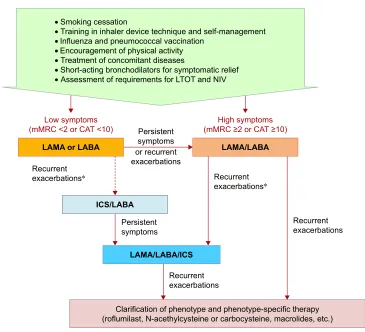
use the letters A–D for simplicity and clarity. Third, an initial group of common pharmacologic and nonpharmacologic measures was excluded from the algorithm and placed before the decision tree, because these measures apply to all patients, irrespective of the level of symptoms or risk (Figure 1).
The treatment algorithm initiates with the evaluation of symptoms with the modified Medical Research Council dyspnea scale or COPD Assessment Test questionnaire, as suggested by GOLD, and using the same thresholds.4
However, long-acting bronchodilators (instead of short-acting) are suggested as the preferred therapeutic option. This decision was based on the higher efficacy of long-acting drugs12 and the possibility of underrecognition or
underre-porting of symptoms in patients with COPD.13,14
Although it is recognized that initial therapy with a long-acting antimuscarinic agent (LAMA) or long-acting β-2 agonist (LABA) is indicated in less symptomatic patients, the majority of COPD patients in Russia initially visit a doctor with a high level of symptoms and exercise intolerance.2 In
the case of high symptom level (modified Medical Research Council $2 or COPD Assessment Test .10 units), a com-bined LABA/LAMA is recommended after establishing the diagnosis of COPD. The LABA/LAMA combination is more effective than monotherapies in dyspnea relief, increasing exercise tolerance and improving patients’ quality of life.15
LABA/LAMA is also the preferred option when patients on bronchodilator monotherapy have recurrent exacerbations due to the superiority of the LABA/LAMA versus long-acting bronchodilators in monotherapy16 and especially versus the
LABA/inhaled corticosteroid (ICS) combination in the pre-vention of exacerbations.17
Combinations including ICS should not be used as first-line therapy in COPD. ICS as a component of a double (LABA/ICS) or triple (LAMA/LABA/ICS) therapy can be
Figure 1 Pharmacologic treatment of COPD.
Notes: Proposed algorithm of the Russian National guidelines for the management of COPD. *Predominantly non-infectious exacerbations (ACO or eosinophilic inflammation
type).
Abbreviations: LTOT, term oxygen therapy; NIV, noninvasive ventilation; mMRC, modified Medical Research Council; CAT, COPD Assessment Test; LABA,
long-acting beta-adrenergic; LAMA, long-long-acting antimuscarinic; ICs, inhaled corticosteroid; ACO, asthma–COPD overlap.
,&6/$%$
3HUVLVWHQW V\PSWRPV RUUHFXUUHQW H[DFHUEDWLRQV
• 6PRNLQJFHVVDWLRQ
• 7UDLQLQJLQLQKDOHUGHYLFHWHFKQLTXHDQGVHOIPDQDJHPHQW
• ,QIOXHQ]DDQGSQHXPRFRFFDOYDFFLQDWLRQ
• (QFRXUDJHPHQWRISK\VLFDODFWLYLW\
• 7UHDWPHQWRIFRQFRPLWDQWGLVHDVHV
• 6KRUWDFWLQJEURQFKRGLODWRUVIRUV\PSWRPDWLFUHOLHI
• $VVHVVPHQWRIUHTXLUHPHQWVIRU/727DQG1,9
/RZV\PSWRPV P05&RU&$7
5HFXUUHQW
H[DFHUEDWLRQV 5HFXUUHQW
H[DFHUEDWLRQV
5HFXUUHQW H[DFHUEDWLRQV
5HFXUUHQW H[DFHUEDWLRQV 3HUVLVWHQW
V\PSWRPV
/$0$RU/$%$
/$0$/$%$,&6
/$0$/$%$
+LJKV\PSWRPV P05&RU&$7
&ODULILFDWLRQRISKHQRW\SHDQGSKHQRW\SHVSHFLILFWKHUDS\ URIOXPLODVW1DFHWK\OF\VWHLQHRUFDUERF\VWHLQHPDFUROLGHVHWF
International Journal of Chronic Obstructive Pulmonary Disease downloaded from https://www.dovepress.com/ by 118.70.13.36 on 22-Aug-2020
Dovepress
Aisanov et al
administered in situations when recurrent exacerbations occur during first-line therapy with long-acting bronchodila-tors and especially in patients who have concomitant asthma, based on internationally accepted criteria,18 or eosinophilic
inflammation.4,6,9–11,19 However, there is no consensus yet
on the threshold level of blood eosinophils, which predicts response to ICS in COPD.
In patients presenting recurrent exacerbations in spite of receiving LABA/LAMA or triple therapy, it is necessary to investigate the phenotype and consider the possibility of administering phenotype-specific therapy. This therapy may include roflumilast in the case of severe airflow limitation, chronic bronchitis, and previous hospitalization;20
muco-lytic agents particularly in chronic bronchitic patients with frequent exacerbations;21 and/or macrolides in the case of
frequent infective exacerbations,22 especially in the presence
of associated bronchiectasis.4,6,9–11
At all stages of treatment, the efficacy and safety have to be carefully assessed, and escalation and de-escalation is possible in the case of lack of or insufficient efficacy of safety issues. Since COPD is a progressive disease and bronchodilators are only effective during administration, they should not be discontinued except in the case of significant side effects. In contrast, there is evidence of excessive and inadequate use of ICS in COPD,2,3,23 which may be associated
with short- and long-term side effects. In fact, in a recent study conducted in Russia up to 19% of GOLD B patients were on LABA/ICS and 12% on triple therapy.2 However,
ICS withdrawal is not represented in the algorithm, because it was agreed by the panel that there is insufficient evidence to establish clear criteria as to when and how to discontinue ICS in patients with COPD.24
Conclusion
Although based on the GOLD statement, the algorithm pro-posed reflects and summarizes different approaches to the pharmacological treatment of COPD. It is well recognized that long-acting bronchodilators are the bases of treatment, but the most severe patients require a more personalized approach taking into account their particular phenotype in order to select the most appropriate treatment that achieves the best balance between high efficacy and low risk of side effects. In addition, the treatment algorithm must be simple to permit implementa-tion in the electronic clinical records, and it should be easy to remember and use by clinicians in order to reduce the gaps in the application of COPD-treatment recommendations.25,26
Disclosure
The authors report no conflicts of interest in this work.
References
1. Chuchalin AG, Khaltaev N, Antonov NS, et al. Chronic respiratory diseases and risk factors in 12 regions of the Russian Federation.
Int J Chron Obstruct Pulmon Dis. 2014;9:963–974.
2. Arkhipov V, Arkhipova D, Miravitlles M, Lazarev A, Stukalina E. Characteristics of COPD patients according to GOLD classification and clinical phenotypes in the Russian federation: the SUPPORT trial.
Int J Chron Obstruct Pulmon Dis. 2017;12:3255–3262.
3. Koblizek V, Milenkovic B, Barczyk A, et al. Phenotypes of COPD patients with a smoking history in Central and Eastern Europe: the POPE Study. Eur Respir J.2017;49:1601446.
4. Vogelmeier CF, Criner GJ, Martínez FJ, et al. Global strategy for the diagnosis, management, and prevention of chronic obstructive lung disease 2017 report: GOLD executive summary. Arch Bronconeumol. 2017;53:128–149.
5. Wedzicha J, Calverley P, Albert R, et al. Prevention of COPD exacer-bations: an European Respiratory Society/American Thoracic Society (ERS/ATS) guideline. Eur Respir J. 2017;50:1602265.
6. Miravitlles M, Vogelmeier C, Roche N, et al. A review of national guide-lines for management of COPD in Europe. Eur Respir J. 2016;47: 625–637.
7. Russian Respiratory Society. Chronic obstructive pulmonary disease. Clinical guidelines. Available from: http://www.spulmo.ru/obra-zovatelnyeresursy/federalnyeklinicheskierekomendatsii. Accessed August 18, 2017.
8. Ministry of Health of Russian Federation. Requirements for the figu-ration of clinical recommendations for placement in the Rubricator. Available from: http://nasci.ru/_resources/directory/196/common/ Pismo_01.09.pdf. Accessed August 18, 2017.
9. Miravitlles M, Soler-Cataluña JJ, Calle M, et al. Spanish COPD guidelines (GesEPOC) 2017. Pharmacological treatment of stable chronic obstructive pulmonary disease. Arch Bronconeumol. 2017;53: 324–335.
10. Zykov KA, Ovcharenko SI. Approaches to drug therapy for COPD in Russia: a proposed therapeutic algorithm. Int J Chron Obstruct Pulmon Dis. 2017;12:1125–1133.
11. Miravitlles M, Anzueto A. A new two-step algorithm for the treatment of COPD. Eur Respir J. 2017;49:1602200.
12. Tashkin DP, Cooper CB. The role of long-acting bronchodilators in the management of stable COPD. Chest. 2004;125:249–259. 13. Miravitlles M, Ribera A. Understanding the impact of symptoms on
the burden of COPD. Respir Res. 2017;18:67.
14. Gruenberger JB, Vietri J, Keininger DL, Mahler DA. Greater dyspnea is associated with lower health-related quality of life among European patients with COPD. Int J Chron Obstruct Pulmon Dis. 2017;12: 937–944.
15. Thomas M, Halpin D, Miravitlles M. When is dual bronchodilation indicated in COPD? Int J Chron Obst Pulm Dis. 2017;12:2291–2305. 16. Wedzicha JA, Decramer M, Ficker JH, et al. Analysis of chronic obstruc-tive pulmonary disease exacerbations with the dual bronchodilator QVA149 compared with glycopyrronium and tiotropium (SPARK): a randomised, double-blind, parallel-group study. Lancet Respir Med. 2013;1:199–209.
17. Wedzicha JA, Banerji D, Chapman KR, et al. Indacaterol–glycopyrronium versus salmeterol–fluticasone for COPD. N Engl J Med. 2016;374: 2222–2234.
18. 2017 GINA Report, Global Strategy for Asthma Management and Prevention. Available from: http://ginasthma.org/2017-gina-report-global-strategy-for-asthma-management-and-prevention/. Accessed November 18, 2017.
19. Sin DD, Miravitlles M, Mannino DM, et al. What is asthma-COPD overlap syndrome (ACOS)? Towards a consensus definition from a roundtable discussion. Eur Respir J. 2016;48:664–673.
20. Rabe KF, Calverley PMA, Martinez FJ, Fabbri LM. Effect of roflu-milast in patients with severe COPD and a history of hospitalisation.
Eur Respir J. 2017;50:1700158.
International Journal of Chronic Obstructive Pulmonary Disease downloaded from https://www.dovepress.com/ by 118.70.13.36 on 22-Aug-2020
International Journal of COPD
Publish your work in this journal
Submit your manuscript here: http://www.dovepress.com/international-journal-of-chronic-obstructive-pulmonary-disease-journal The International Journal of COPD is an international, peer-reviewed
journal of therapeutics and pharmacology focusing on concise rapid reporting of clinical studies and reviews in COPD. Special focus is given to the pathophysiological processes underlying the disease, intervention programs, patient focused education, and self management protocols.
This journal is indexed on PubMed Central, MedLine and CAS. The manuscript management system is completely online and includes a very quick and fair peer-review system, which is all easy to use. Visit http://www.dovepress.com/testimonials.php to read real quotes from published authors.
Dovepress
Dove
press
russian guidelines for the management of COPD
21. Cazzola M, Rogliani P, Calzetta L, Hanania NA, Matera MG. Impact of mucolytic agents on COPD exacerbations: a pair-wise and network meta-analysis. COPD. 2017;14:552–563.
22. Uzun S, Djamin RS, Kluytmans JA, et al. Azithromycin maintenance treatment in patients with frequent exacerbations of chronic obstruc-tive pulmonary disease (COLUMBUS): a randomised, double-blind, placebo-controlled trial. Lancet Respir Med.2014;2:361–368. 23. Barrecheguren M, Monteagudo M, Ferrer J, et al. Treatment patterns in
COPD patients newly diagnosed in primary care. A population-based study. Respir Med. 2016;111:47–53.
24. Tariq SM, Thomas EC. Maintenance therapy in COPD: time to phase out ICS and switch to the new LAMA/LABA inhalers? Int J Chron Obstruct Pulmon Dis. 2017;12:1877–1882.
25. Calle Rubio M, Alcázar Navarrete B, Soriano JB, et al. Clinical audit of COPD in outpatient respiratory clinics in Spain: the EPOCONSUL study. Int J Chron Obstruct Pulmon Dis. 2017;12:417–426. 26. Davis KJ, Landis SH, Oh YM, et al. Continuing to Confront COPD
International Physician Survey: physician knowledge and application of COPD management guidelines in 12 countries. Int J Chron Obstruct Pulmon Dis. 2014;10:39–55.
International Journal of Chronic Obstructive Pulmonary Disease downloaded from https://www.dovepress.com/ by 118.70.13.36 on 22-Aug-2020