IJEDR1502219
International Journal of Engineering Development and Research (www.ijedr.org)1342
Performance Analysis of Routing Protocols in
MANETS under VOIP Using OPNET Simulator
Sandeep ravikanti, Dudekula Abdulla Asstiant Professor
Department of CSE,
Methodist college of engineering and technology Hyderabad, Telangana, India
________________________________________________________________________________________________________
Abstract - Mobile Ad Hoc Networks (MANETs)[2] are an emerging type of wireless networking, in which mobile nodes associate on an extemporaneous or ad hoc basis. MANETs are self-forming and self-healing, enabling peer-level communications between mobile nodes without reliance on centralized resources or fixed infrastructure. Many ground breaking applications have been suggested for MANETs including the Voice over Internet Protocol (VoIP)[7]. In order to support VoIP application over MANETs a suitable routing protocol is essential. Several routing protocols have been proposed for MANETs. In this paper, the performances of different routing protocols have been investigated and compared for VoIP application. Some popular routing protocols namely Dynamic Source Routing (DSR)[9], Ad hoc On-demand Distance Vector (AODV)[6], Temporally-Ordered Routing Algorithm (TORA)[7] have been considered in this investigation. The OPNET simulation results show that the TORA protocol is a good candidate for VoIP application.
Key terms - FSR, AODV, DSR, MANETs, VOIP, Qos metrics, OPNET, TORA.
________________________________________________________________________________________________________
1. INTRODUCTION
Cellular Wireless Networks are Infrastructure dependent network. These networks are Single-Hop Wireless links. This network provides guaranteed bandwidth (designed for voice traffic). These runs with Circuit-Switching (evolving toward packet switching) process. Developing these networks are High cost and time of deployment. Seamless connectivity (low call drops using handoffs). Reuse of frequency spectrum through geographical channel reuse. Cellular networks[8] are easy to achieve the time synchronization. These networks are easy to employ bandwidth reservation. Application domains include mainly civilian and commercial sectors. Maintenance of these networks is of high cost while compared to other networks maintenance (backup power source, staffing etc.). Major goals of routing and call admission are to maximize the call acceptance ratio and minimize the call drop ratio. Cellular Networks are widely deployed and currently in the third generation of evolution.
Ad-Hoc Networks[4] are Multi-hop radio relaying and without support of infrastructure. These are of two types: 1. Wireless Mesh Networks
2. Wireless Sensor Network
Ad-Hoc networks are Infrastructure Less and Multiple-hop wireless links. Ad-Hoc networks are shared radio channel which are more suitable for best-effort data traffic. These are running with Packet-Switching (evolving towards the emulation of circuit switching)[3]. Developing this network is quick and cost-effective deployment. There are frequent path breaks due to mobility in Ad-Hoc networks. These networks reuse Dynamic frequency based on carrier sense mechanism.
In this, time synchronization is difficult and consumes bandwidth which causes some problems. To reserve the bandwidth in Ad-Hoc network[2], it requires complex medium access control protocols. Major application domains include battlefields, emergency search and rescue operations and collaborative computing etc. Mobile Hosts require more intelligence (should have a transceiver as well as routing/switching capability). Self-organization and maintenance properties are built into the network. Main aim of routing is to find paths with minimum overhead and also quick re-configuration of broken paths.
Mobile ad-hoc networks (MANET)
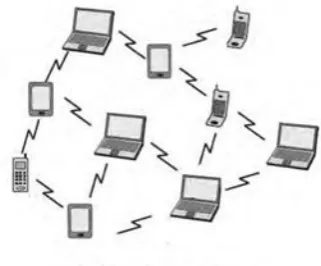
Opposed to the infrastructure wireless networks where each user directly communicates with an access point or base station, a mobile ad-hoc network, or MANET is a kind of wireless ad-hoc network. It is a self configuring network of mobile routers connected by wireless links with no access point. Every mobile device in a network is autonomous. The mobile devices are free to move haphazardly and organize themselves arbitrarily. In other words, ad-hoc network do not rely on any fixed infrastructure (i.e. the mobile ad-hoc network is infrastructure less wireless network. The Communication in MANET is take place by using multi-hop paths.
IJEDR1502219
International Journal of Engineering Development and Research (www.ijedr.org)1343
Fig 1.Mobile Ad-Hoc NetworkCHALLENGES OF MOBILE AD-HOC NETWORK:
Regardless of the variety of applications and the long history of mobile ad hoc network, there are still some issues and design challenges that we have to overcome. This is the reason MANET is one of the elementary research field. MANET is a wireless network of mobile nodes; it’s a self organized network. Every device can communicate with every other device i.e. it is also multi hop network.
As it is a wireless network it inherits the traditional problem of wireless networking:[4] The channel is unprotected from outside signal.
The wireless media is unreliable as compared to the wired media. Hidden terminal and expose terminal phenomenon may occur. The channel has time varying and asymmetric propagation properties.
Fig 2.Wireless Network
With these problems, there are some other challenges and complexities:
The scalability is required in MANET[2][8] as it is used in military communications, because the network grows according to the need, so each mobile device must be capable to handle the intensification of network and to accomplish the task.
MANET is an infrastructure less network, there is no central administration. Each device can communicate with every other device, hence it becomes difficult to detect and manage the faults.
In MANET, the mobile devices can move randomly. The use of this dynamic topology results in route changes, frequent network partitions and possibly packet losses.
Each node in the network is autonomous; hence have the equipment for radio interface with different transmission/receiving capabilities these results in asymmetric links. MANET uses no router in between.
In network every node acts as a router and can forward packets of data to other nodes to provide information partaking among the mobile nodes.
Difficult chores to implement ad-hoc addressing scheme, the MAC address of the device is used in the stand alone ad hoc network. However every application is based on TCP/IP and UDP/IP.
2. ROUTING PROTOCOLS IN MANET’s
Routing is the process of selecting paths in a network along which to send network traffic[5]. The process of finding a route or path along which the data or control packets can be delivered between nodes in the network is also known as routing. Again routing is the process of creating or updating the table, called routing table, which contains the information that a router needs to route packets, that helps in forwarding (the way a packet delivered to the next station). The information may include the network address, the cost, and the address of next hop and so on.
PROBLEMS WITH ROUTING IN MANET’s:
IJEDR1502219
International Journal of Engineering Development and Research (www.ijedr.org)1344
Dynamic Topology: MANET nodes can leave and join the network, and move independently. As a result the network topology can change frequently. It is hard to differentiate normal behavior of the network from anomaly/malicious behavior in this dynamic environment. For example, a node sending disruptive routing information can be a malicious node, or else simply be using outdated information in good faith. Moreover mobility of nodes means that we cannot assume nodes, especially critical ones (servers, etc.), are secured in locked cabinets as in wired networks. Nodes with inadequate physical protection may often be at risk of being captured and compromised. Cooperativeness: Routing algorithms[5] for MANETs usually assume that nodes are cooperative and non- malicious. As a result, a malicious attacker can easily become an important routing agent and disrupt network operations by disobeying the protocol specifications. For example, a node can pose as a neighbor to other nodes and participate in collective decision-making mechanisms, possibly affecting networking significantly.
Lack of a Clear Line of Defense: MANETs do not have a clear line of defense; attacks can come from all directions. The boundary that separates the inside network from the outside world is not very clear on MANETs. For example, there is no well defined place where we can deploy our traffic monitoring, and access control mechanisms. Whereas all traffic goes through switches, routers, or gateways in wired networks, network information in MANETs is distributed across nodes that can only see the packets sent and received in their transmission range.
Limited Resources: Resource constraints are a further vulnerability. There can be a variety of devices on MANETs, ranging
from laptops to handheld devices such as PDAs and mobile phones. These will generally have different computing and storage capacities that can be the focus of new attacks. For example, mobile nodes generally run on battery power. This has led to emergence of innovative attacks targeting this aspect, e.g. “Sleep Deprivation Torture”. Furthermore, the introduction of more security features into the network increases the computation, communication and management load. This is a challenge for networks that are already resource-constrained.
3. CLASSIFICATION OF ROUTING PROTOCOLS IN MANET’S
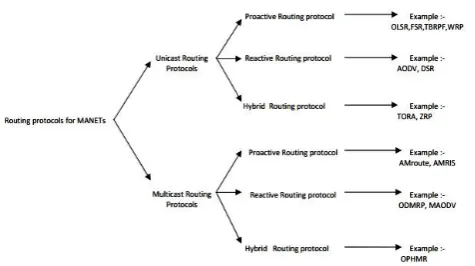
Routing protocols typically fall under two classifications first one is unicast Routing Protocol[5], second one is multicast Routing Protocol. Different routing protocols try to solve the problem of routing in mobile ad hoc network in one way or the other. Unicast routing protocols are divided into proactive, reactive and hybrid routing protocols[7], and the multicast routing protocol are divided into proactive, reactive, and hybrid routing protocol gives a classification on routing protocol is based on unicast and multicast routing protocol. Proactive routing[5] that means route available immediately. Reactive routing that means discovers the route when needed. And hybrid routing that means combination of both, such as proactive for neighborhood, reactive for far away.
Fig 3.Classification of Routing protocols for MANET’s 3.1 UNICAST ROUTING PROTOCOLS
Most applications in the MANET are based upon unicast communication. Thus, the most basic operation in the IP layer of the MANET [2] is to successfully transmit data packets from one source to one destination. The forwarding procedure is very simple in itself: with the routing table [3], the relay node just uses the destination address in the data packet to look it up in the routing table.
Fig 4 unicast routing 3.1.1 PROACTIVE UNICAST ROUTING PROTOCOLS:
IJEDR1502219
International Journal of Engineering Development and Research (www.ijedr.org)1345
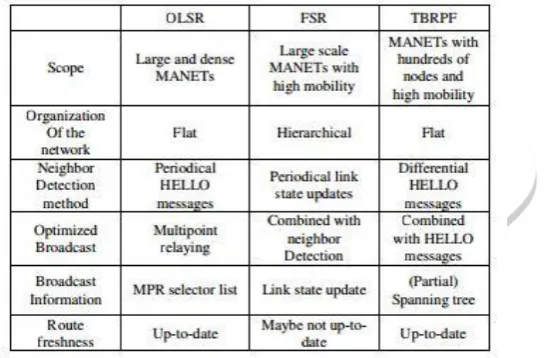
Optimized link state routing protocol (OLSR)[7] is a proactive (table-driven) routing protocol[6] for MANETs. A route between sources to destination is available immediately when needed. OLSR is based on the link-state algorithm. Conventionally, all wireless nodes flood neighbor information in a link-state protocol, but not in OLSR node. It is advertise information only about links with neighbor who is in its multipoint relay selector set. Its reduce size of control packets reduces flooding by using only multipoint relay nodes to send information in the network and reduce number of control packets by reducing duplicate transmission. This protocol does not expect reliable transfer, since updates are sent periodically. OLSR used hop-by-hop routing. Routes are based on dynamic table entries maintained at intermediate nodes. The protocol is design to work in distributed manner and thus does not depend up on the central entity. The protocols thus support a nodal mobility that can be traced through its local control message, which depends up on the frequency of these messages.B) FISHEYE STATE ROUTING PROTOCOL (FSR):
The Fisheye State Routing (FSR)[6] is a table driven unicast routing protocol for Mobile Ad hoc Networks based on Link State routing algorithm in effect with reduced overhead to keep network topology information. As showed in its name, FSR utilizes a function similar to a fish eye. The eyes of fishes catch the pixels near the focal with high detail, and the detail decreases as the distance from the focal point increases. Similar to fish eyes, FSR maintains the accurate distance and path quality information about the immediate neighboring nodes, and progressively reduces detail as the distance increases.
C) TOPOLOGY BROADCAST BASED ON REVERSE-PATH:
Forwarding Routing Protocol (TBRPF)[7][5] Topology Broadcast Based on Reverse-Path. TBRPF aims at the Mobile Ad hoc Network with at most several hundreds of mobile nodes or high mobility of nodes. Every node in the wireless network keeps partial global topology information. When a node needs the shortest path to every other node, a minimum spanning tree rooted at it is computed using modified Dijkstra’s algorithm[3]. TBRPF transmits only the differences between the previous network state and the current network state. Therefore, routing messages are smaller, and can therefore be sent more frequently. This means that nodes' routing tables are more up-to-date.
Table 1 Characteristic Comparison of Proactive Unicast Routing Protocol 3.2 REACTIVE UNICAST ROUTING PROTOCOLS:
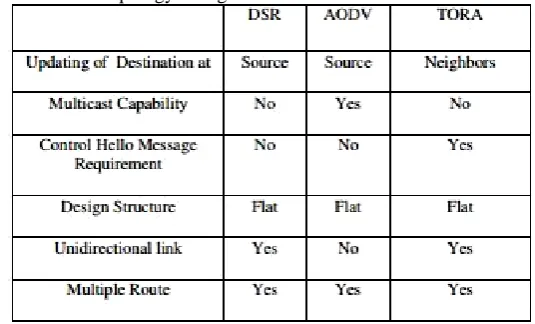
Due to the frequently changing topology of the Mobile Ad hoc Network, the global topology information stored at each node needs to be updated frequently, which consumes lots of bandwidth, because the link state updates received expire before the route between itself and another node is needed. To minimize the wastage of bandwidth, the concept of on demand or reactive routing protocol is proposed. In On demand protocols the routing is divided into the following two steps: first one is route discover y and second one is route maintenance. The most distinctive On Demand unicast routing protocols are Dynamic Source Routing (DSR)[9] protocol, Ad hoc On Demand Distance Vector Routing (AODV)[6] protocol and Temporally Ordered Routing Algorithm etc., in Table 2, gives the Characteristic comparison of Reactive Unicast Routing Protocols.
The following are the three protocols we selected for this paper. A) DYNAMIC SOURCE ROUTING PROTOCOL (DSR) :
Dynamic Source Routing (DSR) is an On Demand unicast routing protocol that utilizes source routing algorithm. In source routing algorithm, each data packet contains complete routing information to reach its dissemination. Additionally, in DSR[9] each node uses caching technology to maintain route information that it has discovered. For example, the intermediate nodes cache the route towards the destination and backward to the source. Furthermore, because the data packet contains the source route in the header, the overhearing nodes are able to cache the route in its routing cache.
B) AD-HOC ON-DEMAND DISTANCE VECTOR ROUTING PROTOCOL (AODV):
IJEDR1502219
International Journal of Engineering Development and Research (www.ijedr.org)1346
We used this below algorithm in TORA to calculate results and analysis.C.TEMPORALLY ORDERED ROUTING ALGORITHM (TORA):
Temporally Ordered Routing Algorithm (TORA) is a On Demand routing algorithm based on the concept of link reversal. This Routing protocol improves the partial link reversal method by detecting partitions and stopping non-productive link reversals. TORA can be used for highly dynamic mobile ad hoc networks. TORA[4] has three basic steps: route creation, route maintenance and route erasure. In TORA the DAG provides the capability that many nodes can send packets to a given destination and guarantees that all routes are loop-free. Because of node mobility the DAG in TORA may be disconnected. So, route maintenance step is a very important part of TORA.This routing protocol has the unique feature that control messages are localized into a small set of nodes near the topology changes occurred.
Table 2 Characteristic Comparison of Reactive Unicasting Routing Protocols 3.3 HYBRID UNICAST ROUTING PROTOCOLS:
Hybrid routing protocol attempts to discover balance between the two such as proactive for neighborhood, reactive for far away. Based on proactive and reactive routing protocols, some hybrid routing protocols are proposed to combine their advantages. The most distinctive hybrid routing protocol is Zone Routing Protocol.
ZONE ROUTING PROTOCOL (ZRP):
Zone Routing Protocol (ZRP) is a hybrid routing protocol for mobile ad hoc networks. The hybrid protocols are proposed to reduce the control overhead of proactive routing approaches and decrease the latency caused by route search operations in reactive routing approaches. Zone Routing Protocol (ZRP)[9] is a framework of hybrid routing protocol suites, which is made up the following modules: First one is Intra-zone Routing Protocol, second one is Inter-zone Routing Protocol, and last one is Border cast Resolution Protocol. ZRP refers to the locally proactive routing component as the Intra-zone Routing Protocol (IARP). The globally reactive routing component is named Inter-zone Routing Protocol (IERP). IERP and IARP are not specific routing protocols. Instead, IARP [8] is a family of limited-depth, proactive link-state routing protocols. IARP maintains routing information for nodes that are within the routing zone of the node. Correspondingly, IERP is a family of reactive routing protocols that offer enhanced route discovery and route maintenance services based on local connectivity monitored by IARP.
3.4 MULTICAST ROUTING PROTOCOLs:
Although multicast transmission has not been widely deployed in the current MANETs, it will become very important in multimedia communications in the near future. To send a same data packet to multiple receivers in the MANET simultaneously, the simplest method is to broadcast the data packets.
Multicast: Data packet replicated by the network
However, broadcast consumes considerable bandwidth and power, which should be avoided as much as possible. Multicast can be use for save the bandwidth while transmitting same data packets to multiple receivers. Fig. 10 shows the multicast process, data packet is replicated by the network. There have been many multicast routing protocols proposed for MANET. They could be divided into three groups: first one is proactive multicast, second one is reactive multicast and last one is hybrid multicast routing protocol.
3.4.1 PROACTIVE MULTICAST ROUTING PROTOCOLS:
IJEDR1502219
International Journal of Engineering Development and Research (www.ijedr.org)1347
A) AD-HOC MULTICAST ROUTING (AM ROUTE):Ad-hoc Multicast Routing (AM Route) is a tree based multicast routing protocol for mobile ad hoc networks. AM Route creates a multicast shared-tree over mesh. AM Route relies on the existence of an underlying unicast routing protocol. AM Route has two key phases: mesh creation and tree creation. This protocol can be used for networks in which only a set of nodes supports AM Route routing function. It is only one logical core in the multicast tree, which is responsible for group member maintenance and multicast tree creation. In this routing protocol builds a user- multicast tree, in which only the group members are included; because non-members are not included in the tree, the links in the tree are virtual links.
B)AD-HOC MULTICAST ROUTING PROTOCOL UTILIZING INCREASING ID NUMBERS (AMRIS):
MRIS dynamically assigns every node (on demand) in a multicast session[2] with an id number known as msm-id. The msm-id provides a heuristic height to a node and the ranking order of msm-id numbers directs the flow of datagram in the multicast delivery tree. Every node calculates its msm-id during the initialization phase, which is initiated by a special node called S-id. Normally, the S-id is the source node if there is only one source for the session. Otherwise, the S-id is the source node that has the minimum msm-id. The S-id broadcasts a NEW_SESSION message to its neighbors. When a node wants to join the multicast session, it chooses one of its neighbors which have the smaller msm-id as its parent and send it a JOIN-REQ[5] message. If the neighbor is in the tree (if the tree has been built), it answers with a JOIN-ACK message, which means the joining is successful; otherwise (when it is the first time to build the tree), the neighbor forwards JOIN-REQ to its own neighbors and waits for the reply, which is repeated until the JOIN-REQ arrives at an on-tree node or the source. As a result, a delivery tree rooted from the source is formed to include all the group members and some relay non-members. AMRIS repairs the broken links by performing local route repair without the need for any central controlling node, thereby reducing the
4. QOS METRICS
A) PACKET DELIVERY RATIO:
It is defined as the ratio of number of data packets[1] delivered to all the receivers to the number of data packets supposed to be delivered to the receivers.
This ratio represents the routing effectiveness[1][3] of the protocol: PDR = Packets delivered
Packets sent
B) AVERAGE END-TO-END DELAY:
It is the average time taken for a data packet to move from the source to the receivers[1]: Avg. EED = Total EED
No. of packets
C) THROUGHPUT:
Throughput refers to how much data can be transferred from the source to the receiver(s) in a given amount of time[1]: Throughput = Number of packets sent
Time Taken
5. SIMULATION RESULTS AND ANALYSIS
The performances of different routing protocols for VoIP applications have been investigated via OPNET simulator. The default parameters used in the simulations are listed in the table
Simulation parameters and values
Parameters Values
Number of nodes 50
Network size 1000m*1000m
Mobility . Placed in row an column based model
Communication model Random way point model with continus movement Placed in row an column based model Selection by strict channel match 300m
600 simulation seconds
SIMULATED APPLICATION AND PROTOCOLS
Parameters Values
Physical layer Segmented calculation of the signal power and SNR
MAC layer IEEE802.11 DCF with transmission rate of 12 Mbps for voice application
Routing AODV,DSR,TORA
Applications Applications
Codec G.711 and GSM-EFR
Compression and Decompression delay 0.02sec
Type of service(TOS) Interactive voice,unicast
IJEDR1502219
International Journal of Engineering Development and Research (www.ijedr.org)1348
DSR simulations: sample DSR scenario with 50 nodesIn the above simulation 50 nodes are used for caluclating the results.
End to end delay in DSR
the below graph shows delay between the one node to another node.
Load vs Medium Access Delay in DSR
This graph shows the delay between the load on the node and access to the medium.
Throughput with load in DSR[9]
This is the actual graph it shows the throughput generated by the algorithm.
TORA Results
These following graphs are showing our actual algorithm results in TORA[4].
IJEDR1502219
International Journal of Engineering Development and Research (www.ijedr.org)1349
Throughput of the nodes in TORA.End to end delay with Medium Access delay inTORA.
This graph shows the delay between the load on the node and access to the medium(actual and TORA)
AODV Results
These below graphs show results in case of AODV[6] routing algorithm when we run in TORA[9].
End-to-End delay with Medium Access delay in AODV [6]
This graph shows the delay between the load on the node and access to the medium(actual and TORA
Load with throughput in AODV
6. CONCLUSION AND FUTURE WORKS
IJEDR1502219
International Journal of Engineering Development and Research (www.ijedr.org)1350
investigation goes in favor of TORA protocol, for using voice codes G.711 and GSM-EFR[1] in small and large network respectively we need do to a more comprehensive study to confirm this claim. We need to investigate the other routing protocols proposed in the literatures.7. REFERENCES
[1] D. Chalmers and M. Sloman, “A survey of quality of service in mobile computing environments,” IEEE Communications Surveys and Tutorials, Vol. 2, No. 2, Second Quarter 1999, pp. 2-10
[2] S. Corson. And J. Macker. “Mobile Ad Hoc Networking (MANET): Routing Protocol Performance Issues and Evaluation Consideration”, available at http://www.ietf.org/rfc/rfc2501.txt
[3] E.M. Royer, C-K. Toh, “A Review of Current Routing Protocols for Ad Hoc Mobile Wireless Networks”, IEEE Personal Communications Magazine, April 1999, pp. 46-55.
[4] Aftab Ahmad. “Wireless and Mobile Data Networks.” John Wiley & Sons, Inc., Hoboken, NJ, USA, 2005. [5] T. Clausen, and P. Jacquet, “Optimized Link State Routing Protocol (OLSR)”, IETF, RFC 3626, 2003.
[6] C. E. Perkins, E. M. Belding-Royer, and S. R. Das, “Ad hoc On-Demand Distance Vector (AODV) routing,” Internet Engineering Task Force (IETF) draft, November 2002.
[7] T. Camp, J. Boleng, and V. Davies, “A survey of mobility models for ad hoc network research,” Wireless Communications and Mobile Computing (WCMC): Special issue on Mobile Ad Hoc Networking: Research, Trends and Applications, Vol. 2, No. 5, 2002, pp.483-502
[8] I. D. Aron and S. K. S. Gupta, “On the scalability of on-demand routing protocols for mobile ad hoc networks: an analytical study,” Journal of Interconnection Networks, Vol. 2, No. 1, pp. 5-29, 2001.
[9] J. Broch, D. B. Johnson, and D. A. Maltz, “The Dynamic Source Routing (DSR) protocol for Mobile Ad hoc Networks”, IETF Mobile Ad hoc Network (MANET) working groups, Dec. 1998.
Sandeep Ravikanti received his Masters degree in Computer Science & Engineering in 2012 from HITAM College, Hyderabad, India. Presently, he is working as Asstiant Professor Department Of CSE, Methodist college of engineering and technologyHyderabad, TELANGANA, INDIA