Towards a Game Theoretic View of
Secure Computation
Gilad Asharov∗ Ran Canetti† Carmit Hazay‡
February 6, 2012
Abstract
We demonstrate how Game Theoretic concepts and formalism can be used to capture cryp-tographic notions of security. In the restricted but indicative case of two-party protocols in the face of malicious fail-stop faults, we first show how the traditional notions of secrecy and correctness of protocols can be captured as properties of Nash equilibria in games for rational players. Next, we concentrate on fairness. Here we demonstrate a Game Theoretic notion and two different cryptographic notions that turn out to all be equivalent. In addition, we provide a simulation based notion that implies the previous three. All four notions are weaker than existing cryptographic notions of fairness. In particular, we show that they can be met in some natural setting where existing notions of fairness are provably impossible to achieve.
∗
Department of Computer Science, Bar-Ilan University, Israel. Supported by the European Research Council as part of the ERC project [email protected]
†
Department of Computer Science, Tel-Aviv University, Israel. Supported by the Check Point Institute for Infor-mation Security, BSF, ISF, and Marie Curie grants. [email protected]
‡
Contents
1 Introduction 2
2 The Model and Solution Concepts 7
2.1 Cryptographic Definitions . . . 7
2.1.1 Cryptographic Security . . . 8
2.2 Game Theoretic Definitions . . . 9
3 Privacy and Correctness in Game Theoretic View 11 3.1 Privacy in Game Theoretic view . . . 12
3.2 Correctness in Game Theoretic view . . . 15
4 Exploring Fairness in the Two-Party Setting 17 4.1 Fairness in Game Theoretic View . . . 18
4.2 A New Indistinguishability-Based Definition of Fairness . . . 19
4.3 The Gradual Release Property . . . 22
4.4 A New Notion of Simulation Based Security . . . 26
4.4.1 Simulation Based Security with Fairness . . . 29
4.4.2 Simulation-Based Definition Implies Game-Based Fairness . . . 32
4.5 The Feasibility of Our Definition . . . 34
4.5.1 An Impossibility Result . . . 34
4.5.2 A Positive Result . . . 37
1
Introduction
Both Game Theory and the discipline of cryptographic protocols are dedicated to understanding the intricacies of collaborative interactions among parties with conflicting interests. Furthermore, the focal point of both disciplines is the same, and is algorithmic at nature: designing and analyzing algorithms for parties in such collaborative situations. However, the two disciplines developed very different sets of goals and formalisms. Cryptography focuses on designing algorithms that allow those who follow them to interact in a way that guarantees some basic concrete properties, such as secrecy, correctness or fairness, in face of adversarial, malicious behavior. Game Theory is more open-ended, concerning itself with understanding algorithmic behaviors of “rational” parties with well-defined goals in a given situation, and on designing rules of interaction that will “naturally” lead to behaviors with desirable properties.
Still, in spite of these differences, some very fruitful cross fertilization between the two disciplines has taken place (see e.g. [25, 6]). One very natural direction is to use cryptographic techniques to solve traditional Game Theoretic problems. In particular, the works of Dodis et al. [5], Ismalkov et al. [24, 23], Abraham et al. [1] and Halpern and Pass [22] take this path and demonstrate how a mutli-party protocol using cryptographic techniques can be used to replace a trusted correlation device or a mediator in mechanism design.
Another line of research is to extend the traditional Game Theoretic formalisms to capture, within the context of Game Theory, cryptographic concerns and ideas that take into account the fact that protocol participants are computationally bounded, and that computational resources are costly [5, 22, 19].
Yet another line of work is aimed at using Game Theoretic concepts and approach to amend traditional cryptographic goals such as secure and fair computation. A focal point in this direction has been the concept of rational fair exchange of secrets (also known as rational secret sharing) [21, 17, 28, 26, 27, 29, 7, 2]. Here the goal is to design a protocol for exchanging secrets in a way that “rational players” will be “interested” in following the protocol, where it is assumed that players are interested in learning the secret inputs of the other players while preventing others from learning their own secrets. In fact, it is assumed that the participants have specific preferences and some quantitative prior knowledge on these preferences of the participants is known to the protocol designer. Furthermore, such prior knowledge turns out to be essential in order to get around basic impossibility results [2, 4].
These ingenious works demonstrate the benefit in having a joint theory of protocols for collab-orative but competing parties; but at the same time they underline the basic incompatibility in the two formalisms. For instance, the (primarily Game Theoretic) formalisms used in the works on rational secret sharing do not seem to naturally capture basic cryptographic concepts, such as semantic security of the secrets. Instead, these works opt for more simplistic notions that are not always compatible with traditional cryptographic formalisms. In particular, existing modeling (that is used both by constructions and by impossibility results) treats the secret as an atomic unit and consider only the case where the parties either learnt or did not learn the secret entirely. Unlike traditional cryptographic modeling, the option where partial information about the secret is leaked through the execution is disregarded.
concentrate on the setting of two-party protocols and fail-stop adversaries. While this setting is admittedly limited, it does incorporate the core aspects of secrecy, correctness and fairness in face of malicious (i.e., not necessarily “rational”) aborts.
In this setting, we first show Game Theoretic notions of secrecy and correctness that are equiv-alent,respectively, to the standard cryptographic notions of secret and correct evaluation of deter-ministic functions in the fail-stop setting (see e.g [10]). We then turn to capturing fairness. Here the situation turns out to be more intricate. We formulate a natural Game Theoretic notion of fairness, and observe that it isstrictly weaker than existing cryptographic notions of fair two-party function evaluation. We then formulate new cryptographic notions of fairness that are equivalent
to this Game Theoretic notion, and a simulation-based notion of fairness that implies the above three. Furthermore, we show that these new notions can indeed be realized in some potentially meaningful settings where traditional cryptographic notions are provably unrealizable.
The results in more detail. The basic idea proceeds as follows. We translate a given protocol into a set of games, in such a way that the protocol satisfies the cryptographic property in question
if and only if a certain pair of strategies (derived from the protocol) are in a (computational) Nash equilibrium in each one of the games. This allows the cryptographic question to be posed (and answered) in Game Theoretic language. More precisely, given a protocol, we consider the (extensive form with incomplete information) game where in each step the relevant party can decide to either continue running the protocol as prescribed, or alteratively abort the execution. We then ask whether the pair of strategies that instruct the players to continue the protocol to completion is in a (computational) Nash equilibrium. Each cryptographic property is then captured by an appropriate set of utilities and input distributions (namely, distributions over the types). In particular:
Secrecy. A given protocol is secret (as in, e.g. [10]) if and only if the strategy that never aborts the protocol is in a computational Nash equilibrium with respect to the following set of utilities and distributions over the types. For each pair of values in the domain, we define a distribution that chooses an input for one party at random from the pair. The party gets low payoff if the two values lead to the same output value and yet the other party managed to guess which of the two inputs was used. It is stressed that this is the first time where a traditional cryptographic notion of secrecy (in the style of [14]) is captured in Game Theoretic terms. In particular, the works on rational secret sharing do not provide this level of secrecy for the secret. (Indeed, the solution approaches taken there need the secret to be taken from a large domain.)
Correctness. A protocol correctly computes a deterministic function if and only if the strategy that never aborts the protocol is in a computational Nash equilibrium with respect to the set of utilities where the parties get high payoff only if they output the correct function value on the given inputs (types), or abort before the protocol starts; in addition, the players get no payoff for incorrect output.
to be sent, also a prediction of the output value in case the execution is aborted. (Although the setting makes sense for any function, it may be helpful to keep in mind thefair exchange function, where the output of each party is the input of the other.)
Current notions of fairness for two party protocols in this model (e.g., [18, 16]) require there to be a point in the computation where both parties move from a state of no knowledge of the output to a full knowledge of it. This is a strong notion, which is impossible to realize in many situations. Instead, we would like to investigate more relaxed notions of fairness, which allow parties to gradually learn partial information on their desired outputs - but do so in a way that is “fair”. Indeed, such an approach seems reasonable both from a game theoretic point of view (as a zero-sum game) and from a cryptographic point of view via the paradigm of gradual release (see e.g. [3, 13, 9, 18, 2] and the references within).
A first thing to note about such a notion of fairness is that it is sensitive to the potential prior knowledge that the parties may have on each other’s inputs. Indeed, a “gradual release” protocol that is “fair” without prior knowledge may become “unfair” in a situation where one of the parties has far more knowledge about the possible values of the inputs of the second party than vice versa. We thus explicitly model in our security notions the knowledge that each party has on the input of the other party. That is, we let each party has, in addition to its own input, some additional information on the input of the other party. Furthermore, to simplify matters and put the two parties on equal footing, we assume that the information that the parties have on the input of the other consists of two possible values for that input. That is, each party receives three values: its own input, and two possible values for the input of the other party. Indeed, such information naturally captures situations where the domain of possible inputs is small (say, binary). The formalism can also be naturally extended to deal with domains of small size which is larger than two.
We first sketch our Game Theoretic notion. We consider the following set of distributions over inputs (types): Say that a quadruple of elements (a0, a1, b0, b1) in the domain of functionf is valid if for alli∈ {0,1},f(a0, bi)6=f(a1, bi) andf(ai, b0)6=f(ai, b1). For each valid quadruple of values in the domain, we define a distribution that chooses an input for one party at random from the first two values, and an input for other party at random from the other two values. The utility function for a party is the following: When the party aborts the protocol, each party predicts its output. If the party predicts correctly and the other one does not, then it gets payoff +1. If it predicts incorrectly and the other party predicts correctly then it gets payoff -1. Else, it gets payoff 0. We say that a protocol is Game Theoretically Fair if the strategy that never aborts the protocol is in a computational Nash equilibrium with respect to the above utility, applied to both parties, and any distribution from the above family.
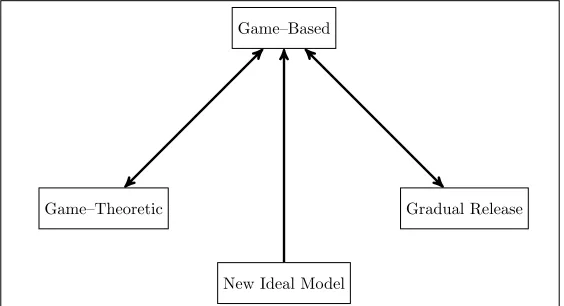
We then consider three different cryptographic notions of fairness and investigate their relation-ships with the above Game Theoretic notion; see Figure 1 for an illustration.
• First, we formulate a simple “game based” notion of fairness that limits the gain of an arbitrary (i.e., not necessarily “rational”) fail-stop adversary in a game that closely mimics the above Game Theoretic interaction. The main difference between the notions is that in the cryptographic setting the adversary is arbitrary, rather than rational. Still, we show that the notions are equivalent.
• Next, we show that this notion in fact corresponds to the natural concept of gradual release.
protocol is fair (as in the above notions)if and only ifit satisfies the gradual release property. We note that the notion of gradual release is in essence the basis of the classic protocols of Beaver, Goldwasser and Levin [3, 13]. It has also been a key tool in the work of Asharov and Lindell [2].
• Then, we formulate an ideal-model based notion of fairness that allows for gradual release of secrets. In this notion the ideal functionality accepts a “sampling algorithm”M from the ideal-model adversary. The functionality then obtains the inputs from the parties and runs M on these inputs, and obtains fromM the outputs that should be given to the two parties. The functionality then makes the respective outputs available to the two parties. (Ie, once the outputs are available, the parties can access them at any time.) The correctness and fairness guarantees of this interaction clearly depend on the properties ofM. We thus require thatM be both “fair” and “correct”, in the sense that both parties get correct output with roughly equal (and substantial) probability. We then show that the new simulation based definition implies the gradual release notion. (We note that the converse does not necessarily hold with respect to secure computation in the fail-stop model, even disregarding fairness).
Game–Based
New Ideal Model
Gradual Release Game–Theoretic
Figure 1: Our four notions of fairness and their relationships
On the definitional choices. One question that comes to mind when considering our modeling is why use plain Nash equilibria to exhibit correspondence between cryptographic notions and Game Theoretic ones. Why not use, for instance, stronger notions such as Dominant Strategy, Survival Under Iterated Deletions, or Subgame Perfect equilibria. It turns out that in our setting of two party computation with fail-stop faults, Nash equilibria do seem to be the concept that most naturally corresponds to cryptographic secure protocols. In particular, in the fail-stop case any Nash equilibrium is sub-game perfect, or in other words empty threats do not hold (see more discussion on this point in the next section).
Recent related work. Our impossibility result can be interpreted as an extension of Cleve’s impossibility result. We show that fairness is impossible to achieve even if correctness holds with probability less than 1 (and non-negligibly greater than 1/2). Interestingly, we overcome this impossibility result by relaxing the requirements and show that fairness can be achieved for protocols with correctness 1/2. We also demonstrate that such level of correctness is still meaningful in some cases.
In a recent work, Groce and Katz [20] overcome the impossibility result from a different approach where instead of relaxing the correctness they relax the utility functions of the parties. They showed that once the parties have a strict incentive to compute the function in an ideal world, a (computational) Nash protocol can be designed. The number of rounds in their construction depends on the amount of relaxation in the utilities, i.e., it is a function of the gap between the utility when playing honestly, and the best utility possible upon aborting and guessing the outputs with no information.
Future work. Although considered in [20], it is still an interesting challenge to extend the mod-eling of this work to the Byzantine case. For one, in the Byzantine case there are multiple crypto-graphic notions of security, including various variants of simulation based notions. Capturing these notions using Game Theoretic tools might shed light on the differences between these cryptographic notions. In particular, it seems that here the Game Theoretic formalism will have to be extended to capture arbitrary polynomial time strategies at each decision point.In particular, it seems likely that more sophisticated Game Theoretic solution concepts such as sub-game perfect equilibria and computational relaxations thereof [19, 30] will be needed.
Another challenge is to extend the notions of fairness presented here to address also situations where the parties have more general, asymmetric a priori knowledge on each other’s inputs, and to find solutions that use minimal trust assumptions on the system. Dealing with the multi-party case is another interesting challenge.
2
The Model and Solution Concepts
We review some basic definitions that capture the way we model protocols as well as the solution concepts from Game-Theory.
2.1 Cryptographic Definitions
We review some standard cryptographic definitions of security for protocols. The definitions address secrecy and correctness using the indistinguishability approach.
Negligible functions and indistinguishability. A functionµ(·) isnegligible if for every poly-nomial p(·) there exists a value N such that for all n > N it holds that µ(n) < p(1n). Let X = {X(a, n)}n∈N,a∈{0,1}∗ and Y = {Y(a, n)}n∈N,a∈{0,1}∗ be distribution ensembles. Then, we
say that X and Y are computationally indistinguishable, denoted X ≡c Y, if for every non-uniform probabilistic polynomial time (ppt) distinguisherDthere exists a negligible functionµ(·) such that for all sufficiently longa∈ {0,1}∗,
|Pr[D(X(a, n)) = 1]−Pr[D(Y(a, n)) = 1]|< µ(n).
Protocols. Our basic object of study is a two-party protocol, modeled as a pair of interacting Turing machines as in [15]. We formulate both the cryptographic and the Game Theoretic concepts in terms of two-party protocols. We restrict attention toppt machines. (To simplify the analysis, we consider machines that are polynomial in a globally known security parameter, rather than in the length of their inputs.)
Two-Party functions. In general, a two-party functionis a probability distribution over func-tionsf :{0,1}∗×{0,1}∗×N→ {0,1}∗×{0,1}∗. Here the first (second) input and output represent the input and output of the first (second) party, and the third input is taken to be the security parameter. In this work we consider the restricted model of deterministic functions. We say that a function isefficiently invertible if, fori= 0,1, given 1n, an input valuexi and an output valuey,
it is possible to compute in ppta value x1−i such that f(x0, x1, n) =y.
2.1.1 Cryptographic Security
We present game based definitions that capture the notions of privacy and correctness. We restrict attention to deterministic functions. By definition [10], the View of the ith party (i ∈ {0,1}) during an execution of π on (x0, x1) is denoted Viewπ,i(x0, x1, n) and equals (xi, ri, mi1, ..., mit),
where ri equals the contents of the ith party’s internal random tape, and mij represents the jth message that it received.
Privacy. We begin by introducing a definition of private computation [10]. Intuitively, it means that no party (that follows the protocol) should be able to distinguish any two executions when using the same inputs and seeing the same outputs. This holds even for the case that the other party uses different inputs. More formally:
Definition 2.1 (privacy) Let f and π be as above. We say that π privately computes f if the following holds:
1. For every non-uniform ppt adversaryA that controls party P0
Viewπ,A(z),0(x0, x1, n) x
0,x1,x01,y,z∈{0,1}∗,n∈N
c
≡
Viewπ,A(z),0(x0, x01, n) x0,x1,x0
1,z∈{0,1}∗,n∈N
where |x0|=|x1|=|x01|and f(x0, x1) =f(x0, x01).
2. For every non-uniform ppt adversaryA that controls party P1
Viewπ,A(z),1(x0, x1, n) x
0,x00,x1,z∈{0,1}∗,n∈N
c
≡
Viewπ,A(z),1(x00, x1, n) x
0,x00,x1,z∈{0,1}∗,n∈N
where |x0|=|x00|=|x1|and f(x0, x1) =f(x00, x1).
Correctness. Recall that we distinguish between output that corresponds to successful termina-tion of the protocol, and output generated as a result of an abort message. We assume that the two types have distinct formats (e.g., the second output starts with a ⊥ sign). The correctness requirement only applies to the first type of output. More precisely:
Definition 2.2 (correctness) Let f and π be as above. We say that π correctly computes f if for all sufficiently large inputs x0 and x1 such that |x0|=|x1|=n, we have:
Pr[Outputπ,i∈ {⊥ ◦ {0,1}∗, f(x0, x1)}]≥1−µ(n)
where Outputπ,i 6= ⊥ denotes the output returned by Pi upon the completion of π whenever the
strategy of the parties is continue, and µis a negligible function.
2.2 Game Theoretic Definitions
We review the relevant concepts from Game Theory, and the extensions needed to put these concepts on equal footing as the cryptographic concepts. (Specifically, these extensions include introducing asymptotic, computationally bounded players, and negligible error probabilities.) For simplicity, we restrict attention to the case of two-player games. Traditionally, a 2-player (normal form, full information) game Γ = ({A0, A1},{u0, u1}) is determined by specifying, for each player Pi, a set
Ai of possible actions and a utility function ui:A0×A1 7→R. LettingA def
= A0×A1, we refer to a tuple of actions a= (a0, a1)∈A as an outcome. The utility function ui of partyPi expresses this
player’s preferences over outcomes: Piprefers outcomeato outcomea0 if and only ifui(a)> ui(a0).
A strategy σi for Pi is a distribution on actions in Ai. Given a strategy vector σ =σ0, σ1, we let ui(σ) be the expected utility ofPi given that all the parties play according toσ. We continue with
a definition of Nash equilibria:
Definition 2.3 (Nash equilibria for normal form, complete information games)Let Γ = ({A0, A1},{u0, u1}) be as above, and let σ=σ0, σ1 be a pair of strategies as above. Then σ is in a
Nash equilibrium if for all i and any strategy σi0 it holds that ui(σ000, σ100) ≤ui(σ), where σi00 =σ0i and
σ1−00 i=σ1−i.
The above formalism is also naturally extended to the case of extensive form games, where the parties take turns when taking actions. Here the strategy is a probabilistic function of a sequence of actions taken so far by the players. The execution of a game is thus represented naturally via the
historywhich contains the sequence of actions taken. Similarly, the utility function of each player is applied to the history.
Another natural extension is to games with incomplete information. Here each player has an additional piece of information, called type, that is known only to itself. That is, the strategy σi
now takes as input an additional valuexi. We also let the utility function depend on the types, in
addition to the history. In fact, we let the utility of each player depend on the types ofboth players.
This choice seems natural and standard, and greatly increases the expressibility of the model. We note however that as a result, a party cannot necessarily compute its own utility. To extend the notion of Nash equilibria to deal with this case, it is assumed that an a priori distribution on the inputs (types) is known and fixed. The expected utility of players is computed with respect to this distribution.
Definition 2.4 (Nash equilibria for extensive form, incomplete information games) Let
Γ = ({A0, A1},{u0, u1})be as above, and letDbe a distribution over({0,1}∗)2. Also, letσ =σ0, σ1
be a pair of extensive-form strategies as described above. Thenσ is in aNash equilibrium forD if for all i and any strategy σi0 it holds that ui(x0, x1, σ000(x0), σ100(x1)) ≤ ui(x0, x1, σ0(x0), σ1(x1)), where (x0, x1) is taken from distribution D, σi(x) denotes the strategy of Pi with type x, σ00i = σ0i and
σ1−00 i=σ1−i.
party), we move to an asymptotic treatment. That is, we consider an infinite sequence of games. That is, instead of considering a single game, we consider an infinite sequence of games, one for each value of a security parameter n∈ N. (Formally, we give the security parameter as an additional
input to each set of possible actions, to each utility function, and to the distribution over types.) The only strategies we consider are those whose runtime is polynomial in n.1 The third and last step is to relax the notion of “greater or equal to” to “not significantly less than”. This is intended to compensate for the small inevitable imperfections of cryptographic constructs. That is, we have:
Definition 2.5 (Computational Nash equilibria for extensive form, incomplete inf. games) Let Γ = ({A0, A1},{u0, u1}) be as above, and let D = {Dn}n∈N be a family of distributions over
({0,1}∗)2. Let σ =σ0, σ1 be a pair ofppt extensive-form strategies as described above. Then σ is
in aNash equilibrium forDif for all sufficiently largen’s, alliand anyppt strategyσi0 it holds that
ui(n, x0, x1, σ000(n, x0), σ001(n, x1))≤ ui(n, x0, x1, σ0(n, x0), σ1(n, x1)) +µ(n), where (x0, x1) is taken
from distribution Dn,σi(x, n) denotes the strategy ofPi with type x, σi00=σi0 andσ001−i =σ1−i, and
µ is a negligible function.
We remark that an alternative and viable definitional approach would use a parametric, non asymptotic definition of cryptographic security. Another viable alternative is to use the [22] no-tion of costly computano-tion. We do not take these paths since our goal is to relate to standard cryptographic notions, as much as possible.
Our setting We consider the following setting: Underlying the interaction there is a two-party protocol π = (π0, π1). At each step, the relevant party can make a binary decision: Either abort the computation, in which case the other party is notified that an abort action has been taken, or else continue running the protocol π scrupulously. That is, follow all instructions of the protocol leading to the generation of the next message, including making all random choices as instructed. Namely, the strategic part of the action is very simple (a mere binary choice), in spite of the fact that complex computational operations may be involved. One may envision a situation in which a human has access to a physical device that runs the protocol, and can only decide whether or not to put the device into action in each round.
The traditional Game Theoretic modeling of games involving such “exogenous” random choices that are not controllable by the players involves, introduces additional players (e.g., “Nature”) to the game. In our case, however, the situation is somewhat different, since the random choices may be secret, and in addition each player also has access to local state that is preserved throughout the interaction and may affect the choices. We thus opt to capture these choices in a direct way: We first let each player havelocal history. (Initially, this local history consists only of the type of the player and its internal randomness.) The notion of an “action” is then extended to include also potentially complex algorithmic operations. Specifically, an action may specify a (potentially randomized) algorithm and a configuration. The outcome of taking this action is that an output of running the said algorithm from the said configuration, is appended to the history of the execution, and the new configuration of the algorithm is added to the local history of the player. More formally:
1
Definition 2.6 Let π = (P0, P1) be a two-party protocol (i.e., a pair of Interactive Turing
Ma-chines). Then, thelocal history of Pi (fori∈ {0,1}), during an execution ofπ on input(x0, x1) and internal random tape ri, is denoted by Historyπ,i(x0, x1, n) and equals (xi, ri, mi1, . . . , mit), where
mij represents itsjth message. Thehistoryofπduring this execution is captured by(m10, m11), ...,(m0t, m1t)
and is denoted by Historyπ. The configuration of π at some point during the interaction consists of the local configurations of P0, P1.
Fail-stop games. We consider games of the form Γπ,u= ({A0, A1},{u0, u1}), where A0 =A1=
{continue,abort}. The decision is taken before the sending of each message. That is, first the programπi is run from its current configuration, generating an outgoing message. Next, the party
makes a strategic decision whether to continue or to abort. A continueaction by player imeans that the outgoing message generated by πi is added to the history, and the new configuration is
added to the local history. An abort action means that a special abort symbol is added to the configurations of both parties and then both π0 and π1 are run to completion, generating local outputs, and the game ends. We call such gamesfail-stop games.
The utility functions in fail-stop games may depend on all the histories: the joint one, as well as the local histories of both players. In the following sections, it will be convenient to define utility functions that consider a special field of the local history, called thelocal outputof a playerPi. We
denote this field by Outputπ,i. Denote by σcontinue the strategy that always returns continue. The basic Game Theoretic property of protocols that we will be investigating is whether the pair of strategies (σcontinue, σcontinue) is in a (computational) Nash equilibrium in fail-stop games, with respect to a given set of utilities and input distributions. That is:
Definition 2.7 (Nash protocols) Let Dbe a set of distribution ensembles over pairs of strings, and letU be a set of extensive-form binary utility functions. A two-party protocolπis calledNash Pro-tocol with respect toU,Dif, for any u∈ U andD∈ D, the pair of strategiesσ = (σcontinue, σcontinue)
is in a computational Nash equilibrium for the fail-stop game Γπ,u and distribution ensemble D.
On subgame perfect equilibria and related solution concepts. An attractive solution concept for extensive form games (namely, interactive protocols) is subgame perfect equilibria, which allow for analytical treatment which is not encumbered by “empty threats”. Furthermore, some variants of this notion that are better suited to our computational setting have been recently proposed (see [19, 30]). However, we note that in our limited case of fail-stop games any Nash equilibrium is subgame perfect. Indeed, once one of the parties aborts the computation there is no chance for the other party to “retaliate”, hence empty threats are meaningless. (Recall that the output generation algorithms are not strategic, only the decision whether to abort is.)
3
Privacy and Correctness in Game Theoretic View
3.1 Privacy in Game Theoretic view
Our starting point is the notion of private computation. A protocol is private if no (fail-stop) PPT adversary is able to distinguish any two executions where the adversary’s inputs and outputs are the same, even when the honest party uses different inputs in the two executions. Our goal, then, is to define a set of utility functions that preserve this property for Nash protocols. We therefore restrict ourselves to input distributions over triples of inputs, where the input given to one of the parties is fixed, whereas the input of the other party is uniformly chosen from the remaining pair. This restriction captures the strength of cryptographic (semantic) security: evenif a party knows that the input of the other party can only be one out of two possible values, the game does not give it the ability to tell which is the case. We then have a distribution for each such triple.
We turn to defining the utility functions. At first glance it may seem that one should define privacy by having each party gain whenever it learns something meaningful on the other party’s private input. Nevertheless, it seems that it is better to make a partyloseif the other party learns anything about its secret information. Intuitively, the reason is that it must be worthwhile for the party who holds the data to maintain it a secret. In other words, having the other party gain any profit when breaking secrecy is irrelevant, since it does not introduce any incentive for the former party to prevent this leakage. (Note however that here the utility of a party depends on events that are not visible to it during the execution.) The following definition formalizes the above.
Definition 3.1 (Distribution ensembles for privacy) Thedistribution ensemble for privacy for P0 for a two-party function f is the ensemble Dfp={Dpf,n}n∈N where
Dpf,n={Da0,a1,b}a0,a1,b∈{0,1}n,f(a0,b)=f(a1,b), and Da0,a1,b outputs(x, b), where x
R
←(a0, a1).
Distribution ensembles for privacy forP1 are defined analogously.
Let π be a two-party protocol computing a function f. Then, for every n, a, b, c as above and for everypptalgorithmB, let theaugmented protocol for privacyforπ, with guess algorithmB, be the protocol that first runsπ, and then runsB on the local state ofπ and two additional auxiliary values. We assume thatBoutputs a binary value. This value is interpreted as a guess for which of the two auxiliary values is the input value of the other party.
Definition 3.2 (Utility function for privacy) Let π be a two-party protocol and f be a two party function. Then, for every a0, a1, b such that f(a0, b) = f(a1, b), and for every guessing
algorithmB, the utility function for privacy for party P0, on input x∈ {a0, a1}, is defined by:
up0(Historyπp
Aug,B,1(x, b, n), a0, a1, b)7→ (
−1 ifguessπp
Aug,B,1=g and x=ag 0 otherwise
Definition 3.3 (Game-Theoretic private protocols) Let f and π be as above. Then, we say that π is Game-Theoretic private for party P0 if πAugp ,B is a Nash protocol with respect to u
p
0, u
p
1
and Dfp and all valid ppt B.
Game-Theoretic private protocol for P1 is defined analogously. A protocol is Game-Theoretic private if it is Game-Theoretic private both for P0 and for P1.
Theorem 3.4 Let f be a deterministic two-party function, and let π be a two-party protocol that computes f correctly (cf. Definition 2.2). Then, π is Game-Theoretic private if and only if π
privately computes f in the presence of fail-stop adversaries.
Proof: We begin with the proof that a Game-Theoretic private protocol implies privacy by indistinguishability. Assume by contradiction thatπ does not compute f privately (in the sense of Definition 3.1) with respect to party P0 (w.l.o.g.). This implies that there exists appt adversary
A that corrupts party P0, a ppt distinguisher D, a non-negligible function and infinitely many tuples (x0, x01, x11, n) where|x0|=|x01|=|x11|=nand f(x0, x01) =f(x0, x11) such that,
Pr[D(Viewπ,A(z)(x0, x01, n)) = 1]−Pr[D(Viewπ,A(z)(x0, x11, n)) = 1]≥(n).
We assume, without loss of generality, thatAnever aborts prematurely, or in fact, it plays honestly. This is because we can construct an equivalent distinguisher that ignores all the messages sent after the round in whichA would have originally aborted, and then appliesD on the remaining view.
Recall that (σcontinue
0 , σcontinue1 ) is a computational Nash Equilibrium in the game ΓπAugp ,B,up for
any Valid ppt B, we therefore show that there exist a Valid ppt B in which ΓπpAug,B,up is not a
fail-stop game. That is, there exist an alternative strategyσ01 forP1, a non-negligible function0(·) and infinitely many distributions Dx0,x0
1,x11 ∈ D p
f such that
u1(σcontinue0 , σ10)> u1(σcontinue0 , σcontinue1 ) +0(n)
contradicting the assumption that (σcontinue
0 , σcontinue1 ) is Nash Equilibrium in the game ΓπAugp ,B,up.
Let σabort
1 be the strategy where P1 aborts the protocol before it starts (the initial abort strategy). Then, for anyDx0,x0
1,x11 ∈D p
f, and any ppt valid algorithmBit holds that:
u1(σ0continue, σ1abort) =−1/2
Consider the following B algorithm: On input Historyπ,1(x, c, n), x0, x01, x11,B invokes the distin-guisher Dand outputs x01 ifDoutputs 1, and outputsx11 otherwise.
We now consider the expected utility of P1 in the game ΓπpAug,B,up, when both parties run
according to the prescribed strategy:
u1(σ0continue, σ1continue)
= −1·Pr[guessπp
Aug,B,0=x
b
1]
= −Pr[D(Viewπ,A(z)(x0, xb1, n)) = 1∧b= 0]−Pr[D(Viewπ,A(z)(x0, xb1, n)) = 0∧b= 1]
= −1/2·Pr[D(Viewπ,A(z)(x0, xb1, n)) = 1|b= 0] + (1−Pr[D(Viewπ,A(z)(x0, xb1, n)) = 1|b= 1])
Then it holds that,
u1(σ0continue, σabort1 )−u1(σ0continue, σ1continue)≥ −1/2 + 1/2 + 1/2·(n)≥1/2·(n)
contradicting the assumption that (σcontinue
0 , σ1continue) is in Nash Equilibrium. The above implies thatπ is not a Nash protocol.
We now turn to the proof in which privacy implies Nash with respect to up0, up1 and Dfp and all valid B. Assume by contradiction that there exists a ppt B, such that the augmented protocol πAugp ,B is not a Nash protocol with respect to these parameters and partyP1 (w.l.o.g.). This means that there exist an alternative strategy σ10, infinitely many distributions Dx0,x0
1,x11,n ∈ D p
f and a
non-negligible function such that
u1(σcontinue0 , σ01)≥u1(σ0continue, σcontinue1 ) +(n)
without loss of generality, we can assume that σ10 is the initial abort strategy; this is because in any other strategy, some information regarding P1’s input may be leaked (since it participates in the protocol), and lowers the utility. Moreover, for any validppt algorithmB it holds that
u1(σ0continue, σ1abort) =−1/2
From the contradiction assumption, it holds that
u1(σ0continue, σ1abort) ≥ u1(σ0continue, σ1continue) +(n)
−1/2 ≥ −Pr[guessπp
Aug,B,0=x
b
1] +(n)
Pr[guessπp
Aug,B,0 =x
b
1] ≥ 1/2 +(n)
Next we now show that this implies that there exists a ppt adversary A, a ppt distinguisher D, a non-negligible function 0 and infinitely many tuples of equal length inputs (x0, x01, x11) with f(x0, x01) =f(x0, x11) such that,
Pr[D(Viewπ,A(z)(x0, x 0
1, n)) = 1]−Pr[D(Viewπ,A(z)(x0, x11, n)) = 1]
≥
0(n)
Fix (x0, x01, x11, n) and consider an adversary A that simply runs as an honest party. Then, define a distinguisher D that invokes the algorithm B and outputs 1 if and only if B outputs x01. Then formally,
Pr[D(Viewπ,A(z)(x0, x 0
1, n)) = 1]−Pr[D(Viewπ,A(z)(x0, x11, n)) = 1] =
Pr[guessπpAug,B,0 =x 0
1 |b= 0]−Pr[guessπpAug,B,0 =x 0
1 |b= 1] =
Pr[guessπpAug,B,0 =x 0
1∧b= 0]/Pr[b= 0]−
1−Pr[guessπp
Aug,B,0 =x 1
1∧b= 1]/Pr[b= 1] =
2 Pr[guessπpAug,B,0 =x 0
1∧b= 0] + 2 Pr[guessπAugp ,B,0 =x11∧b= 1]−1 =
2 Pr[guessπpAug,B,0 =x
b
1]−1
≥2·(1/2 +(n))−1 = 2(n)
3.2 Correctness in Game Theoretic view
We continue with a formulation of a utility function that captures the notion of correctness as formalized in Definition 3.5. That is, we show that a protocol correctly computes a deterministic function if and only if the strategy that never aborts the protocol is in a computational Nash equilibrium with respect to the set of utilities specified as follows. The parties get high payoff only if they output the correct function value on the given inputs (types), or abort before the protocol starts; in addition, the players get no payoff for incorrect output. More formally, we introduce the set of distributions for which we will prove the Nash theorem. The distribution ensemble for correctness is simply the collection of all point distributions on pairs of inputs:
Definition 3.5 (Distribution ensemble for correctness) Let f be a deterministic two-party function. Then, the distribution ensemble for correctness is the ensemble Dc
f = {Dcn}n∈N where
Dcn={Da,b}a,b∈{0,1}n, andDa,b outputs (a, b) w.p. 1.
Note that a fail-stop adversary cannot affect the correctness of the protocol as it plays honestly with the exception that it may abort. Then, upon receiving an abort message we have the following: (i) either the honest party already learnt its output and so, correctness should be guaranteed, or, (ii) the honest party did not learn the output yet, for which it outputs⊥together with its guess for the output (which corresponds to a legal output by Definition 2.2). Note that this guess is different than the guess appended in Definition 3.2 of utility definition for privacy, as here, we assume that the protocol instructs the honest party how to behave in case of an abort. Furthermore, an incorrect protocol in the presence of fail-stop adversary implies that the protocol is incorrect regardless of the parties’ actions (where the actions are continue or abort).
This suggests the following natural way of modeling a utility function for correctness: The parties gain a higher utility if they output the correct output, and lose if they output an incorrect output. Therefore, the continue strategy would not induce a Nash Equilibrium in case of an incorrect protocol, as the parties gain a higher utility by not participating in the execution. More formally:
Definition 3.6 (Utility function for correctness) Letπ be a two-party fail-stop game as above. Then, for every a, b as above theutility function for correctness for party P0, denoted uc0, is defined
by:
• uc0(Historyφπ,0) = 1.
• uc0(Outputπ,0, a, b)7→
1 ifOutputπ,0 =f(a, b) 0 otherwise
where Historyφπ,0 denotes the case that the local history of P0 is empty. (Namely, P0 does not
participate in the protocol).
Intuitively, this implies that the protocol is a fail-stop game if it is correct and vice versa. A formal statement follows below. uc1 is defined analogously, with respect toP1.
Theorem 3.7 Let f be a deterministic two-party function, and letπ a two-party protocol. Then,
π is a Nash protocol with respect to uc
0, uc1 and Dfc if and only if π correctly computes f in the
Proof: We begin with the proof that a Nash protocol with respect to uc0, uc1 and Dc
f implies
correctness. Assume by contradiction that π does not compute f correctly. Meaning, there exist infinitely many pairs of inputs (x0, x1),i∈ {0,1} and a non-negligible functionsuch that
Pr[Outputπ,i∈ {⊥ ◦ {/ 0,1}∗, f(x0, x1)}]≥(n)
We assume that the output of the protocol in case of prematurely abort starts with ⊥. Thus, our contradiction assumption holds only for the case where the protocol terminates successfully, however,Pi outputs a value different than f(x0, x1). Without loss of generality, assume thati= 0. We now show that (σcontinue
0 , σ1continue) does not induce a computational Nash Equilibrium in the game Γπ,uc. Namely, the expected utility forP0 when both parties play according to the prescribed
strategy is,
u0(σ0continue, σcontinue1 ) = Pr[Outputπ,0 ={f(x0, x1),⊥ ◦ {0,1}∗}]
= 1−Pr[Outputπ,0∈ {f(x0, x1),⊥ ◦ {0,1}∗}]≤1−(n)
Letσabort
0 be the strategy for which P0 initially aborts (i.e., does not participate in the protocol). Then, we have that
u0(σ0abort, σcontinue1 ) = 1
Thus, it holds that
u0(σabort0 , σ1continue)≥u0(σ0continue, σcontinue1 ) +(n)
contradicting the assumption that (σcontinue
0 , σcontinue1 ) induces a computational Nash Equilibrium in game Γπ,uc.
We now turn to the proof in which correctness implies Nash with respect to uc0, uc1 and Dc
f.
Assume by contradiction that π is not a Nash protocol with respect to uc
0 (w.l.o.g.) and Dfc.
This means that there exist an alternative strategy for P0 (w.l.o.g), infinitely many distributions Dx0,x1,n∈ D
c
f and a non-negligible functionin which
u0(σ00, σ1continue)≥u0(σ0continue, σcontinue1 ) +(n)
When both parties follow the prescribed strategy, the format of the output does not start with ⊥, and thus we have
u0(σ0continue, σ1continue) = Pr[Outputπ,i∈ {⊥ ◦ {0,1}∗, f(x0, x1)}]
Under the assumption thatP1 plays according toσ1continue, onceP0 starts the protocol - its utility can only reduces unless it outputs f(x0, x1) exactly. This can happen only when the protocol terminates successfully, i.e., it plays according toσcontinue
0 . Therefore, the only alternative strategy that yields a higher utility is σabort
0 (i.e, the initial abort). The expected utility for P0 when it plays according to σabort
0 and σ1 plays according to σ1continue is 1. Thus, we have that
u0(σabort0 , σcontinue1 ) ≥ u0(σcontinue0 , σcontinue1 ) +(n)
Yielding thatπ does not computef correctly on these inputs.
We conclude with the following theorem that combines the definitions for privacy and correct-ness, and states that they imply simulation based security with respect to fail-stop adversaries. For technical reasons arise in the proof, we assume thatf is also invertible, i.e.,f operates over a (polynomially) bounded domain so that for every value in the range it is easy to find an element in the domain mapped to this value.
Theorem 3.8 Let f be a deterministic, invertible two-party function, and let π be a two-party protocol. Then, π is Nash with respect to uc0, uc1, up0, up1 and Dc
f ∪ D
p
f if and only if π computes f
privately and correctly in the presence of fail-stop adversaries.
Informally, the proof follows from the fact that privacy and correctness against of fail-stop adver-saries are equivalent to simulation based security. On the other hand, private and correct protocols are equivalent to games that are Nash with respect to utility functions for correctness and privacy, thus, the theorem follows.
4
Exploring Fairness in the Two-Party Setting
Having established the notions of privacy and correctness using Game Theoretic formalism, our next goal is to capture fairness in this view. However, this turns out to be tricky, mainly due to the highly “reciprocal” and thus delicate nature of this notion. To illustrate, consider the simplistic definition for fairness that requires that one party learns its output if and only if the second party does. However, as natural as it seems, this definition is lacking since it captures each party’s output as an atomic unit. As a result, it only considers the cases where the parties either learnt or did not learn their output entirely, and disregards the option in which partial information about the output may be gathered through the execution. So, instead, we would like to have a definition that calls a protocol fair if at any point in the execution both parties gather, essentially, the same partial information about their respective outputs.
Motivated by this discussion, we turn to the Game Theoretic setting with the aim to design a meaningful definition for fairness, as we did for privacy and correctness. This would, for instance, allow investigating known impossibility results under a new light. Our starting point is a definition that examines the information the parties gain about their outputs during the game, where each party loses nominatively to the success probability of the other party guessing its output. (This is motivated by the same reasoning as in privacy). In order to obtain this, we first define a new set of utility functions for fairness for which we require that the game would be Nash; see Section 4.1 for the complete details.
be fair. We then introduce in Section 4.4 a new notion of simulation based definition for captur-ing security of protocols that follow our game-based notion of fairness, specified above. This new notion is necessary as (gamed-based) fair protocols most likely cannot be simulatable according to the traditional simulation based definition [10]. We consider the notion of “partial information” in the ideal world alongside preserving some notion of privacy. We then prove that protocols that satisfy this new definition are also fair with respect to game-based definition.
Finally, we consider the realizability of our notion of fairness. We then observe that our notion is meaningful even in the case where parties are not guaranteed to always learn the output when both parties never abort. Somewhat surprisingly, in cases where the parties learn the output with probability one half or smaller, our notion of fairness is in factachievablewith no set-up or trusted third parties. We demonstrate two-party protocols that realize the new notion in this settings. We also show that whenever this probability raises above one half, our notion of fairness cannot be realized at all.
4.1 Fairness in Game Theoretic View
In this section we present our first definition for fairness that captures this notion from a Game Theoretic view. As for privacy and correctness, this involves definitions for utility functions, input distributions and a concrete fail-stop game (or the sequence of games). We begin with the descrip-tion of the input distribudescrip-tions. As specified above, the input of each party is picked from a domain of size two, where all the outputs are made up of distinct outputs. More formally,
Definition 4.1 (Collection of distribution ensembles for fairness) Letf be a two-party func-tion. Let (x0
0, x10, x01, x11, n) be an input tuple such that: |x00|=|x10|=|x01|=|x11|=n, and for every b∈ {0,1} it holds that:
• f0(x00, xb1)6=f0(x10, xb1) (in each run there are two possible outputs forP0).
• f1(xb0, x01)6=f1(xb0, x11), (in each run there are two possible outputs forP1).
Then, a collection of distribution ensembles for fairness Df
f is a collection of distributions Dff =
{Dx0
0,x10,x01,x11,n}x00,x10,x01,x11,n such that for every(x
0
0, x10, x01, x11, n)as above, Dx0
0,x10,x01,x11,n is defined by
(x0, x1)←Dx0
0,x10,x01,x11,n(1
n), where x
0
R
←(x00, x10) and x1
R
←(x01, x11).
Next, let πB be the protocol, where B = (B0,B1). By this notation, we artificially separate between the protocol and the predicting algorithms in case of prematurely abort. More precisely, in the case thatP0 prematurely aborts,P1 invokes algorithmB1 on its input, its auxiliary information and the history of the execution, and outputs whateverB1does. B0is defined in a similar manner. In fact, we can refer to these two algorithms by the instructions of the parties regarding the values they need to output after each round, capturing the event of an early abort. We stress these algorithms are embedded within the protocol. However, this presentation enables us to capture scenarios where one of the parties follow the guessing algorithm as specified by the protocol, whereas the other party follows an arbitrary algorithm. That is, we can consider protocols πB0 (with B0 = (Be0,B1)) that are equivalent to the original protocolπB except for the fact thatP0 guesses its output according toBe0 instead of B0. We now describe the fairness game Γπ
B,uf for some B= (B0,B1). The inputs of the parties, x0, x1, are selected according to some distribution ensemble Dx0
in Definition 4.1. Then, the parties run the fail-stop game, where their strategies instruct them in each step whether toabortorcontinue. In case that a partyPiaborts, the outputs of both parties
are determined by the algorithms (B0,B1). LetOutputπB0,i denote the output of Pi in gameπB0, then a utility function for fairness is defined by:
Definition 4.2 (Utility function for fairness) Letf be a deterministic two-party function, and letπ be a two-party protocol. Then, for everyx00, x01, x01, x11, nas above (cf. Definition 4.1), for every pair of strategies(σ0, σ1)and for everypptBe0, theutility function for fairnessfor partyP0, denoted
by uf0, is defined by:
uf0(σ0, σ1)7→
1 if Outputπf
B0,0=f0(x0, x1)
∧ Outputπf
B0,1
6
=f1(x0, x1)
−1 if Outputπf
B0,0
6
=f0(x0, x1)∧ Outputπf
B0,1 =f1(x0, x1) 0 otherwise
where x0, x1 are as in Definition 4.1 and B0 = (Be0,B1). Moreover, the utility forP1, uf1 = 0.
Since the utility function ofP1is fixed, onlyP1has no incentive to change its strategy. Moreover, we consider here the sequence of games where P1 always guesses its output according to B1, the “original” protocol. This actually means that P1 always plays honestly, from the cryptographic point of view. We are now ready to define a protocol that is Game-Theoretic fair for P1 as:
Definition 4.3 (Game-Theoretic fairness for P1) Let f and πB be as above. Then, we say
thatπB isGame-Theoretic fair for partyP0 if ΓπB0,(uf0,uf1) is a Nash protocol with respect to(u f
0, uf1)
and Df
f and all pptBe0, where B0= (Be0,B1).
Namely, if πB is not Game-Theoretic fair for P1, then P0 (and only P0) can come up with a better strategy, and some other guessing algorithm Be0 (where both define an adversary in the cryptographic world). This is due to the fact that the utility for P1 is fixed, and so it cannot find an alternative strategy that yields a higher utility. In other words, P1 has no reason to invoke a different guess algorithm, and so this definition formalizes the case where P1 is honest in the protocolπB. This, in particular, implies that a somewhat natural zero-sum game, where the total balance of utilities is zero, does not work here.
Similarly, we define Game-Theoretic fair for partyP0, where here we consider all the protocols πB0, for all ppt Be1 and B0 = (B0,Be1), and the utilities functions are opposite (that is, the utility forP0 is fixed into zero, whereas the utility of P1 is modified according to its guess). We conclude with the definition for Game-Theoretic protocol:
Definition 4.4 (Game-Theoretic fair protocol) Let f and π be as above. Them. we say that
π isGame-Theoretic fair protocol if it is Game-Theoretic fair for both P0 and P1.
4.2 A New Indistinguishability-Based Definition of Fairness
test for the protocol in a “fair” environment, where each party has two possible inputs and its effective input is chosen uniformly at random from this set. Moreover, both parties know the input tuple and the distribution over the inputs. This is due to the fact that we, untraditionally, assume that the protocol instructs the honest party to guess the output of the function based on its view and the information it recorded so far. By doing so, we are able to capture scenarios for which
both parties learn thesame incomplete information (in a computationally indistinguishable sense) regarding their output. In particular, as long as both parties hold the same partial information, with the same probability, then the protocol is fair.
We note that these scenarios are not fair under the traditional simulation based definition [10], since they do not follow the all or nothing method, in which the parties can only learn the entire output at once. In order to illustrate this, consider a protocol that enables both parties to learn the correct output with probability about 3/4. Then, this protocol is fair according to our definition below although it is not simulatable by the [18] definition. Before introducing the game-based definition, we first introduce non-trivial functionalities, to avoid functionalities that one of the parties may know the correct output without participating.
Definition 4.5 (Non-trivial functionalities.) Let f be a two-party function. Then, f is non trivial if for all sufficiently large n’s, there exists an input tuple (x00, x10, x10, x11, n) such that |x00|=
|x10|=|x01|= |x11|=n and {f0(x0, xb1), f0(x0, xb1)}b∈{0,1}, {f1(xb0, x10), f1(xb0, x11)}b∈{0,1} are distinct
values.
We are now ready to introduce our formal definition for fairness:
Definition 4.6 (Game-based definition for fairness.) Let f be a non-trivial two-party func-tion, and let π be a two-party protocol. Then, for every input tuple (cf. Definition 4.5) and any
ppt fail-stop adversaryA, we define the following game:
Game Fairπ,A(x00, x01, x01, x11, n):
1. Two bits b0, b1 are picked at random.
2. Protocolπ is run on inputs xb0
0 forP0 and xb11 forP1, whereA sees the view ofPi∗.
3. WheneverAoutputs a valuey,P1−i∗ is given an abortmessage. (At this point,P1−i∗ would write its guess for f1−i∗(xb0
0 , x
b1
1 , n) on its output tape.)
4. The output of the game is:
• 1 if (i)y=f0(xb0
0 , x
b1
1 , n) and (ii) P1−i∗ does not outputf1(x
b0
0 , x
b1
1 , n).
• −1 if (i)y6=f0(xb00, x
b1
1 , n) and (ii) P1−i∗ outputs f1(xb0 0 , x
b1
1 , n).
• 0 otherwise (i.e., either both parties output correct outputs or both output incorrect outputs).
We say thatπ fairly computes f if for every pptadversaryA, there exists a negligible functionµ(·)
such that for all sufficiently large inputs it holds that,
At first sight it may seem that Definition 4.6 is tailored for the fair exchange function, i.e., when the parties trade their inputs. This is due to the fact that the parties’ output completely reveal their inputs. Nevertheless, we note that the definition does not put any restriction on f in this sense and is aimed to capture fairness with respect any nontrivial function. We continue with the following theorem:
Theorem 4.7 Let f be a two-party function and let π be a protocol that computes f correctly. Then, π is Game-Theoretic fair (in the sense of Definition 4.4), if and only if π fairly computes f
in the presence of fail-stop adversaries, (in the sense of Definition 4.6).
Proof: We first write explicitly the guessing algorithm B = (B0,B1) and denote the protocol π asπB. Assume that πB is Game-Theoretic fair for P0 and P1; we thus prove that πB is fair in the sense of Definition 4.6.
Assume by contradiction that πB is not fair with respect to this latter definition. Thus, there exist infinitely many input tuples x00, x10, x10, x11, n which yield distinct outputs, a pptadversary A controllingP0 (w.l.o.g.) and a non-negligible function for which
E(Fairπ,A,0(x00, x10, x01, x11, n))≥(n)
This implies that,
Pr
Fairπ,A(x00, x01, x01, x11, n) = 1
−Pr
Fairπ,A(x00, x10, x01, x11, n) =−1
≥(n)
Namely, whenP1runs according to the protocol specifications andP0runs according toA0sstrategy, the expected advantage ofP0 overP1 in guessing successfully is non-negligibly higher.
We now show that there exists B0 = (BA
0,B1) for which the game ΓπB0,uf is not a Nash game. That is, consider an alternative strategy σA0 forP0: This strategy invokes the adversary A, such that for each message that the strategy receives from the other party, it forwards this message to
A. Furthermore, whenever it receives the message and guess for the following round from the game (together with the random coins that were used to generate these values), the strategy invokes the adversaryA with the appropriate random coins. If the adversary chooses to output this message, σ0A outputs the action continue. If the adversary A chooses to abort,σ0A outputsabort.
Moreover, letBA0 be the following guess algorithm: On input
Historyπ,0(xb0
0 , x
b1
1 , n), x00, x10, x01, x11
,
BA0 invokes the adversaryAon the above history. Upon completion,B0A outputs whateverAdoes. Let ~x = (xb0
0 , x
b1
1 ). Then, in a run of (σA0, σcontinue1 ) in the game ΓπB0,uf where B
0 = (BA
0,B1), we have that:
Pr[Outputπ
B0,0 =f0(~x)∧OutputπB0,16=f1(~x)]−Pr[OutputπB0,06=f1(~x)∧OutputπB0,1 =f1(~x)]≥(n) yielding that the expected utility of P0 when it follows σ0A (and assuming that P1 runs according
to the prescribed strategy), is non-negligible. That is,
u0(σ0A, σ1continue)≥(n)
When both parties play according to the prescribed strategyσcontinue
i , both parties learn the correct
output at the end of the protocol except to some negligible function µ(·), and thus:
which is implied by the correctness of the protocol, and thus:
u0(σA0, σcontinue1 )−u0(σ0continue, σ1continue)≥(n)−µ(n)≥(n)/2
for infinitely manyn’s, implying that there exists a non-negligible difference between the alternative strategy and the prescribed strategy, and thus,πB is not Game-Theoretic fair forP0.
Next, assume thatπB meets Definition 4.6 and prove thatπB is Game-Theoretic fair forP0 and P1. Assume by contradiction that πB is not Game-Theoretic fair for P1 (w.l.o.g.), implying that there exists an alternative strategy σ00, infinitely many distributions Dx0
0,x10,x01,x11,n ∈ D f
f, appt Be0 and a non-negligible functionsuch thatπB0 is not a Nash protocol, whereB0 = (Be0,B1). Namely,
u0(σ00, σcontinue1 )≥u0(σ0continue, σcontinue1 ) +(n)
Based on the same assumption as above, when both parties follows σcontinue then both learn the correct output except to some negligible functionµ(·), and thus:
u0(σ0continue, σcontinue1 )≥ −µ(n)
implying that,
u0(σ00, σ1continue)≥u0(σcontinue0 , σ1continue) +(n)≥(n)−µ(n)≥(n)/2
Now, consider the following adversary A which controls the party P0: A invokes the strategy σ00 with the random coins of A. Then, wheneverσ00 outputscontinue,Acomputes the next message (using the same random coins) and output it. WheneverAreceives a message fromP1, it passes the message toσ00. Whenσ00 outputsabort,Aaborts, invokes the guess algorithmBe0, and outputs the corresponding output to Be0’s guess. We have that an execution of the protocolπB with an honest partyP1 and the adversary A, is equivalent to an execution of the game ΓπB0,uf withB
0= ( e
B0, B1) where the parties follow the (σ00, σcontinue
1 ) strategies. Therefore, we have that
Pr[OutputπB,0=f0(~x)∧OutputπB,1 6=f1(~x)]−Pr[OutputπB,0 6=f1(~x)∧OutputπB,1=f1(~x)] =u0(σ00, σ1continue)≥(n)/2
and so,
E(Fairπ,A(x00, x10, x01, x11, n))≥(n)/2
contradicting the assumption that πB is fair.
4.3 The Gradual Release Property
the other hand, the fact that gradual release is implied by fairness (cf. Theorem 4.10), may shed light on the reason it is impossible to achieve gradual release under certain constraints.
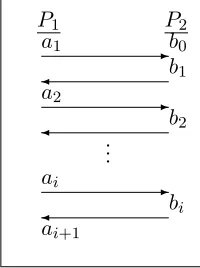
We show a tight correlation between Definition 4.6 for fairness and the gradual release property. Namely, we show that each notion is implied by the other. Without loss of generality, assume that P0 is the first to send a message in the protocol. Aroundin the protocol consist of a message from P0 toP1, and a message from P1 toP0. Recall that in Definition 4.6, we assume that the protocol instructs the parties how to guess the output in the case of anabort message. In a broader sense, the protocol can instruct each party to maintain a tape where it updates its guess after each round. This corresponds to having each party computing its guess, conditioned on the event that the other party aborts in the following round. More formally, denote by ai+1 the guess of party P0 whenP1 aborts after sending its message in round i; likewise, bi+1 denotes the guess of P1 when P0 quits after sending its message at roundi. We call these values the “default outputs”; see figure 2 for an illustration. We further note, that if the execution is terminated in some roundi, (either due to an early abort or to a successful completion), the parties define byaj =ai and bj =bi for all j > i.
P1 P2
-a1 b0
b1
a2
b2 ..
.
ai
bi
ai+1
Figure 2: Default output notations (non-simultaneous)
We generalize the default output notations to deal with arbitrary guess algorithm. Namely, a fail stop adversaryA may prematurely abort and guess its output, according to a guess algorithm different than the one specified by the protocol. Formally, for every adversary A, denoted by guessA,i, the adversary’s guess in round i. We note that an adversary may not write its guess in
every round, however, without loss of generality, we can assume that it does so. Note thatguessA,i is a random variable that is well defined even if the protocol has been terminated before round i. Then, we define the gradual release to deal with every adversary. We continue with a formalization of gradual release:
Definition 4.8 (m-gradual release) Let f be a non-trivial two-party function, and let π be a protocol. We say that π maintains m-gradual release, if for every ppt fail-stop adversary A, there
exists a negligible function µ(·), such that for every i < m and every x00, x10, x01, x11, n as above (cf. Definition 4.5) it holds that:
1. In caseA controls partyP0:
Pr
guessA,i+1=f0(x0, x1)
2. In caseA controls partyP1:
PrguessA,i=f1(x0, x1)
≤Pr [ai =f0(x0, x1)] +µ(n),
where x0← {R x00, x10} and,x1← {R x01, x11}.
Having defined m-gradual release, we say that a protocol maintains gradual release if it is poly-gradual release for some polynomial poly which indicates an upper bound its number of rounds. This captures the fact that the protocol must be terminated within a strict polynomial number of rounds.
Definition 4.9 (Gradual release) Let f and π be as above. Then, we say that π maintains gradual release if it m-gradual release for m = poly(n) for some polynomial poly that bounds the number of rounds of π.
Fairness implies gradual release. We complete this section by establishing a correlation be-tween the two notions of fairness and gradual release. In particular, we prove that each is implied by the other, beginning with the proof that fairness implies gradual release:
Theorem 4.10 Letf andπ be as above. Letpolybe a polynomial that bounds the number of rounds of the protocol π and assume that π is fair (in the sense of Definition 4.6). Then, π maintains gradual release (cf. Definition 4.9).
Proof: The proof follows by contradiction. Namely, assume that π does not maintain the gradual release property. Then, there exists an adversaryAthat controls (w.l.o.g) partyP0, a non-negligible function(·), a roundpoly(n)≥i >0 and infinitely many tuplesx0
0, x10, x01, x11, n, such that,
Pr
guessA,i+1=f0(x0, x1)
≥Pr [bi =f1(x0, x1)] +(n)
Then observe that,
PrguessA,i+1 =f0(x0, x1)
= PrguessA,i+1 =f0(x0, x1)∧bi =f1(x0, x1)
+ Pr
guessA,i+1 =f0(x0, x1)∧bi 6=f1(x0, x1)
and that,
Pr [bi =f1(x0, x1)] = Pr
bi=f1(x0, x1)∧guessA,i+1 =f0(x0, x1)
+ Prbi=f1(x0, x1)∧guessA,i+1 6=f0(x0, x1)
Combing these and based on the contradiction assumption we conclude that,
Pr
guessA,i+1=f0(x0, x1)∧bi6=f1(x0, x1)
>Pr
bi =f1(x0, x1)∧guessA,i+1=f0(x0, x1)
+(n) (1)
Next, we describe apptadversaryAifor which the expected output gameFairπ,Ai(x 0
Note first, that Ai runs in polynomial time since i <poly(n), and the honest party’s instructions can be followed in polynomial time as well. Moreover, it holds that,
Pr
Fairπ,Ai(x 0
0, x10, x01, x11, n) = 1
= Pr
guessA,i+1 =f0(x0, x1)∧bi 6=f1(x0, x1)
(2)
wherex0, x1 are chosen according to gameFairπ,Ai(x 0
0, x10, x01, x11, n), (which is exactly as they were chosen according to Definition 4.9). Then, Eq. (2) holds since the output of game Fairπ,Ai is 1 only whenAi outputs the correct output f0(x0, x1), whereas P1 outputs an incorrect output, i.e., different than f1(x0, x1). We stress that the probability above already embeds the event that the parties do not reach roundi+ 1 (namely, whenπ is terminated before roundi+ 1). This is due to the fact that in caseπ is terminated in roundj, it holds that guessA,i+1 =guessA,j, andbi=bj for
all j < i.
Similarly, we have that,
PrFairπ,Ai(x 0
0, x10, x01, x11, n) =−1
= PrguessA,i+16=f0(x0, x1)∧bi=f1(x0, x1)
Finally, combining the above we get that,
E(Fairπ,Ai(x 0
0, x10, x01, x11, n)) = Pr
Fairπ,Ai(x 0
0, x10, x01, x11, n) = 1
−Pr
Fairπ,Ai(x 0
0, x10, x01, x11, n) =−1
= Pr
guessA,i+1 =f0(x0, x1)∧bi 6=f1(x0, x1)
−Pr
guessA,i+16=f0(x0, x1)∧bi=f1(x0, x1)
> (n)
In contradiction to the assumption thatπ is fair with respect to Definition 4.6.
Gradual release implies fairness. Next, we prove that fairness is implied by gradual release:
Theorem 4.11 Letf andπ be as above and assume thatπ maintains the gradual release property (cf. Definition 4.9). Then, π is a fair protocol (in the sense of Definition 4.6).
Proof: LetAbe any adversary. We show that for there exists a negligible functionµ(·), such that for all sufficiently large inputs (x0
0, x10, x01, x11, n) it holds that:
E(Fairπ,A(x00, x10, x10, x11, n))≤µ(n)
Fix (x0
0, x10, x01, x11, n) to be the input tuple and assume without loss of generality that i∗ = 0. Moreover, denote by abortAi the even that A aborts in round i. We compute the expected value of the game Fairπ,A, conditioned on the event that A aborts in round i. Recall that whenever A
aborts in roundiit outputsguessA,i, whereasP1outputsbi−1. Then, for everyr(n)> i >0 (where r(n) denotes a polynomial bound on the number of rounds ofπ), we have that,
E(Fairπ,A(x00, x10, x01, x11, n)|abort A
i )
= Pr[Fairπ,A(x00, x10, x01, x11, n) = 1|abort A
i ]−Pr[Fairπ,A(x00, x10, x01, x11, n) =−1|abort A
i ]
= Pr[guessA,i=f0(x0, x1)∧bi−1 6=f1(x0, x1)]−Pr[guessA,i6=f0(x0, x1)∧bi−1 =f1(x0, x1)] = Pr[guessA,i=f0(x0, x1)∧bi−1 6=f1(x0, x1)] + Pr[guessA,i=f0(x0, x1)∧bi−1 =f1(x0, x1)]