Available Online atwww.ijcsmc.com
International Journal of Computer Science and Mobile Computing
A Monthly Journal of Computer Science and Information Technology
ISSN 2320–088X
IMPACT FACTOR: 6.017IJCSMC, Vol. 8, Issue. 3, March 2019, pg.306 – 319
Proposed Implementation Method
to Improve LSB Efficiency
Ziad Alqadi
1; Bilal Zahran
2; Qazem Jaber
3; Belal Ayyoub
4; Jamil Al-Azzeh
5;
Ahmad Sharadqh
61Computer Engineering Department, Al Balqa’a Applied University, Amman, 11134, Jordan
E-mail: [email protected]
2Computer Engineering Department, Al Balqa’a Applied University, Amman, 11134, Jordan
E-mail: [email protected]
3Department of Mechatronics Engineering, Al Balqa’a Applied University, Amman, 11134, Jordan
E-mail: [email protected]
4Computer Engineering Department, Al Balqa’a Applied University, Amman, 11134, Jordan
E-mail: [email protected]
5Computer Engineering Department, Al Balqa’a Applied University, Amman, 11134, Jordan
E-mail: [email protected]
6Computer Engineering Department, Al Balqa’a Applied University, Amman, 11134, Jordan
E-mail: [email protected]
Abstract: Data steganography is an important process, which is needed in various human life applications,
so the need for efficient method of data hiding is vital issue. In this paper we will introduce a new method of
LSB implementation, the proposed method will decrease the hiding process time to make this process more
efficient, doing this the proposed method must keep other parameter such MSE and PSNR closed to that
obtained by a popular standard method of LSB implementation.
Keywords: Steganography, hiding time, MSE, PSNR, speedup, capacity.
1-
Introduction
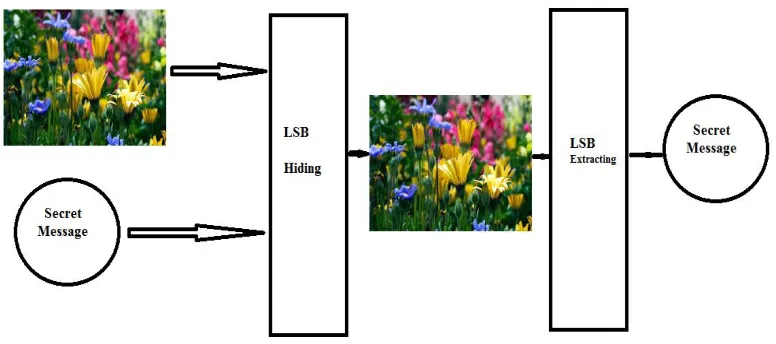
Figure (1): Data steganography process
Digital color image [6], [7] are usually presented by a 3D matrix, one dimension for one of the three colors
(Red, green, and blue); the 3D matrix has a huge size capable to hold a big message in size.
The selected method for data steganography must perform the hiding process to insert the secret message into
the covering image without destroying the image, and must perform the extracting process to get the original
secret message.
The selected method of data steganography must have the following features:
-
Capacity: This feature means the amount of data (message length in bytes) which can be hidden in the
covering image without destroying the image, here it is reasonable to use a high resolution color
image(with huge size) to hold a long secret message [8], [9].
-
Minimizing the negative effects of embedding a message in color image by minimizing a mean square
error (MSE) [10] between the original covering image and the holding image, or maximizing peak
signal to noise ratio (PSNR) [10], [13], [14] between both images, the covering and holding.
-
Accuracy, which means that the extracted message is the same as hidden message [11], [12].
-
Efficiency: here we have to look for minimizing both of the hiding time and extracting time.
2-
Least significant bit method of steganography
Least significant bit (LSB) is the most popular method of data hiding-extracting because of many reasons like
[9], [12]:
-
Very simple to be implemented.
-
Very accurate by extracting the message without any loss of information.
-
Provides low times for hiding and extracting processes.
-
It suits the process of hiding short messages and very long messages,
-
The capacity of this method is equal the image size divided by 8, so using big images will allow us to
hide huge messages [2].
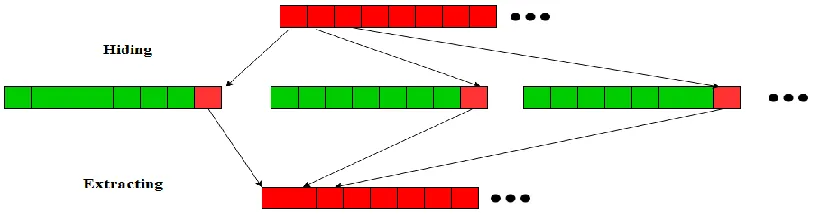
LSB method as shown in figure (2) reserves 8 bytes from the covering image to hide single character from the
message, so we have to get the binary version of the character byte, and take each bit of this character to be
inserted in the corresponding least significant bit of the image byte as shown in figure (2).
Figure (2): LSB hiding and extracting
3-
First method of LSB implementation
This method of LSB implementation is
the most traded and usedby the users and researchers, but this method of
implementation has a high hiding time specially, when it used for hiding short a medium messages.
The hiding process of this method can be implemented applying the following steps:
1)
Get the covering image, define the image size.
2)
Get the secret message, define the secret message length.
3)
Get the decimal values of the message.
4)
Get the transpose binary version of the message.
5)
Reshape the transpose binary version to one column array.
6)
For each bit in the reshaped array do the following:
ii.
If the LSB bit equal the bit of the reshaped array of the message then the holding byte must equal
the covering byte, else add the bit to covering byte to get the covering byte.
The extracting process can be implemented applying the following steps:
1)
Get the message length.
2)
For each character to be extracted reserve a set of 8 bytes from a holding image.
3)
Get the LSB from each byte in the set.
4)
Multiply each bit by the corresponding weight [128, 64, 32, 16, 8, 4, 2, 1].
5)
Summate the results of step 4 to get the decimal value of the character.
4-
Proposed method of LSB implementation
This method uses LSB concepts and can be implemented applying the following steps:
1)
Get the covering image and reshape it to one row array.
2)
For each character (a) reserve an array of 8 bytes from the covering image (P).
3)
Set the multiplier cc to 128.
4)
Set I to 1.
5)
Get the covering byte (S) by applying the following steps:
i.
Get a1 by applying anding (a) with (cc).
ii.
Bit shift left (a1) (i-1) times (a2).
iii.
Shift right a2 7 times to get a3.
iv.
Bit anding P (I) with 254 to get a4.
v.
Get the holding byte S (I) by oring a3 and a4.
vi.
Increment I
vii.
Divide cc by 2.
viii.
If I less than 8 go to step 5
6)
Repeat step 5 for each character in the message.
The extracting phase can be implemented applying the following steps:
For each character apply the following steps:
2)
Set the decimal value (DV) of the character to zero.
3)
Set the multiplier (VV) to 128.
4)
Set I to 1.
5)
Find the modulus 2 of S (I) (e1).
6)
Multiply e1 by VV. (e2)
7)
Add e2 to DV.
8)
Divide VV by 2.
9)
Increment I.
10)
If I less than 8 go to step 5
11)
Store DV as a byte of the message.
The following example shows how this method works:
Hiding process
Character "B" decimal a=66
cc=128
Covering bytes p= [200, 191, 189, 76, 89, 240, 80,101]
i
cc
a1=bitand(
a,cc)
a1=uint8(bitshift(a1,i-1))
a1=(bitshift(a1,
-7))
s(i)=uint8(bitand(p(i),
254))
s(i)=uint8(bitor(s(i),
a1))
1 12
8
Holding bytes s= [200 191 188 76 88 240 81 100]
i
vv
a1=mod(s(i),2) a1=a1*vv
ccc=ccc+a1
1
128
0
0
0
2
64
1
64
64
3
32
0
0
64
4
16
0
0
64
5
8
0
0
64
6
4
0
0
64
7
2
1
2
66
8
1
0
0
66(the same
character)
5-
Implementation and experimental results:
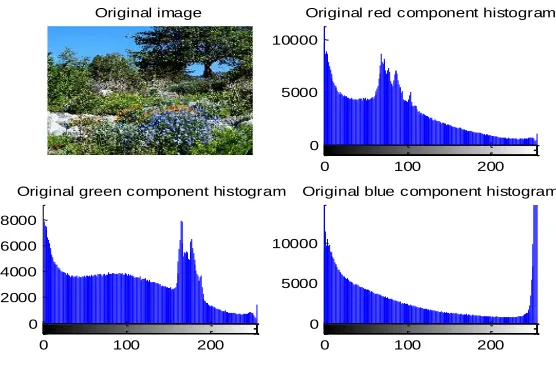
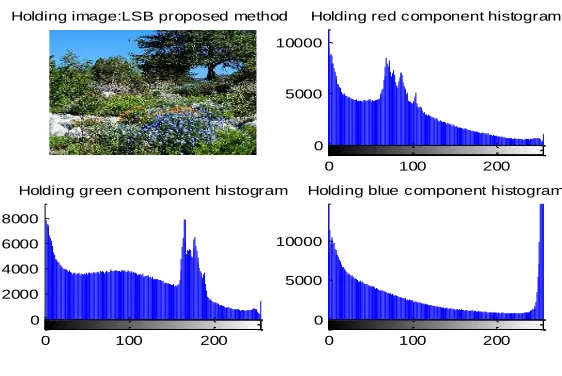
The first and the proposed methods of LSB were implemented using matlab codes, figure (3) shows the original
image which was prepared to hold a secret message with length = 500 characters, figure (4) shows the holding
image after applying the first method, while figure (5) shows the holding image after applying the proposed
method:
Original image
0 100 200
0 5000 10000
Original red component histogram
0 100 200
0 2000 4000 6000 8000
Original green component histogram
0 100 200
0 5000 10000
Original blue component histogram
Holding image:LSB
0 100 200
0 5000 10000
Holding red component histogram
0 100 200
0 2000 4000 6000 8000
Holding green component histogram
0 100 200
0 5000 10000
Holding blue component histogram
Figure (4): Holding image after applying first method
Holding image:LSB proposed method
0 100 200
0 5000 10000
Holding red component histogram
0 100 200
0 2000 4000 6000 8000
Holding green component histogram
0 100 200
0 5000 10000
Holding blue component histogram
Figure (5): Holding image after applying proposed method
From figures (3), (4) and (5) we can see that the holding images using both methods are closed together, the
color histograms of the three images are much closed and it is very difficult to notice any changes by human
eyes, which tells us that both methods satisfy the requirements of data steganography.
The following 2 experiments were implemented to discuss some parameters of the both methods:
Experiment 1:
Evaluating methods performance (efficiency)
In this experiment we took a huge color image to be used as a holding image (size=2500608 bytes), we
categorized the secret message into three groups:
-
Short messages with length range 100 to 1000 characters.
-
Huge messages with length above 12800 characters.
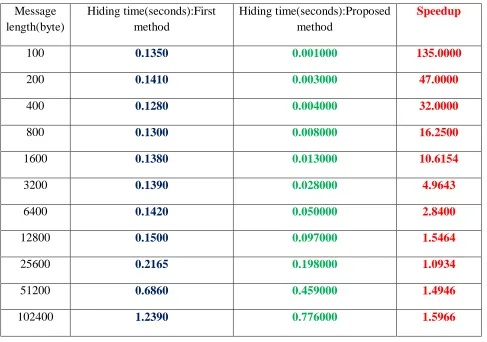
The experimental results of this experiment are shown in table (1)
Table (1): Results of experiment 1
Message
length(byte)
Hiding time(seconds):First
method
Hiding time(seconds):Proposed
method
Speedup
100
0.1350
0.001000
135.0000
200
0.1410
0.003000
47.0000
400
0.1280
0.004000
32.0000
800
0.1300
0.008000
16.2500
1600
0.1380
0.013000
10.6154
3200
0.1390
0.028000
4.9643
6400
0.1420
0.050000
2.8400
12800
0.1500
0.097000
1.5464
25600
0.2165
0.198000
1.0934
51200
0.6860
0.459000
1.4946
102400
1.2390
0.776000
1.5966
0 2 4 6 8 10 12 x 104 0
0.2 0.4 0.6 0.8 1 1.2 1.4
Messgae size(byte)
H
id
in
g
ti
m
e(
se
co
n
d)
Hiding time:image size=2500806 Existing method
Proposed method
Figure (6): Hide time comparisons
Experiment 2:
Evaluating methods MSE and PSNR
In this experiment we took a huge color image to be used as a holding image (size=2500608 bytes), we
categorized the secret message into three groups:
-
Short messages with length range 100 to 1000 characters.
-
Medium messages with length range 1600 to 6400 characters.
-
Huge messages with length above 12800 characters.
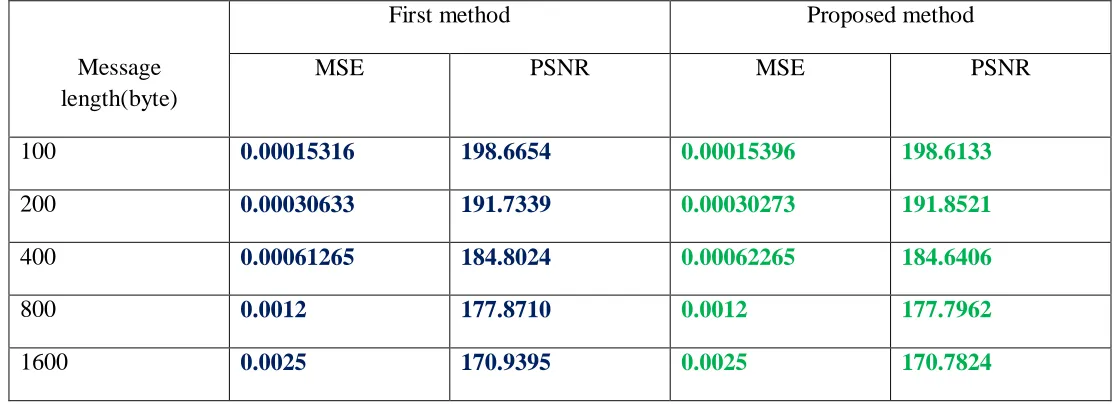
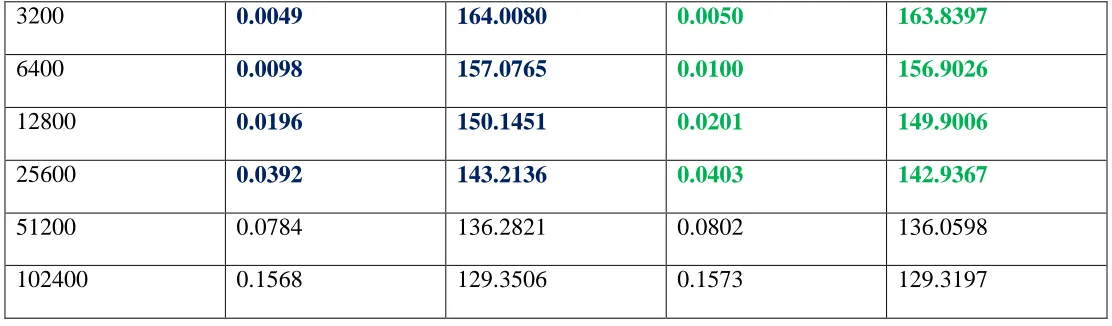
The experimental results of this experiment are shown in table (2)
Table (2): Results of experiment 2
Message
length(byte)
First method
Proposed method
MSE
PSNR
MSE
PSNR
100
0.00015316
198.6654
0.00015396
198.6133
200
0.00030633
191.7339
0.00030273
191.8521
400
0.00061265
184.8024
0.00062265
184.6406
800
0.0012
177.8710
0.0012
177.7962
3200
0.0049
164.0080
0.0050
163.8397
6400
0.0098
157.0765
0.0100
156.9026
12800
0.0196
150.1451
0.0201
149.9006
25600
0.0392
143.2136
0.0403
142.9367
51200
0.0784
136.2821
0.0802
136.0598
102400
0.1568
129.3506
0.1573
129.3197
From table (2) we can raise the following facts:
-
PSNR for the proposed method is much closed to PSNR for method1 (see figure (7)).
-
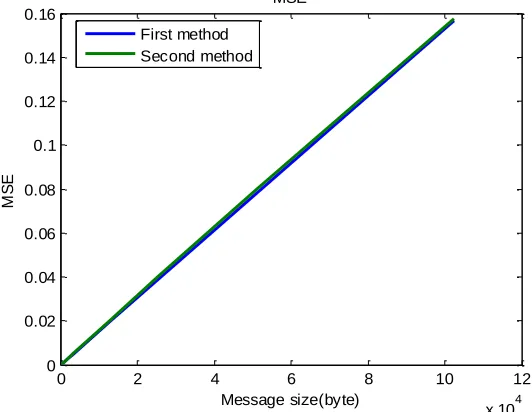
MSE for the proposed method is much closed to MSE for method1 (see figure (8)).
-
MSE for both methods is very low, and PSNR for both methods is high, which means that the holding
image is much close to the original covering image, and because of this it will be very difficult to notice
the differences between the 2 images by human eyes.
0 2 4 6 8 10 12 x 104 120
130 140 150 160 170 180 190 200
Message size(byte)
P
S
N
R
PSNR
First method Second method
0 2 4 6 8 10 12 x 104 0
0.02 0.04 0.06 0.08 0.1 0.12 0.14 0.16
Message size(byte)
M
S
E
MSE First method
Second method
Figure (8): MSE comparisons
Conclusion
A method of LSB implementation was proposed. The proposed method was implemented and tested; the
obtained experimental results were analyzed.
The analysis of experimental results showed that the proposed method is more efficient by decreasing the hiding
time, and the proposed method has a noticeable speedup when hiding various secret messages.
The proposed method gave a low MSE, and high PSNR, the values of these parameters are acceptable.
References
1. Ziad A. Alqadi, Majed O. Al-Dwairi, Amjad A. Abu Jazar and Rushdi Abu Zneit, Optimized True-RGB color Image Processing, World Applied Sciences Journal 8 (10): 1175-1182, ISSN 1818-4952, 2010.
2. A. A. Moustafa, Z. A. Alqadi, “Color Image Reconstruction Using A New R'G'I Model”, Journal of Computer Science, Vol.5, No. 4, pp. 250-254, 2009.
3. K Matrouk, A Al-Hasanat, H Alasha'ary, Z. Al-Qadi,H Al-Shalabi, “Speech fingerprint to identify isolated word person”, World Applied Sciences Journal, Vol. 31, No. 10, pp. 1767-1771, 2014
4. J. Al-Azzeh, B. Zahran, Z. Alqadi, B. Ayyoub, M. Abu-Zaher, “A Novel zero-error method to create a secret tag for an image”, Journal of Theoretical and Applied Information Technology, Vol . 96. No. 13, pp. 4081-4091, 2018.
5. Prof. Ziad A.A. Alqadi, Prof. Mohammed K. Abu Zalata, Ghazi M. Qaryouti, Comparative Analysis of Color Image Steganography, JCSMC, Vol.5, Issue. 11, November 2016, pg.37–43.
6. M. Jose, “Hiding Image in Image Using LSB Insertion Method with Improved Security and Quality”, International Journal of Science and Research, Vol. 3, No. 9, pp. 2281-2284, 2014.
7. R. M. Patel, D. J. Shah, “Conceal gram :Digital image in image using LSB insertion method”, International Journal of Electronics and Communication Engineering & Technology, Vol. 4, No.1, pp. 230-2035, 2013, 8. N. Akhtar, P. Johri, S. Khan, “Enhancing the security and quality of LSB based image steganography”, 5th
September 27-29, 2013.
9. M. Juneja, P. S. Sandhu, “An improved LSB based Steganography with enhanced Security and Embedding/Extraction”, 3rd International Conference on Intelligent Computational Systems, Hong Kong China, January 26-27, 2013.
10. H. Alasha'ary, K. Matrouk, A. Al-Hasanat, Z. A lqadi, H. Al-Shalabi (2013), Improving Matrix Multiplication Using Parallel Computing, International Journal on Information Technology (I.RE.I.T.) Vol. 1, N. 6 ISSN 2281-2911
11. Bilal Zahran, Ziad Alqadi, Jihad Nader, Ashraf Abu Ein A COMPARISON BETWEEN PARALLEL AND SEGMENTATION METHODS USED FOR IMAGE ENCRYPTION-DECRYPTION, International Journal of Computer Science & Information Technology (IJCSIT) Vol 8, No 5, October 201.
12. Z.A. Alqadi, A. Abu-Jazzar (2005), Analysis Of Program Methods Used For Optimizing Matrix Multiplication, Journal of Engineering, vol. 15 n. 1, pp. 73-78.
13. Z.A. Alqadi, M. Aqel, I.M. El Emary, (2008) "Performance Analysis and Evaluation of Parallel Matrix Multiplication Algorithms" , World Applied Sciences Journal, vol. 5 (2):, ISSN 1818-4952, 2008
14. H. Alasha'ary, K. Matrouk, A. Al-Hasanat, Z. Alqadi, H. Al-Shalabi (2013), Improving Matrix Multiplication Using Parallel Computing, International Journal on Information Technology(I.RE. I.T.) Vol. 1, N. 6 ISSN 2281-2911
15. Ziad Al-Qadi, Musbah Aqel, Performance analysis of parallel matrix multiplication algorithms used in image processing, World Applied Sciences Journal, vol. 6, issue 1, pp 45-52, 2009.
16. Jamil Al-Azzeh, Bilal Zahran and Ziad Alqad, Salt and Pepper Noise: Effects and Removal International Journal on Electrical Engineering and Informatics 2(4),
17. T. Vimala, “Salt and Pepper Noise Reduction Using Mdbutm Filter With Fuzzy Based Refinement”, Volume 2, Issue 5, May 2012.
18. F. A. Jassim, “Image Denoising Using Interquartile Range Filter with Local Averaging”, International Journal of Soft Computing and Engineering (IJSCE), vol. 2, Issue 6, pp: 424 –428, January 2013.
19. Jamil S. AL-Azzeh: Distributed Mutual Inter-Unit Test Method For D-Dimensional Mesh-Connected Multiprocessors With Round-Robin Collision Resolution: Jordanian Journal of Computers and Information Technology April 2019.
20. Jamil AL-Azzeh, Bilal Zahran, Ziad Alqadi, Belal Ayyoub, Muhammed Mesleh : A Novel Based On Image Blocking Method To Encrypt-Decrypt Color JOIV: International Journal on Informatics Visualization, 2019
21. Jamil AL-Azzeh, Evaluation Method for SDN Network Effectiveness in Next Generation Cellular Networks : International Journal of Communication Networks and Information Security December 2018.
22. Jamil AL-Azzeh: Improved testability method for mesh-connected VLSI multiprocessors: Jordanian Journal of Computers and Information Technology August 2018.
23. Jamil AL-Azzeh: A Novel Zero-Error Method to Create a Secret Tag for an Image; Journal of Theoretical and Applied Information Technology 15th July 2018.
24. Jamil AL-Azzeh, Qualitative risk analysis of software development ; Asian Journal of Information Technology
July 2018.
25. Bilal Zahran , Jamil AL-Azzeh, A Modified LBP Method To Extract Features From Color Images : Journal of Theoretical and Applied Information Technology May 2018.
26. Jamil AL-Azzeh, Information Technologies for Supporting Administrative Activities of Large Organizations; DESIDOC Journal of Library & Information Technology, Vol. 38, No. 3, May 2018.
27. Jamil AL-Azzeh: A Distributed Multiplexed Mutual Inter-Unit in-Operation Test Method for Mesh-Connected VLSI Multiprocessors; Jordan Journal of Electrical Engineering; 2017 Volume 10, Number 5.
28. Jamil AL-Azzeh: Fault-Tolerant Routing in Mesh-Connected Multicomputer based on Majority-Operator-Produced Transfer Direction Identifiers; Jordan Journal of Electrical Engineering Volume 3, Number 2, April
2017.
29. Jamil AL-Azzeh, Analysis of Self-Similar Traffic Models in Computer Networks; International Review on Modelling and Simulations; October 2017 Volume 10, Number 5.
Scientific and Technical Conference; Russia May 24-26, 2017.
31. Mazen Abuzaher, Jamil AL-Azzeh: JPEG Based Compression Algorithm; International Journal of Engineering and Applied Sciences Volume 4, Number 4, 2017
32. Jamil AL-Azzeh: ZigBee, Bluetooth and Wi-Fi Complex Wireless Networks Performance Increasing; International Journal On Communications Antenna and Propagation, vol 7 No 1 February 2017.
33. Jamil AL-Azzeh ,Implementing Built-In Test in Analog and Mixed-Signal Embedded-Core-Based System-On-Chips; Asian Journal of Information Technology, Medwell Journals ,2016. (SJR indicator = 0.11).
34. Jamil AL-Azzeh, Creating a Color Map to be used to Convert a Gray Image to Color Image; International Journal of Computer Applications (0975 – 8887).Volume 153 – No2, November 2016.
35. Jamil AL-Azzeh: Analysis of Second Order Differential Equation Coefficients Effects on PID Parameters International Journal on Numerical and Analytical Methods in Engineering (IRENA) Vol 4, No 2 2016.
36. Jamil AL-Azzeh; Automated Demodulation of Amplitude Modulated Multichannel Signals with Unknown Parameters Using 3D Spectrum Representation Research Journal of Applied Sciences, Engineering and Technology, Maxwell Scientific Publication June 05, 2016
37. Jamil S. Al-Azzeh, Adaptive Regulation of Radiated Power Radio Transmitting Devices in Modern Cellular Network Depending on Climatic Conditions. Contemporary Engineering Sciences, Vol. 9, 2016,
38. Mazin Al Hadidi, Jamil AL-Azzeh, Methods of Risk Assessment for Information Security Management, International Review on Computers and Software (I.RE.CO.S.), Vol. 11, N. 2 ISSN 1828-6003 (impact factor = 6.14). February 2016.
39. Jamil AL-Azzeh, Bidirectional Virtual Bit-slice Synchronizer: A Scalable Solution for Hardware-level Barrier Synchronization. Research Journal of Applied Sciences, Engineering and Technology, 11(8): 902-909. Maxwell Scientific Publication Corp November 2015.
40. Jamil AL-Azzeh, The Organization of Built-in Hardware-Level Mutual Self-Test in Mesh-Connected VLSI Multiprocessors; International Journal on Information Technology (I.RE.I.T.) Vol. 3, Praise Worthy Prize, March 2015.
41. Jamil AL-Azzeh; an approach to achieving increased fault-tolerance and availability of multiprocessor-based computer systems"; Australian Journal of Basic and Applied Sciences. Apr. 2014
42. Jamil AL-Azzeh,Computer simulation of vibration robot created for the wall movement;Research Journal of Applied Sciences.; 2014 , Issue: 9, Page No.: 597-602 ,
43. Jamil AL-Azzeh, Review of Methods of Distributed Barrier Synchronization of Parallel Processes in Matrix VLSI Systems, International Review on Computers and Software (IRECOS), Praise Worthy Prize, Part A, vol. 8, no. 4, pp.42- 46, April 2013
44. Jamil AL-Azzeh, Fastest Color Model for Image Processing Using Embedded Systems Australian Journal Of Basic And Applied Sciences. Dec 2013, Vol. 7 Issue 14, p83-89. 7p.
45. Jamil AL-Azzeh, Using Virtual Network to Solve Freight Company Problems; World Applied Sciences Journal 27 (6): 754-758, 2013; (SJR indicator = 0.17)
46. Jamil AL-Azzeh, Detection of eyes using FCM, International Review on Computers and Software (IRECOS), Praise Worthy Prize, Part A, vol. 7, no. 4, pp.1428-1434, Jul. 2012 (impact factor = 6.14).
47. Jamil AL-Azzeh, An optical character recognition, Contemporary Engineering Sciences, vol. 5, no. 11, pp. 521-529, 2012.
48. Jamil AL-Azzeh, Analysis of Matrix Multiplication Computational Methods European Journal of Scientific Research Vol.121 No.3, 2014, pp.258-266.
49. Ziad A. Al-Qadi, Musbah J. Aqel Performance analysis of parallel matrix multiplication algorithms used in image processing: World Applied Sciences Journal 6 (1): 45-52, 2009.
50. Mohammed Abuzalata; Ziad Alqadi, Jamil Al-Azzeh; Qazem Jaber Modified Inverse LSB Method for Highly Secure Message Hiding: ; International Journal of Computer Science and Mobile Computing, Vol.8 Issue.2, February- 2019, pg. 93-103
52. Jamil Al-Azzeh, Ziad Alqadi, Mohammed Abuzalata; Performance Analysis of Artificial Neural Networks used for Color Image Recognition and Retrieving: International Journal of Computer Science and Mobile Computing, Vol.8 Issue.2, February- 2019
53. Rashad J. Rasras, Mohammed Abuzalata ; Ziad Alqadi ; Jamil Al-Azzeh ; Qazem Jaber, Comparative Analysis of Color Image Encryption-Decryption Methods Based on Matrix Manipulation International Journal of Computer Science and Mobile Computing, Vol.8 Issue.3, March- 2019, pg. 14-26.
54. Jamil Al-Azzeh#, Bilal Zahran# , Ziad Alqadi#, Belal Ayyoub#, Muhammed Mesleh ;A Novel Based on Image Blocking Method to Encrypt-Decrypt Color; INTERNATIONAL JOURNAL ON INFORMATICS VISUALIZATION VOL 3 (2019) NO 1
55. Jamil Al-Azzeh, B. Zahran, Z. Alqadi, B. Ayyoub and M. Mesleh," A Novel Based On Image Blocking Method To Encrypt-Decrypt Color",International Journal on Informatics Visualization, Vol 3, No 1. 2019.
56. B. Zahran, J. AL-Azzeh, Z. Al Qadi, M. Al Zoghoul and S. Khawatreh,"A Modified LBP Method to Extract Features from Color Images", Journal of Theoretical and Applied Information Technology(JATIT), Vol.96. No 10, 2018.
57. J. AL-AZZEH, B. ZAHRAN, Z. ALQADI, B. AYYOUB, M. ABU-ZAHER, "A novel Zero-error Method to Create a Secret Tag for an Image", Journal of Theoretical and Applied Information Technology(JATIT), Vol.96. No 13, 2018.pp: 4081-4091.
58. Jamil AL-AZZEH, B. ZAHRAN, Z. ALQADI," Salt and Pepper Noise: Effects and Removal", International Journal on Informatics Visualization, Vol.2. No 4, 2018.pp: 252-256.
59. Jihad Nader, Ziad Alqadi, Bilal Zahran, "Analysis of Color Image Filtering Methods", International Journal of Computer Applications (IJCA), Volume 174, issue 8, 2017, pp:12-17.
60. Ziad Alqadi, Bilal Zahran, Jihad Nader, " Estimation and Tuning of FIR Lowpass Digital Filter Parameters", International Journal of Advanced Research in Computer Science and Software Engineering, Volume 7, Issue 2, 2017, pp:18-23.
61. B.Ayyoub “Wired and WLAN Optimal Design Using Opnet IT GURU”, Contemporary Engineering Sciences, Vol 7, 2014 No. 6,263-272, HIKARI Ltd. ISSN 1313-6569.
62. B.Ayyoub “ A Smart Model For Web Programming Agile Testing”, Global Journal Of Researches in Engineering (GJRE), (USA) Volume 14, Issue 2, 2014 , ISSN09755861.