Signatures
Chifumi Sato1, Takeshi Okamoto2, and Eiji Okamoto3 1
SBI Net Systems Co., Ltd., Sumitomo Ichigaya Bldg., 16th Floor, 1–1 Ichigaya-honmuracho Shinjuku-ku, Tokyo, 162–0845, Japan
2
Department of Computer Science, Faculty of Health Sciences, Tsukuba University of Technology, 4–12–7 Kasuga Tsukuba-shi, Ibaraki, 305–0821, Japan
3 Graduate School of Systems and Information Engineering, University of Tsukuba, 1–1–1 Tennodai Tsukuba-shi, Ibaraki, 305–8573, Japan
Abstract. In this paper, we define an underlying computational prob-lem and its decisional probprob-lem. As an application of their probprob-lems, we propose an efficient designated verifier signature (DVS) scheme without random oracles (related to symmetric pairings). We formally redefine the (Strong) Privacy of Signature’s Identity, and prove our DVS scheme sat-isfying security based on the difficulty of the problems. Also we prove that the difficulty of the computational problem is tightly equivalent to the Strong Unforgeability of our proposed conventional signature scheme (without random oracles) related to asymmetric pairings. We believe that our underlying problems are profitable to propose many efficient crypto-graphic schemes.
Keywords:Designated verifier signatures, Digital signatures, Standard model
1
Introduction
Security of cryptographic protocols and schemes in public-key infrastructure is usually reduced problems which everyone believes difficult to solve. For exam-ple, the Unforgeabilty (or Existential Unforgeability under an Adaptive Chosen Message Attack) of the Waters conventional signature scheme [16] is based on the difficulty of the Computational Diffie–Hellman (CDH) problem.
Our scheme satisfies the following security: Correctness, Strong Unforgeabil-ity (or Strong UnforgeabilUnforgeabil-ity under an Adaptive Chosen Message Attack), Non-Transferability, and (Strong) Privacy of Signature’s Identity. The security is based on the difficulty of our proposed problems. Our scheme is delegatable, so the signer can delegate the third party a right of signer’s signing. From the del-egatability, for example our DVS scheme is suitable for the following two cases. The first case is that a signer does not want to delegate such as an authenti-cation associated with a payment. The second case is that a designated verifier allows for the signer to delegate such as an e-ticket for some service. However, our scheme is not suitable for an e-election since the signer is able to sell his own suffrage to a third party.
Huang–Yang–Wong–Susilo [5] provided a highly efficient DVS scheme with-out random oracles, which is to be secure if pseudo-random functions have the pseudo-randomness. The (t, ε)-pseudo-randomness means that outputs of the functions can only be distinguished from those of the random oracles in polyno-mial timestwithin probabilities (1/2−ε,1/2 +ε). However the valueεmust be negligible if the scheme is secure. Our scheme is more efficient than DVS schemes [17, 10] whose security can be proven without the assumption of random oracles, and without that of the pseudo-randomness.
On the other hand, it is known that the difficulty of solving the RSA problem is tightly equivalent to be the difficulty that ciphertexts of the RSA cryptosystem are perfectively broken against chosen ciphertext attacks. Also the difficulty of solving the CDH problem is tightly equivalent to be the difficulty that agreement keys of the primitive Diffie–Hellman key agreement [3] are perfectively broken against passive adversary attacks.
In this paper, we prove that the difficulty of our computational problem is tightly equivalent to Strong Unforgeability of our proposed conventional signa-ture scheme. Unfortunately, this scheme is not enough to be efficient since the scheme is constructed based on asymmetric pairings. However, we believe that the result is important to justify our proposed problem. More detailed descrip-tion is in Secdescrip-tion 3.1.
The paper is organized in the following way. In Section 2, we prepare for the construction of our proposals. In Section 3, we will provide three proposals: a computational problem, a decisional problem and a DVS scheme. We describe security and efficiency of our DVS scheme in Section 4. In Section 5, we propose a conventional signature scheme and describe its security. We provide conclusions in Section 6.
2
Preliminaries
In this section, we state the definition of a symmetric pairing (or bilinear map). This definition is due to [2].
We assume that
– e : G×G → GT is the cryptographic symmetric pairing satisfying the
following properties:
Bilinearity:e(ua, vb) =e(u, v)ab for anyu, v∈Gand anya, b∈Z.
Non-degenerate:e(g1, g2)6= 1GT forhg1i=hg2i=G.
Computable: There is an efficient algorithm to compute e(u, v) for any
u, v∈G.
3
Our Proposals
In this section, we define an underlying computational problem and its decisional problem, and propose a DVS scheme without random oracles.
3.1 Proposed Computational Problem
We provide Assumption 1 related to the Computational Diffie–Hellman (CDH) Assumption. Here we say that the (t, ε)-CDH Assumption inGholds if for any adversaryArunning in timetand an advantage ε, we have that
Pr[A(g, ga, gb) =gab]< ε
where the probability is over the choice of a random generatorg∈RG, random numbersa, b∈RZ∗p and the random bits ofA.
The problem is defined as follows. Given
(
g1, g2, gx1, g
ri
2 , g
x+1/ri
2 ¯¯¯i= 1, . . . , q
)
(1) as input for random generatorsg1, g2∈RGand random numbersx, r1, . . . , rq ∈R Z∗
p, compute
(
gr∗ 2 , g
x+1/r∗ 2
)
for some r∗ ∈Z∗p andr∗ ∈ {/ r1, . . . , rq}. Note that
the indexx+ 1/ri meansx+ (1/ri). We say that algorithmAhas an advantage
εin solving the problem if
Pr
[
A(g1, g2, g1x, g
ri
2, g
x+1/ri
2 ¯¯¯i= 1, . . . , q
)
=
(
gr∗ 2 , g
x+1/r∗
2 ) ¯¯¯
r∗∈Z∗p,
r∗∈ {/ r1, . . . , rq} ]
≥ε ,
where the probability is over the choiceg1, g2∈RG,x, r1, . . . , rq ∈RZ∗p and the
random bits ofA.
Assumption 1 A (q, t, ε)-Computational Assumption I holds inGif not-time adversary has an advantage of at leastεin solving the problem inG.
Our problem is similar to those of [13, 14]. However, security of all schemes in [13, 14] is based on the problems with asymmetric pairings ˆe : G1×G2 → GT. In particular, concerning how to compare signature lengths of the ID-based
signature scheme [14], it assume that the representation of elements in G1,G2
In general,|Zp| ≤ |G1|and|G2| ≥2|G1|. Then, in the best case,|Zp|=|G1|and
|G2|= 2|G1|, so we can use as unit|Zp|. Then, a signature in the scheme consists
of 4 elements inG2and 1 element inG1, amounting then to 9 such units. Now, if we use the generic construction from [4], applied to the DLP-based strong one-time signature in Appendix A of [1] and the ID-based signature (IBS) scheme in [11], we obtain a strongly unforgeable IBS consisting of 6 elements inG1 and 2 elements inZp, and a computational cost dominated by 3 pairings, while relying
on better computational assumptions than the IBS scheme [14].
On the other hand, our proposed problem is based on symmetric pairings
e:G×G→GT. Then we will construct an efficient designated verifier signature
scheme. It is not easy to compare the problems either on asymmetric pairings or on symmetric ones. Our definition is profitable to propose many efficient cryptographic schemes.
Difficulty of solving our problem based on symmetric pairings is equivalent to be strongly unforgeable for a proposed DVS scheme. This is part of security in the DVS scheme. If the problem is based on asymmetric pairings, the problem is equivalent to be strong unforgeable for a proposed scheme. This is a main security of the conventional signature scheme.
3.2 Proposed Decisional Problem
The following problem is a decisional one of the above computational problem. Given
(
g1, g2, gx1, g
ri
2 , g
x+1/ri
2 , g
r∗
2 , R¯¯¯i= 1, . . . , q
)
(2) as input for random generatorsg1, g2∈RGand random numbersx, r1, . . . , rq ∈R Z∗
p,r∗∈Z∗p,r∗∈ {/ r1, . . . , rq}andR∈G, output 1 ifR=g x+1/r∗
2 and output 0 otherwise. We say that algorithmAhas an advantage εin solving the problem if
¯¯ ¯Pr
[
A(g1, g2, gx1, g
ri
2, g
x+1/ri
2 , g
r∗
2 , R¯¯¯i= 1, . . . , q
)
= 1
]
−Pr
[
A(g1, g2, g1x, g
ri
2 , g
x+1/ri
2 , g
r∗
2 , g
x+1/r∗ 2
¯¯
¯i= 1, . . . , q
)
= 1] ¯¯¯≥ε ,
where the probability is over the choice g1, g2, R ∈R G, x, r1, . . . , rq ∈R Z∗p,
r∗∈Z∗p, r∗6∈ {r1, . . . , rq}and the random bits ofA.
Assumption 2 A (q, t, ε)-Decisional Assumption II holds in G if no t-time adversary has an advantage of at leastεin solving the problem inG.
3.3 A Designated Verifier Signature Scheme DVS
messageM is an element inZp, but the domain can be extended to all of{0,1}∗
using a collision-resistant hash functionH:{0,1}∗→Zp.
DVS.Setup: Choose multiplicative cyclic groupsGandGT of sufficiently large
prime order p. Assume that e : G×G → GT is a symmetric pairing. The
public key is generated as follows. Choose a random generator, g1 ∈G. Public parameters are
params:= (G,GT, p, e, g1).
DVS.SKeyGen: A signerSgenerates (x, y)∈R(Z∗p)2, and calculate (X, Y) :=
(gx
1, g
y
1)∈G2. The public and private keys ofS are:
P KS := (X, Y) and SKS := (x, y),
respectively.
DVS.VKeyGen: A designated verifierDgeneratesg2:=gd1∈Gfromd∈RZ∗p,
sets z:=e(g1, g2), and sends (g2, z) to the signer. The public and private keys ofD are:
P KD:= (g2, z) and SKD:=d ,
respectively.
DVS.Sign: A designated signature of a messageM ∈Zpis generated as follows.
First, a random r∈Z∗p is chosen. The designated signature is then constructed
as:
σ:=
(
gr2, g
x+M y+1/r
2
)
∈G2. (3)
DVS.Verify: Suppose we wish to check ifσ= (σ1, σ2) is a designated signature for a messageM. The designated verifier verifies
e
(
X−1·Y−M·σ21/d, σ1
)
=z .
If the equality holds the result isvalid; otherwise the result is invalid.
4
Security and Efficiency of Our DVS Scheme
4.1 Correctness
If a signer S with the public keyP KS constructs a signature σ on a message
M as described in the DVS.Sign phase above, it is easy to see that σ will be accepted by a designated verifierD:
e
(
X−1·Y−M ·σ12/d, σ1
)
=e
(
(g1x)−1·(g1y)−M·
(
g2x+M y+1/r
)1/d
, gr2
)
=e
(
g1−x·g−1M y·g1x+M y+1/r, g2r
)
=e
(
g11/r, g2r
)
=e(g1, g2). Thus the scheme is correct.
4.2 Strong Unforgeability
Definition of Strong Unforgeability for DVS is based on the Unforgeability in [10], by changing the third requirement in theOutputphase to the signature is not output as a response to a Queryphase.
Theorem 1. Suppose that the (q0, t0, ε0)-Computational Assumption I holds in G. Then the proposed designated verifier signature scheme DVS is (q, t, ε) -strongly unforgeable, provided thatq≤q0,t≤t0−O(qT)andε≥2ε0, whereT is the maximum time for an exponentiation in G.
An outline of the proof is as follows. Suppose that there exists an adversary, A, who breaks the Strong Unforgeability for DVS, and a challenger, B, takes the Assumption I challenge. After A and B execute the strongly unforgeable game,Aoutputs a valid tuple for a message and a signature. ThenBreplies the Assumption I response with non-negligible probability. This is a contradiction to hold the Assumption I .
Although we can prove thatDVS is strongly unforgeable if and only if the Assumption I holds inG. However the Strong Unforgeability is part of security in the DVS scheme, so we will omit to prove it in this paper.
Proof. Suppose that there exists an adversary,A, who breaks the (q, t, ε)-Strong Unforgeability (SUF) of our DVS schemeDVS:
Pr [Abreaks (q, t, ε)-SUF ofDVS]≥ε . (4) We construct a simulator,B, to play the Computational Assumption I game. The simulatorBwill take the Assumption I challenge (1) forx, ri∈RZ∗p(i= 1, . . . , q)
Simulator Description Setup: The simulatorBsends
params= (G,GT, p, e, g1)
to the adversaryA.Bgeneratesg1y∈Gfromy∈RZ∗p. He generatesb∈R{0,1}, and sends toAeither
{
(4.2.1-1) P KS = (gx1, g
y
1) ifb= 0 , or (4.2.1-2) P KS = (g
y
1, g1x) ifb= 1 .
The adversary A cannot know whether the received parameter is in the cases (4.2.1-1) or (4.2.1-2). AlsoBsends
P KD= (g2, z) to the adversaryA, wherez=e(g1, g2).
Signature Queries: The adversary A issues signature queries M1, . . . , Mq.
These queries may be asked adaptively so that each queryMi may depend on
the replies toM1, . . . , Mi−1.
In the case (4.2.1-1), the simulatorB generates the signature (σi,1, σi,2) :=
(
gri
2,
(
gx+1/ri
2
)
·(g2y)Mi) (=(gri
2 , g
x+Miy+1/ri
2
) )
,
and sends it toA. In the case (4.2.1-2) andMi6= 0,B generates
(σi,1, σi,2) :=
(
(gri
2 )
1/Mi,(gx+1/ri
2
)Mi
·gy2
) (
=
(
gri/Mi
2 , g
y+Mix+Mi/ri
2
) )
,
and sends it toA. In the case (4.2.1-2) and Mi = 0, B generates (σi,1, σi,2) :=
(
gri0
2 , g
y+1/ri0
2
)
forri0∈RZ∗p, and sends it toA.
Output: The adversaryAoutputs (M∗, σ∗) such thatσ∗= (σ∗,1, σ∗,2)∈G2is a valid signature ofM∗, and (M∗, σ∗,1, σ∗,2)∈ {/ (M1, σ1,1, σ1,2), . . . ,(Mq, σq,1, σq,2)}.
Analysis
The signature σ∗ is valid. In the case (4.2.1-1), assume that (σ∗,1, σ∗,2) :=
(
gr∗ 2 , g
x+M∗y+1/r∗
2
)
forr∗∈Z∗p and
(M∗, r∗)6= (Mi, ri) (5)
fori= 1, . . . , q(i.e. (M∗, r∗)∈ {/ (M1, r1), . . . ,(Mq, rq)}). Also, in the case
(4.2.1-2), assume that (σ∗,1, σ∗,2) :=
(
gr∗ 2 , g
y+M∗x+1/r∗
2
)
forr∗∈Z∗p and
(M∗, r∗)6≡
{
(Mi, ri/Mi) (modp) forMi6= 0 ,
fori= 1, . . . , q.
(4.2.2-1.1) Ifr∗∈ {/ r1, . . . , rq}in the case (4.2.1-1), the simulatorBcalculates
(
gr∗ 2 , g
x+1/r∗
2
)
=
(
σ∗,1, σ∗,2·(g2y)−
M∗)
which is a valid output for the Assump-tion I game.
(4.2.2-1.2) Otherwise in the case (4.2.1-1), assume thatr∗ =rj (1≤j ≤q).
Then we haveM∗ 6=Mj from (9). Though the simulator B can calculateg y
2 = (σ∗,2/σj,2)
1/(M∗−Mj)from the only (M
∗, σ∗,2) and (Mj, σj,2), he does not seem to propose a valid output for the Assumption I game. However, notice that A does not know whetherBsimulates (4.2.2-1.2) or the following (4.2.2-2.1). (4.2.2-2.1) In the case (4.2.1-2), if there exists an index j (1 ≤j ≤q) such that
r∗≡
{
rj/Mj forM∗=6 Mj andMj 6= 0,
r0j forM∗6= 0 and Mj = 0,
the simulatorBcan calculategx
2such as (4.2.2-1.2). He can generate
(
gr0∗ 2 , g
x+1/r0∗
2
)
forr0∗∈ {/ r1, . . . , rq}, which is a valid output for the Assumption I game.
(4.2.2-2.2) Otherwise in the case (4.2.1-2), assume thatr∗6≡ri/MiforMi6= 0,
and assume that r∗ 6=r0i forMi = 0. SinceBcannot obtain new information of
solving the Assumption I game fromA at the simulator description in Section 4.2.1, it seems thatBcannot propose a valid output for the game.
Let Pr [Bbreaks (q0, t0, ε0)-Assumption I ] be the probability that B gener-ates a valid output for the Assumption I game.
Lemma 1.
1
2 Pr[Abreaks(q, t, ε)-SUF ofDVS]≤Pr[B breaks(q0, t0, ε0)-Assumption I] . Proof of this lemma is proposed in Appendix A. From the assumption in Theorem 1,
Pr [Bbreaks (q0, t0, ε0)-Assumption I ]< ε0 . (6) From (4), (10) and Lemma 1, we have
ε
2 ≤ 1
2 Pr [Abreaks (q, t, ε)-SUF ofDVS]
≤Pr [Bbreaks (q0, t0, ε0)-Assumption I ]< ε0 , which is a contradiction to the assumptionε/2≥ε0 in Theorem 1.
4.3 Non-Transferability
Definition of Non-Transferability is based on [15]. We show that, if designated signatures can be simulated by the verifier himself then a designated signature adds no computational ability to the verifier.
From verifier’s secretd, the verifier generates
(
(gr1)d,
(
gx1·(gy1)M ·g11/r
)d)
,
which is equal to (3). Therefore the proposed DVS scheme satisfies the Non-Transferability.
4.4 Privacy of Signature’s Identity
The (Strong) Privacy of Signature’s Identity (PSID) is given in [8] as follows. Given a message M and a designated verifier signature σ of this message, it is computationally infeasible, without the knowledge of the private key of the designated verifier or the one of the signer, to determine which pair of signing keys was used to generateσ.
We formally define (q, t, ε)-PSID as follows. This security is defined using the following game between a challengerBand an adversaryA:
Setup: The challengerBtakes a security parameterkand runs theDVS.Setup phase of the DVS scheme. It gives the adversaryAthe resulting system pa-rametersparams.Bruns theDVS.SKeyGenphase, and sendsAthe resulting public keys of signersS0andS1. AlsoBruns theDVS.VKeyGenphase, and sendsA the resulting a public key of a designated verifier D. It keeps the private keys ofS0, S1, D to itself.
Queries 1: Signature queries (b1, M1), . . . ,(bq1, Mq1) are issued byA. Here each
bi∈ {0,1} (i= 1, . . . , q1) means the index of eitherS0 orS1. To each query
Mj the challengerBresponds by runningDVS.Sign to generate a signature
σiofMirespecting to the private keySKiofSi, and sendingσi toA. These
queries may be asked adaptively such that each query Mi may depend on
the replies toM1, . . . , Mi−1.
Challenge: The adversaryAsubmits a plaintextM∗∈ MforM∗6∈ {M1, . . . , Mq1}.
The challenger selects random bitb∈R{0,1}, setsσ∗=DVS.Sign(params, SKb, Mb),
and sendsσ∗ to the adversary as its challenge designated signature.
Queries 2: This is a identical toQueries 1fori=q1+ 1, . . . , q, except thatA may not request the signature ofM∗
Guess: The adversary submits a guessb0 ∈ {0,1}. The adversary wins ifb=b0. We defineAdvPSIDAto be the probability thatAwins the above game, taken over the coin tosses made byBandA:
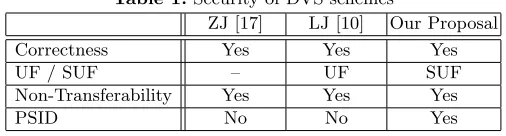
Table 1.Security of DVS schemes
ZJ [17] LJ [10] Our Proposal
Correctness Yes Yes Yes
UF / SUF – UF SUF
Non-Transferability Yes Yes Yes
PSID No No Yes
Definition 1. An adversary A (q, t, ε)-breaks a designated verifier signature (DVS) scheme if A runs in a time of at most t, A makes at most q Queries, and AdvPSIDA is at least ε. A DVS scheme is the (q, t, ε)-(Strong) Privacy of Signature’s Identity (PSID), if no adversary (q, t, ε)-breaks it.
Theorem 2. Suppose that the(q0, t0, ε0)-Decisional Assumption II holds inG. Then the proposed designated verifier signature schemeDVSsatisfies the(q, t, ε) -(Strong) Privacy of Signature’s Identity, provided that q ≤q0, t ≤t0−O(qT) andε≥ε0, whereT is the maximum time for an exponentiation in G.
Proof of this theorem is proposed in Appendix B. An outline of the proof is as follows. Suppose that there exists an adversary, A, who breaks PSID for DVS, and a challenger, B, takes the Assumption II challenge. After A and B execute PSID game, A outputs a bit to indicate which the private key of the signers is used. Then Breplies the Assumption II response with non-negligible probability. This is a contradiction to hold the Assumption II .
Ifσ0 ∈G2 is a valid designated verifier signature ofS
1, then it is an invalid one of S0. Therefore it is computationally infeasible, without the knowledge of the private key of the designated verifier or the one of the signers, to determine whether valid or invalid at signatures of signers.
4.5 Delegatability
The Delegatability is that the signer can delegate her signing ability – with respect to a fixed designated verifier – to a third party, without revealing her private key or making it possible for the third party to sign with respect to other designated verifiers. Our scheme is delegatable if the signer sends the third party Aa pair (gx
2, g
y
2) forx, y∈Z∗p. ThenAcan generate a valid designated signature:
σ= (σ1, σ2) :=
(
gr2, gx2+M y+1/r
)
forr∈RZ∗p.
4.6 Security Comparison of DVS schemes
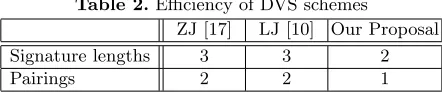
Table 2.Efficiency of DVS schemes
ZJ [17] LJ [10] Our Proposal Signature lengths 3 3 2
Pairings 2 2 1
Unforgeability (SUF), Non-Transferability, and (Strong) Privacy of Signature’s Identity (PSID). Only our scheme satisfies the PSID in this table. Notice that security of the DVS scheme [10] relies on the strange looking Knowledge-of-Exponentassumption [7, 10], which is non-black box in that security reductions from this assumption entail some kind of access to the internal state of the adversary. Our scheme does not rely on this assumption.
4.7 Efficiency Comparison of DVS schemes
Table 2 shows the efficiency of DVS schemes without random oracles (and with-out pseudo-randomness), by comparing signature lengths as unit|Zp|=|G|, and
by the number of pairings during one iteration of verification. Our scheme is the most efficient within the scope in these schemes.
5
Our Computational problem and a Signature Scheme
The aim of this section is to justify our proposed computational problem. We propose a conventional signature schemeS, which gives the result that the dif-ficulty of the computational problem (the Assumption I) is equivalent to be strongly unforgeable forS. Unfortunately, the scheme is based on the asymmet-ric pairings ˆe:G1×G2→GT, so a signature in the scheme consists of 2 elements
in G2, amounting then to 4 units as unit|Zp|=|G1|=|G2|/2.
5.1 A Conventional Signature Scheme S
We give a conventional signature scheme with three phases:S.KeyGen, S.Sign, and S.Verify. For the moment we shall assume that the signature message M
is an element in Zp, but the domain can be extended to all of {0,1}∗ using a
collision-resistant hash functionH:{0,1}∗→Zp.
S.KeyGen: Choose multiplicative cyclic groups G1,G2 and GT of sufficiently
large prime order p, random generators g2 of G2, the one-way isomorphism4
f : G2 → G1 with a generator g1 := f(g2) ∈ G1, the asymmetric pairing ˆ
e: G1×G2 →GT. The public key is generated as follows. Generate a private
4
key SK := (gx
2, g
y
2) ∈ G22 from secrets x, y ∈R Z∗p, and calculate (X, Y) :=
(f(gx
2), f(g
y
2)) (= (g1x, g
y
1)∈G21).
(
Z∗
p
)2
−→ G2
2
f
−→ G2 1 (x, y) 7−→SK:= (gx
2, g
y
2)7−→(X, Y) := (f(g2x), f(g
y
2)) (= (g1x, g
y
1)) Assume thatz:= ˆe(g1, g2)∈GT. The public and private keys are:
P K := (G1,G2,GT, p,e, f, gˆ 1, g2, X, Y, z) and SK:= (g2x, g
y
2), respectively.
S.Sign: A signature of a message M ∈ Zp is generated as follows. First, a
randomr∈Z∗p is chosen. The signature is then constructed as:
σ:=
(
gr2, g2x+M y+1/r
)
.
S.Verify: Suppose we wish to check ifσ= (σ1, σ2) is a signature for a message
M. Verify
ˆ
e(X−1·Y−M·f(σ2), σ1
)
=z .
If the equality holds the result isvalid; otherwise the result is invalid. It is easy to see thatσ will be accepted by a verifier. Thus the scheme is correct.
5.2 The Computational Problem and Strong Unforgeability
Theorem 3. Assume thatg1=f(g2)∈G1for the one-way isomorphismf : G2→ G1and the random generatorg2∈RG2. That the conventional signature scheme S is strongly unforgeable is almost equivalent to that the Computational Assump-tion I holds in (G1,G2). More correctly,
(T3-1) Suppose that the(q0, t0, ε0)-Computational Assumption I holds in(G1,G2) with g1 =f(g2). Then the signature schemeS is (q, t, ε)-strongly unforge-able, provided that q ≤ q0, t ≤ t0−O(qT) and ε ≥ 2ε0, where T is the maximum time for an exponentiation inG2.
(T3-2) Assume that the signature schemeS is(q1, t1, ε1)-strongly unforgeable. Then the (q, t, ε)-Computational Assumption I holds in (G1,G2) with g1 =
f(g2), provided thatq≤q1,t≤t1 andε≥ε1.
Proof (of (T3-2) in Theorem 3).The challenger generates a public pair (P K, SK), and sends the private key SK to the adversary. The adversary generates mes-sages Mi (i= 1, . . . , q) which areM1=· · ·=Mq, and sendsM1, . . . , Mq to the
challenger. For each messageMi (i= 1, . . . , q), The challenger generates
σi=
(
gri
2 , g
x+Miy+1/ri
2
)
,
and sends it to the adversary. Then the challenger performs the Assumption I game for input
(
g1, g2, g1x·(g
y
1)
Mi, gri
2 , g
x+Miy+1/ri
2 ¯¯¯i= 1, . . . q
)
,
and receives a valid output
σ∗=
(
gr∗ 2 , g
x+M∗y+1/r∗
2
)
for r∗ 6∈ {r1, . . . , rq} and M∗ = M1 = · · · = Mq. This output is valid with a
probability greater thanε. The adversary outputs (M∗, σ∗), which is valid in the strongly unforgeable game with a probability greater thanε. This is a contradict to the assumption of the theorem. We have proven (T3-2) of Theorem 3.
6
Conclusions
In this paper, we defined an underlying computational problem and its decisional problem. As an application of their problems, we proposed an efficient DVS scheme without random oracles. We proved our DVS scheme satisfying security based on the difficulty of the problems. Also we proved that the difficulty of the computational problem was tightly reduced to the Strong Unforgeability of our proposed conventional signature scheme related to asymmetric pairings.
References
1. M. Abe, Y. Cui, H. Imai, and E. Kiltz. Efficient hybrid encryption from ID-based encryption. Cryptology ePrint Archive, Report 2007/023, 2007. http://eprint. iacr.org/.
2. D. Boneh and M. K. Franklin. Identity-based encryption from the Weil pairing. InCRYPTO2001, LNCS2139, pages 213–229. Springer-Verlag, 2001.
3. W. Diffie and M. E. Hellman. New directions in cryptography. IEEE Trans. Inf. Theory, 22(6):644–654, 1976.
4. Q. Huang, D. S. Wong, and Y. Zhao. Generic transformation to strongly unforge-able signatures. InACNS2007, LNCS4521, pages 1–17. Springer-Verlag, 2007. 5. Q. Huang, G. Yang, D. S. Wong, and W. Susilo. Efficient strong designated verifier
signature schemes without random oracles or delegatability. Cryptology ePrint Archive, Report 2009/518, 2009. http://eprint.iacr.org/.
7. F. Laguillaumie, B. Libert, and J.-J. Quisquater. Universal designated verifier signatures without random oracles or non-black box assumptions. In SCN2006, LNCS4116, pages 63–77, 2006.
8. F. Laguillaumie and D. Vergnaud. Designated verifier signatures: Anonymity and efficient construction from any bilinear map. In SCN 2004, LNCS 3352, pages 105–119, 2004.
9. Y. Li, W. Susilo, Y. Mu, and D. Pei. Designated verifier signature: Definition, framework and new constructions. InUIC, pages 1191–1200, 2007.
10. Y. Liao and C. Jia. Designated verifier signature without random oracles. In ICCCAS2008, pages 474–477. IEEE Computer Society Press, 2008.
11. K. G. Paterson and J. C. N. Schuldt. Efficient identity-based signatures secure in the standard model. InACISP2006, LNCS4058, pages 207–222. Springer-Verlag, 2006.
12. T. Saito, F. Hoshino, S. Uchiyama, and T. Kobayashi. Candidate one-way functions on non-supersingular elliptic curves. IEICE Transactions, 89-A(1):144–150, 2006. 13. C. Sato, T. Okamoto, and E. Okamoto. Sender authenticated key agreements
without random oracles. IEICE Transactions, 92-A(8):1787–1794, 2009.
14. C. Sato, T. Okamoto, and E. Okamoto. Strongly unforgeable ID-based signatures without random oracles. In ISPEC 2009, LNCS 5451, pages 35–46. Springer-Verlag, 2009.
15. S. F. Shahandashti and R. Safavi-Naini. Construction of universal designated-verifier signatures and identity-based signatures from standard signatures. In Pub-lic Key Cryptography 2008LNCS4939, pages 121–140, 2008.
16. B. Waters. Efficient identity-based encryption without random oracles. In EURO-CRYPT 2005, LNCS3027, pages 114–127. Springer-Verlag, 2005.
17. J. Zhang and C. Ji. An efficient designated verifier signature scheme without random oracles. InISDPE ’07: Proceedings of The First International Symposium on Data, Privacy, and E-Commerce, pages 338–340, Washington, DC, USA, 2007. IEEE Computer Society.
A
Security Proof of Lemma 1 (SUF for
DVS
)
Proof (Proof of Lemma 1). Letεi,j (i, j= 1,2) be the probability in (4.2.2-i, j)
that Bcan generate a valid output for the Assumption I game after he receive the valid output of the simulator description fromA. Letε01,2be the probability that Bcan generateg2y from only (M∗, σ∗,2) and (Mj, σj,2) in (4.2.2-1.2).
Sinceε01,2=ε2,1 andε1,1+ε01,2= 1, we have Pr [Bbreaks (q0, t0, ε0)-Assumption I ]
= 1
2(ε1,1+ε1,2+ε2,1+ε2,2) Pr [Abreaks (q, t, ε)-SUF ofDVS] ≥ 1
2(ε1,1+ε
0
1,2) Pr [Abreaks (q, t, ε)-SUF ofDVS] = 1
B
Security Proof of Theorem 2 (PSID for
DVS
)
Proof. Suppose that there exists an adversary,A, who breaks the (q, t, ε)-(Strong) Privacy of Signature’s Identity (PSID) of our DVS schemeDVS:
¯¯
¯¯Pr [Abreaks (q, t, ε)-SUF ofDVS]−1 2
¯¯
¯¯≥ε . (7)
We construct a simulator, B, to play the Decisional Assumption II game. The simulatorBwill take the Decisional Assumption II challenge (2) forx, r∗∈RZ∗p
and runAexecuting the following steps.
B.1 Simulator Description
Setup: The simulatorBsends
params= (G,GT, p, e, g1) to the adversaryA.Bgeneratesg1y,(gx
1)s, gt1∈Gfromy, s, t∈RZ∗p. He generates
b∈R{0,1}, and sends
P KS0 = (g x
1, g
y
1) andP KS1= (g xs
1 , g
t
1) toA. AlsoBsends
P KD= (g2, z) to the adversaryA, wherez=e(g1, g2).
Queries 1: The adversary Aissues (b1, M1), . . . ,(bq1, Mq1) where bi ∈ {0,1}
(i= 1, . . . , q1) means the index of eitherS0 or S1. These queries may be asked adaptively such that each queryMimay depend on the replies toM1, . . . , Mi−1. In the casebi= 0, the simulatorBgenerates the signature forS0:
σi :=
(
gri
2, g
x+1/ri
2 ·g
Miy
2
)
,
and sends it toA. In the case bi= 1,B generates the signature forS1:
σi:=
(
(gri
2) 1/s
,
(
gx+1/ri
2
)s
·gMit
2
)
,
and sends it toA.
Challenge: The adversaryAsubmits a messageM∗∈ MforM∗6∈ {M1, . . . , Mq1}.
The simulatorBselects random bitb∈R{0,1}. In the caseb= 0, the simulator Bgenerates the signature for S0:
σ∗:=
(
gr∗ 2 , R·g
M∗y
2
) (
=
(
gr∗ 2 , g
x+M∗y+1/r∗
2
)
ifR=gx2+1/r∗
)
and sends it toA. In the case b= 1,B generates the signature forS1:
σ∗:=
(
(gr∗ 2 )
1/s
, Rs·gM∗t
2
) (
=
(
gr2∗/s, gxs2 +M∗t+s/r∗
)
ifR=gx2+1/r∗
)
,
and sends it toA.
Guess: The adversaryA outputs a guessb0 ∈ {0,1}. If b0 =b thenB outputs a guess ofR= 1 (indicating thatR=g2x+1/r∗); otherwise, it outputs R= 0.
B.2 Analysis
If R =g2x+1/r∗, then the simulation is perfect, and A will guess the bit b cor-rectly with probability 1/2 +ε0. Otherwise, R is uniformly random, and thus
σ∗ is uniformly random and independent, and can not impart no information regarding the bitb. From (7), we have that
¯¯ ¯ Pr
[
A(g1, g2, g1x, g
ri
2 , g
x+1/ri
2 , g
r∗
2 , R¯¯¯i= 1, . . . , q
)
= 1
]
−Pr
[
A(g1, g2, g1x, g
ri
2 , g
x+1/ri
2 , g
r∗ 2 , g
x+1/r∗
2 ¯¯¯i= 1, . . . , q
)
= 1] ¯¯¯ ≥¯¯¯¯1
2 −Pr [Abreaks (q, t, ε)-PSID ofDVS]
¯¯ ¯¯≥ε
forx, ri ∈RZ∗p, r∗∈Z∗p, r∗ 6∈ {r1, . . . , rq} andR∈RG, which is a contradiction to the assumptionε≥ε0 in Theorem 2. We have proven the theorem. ut
C
Security Proof of (T3-1) in Theorem 3 (SUF for
S
)
An outline of the proof is as follows. Suppose that there exists an adversary, A, who breaks the Strong Unforgeability (SUF) of our signature scheme S in Section 5.1, and a challenger,B, takes the Assumption I challenge (withg1∈G1 andg2∈G2). AfterAandBexecute the strongly unforgeable game,Aoutputs a valid tuple for a message and a signature. Then B replies the Assumption I response with non-negligible probability. This is a contradiction to hold the Assumption I.
Proof (of (T3-1) in Theorem 3).Suppose that there exists an adversary,A, who breaks (q, t, ε)-SUF of our signature schemeS:
Pr [Abreaks (q, t, ε)-SUF ofS]≥ε . (8) We construct a simulator, B, to play the Assumption I game. The simulator B will take the Assumption I challenge (1) for x, ri ∈RZ∗p (i = 1, . . . , q) and run
C.1 Simulator Description
Setup: The simulator B generatesgy1 ∈G1 from y ∈R Z∗p. He generatesb ∈R {0,1}, and sends to the adversaryAeither
{
(C.1-1) (G1,G2,GT, p,ˆe, f, g1, g2, g1x, g
y
1) ifb= 0 , or (C.1-2) (G1,G2,GT, p,ˆe, f, g1, g2, g
y
1, g1x) ifb= 1.
The adversary A cannot know whether the received parameter is in the cases (C.1-1) or (C.1-2).
Signature Queries: The adversary A issues signature queries M1, . . . , Mq.
These queries may be asked adaptively so that each queryMi may depend on
the replies toM1, . . . , Mi−1.
In the case (C.1-1), the simulatorBgenerates the signature (σi,1, σi,2) :=
(
gri
2,
(
gx+1/ri
2
)
·(g2y)Mi) (
=
(
gri
2 , g
x+Miy+1/ri
2
) )
,
and sends it toA. In the case (C.1-2) andMi6= 0,Bgenerates
(σi,1, σi,2) :=
(
(gri
2 )
1/Mi,(gx+1/ri
2
)Mi
·gy2
) (
=
(
gri/Mi
2 , g
y+Mix+Mi/ri
2
) )
,
and sends it to A. In the case (C.1-2) and Mi = 0, B generates (σi,1, σi,2) :=
(
gri0
2 , g
y+1/ri0
2
)
forri0∈RZ∗p, and sends it toA.
Output: The adversaryAoutputs (M∗, σ∗) such thatσ∗= (σ∗,1, σ∗,2)∈G22is a valid signature ofM∗, and (M∗, σ∗,1, σ∗,2)∈ {/ (M1, σ1,1, σ1,2), . . . ,(Mq, σq,1, σq,2)}.
C.2 Analysis
The signatureσ∗is valid. In the case (C.1-1), assume that (σ∗,1, σ∗,2) :=
(
gr∗ 2 , g
x+M∗y+1/r∗ 2
)
forr∗∈Z∗p and
(M∗, r∗)6= (Mi, ri) (9)
fori= 1, . . . , q (i.e. (M∗, r∗)∈ {/ (M1, r1), . . . ,(Mq, rq)}). Also, in the case
(C.1-2), assume that (σ∗,1, σ∗,2) :=
(
gr∗ 2 , g
y+M∗x+1/r∗
2
)
forr∗∈Z∗p and
(M∗, r∗)6≡
{
(Mi, ri/Mi) (modp) forMi6= 0 ,
(0, ri0) (modp) forMi= 0
fori= 1, . . . , q.
(C.2-1.1) If r∗ ∈ {/ r1, . . . , rq} in the case (C.1-1), the simulator B calculates
(
gr∗ 2 , g
x+1/r∗
2
)
=
(
σ∗,1, σ∗,2·(g2y)
−M∗)
which is a valid output for the Assump-tion I game.
(C.2-1.2) Otherwise in the case (C.1-1), assume that r∗ = rj (1 ≤ j ≤ q).
(σ∗,2/σj,2)
1/(M∗−Mj)from the only (M
∗, σ∗,2) and (Mj, σj,2), he does not seem to propose a valid output for the Assumption I game. However, notice that A does not know whetherBsimulates (C.2-1.2) or the following (C.2-2.1). (C.2-2.1) In the case (C.1-2), if there exists an indexj (1≤j≤q) such that
r∗≡
{
rj/Mj forM∗=6 Mj andMj 6= 0,
r0j forM∗6= 0 and Mj = 0,
the simulatorBcan calculategx2such as (C.2-1.2). He can generate
(
gr0∗ 2 , g
x+1/r0∗
2
)
forr0∗∈ {/ r1, . . . , rq}, which is a valid output for the Assumption I game.
(C.2-2.2) Otherwise in the case (C.1-2), assume thatr∗ 6≡ri/Mi for Mi 6= 0,
and assume that r∗ 6=r0i forMi = 0. SinceBcannot obtain new information of
solving the Assumption I game from A at the simulator description in Section C.1, it seems that Bcannot propose a valid output for the game.
Let Pr [B breaks (q0, t0, ε0)-Assumption I ] be the probability thatB gener-ates a valid output for the Assumption I game.
Lemma 2. 1
2 Pr[Abreaks (q, t, ε)-SUF of S]≤Pr[B breaks(q0, t0, ε0)-Assumption I ] . Proof (Proof of Lemma 2). Letεi,j (i, j = 1,2) be the probability in (C.2-i, j)
that B can generate a valid output for the Assumption I game after he receive the valid output of the simulator description fromA. Letε01,2be the probability that Bcan generateg2y from only (M∗, σ∗,2) and (Mj, σj,2) in (C.2-1.2).
Sinceε01,2=ε2,1 andε1,1+ε01,2= 1, we have Pr [Bbreaks (q0, t0, ε0)-Assumption I ]
= 1
2(ε1,1+ε1,2+ε2,1+ε2,2) Pr [Abreaks (q, t, ε)-SUF ofS] ≥ 1
2(ε1,1+ε
0
1,2) Pr [Abreaks (q, t, ε)-SUF of S] = 1
2 Pr [Abreaks (q, t, ε)-SUF ofS] .
u t From the assumption in Theorem 3,
Pr [Bbreaks (q0, t0, ε0)-Assumption I ]< ε0. (10) From (8), (10) and Lemma 2, we have
ε
2 ≤ 1
2 Pr [Abreaks (q, t, ε)-SUF ofS]
≤Pr [Bbreaks (q0, t0, ε0)-Assumption I ]< ε0 , which is a contradiction to the assumptionε/2≥ε0 in Theorem 3.