Available online: http://edupediapublications.org/journals/index.php/IJR/ P a g e | 14
VLSI Design of Polynomial Weight Functions Based Cellular
Network Architecture
P. S. S. T. U. Kameswari, B. Gangadhara Rao
.M.Tech NOVA College of engineering and technology, Vegavaram, Jangareddygudem, A.P
.
Asst. Prof. NOVA College of engineering and technology, Vegavaram, Jangareddygudem, A.P .
Abstract
Imitations of cell nonlinear systems on
advanced reconfigurable equipment are prestigious
for an effective calculation of gigantic information,
surpassing the precision and adaptability of
full-hand crafts. In this commitment, an advanced
execution with polynomial coupling weight
capacities is proposed surprisingly, building up
novel fields of utilization, e.g., in the medicinal flag
preparing and in the arrangement of halfway
differential conditions. We show an engineering
that is fit for preparing vast scale systems with a
high level of parallelism, actualized on best in class
field-programmable door clusters.
I. INTRODUCTION
Since their presentation in 1988, the cellular
nonlinear networks (CNNs) have ended up being
reasonable for the picture handling, medicinal flag
preparing, robot control, and arrangement of partial
differential equations (PDEs), among others. Simple
and blended flag usage of the CNN all inclusive
machine give the uncommon computational
execution of thousands of handling units on a
solitary chip.
Be that as it may, the exactness of simple usage is
typically not adequate for numerically modern
applications. Besides, the plan of these application
specific integrated circuits (ASICs) is by and large
settled and parameters like system size or
information accuracy can't be balanced.
Accordingly, the imitating of CNNs on
reconfigurable computerized gadgets, particularly
on field-programmable gate arrays (FPGAs), ends
up noticeably appealing for prototyping and
applications where adaptability as well as higher
exactness is required.
It has been demonstrated that systems with
nonlinear couplings are inescapable for various
naturally propelled applications and particularly to
Available online: http://edupediapublications.org/journals/index.php/IJR/ P a g e | 15
with a polynomial-type CNN (PTCNN) has been
proposed for the applications in EEG flag handling.
This is viewed as the main commonsense usage of a
PTCNN up until this point.
1.
In this commitment, we show a headway of
the as of late acquainted NERO engineering
with the TITUS archi-tecture for the advanced
copying of PTCNNs with a discretionary
polynomial request. In Section II, the hidden
numerical model is presented. Segment III is
committed to engineering adjustments for the
preparing of nonlinear couplings. A few
consequences of the implemen-tation on Xilinx
FPGAs are given in Section IV, and two
application illustrations are examined in Section
V. At last, the conclusion is attracted Section
VI.
II. PTCNN architecture MODEL
A CNN is a customary arrangement of
processing elements (PEs) (cells) that are coupled to
its neighbors in horizontal and corner to corner
bearings. In a typical 1-neighborhood every phone
is consequently coupled to eight neighbors and to
itself (additionally called 3 × 3 neighborhood). In a
PTCNN, the couplings between the neighboring
cells are spoken to by polynomial weight capacities.
Since a standard model has not yet been
characterized, we only allude to criticism and
feedforward terms of polynomial request P ∈ N
which prompts a cell state characterized by the
differential condition
To avoid confusion, y p denotes the pth power of y,
whereas in a( p), p is an index. Using the forward
Euler integration method, we obtain the
discrete-time state equation of a PTCNN
with the nonlinear output function
Available online: http://edupediapublications.org/journals/index.php/IJR/ P a g e | 16
replacing the lower term in (1). Applying the
Horner scheme, the double sums in (2) can be
rewritten as The double sum in (4) is written down
similarly.
III. HARDWARE ARCHITECTURE
NERO Architecture
An immediate mapping of the cell organize
structure to advanced hard-product is achievable
and effective, yet emphatically constrained by the
accessible assets. Consequently, we outlined the
NERO engineering by mapping substantial scale
systems to medium-or little scale processor clusters,
yet holding the nearby couplings of the CNN
worldview and limiting the number and length of
interconnections between the PEs. To take into
consideration numerous cycle CNN operations like
wave engendering and for complex calculations
with various progressive operations on similar
information, the total info information is put away
in neighborhood memory of the processor exhibit.
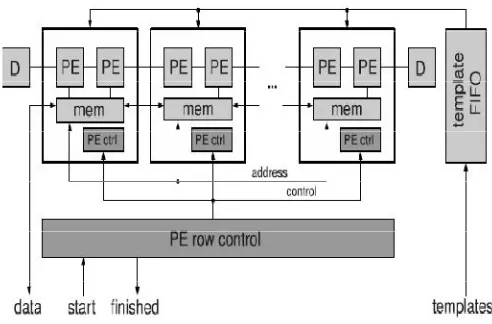
Fig. 1. Array architecture with a row of locally
coupled PEs and additional PE dummies (D).
In this engineering, the system is separated
into vertical sections that are dealt with line-by-line
and fragment by-portion by a column of npe PEs.
Every PE is associated with its left and right
neighbors, or to a spurious PE at either closures of
the line, individually. Fig. 1 demonstrates the
structure of the 1-D processor cluster with the
fundamental control and information ways. For an
ideal equipment usage (Section IV-A), two PEs
Available online: http://edupediapublications.org/journals/index.php/IJR/ P a g e | 17
unit. Both the PEs and the mems are coupled just
locally to direct the steering intricacy. The left and
right PE fakers (D) have no computation center and
are required just to give information from the
outskirts to the neighboring fragments, or to
guarantee the system bound-ary conditions,
separately. The format esteems (weight coefficients)
of the operation are put away in a layout
first-in-first-out that is outlined as a ring support.
B. TITUS—Extension for PTCNN
The modifications to NERO to process the PTCNN
state equation (2) comprise the calculation core of
the PE, the local controller unit, and the template
FIFO. The novel architecture of the calculation core
will be explained subsequently.
The utilization of the Horner scheme (5) exhibits
some advantages over the conventional form of the
PTCNN state equation (2)—the powers of the state
variables do not have to be stored explicitly in
registers, and the interconnections within the PE can
be retained.
With an increasing polynomial order, each cell state
computa-tion easily requires dozens of MAC
operations. Therefore, a fur-ther parallelization
inside the PE becomes reasonable. Equation (5)
permits a semiparallel or fully parallel computation
for all neighbors, followed by an accumulation of
the intermediate results.
For the targeted FPGA platform, the usage of three
DSPs rendered the best choice since the on-chip
DSP slices feature a three-stage pipeline that can be
utilized efficiently to store three intermediate
results. This configuration allows each DSP to
calculate the three polynomials in a pipeline with
single clock cycle latency and without any
interruption.
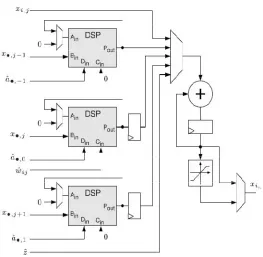
The structure of the extended calculation core is
shown in Fig. 2. It comprises three DSPs for the
left, central, and right column, each processing the
contribution of three neighboring cells to the state
equation. Each DSP (shown in Fig. 3) calculates
three elements of the Horner scheme
mk+1= x · (a +mk) (6)
Available online: http://edupediapublications.org/journals/index.php/IJR/ P a g e | 18
Fig. 2. TITUS calculation core for the emulation of
a PTCNN—the place-holder (•) refers to all rows of
the neighborhood.
Fig. 3. Structure of the DSP core.
The quantity of emphasess of (6) relies upon the
chose polyno-mial arrange. The outcomes are
collected, added to wˆi j , lastly compelled to the
range [−1; 1] with the administrator N. This
requirement can be avoided for the estimation of the
counterbalance term wˆi j that ought to be put away
with the most noteworthy conceivable exactness to
avert numerical issues. With a specific end goal to
give the layout esteems effectively, it is additionally
important to expand the format FIFO module (Fig.
1) by supplanting the single cushion with three
cradles working in parallel.
In past work, we utilized Genetic Algorithms (GAs)
to advance Artificial Non-direct Networks (ANNs)
showing fake versatile conduct, with highlights like
those seen in creatures and people. In (Bilotta et al.
2006), we supplanted ANNs with another class of
dynamical framework called Cellular Non-straight
Networks (CNNs) and utilized CNNs to execute a
multilayer motion show for six-legged fake robots
in a virtual domain with a large number of the
qualities of a physical condition. In the first place
created by Chua and associates (1988), CNNs have
been stretched out to make a CNN Universal
Machine (CNN-UM) (Roska and Chua, 1993), the
Available online: http://edupediapublications.org/journals/index.php/IJR/ P a g e | 19
reasonable for the demonstrating of tangible engine
forms. Utilizations of the chip incorporate the
demonstrating of the mammalian retina (Roska et
al. , 2006) and engine coordination in life-like
robots (Arena and Fortuna, 2002).
CNNs can be sorted out in complex designs of one,
a few dimensional processor exhibits in which the
cells are indistinguishable non-straight dynamical
frameworks, whose as it were associations are
neighborhood.
CNNs can be composed in one-a few dimensional
topologies. As we will find in the accompanying
areas, CNN applications are of importance to a wide
range of controls including Robotics, Dynamic
Systems Theory, Neuro-brain science, Biology and
Information Processing. One of the principal
applications was picture preparing. A digitalized
picture can be spoken to as a two dimensional grid
of pixels. To handle it with a CNN, all that is
important is to utilize the standardized shades of
pixels (i,j) as the underlying condition of the
system. The system at that point acts as a
non-straight dynamical framework with various
conditions equivalent to the quantity of cells. The
system makes it conceivable to play out various
helpful operations on the picture. These incorporate
edge location, era of the opposite figure and so
forth. For extra data on this theme and on different
uses of CNNs, see (Chua, 1998).
As we will find in Section 6, CNNs are
fundamentally the same as programmable
non-direct dynamical circuits – and in actuality physical
executions regularly utilize these circuits. Given
CNN's nonlinear outline, CNNs frequently create
clamorous flow. Given the nearness of nearby
movement in singular cells, it is conceivable to
watch a wide scope of emanant practices. One of
these is the arrangement of Turing designs (Chua,
1995), which are frequently utilized as a part of
robot control. (Field et al., 1998; Arena and Fortuna
2002). Similarly as with all complex developing
wonders, it is hard to distinguish the full scope of
nonlinear dynamic practices a CNN can create and
similarly difficult to control the system's conduct.
The principle reason is that the elements of
individual cells are controlled by first request
non-direct differential conditions. Given that the cells
are coupled, the conditions are additionally coupled.
This makes them like the Lorenz framework and
Chua's circuit (Bilotta et al. 2007a-2007f) which
likewise show very perplexing, scientifically
obstinate flow. What is uncommon about CNNs is
that they can be utilized to repeat the intricate
progression of other non-straight frameworks, for
Available online: http://edupediapublications.org/journals/index.php/IJR/ P a g e | 20
this sense, we can consider CNNs as a general
model or a meta-demonstrate for other dynamical
frameworks.
Another imperative utilization of CNN is in the
numerical arrangement of Partial Differential
Conditions (PDEs). In the event that we utilize a
network to make a discretized space, in which
variable esteems are spoken to by convergences on
the lattice, the subsidiaries concerning spatial
factors can likewise be discretized while the
subsidiaries as for time stay unaltered. These
discretized differential conditions can be mapped
onto the conditions managing the conduct of the
CNN. Thusly, CNNs can reenact an expansive
scope of physical wonders. For more data and a
survey of this part of CNN see (Chua, 1998).
Particular CNN designs can imitate a wide scope of
non-straight marvels that scientists, neurologists and
material science have seen in dynamic non-direct
media and in living tissue. These incorporate
solitons, eigen waves, winding waves,
straightforward examples, Turing designs and so on.
Given CNN's nearby availability, dispersion is a
characteristic property of the system; dispersion
response elements can be reproduced utilizing the
collaborations between an inhibitory also, an
excitory layer. This class of two-layer CNN has
been known as a Reaction-Diffusion CNN. this
work, the authors went so far as to propose the idea
of an alphabet for vision – and argued that
understanding this natural language was one of the
most important problems in modern science. It is a
problem with great relevance to the construction of
artificial organs.
PROPOSED FULLADDER
The proposed modified full adder circuit as shown
in figure, consists of two 2:1 MUX and an XOR
gate. In the proposed structure, one XOR block in
the conventional fulladder is replaced by a
multiplexer block so that the criticalpath delay is
minimized. .
fig 4. Proposed Full Adder
Available online: http://edupediapublications.org/journals/index.php/IJR/ P a g e | 21
RTL Schematic
Simulation output
V. DISCUSSIONS AND CONCLUSION
Broadly useful design for a computerized
imitating of CNNs with polynomial couplings has
been displayed. Actualized on a best in class FPGA,
the framework is able to do fast calculation of
PTCNN operations on expansive scale systems. The
proposed framework is viewed as the primary
advanced equipment execution of a PTCNN up
until this point. Applications for picture handling
and the reenactment of PDEs have been talked
about, some of which proved unable be
acknowledged in a CNN equipment some time
recently. We are as of now actualizing an
augmentation of the polynomialweight design
supporting on-chip improvements of system
parameters, and accordingly making ready to an
extremely productive assurance of issue particular
layouts.
REFERENCES
[1] L. O. Chua and L. Yang, “Cellular neural networks:
Theory,” IEEE Trans. Circuits Syst., vol. 35, no. 10, pp.
1257–1272, Oct. 1988.
[2] L. Nicolosi, F. Abt, A. Blug, A. Heider, R. Tetzlaff,
and H. Höfler, “A novel spatter detection algorithm
based on typical cellular neural network operations for
laser beam welding processes,” Meas. Sci. Technol., vol.
23, no. 1, p. 015401, 2012.
[3] F. Gollas, C. Niederhöfer, and R. Tetzlaff, “Toward
an autonomous platform for spatio-temporal EEG-signal
analysis based on cellular nonlinear networks,” Int. J.
Circuit Theory Appl., vol. 36, nos. 5–6, pp. 623–639,
Sep. 2008.
[4] P. Arena, L. Fortuna, M. Frasca, and L. Patané, “A
CNN-based chip for robot locomotion control,” IEEE
Trans. Circuits Syst. I, Reg. Papers, vol. 52, no. 9, pp.
Available online: http://edupediapublications.org/journals/index.php/IJR/ P a g e | 22
[5] T. Roska, L. O. Chua, D. Wolf, T. Kozek, R.
Tetzlaff, and F. Puffer, “Simulating nonlinear waves and
partial differential equations via CNN. I. Basic
techniques,” IEEE Trans. Circuits Syst. I, Fundam.
Theory Appl., vol. 42, no. 10, pp. 807–815, Oct. 1995.
[6] F. Puffer, R. Tetzlaff, and D. Wolf, “Modeling
nonlinear systems with cellular neural networks,” in
Proc. IEEE Int. Conf. Acoust., Speech, Signal Process.