Robust Encryption, Revisited
Pooya Farshim1, Benoˆıt Libert2, Kenneth G. Paterson3, and Elizabeth A. Quaglia4
1 Fachbereich Informatik, Technische Universit¨at Darmstadt, Germany 2
Technicolor, France
3
Information Security Group, Royal Holloway, University of London, UK
4 D´epartement d’Informatique, ´Ecole Normale Sup´erieure – Paris, France
Abstract. We revisit the notions of robustness introduced by Abdalla, Bellare, and Neven (TCC 2010). One of the main motivations for the introduction of strong robustness for public-key encryption (PKE) by Abdalla et al. to prevent certain types of attack on Sako’s auction protocol. We show, perhaps surprisingly, that Sako’s protocol is still vulnerable to attacks exploiting robustness problems in the underlying PKE scheme, even when it is instantiated with astrongly robust scheme. This demonstrates that current notions of robustness are insufficient even for one of its most natural applications. To address this and other limitations in existing notions, we introduce a series of new robustness notions for PKE and explore their relationships. In particular, we introducecomplete robustness, our strongest new notion of robustness, and give a number of constructions for completely robust PKE schemes.
Keywords.Robustness, Anonymity, Public-key encryption, Security proofs.
1 Introduction
A commonly pursued goal in cryptography is message privacy, which is typically achieved by means of encryption. In recent years, the privacy of users has become an equally relevant concern. It has led the research community to strive for anonymity properties when designing cryptographic primitives. In public-key encryption, in particular,key-privacy (a.k.a. receiver anonymity) was introduced in [4] to capture the idea that a ciphertext does not leak any information about the public key under which it was created, thereby making the communication anonymous. In this context, Abdalla, Bellare, and Neven [2] raised a fundamental question: how does a legitimate user know if an anonymous ciphertext is intended for him? Moreover, what happens if he uses his secret key on a ciphertext not created under his public key? To address this question, Abdalla et al. formalized a property called robustness, which (informally speaking) guarantees that decryption attempts fail with high probability if the “wrong” private key is used. They argued that, in all applications requiring anonymous public-key encryption, robustness is usually needed as well. These applications include auction protocols with bid privacy [28], consistency [1] in searchable encryption [8] and anonymous broadcast encryption [3,24]. As shown by Mohassel [25], robustness is also important in guaranteeing the anonymity of hybrid encryption schemes resulting from the combination of anonymous asymmetric and symmetric components.
1.1 Robust public-key encryption
Robustness ensures that a ciphertext cannot correctly decrypt under two different secret keys. This notion has (often implicitly) been present in the literature (e.g., [28,8,10,22,3]), but formal definitions remained lacking until the recent foundational work of Abdalla et al. [2]. In particular, Abdalla et al. introduced two flavors of encryption robustness:weak and strong robustness.
Weak robustness is modeled as a game in which a winning adversary outputs a valid message M and two distinct public keyspk0 and pk1 such that the encryption of M underpk0 decrypts to a valid message undersk1, the secret key corresponding topk1. This notion is of interest since it precisely addresses the issue
Strong robustness—also called SROB-CCA when the adversary has access to a decryption oracle— allows for a more powerful adversary which chooses a ciphertextC (as opposed to a message which will be honestly encrypted) and two distinct public keys, and wins if C decrypts to a valid message under both corresponding secret keys. In [2] the need for this notion is motivated by scenarios where ciphertexts can be adversarially chosen. The authors of [2] give Sako’s auction protocol [28] as an example of such a situation, explaining that strong robustness is required in order to prevent an attack on the fairness of this protocol by a cheating bidder and a colluding auctioneer.
As pointed out by Abdalla et al. [2], merely appending the receiver’s public key to the ciphertext is not an option for providing robustness, since it destroys key-privacy properties. Abdalla et al. also showed that the seemingly natural solution of using an unkeyed redundancy function to modify the message before encryption does not achieve even weak robustness, thus demonstrating the non-triviality of the problem. They then gave several anonymity-preserving constructions to obtain both weak and strong robustness for public-key encryption. Using a simple tweak, they also showed how to render the Cramer– Shoup cryptosystem [13] strongly robust without introducing any overhead.
More recently, Mohassel [25] studied robustness in the context of hybrid encryption [14]. He showed that weak robustness (and not only anonymity) is needed in the asymmetric part of a hybrid encryption scheme to ensure anonymity of the overall scheme. Mohassel also considered relaxations, called collision-freeness, of both weak and strong robustness. He showed that many constructions in the literature are natively collision-free and showed how to generically turn any weakly (resp., strongly) collision-free scheme into a weakly (resp., strongly) robust one.
1.2 Our contributions
The need for stronger definitions. In this paper, we argue that some applications require even stronger forms of robustness than those considered in [2,25]. The first such application is, perhaps surpris-ingly, the construction of auction protocols with bid privacy, like that of Sako [28]. Recall that this was one of the initial motivations for analyzing robustness in [2]. Strong robustness actually turns out not to suffice for thwarting attacks against the fairness of Sako’s auction protocol [28]: strong robustness assumes honestly generated public keys whereas, if the auctioneer can collude with cheating bidders (as assumed in [2]), what really needs to be considered is an adversary who can maliciously generate ciphertextsand the public keys. To illustrate this, we show an attack on the fairness of Sako’s protocol when instantiated with CS?, a variant of the Cramer–Shoup encryption scheme which was proven to be key-private and strongly
robust in [2]. This observation, then, motivates us to introduce notions of robustness where keys may be maliciously generated. We do not offer a full treatment of the delicate issue of fairness in auction protocols and its relation to robustness, since that is beyond the scope of this paper. Rather, as with [2], we use Sako’s protocol as a motivation for introducing and studying stronger robustness notions.
The limitations of existing robustness notions, and therefore the motivation for this work, are not solely restricted to Sako’s protocol. For instance, existing notions are not necessarily strong enough to provide robustness guarantees if the scheme is used to encryptkey-dependent messages [7] or messages encrypted underrelated keys [6]. This is because the adversary is denied access to the secret keys in these notions. The strongest of our new notions gives the adversary sufficient power and automatically provides robustness in these more challenging settings.
Fig. 1.Relations among notions of robustness.
view robustness in terms of the behavior of the encryption and decryption algorithms with respect to each other, and obtain our CROB notion. Roughly speaking, in CROB, the adversary should not be able to find “collisions” in the scheme beyond those which are already implied by the correctness property of the scheme. For example, he should not be able to “explain” a ciphertextCof his choice as an encryption under two different adversarially chosen public keyspk0,pk1 by revealing the plaintext and the encryption coins forpk0 and the secret keysk1 forpk1. As we will see, full robustness can be viewed as the “decryption-only
part” of CROB. Another natural notion of robustness, which we call key-less robustness (KROB), arises as the dual notion corresponding to the “encryption-only part” of CROB, and is also implied by CROB. Finally, XROB is a “mixed” notion derived from FROB and KROB that has no natural interpretation but is a useful tool in establishing results about these notions.
We next study how these new notions of robustness relate to each other and to existing notions. Figure 1 summarizes the main relations that we prove between our new and existing robustness notions. In this figure, the lack of an implication between two notions should be interpreted as meaning that we prove a separation. Thus, for example, we will show that CROB is strictly stronger than FROB. It is apparent from the figure that we provide a complete account of the pairwise relations between the various robustness notions. In addition to these relations, we can prove several pairwise separations. For example, we will show that no two of the three notions from{FROB,KROB,XROB}are sufficient to prove CROB, but that their combination is. Thus we obtain a characterization of CROB in terms of the three intermediate notions. These separations are not displayed in the figure for ease of visual presentation.
That robustness can come in so many flavors may be unsettling to some readers. Certainly, one should not seek to clutter the definitional landscape unnecessarily. Yet, with the exception of XROB, all of our notions arise as natural generalizations of the existing notions. Exploring their relations is then a natural endeavor. This is not so different from the situation for, say, confidentiality and anonymity notions for public-key encryption, where we now have many different security definitions and developing an under-standing of their relations has taken several years.
Constructions of completely robust encryption.Having defined CROB and its weaker relatives, we prove it to be achievable via a variety of efficient and natural constructions.
We first show that the generic construction for strong robustness presented in [2] is already powerful enough as to also achieve CROB. Further, we observe that a slight modification of this transformation allows dispensing with the weak robustness assumption—which was necessary in [2]—on the underlying PKE scheme. Moreover, we point out that the random-oracle-based generic transformation of Mohassel [25] also achieves CROB.
pinpointed that applying the one-time-signature-based CHK transformation to the Boyen–Waters IBE [11], for example, does not provide SROB-CCA or even SROB-CPA. Here, we show how to obtain AI-CCA-secure, completely robust PKE schemes from weakly secure IBE schemes. Our construction is a variant of the Boneh–Katz construction for chosen-ciphertext security [9], and it only requires the underlying IBE to satisfy a weak level of security under chosen-plaintext attacks. In comparison, the most powerful trans-formation of [2] must start from a scheme that is already AI-CCA-secure to achieve a comparable result. Because our technique simultaneously provides complete robustnessand AI-CCA security, it enjoys better efficiency than applying the strongest robustness-conferring transformation of [2] to an AI-CCA-secure scheme obtained from the original Boneh–Katz transformation.
Finally, we also ask whether we can improve upon the efficiency of generic constructions with concrete schemes whose security rests on specific computational assumptions. By giving a concrete construction of a scheme that is CROB and AI-CCA-secure, we present a different and potentially more efficient way of directly achieving CROB for certain hybrid encryption schemes such as the Hofheinz–Kiltz [20] or Kurosawa–Desmedt [23] schemes. To do so, we take advantage of certain properties in the underlying sym-metric components. Namely, we consider hybrid schemes that build on theencrypt-then-MAC paradigm in their symmetric part to obtain a suitably secure symmetric cipher. We show that, if the message authen-tication code (MAC) is what we call committing, then a simple modification in the hybrid scheme gives complete robustness without any significant computational overhead. The use of committing MACs readily extends as a tool to design AI-CCA-secure CROB hybrid constructions via the KEM/DEM framework [14]. Concretely, Mohassel [25] showed that the KEM/DEM framework gives an AI-CCA-secure hybrid encryp-tion scheme when the KEM component is weakly robust and AI-CCA, and the DEM component is an authenticated symmetric encryption scheme. If the latter part is furthermore realized using the encrypt-then-MAC approach with a committing MAC, we easily obtain complete robustness as well. As we will see, the committing MAC technique can also offer certain advantages.
Taken altogether, our constructions achieving CROB rely on different building blocks and, when fully instantiated, allow us to rely on a variety of different hardness assumptions. They demonstrate that CROB, while providing strong guarantees, is attainable in an efficient and flexible manner.
Organization.We start by reviewing the previous notions of robustness and highlighting their limitations in Section 2. Section 3 presents our new notions of robustness. In Section 4, we study the relations among notions of robustness. We describe our generic constructions in Section 5 and give an efficient construction in Section 6. We close by some concluding remarks in Section 7.
2 Previous Notions of Robustness and Their Limitations
We first briefly recall the existing notions of robustness, namely weak and strong robustness from [2].
2.1 Weak and strong robustness
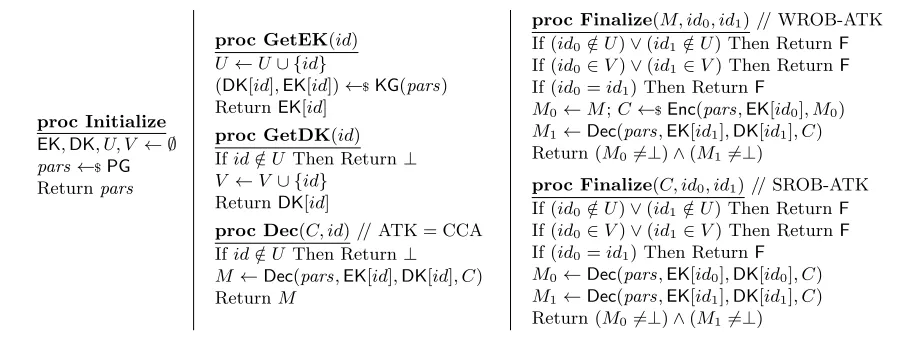
LetPKE = (PG,KG,Enc,Dec) be a public-key encryption scheme consisting of parameter-generation, key-generation, encryption, and decryption algorithms (see Appendix A for the detailed syntax). The authors of [2] distinguish between weak robustness, where the adversary has to output a message and two public keys, andstrong robustness, where it outputs a ciphertext and two public keys. The corresponding games are recalled in Figure 2.
2.2 Strong robustness does not suffice for auction protocols
Sako’s auction protocol [28] was the first practical protocol to ensure bid privacy, i.e., to hide the bids of losers. The basic idea is as follows. Let V ={v1, ..., vN} be the set of possible bid values. The auctioneer
proc Initialize
EK,DK, U, V ← ∅
pars←$PG
Returnpars
proc GetEK(id) U ←U∪ {id}
(DK[id],EK[id])←$KG(pars)
ReturnEK[id]
proc GetDK(id) Ifid /∈U Then Return⊥
V ←V ∪ {id}
ReturnDK[id]
proc Dec(C, id) // ATK = CCA Ifid /∈U Then Return⊥
M ←Dec(pars,EK[id],DK[id], C) ReturnM
proc Finalize(M, id0, id1) // WROB-ATK
If (id0∈/U)∨(id1∈/U) Then ReturnF
If (id0∈V)∨(id1∈V) Then ReturnF
If (id0=id1) Then ReturnF
M0←M;C←$Enc(pars,EK[id0], M0)
M1←Dec(pars,EK[id1],DK[id1], C)
Return (M06=⊥)∧(M16=⊥)
proc Finalize(C, id0, id1) // SROB-ATK
If (id0∈/U)∨(id1∈/U) Then ReturnF
If (id0∈V)∨(id1∈V) Then ReturnF
If (id0=id1) Then ReturnF
M0←Dec(pars,EK[id0],DK[id0], C)
M1←Dec(pars,EK[id1],DK[id1], C)
Return (M06=⊥)∧(M16=⊥)
Fig. 2.Games defining weak/strong robustness.
encrypts a pre-determined message M under the public keypki. This is signed and posted by the bidder. Toopen a bid the auctioneer attempts to decrypt the encrypted bids one by one usingskN. If at least one
decrypts toM, the auctioneer publishes the winning bidvN, a list of all the winning bidders and the secret
key skN for the bidders to verify correctness of the result. If no decryption returns M, the auctioneer
repeats the procedure using skN−1, and so on. For the auction to hide the bid values, the underlying
public-key encryption scheme needs to be key-private, in the sense of [4].
In [28], Sako provided an example of an auction protocol scheme based on the ElGamal public-key encryption scheme, which is key-private. In [2], Abdalla et al. gave an attack which allows a cheating bidder and a colluding auctioneer to break the fairness of the protocol. This attack is based on the fact that the ElGamal scheme is not robust and therefore the auctioneer can open the cheating bidder’s bid to an arbitrary (winning) value. To prevent this attack, the authors of [2] suggest using any strongly
robust scheme (strong robustness, instead of simply weak robustness, is required since the ciphertexts are generated adversarially).
We show that strong robustness is not sufficient to prevent an attack of the above type on Sako’s protocol. More precisely, we present an attack on the protocol when it is instantiated with a variant of the Cramer–Shoup encryption scheme,CS?, which is known to be key-private and strongly robust (the latter
result was proved in [2]). Just as with the attack of Abdalla et al. [2], the attack we present assumes a cheating bidder and a colluding auctioneer. The key idea behind the attack (which is presented in detail in Appendix C) is that an auctioneer can maliciously prepare the public keys so that the cheating bidder’s encryption decrypts toM underany secret key.
This attack shows that strong robustness is not enough to guarantee fairness in Sako’s auction protocol. Intuitively what is needed here is a form of robustness wherein all the public keys and ciphertexts in the system may be adversarially generated. In the coming sections we will formalize stronger notions of robustness which rule out such attacks.
3 New Notions of Robustness
3.1 A direct strengthening: full robustness
Recall that an SROB adversary has to output a ciphertext C and two public keys pk0 and pk1 such that
C decrypts to a message M0 under (sk0,pk0) and a messageM1 under (sk1,pk1). The notion poses three
The first condition isinherent to modeling the behavior of an encryption scheme when used on different public keys, and removing it would make it trivial for an adversary to win.
We now look at the notion resulting from the removal of the second restriction, i.e., when the adversary is allowed to query secret keys even for the finally output public keys. We call this notion unrestricted strong robustness (USROB). This game therefore proceeds as the SROB game does except that the check (id0 ∈ V)∨(id1 ∈ V) is no longer present in the Finalize procedure. This notion is powerful enough to
model scenarios where keys are honestly generated, but an adversary may know the secret keys. This, for example, includes robustness for the encryption of key-dependent messages as discussed in the introduction. However, as we have seen in the previous section, if an adversary can control the generation of keys, it may be unreasonable to assume that it can only generate the keys honestly. We therefore can strengthen USROB further by removing the third restriction on the adversary. We, however, ask the adversary to return secret keys for the public keys that it chooses. Two points deserve further attention at this point. First, returning the secret keys is to allow for a polynomial-time game definition which is not excessively strong. Second, we do not require the secret keys to be valid. Indeed, it is the responsibility of the decryption algorithm to check that the key-pair it receives is valid. Note that as a result of removing the two restrictions, the adversary has now full control over the keys, and we no longer need to provide the adversary with the oracles present in the SROB and USROB games. These modifications result in a simple, but strong, notion we callfull robustness (FROB), and formalize in Figure 3.
proc Initialize
pars←$PG
Returnpars
proc Finalize(C,pk0,pk1,sk0,sk1) // FROB
If (pk0=pk1) Then ReturnF
M0←Dec(pars,pk0,sk0, C)
M1←Dec(pars,pk1,sk1, C)
Return (M06=⊥)∧(M16=⊥)
Fig. 3.Game defining full robustness.
3.2 A unified approach: complete robustness
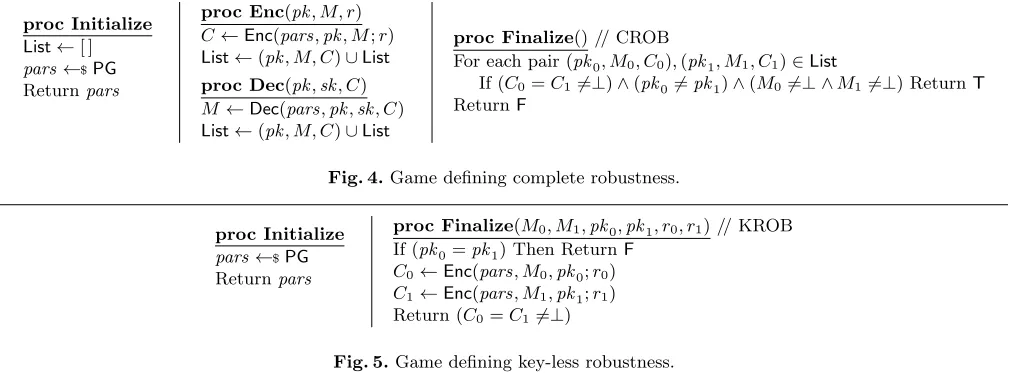
At this point it can be asked if there are attacks which fall outside the FROB model. To answer this question, we take a somewhat different approach towards robustness and view it in terms of the behavior of the encryption and decryption routines of a scheme with respect to each other. In fact, this is the underlying intuition behind not only the original weak robustness notion,5but also the standard correctness criterion for a PKE scheme (albeit for a single key). This leads us to a new notion which we termcomplete robustness (CROB). In this game the shared parameters of the system are passed to an adversary, which then arbitrarily interacts with the encryption and decryption routines on plaintexts, ciphertexts, keys, and even random coins of its choice. Its goal is to find an “unexpected collision” in the cryptosystem (i.e., one outside that imposed by the correctness criterion). We formalize the CROB game in Figure 4.
Key-less robustness. It can be seen through an easy inspection that full robustness is a sub-case of complete robustness where the adversary is restricted to querying the Dec oracle. One can also consider the dual case where the adversary only queries theEncoracle. This results in a new notion which we call
key-less robustness (KROB). Key-less robustness differs from full robustness in that an adversary no longer needs to return any secret keys, but instead “opens” a ciphertext by providing the random coins and the message used in the encryption. More precisely, the adversary outputs two messages, two distinct public keys and two sets of random coins, and its goal is to invoke a collision in the encryption algorithm. The game is shown in Figure 5.
5
proc Initialize
List←[ ] pars←$PG
Returnpars
proc Enc(pk, M, r) C←Enc(pars,pk, M;r) List←(pk, M, C)∪List
proc Dec(pk,sk, C) M←Dec(pars,pk,sk, C) List←(pk, M, C)∪List
proc Finalize() // CROB
For each pair (pk0, M0, C0),(pk1, M1, C1)∈List
If (C0=C16=⊥)∧(pk06=pk1)∧(M0 6=⊥ ∧M16=⊥) ReturnT
ReturnF
Fig. 4.Game defining complete robustness.
proc Initialize
pars←$PG
Returnpars
proc Finalize(M0, M1,pk0,pk1, r0, r1) // KROB
If (pk0=pk1) Then ReturnF C0←Enc(pars, M0,pk0;r0)
C1←Enc(pars, M1,pk1;r1)
Return (C0=C16=⊥)
Fig. 5.Game defining key-less robustness.
Intuitively this notion appears to be the strongest amongst the ones considered so far, since the ad-versary has the liberty to choose the public keys and does not have to reveal any secret information. Surprisingly, we will see that key-less robustness does not implyany other of the other notions considered so far (FROB, SROB, and not even weak robustness). Furthermore, we will show that FROB does not imply KROB either. In the next section we give a complete treatment of relations among different notions.
Identity-based encryption. In the IBE setting the identities (analogous to public keys in the PKE setting) are already chosen maliciously, while the natural extension of our notions would allow the adversary to also choose the IBE master keys maliciously. In particular, the identity-based analogue of FROB would be strong enough to guarantee well-addressedness according to the definition proposed by Hofheinz and Weinreb [21] (see also Figure 9 in Appendix B), whereas SROB-CCA may not always do so. We leave the further development of the ID-based setting to future work.
4 Relations among Notions of Robustness
We now study how the various notions of robustness relate to each other. Starting with complete robustness, it may be asked if KROB and FROB are strong enough together to jointly imply CROB. We show that this is not the case. Indeed, there is a third “mixed” notion of robustness implicit in CROB, which we term XROB and formalize in Figure 6. As the next theorem shows, the XROB notion is necessary in the sense that it is not implied by KROB and FROB together.
In fact, no pair of the notions from {FROB,KROB,XROB} implies the third. Furthermore, the con-junction of all three notions is sufficient to imply CROB.
Theorem 1 (CROB Characterization). A PKE scheme is CROB if and only if it is simultaneously
FROB, KROB, and XROB. Furthermore, no combination of at most two of FROB, KROB, and XROB
is sufficient to provide the CROB guarantees.
We prove the theorem via a sequence of propositions in Appendix E. To give a flavor of our results we present one of these next.
Proposition 1 (FROB∧KROB =6⇒ XROB). Let PKE be a public-key encryption scheme which is
FROBand KROB. Then there is a scheme PKE0 which is FROBand KROB, but fails to be XROB.
Proof. We define the required scheme PKE0 as follows.
proc Initialize
pars←$PG
Returnpars
proc Finalize(M0,pk0, r0, C1,pk1,sk1) // XROB
If (pk0=pk1) Then ReturnF
C0←Enc(pars, M0,pk0;r0)
M1 ←Dec(pars,pk1,sk1, C1)
Return (C0=C1)∧(M0=6 ⊥)∧(M16=⊥)
Fig. 6.Game defining mixed robustness.
KG0(pars): Run KG(pars) to obtain (sk,pk). Return (sk,0kpk).
Enc0(pars, bkpk, M;r): Run Enc(pars,pk, M;r) to obtain C. OutputbkC.
Dec0(pars, bkpk,sk, ckC): If b = 1 return ⊥. If c = 1 return a fixed (e.g., the lexicographically smallest) message M? in the message space forpk. Else returnDec(pars,pk,sk, C).
Note that PKE0 is a correct public-key encryption scheme. We show PKE0 is not XROB. Consider the XROB adversary A which obtains pars, generates a key-pair (sk,0kpk) and a set of coins r for the encryption algorithm, and returns (M,1kpk, r,1kC,0kpk,sk) where M is any valid message and C :=
Enc(pars,pk, M;r). This tuple wins the XROB game with probability 1 as 1kpk 6= 0kpk, the output of
Enc0(pars,1kpk, M;r) is 1kC, and the output ofDec0(pars,0kpk,sk,1kC) isM?6=⊥.
It is easy to see that PKE0 is still KROB. Indeed, since Enc0 attaches the first bit of its input public key to the ciphertext, if a collision in the output ofEnc0 for two distinct public keys arises, it must be that the public keys have the same starting bit and hence they must be differing in their remaining parts. This then translates into a KROB attack on the underlying schemePKE.
To see that the modified scheme is also FROB, observe that no adversary can win the FROB game by outputting any public key whose starting bit is a 1 as otherwise the decryption algorithm will reject. Therefore the public keys must start with a 0, and as before, in a successful FROB attack the remaining parts of the public keys must be differing. Now since the leading bit,c, of the ciphertexts does not affect
Dec0, we also obtain an FROB attack on the starting schemePKE. ut
It is natural to study how our new notions relate to the existing notions from Abdalla et al. [2]. Since USROB is a natural intermediate notion, for the sake of completeness, we also investigate where it stands in relation to existing notions. We start by observing that FROB =⇒ USROB =⇒ SROB-CCA as the adversary becomes progressively more restricted in each game. Moreover, in the first part of the following theorem, we show that USROB is strictly stronger than SROB-CCA, and that FROB is strictly stronger than USROB. In the second part of the theorem we show that KROB does not even imply WROB-CPA, separating this notion from all notions other than complete robustness. Finally, we show that XROB implies WROB-CCA but not SROB-CPA. Hence XROB can be seen a strengthened version of weak robustness in a direction orthogonal to strong robustness.
Theorem 2 (Relation with WROB and SROB). Let PKE be a PKE scheme. We have the following.
– FROB: If PKE is FROB, then it is also USROB. If PKE is USROB then it is also SROB-CCA. Moreover, these implications are strict.
– KROB: KROB does not implyWROB-CPA and SROB-CCA does not imply KROB.
– XROB: IfPKE isXROB, then it is alsoWROB-CCA. Furthermore,XROBdoes not implySROB-CPA
and SROB-CCA does not imply XROB.
5 Generic Constructions of Completely Robust Public-key Encryption
5.1 Mohassel’s transformation
Mohassel [25] gives a generic transformation in the random-oracle model that converts an AI-ATK encryp-tion scheme into one which is SROB-CCA without compromising its AI-ATK security. This construcencryp-tion also achieves complete robustness. In this construction, the hash valueH(pk, r, M), whereris the random-ness used in the encryption, is attached to ciphertexts. This immediately rules out all forms of collisions between ciphertexts, as the hash values are unlikely to collide on two distinct public keys.
5.2 The ABN transformation
In [2, Theorem 4.2] the authors give a generic construction for a schemePKE which confers strong robust-ness and preserves the AI-ATK security of the starting scheme PKE, provided that the latter scheme is additionally WROB. We briefly describe how the transformation works, and refer the reader to the original work for the details. At setup, include inpars forPKE the parameters of a commitment scheme (see Ap-pendix G for the definitions). When encrypting, commit to the public key, and encrypt thede-commitment
along with the message. Also include the commitment as a ciphertext component. Decryption checks the commitment/de-commitment pair for consistency and rejects if this is not the case. We strengthen the result of [2], showing that this construction achieves complete robustness:
Theorem 3 (The ABN Transformation AchievesCROB).LetAbe a PPTCROBadversary against
PKE. Then there exist PPT adversariesB1, B2, and B3 against the binding property of CMT such that
AdvcrobPKE(A)≤AdvbindCMT(B1) +AdvbindCMT(B2) +AdvbindCMT(B3).
The proof of this theorem is given in Appendix H, where we show scheme PKE is simultaneously FROB, KROB, and XROB.
5.3 A modification of the ABN transformation
While the original transformation [2] does provide AI-ATK and CROB guarantees, the AI-ATK security of the transformed scheme PKE relies on the weak robustness of the underlying encryption schemePKE in the case of chosen-ciphertext adversaries (i.e., when ATK = CCA). We show that, if the underlying encryption scheme supports labels [29] (in which case the encryption and decryption algorithms both take an additional public string L as input; see Appendix A), this assumption can be eliminated and we only needPKE to be AI-ATK-secure.
Although the weak robustness assumption is not too demanding in theory (since any encryption scheme can be made weakly robust by means of a keyed redundancy-based transformation [2]), our construction provides better efficiency in some settings since many AI-CCA encryption schemes, such as the Cramer– Shoup or the Kurosawa–Desmedt scheme, natively support labels.6
Our transformation, which relies on a commitment scheme CMT = (CPG,Com,Ver), is as follows.
PG(1λ): Runpars ←$PG(1λ) to obtain public parameterspars forPKE. Then, generatecpars ←$CPG(1λ)
forCMT. Finally, return (pars,cpars).
KG(pars,cpars): Compute and return (sk,pk)←$KG(pars).
Enc (pars,cpars),pk, M: The algorithm proceeds in two steps.
6In the worst case, labeled public-key encryption schemes can always be obtained by appending the label to the encrypted
1. Commit topk by computing a pair (com, dec)←$Com(cpars,pk).
2. EncryptMkdec under the labelL=com by computingC ←$Enc(pars,pk, Mkdec, L).
Return (C, com) as the final ciphertext.
Dec (pars,cpars),pk,sk,(C, com): The algorithm proceeds in two steps.
1. Compute M0 ← Dec pars,pk,sk,(C, com), L, with L = com. Then, parse M0 as Mkdec (and return⊥ifM0 cannot be parsed properly).
2. Return M ifVer(cpars,pk, com, dec) = 1. Else return⊥.
Theorem 4, whose proof is in Appendix I, shows that thanks to the use of labels, we do not have to rely on any weaker form of robustness ofPKE when proving the AI-ATK security of PKE.
Theorem 4. If PKE is AI-ATK-secure andCMT is a hiding commitment, then PKE isAI-ATK-secure. More precisely, for any PPT AI-ATK adversary A against PKE, there exists a PPT AI-ATK adversary
B1 againstPKE and a PPT distinguisher B2 against CMT such that
AdvPKEai-atk(A)≤2·AdvPKEai-atk(B1) +AdvhideCMT(B2).
Furthermore, the above construction isCROBifCMT is a binding commitment. More precisely, for any PPTCROB adversaryA, there exists a PPT adversaryB against the binding property of the commitment scheme such that
AdvcrobPKE(A)≤AdvbindCMT(B).
5.4 Completely robust AI-CCA-secure PKE from selectively secure IBE
Next, we present a modification of the Boneh–Katz approach [9] which provides both CROB and AI-CCA security when applied to any IBE scheme that only provides TA anonymity in the multi-authority selective-ID setting (or sselective-ID-TAA-CPA security, as defined in Appendix J). In particular, this positively answers the question of whether CHK-like techniques can be used to achieve a strong flavor of robustness from weakly secure IBE.
Let IBE be an sID-TAA-CPA secure IBE scheme. We obtain a completely robust AI-CCA-secure public-key encryption schemePKE by combiningIBE with a strongly secure message authentication code MAC and a trapdoor commitment schemeT CMT.
Recall that a trapdoor commitment scheme T CMT = (CPG,Com,Ver,Equiv) consists of efficient algo-rithms where (CPG,Com,Ver) function as in an ordinary commitment except thatCPGoutputs public pa-rameterscpars and a trapdoortd. In addition,Equivallows equivocating a commitment using the trapdoor
td: for any two messagesm1, m2 and any tuple (com, dec1) produced as (com, dec1)←$Com(cpars, m1), the
trapdoortdallows computingdec2←$Equiv(td, com, m1, dec1, m2) such thatVer(cpars, com, m2, dec2) = 1.
Moreover, (com, dec2) has the same distribution asCom(cpars, m2).
Our IBE-based constructionPKE = (PG,KG,Enc,Dec) is as follows.
PG(1λ): Runpars ←$IBE.PG(1λ) to obtain common public parameterspars. Also runcpars ←$CPG(1λ)
to obtain public parameters for a trapdoor commitment scheme T CMT. Then, choose a message authentication code MAC with key length`∈poly(λ). Finally, return (pars,cpars,MAC).
KG(pars,cpars,MAC): Generate a master key pair (msk,mpk)←$IBE.MPG(pars) for IBE. Return the
key pair (sk,pk) := (msk,mpk).
Enc (pars,cpars,MAC),pk, M
: To encryptM under pk =mpk, the algorithm proceeds as follows. 1. Choose a random MAC keyk←${0,1}`.
2. Commit tompkkkby computing a pair (com, dec)←$Com(cpars,mpkkk).
4. Compute tag =MacGenk(C) and return (C, com,tag) as the final ciphertext.
Dec (pars,cpars,MAC),pk,sk,(C, com,tag)
: Given pk = mpk and sk = msk, conduct the following steps.
1. Compute dkcom ←$ IBE.KG(pars,msk, com) and then M0 ← IBE.Dec pars,mpk,dkcom, com, C
. Then, parseM0 asMkkkdec (and return⊥ ifM0 =⊥or ifM0 cannot be parsed properly).
2. IfMacVerk C,tag
= 1 and Ver(cpars,mpkkk, com, dec) = 1, return M. Otherwise, return⊥.
A difference with the original Boneh–Katz construction—which can use a weak form of commitment calledencapsulation—is that our construction requires a full-fledged commitment scheme. This is because, in order to achieve complete robustness, we need to commit to the master public key of the scheme at the same time as the MAC key in the encryption algorithm. Moreover, the proof of AI-CCA security requires the commitment to be atrapdoor commitment: the trapdoor plays an essential role when it comes to reduce the sID-TAA-CPA security of the IBE to the AI-CCA security of the encryption scheme.
The proof of the following theorem can be found in Appendix J.
Theorem 5. If IBE is sID-TAA-CPA-secure, MAC is strongly unforgeable, and T CMT is a computa-tionally binding trapdoor commitment scheme, then PKE is AI-CCA-secure. Moreover, the scheme PKE
is CROBif T CMT is computationally binding.
6 A Concrete CROB Scheme
In this section, we describe a simple way to achieve complete robustness using hybrid encryption where the symmetric component uses the encrypt-then-MAC approach. To this end, we require the MAC to satisfy a “MAC analogue” of the notion of committing symmetric encryption [17]. Informally this notion requires that a given MAC tag is valid for a single message regardless of the key used.
Committing MAC.We say MAC = (MacGen,MacVer) is committing if for any messagem and any key
k, there exists no message-key pair (m0, k0) such that m0 6=m and MacVerk0(m0,MacGenk(m)) = 1.
We also need the MAC to computationally hide the message. Note that the following definition is implied by the definition of message-hiding security used in [15, Definition 2.2].
Indistinguishable MAC. We say that a message authentication code MAC = (MacGen,MacVer) with key spaceKSpprovidesindistinguishabilityif, for any two messagesm0, m1, it is computationally infeasible
to distinguish the distributions Db :={tag ←$MacGenk(mb) :k←$KSp}forb∈ {0,1}.
For our purposes, the MAC only has to provide one-time strong unforgeability. Namely, the adversary is allowed to see one pair of the form (m,tag), wheretag =MacGenk(m), and should not be able to produce
a pair (m0,tag0) such that (m0,tag0)6= (m,tag) andMacVerk(m0,tag0) = 1.
Using ideas from [17], it is easy to construct a MAC which is simultaneously committing, indistin-guishable, and strongly unforgeable. The idea is to use a family ofinjectiveandkey-binding pseudorandom functions: for any distinct keys k1, k2, the functions fk1(·) and fk2(·) have disjoint ranges, i.e., there exist
no two pairs (k1, x1),(k2, x2) such that k1 6=k2 and fk1(x1) =fk2(x2). The key space of the MAC is that
of the PRF. For any messagem6= 1λ, the MAC generation computes and outputs the pair (f
k(1λ), fk(m)).
The first component serves as a perfectly binding commitment to the key k while the injectivity of fk(·)
guarantees that the MAC is only valid for one message. In addition, its strong unforgeability and indistin-guishability properties are both implied by the pseudorandomness of {fk}k as long as the message space
of the MAC,MSpmac, does not include 1λ (the proof is straightforward).
comes with the advantage that its computational efficiency is the same as the original HK scheme and in particular it is more efficient than combining HK with a commitment using the ABN transformation.
PG(1λ): Choose a groupGof prime orderp >2λwithg←$G. Also, choose a symmetric encryption scheme
(E,D) of key length `0 and a message authentication code MAC = (MacGen,MacVer) of key length `1. Finally, choose a key-derivation function KDF : G → {0,1}`0+`1, a target collision-resistant hash function7 TCR:G→Zp, and a collision-resistant hash functionH :{0,1}∗ →MSpmac, where MSpmac
is the message space of MAC. The public parameters consist of pars := G, p, g, (E,D), MAC,
TCR, KDF, H
.
KG(pars): Choose x, y, z←$Z∗p and computeu=gx,v=gy, and h=gz. The public key is pk = u, v, h
and the private key issk = (x, y, z)∈(Z∗p)3.
Enc pars,pk, M
: To encryptM under the public key pk, choose s←$Z∗p and compute
C1 =gs, C2= (uτ ·v)s, C3 ←$EK0(M), tag =MacGenK1(H(C3, u, v, h))
where τ =TCR(C1)∈Z∗p and (K0, K1) =KDF(hs)∈ {0,1}`0+`1. Return C= (C1, C2, C3,tag). Dec pars,pk,sk, C
: GivenC= (C1, C2, C3,tag), return⊥ifC2 6=C1τ·x+y, whereτ =TCR(C1). Otherwise,
compute (K0, K1) = KDF(C1z) and then M ← DK0(C3). Return M if MacVerK1(H(C3,pk),tag) = 1.
Otherwise, return⊥.
The scheme was known to be IND-CCA-secure. We are also able to prove that it provides AI-CCA security, essentially because the ciphertexts can be shown to be indistinguishable from dummy ciphertexts that are statistically independent of the public key, even in the presence of a decryption oracle. Proofs of the following results may be found in Appendix K.
Theorem 6. The scheme provides AI-CCA security assuming that: (1) The DDH assumption holds in
G; (2) (E,D) is a semantically secure symmetric encryption scheme; (3) KDF is a secure key-derivation
function;8 (4) MAC is a one-time strongly unforgeable MAC and provides indistinguishability; (5)H and TCR are collision-resistant and target collision-resistant, respectively. Furthermore, the scheme is CROB
if H is collision-resistant and MAC is committing.
Interestingly, if the construction of Section 5.4 is modified to use a committing MAC, it can be in-stantiated using any commitment scheme and in particular a perfectly binding commitment or even an encapsulation scheme (as in the original Boneh–Katz construction) also work. In this case, the sender no longer needs to commit to the master public key: (com, dec) is generated by committing to the MAC key only. Instead, the sender computestag astag =MacGenk(H(C,mpk)) using a collision-resistant hash
func-tionH. If the MAC is committing, the resulting construction is easily seen to provide complete robustness. It also remains AI-CCA-secure provided the MAC satisfies the notion of indistinguishability.
7 Closing Remarks
Motivated in part by the shortcomings of existing definitions of robustness, we have made a thorough exploration of the landscape of robustness definitions and their relations, and given a suite of flexible and efficient methods for obtaining completely robust AI-CCA-secure public-key encryption schemes. In future work, one could explore the situation in the ID-based setting. Another open question, well beyond the remit of this paper, is to formalize the fairness of auctions and formally prove that our CROB notion is strong enough to ensure this property for Sako’s protocol or its variants.
7
As in [20], this function can be replaced by an injective encoding fromGtoZp.
8The standard KDF security requires that no distinguisher can tell if it is given the output of the KDF for a random input
Acknowledgments. The authors would like to thank Mihir Bellare for his valuable comments. Pooya Farshim is supported by grant Fi 940/4-1 of the German Research Foundation (DFG). Part of this work was done while Benoˆıt Libert was an F.R.S.-F.N.R.S. scientific collaborator at the Universit´e catholique de Louvain (Belgium). Kenneth G. Paterson was supported by an EPSRC Leadership Fellowship, EP/H005455/1.
References
1. Michel Abdalla, Mihir Bellare, Dario Catalano, Eike Kiltz, Tadayoshi Kohno, Tanja Lange, John Malone-Lee, Gregory Neven, Pascal Paillier, and Haixia Shi. Searchable encryption revisited: Consistency properties, relation to anonymous IBE, and extensions. J. Cryptology, 21(3):350–391, 2008. (Cited on page 1.)
2. Michel Abdalla, Mihir Bellare, and Gregory Neven. Robust encryption. In Daniele Micciancio, editor,TCC 2010, volume 5978 ofLecture Notes in Computer Science, pages 480–497. Springer, 2010. (Cited on pages 1, 2, 3, 4, 5, 8, 9, 14, 15, 17, and 18.)
3. Adam Barth, Dan Boneh, and Brent Waters. Privacy in encrypted content distribution using private broadcast encryption. In Giovanni Di Crescenzo and Aviel D. Rubin, editors, Financial Cryptography 2006, volume 4107 of Lecture Notes in Computer Science, pages 52–64. Springer, 2006. (Cited on pages 1 and 15.)
4. Mihir Bellare, Alexandra Boldyreva, Anand Desai, and David Pointcheval. Key-privacy in public-key encryption. In Colin Boyd, editor, ASIACRYPT 2001, volume 2248 of Lecture Notes in Computer Science, pages 566–582. Springer, 2001. (Cited on pages 1 and 5.)
5. Mihir Bellare, Eike Kiltz, Chris Peikert, and Brent Waters. Identity-based (lossy) trapdoor functions. In Advances in Cryptology – Eurocrypt 2012, Lecture Notes in Computer Science. Springer, 2012. (Cited on page 25.)
6. Mihir Bellare and Tadayoshi Kohno. A theoretical treatment of related-key attacks: Rka-prps, rka-prfs, and applications. In Eli Biham, editor,EUROCRYPT, volume 2656 ofLecture Notes in Computer Science, pages 491–506. Springer, 2003. (Cited on page 2.)
7. John Black, Phillip Rogaway, and Thomas Shrimpton. Encryption-scheme security in the presence of key-dependent messages. In Kaisa Nyberg and Howard M. Heys, editors,Selected Areas in Cryptography, volume 2595 ofLecture Notes in Computer Science, pages 62–75. Springer, 2002. (Cited on page 2.)
8. Dan Boneh, Giovanni Di Crescenzo, Rafail Ostrovsky, and Giuseppe Persiano. Public key encryption with keyword search. In Ronald Cramer, editor,EUROCRYPT 2004, volume 3027 ofLecture Notes in Computer Science, pages 506– 522. Springer, 2004. (Cited on page 1.)
9. Dan Boneh and Jonathan Katz. Improved efficiency for CCA-secure cryptosystems built using identity-based encryption. In Alfred Menezes, editor, CT-RSA 2005, volume 3376 ofLecture Notes in Computer Science, pages 87–103. Springer, 2005. (Cited on pages 4, 10, 25, and 26.)
10. Dan Boneh and Brent Waters. Conjunctive, subset, and range queries on encrypted data. In Vaudenay [30], pages 535–554. (Cited on page 1.)
11. Xavier Boyen and Brent Waters. Anonymous hierarchical identity-based encryption (without random oracles). In Cynthia Dwork, editor,CRYPTO 2006, volume 4117 ofLecture Notes in Computer Science, pages 290–307. Springer, 2006. (Cited on pages 4 and 25.)
12. Ran Canetti, Shai Halevi, and Jonathan Katz. Chosen-ciphertext security from identity-based encryption. In Christian Cachin and Jan Camenisch, editors, EUROCRYPT 2004, volume 3027 of Lecture Notes in Computer Science, pages 207–222. Springer, 2004. (Cited on page 3.)
13. Ronald Cramer and Victor Shoup. A practical public key cryptosystem provably secure against adaptive chosen ciphertext attack. In Hugo Krawczyk, editor, CRYPTO 1998, volume 1462 of Lecture Notes in Computer Science, pages 13–25. Springer, 1998. (Cited on page 2.)
14. Ronald Cramer and Victor Shoup. Design and analysis of practical public-key encryption schemes secure against adaptive chosen ciphertext attack. SIAM Journal of Computing, 33:167–226, 2003. (Cited on pages 2 and 4.)
15. Yevgeniy Dodis, Eike Kiltz, Krzysztof Pietrzak, and Daniel Wichs. Message authentication, revisited. InEurocrypt 2012, volume 7237 ofLecture Notes in Computer Science, pages 355–374. Springer, 2012. (Cited on page 11.)
16. L´eo Ducas. Anonymity from asymmetry: New constructions for anonymous HIBE. In Topics in Cryptology – CT-RSA 2010, volume 5985 ofLecture Notes in Computer Science, pages 148–164. Springer, 2010. (Cited on page 25.)
17. Marc Fischlin. Pseudorandom function tribe ensembles based on one-way permutations: Improvements and applications. InEurocrypt’99, volume 1592 ofLecture Notes in Computer Science, pages 432–445. Springer, 1999. (Cited on page 11.) 18. Rosario Gennaro and Victor Shoup. A note on an encryption scheme of Kurosawa and Desmedt. Cryptology ePrint
Archive: Report 2004/194, 2004. (Cited on pages 26 and 29.)
19. Craig Gentry. Practical identity-based encryption without random oracles. In Vaudenay [30], pages 445–464. (Cited on page 25.)
21. Dennis Hofheinz and Enav Weinreb. Searchable encryption with decryption in the standard model. IACR Cryptology ePrint Archive, 2008:423, 2008. (Cited on pages 7 and 15.)
22. Jonathan Katz, Amit Sahai, and Brent Waters. Predicate encryption supporting disjunctions, polynomial equations, and inner products. In Nigel P. Smart, editor,EUROCRYPT 2008, volume 4965 ofLecture Notes in Computer Science, pages 146–162. Springer, 2008. (Cited on page 1.)
23. Kaoru Kurosawa and Yvo Desmedt. A new paradigm of hybrid encryption scheme. In Crypto 2004, volume 3152 of Lecture Notes in Computer Science, pages 426–442. Springer, 2004. (Cited on pages 4, 17, and 29.)
24. Benoˆıt Libert, Kenneth G. Paterson, and Elizabeth A. Quaglia. Anonymous broadcast encryption: adaptive security and efficient constructions in the standard model. InPublic Key Cryptography 2012 (PKC 2012), Lecture Notes in Computer Science. Springer, 2012. Available from http://eprint.iacr.org/2011/476. (Cited on pages 1, 17, and 18.)
25. Payman Mohassel. A closer look at anonymity and robustness in encryption schemes. In Masayuki Abe, editor, ASI-ACRYPT, volume 6477 ofLecture Notes in Computer Science, pages 501–518. Springer, 2010. (Cited on pages 1, 2, 3, 4, 9, and 15.)
26. Kenneth G. Paterson and Sriramkrishnan Srinivasan. Security and anonymity of identity-based encryption with multiple trusted authorities. In Steven D. Galbraith and Kenneth G. Paterson, editors,Pairing 2008, volume 5209 ofLecture Notes in Computer Science, pages 354–375. Springer, 2008. (Cited on page 25.)
27. Kenneth G. Paterson and Sriramkrishnan Srinivasan. Building key-private public-key encryption schemes. In Colin Boyd and Juan Manuel Gonz´alez Nieto, editors,ACISP 2009, volume 5594 ofLecture Notes in Computer Science, pages 276–292. Springer, 2009. (Cited on page 25.)
28. Kazue Sako. An auction protocol which hides bids of losers. In Hideki Imai and Yuliang Zheng, editors, Public Key Cryptography, volume 1751 ofLecture Notes in Computer Science, pages 422–432. Springer, 2000. (Cited on pages 1, 2, 4, 5, and 18.)
29. Victor Shoup. A proposal for an ISO standard for public key encryption (version 2.1). Manuscript, 2001. (Cited on pages 9 and 14.)
30. Serge Vaudenay, editor. Advances in Cryptology - EUROCRYPT 2006, 25th Annual International Conference on the Theory and Applications of Cryptographic Techniques, St. Petersburg, Russia, May 28 - June 1, 2006, Proceedings, volume 4004 ofLecture Notes in Computer Science. Springer, 2006. (Cited on page 13.)
A (Labeled) PKE Schemes and AI-ATK Security
We recall the syntax of a (labeled) public-key encryption scheme. We chose not to use the syntax of a Generalized Encryption (GE) scheme [2], which simultaneously formalizes PKE and IBE schemes, for two reasons. First, we will be mainly treating the robustness of public-key encryption schemes in this paper. Second, the GE syntax is not flexible enough to allow defining the identity-based analogs of the notions that we present for PKE schemes.
Labeled public-key encryption. A labeled public-key encryption scheme [29] is defined through a four-tuple of algorithms as follows.
1. PG(1λ): This is the parameter generation algorithm. On input a security parameter λ∈
N, it outputs a set pars of common public parameters shared by all users in the scheme.
2. KG(pars): This is the key generation algorithm. On input of the public parameters pars, it outputs a key-pair (sk,pk). Implicit in pk are descriptions of the message spaceMSpand the label spaceLSp. 3. Enc(pars,pk, M, L): This is the encryption algorithm. On input of the public parameterspars, a public
key pk, a messageM, and a labelL, it outputs a ciphertext C or the special error symbol ⊥.
4. Dec(pars,pk,sk, C, L): This is the encryption algorithm. On input of the public parameters pars, a public key pk, a secret key sk, a ciphertext C, and a label L, it outputs a message M or the special error symbol ⊥.
A (standard) public-key encryption scheme is a labeled public-key encryption whereLSp={}.
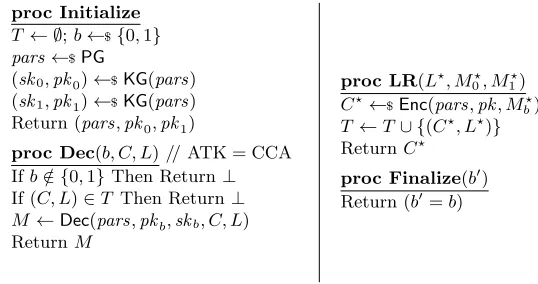
of a PKE scheme in a single game. The advantage of an adversary in the AI-ATK game is defined in the usual way:
Advai-atkPKE (A) :=|2·Pr[AI-ATKAPKE ⇒T]−1|
where game AI-ATK is shown in Figure 7. Note that we omit the security parameter from the games, and deal with concrete security.
proc Initialize
T ← ∅;b←${0,1}
pars←$PG
(sk0,pk0)←$KG(pars)
(sk1,pk1)←$KG(pars)
Return (pars,pk0,pk1)
proc Dec(b, C, L) // ATK = CCA Ifb /∈ {0,1}Then Return⊥
If (C, L)∈T Then Return⊥
M ←Dec(pars,pkb,skb, C, L) ReturnM
proc LR(L?, M?
0, M1?)
C?←
$Enc(pars,pk, Mb?)
T ←T∪ {(C?, L?)}
ReturnC?
proc Finalize(b0) Return (b0=b)
Fig. 7.Games defining AI-ATK security for encryption schemes with labels.
Correctness.We call schemePKEcorrect if for anyλ∈N, anypars ←$PG(1λ), any (sk,pk)←$ KG(pars),
any M ∈MSp, any L∈LSp, and anyC ←$Enc(pars,pk, M, L), we have thatDec(pars,pk,sk, C, L) =M.
Correctness definitions do not specify how the cryptosystem behaves should the incorrect key pair be used upon decryption. They are merely a property of the scheme when decryption is run on the correct keys. Robustness definitions, on the other hand, model how this behavior on different keys, and were implicit in a number of works prior to [2]. We briefly recall a number of robustness notions that exist in the literature.
B Collision Freeness and Well-addressedness
Collision freeness.This notion was introduced in [25] and captures the idea that a ciphertext should decrypt to two distinct messages when decrypted using two distinct secret keys. While this notion seems to be of standalone interest only in limited scenarios (in the case of expected messages for example) The author considers bothweak andstrong collision freeness, both in the CPA and CCA setting (in the former case there is no access to the Dec procedure). These notions were introduced as intermediate steps to achieve strong robustness. The corresponding games are described in Figure 8. Note that, since it requires the two messages to also collide (as well as being valid), collision freeness can be considered as a relaxation of the notion of robustness (which only requires validity).
Strong correctness.The notion of strong correctness was introduced by Barth et al. [3]. This notion is similar to the weak robustness notion except that the adversary is required to output the message before receiving the public parameters of the system. This notion is therefore is even weaker than WROB. As it this notion is about two public keys, in our view it is not a “correctness” condition.
proc Initialize
pars←$PG
(sk0,pk0)←$KG(pars)
(sk1,pk1)←$KG(pars)
Return (pars,pk0,pk1)
proc Dec(b, C) // ATK = CCA Ifb /∈ {0,1}Then Return⊥
M ←Dec(pars,pkb,skb, C) ReturnM
proc Finalize(M) // Weak collision freeness M0←M;C←$Enc(pars,pk0, M0)
M1←Dec(pars,pk1,sk1, C)
Return (M0 6=⊥)∧(M1 =6 ⊥)∧(M0=M1)
proc Finalize(C) // Strong collision freeness M0←Dec(pars,pk0,sk0, C)
M1←Dec(pars,pk1,sk1, C)
Return (M0 6=⊥)∧(M1 =6 ⊥)∧(M0=M1)
Fig. 8.Games defining (two-user) weak/strong collision freeness.
definition below. As we shall see, the ID-analogues of notion of robustness that we introduce are strong enough to imply well-addressedness.
proc Initialize
pars←$IBE.PG
(msk,mpk)←$IBE.MPG(pars)
Return (msk,mpk)
proc Encrypt(id0)
M0←$MSp
C←$IBE.Enc(pars,mpk, id0, M0)
ReturnC
proc Finalize(id1)
If (id0=id1) Then ReturnF
skid1 ←$IBE.KG(pars,msk, id1)
M1← IBE.Dec(pars,mpk, id1,skid1, C)
Return (M16=⊥)
Fig. 9.Games defining well-addressedness of an IBE scheme. An adversary is legitimate if it callsEncryptexactly once.
C On the Fairness of Sako’s Protocol using SROB Encryption Schemes
We first recall theCS? scheme. The common public parameters forCS? consist of a group
Gof prime order
pand the description of a family of functionsH:Keys(H)×G3→G. The algorithms ofCS?are as follows:
PG: Choose K←$Keys(H),g1←$G, andw←$Zp∗. Letg2←g1w. Return (g1, g2, K). KG(g1, g2, K): Choose random exponents x1, x2, y1, y2, z1, z2 ←$Zp and compute
e=gx1 1 g
x2
2 , f =g
y1 1 g
y2
2 , h=g
z1 1 g
z2 2 .
The public key is pk = (e, f, h) and the private key is sk = (x1, x2, y1, y2, z1, z2). Enc(pars,pk, M): To encrypt a message M ∈G,
1. Picku←$Z∗p and computea1 =g1u,a2 =gu2, andb=hu.
2. Letc←b·M, v←H(K,(a1, a2, c)), d←eufuv.
The ciphertext is C = (a1, a2, c, d).
Dec(pars,pk,sk, C): Parse the ciphertext C as (a1, a2, c, d). Compute v ← H(K,(a1, a2, c)), M ← c· a−z1
1 a
−z2
2 . If d6=a
x1+y1v
1 a
x2+y2v
2 then set M ←⊥. Ifa1 = 1 then setM ←⊥. ReturnM.
The attack works as follows. LetV ={v1, ..., vN}be the set of possible bid values. The auctioneer runs
He selectsu, z1, z2, α1, α2←Z∗p and computesa1 =gu1,a2=gu2,b=a
z1 1 a
z2
2 ,c=b·M, and d=a
α1 1 a
α2 2 . He
then computesv=H(K,(a1, a2, c)). Ifv= 0, the auctioneer re-samples and re-computes the values, until v6= 0. He then considers the following system of multivariate linear equations
(
x1+vy1=α1 x2+vy2=α2
and findsN solutions (xi1, xi2, yi1, yi2) withi∈ {1, ..., N}, where all the values are in Zp.
The auctioneer sets ski to be (xi1, xi2, yi1, yi2, z1, z2) for i ∈ {1, ..., N}. He passes u to the cheating
bidder and publishes all the public keys pki= (gxi1 1 g
xi1
2 , g
yi1
1 g
yi2
2 , g
z1 1 g
z2
2 ) withi∈ {1, ..., N}.
The cheating bidder can now bid for the valueviby encryptingM with randomnessuunder the public
keypki to get ciphertextC. Such an encrypted bidCwill decrypt toM underanyskj withj∈ {1, ..., N},
since xi1 +vyi1 = xj1 +vyj1 and xi2 +vyi2 = xj2 +vyj2, by construction. This means that during the
protocol, the auctioneer can first observe the highest honest bid (say h < N). Then, he can declare the cheating bidder as the winner (for the bidh+ 1) by revealing the private keyskh+1. This clearly gives the
dishonest bidder and colluding auctioneer a cheating strategy and breaks the fairness of the protocol.
Remark 1.It may be argued that the above attack can be detected by the bidders, as the maliciously gen-erated public keys share the same third component. Although this is a valid point, it may be unreasonable to assume that the bidders perform such checks outside the protocol description. Indeed, one (or the) goal of robustness is to ensure that such checks are already implemented within the decryption algorithm. Let us note that the attack of Abdalla et al. on the robustness of ElGamal also falls within the category of such “traceable” attacks, as the ciphertexts are of the form (1, C). Despite this, and in order to further justify the relevance of the new notions, we demonstrate in Appendix D an untraceable attack on the modified Kurosawa–Desmedt encryption scheme (which was proven strongly robust under chosen-ciphertext attacks in [24]).
Remark 2. The alert reader might notice that, if the auctioneer is allowed to collude with bidders, then other, more direct attacks on the protocol are possible: indeed, the auctioneer can first decrypt all honest bidders’ ciphertexts and tell the cheating bidder what his incremental bid has to be. These attacks can all be prevented, informally at least, by having all players initially send a commitment to their ciphertexts (as already suggested in [2, Appendix C]), so that a colluding bidder and auctioneer do not see honest bidders’ ciphertexts before a cheating bid is sent. In contrast, our attack works even in this case.
D A Variant of Kurosawa–Desmedt Is SROB-CCA but Not CROB
We recall the Kurosawa–Desmedt (KD) cryptosystem [23]. Here, the common public parameters consist of a group G of prime order p > 2λ, with generators g1, g2 ∈R G. They also include the description of a universal one-way hash function H :{0,1}∗ →Zp, a key-derivation function KDF :G→ {0,1}k, for some integerk∈poly(1λ), a symmetric authenticated encryption scheme (E,D) of key lengthk.
KG(pars): Given common public parameterspars = (G, g1, g2, H), choosex1, x2, y1, y2 ←$Zp and compute e=gx1
1 g
x2
2 , f =g
y1 1 g
y2 2
The public key is pk = (e, f) and the private key issk = (x1, x2, y1, y2). Enc(pars,pk, M): To encrypt a message M ∈G,
1. Picku←$Zp and compute
a1=gu1, a2 =gu2, d= (e·fv)u,
2. Compute K=KDF(d)∈ {0,1}k,c=E K(M).
The ciphertext is C = (a1, a2, c).
Dec(pars,pk,sk, C): Parse the ciphertextC as (a1, a2, c). Compute v =H(a1, a2),d=a1x1+v·y1 ·a
x2+v·y2
2 ,
and K =KDF(d) ∈ {0,1}k. Then, return m =D
K(c) (which may be ⊥ if c fails to properly decrypt
under the key K).
The above algorithms describe the original Kurosawa–Desmedt encryption scheme. Following [2], we denote byKD?the modifiedKDscheme where the encryption exponentu= 0 is explicitly disallowed: namely, the sender chooses u←$ Z∗p (instead of u←$ Zp) at encryption and the receiver outputs ⊥ upon receiving a
ciphertext (a1, a2, c) such thata1 = 1G. We prove in [24] thatKD
? is strongly robust (with some conditions
on the symmetric components).
We will next see that KD? is not fully robust (and hence neither completely robust). We construct an
adversaryA which gets as inputpars, picksm←$Gand u, α1, α2 ←$Z∗p. It then computes
a1=gu1, a2 =gu2, v=H(a1, a2), d=aα11a
α2 2 .
Now consider the following system of multivariate linear equations
(
x1+vy1=α1 x2+vy2=α2
Unless v = 0 such system has an infinite number of solutions. (In the case v = 0, A re-samples u). In particular, let (x10, x20, y10, y20) and (x11, x21, y11, y21) be two integer solutions to the system.
Now Asetspk = (e, f) andpk0 = (e0, f0) to be
e=gx10 1 g
x20
2 , f =g
y10 1 g
y20
2 , e
0 =gx11
1 g
x21
2 , f
0 =gy11
1 g
y21 2 ,
i.e., the public keys corresponding to secret keys sk = (x10, x20, y10, y20) and sk0 = (x11, x21, y11, y21),
respectively. The adversary A finally computes d=aα1 1 a
α2
2 , K =KDF(d), and c=EK(M) and obtains a
ciphertextC = (a1, a2, c). Its output for the full robustness game will be C,pk,pk0,sk,sk0
. By the choice ofsk and sk0, it is clear thatC, decrypted under both secret keys, will return a valid messageM 6=⊥with probability 1.
In [24], the KD? scheme was proved SROB-CCA assuming that the key-derivation function is collision-resistant and that the symmetric encryption scheme is key binding (i.e., each ciphertext is only valid for one key). Even when these conditions are satisfied, the above attack still works since both keys recover the samed=aα1
1 a
α2
2 at decryption.
When KD? is used to implement the auction protocol of [28], this attack is much harder to detect than that of Section 2.2 and the one of [2]: the only apparent way to make it evident is to audit the entire system and force the auctioneer to reveal all private keys.
E Proof of the Characterization Theorem
We prove the theorem via a sequence of propositions as follows.
Proof. For the forward direction, suppose there is an adversary which wins one of the FROB, KROB, or XROB games. Then this adversary also wins the CROB game by querying the FROB winning tuples to theDecoracle, the KROB winning tuples to the Encoracle, and finally the first XROB winning tuple to theEnc oracle and the second to theDec oracle.
For the backward direction, note that a pair of winning tuples for the CROB game can arise in one of three possible ways: (1) Both tuples were added to the list through decryption queries. This translates into a winning output for an FROB adversary; (2) Both tuples were added to the list through encryption queries. This translates into a winning output for a KROB adversary; (3) One tuple was added to the list through an encryption query and the other through a decryption query. This translates into a winning
output for an XROB adversary. ut
For the first separation, we prove the stronger statement that KROB and XROB together are insufficient to guarantee SROB-CPA (and hence also fail to imply FROB). As we shall see in Proposition 8, we have that XROB =⇒ WROB-CCA, and hence this is the “best separation” one can hope for.
Proposition 3 (KROB∧XROB =6⇒ SROB-CPA).LetPKE be a public-key encryption scheme which is
KROBandXROB. Then there is a schemePKE0 which is KROBandXROB, but fails to be SROB-CPA.
Proof. We define the required schemePKE0to be identical toPKEexcept for its encryption and decryption algorithms, which we modify as follows:
Enc0(pars,pk, M): RunEnc(pars,pk, M) to obtain ciphertextC. Return 0kC.
Dec0(pars,pk,sk, ckC): If c= 0 return Dec(pars,pk,sk, C). Ifc= 1 return a fixed (e.g., the lexicographi-cally smallest) message M? in the message space for pk.
Note that PKE0 is a correct public-key encryption scheme. Scheme PKE0 is not SROB-CPA. Consider the adversaryAwhich queriesGetEKtwice to obtain, with overwhelming probability, two distinct public keyspk0 andpk1. NowApicks a randomC from the ciphertext space and gives (1kC,pk0,pk1) as its final output. It is easy to see that A wins with an overwhelming probability:pk0 6=pk1 and the decryption of 1kC always returns a valid message by construction.
Next we show PKE0 is still KROB. It is easy to see that the tweaks in the modified scheme do not affect the KROB game, since the new encryption algorithm prepends a zero-bit to all ciphertexts.
In order to show that PKE0 is still XROB, suppose an adversary A(pars) outputs a winning tuple (M,pk0, r0, C1,pk1,sk1), where pk0 and pk1 are two distinct public keys. Note it must be the case that C1= 0kC˜1, as otherwiseA cannot win the XROB game (M is encrypted usingEnc in the game). Now an
adversaryB can win the XROB game forPKE by outputting (M,pk0, r0,C˜1,pk1,sk1). ut
Proposition 4 (FROB∧XROB =6⇒ KROB). Let PKE be a public-key encryption scheme which is
FROBand XROB. Then there is a scheme PKE0 which is FROBand XROB, but fails to be KROB.
Proof. We define the required scheme PKE0 as follows.
PG0(1λ): Run PG(1λ) to obtain pars. Return pars.
KG0(pars): Run KG(pars) to obtain (sk,pk). Return (sk,0kpk).
Enc0(pars, bkpk, M): If b= 1, output 1λ. If b= 0, run Enc(pars,pk, M), obtain ciphertextC and output 0kC.
Dec0(pars, bkpk,sk, ckC): If b= 1 or c= 1 return⊥. Else, run and outputDec(pars,pk,sk, C).
Next we show that PKE0 is still FROB Suppose an adversary A(pars) outputs a winning tuple (ckC, b0kpk0, b1kpk1,sk0,sk1), where b0kpk0 and b1kpk1 are two distinct public keys. Note it must be
the case thatb0 =b1 = 0, as otherwise decryption rejects andAcannot win the FROB game. Therefore it
is necessarily the case that pk0 6=pk1, and an adversaryB can also win the FROB game against PKE by outputting (C,pk0,pk1,sk0,sk1).
In order to show that PKE0 is also XROB, suppose an adversary A(pars) outputs a winning tuple (M, b0kpk0, r0, ckC, b1kpk1,sk1), whereb0kpk0 andb1kpk1 are two distinct public keys. We must have that b1 = 0 and c = 0 as otherwise decryption rejects. We must also have that b0 = c, as the first bit of a
ciphertext output by encryption matches the first bit of the public key. Thereforeb0 =b1 =c= 0, and an
adversaryB can also win the XROB game against PKE by outputting (M,pk0, r0, C,pk1,sk1). ut
These propositions, together with Proposition 1, complete the proof of Theorem 1.
F Relation with WROB and SROB
It is clear that FROB =⇒ USROB =⇒ SROB-CCA as the adversary becomes progressively more restricted in each game. We prove the rest of the theorem via a sequence of propositions.
Proposition 5 (USROB =6⇒ FROB). Let PKE be a public-key encryption scheme which is USROB. Then there is a scheme PKE0 which isUSROB, but fails to be FROB.
Proof. We define the required scheme PKE0 as follows.
PG0(1λ): Run PG(1λ) to obtain pars. Return pars.
KG0(pars): Run KG(pars) to obtain (sk,pk). Return (sk,0kpk).
Enc0(pars, bkpk, M): RunEnc(pars,pk, M) to obtain C. ReturnC.
Dec0(pars, bkpk,sk, C): Return Dec(pars,pk,sk, C).
Observe that PKE0 is a correct public-key encryption scheme. Furthermore,PKE0 is not FROB. Con-sider the adversaryA which runsKG0(pars) to get a valid key-pair (sk,0kpk), picks a random messageM
and runs Enc0(pars,0kpk, M) to obtain a ciphertextC. The adversaryAgives (C,0kpk,1kpk,sk,sk) as its final output. It is easy to see that A wins with probability 1: 0kpk 6= 1kpk and the decryption ofC with the secret keysk returns a valid message due to correctness.
We now show PKE0 is USROB. Suppose there is an adversaryA which wins the USROB game against PKE0. We construct an adversary B that interacts with A to win the USROB game against PKE with the same probability. Algorithm B(pars) runs A(pars) and handlesA’s queries by forwarding them to its own oracles simply prepending a zero-bit to all the public keys sent and received. Finally, whenAoutputs (C,pk0,pk1) with pk0 6= pk1, B also outputs the same tuple. It’s easy to see that B provides a perfect
simulation ofA’s environment, and that if Awins so does B. ut
Proposition 6 (SROB-CCA =6⇒ USROB).Let PKE be a public-key encryption scheme which is SROB-CCA. Then there is a scheme PKE0 which is SROB-CCA, but fails to be USROB.
Proof. We define the required scheme PKE0 as follows.
PG0(1λ): Run PG(1λ) to obtain pars. Return pars.
KG0(pars): Run KG(pars) to obtain (sk,pk). Samples←${0,1}λ and return (skks,pk). Enc0(pars,pk, M): RunEnc(pars,pk, M) to obtain ciphertextC. Return C.
Dec0(pars,pk,skks, C): ParseC asC1kC2. Run Dec(pars,pk,sk, C1). If the output is a valid message M,
return M. Otherwise, check if C2 = s, and if so return a fixed (e.g., the lexicographically smallest)
PKE0 is a correct public-key encryption scheme.9 We first prove PKE0 is not USROB by constructing an adversary A which wins the USROB game against PKE0. Algorithm A(pars) queries GetEK on two identities id0, id1 to obtain, with overwhelming probability, two distinct public keyspk0 and pk1. It then
queriesGetDK(id0) and receives sk0ks0. AlgorithmA runs Enc0(pars,pk1, M1), whereM1 is any (valid)
message, obtaining C1. Adversary A then sets C2 :=s0 and outputs (C := (C1kC2),pk0,pk1) as its final
output. It is easy to see that this is a winning strategy forA:C when decrypted with respect topk1 would return M1 due to the correctness of the scheme. Furthermore, when decrypted with respect to pk0 we
obtain a valid messageM sinceC2 =s0.
We now prove that PKE0 is SROB-CCA. Suppose there is an adversaryAwhich wins the SROB-CCA game against PKE0. We construct an adversary B that interacts with A to win the SROB-CCA game againstPKE. Algorithm B(pars) runsA(pars) and handles its queries as follows:
– GetEK(id) query: B queries its own GetEK(id) to get a public key pk. It then selects and stores a random bit-strings of lengthλ. AlgorithmB givespk toA.
– GetDK(id) query: B queries its own GetDK(id) for the corresponding secret key sk. Algorithm B then retrieves and appends stosk and gives skksas the response toA.
– Dec(C1kC2,pk) query: B passes (C1,pk) to its own oracle. If the answer is a valid message M, B
forwards M to A. If the output is ⊥, B checks whether C2 is equal to s (which it holds). If so, B
outputsM? as the response toA’s query. If not,B returns ⊥.
Finally, when Aoutputs (C1kC2,pk0,pk1), Boutputs (C1,pk0,pk1).
We note that B provides a perfect simulation of A’s environment and that B wins whenever A wins unlessA does so by guessing thes-component of eitherpk0 or pk1. Since these s-components are random and information theoretically hidden from A’s view, the probability of this event is at most 2· 1
2λ. This
completes the proof. ut
Note that by Proposition 4 we also have that SROB-CCA =6⇒ KROB. The following proposition provides a separation in the reverse direction.
Proposition 7 (KROB =6⇒ WROB-CPA).Let PKE be a public-key encryption scheme which isKROB. Then there is a scheme PKE0 which isKROB, but fails to be WROB-CPA.
Proof. We define the required schemePKE0 to be identical toPKE except its decryption algorithm, which we modify as follows:
Dec0(pars,pk,sk, C): IfDec(pars,pk,sk, C) is a valid messageM, returnM. If not return a fixed (e.g., the lexicographically smallest) message M? in the message space forpk.
It is easy to see that PKE0 is correct but it is not WROB-CPA: the decryption algorithm never returns ⊥. However, the modified scheme is still KROB as the tweaked decryption algorithm does not
affect the KROB game. ut
By Proposition 1 we have that SROB-CCA =6⇒ XROB, and by Proposition 3 we have that XROB =6⇒ SROB-CPA. The implication to WROB is proved next.
Proposition 8 (XROB =⇒ WROB-CCA).LetPKE be a public-key encryption scheme which isXROB. Then PKE is also WROB-CCA.
Proof. Let A be a WROB-CCA adversary. We construct an XROB adversary B as follows. Algorithm B on inputpars runsA(pars) and answers its various queries as follows:
9If the decryption rule was defined to check for the equality before running Dec, correctness would only hold with