Practical Fully Secure Three-Party Computation via Sublinear
Distributed Zero-Knowledge Proofs
Elette Boyle∗ Niv Gilboa† Yuval Ishai ‡ Ariel Nof§ December 4, 2019
Abstract
Secure multiparty computation enables a set of parties to securely carry out a joint com-putation on their private inputs without revealing anything but the output. A particularly motivated setting is that of three parties with a single corruption (hereafter denoted 3PC). This 3PC setting is particularly appealing for two main reasons: (1) it admits more efficientMPC protocols than in other standard settings; (2) it allows in principle to achievefull security(and fairness).
Highly efficient protocols exist within this setting with security against a semi-honest ad-versary; however, a significant gap remains between these and protocols with stronger security against amaliciousadversary.
In this paper, we narrow this gap within concretely efficient protocols. More explicitly, we have the following contributions:
• Concretely Efficient Malicious 3PC.We present an optimized 3PC protocol for arith-metic circuits over rings with (amortized) communication of 1 ring element per multiplication gate per party, matching the best semi-honest protocols. The protocol applies also to Boolean circuits, significantly improving over previous protocols even for small circuits.
Our protocol builds on recent techniques of Boneh et al. (Crypto 2019) for sublinear zero-knowledge proofs on distributed data, together with an efficient semi-honest protocol based on replicated secret sharing (Araki et al., CCS 2016).
We present a concrete analysis of communication and computation costs, including several optimizations. For example, for 40-bit statistical security, and Boolean circuit with a million (nonlinear) gates, the overhead on top of the semi-honest protocol can involve less than 0.5KB of communicationfor the entire circuit, while the computational overhead is dominated by roughly 30 multiplications per gate in the fieldF247. In addition, we implemented and
benchmarked the protocol for varied circuit sizes.
• Full Security. We augment the 3PC protocol to further providefull security(with guaran-teed output delivery) while maintaining amortized 1 ring element communication per party per multiplication gate, and with hardly any impact on concrete efficiency. This is contrasted with the best previous 3PC protocols from the literature, which allow a corrupt party to mount a denial-of-service attack without being detected.
∗
IDC Herzliya, Israel. email: [email protected].
†
Ben-Gurion University, Israel email: [email protected].
‡
Technion, Israel. email: [email protected].
§
1
Introduction
Protocols for secure computation [Yao86, GMW87,BGW88,CCD88] enable a set of parties with private inputs to compute a joint function of their inputs while revealing nothing but the output. Secure computation provides a general-purpose method for computing across sensitive data items, as well as for eliminating single points of failure. As a result, a major research effort has been undertaken within the applied cryptography and security community in improving the concrete efficiency of secure computation protocols.
Among the most studied settings for prospective practical applications is that of three-party secure computation tolerating a single corrupt party (henceforth referred to as 3PC). This setting is highly motivated by two significant features: As the minimal nontrivial setting with an honest majority, it seems to have the greatest potential for admitting fast, simple protocols. Indeed, 3PC protocols can make use of simple information-theoretic secret sharing, whereas two-party secure computation protocols rely on more complex public-key primitives such as oblivious transfer or homomorphic encryption that incur higher communication and computation costs. Further, it is the minimal setting in which one can achievefull security, where honest parties are guaranteed to learn the output at the conclusion of the protocol. This lies again in contrast to settings without honest majority, where one can only hope to provide a weaker notion ofsecurity with abort, leaving the protocol open to denial-of-service attacks from a corrupt party.
Within each setting, two classic adversary models are typically considered: semi-honest (where the adversary follows the protocol specification but may try to learn more than allowed from the protocol transcript) and malicious (where the adversary can run an arbitrary polynomial-time attack strategy). Highly efficient protocols for 3PC have been obtained in the semi-honest model; see [BLW08, AFL+16, CGH+18, CCPS19] and references therein. However, despite tremendous progress, there is still a significant gap in concrete complexity costs between solutions in the semi-honest and malicious settings, particularly for Boolean circuits.
Since concretely efficient 3PC protocols are computationally simple and only employ symmetric cryptography, their overall cost is typically dominated by communication rather than computation.1 Consequently, the main efforts in this line focus on minimizing the ratio between the amortized communication costs of malicious and semi-honest solutions (while maintaining reasonable com-putation complexity). For the case of evaluating an arithmetic circuit over a ring, the best such semi-honest protocols have an amortized communication cost of only 1 ring element per multi-plication gate per party [AFL+16]. (In this work, the term “ring” refers to either a finite field or a ring of the form Z2k; the term “amortized communication cost” refers to the ratio between
the communication and the number of gates when the latter tends to infinity.) To date, the best such malicious-secure protocols that have been optimized and implemented communicate 2 field elements per multiplication gate per party over large fields (of size comparable to 2σ for statistical security parameter σ) [CGH+18, NV18], or alternatively 7 bits per AND/OR gate per party for Boolean circuits (where XOR/NOT gates are for free) [ABF+17].
1
1.1 Our Contributions
In this paper, we present an optimized high-throughput protocol for the malicious 3PC setting of three parties and an honest majority. Our protocol begins with the efficient semi-honest protocol of [AFL+16] that relies on replicated secret-sharing.2 Then, building on the recent work of Boneh et al. [BBC+19], compiles it to be maliciously secure by adding a single step at the end of the protocol which verifies the correctness of behavior during the execution. Our protocol has very low communication: it requires each party to send only one field/ring element per multiplication gate (amortized over the circuit). This is exactly the amortized communication cost of the best known semi-honest protocols (that do not employ public-key cryptography). We measured the concrete efficiency of our protocol and report its practicality. Our findings indicate that the improved amor-tized communication cost does not conflict with concrete efficiency: the communication advantage over earlier protocols kicks in even for fairly small circuits, and the computational overhead is reasonable.
As mentioned, our starting point towards achieving malicious security is the recent work by Boneh et al. [BBC+19], which introduced the new notion of zero-knowledge proofs over distributed data. Such proofs involve a single prover and multiple verifiers. The prover wishes to prove the correctness of a statement over some data which is known entirely to the prover but is distributed among the verifiers. The protocols from [BBC+19] have sublinear proof size when applied to simple statements. The authors have also identified the potential of this tool for MPC in the presence of malicious adversaries, as in such protocols the information is secret-shared between the parties, and each party needs to prove that it behaved correctly to the other parties given that information. This can be useful in particular in the setting of three parties with one corruption, since in this case we are guaranteed that only the prover or one of the verifiers is corrupted, leading to much more efficient protocols. However, the asymptotically efficient protocols presented in [BBC+19] use several layers of abstraction, and were not optimized or even analyzed for concrete efficiency.
In this paper, we take a step forward and show how to turn the protocols from [BBC+19] into efficient zero-knowledge protocols for verifying that all the messages sent in a concretely efficient 3PC protocol were correct. Moreover, adapting the protocol to a specific setting enables us to introduce an optimized version and to prove that it securely computes an ideal functionalityFvrfy
that is used in the main protocol. The sublinear communication complexity of the zero-knowledge protocol ensures that, amortized over the circuit, the communication cost of the final 3PC protocol does not increase beyond the cost of the semi-honest baseline, and moreover the concrete overhead is small. Our initial protocol works only over finite fields, but then we show how to extend it to work also over the ring Z2k by using variants of techniques from [BBC+19]. This requires
working over a larger ring, which blows up the cost of the zero-knowledge proofs by a small factor. However, since the proofs are still sublinear in the size of the circuit, this does not increase the amortized communication cost. Finally, while the basic version of our protocol (as well as the protocol from [BBC+19]) only achieves “security with abort,” we show how to achievefull security, including fairness and guaranteed output delivery, at a minor additional cost.
We present a detailed concrete analysis of both the computational and the communication cost of our protocol and discuss multiple optimizations that improve the overall efficiency. We also ran experiments to measure the actual performance of our protocol. As the semi-honest protocol has been shown to achieve very high throughput in different settings [AFL+16,ABF+17,CGH+18], we
focus only on the verification step, which anyway can be executed in parallel and independently of the main semi-honest protocol. Our experiments demonstrate the computational effort (measured by its running time) required by each party in the verification step. The experiment was run in an AWS c5.9xlarge instance (Intel Xeon Platinum 8000 series with clock speed of up to 3.5 GHz) for different sizes of arithmetic circuits over a 31-bit Mersenne field. (These fields enable particularly fast multiplications and are big enough for most arithmetic computations.) In this setting, applying the verification protocol to all 1 million gates simultaneously requires 2.3 seconds. However, when splitting the gates into 8 groups of 216 gates, where each group is being verified separately, it is possible to complete the verification of all the groups (without parallelizing the computation!) in less than a second, while the communication overhead is only 0.04 field elements per gate on average (thus adding less than 5% of the communication required by the semi-honest protocol). This shows a promising potential for usefulness in real-world applications where bandwidth is a bottleneck.
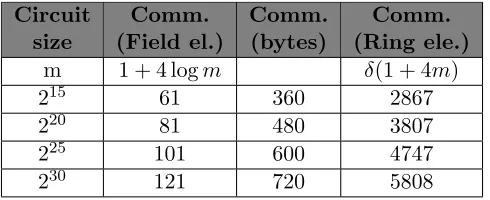
Finally, we present additional efficiency improvements (at the expense of additional rounds of interaction3) by optimizing and concretely analyzing a recursive proof composition technique suggested in [BBC+19]. For 40 bits of statistical security, the communication complexity of the recursive protocol for verifying m Boolean gates is roughly 4 logm field elements, for a field F2w
where w ≈ 42 + log logm. For example, for a Boolean circuit with a million (nonlinear) gates, the verification protocol requires less than 0.5KB of communication for the entire circuit. The computational complexity of this protocol is dominated by roughly 30 field multiplications per gate. See Table5 vs. Table4 for comparing the concrete communication costs of the recursive vs. non-recursive protocol for Boolean circuits.
1.2 Comparison to Previous Work
The problem of 3PC with one malicious party has drawn a lot of attention in recent years. As the 3PC setting gives rise to the simplest and most efficient protocols, this setting was considered par-ticularly attractive for applications such as financial data analysis [BLW08,BNTW12], protecting cryptographic keys [AFL+16], privacy-preserving machine learning [MR18], and more.
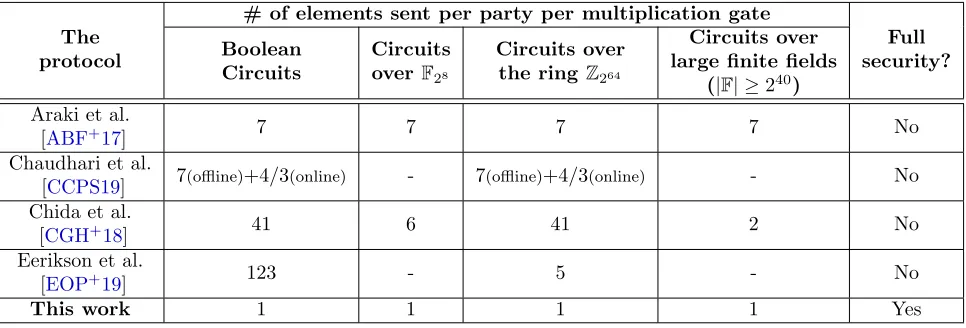
In this section, we compare the communication complexity and security of our protocol to the best concretely efficient 3PC protocols and to protocols for four parties with a single corruption. We restrict our attention to protocols that have been optimized for concrete efficiency and implemented, thus excluding the recent work of Boneh et al. [BBC+19] on which we build. In Table 1 we present a comparison between our results to other 3PC protocols for computing circuits that are defined over different domains: the Boolean domain F2, the field F28, which is commonly used in secure evaluations of AES, large finite fields, which are used emulate numerical computations over the integers or reals, and the ring Z2k, which is used for integer arithmetic in CPUs with k-bit
architectures, e.g. k= 32 ork= 64.
• The most efficient protocol for Boolean circuits, measured by total communication complexity, is [ABF+17], which achieves its low communication (7 bits per AND gate per party) by an efficient instantiation of the “cut–and–choose” method. The recent work of [CCPS19] has slightly higher overall communication but focuses on minimizing the online (input-dependent) cost. Indeed, the online communication cost of [CCPS19] per party is 43 bits per AND gate.
• The protocol of [CGH+18] (and also [NV18], but with higher computational cost) is the most efficient for “large” finite fieldsF, i.e. fields such thatF| ≥2σ for a statistical security parameter
σ. For this field size, the protocol of [CGH+18] requires each party to send 2 field elements per multiplication (i.e., doubling the communication cost of the semi-honest protocol). However, for small fields (e.g, F2 or F28) or non-field rings, their protocol requires many repetitions, making it inefficient.
• Recently, there has been considerable interest in MPC over the ringZ2k (see [CDE+18,CRFG19,
DOS18,GRW18,EOP+19,CCPS19] and references therein). In the setting of three parties with honest majority, Eerikson et al. [EOP+19] present two protocols, one that mixes operations on fields and on rings and one that relies on ring operations only. The latter protocol uses ideas from [CDE+18], lifting each element to a larger ringZ2k+s, and resulting in statistical error 2−s.
Since each party is required to send 3(k+s) bits per multiplication gate, then whenk= 64, the number of ring elements sent is roughly 5. However, when the ring is small (in particular, when
k= 1), the value ofsis much larger than the bit-length of ring elements, since it determines the statistical error. This significantly increases the number of ring elements sent per gate.
To compare the security of our protocol to other protocols in Table 1, we remark that all of these protocols (including ours) use mild cryptographic assumptions, such as the existence of one-way functions or collision-resistant hash functions, to achieve their best efficiency. In fact, our protocol only makes a black-box use of any pseudorandom function (implemented in practice by a block cipher).
Our protocol is the only one in the table that provides full security rather than security with abort, which is a major qualitative advantage. It is well known that full security is achievable in our 3PC setting, assuming the availability of broadcast channels4 or a PKI [RB89]. However, to the best of our knowledge, no other concretely efficient protocol in our setting achieves this, excluding protocols based on garbled circuits whose throughput is much worse than ours (see detailed comparison below).
It is also instructive to compare our results to what was achieved in the setting of two-thirds honest majority, i.e. the number of corrupt parties is less than a third of the total number of parties. Very recently, [FL19] presented a protocol (an improvement of [BHKL18]) which works over fields and requires each party to send 223 field elements per multiplication gate. The communication complexity of this protocol is higher than ours and the protocol only works over fields. However, the construction is applicable for any number of parties. Another low-communication protocol was proposed by [GRW18]. Their protocol is designed for the specific setting of 4 parties and one corruption and has communication cost of 1.5 ring elements per multiplication gate per party. While [FL19] guarantees security with abort only, in [GRW18] it is also shown how to achieve guaranteed output delivery but without concrete cost analysis. We stress that both of the above protocols do not apply to the case of 3PC; a minimal number of 4 parties is required to begin with. Finally, we remark that for the case of evaluating Boolean circuits using the garbled-circuit approach [Yao86], and in the same setting of honest-majority 3PC, [IKKP15,MRZ15] have shown that it is possible to achieve malicious security with abort with similar cost of semi-honest. This was later extended to full security in [BJPR18]. In general, protocols using the garbled-circuit approach have the advantage of being constant-round, but their throughput is worse than ours by
4
The protocol
# of elements sent per party per multiplication gate
Full security? Boolean
Circuits
Circuits overF28
Circuits over the ringZ264
Circuits over large finite fields
(|F| ≥240) Araki et al.
[ABF+17] 7 7 7 7 No
Chaudhari et al.
[CCPS19] 7(offline)+4/3(online) - 7(offline)+4/3(online) - No Chida et al.
[CGH+18] 41 6 41 2 No
Eerikson et al.
[EOP+19] 123 - 5 - No
This work 1 1 1 1 Yes
Table 1: Comparison between concretely efficient 3PC protocols. Statistical security for all proto-cols in the table is 40-bit. The communication per gate, measured by number of elements sent by each party, is amortized over a large circuit.
roughly two orders of magnitude. Moreover, protocols based on garbled circuits do not natively extend to evaluating arithmetic circuits, which are useful for many applications.
2
Preliminaries
Notation. LetP1, P2, P3 denote the three parties participating in the computation. In this work, we assume an honest majority, and thus one party may be corrupted. We denote byRa finite ring, by Fa finite field and by Z2k the ring of integers modulo 2k. Finally, [n] is used to denote the set
{1, . . . , n}.
2.1 Replicated Secret Sharing
In this section, we present the “replicated secret sharing” scheme used in our protocol and its operations. Originally used for realizing general access structures [ISN89], replicated secret sharing turned out to be useful for simple and concretely efficient MPC protocols with a small number of parties [Mau06,CDI05,BLW08,AFL+16]. The description in this section is specialized to the 3PC case and is based on [AFL+16,FLNW17].
To share an element v in a ring R, the dealer chooses three random elements v1, v2, v3 ∈ R under the constraint that v1 +v2+v3 = v. (This can be done by picking v1, v2 at random and computing v3 =v−(v1+v2).) Then, the dealer shares v so that P1’s share is (v1, v3), P2’s share is (v2, v1) and P3’s share is (v3, v2). We use JvKto denote a sharing of v and denote Pi’s share by (vi, vi−1).
Thereconstruct(JvK, i) procedure. In this procedure, partyPi+1and partyPi−1 send their shares to Pi. Then Pi checks that the shares are consistent by checking that the same vi+1 was sent by both parties. If this holds, then Pi computes v1+v2+v3=v. Otherwise, Pi aborts.
Local operators. Given two shared secrets JuK and JvK, the parties can compute locally the sharing ofu+v, i.e.,Ju+vK. Whenever we write that the parties computeJuK+JvK(likewise for subtraction), it means that each partyPi sets its share ofu+v to be (ui+vi, ui−1+vi−1) where (ui, ui−1) is its share ofu and (vi, vi−1) is its share ofv.
In addition, given a sharingJvKand an elementσ ∈R, we write that the parties computeσ·JvK
when each partyPi sets its share of σ·v to be (σ·vi, σ·vi−1), where (vi, vi−1) is its share ofv. Finally, given a sharing JvKand an element σ ∈R, the parties can compute locally Jv+σK by having party P1 set its new share to be (v1+σ, v3), party P2 sets its share to be (v2, v1+σ) and the share of P3 remains the same.
2.1.1 The Semi-Honest Multiplication Protocol
We now show the protocol (as in [AFL+16]) for computing a sharing of v·u, given JvK and JuK. Let (vi, vi−1) and (ui, ui−1) be the shares of v and u respectively held byPi. We assume that the parties P1, P2, P3 hold correlated randomness α1, α2, α3, respectively, picked uniformly at random subject toα1+α2+α3= 0. The parties compute 32
-shares (namely, 2-out-of-3 shares) ofv1v2 as follows:
1. Step 1 – compute 33-sharing: Each partyPi computes zi =ui·vi+ui·vi−1+ui−1·vi+αi and sends it toPi+1. These messages are computed and sent in parallel.
2. Step 2 – compute 32-sharing: Holdingzi−1 and zi, each party Pi stores (zi, zi−1).
Generating correlated randomness. It is possible to securely generate correlated randomness with perfect security by having each party Pi simply choose a random ρi ∈R and send it toPi+1 (where P3 sends to P1). Then, each party takes its random element to be its element subtracted by the element it received: P1 computes α1=ρ1−ρ3,P2 computes α2 =ρ2−ρ1 and P3 computes
α3 =ρ3−ρ2. Observe that α1+α2+α3 = 0 as required. In addition, if P1 is corrupted, then it knows nothing aboutα2 and α3 except that α1 =−α2−α3.
As shown in [AFL+16] (following [GI99,CDI05]), there is a simple procedure for generating this type of correlated randomness withcomputational security and without any interaction beyond a short initial setup. Letκ be a computational security parameter and letF ={Fk|k∈ {0,1}κ, Fk: {0,1}κ → R} be a family of pseudo-random functions [GGM86]. To generate random elements
α1, α2, α3 ∈R under the constraint thatα1+α2+α3= 0, the parties work as follows.
1. Setup step: each partyPi chooses a random key ki ∈ {0,1}κ and sends it toPi+1.
2. Computing the correlated randomness: Upon request, each party computesαi =Fki−1(id)−
Fki(id) using the two keys it holds (where idis some public counter that was agreed upon and
is incremented each time).
This method allows the parties to generate all the correlated randomness needed at the cost of one exchange of keys.
2.2 Security Definition
non-unanimous abort (sometimes referred to as “selective abort”). This means that the adversary first receives the output, and then determines for each honest party whether they will receiveabort or receive their correct output.
2.3 Ideal Functionalities
In this section, we define the building blocks used by our protocol, formalized by ideal functionali-ties. For simplicity, we only consider the case where exactly one party is malicious. The correctness of the protocol in the case where no parties are corrupted is easy to verify directly.
2.3.1 Frand - Generating Random shares
We define the ideal functionalityFrandto generate a sharing of a random value unknown to the par-ties. A formal description appears in Functionality2.1. The functionality lets the adversary choose the corrupted parties’ shares, which together with the random secret chosen by the functionality, are used to compute the shares of the honest parties.
FUNCTIONALITY 2.1 (Frand- Generating Random Shares)
Upon receivingri, ri−1 from the ideal adversaryS controlling Pi, the ideal functionalityFrand
chooses a random r∈ R, sets ri+1 =r−ri−ri+1 and hands each honest party Pj its share
(rj, rj−1).
To generate a sharing of a random value, the parties work similarly to generating correlated randomness:
1. Setup step: each partyPi chooses an random key ki∈ {0,1}κ and sends it toPi+1.
2. Computing the correlated randomness: Upon request, each party computes αi =Fki(id)
andαi−1 =Fki−1(id) (whereidis some public counter that was agreed upon and is incremented each time). Then, it sets its share to be (αi, αi−1).
2.3.2 Fcoin - Generating Random Coins
Fcoin is an ideal functionality that chooses a random element from R and hands it to all parties. A simple way to computeFcoin is to use Frand to generate a random sharing and then open it.
2.3.3 Finput – Secure Sharing of Inputs
In this section, we present our protocol for secure sharing of the parties’ inputs. The protocol works exactly as in [CGH+18]: for each inputx belonging to a partyPj, the parties call Frand to generate a random sharingJrK; denote the share held byPi by ri. Then, r is reconstructed to Pj, who echo/broadcasts x−r to all parties. Finally, each Pi outputs the share Jr+ (x−r)K =JxK. This is secure sinceFrand guarantees that the sharing ofris correct, which in turn guarantees that the sharing of x is correct (since adding x−r is a local operation only). In order to ensure that
FUNCTIONALITY 2.2 (Finput- Sharing of Inputs)
LetS be the ideal world adversary and letPi be the corrupted party controlled byS.
1. Functionality Finput receives inputs v1, . . . , vs ∈R from the parties. For every j∈[s], Finput
also receives fromS the share of the corrupted party (vj,i, vj,i−1) for thejth input.
2. For everyi∈[M],Finputcomputesvj,i+1=vj−vj,i−vj,i−1.
3. Finput handsPi−1 the shares{(vj,i−1, vj,i+1)} s
j=1 andPi+1 the shares{(vj,i+1, vj,i)} s j=1.
A formal description of the protocol appears in Protocol 2.3
PROTOCOL 2.3 (Secure Sharing of Inputs)
• Inputs: Letv1, . . . , vs∈Zq be the series of inputs; eachvk is held by somePj.
• The protocol:
1. The parties callFrandstimes to obtain sharingsJr1K, . . . ,JrsK.
2. Fork∈[s], the parties runreconstruct(JriK, j) for Pj to receiverk, where Pj is the owner
of thekth input. IfPk receives⊥, then it sends⊥to all parties, outputsabortand halts.
3. Fork∈[s], partyPj sendswk =vk−rk to all parties.
4. All parties send w~ = (w1, . . . , ws), or a collision-resistant hash of the vector, to all other
parties. If any party receives a different vector to its own, then it outputs⊥and halts.
5. For eachk∈[s], the parties computeJvkK=JrkK+wk.
• Outputs: The parties outputJv1K, . . . ,JvsK.
For completeness, we now prove that Protocol 2.3 securely computes Finput specified in Func-tionality2.2.
Proposition 2.4 Protocol 2.3 securely computes Functionality 2.2 with abort in the presence of one malicious party.
Proof: LetA be the real adversary. We construct a simulatorS as follows:
1. S receives the shares (rk,i, rk,i−1) (fork= 1, . . . , s) thatA sends to Frand in the protocol. 2. For everyk∈[s],S follows the instructions of Frand to define a sharingJrkK.
3. S simulates the honest parties in allreconstruct executions. If an honest partyPj receives⊥in the reconstruction, then S simulates it sending ⊥ to all parties. Then, S simulates all honest parties aborting.
4. S simulates the remainder of the execution, obtaining all wk values from A associated with corrupted parties’ inputs, and sending random wk values for inputs associated with honest parties’ inputs.
6. S outputs whateverAoutputs.
The only difference between the simulation by S and a real execution is that S sends random values wj for inputs associated with honest parties’ inputs. However, by the perfect secrecy of secret sharing, this is distributed identically to a real execution.
2.3.4 Fvrfy- Verifying Correctness of Messages in the Multiplication Protocol
We now define an ideal functionality to verify that the messages sent in the execution of the multiplication protocol are the correct messages according to the protocol’s instructions, given each party’s inputs. Recall that in our multiplication protocol, each party Pi sends one messagezi toPi+1. GivenPi’s input shares (ui, ui−1) and (vi, vi−1) and its randomness αi, let
c(ui, ui−1, vi, vi−1, αi, zi) =ui·vi+ui·vi−1+ui−1·vi+αi−zi. We need to ensure that
c(ui, ui−1, vi, vi−1, αi, zi) = 0. (1) Observe that the input to c is distributed amongPi−1 and Pi+1. Specifically, ui, vi, zi are known to Pi+1, ui−1, vi−1 are known to Pi−1 and ρi, αi−1, which are held by Pi+1 and Pi−1 respectively, determine deterministically the value ofαi, sinceαi =ρi−ρi−1 (see Section2.1.1). We use this fact to define the ideal functionalityFvrfy, which receives the shares on the input wires, the randomness
and the sent/received message from the honest parties, and checks that Eq. (1) holds. This is formalized in Functionality 2.5.
FUNCTIONALITY 2.5 (Fvrfy- Verify Correctness of Messages)
LetSbe the ideal world adversary and letPibe the corrupted party controlled byS. Fvrfyreceives
an indexj and a parameterm∈Zfrom the honest parties. Then:
• IfPj is an honest party, thenFvrfy receives fromPj its input (uk,j, uk,j−1, vk,j, vk,j−1, αk,j, zk,j)
for eachk∈[m].
Ifi=j+ 1, thenFvrfy receivesρk,j−1 for eachk∈[m] from the honest Pj−1 and handsS the input ofPi, i.e., (uk,j, vk,j, αk,j+ρk,j+1, zk,j) for eachk∈[m].
Ifi =j−1, then Fvrfy receives ρk,j for each k∈ [m] from the honest Pj+1 and hands S the input ofPi, i.e., (uk,j−1, vk,j−1, ρk,j−αk,j) for eachk∈[m].
Then,SsendsFvrfythe commandabortoraccept, which is handed byFvrfyto the honest parties.
• IfPj is the corrupted party (i.e., i =j) then Fvrfy receives (uk,i, vk,i, zk,i, ρk,i) fromPi+1 and (uk,i−1, vk,i−1, ρk,i−1) from Pi−1for eachk∈[m].
Then,Fvrfy checks for eachk∈[m] that
c(uk,i, uk,i−1, vk,i, vk,i−1, αk,i, zk,i) = 0
whereαk,i =ρk,i−ρk,i−1.
In addition,Fvrfy hands uk,i, uk,i−1, vk,i, vk,i−1, ρk,i, ρk,i−1, zk,i toS.
If the equality does not hold for eachk∈[m], thenFvrfy sendsabortto the parties. Otherwise,
upon receiving a command abort or accept from S, Fvrfy hands it to the honest parties and
Observe that the functionality checks the correctness of many multiplications at the same time. Concretely efficient protocols for this functionality, with sublinear communication in the number of verified multiplications, will be presented in Sections4 and 7.
3
The Main Protocol
In this section we present our framework to compute an arithmetic circuit over a finite ring R. The protocol utilizes the ideal functionalities (Finput,Fvrfy) defined in the previous section and is described in Protocol 3.2. (We will later instantiate Fvrfy for rings R that are either a finite field
F or integer rings of the form Z2k; however, the general framework applies over any finite ring
R.) The protocol works naturally by having the parties run the semi-honest protocol and then, before reconstructing the outputs, calling theFvrfy functionality to detect any cheating during the
execution.
We state the security features of our protocol in the following two theorems.
Theorem 3.1 (Information theoretic-security) Let R be a finite ring and let f be a 3-party functionality computed by an arithmetic circuit C over R. Suppose that the correlated random-ness for the multiplication protocol (as specified in Section 2.1.1) is generated perfectly. Then, Protocol 3.2 computes f with perfect security with abort in the (Finput,Fvrfy)-hybrid model in the presence of one malicious party.
Proof: Let Pi be the corrupted party and let S be the ideal world adversary. The simulation works as follows:
1. By playing the role ofFinputin the first step, S extracts the inputs ofPi and receives the shares of Pi on each input wire.
2. S simulates the circuit emulating step. For linear gates, it computes locally party Pi’s share on the output wire. For multiplication gates,S runs the semi-honest multiplication protocol with the corrupted Pi in the following way: first, it chooses a random message zi−1 ∈ R and plays the role of Pi−1 sending zi−1 to Pi. Then, it receives the message zi sent by Pi to party Pi+1. Note thatS knows the shares held byPi on each input wire and knows the randomness thatPi should use in the execution (since its randomnessαi is computed by takingρi−ρi−1 whereρi is sent to Pi+1 and ρi−1 is chosen by Pi−1 as described in Section 2.1.1). Thus, S knows whether
zi is the correct message or not and soS records whether cheating took place or not. Finally, S defines (zi, zi−1) to be thePi’s share on the output wire.
3. S simulates the verification step by following the instructions of Fvrfy. Specifically, for proving
the correctness of message sent by honest parties, S outputs abort/accept according to Pi’s instructions. For proving correctness of messages sent by Pi, if S recorded that cheating took place in the previous step, then it plays the role ofFvrfyoutputingabortto the parties. Otherwise,
it outputsabort/acceptaccording to Pi’s instructions.
In any case thatFvrfy outputtedabort,S simulates the honest parties aborting in the real world execution, outputs whatever Pi ouptuts and halts.
PROTOCOL 3.2 (Computing an Arithmetic Circuit Over Finite Fields/Rings)
• Inputs: Each partyPj (j∈ {1,2,3}) holds an inputxj ∈R`.
• Auxiliary Input: The parties hold a description of an arithmetic circuitC that computes f on inputs of length`·3. Letmbe the number of multiplication gates inC.
• Setup: If the correlated randomness for the multiplication protocol is generated using a pseu-dorandom functionFk, then the parties run the setup step as specified in Section2.1.1.
• The protocol:
(a) Sharing the inputs: For each input xk held by Party Pj, partyPj sendsxk toFinput.
Each party records its vector of shares of all inputs as received fromFinput. If any party received⊥from Finput then it sendsabortto the other parties and halts.
(b) Circuit emulation: LetG1, ..., GL be a predetermined topological ordering of the gates of
the circuit. Fork= 1, ..., Lthe parties work as follows:
– If Gk is an addition gate: Given shares JuK and JvK on the input wires, the parties
locally computeJu+vK.
– If Gk is a multiplication-by-a-constant gate: Given shareJuKon the input wire and a
public constantσ∈R, the parties locally computeJσ·uK.
– If Gk is a multiplication gate: Given sharesJuKandJvKon the input wires, the parties
run the semi-honest protocol from Section2.1.1 onJuKand JvK, and define the result as their share on the output wire.
(c) Verification stage: Before the secrets on the output wires are reconstructed, the parties verify that all the multiplications were carried out correctly, as follows.
For each j ∈ {1,2,3}, the parties send j, m, the shares of Pj on the input wires, the
messages sent byPj and its randomness for each multiplication gate toFvrfy.
If a party receivedabortfromFvrfy, then it sends ⊥to the other parties and outputs⊥.
(d) If any party received⊥in any of the previous steps, then it outputs ⊥and halts.
(e) Output reconstruction: For each output wire of the circuit, the parties run reconstruct(JvK, j), where JvK is the sharing of the value on the output wire, and Pj is
the party whose output is on the wire.
(f) If a party received⊥in any call to thereconstructprocedure, then it sends⊥to the other parties, outputs⊥and halts.
• Output:If a party did not output⊥, then it outputs the values it received on its output wires.
5. S simulates the reconstruction of outputs: recall thatS knows Pi’s shares on each output wire and that reconstruction of secretes towards partyPj involves each party sending their shares to
Pj. Thus, for outputs that should be revealed to an honest partyPj,S receives the shares sent by Pi in the reconstruction procedure, and if they don’t match the shares held by Pi, then it sends abortj to the trusted party.
For outputs that should be obtained byPi, letv be such an output (as received from the trusted party in the previous step) and let (vi, vi−1) be the shares of v held by Pi. Then, S computes
vi+1 =v−vi−vi−1 and send it to Pi.
it is computed usingPi−1’s shares of the real values and its correlated randomnessαi−1. However, since αi−1 which is used as a masking is uniformly distributed over R, then so is zi−1, exactly as in the simulation. It remains to show that the view of Pi in the output reconstruction step is distributed identically in both executions. However, this follows directly from the perfect secrecy of the secret sharing scheme. This complete the proof.
Theorem 3.3 (Computational security) LetR be a finite ring and letf be a 3-party function-ality computed by an arithmetic circuit C over R. Suppose that the correlated randomness for the multiplication protocol is generated using a pseudorandom functionFk as specified in Section 2.1.1. Then, Protocol 3.2computes f withcomputational security with abortin the (Finput,Fvrfy)-hybrid
model in the presence of one malicious party.
Proof: The proof is identical to the the proof of Theorem3.1with the only exception being that the simulator runs first the initialization step for the correlated randomness generation protocol. Then, S knows the keys used by Pi to generate its randomness αi in each multiplication gate and thus can compute it by himself and proceed exactly as in the proof of Theorem 3.1. The only difference between the simulation and the real world execution is the way the message zi−1 in each multiplication gate is computed. Specifically, in the simulation it is uniformly distributed over R, whereas in the real execution zi−1 is masked using αi−1 which is computed by taking
Fki−1(id)−Fki+1(id) where ki+1 is unknown to Pi. However, if the corrupted Pi can distinguish between its view in the two execution, then by a straight forward reduction we can show that it is possible to distinguish between a pseudo-random function and a truly random function. This completes the proof.
Remark 3.4 (On the choice of the protocol from [AFL+16]) Protocol 3.2 takes advantage of the simplicity of the semi-honest 3PC protocol of Araki et al. [AFL+16], where the roles of the 3 parties are totally symmetric. This gives rise to an easy implementation that minimizes the overall communication and computation costs. However, it is possible to apply a similar methodology to other semi-honest 3PC protocols from the literature by adapting the implementation ofFvrfy to their message structure. For instance, using the semi-honest 3PC protocol of Katz et al. [KKW18] as the semi-honest baseline, one would get a protocol that has similar overall costs, is slightly more complex to describe and implement, but has the advantage of better performance in an offline-online setting (pushing roughly 1/3 of the communication and computation to an input-independent offline phase).
4
Instantiating
F
vrfy- Proving Honest Behavior
In this section, we show how to securely compute the Fvrfy ideal functionality, building on the approach of Boneh et al. [BBC+19].
4.1 A Protocol for Any Finite Field F
circuit will take 6minputsx1, . . . , x6m (recall that each ccircuit receives 6 inputs) and output the concatenation of the outputs of the smallc circuits.
Our construction of the circuit is however slightly different. We first define a sub-circuitg that containsLsmallccircuits and so it takes 6Linputs and outputs therandom linear combination of its ccircuits’ outputs. Thus,
g(x1, . . . , x6L) = L X
k=1
θk·c(x(k−1)6+1, . . . , x(k−1)6+6).
LettingM =m/L, we define the verification circuit Gwhich outputs a random linear combination of the g circuits outputs. That is,
G(x1, . . . , x6m) = M X
k=1
βk·g(x(k−1)6L+1, . . . , x(k−1)6L+6L)
whereθkandβkare uniformly distributed overFand will be randomly chosen jointly by the parties
as explained below. Observe that the multiplicative depth ofGisconstant, regardless of the depth of the circuit being evaluated by the parties. The goal of a prover Pi is to prove that the output of
Gover the shared input is 0.
Our protocol has three rounds. In the first round, the proverPi defines 6Lrandom polynomials with degree M by settingM+ 1 points of each polynomialfj in the following way: fj(0) is chosen randomly whereas fj(`) for `∈ {1, . . . , M} is assigned by the jth input to the `th g gate. Next, the prover Pi defines a polynomialp(·) which is defined by taking g(f1, . . . , f6L). This means that
p(`) for`∈ {1, . . . , M}, is the output of the `th g gate. Note that since the degree of eachf isM
and the degree of theg circuit is 2, it follows that p is a polynomial of degree 2M. The proof sent by Pi to the other 2 parties at the end of the first round is essentially an additive secret sharing of f1(0), . . . , f6L(0) and the coefficients of p. This clearly does not reveal any information to the other 2 parties.
In the second and third rounds, parties Pi+1 and Pi−1 use the proof sent byPi to validate that the circuit G indeed outputs 0 over the input that is shared between them. To be convinced, the parties need to verify that two properties hold:
1. The output of the circuit is 0. This can be verified by computing PM`=1β`·p(`) where β` is randomly chosen after the proof has been sent. If pis defined correctly, then this is indeed the sum of the outputs of allg gates which yields the output of the circuitG. Note that each party has an additive share of the coefficients of p, but since all the operations are linear, the two parties can compute the random linear combination using their shares of the polynomial p and then send the result to each other.
2. For the previous check to work, the parties need to verify thatp was correctly defined. This is done by sampling a random pointr, and checking thatp(r) =g(f1(r), . . . , f6L(r)), where the left side is computed using the coefficients ofp. For privacy to hold here, the pointrmust be sampled from F\ {1, . . . , M}. Otherwise, the parties will learn inputs to some g gate. If the proverPi cheated and p is not defined correctly, then q(x) =p(x)−g(x) is not the zero polynomial and so the probability to choose a root is bounded by degree| (q)
F|−M = 2M
To reduce communication even further, we observe that since only one party is corrupted it suffices for one verifier (party Pi+1 in Protocol 4.1) to perform the final check in Round 3 and decide whether to accept or abort. This follows from the fact that if the prover is corrupted then both verifiers are honest whereas if the deciding verifier (i.e., Pi+1) is the corrupted party, then all it can do is cause the parties to abort (but not learn any sensitive information). All the above is formalized in Protocol 4.1.
Setting the parameters and cost analysis. Observe that the proof sent by Pi at the end of Round 1 consists of 6L+ 2M+ 1 field elements transmitted to both verifiers. However, observe that instead of choosingf1(0), . . . , f6L(0) randomly and secret sharing them to the verifiers, it is possible to first choose the shares of theses values and use them to compute the values off1(0), . . . , f6L(0). Then, to reduce communication, we can use the well-known trick of lettingPi choose these shares pseudo-randomly and send only a seed to the verifiers. Similarly, Pi can also derive the shares of the remaining 2M + 1 elements from a single seed, but here only for one of the verifies. Thus, overall, Pi sends 2M+ 1 elements in the first step.
In the second round, one verifier sends 6L+ 2 field elements. As this proof is executed three times (each time one of three parties acts as the prover and the other two as the verifiers), we conclude that overall each party sends in the verification step roughly 6L+ 2M+ 3 field elements. By setting M =L =√m, this is translated to 8√m+ 3 field elements per party. The amount of communication in this step is thus sub-linear in the size of the circuit, and so when amortized over its size, each party sends √8
m field elements per multiplication gate. The overall communication per party for computing an arithmetic circuit ofm multiplication gates is thus roughly 1 field element per multiplication.
Security proof. We prove that our protocol securely realizes the ideal functionality Fvrfy in the Theorem 4.2. For computing the statistical error, we take into consideration that the prover can succeed in cheating, if the random coefficients cause the output ofG to be 0 (which happens with probability |1
F|) or, as explained above, if the point r is the root of the polynomial q(x) (which happens with probability |2M
F|−M). In the proof of Theorem4.2, we show that the two events yield an overall cheating probability bounded by |2M+1
PROTOCOL 4.1 (Securely ComputingFvrfy for Finite Fields)
• Inputs: ProverPi holds the vector (xi1, . . . , xi6m) such that∀k∈[m]:
xi6(k−1)+1, xi6(k−1)+2, x6(i k−1)+3, xi6(k−1)+4, xi6(k−1)+5, xi6(k−1)+6= (ui,k, ui−1,k, vi,k, vi−1,k, αi,k, zi,k)
Pi+1 holds the vector (xi1+1, . . . , x i+1
6m) such that∀k∈[m]:
xi6(+1k−1)+1, xi6(+1k−1)+2, xi6(+1k−1)+3, xi6(+1k−1)+4, xi6(+1k−1)+5, xi6(+1k−1)+6= (ui,k,0, vi,k,0, ρi,k, zi,k)
Pi−1holds the vector (xi1−1, . . . , x i−1
6m) such that∀k∈[m]:
x6(i−k1−1)+1, x6(i−k1−1)+2, x6(i−k1−1)+3, x6(i−k1−1)+4, xi6(−k1−1)+5, xi6(−k1−1)+6= (0, ui−1,k,0, vi−1,k,−ρi−1,k,0)
whereαi,k =ρi,k−ρi−1,k.
• Auxiliary Input: All parties hold public parametersLandM. • The protocol:
1. Round 1:
(a) The parties callFcoin to receive randomθ1, . . . , θL∈F.
(b) Pi chooses randomw1, . . . , w6L∈F.
(c) Pi defines 6Lpolynomialsf1, . . . , f6L ∈F[x] of degreeM such that for eachj∈[6L]:
fj(0) =wj and ∀`∈[M] :fj(`) =xi6L(`−1)+j
(Note thatfj(`) is thejth input to the`thg gate)
(d) Pi computes the coefficients of the 2M-degree polynomial p(x)∈F[x] defined byp=
g(f1, . . . , f6L) (wheregis as described in the text). Leta0, . . . , a2M ∈Fbe the obtained
coefficients.
(e) Pi defines ~π= (w1, . . . , w6L, a0, . . . , a2M). Then, it chooses random~πi+1 ∈F6L+2M+1
and defines~πi−1=~π−~πi+1.
(f) Pi sends~πi+1 to Pi+1 andπi−1 toPi−1.
2. Round 2:
(a) The parties callFcoin to receive randomβ1, . . . , βM ∈Fandr∈F\ {0, . . . , M}.
(b) Each party Ptwhere t∈ {i−1, i+ 1} does the following:
i. Parse the message~πtas (wt
1, . . . , wt6L, a t
0, . . . , at2M).
ii. Define 6Lpolynomialsft
1, . . . , f6tL∈F[x] of degree M such that for eachj∈[6L]:
fjt(0) =wtj and ∀`∈[M] :fjt(`) =xt6L(`−1)+j
iii. Computefjt(r) for eachj ∈[6L] andptr= P2M
j=0a t j·r
j.
iv. Computebt=PM j=1βj·
P2M k=0a
t k·j
k.
(c) Pi−1sendsf1i−1(r), . . . , f i−1 6L (r), p
i−1
r , bi−1to Pi+1 3. Round 3:
(a) Upon receiving the message sent from Pi−1 in Round 2,Pi+1 computes:
∀j∈[6L] :fj0(r) =f i+1 j (r) +f
i−1
j (r), pr=pir+1+pri−1 and b=bi+1+bi−1
(b) Pi+1 checks that: (1) pr=g(f10(r), . . . , f60L(r)) and (2)b= 0.
Theorem 4.2 Protocol 4.1 securely computes Fvrfy with abort in the presence of one malicious party, with statistical error |2M+1
F|−M.
Proof: We construct an ideal world simulatorS for two different cases.
Case 1: the prover Pi is corrupted. In this case,S receives the inputs of Pi fromFvrfy and
so S knows the inputs of the honest parties. Thus, S can simulate exactly the role of the honest parties in the protocol. S invokes the real world adversary to receive the proof sent by Pi to the two other parties. S simulatesFcoinhanding the pointr and random coefficients to the parties and follows the instructions of two verifiers.
If Pi was acting honestly in the execution of the main protocol and the output of the circuit c is 0 for every multiplication gate, then S sends Fvrfy the output of the verifiers. Note that in this
case, the simulation is perfect.
In contrast, if the output of the circuitcis not 0 for some multiplication gate (meaning that the prover has cheated in the execution), then Fvrfy outputsabort to the parties. Thus, if the honest
parties simulated by S output accept, thenS outputsfailand halts.
The only difference between the simulation and the real execution is the event thatSoutputfail. Observe that this happens if and only if one the following events happen: (1) the random coefficients
θ1, . . . , θLwere chosen such that the output of theggates is 0 or, (2)p(r) =g(f1(r), . . . , f6L(r)) but
p(x) 6= g(f1(x), . . . , f6L(x)), or (3) if the random linear combination using β1, . . . , βM yields that the output of the circuit Gis 0. In the first and third events, the check will pass with probability of at most |1
F| (as each random coefficient is uniformly distributed overF). In the second event, the polynomial q(x) =p(x)−g(f1(x), . . . , f6L(x)) is not the zero polynomial. Recall that the degree of p(x) is 2M and thus so is the degree ofq(x). Since r is chosen uniformly from F\ {0, . . . , M}
and there are at most 2M roots forq(x), the probability that the check passes and the failevent occurs in this case is bounded by |2M
F|−M.
Observe that theθcoefficients are known before the proof is sent, whereas theβ coefficients are being chosen only after the proof is sent. Thus, if the first event occurs, then the prover knows that it succeeded in cheating before generating the proof, which means that it can act honestly from now on. On the other hand, when the first event does not occur, the prover needs to decide whether to cheat in the generation of the polynomial p or to hope that the third event will happen. Since
2M |F|−M ≥
1
|F|, the prover will clearly prefer to cheat in the proof. Overall, we have that the success cheating probability is bounded by |1
F| + (1− 1 |F|)
2M |F|−M <
2M+1
|F|−M, which is exactly the statistical error of the protocol .
Case 2: the prover Pi is honest. In this case, the simulator S receives the inputs known to the corrupted verifier Pi but it needs to simulate the protocol execution without knowing the prover and the other verifier’s inputs. Thus, S simulates Fcoin handing θ1, . . . , θL ∈ F to the
parties and then it chooses a random π0 ∈ F6L+2M+1 and hands it to the real world adversary as the message sent by the prover Pi. Then, it simulate the ideal functionality Fcoin handing a random pointr ∈F\ {0, . . . , M}and coefficientsβ1, . . . , βM ∈Fto the parties. SinceS knows the
corrupted party’s inputs, it can compute now the message that should be sent by the corrupted partyf10(r), . . . , f60L(r), p0r, b0. IfPi−1 is the corrupted party and so it only sends its message at the end of Round 2 to the honestPi+1 who decides whether to accept or not, then upon receiving the message, S can tell whether the honest Pi+1 will abort or accept by comparing it to the message that should have been sent. We conclude that in this case the simulation is perfect.
f100(r), . . . , f600L(r)∈F, computes
gr =g (f10(r) +f 00
1(r)), . . . ,(f 0
6L(r) +f 00 6L(r))
and set p00r = gr −p0r. Finally, it sets b00 = −b0 and hands the message f100(r), . . . , f600L(r), p 00 r, b00 to adversary as the message sent by the honest verifier Pi−1. Then, it waits for the adversary controllingPi+1 to outputaccept orabortand hand its output toFvrfy.
We claim that the view of the adversary in the simulation is distributed identically to its view in the real execution. First, observe that this follows immediately for the message sent by the prover at the end of Round 1 due to the perfect secrecy of additive secret sharing. Next, observe that
fk(r) for eachk∈[6L] can be written using Lagrange coefficientsλ0(r), . . . , λM(r) in the following way:
fk(r) =λ0(r)·fk(0) + M X
`=1
λ`(r)·fk(`).
Now, sincer /∈ {0, . . . , M}it follows that λ0(r)6= 0. Thus, using the fact that fk(0) is distributed uniformly and independently over F, we obtain that fk(r) is also uniformly distributed over F.
Thus, the distribution off100(r), . . . , f600L(r) is exactly as in the real execution. Sincegr is computed as in a real execution on f10(r), . . . , f60L(r) andf100(r), . . . , f600L(r), it is also distributed the same.
Finally, we claim that in both executionsb00is uniformly distributed overFunder the constraint
that b0 +b00 = 0. This follows by definition for the simulation. In the real execution, recall that
b00=PM j=1βj·
P2M
k=0a00k·jk
where allβjs are public random and alla00ks are uniformly distributed over F as they are random shares of the the polynomial p’s coefficients. Thus, the distribution is
again the same. We conclude that in this case, the simulation is perfect. This concludes the proof.
We remark that when using the optimization described above to reduce communication, where the prover just sends random seeds from which pseudo-random shares are derived, we obtain com-putational security. The proof is identical to the proof of Theorem 4.2, with an additional step where it is shown by a reduction that if it is possible to distinguish between the transcript when true randomness is used and the transcript when pseudo-randomness is used with non-negligible probability, then this can be used to distinguish between random and pseudo-random functions with the same probability.
Remark 4.3 (Recomputable verification) Note that Protocol 4.1 satisfies the following “re-computable verification” property. For prover Pi, each verifier party Pt, t∈ {i−1, i+ 1}, sends a singlemessage in the protocol, which is computed as adeterministicfunctionvt=VMsgt(πt, xt,pub) of the messages πt sent from Pi to Pt, the input xt and values pub that are publicly known by all parties. More explicitly, the message of Pt (described in Round 2 (c)) depends determinis-tically on the prover’s message ~πt, its inputs to the protocol ~xt, and the public random coins
4.2 Extending the Protocol to the Ring Z2k
In this section, we show how our protocol can work over the ring Z2k. This is of importance since
arithmetic in the hardware of modern computers is done modulo 2k unlike field operations. The main problem of extending our protocol to rings is that elements may not have an in-verse, preventing polynomial interpolation. The idea behind our solution is to work over the ring
Z2k[x]/f(x), i.e. the ring of all polynomials with coefficients in Z2k working modulo a polynomial
f that is of the right degree and irreducible over Z2. As we will see, this will enable us to define
enough points on our polynomials which allows interpolation.
Before proceeding we define some notations for this section. Given a polynomial g(x)∈Z2k[x],
we denote by g2 the polynomial obtained by reducing each coefficient of g modulo 2. We say that an elementain a ringR is azero divisor if there exists b∈Rsuch that a·b= 0. In contrast,ais called a unit if it has a multiplicative inverse. It is easy to see that in a finite ring any element is either a zero divisor or a unit.5
In the following claim we prove a useful property of the ring Z2k[x]/f(x).
Claim 4.4 Let f(x) ∈ Z2k[x] be a polynomial of degree d such that f2(x) is irreducible over F2.
Then, any g(x)∈Z2k[x]/f(x) is a unit if and only if g2(x)6= 0.
The proof appears in AppendixA.
Recall that in our protocol we need to interpolate a polynomialp(x) of degree 2M. This means that we need to define 2M + 1 points (α0, p(α0)), . . . ,(α2m+1, p(α2m+1)) satisfying the property that for eachi, j such that i6=j it holds that αi−αj is a unit. From Claim4.4 it follows that we can choose the elements α0, . . . , α2M+1 from the set of polynomials overZ2k with each coefficient
being in {0,1}. If 2d > 2M + 1, then we will have enough elements in this set. Note that each
αi−αj is a polynomial which when reduced modulo 2 is not 0 and so by Claim4.4 is a unit and has an inverse.
The protocol. The protocol works as in Protocol 4.1 with two differences. First, the parties extend the input from elements in Z2k to a vector of coefficients inZ2k[x]/f(x). This can be done
by setting the input to be the free coefficient and adding random d elements. Recall that each input is known by two of the three parties and thus they need to choose jointly these coefficients (for example, by agreeing on a seed from which all the randomness will be derived). The second difference is that the parties use the elements α0, . . . , α2M+1 as defined above instead of the set
{0, . . . ,2M+ 1}.
Security (sketch). Security is proved exactly as in the proof of Theorem4.2. The only difference is that the cheating probability of the prover and hence the statistical error of the protocol is computed differently, since the number of roots of a polynomial defined over a ring, may be larger than its degree. To compute this we first prove the following claim.
Claim 4.5 Let f(x) be as in Claim 4.4. Then, the number of zero divisors in Z2k[x]/f(x) is at
most (2k−1)d.
The proof appears in AppendixA.
We next show a general claim about the number of roots of a polynomial over a ring based on its number of zero divisors.
Claim 4.6 Let R be a commutative ring with unity, such that there are z zero divisors in R and let g(x) be a polynomial of degree δ over R. then, f(x) has at most zδ+ 1roots in R
The proof appears in AppendixA.
Combining Claim4.5and Claim4.6we obtain that the number of roots of a degree-δpolynomial
g(x) defined overZ2k[x]/f(x) is 2(k−1)dδ+ 1.
We thus can say that the probability that a cheating prover Pi can cause the two other parties to output accept is bounded by 2(k−21)kdd−·2MM+1 (recall that the two verifiers can query all points in
Z2k[x]/f(x) except for the points (α0, . . . , αM)).
Our result in this section is summarized in the following theorem.
Theorem 4.7 Let d be such that 2d > 2M + 1. Then, our protocol (as described in the text above) securely computes Fvrfy with abort in the presence of one malicious party with statistical
error 2(k−21)kdd−·2MM+2.
Setting the parameters and concrete cost. To achieve statistical error that is sufficiently small, it is necessary that 2d will be much larger than 2M + 1. Let γ be the smallest number for which 2γ ≥2M. Then, we can write
2(k−1)d·2M+ 1
2kd−M ≤
2(k−1)d·2γ+ 1 2kd−M ≈2
−(d−γ)
Recall that our protocol yields sub-linear communication when we set M = √m, where m is the number of multiplication gates being verified together. This allows us to derive concrete values fordbased on m. For example, if we verify m= 220 multiplication gates using our protocol, then
M = 210 andγ = 11. Thus, to achieve statistical security of 40 bits, we can set d= 51.
In terms of communication, all we are doing in the protocol is lifting each element in Z2k to a
d-degree polynomial inZ2k[x]/f(x). Thus, communication is blown up by a factor ofdand so the
number of bits sent in the protocol is (6L+ 2M+ 3)k·d.
As in the protocol for fields, we can set L=M =√m. Sinced grows logarithmically withm, we obtain that communication is sub-linear also for rings.
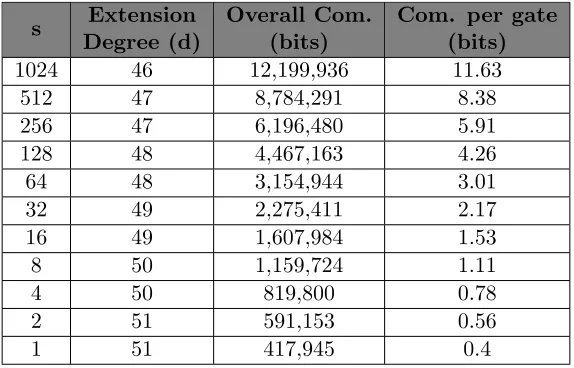
Remark 4.8 As an alternative to the above, it is possible to use a constantdand repeat the protocol multiply times to achieve the desired level of security. Reducing the degree of the extension ring has the potential to improve computation complexity. On the negative side, this comes at the cost of increasing communication. Specifically, if dis constant and σ is the statistical security parameter, then the number of repetitions ` is the smallest integer that satisfied the condition ` ≥ σ
d−γ (since it is required that 2(d−1γ)` ≤
1
2σ). The resulted communication cost is (6L+ 2M + 3)k·d` bits sent
by each party.
5
Achieving Full Security
Our protocol is in the (Fbc,Fcoin)-hybrid model: i.e., assuming access to a broadcast channel and (fully secure) coin-toss functionality. We remark that use of a broadcast channel is necessary to achieve full security within this setting, where broadcast is not possible without setup [PSL80]. Full security of both is achievable given PKI serup [RB89]. As our protocol makes minimal use of these functionalities—few calls, with small input size, independent of the evaluated circuit size— any reasonable implementations ofFbc andFcoinover PKI will suffice for ensuring the cost of their execution is dominated by other costs.
While player elimination techniques can often be used for upgrading from security with abort to full security (see [IKP+16] for a general result along these lines), these techniques are inefficient when applied to protocols for general circuits. An efficient general compiler was given in [DOS18] that converts a rich class of protocols (including ours) from security with abort to the stronger notion offairness, where either all parties learn the output or none do. However, while the compiler provides small concrete overhead, it does not provide a solution for full security; i.e., guaranteed output delivery. This means that any single party can mount a denial-of-service attack without being identified.
To bridge the gap from fairness to full security, there must in particular be means for identifying an honest party in the case of premature abort. This is a not a straightforward task (even given broadcast), as the identification must be donewhile preserving privacy. As we show, this is precisely what ourFvrfy instantiation achieves.
In what follows, we present the fully secure protocol directly with respect to the particular protocol Πf as in Protocol 3.2, and protocol Πvrfy implementing Fvrfy as in Section 4. However,
the blueprint can be extended to comparable building blocks, when the following properties are satisfied:
• The protocol Πvrfy realizingFvrfysatisfiesrecomputable verification: namely, each verifier sends a
single message, calculated as a deterministic functionVMsgt(πt,pub) of messages from the prover
πt and public values pub. In particular, this means that the prover himself can recompute the expected message of each verifier. As observed, this property holds for our protocol Πvrfy (see
Section 4.1, Remark “Recomputable verification.”)
• The protocol Πf for computingfwith security with abort has the property that the final messages in the protocol are robust, in the sense that each party Pi expects to receive identical messages from Pi−1 and Pi+1. In particular, this means the final output can be reconstructed from just the final message of one honest party.
Note that robustness holds for our Protocol3.2, as the final-round messages are parallel executions of the reconstruct(JwK, i) procedure on replicated secret shares, wherein parties Pj−1, Pj+1 send their (identical) share values wj+1 toPj (see Section2.1).
High-level protocol description. Recall the challenge is in guaranteeing output delivery in cases where adversarial behavior would cause an abort in the protocol Πf. As common, we devise means for parties in the face of adversarial behavior to identify and agree upon a party who must necessarily be honest (and thus can act as trusted party). In particular, our primary task is to provide an arbitration procedure for the case when a party Pi’s proof is rejected by a verifier
Pi−1, Pi+1 in the verification procedure Πvrfy. Such rejection can be caused by an invalid proof
no abort can occur; nevertheless, an abort during this phase could be resolved by jumping to this verification step, requiring the parties to justify their behavior (in zero knowledge) up to this point. We observe that the recomputable verification property of Πvrfy allows for a simple procedure
for an honest proverPi to identify and accuse a malicious verifier. The verifiers now each broadcast their respective message from Πvrfy; the prover Pi can then recompute and check whether each message is as expected. The length of the messages that the verifier broadcasts is sublinear in the circuit size,o(|C|), and one can further compress for concrete optimization via a few modifications and collision-resistant hashing.
The final challenge is to reconstruct the output in the case that all 3 parties’ proofs are accepted (if any is rejected we are in the case addressed above), but where a corrupt party withholds or sends a malformed final message. Here we rely on therobustnessof the final messages in Πf. Since each honest party will send his final messages correctly, this guarantees that each party will in fact be able to reconstruct the correct output; however, this may be indistinguishable from a malicious output derived from a malicious final message. To identify which output is correct, we add a MAC for each party, and run the underlying protocol on an augmented authenticated functionality f0
that accepts the original party inputsxi as well as MAC keyssi, and computesf as well as MACs on the output value with respect to the 3 corresponding keys.
A complete description is given as Protocol 5.2. Leveraging pseudorandomness for share com-pression as in Section3, we obtain the following theorem.
Theorem 5.1 (Fully Secure 3PC) Let R be a finite field, or ring R =Z2k. Then, for any R
-arithmetic circuitC witho(|C|)output wires, there exists a 3-party protocol for computingC in the (Fbc,Fcoin)-hybrid model, with the following features:
• The protocol makes black-box use of any pseudorandom generator.
• The protocol is computationally secure, with guaranteed output delivery against one malicious party.
• The communication complexity is |C|+o(|C|) elements of R per party, in addition to a constant number of calls to Fcoin and Fbc on messages of length o(|C|), where |C| denotes the number of
multiplication gates in C.
PROTOCOL 5.2 (Fully Secure 3PC)
• Inputs: Each partyPj (j∈ {1,2,3}) holds an inputxj ∈R`.
• Auxiliary Input: The parties hold a description of an arithmetic circuitC that computes f on inputs of length`·3.
LetMAC= (MAC.Gen,MAC.Tag,MAC.Verify) be an information theoretic one-time MAC. We denote by Πf the underlying protocol with security with abort (Protocol3.2) executed for
functionf.
• The base protocol:
1. Input sharing & circuit emulation: Each party samples a random MAC key, si ← MAC.Gen(1λ), for desired (statistical) security parameterλ. Execute as in Πf0, for the mod-ified function f0((x
1, s1),(x2, s2),(x3, s3)) = (y := f(x1, x2, x3),(MAC.Tag(y, si))i∈{1,2,3), where each party Pi uses input pair (xi, si). If at any point during this phase a party Pi reaches abort, he instead broadcasts via Fbc “inconsistent,” and all parties skip to the
Verification stage.
2. Verification stage:
(a) Begin as in Πf0: For each proverj∈ {1,2,3}, the parties execute protocol Πvrfyrealizing
Fvrfy, with inputj, the shares of Pj on the input wires, the messages sent by Pj and
its randomness for each multiplication gate.
For each proverj∈ {1,2,3}and verifiert∈ {j−1, j+ 1}, denotePt’s verifier message
byvt,j (see notation from the text, or Remark4.3), and Pt’s output bit by Acceptt,j
(indicating whetherPtaccepted the proof of Pj).
(b) Each partyPt,t∈ {1,2,3}, broadcasts the tuple (vt,t−1,Acceptt,t−1, vt,t+1,Acceptt,t+1).
• Determining outputs:
1. Output reconstruction, if ∃rejection:
Let i ∈ {1,2,3} be the minimal rejected prover index, i.e. for which (Accepti−1,i ∧ Accepti+1,i) = 0.
(a) Pi accuses: PartyPi identifies whether a party acted maliciously during verification by
recomputing the expected verifier messages. If fort∈ {i−1, i+ 1}the received message vt,i is not equal to the expected valuevt,i 6=VMsgt(πt, xt,pub) (see notation from the
text, or Remark4.3) thenPi selects one suchtand broadcasts “AccusePt.”
(b) Send inputs to honest party: Letj∗∈ {i−1, i+ 1}be the minimal index that wasnot
accused in the previous step. (Note that all parties agree onj∗ sincePi’s accusation is
broadcast.) Each partyPj,j ∈ {1,2,3}sends his input xj directly to partyPj∗. (c) Honest party computes: Party j∗ evaluates f on the received inputs, and sends the
outputyto all parties.
2. Output reconstruction, if 6 ∃ rejection:
(a) Each party sends the final reconstruction message as per Πf0. Denote the message from
Pi toPj, fori6=j ∈ {1,2.3}, bymsgi,j.
(b) Each Pi,i∈ {1,2,3}: Perform the following to output.
– Reconstruct the final output values y0t for t ∈ {i−1, i+ 1}, induced by msgt,i (by the assumed final-round robustness property of Πf0; see text). Parse each as
y0t= (yt, σt1, σ2t, σt3).
– Verify tag: For t∈ {i−1, i+ 1}, if 1 =Verify(yt, σti, si), then outputyt.