An Overview on: Bubble Deck Slab
Vishal Rajendra Shelar
1, Shaikh Sameer J.
2Diploma Student, Department of Civil Engineering, MGM’s Polytechnic, Aurangabad, Maharashtra, India 1
Lecturer, Department of Civil Engineering, MGM’s Polytechnic, Aurangabad, Maharashtra, India 2
ABSTRACT: This project introduces the bubble deck slab its uses and advantages to constructs economical and light weight structure. To use this technique, we ha ve reduced the total construction material and concrete by 35%. This project deals with reduction of dead load of slab by introduction of high -density polythene bubble in the middle of slab. By introducing the gap, it leads to 30 to 50% lighter slab which reduces the loads on columns, walls and foundation, thus having various advantages over the traditional slab. The aim of this project is to introduce about the various properties of bubble deck slab based on various studies done in the comparison with the conventional slab. Using bubble deck means floor cycle up to 20% faster than traditional construction method. By the Use of recycled material, lower energy consumption and reduced CO2 emissions, less transportation and crane lifts that make bubble deck mor e environmentally friendly than other concrete construction technique.
Advantages of these project are material and weigh reduction, construction and time saving, cost saving, green design i.e. we used HDPE (High Density Polyethene) recycled balls because to reduce wastage of plastics instead of burning the plastics. The Bubble Deck slabs being entirely recyclable. Recycled balls can be recovered during the demolition of the building to meet the goal of sustainable construction)
KEYWORDS: Bubble Deck, Comparison, Advantages.
I. INTRODUCTION 1.1General
The Bubble Deck method for the both directions reinforced composite concrete slab with gaps was invented in Denmark, it is licensed, and it was conceived to achieve saving of concrete and energy in buildings construction. The composite slabs are made of Bubble Deck type slab elements with hollow gaps, poured in place on transversal and longitudinal directions. By inserting the gaps leads to a 30 to 50% light weight slab which are minimize the loads on the columns, walls and foundations, and of Members of the entire building. “Bubble Deck” slab elements are plates with ribs on two directions made of reinforced concrete or precast concrete with spherical or circular shaped bubble (HDPE). These slabs consist of a bottom and an upper concrete part connected with vertical ribs that go around the gaps present in the slab. The reinforcement of the slab is made of two meshes one at the bottom part and one at the upper part of on the (HDPE) balls that can be tied with MS wire or by welding. The distances between the two bars are depend on the dimensions/Diameter of the bubbles that are to be embodied and the quantity of the reinforcement from the longitudinal and the transversal ribs of the slab. The two mashes are connected after placing the spheres into places in order to form a rigid shell. The bubbles are made by high density polythene material which is inserted in the concrete, arranged according to the project or design of the slab and placed between the reinforcement meshes. The material that are made of don’t react chemically with the concrete or the reinforcement, it has no porosity and has enough rigidity and strength to take over the loads as much as from the pouring of the concrete as from the subsequent phases of this process.
place in-effective concrete in the middle portion or centre of the slab, thus reduce or decreasing the dead weight or load and increasing the efficiency of the floor. The method which substitute the concrete by the use of recycled balls (HDPE) with less amount of concrete is known as “The Bubble Deck Technology”. Bubble Deck, a unique light, bi-axial concrete slab, is generally designed using the conventional design method. Bubble deck slab is a method of which is eliminate or reduce some % of concrete from the middle/centre portion of a floor slab, which is not performing any structural function in the slab, thereby affected reducing structural dead weight. The highly dense polyethylene hollow spheres put back the in-effective concrete in the centre of the slab, thus decreasing the dead weight and increasing the efficiency of the floor.
This method deals mainly in two directional reinforced complex concrete slabs with gaps. It ensures was conceived to achieve saving of concrete and energy in buildings construction. It is a new patent ed technique and it is a direct of connecting air and steel.
By utilize Bubble Deck method, the amount of concrete and cement is reduced/decreased by 30 to 50% for the same built surface compared with the conventional slabs, fact that gives an important re duced quantity of carbon emitted.
Bubble Deck slabs with gaps is interlocked so they don’t produce risks during its working period. Bubble deck has many advantages, beside it is reduced the material, the load, lower the cost and increasing the span length it is also a green technology. After all the punching shear capacity is one of the necessary properties of flat slab, the effect of the cavities due to using the plastic balls on the punching action of self -compacted concrete was study in this paper.
II. TYPE OF BUBBLE DECK SLAB 1. Type A (Partially Pre-casted slab)
Filigree elements Bubble Deck Type A Partially Pre-casted slab is a combination of constructed and unconstructed elements. A 60mm thick concrete bed that acts as both the formwork and part of the finished depth is precast and bring on site with the bubbles and steel reinforcement unattached. The bubbles are then supported by temporary stands on top of the precast Layer. Further or additional steel may be introducing according to the reinforcement/steel mesh essential of the design. Fig shows the cross-section of a typical filigree element.
Fig.1.1Filigree elements Bubble deck Type A
2. Type B (Assembly of bubbles and steel mesh)
Fig.1.2. Reinforcement modules Bubble Deck Type B
3. Type C (Fully Pre-casted)
Finished planks Bubble Deck Type C Fully Pre-casted are a shop-fabricated module that includes the plastic spheres, reinforcement mesh and concrete in its finished form. The member is constructed to the final depth in the form of a plank and is transported on site. Unlike Type A and B, it is a one-way spanning design that requires the use of support beams or load beams. Fig shows the cross-section of finished planks.
Fig.1.3. Finished planks Bubble Deck Type C
1.3 Structural Properties of Bubble Deck Slabs. A. Compressive strength and Flexural capacities.
Bubble deck slab is conceptualized to exclude a significant volume of concrete as compared to a solid slab in the central core where the slab is principally un-stressed in flexure. The thickness of compressed concrete is normally a small percentage of the slab thickness. The concrete between the ball and the surface so there is no reasonable difference between the behaviour of a Bubble Deck and solid slab. The only working rudiments are the steel on the tension side and the outer 'shell' of concrete on the compression side. In terms of flexural strength, the moments of resistance are the same as for solid slab.
B. Durability.
The staying power of bubble deck slab is not approximately different from ordinary solid slabs. The concrete is standard grade and combined with suitable bar cover provides most control of durability equal with normal standards for solid slabs. When the filigree slabs are fabricated, the reinforcement member and balls are vibrated into the concrete and produce the consistency of compaction so that a density of surface concrete is produced which is at least as impermeable and durable? Bubble deck slab elbow have a chamfer on the inside to assure that concrete surrounds each bar does not grant a direct route to air from the re-bar surface. This is mainly a fusion of the fire resistance but is also relevant to durability.
C. Fire Resistance
appreciable effect. Fire protection depends on concrete cover approximately 60-180 minutes. While Bubble deck slabs are not designed to provide thermal insulation due to enclose of the air bubbles in the middle of the concrete slab Bubble deck obtained between 17% to 39% higher thermal resistance than an equivalent solid slab of the same depth. Bubble deck slabs can therefore make a useful improvement towards the thermal insulation obtained by the overall construction.
D. Shear Strength
In any flat slab, design shear resistance is commonly demanding near columns. The shear stresses isolated from the columns diminishes promptly and outside the column zones it has been determine by testing and calculation the transverse and longitudinal shear stresses are In rich the capacity of the Bubble deck slab system. Near the columns, bubbles are left out so in these zones a Bubble deck slab is designed absolutely the same way as a solid slab. Shear support of Bubble deck slab is 0.6 times the shear support of a solid slab of the same depth. If this is exceeded by the tested shear, at a column for example, we allowance out the balls and use the full solid shear values. Using Euro code 2, we would calculate the applied shear at 2d and subsequent perimeters from the column face as per the code requirements, as well as at the column face itself. We would then analyse this to our calculated resistance. If the applied shear is less than the unreinforced hollow slab resistance, no further check is required. If the tested shear is higher than the hollow slab resistance, we delete balls and make it solid and then check the solid part. The sheer quantity is measured for two ratios of aid (distance from imposed force to support divided by deck depth/thickness). The results are shown in table 6.5. If the resistance is still higher than the solid slab protection and less than the maximum grant, we implement shear reinforcement. For these reasons, it is demonstrated that the design may be carried out in every way treating the slab as a solid slab, with the provisions mentioned above, which is all appropriated account of in the design action? We therefore use Euro code 2, which is fully compatible with the system, for our design and which is somewhat more up to date than BS811O. Punching shear, the average shear capacity is measured to 91 % compared to the calculated values of a solid deck.
E. Sound Insulation
A relation was made between Bubble Deck and one-way prefabricated hollow deck of similar height. The noise reduction with Bubble Deck was 1db higher than the one-way prefabricated hollow deck slab. The main principle for reducing noise is the weight of the deck and therefore Bubble Deck will not act differently than other deck types with equal weight. The Bubble deck slab construction is following every usual principle and can be calculated according to usual principles. Bubble deck behave acoustically in a better way than any other hollow or solid floor surfaces. Because of the three-dimensional structure and the graduated force flow, the hollow spheres have a positive influence on sound insulation. The tests reveal that the airborne sound insulation is even higher than expected. This indicates the bubbles have a positive influence on sound insulation.
F. Vibration
1.4Material
1. Recycled Balls
Generally, we used HDPE (High Density Polythene) recycled balls because to reduce/Minimize wastage of plastics instead of burning the plastics. Recycled balls can be recovered or reused during the demolition of the building to meet the goal of sustainable construction. The recycled polyethylene hollow balls are shown in fig.1.4.
Fig.1.4. Recycled Polyethylene Hollow Spheres
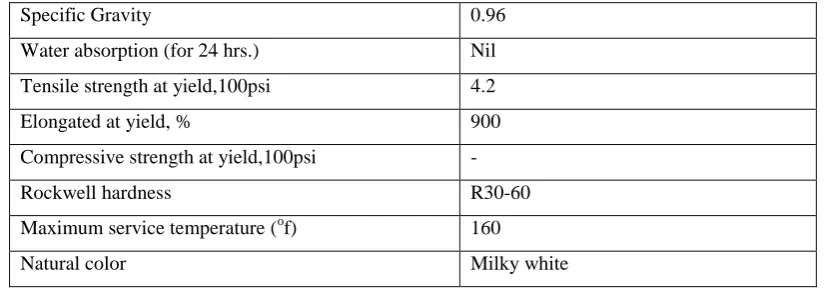
Table 1.1: Properties of HDPE Balls
Specific Gravity 0.96 Water absorption (for 24 hrs.) Nil Tensile strength at yield,100psi 4.2 Elongated at yield, % 900 Compressive strength at yield,100psi - Rockwell hardness R30-60 Maximum service temperature (of) 160
Natural color Milky white
2. Steel reinforcement
(HYSD) High grade steel of Fe 550 or Fe 500 is generally used in that slab. The same grade of steel is used in both of side in top and bottom steel mesh. Reinforcement are accurately placed and secured in position in a manner that will prevent its displacement during the placement of concrete. Reinforcement provided in both directions i.e. transverse and longitudinal direction in the form of welded or by winding reinforcement mesh.
3. Diagonal girder
The diagonal girders keep the HDPE bubbles to fixed in between the top and bottom reinforcement. It acts as a support to the ball when the concreting work in process. Girders that are applied as shear force reinforcement have to meet the following requirements.
a) The center-to-Centre-distance of the girder should be a maximum of twice the floor thickness.
c) Every pair of two diagonals, existing of one up running and one down running bar, should be welded with 2 welding points to both the lower and the upper longitudinal bar.
d) The welding points with which the diagonals are attached to the lower and upper longitudinal bar should have a resistance per welding point of at least 25% of the flow strength of the diagonal. The distance between the edge of the floor support and the connection of the first diagonal from the floor support with the upper longitudinal bar of the girder should be maximal times the height of the girder. The diagonal girder with bottom reinforcement is shown in fig.
Fig.1.5. Diagonal Girder
1.5 Comparison between Bubble Deck Slab and Solid Deck Slab 1) Shear strength and punching shear:
The results of a number of practical tests establish that the shear strength depends on the effective mass of the concrete. The shear capacity is measured to be in the range of 72-91% of the shear capacity of a solid deck. In calculations, a factor of 0, 6 are used on the shear capacity for a solid deck of identical height. This guarantees a large safety margin. Areas with high shear loads demand therefore an Appropriate attention, e.g. around columns. That is solved by excluding a few balls in the critical area around the columns, therefore giving total shear capacity.
2) Bending Strength and Deflection Behaviour:
Bubble Deck where compared to a solid deck both practically and theoretically. The results in the table below show that for the same deck thickness the bending strength is the same for Bubble Deck and for a solid deck and that the stiffness of the Bubble Deck is somewhat lower. But technical university of Denmark also carried out test on stiffness of bubble deck slab. They verified the result and they found out, for same strength, bubble deck has 87% of bending stiffness of similar solid slab but only 66% concrete volume due to HDPE spheres.
3) Anchoring
The anchoring in the two types is identical. The balls do not influence the anchoring.
4) Sound
5) Creep
No important difference between Bubble Deck and solid deck. Differences can be due to the fact that the tests only were considered in a one-way-span.
6) Comparison in Cost
Only differences in materials concerning the slabs are considered. For the same amount of steel and concrete, Bubble Deck has 40 % larger span and is moreover 15 % cheaper. For the same span, Bubble Deck reduces/decrease the amount of concrete by 33 %, and reduces the price of slab with 30 %.
(1) Bubble Deck Slab
Size of model slab = 6.3 x 4.5 x 0.3=8.505 m³
Amount of concrete replaced by bubbles is (Π/4 x 0.2703) /24 x 250 = 2.6m³ Amount of concrete in bubble deck slab is 8.505-2.6 =5.905 m³
(2) Convectional slab.
Beam in x-direction is 3 x (4.5 x 0.3 x 0.450) =2.430m3 Beam in y-direction is 4 x (2.7 x 03 x 0.45) =1.944m3 Slab portion is 2 x (3.9 x 2.7 x 0.18) =3.7908m3
Amount of concrete in convectional slab is 2.340+1.944+3.7908=8.0748m3.
Comparison
Concrete saving is calculated by comparing the equation = (2)-(1) Quantity of concrete saved in model slab is 8.0748 - 5.90=2.1698m3
Percentage of concrete replacedor saved or reduce from slab = (2.1698/8.0748) x 100 =26.9% ≈ 27% % of concrete replaced or saved or reduce from slab = 27%
Table 1.2.Cost and Amount Comparison between Bubble deck and Conventional Concrete Slab
Convectional slab Bubble deck slab
Amount of concrete = 8.0748 m³ Amount of concrete = 5.905 m³ Cost of concrete for construction is
8.0748 x 8400 = 67828.32
Cost of concrete for construction is 5.905 x 8400 = 49602
There is no cost saving Cost saving is 67828.32 - 49602 = Rs.18226.32
7) Comparison in Weight or Density between the Bubble and the same Sphere of Concrete.
Fig.1.6. Weight of Bubble
Calculation and comparison of the weight of the Concrete sphere.
Unit Weight (Density) of Concrete = 2500 kg/m3 Density = Mass/Volume
So, we need Mass,
i.e. formula is Mass=Density X Volume Volume of Sphere of 150mm diameter = (4/3) πr3
Radius = 0.075m, π = 3.14.
Volume of Sphere = (4/3) X3.14X (0.075)3 = 0.001766 m3 Mass = 2500kg/m3 X 0.001766m3
Mass of 150mm Diameter Concrete Sphere = 4.415 kg.
The Difference between the weight of ball (HDPE) and weight of Concrete sphere = 4.261 Kg.
1.6Advantages
a) Material and Weight Reduction
The main advantage of a Bubble deck slab is they can use 30-50% less concrete than normal solid slabs. The (High density Polyethene Ball) HDPE bubbles replace the non-effective concrete in the centre of the Slab or Section, that reduces the dead load of the structure by Reducing/removing unused, heavy material i.e. Concrete. Reducing or Removing concrete material and weight also leads to less structural steel since the need for reinforcement diminishes. The foundations for the structure can be designed for smaller dead loads as well. Overall, due to the lighter floor slabs, the several downstream components can be engineered for lower loads and thus save extra/additional material.
b) Structural Properties
Because of the lesser dead weight of the slab and its two-way spanning action, load-bearing walls become unnecessary. Bubble deck is also designed as a flat slab, which reduces and decrease the need for support beams and girder members in the structure. As a result, these features reduce some of the structural requirements for the foundations and columns. Also, Bubble deck slabs can be designed and analysed as a standard concrete flat slab according to research performed on its strength and ductility.
c) Construction and Time Savings
Time savings can also be managed through the faster construction of walls, columns and MEPs due to the lack of support beams and load bearing walls for this innovative flat slab. Because of that Addition time may be saved from the early/quicker curing time since there is less concrete in the slab.
d) Cost Savings
In compare to the savings in material and time, cost reductions are also important in the Bubble deck slab system. The decreased and by reducing weight and materials mean lower transportation costs and would by more economical to lift the components. With less on-site construction from the full and semi-precast slab, labor costs will be decrease because of less work. In addition, money can be saved in the design and construction of the building frame elements (i.e. Columns and walls) for lower loads. There is a little bit increase in production costs for the Bubble deck slab due to the manufacturing and assembly of the HDPE spheres. However, the other savings in material, time, transportation and labor will offset this manufacturing price increase (Stubbs).
e) Green Design
The number of owners, designers and engineers who desire green alternatives is growing exponentially. Bubble deck is a fitting solution for lowering the demonstrate carbon in new buildings. According to the Bubble Deck Company, 1 kg of recycled plastic replaces/restore 100 kg of concrete. By using less concrete, designers can save up to 40% on demonstrate carbon in the slab, resulting in significant savings downstream in the design of other structural members. Carbon discharge from transportation and equipment usage will also decrease or reduces with the use of short materials. Also, the HDPE bubbles can be regained and reused for other projects or can be recycled.
III. METHODOLOGY
3.1Collection of data
We collect data about bubble deck slab with help to teachers and from different research papers. From that data we have study about the difference between the bubble deck slab and conventional slab. From that study we make a model on it by step by step i.e. (design of steel for conventional slab, mix design of conventional slab, design of steel for bubble deck slab, mix design of bubble deck, etc.)
3.2 Construction Methodology (Bubble Deck Slab) 3.2.1 Selection of Materials
These materials use for the research where obtained within Aurangabad city. Ordinary Portland cement (OPC) (Ambuja brand) Was used for the project, the fine aggregate (sharp sand) use was obtained from a flowing river it was dried for some days in the laboratory and then sieved to be free from deleterious material. Coarse aggregate was purchase from a quarry site. And instead of bubble we used plastic balls. Ordinary cline tap water free for drinking was used for the experiment. We used steel having 8mm diameter for the project.
3.2.2 Making steel mesh for conventional slab (one way)
Fig.2.1. Conventional slab mesh
3.2.3Making steel mesh for Bubble Deck slab
We take 8mm diameter bar of 30 feet’s and cut it in to 22 inches each strip. In that system no bent up is required in a main bar, only straight bar mesh is provided in bottom and top of bubbles. The main and distribution bar is place in 2.5 inches in distance. And that these two meshes we fix a Bubble (HDPE) in proper manner.
Fig.2.2. Bubble Deck Slab Mesh
3.2.4Provision Bottom Reinforcement
The initial step is laying the bottom reinforcement for increase the tensile strength of the structure. It fetches the ball and aligns it in a straight line. Bottom reinforcements are two directionally righted reinforcement meshes.
3.2.5Provision of Top Reinforcement
After placing the balls, top reinforcement meshes are provided on the top of the sphere. It is positioning the ball and also acts as a cover for the balls. The two mashes are connected after placing the spheres into places in order to form a rigid shell. In order to achieve the reinforcement modules for Bubble Deck slabs with gaps. The following operations must take place:
• Making the steel reinforcement meshes.
• Placing the pipelines, cables and element of electric fittings.
• Fixing small boxes or pieces of polystyrene on reinforcement meshes for marking the position of the walls or the columns and installations.
• Placing of the polystyrene spheres between the meshes according to plans
3.2.6Location of balls
positioning of the slab elements it is checked if the displaying of the spheres is according to the plans. Also, it is checked the reinforcement in the over concreting areas. The transversal reinforcement bars must be embedded in the adjacent slab elements. To maintain the building configuration partially pre-casted elements are made and designed. They are delivered with pieces of polystyrene included that mark the position of the walls or the columns.
3.2.7Mix proportions of conventional and bubble deck slab
Batching operation by weight approaches was adopted in the study. Preliminary mixes of 1:2:4 (cement: fine sand: coarse aggregate) were investigated with water/cement ratio of 0.80, and 0.70 respectively so as to obtained the required w/c ratio for the actual mixes.
3.3Casting and Curing of Conventional and Bubble Deck Slab 3.3.1Bottom Concrete
Concrete is provided at the bottom of the assembly line. It acts as a bonding material for ball because the ball attached with the concrete. We take waste tiles for casting of slab for better smooth finishing. Then apply oil on it and place steel mesh of conventional slab and bubble deck slab mesh in the two different formwork mould. Concrete provided over the slab by trowel. Concrete is poured in between the ball gaps. Immediately after pouring, the surface of the concrete is cleaned with under pressure water to remove the dust and to moister the surface. Especially in times of high temperatures the surface of the precast element is kept wet to ensure the needed adherence and the connections of the partially prefabricated elements are not rigorously followed according to the design the concreting is adjusted with fluid mortar or with a thin layer of silicon pumped at the bottom part of the connection. In order to adjust the connections, one should never use expanded foams that may lead to reducing the thickness of the concrete layer and therefore to reducing the durability of the reinforcement and the fire resistance. Self-compacting concrete can be poured into forms, flow around congested areas of reinforcement and into tight sections, allow air to escape and resist segregation, without the standard consolidation efforts.
After concreting, vibration is provided for bottom and top concrete setting. Removing air content from the slab. Thin vibrator should be used for compaction as there is less space between the spheres. The surface of the poured concrete in leveled with a metallic profile. Finally, concrete surface finished with finishing tools. There is no further work required, the slab is complete unless requirement for exposed soffit.
Then place it to 24 hr. for final setting. After setting we removed the formwork and place the slabs for curing for 7 days.
IV. CONCLUSION
In the present scenario of the construction industries we need different types of methods which are more economical, easy to construct and environment friendly. The Bubble Deck Slab is one the technology which helps us to achieve the economy, easy to construct and environment friendly. Bubble deck Technology is the innovative system that eliminates Concrete in the mid-section, secondary supporting structure such as beams reinforced concrete columns or structural walls.
As compared to conventional concrete the weight reduction is about 13% (for 1 m3) which will help in decreasing dead load and hence ultimately will reduce the moments. This will help in a stable structure which will also reduce the initial constructional cost up to 12 %. (for 1 m3).
REFERENCES
1) M. Surendar, M. Ranjitham (2016). Numerical and Experimental Study on Bubble Deck Slab Research Article Volume 6 Issue No. 2016 IJESC.
2) Tina Lai “Structural behavior of bubble deck slab and their applications to lightweight bridge decks” M-Tech thesis, MIT, 2009.
3) Bubble deck design and detailing, Bubble Deck Voided Flat Slab Solutions- Technical Manual and Documents (2007).
4) Prabhu Teja and P Vijay Kumar International Journal for Research in Applied Science & Engineering Technology (IJRASET), Volume 5 Issue
X, October 2017.
5) (IRJET) Volume: 05 Issue -02, Feb-2018 N. Lakshmipriya, M. Karthik Pandi, UG students, Dept. of Civil Engineering, Dr. Mahalingam
College of Engineering and Technology, Pollachi, Tamil Nadu.
6) Bubble Deck Engineering Design & Properties" Overview." Bubble Deck Voided Flat Slab Solutions- Technical Manual and Documents (2007).
7) Bubble Deck Slab properties “Bubble Deck Voided Flat Slab Solutions- Technical Manual and Documents (2006).
8) Comparative Study of Bubble Deck Slab and Solid Deck Slab – A Review Raj. R. Vakil1, Dr.Mangulkar Madhuri Nilesh2 1 Department of
Civil Engineering, Jawaharlal Nehru Engineering College, Aurangabad, (India) Vol.no.6 Issu.no. 10 October 2017.
9) Study And Model Making Of Slab Using Bubble Deck Technology, N. Lakshmipriya, M. Karthik Pandi1, 2 Ug Students, Dept. Of Civil
Engineering, Dr. Mahalingam College of Engineering and Technology, Pollachi, Tamil Nadu.Volume: 05 Issues - 02 Feb-2018.
10) Review Paper: Study on a Comparative Study of Bubble Deck Slab and Conventional Deck Slab. Mr. Devyanshu Jain, Miss. Nidhi Gupta