Implementation of a Strongly Robust Identity-Based Encryption
Scheme over Type-3 Pairings
*Hiroshi Okano¶, Keita Emura§, Takuya Ishibashi¶,§, Toshihiro Ohigashi¶,§, and Tatsuya Suzuki†
¶Tokai University, Japan.
§National Institute of Information and Communications Technology (NICT), Japan. †University of Tsukuba, Japan.
April 28, 2020
Abstract
Identity-based encryption (IBE) is a powerful mechanism for maintaining security. However, systems based on IBE are unpopular when compared with those of the public-key encryption (PKE). In our opinion, one of the reasons is a gap between theory and practice. For example, a generic transformation of weakly/strongly robust IBE from any IBE has been proposed by Abdalla et al., no robust IBE scheme is explicitly given. This means that, theoretically, anyone can construct a weakly/strongly robust IBE scheme by employing this transformation. However, this seems not easily applicable to non-cryptographers. In this paper, we first introduce the Gentry IBE scheme constructed over Type-3 pairings by employing the transformation proposed by Abe et al., and second we explicitly give strongly/weakly robust Gentry IBE schemes by employing the Abdalla et al. transformation. Finally, we show its implementation result and show that we can add strong robustness to the Gentry IBE scheme with a very few additional costs. We employ the mcl library to support a Barreto-Naehrig curve defined over the 462-bit prime. The encryption requires about 5 ms, whereas the decryption requires about 9 ms.
1
Introduction
1.1 Background
Public-key encryption (PKE) is an important mechanism for maintaining security in several orga-nizations. Identity-based encryption (IBE) [52] is an extension of PKE in which an arbitrary string,
such as email, location information, and biometrics information, is considered to be a public key, and is standardized by the ISO/IEC 18033-5 and IEEE P1363.3. The conventional PKE requires public-key infrastructure systems, whereas IBE does not require such systems. However, IBE can offer secure systems, which are not achievable using PKE. For example, IBE can maintain IoT security as revealed by [2, 8, 40, 50]. Micro Focus [41] launched a secure email service based on IBE and insisted that “IBE can be used to build security systems that are more dynamic, lightweight, and scalable”.
Further, the security systems based on IBE are not popular when compared with PKE-based systems. A gap between theory and practice is one of the reasons for the non-universal applicability of IBE. Regardless, several IBE security definitions are proposed, which include indistinguisha-bility against plaintext/ciphertext attacks (IND-CPA/CCA) [17], selective/adaptive security [15], anonymity against chosen plaintext/ciphertext attacks (ANON-CPA/CCA) [18], and weak/strong robustness [4, 5]. However, software engineers face challenges while implementing the IBE schemes integrated into the security systems since these security properties are not easily selected according to the functionalities or models of the systems if engineers are not familiar with cryptography.
For example, Abdalla et al. [4, 5] introduced robustness which seems attractive to be employed in such systems. Informally, robustness guarantees that a ciphertextC of a plaintextM encrypted by an identityID is not decrypted by a secret key of a different identityID′ (ID̸=ID′). This causes a problem when the underlying IBE scheme is anonymous. Here, anonymity indicates that the ID
information is not revealed from C. Although a receiver’s privacy is protected in an anonymous IBE, nobody can recognize the decryption keys that are to be used, even the corresponding receiver. We remark that, “Cis not decrypted” contains the situation that the decryption algorithm outputs a plaintext M′ whereM ̸=M′. Thus, if a random string such as password is encrypted, then one may receive M′ as own password. If the underlying IBE scheme is robust, then the decryption algorithm outputs a special rejection symbol ⊥ if an inaccurate secret key is used. Abdalla et al. defined two notions of robustness, weak robustness and strong robustness. Refer to Section 4 for details. Although robustness seems naturally holds in usual IBE schemes, this it not true, and is not guaranteed in usual IBE schemes in general. Thus, Abdalla et al. proposed the generic transformation of weakly/strongly robust IBE from any IBE. That is, anyone can theoretically
construct a weakly/strongly robust IBE scheme by employing this transformation. However, this seems not easily applicable to non-cryptographers. In addition, no robust IBE scheme is explicitly given in their paper.1
Moreover, it is difficult to select which parameters, e.g., elliptic curves, should be used for implementation based on a state-of-the-art method for solving the discrete logarithm (DL) prob-lem [12, 39] or based on the type of pairings. These situations may prevent the applicability of IBE.2
1.2 Our Contribution
In this paper, we focus on the robustness [4, 5] because no concrete IBE scheme offers robustness. We explicitly present strongly/weakly robust IBE schemes. Moreover, inspired by [49], we present the implementation results.
We employ the Gentry IBE scheme [32] as the underlying IBE, which is adaptively IND/ANON-CCA secure. Because the Abdalla et al. transformation preserves IND/ANON-CCA security and anonymity, we can add weak/strong robustness of the Gentry IBE scheme without detracting the CCA security
1
As a remark, they explicitly gave a strongly robust CCA secure Cramer-Shoup PKE scheme in their paper.
2Aoki [9] mentioned that majority of the cryptographic algorithms that guarantee security require assumptions,
The original Gentry IBE scheme
• Type 1
• Adaptively CCA secure
• Adaptively Anonymous
The Gentry IBE scheme (Sec. 4.3)
• Strongly Robust
• Type 3
• Adaptively CCA secure
• Adaptively Anonymous
The Gentry IBE scheme (Sec. 3)
• Type 3
• Adaptively CCA secure
• Adaptively Anonymous
The Gentry IBE scheme (Sec. 4.2)
• Weakly Robust
• Type 3
• Adaptively CCA secure
• Adaptively Anonymous Abe et al. Transformation
Abdalla et al. Transformation (For strong robustness)
Abdalla et al. Transformation (For weak robustness)
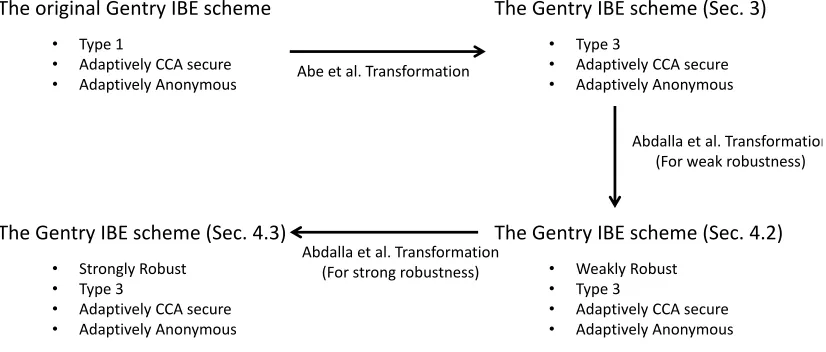
Figure 1: Overview of the Transformations
and anonymity. Unfortunately, the original Gentry IBE scheme is constructed over Type-1 pairings although the construction of schemes over Type-3 pairings is the most efficient (refer to Section 2 for details). Thus, we employ the transformation proposed by Abe et al. [6,7] to the original Gentry IBE scheme, constructed over Type-3 pairings. Then, we employ the transformation proposed by Abdalla et al. Figure 1 reveals an overview of the transformations.
For the implementation of the strongly robust Gentry IBE scheme over Type-3 pairings, we employ the mcl library [42] that supports Type-3 pairings with the parameters that have been selected by considering the state-of-the-art for solving discrete logarithm problem [12, 39]. The encryption requires about 5 ms, whereas the decryption requires about 9 ms.
2
Bilinear Groups
In this section, we define bilinear groups and types as follows:
Definition 1 (Bilinear Groups) Let p be a λ-bit prime, G1,G2 and GT be the groups of order
p; e:G1×G2 →GT is a bilinear map, and g1 and g2 are generators of G1 and G2, respectively.
We require bilinearlity: for all h1 ∈ G1, h2 ∈ G2, and a, b ∈ Zp, e(ha1, hb2) = e(h1, h2)ab, and
non-degeneracy: e(g1, g2)̸= 1 hold.
IfG1=G2, the mapeis calledsymmetric, and we call the setting Type 1. IfG1̸=G2, the map e is called asymmetric. If there is an efficient computable isomorphism ψ :G2 →G1, we call the setting Type 2 (e.g., Miyaji-Nakabayashi-Takano (MNT) curves [43]). If no efficient isomorphism is known betweenG1 andG2, we call the setting Type 3 (e.g., Barreto-Naehrig (BN) curves [14] or Barreto-Lynn-Scott (BLS) curves [13]). Alternatively, we use the terms Type-ipairings/curves or Type-ibilinear groups fori= 1,2,3.
unless there is a specific reason, e.g., employing symmetric curves as Gap-DH groups [36]. The mcl library implements a BN curve [14] defined over the 462-bit primer(z) := 36z4+36z3+24z2+6z+1 and has the order p(z) = 36z4+ 36z3+ 18z2+ 6z+ 1 where z = 2114+ 2101−214−1. Currently, this curve is believed to provide 128-bit security, denoted asBN462in this paper.
Remark. The symmetric pairing is known as a decisional Diffie-Hellman (DDH) solver. That
is, for a tuple (g, ga, gb, gc) ∈ G41, one can check whether c = ab or not by checking whether
e(ga, gb) =e(g, gc). However, in the computational Diffie-Hellman (CDH) problem, computing gab
from (g, ga, gb)∈G31 is still believed to be difficult. Further, the DDH assumption holds in case of both G1 and G2 in Type-3 bilinear groups, which we call the symmetric external Diffie-Hellman (SXDH) assumption. We also state that the DDH assumption holds inG1 and does not hold inG2 in the Type-2 setting, which we call the external Diffie-Hellman (XDH) assumption.
3
The Gentry IBE scheme over Type-3 Pairings
As mentioned in the previous section, Type-3 pairings are better from an efficiency point of view. Unfortunately, the original Gentry IBE scheme is constructed in Type-1 pairings. Thus, in this section, we introduce the Gentry IBE scheme constructed over Type-3 pairings that is obtained by employing the Abe et al. transformation [6, 7] to the original Gentry IBE scheme. Before giving that, we define the syntax of IBE as follows.
Definition 2 (Syntax of IBE) An IBE scheme IBE consists of the following four algorithms,
IBE.Setup, IBE.KeyGen, IBE.Enc and IBE.Dec:
IBE.Setup(1λ): The setup algorithm takes as an input a security parameterλ∈N, and returns a public parameterparams and a master key msk.
IBE.KeyGen(params,msk,ID): The key extract algorithm takes as input an identity ID and
msk, and returns a secret key skID corresponding to ID.
IBE.Enc(params,ID, M): The encryption algorithm takes as input params, ID, a plaintext M, and returns a ciphertext C.
IBE.Dec(params,skID, C): The decryption algorithm takes as input params, skID, and C, and
returns a plaintext M or a reject symbol ⊥.
Next, we introduce the Gentry IBE scheme over Type-3 pairings as follows. In the construction, public parameters h1, h2, and h3, and secret keys (hID,1, hID,2, hID,3) are elements on G2 whereas these are elements on G1 in the original construction.
The Gentry IBE Scheme over Type-3 Pairings:
IBE.Setup(1λ): Choose a Type-3 bilinear group (G1,G2,GT, e, g1, g2) withλ-bit primepwhere g1 and g2 are generators of G1 and G2, respectively. Choose α
$
←− Zp and h1, h2, h3 $
←− G2, compute g1′ =g1α, and outputparams= (g1, g1′, g2, h1, h2, h3, H) where H :{0,1}∗ →Zp is a universal one-way hash function, andmsk=α.
IBE.KeyGen(params,msk,ID): For identityID∈Zp, for i= 1,2,3 choose rID,i $
←−Zp, compute
hID,i= (hig rID,i
IBE.Enc(params,ID, M): Let M ∈ GT be a plaintext to be encrypted. Choose s $
←− Zp, compute C1 =g1′
s
g−1sID, C2 = e(g1, g2)s, C3 =M e(g1, h1)−s, β =H(C1, C2, C3), and C4 = e(g1, h2)se(g1, h3)sβ, and outputC = (C1, C2, C3, C4).
IBE.Dec(params,skID, C): Compute β =H(C1, C2, C3). If C4 ̸= e(C1, hID,2hβID,3)C
rID,2+rID,3β
2 ,
then output ⊥. Otherwise, computeM =C3e(C1, hID,1)C rID,1
2 and output M.
The security of original Gentry IBE scheme relies on the truncatedq-ABDHE assumption where ABDHE stands for augmented bilinear Diffie-Hellman exponent. Since the assumption is defined over Type-1 settings, we also need to duplicate the assumption via the Abe et al. transformation as follows. Interestingly, we do not have to duplicate not all elements. We duplicate generators and (g1α, gα2) only.
Definition 3 (The truncated q-ABDHE Assumption over Type-3 Pairings) Let(G1,G2,
GT) be a Type-3 bilinear groups with λ-bit prime order p. Let g1, g1′ ∈ G1 and g2, g2′ ∈ G2
be generators, α ←−$ Zp, and Z $
←− GT. For all probabilistic polynomial-time adversaries A, we
define the advantage AdvAABDHE(λ) := Pr[A(g1, g1′, g2, g2′, g1α, gα2, gα
2
2 , . . . , gα q 2 , g′1
αq+2, e(gαq+1
1 , g′2))]
−Pr[A(g1, g1′, g2, g2′, g1α, g2α, gα
2
2 , . . . , gα q 2 , g1′
αq+2
, Z)]. We say that the truncated q-ABDHE assump-tion holds if AdvAABDHE(λ) is negligible.
4
Robust Gentry IBE Schemes
In this section, we employ the Abdalla et al. transformation [4, 5] to the Gentry IBE scheme given in Section 3.
4.1 Two Robustness Notions
Abdalla et al. defined two notions of robustness, weak robustness and strong robustness. Weak robustness ensures that M′ ̸=⊥ holds with negligible probability where M′ is defined as M′ :=
IBE.Dec(params,skID′, CID) whereskID′ :=IBE.KeyGen(params,msk,ID′) andCID:=IBE.Enc(params,
ID, M). Here, (M,ID,ID′) is selected by an adversary with the condition M ̸=⊥ and ID ̸=
ID′. Further, we remark that the ciphertext of ID on M is honestly computed. Strong robust-ness ensures that M ̸=⊥ and M′ ̸=⊥ hold with negligible probability where M and M′ are defined as M := IBE.Dec(params,skID, C) and M′ := IBE.Dec(params,skID′, C) where skID :=
IBE.KeyGen(params,msk,ID) and skID′ := IBE.KeyGen(params,msk,ID′). Here, (C,ID,ID′) is se-lected by an adversary with the conditionID̸=ID′. We remark that the ciphertextCis adversarially computed.
4.2 Weakly Robust Gentry IBE Scheme
First, we denote a weakly robust Gentry IBE scheme. We employ the Abdalla et al. transformation
for weak robustness. Intuitively, the auxiliary informationK ←− {$ 0,1}λ is chosen and is contained in public parameters. The encryption algorithm encrypts the plaintext M||K, and the decryption algorithm checks whetherK is appropriately recovered. We remark thatM||Kis not an element of
Weakly Robust Gentry IBE Scheme:
IBE.Setup(1λ): Choose a Type-3 bilinear group (G1,G2,GT, e, g1, g2) withλ-bit prime orderp whereg1 andg2are generators ofG1andG2, respectively. ChooseK
$
←− {0,1}λ,α←−$ Zp, and
h1, h2, h3 $
←− G2, compute g1′ = g1α, and output params = (K, g1, g′1, g2, h1, h2, h3, H, HAES)
where H :{0,1}∗ → Zp is a universal one-way hash function, HAES : GT → {0,1}256 be a collision resistant hash function, and msk=α.
IBE.KeyGen(params,msk,ID): For identityID∈Zp, for i= 1,2,3 choose rID,i $
←−Zp, compute
hID,i= (hig rID,i
2 )1/(α−ID)∈G2, and output skID= (rID,i, hID,i)3i=1.
IBE.Enc(params,ID, M): Choose s ←−$ Zp, compute C1 = g1′ s
g−1sID, C2 = e(g1, g2)s, KAES =
HAES(e(g1, h1)−s),C3 =AES.Enc(KAES, M||K),β=H(C1, C2, C3), andC4=e(g1, h2)se(g1, h3)sβ, and outputC = (C1, C2, C3, C4).
IBE.Dec(params,skID, C): Compute β =H(C1, C2, C3). If C4 ̸= e(C1, hID,2hβID,3)C
rID,2+rID,3β
2 ,
then output ⊥. Otherwise, compute M||K′ = AES.Dec(HAES((e(C1, hID,1)C rID,1
2 )−1), C3). Output⊥ifK′ ̸=K, and output M, otherwise.
4.3 Strongly Robust Gentry IBE Scheme
Next, we denote a strongly robust Gentry IBE scheme. We employ the Abdalla et al. transformation to the weakly robust Gentry IBE scheme as the building block. The transformation additionally introduces a commitment scheme CMT = (CPG,Com,Ver). The parameter generation algorithm
CPG takes as input a security parameter, and outputs the public parametercpar. The committal algorithmComtakes as inputcparand datax, and outputs a commitment comand a decommittal key dec. The verification algorithm Ver takes as input (cpar, x, com, dec), and outputs 1 or 0. We employ the Pedersen commitment scheme [46]. LetG1 be a group with a prime order p. TheCPG
algorithm choosesg′, h′ ←−$ G1. TheComalgorithm choosesdec←−$ Zpand computescom=g′xh′dec. TheVer algorithm outputs 1 ifcom=g′xh′dec and 0 otherwise. The Pedersen commitment scheme is perfectly hiding, and is computationally binding under the DL assumption. Since we do not have to assume the hardness of the DDH problem, we implement the scheme on G1 regardless of types of pairings.
In the scheme, a public key ID is committed. The encryption algorithm encrypts a plaintext
M||dec and the commitment com is contained in the ciphertext. Because the weakly robust IBE scheme is used as the building block, the encryption algorithm encrypts a plaintext M||K||dec in the actual scheme. The decryption algorithm checks whether com is a commitment of ID or not. As in the weak one, we remark thatM||K||dec is not an element of GT and thus we employed the KEM/DEM framework.
Strongly Robust Gentry IBE Scheme:
IBE.Setup(1λ): Choose a Type-3 bilinear group (G1,G2,GT, e, g1, g2) with λ-bit prime or-der p where g1 and g2 are generators of G1 and G2, respectively. Choose K ←− {$ 0,1}λ,
g′, h′ ←−$ G1, α $
←− Zp, and h1, h2, h3 $
Table 1: Comparison among Gentry IBE Schemes over Type-3 Pairings (millisec) Normal (Sec. III) Weakly Robust (Sec. IV) Strongly Robust (Sec. IV)
IBE.Setup 14.66 14.63 15.39
IBE.KeyGen 4.54 4.54 4.49
IBE.Enc 4.66 4.63 5.19
IBE.Dec 8.49 8.46 9.00
IBE.KeyGen(params,msk,ID): For identityID∈Zp, for i= 1,2,3 choose rID,i $
←−Zp, compute
hID,i= (hig rID,i
2 )1/(α−ID)∈G2, and output skID= (ID,(rID,i, hID,i)3i=1).
IBE.Enc(params,ID, M): Choose dec ←−$ Zp and compute com = g′IDh′dec. Choose s $
←− Zp, compute C1 = g′1
s
g1−sID, C2 = e(g1, g2)s, KAES = HAES(e(g1, h1)−s), C3 = AES.Enc(KAES,
M||K||dec),β=H(C1, C2, C3), andC4=e(g1, h2)se(g1, h3)sβ, and outputC= (com, C1, C2, C3, C4).
IBE.Dec(params,skID, C): Compute β =H(C1, C2, C3). If C4 ̸= e(C1, hID,2hβID,3)C
rID,2+rID,3β
2 ,
then output⊥. Otherwise, computeM||K′||dec=AES.Dec(HAES((e(C1, hID,1)C rID,1
2 )−1), C3). Output⊥ifK′ ̸=K. Otherwise, output ⊥ifcom̸=g′IDh′dec, and outputM, otherwise.
Remark. To the best of our knowledge, the strongest notion among several robustnesses is complete robustness defined by Farshim et al. [29].3 They also showed that the transformation from weakly robust IBE to strongly robust IBE, employed in this paper, is already powerful enough to construct completely robust IBE. Thus, the strongly robust Gentry IBE scheme given in this paper provides complete robustness in the strict sense.
5
Implementation
In this section, we give our implementation results.
5.1 Implementation Results
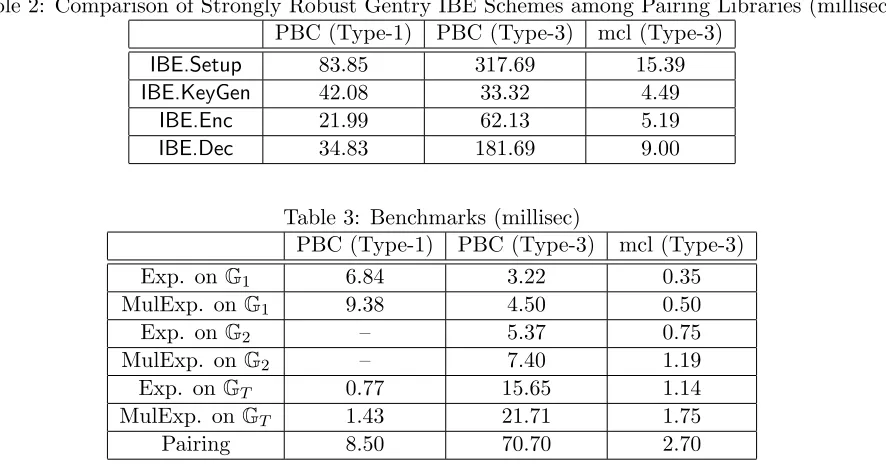
Our implementation environment includes CPU: Intel(R) Core(TM) i7-6950X (3.00GHz), gcc 4.9.2, openssl 1.0.1t, and mcl v1.00. First, we denote a comparison among the Gentry IBE schemes over Type-3 pairings in Table 1. All the schemes are implemented using the mcl library and BN462. We add e(g1, g2), e(g1, h1), e(g1, h2), and e(g1, h3) to params in case of all the implementations. Then, no pairing computation is required in the encryption algorithm at the expense of the pre-computation costs on the setup algorithm. As presented in Table 1, the efficiencies of all the schemes are almost the same, revealing a strong robustness with little additional costs.
In Table 2, we compare the running times of the strongly robust Gentry IBE schemes to denote the effectiveness of the Type-3 curves. Here, PBC stands for the PBC library [1] (we employ pbc-0.5.14). We use the effective security system because the PBC library offers no support to elliptic curves that provide 128-bit security by default. For PBC (Type-1), we generate parameters for a symmetric bilinear group (Type A curve in PBC), defined over 1536-bit prime r using the
3
Table 2: Comparison of Strongly Robust Gentry IBE Schemes among Pairing Libraries (millisec)
PBC (Type-1) PBC (Type-3) mcl (Type-3)
IBE.Setup 83.85 317.69 15.39
IBE.KeyGen 42.08 33.32 4.49
IBE.Enc 21.99 62.13 5.19
IBE.Dec 34.83 181.69 9.00
Table 3: Benchmarks (millisec)
PBC (Type-1) PBC (Type-3) mcl (Type-3)
Exp. on G1 6.84 3.22 0.35
MulExp. onG1 9.38 4.50 0.50
Exp. on G2 – 5.37 0.75
MulExp. onG2 – 7.40 1.19
Exp. onGT 0.77 15.65 1.14
MulExp. onGT 1.43 21.71 1.75
Pairing 8.50 70.70 2.70
PairingParametersGenerator API supported by jPBC [22]. Here, GT is a subgroup of F∗r2. For additional information, we generate parameters for a BN curve (Type F curve in PBC) defined over 462-bit prime using the same API. The implementation results are presented in the PBC (Type-3) column. Moreover, we employ the element pow2 mpz function supported by PBC and themclBnG1 mulVec, themclBnG2 mulVec, and themclBnGT powVecfunctions supported by the mcl library that computegxhy directly from g, h, x, and y, which is generally faster than performing two separate exponentiations (i.e., compute gx and hy separately, and computegxhy). We employ them to compute C1 =g′1
s
g1−sID, com =g′xh′dec, and C4 =e(g1, h2)se(g1, h3)sβ in the encryption algorithm.
imple-mentation than that provided by PBC (Type-3). In total, mcl (Type-3) yields the most efficient implementation result due to the efficency of (Mul)Exp. onG1 and pairing computations, and Exp. on GT is comparable to that of PBC (Type-1).
6
Application to Searchable Encryption
Although robustness itself is already an attractive property, in this section we introduce an ap-plication of robust IBE to searchable encryption. Before giving the apap-plication, we introduce the relation between consistency of searchable encryption and robustness as follows. As a well known result, public key encryption with keyword search (PEKS) [16] can be constructed from anonymous IBE [3]. Intuitively, a keyword ω to be searched is regarded as an identity of an IBE scheme, and a random plaintext R is encrypted by using ω. A secret key skω is regarded as a trapdoor, and one (typically a server that has a role of searching) can check whether a ciphertext is associated to
ω or not by checking the decryption result of the ciphertext using the trapdoor is R. Due to the anonymity, no information of keyword is revealed from the ciphertext.4 Remark that the original paper [16] indicated the fixed R = 0|λ| (for a security parameter λ ∈N), but as mentioned in [3] the construction does not guarantee (wrong keyword) consistency where a ciphertext ofω may be searched by a trapdoor skω′ with ω ̸= ω′. As an application of robustness, Abdalla et al. [4, 5] showed that if the underlying IBE is robust, then this original construction above provides con-sistency. This result fits the following intuition where robustness guarantees that the decryption result of a ciphertext encrypted byω is⊥when skω′ withω̸=ω′ is used.
Suzuki et al. [53, 54] showed that secure-channel free PEKS with public key encryption (SCF-PEKS/PKE), which is explained later more clearly, can be constructed from anonymous IBE with a certain robustness, which they call unrestricted strong collision-freeness. Since unrestricted strong collision-freeness is weaker than complete robustness [29], and the transformation from weakly robust IBE to strongly robust IBE, employed in this paper, is already powerful enough to construct completely robust IBE. Thus, the strongly robust Gentry IBE scheme given in this paper provides unrestricted strong collision-freeness in the strict sense, and it can be employed as an underlying IBE scheme. So, in this section we explicitly present a SCF-PEKS/PKE scheme based on the strongly robust Gentry IBE scheme. Before giving the construction, we explain SCF-PEKS/PKE as follows. In PEKS, a trapdoor needs to be sent to the server via a secure channel since anyone can run the test algorithm if they obtain the trapdoor. We call secure-channel free if no secure channel is required for sending trapdoors to the server. To add the functionality, the server also has a public key and a secret key, and a ciphertext is generated both a keyword and the server public key. The test algorithm requires both a trapdoor and the server secret key. Such schemes, SCF-PEKS (which is also called designated tester PEKS), have been proposed in [11, 23, 24, 26, 27, 35, 37, 47, 48, 55]. In addition, PEKS does not provide a decryption functionality as PKE. Thus, schemes with both PEKS and PKE functionalities, which we call PEKS/PKE, have been proposed in [10,19,20,51,56]. SCF-PKES/PKE provides both these functionalities. Here there are three entities, a receiver, an encryptor, and the server. The receiver has a public key and a master secret key, generates a trapdoor for searching using the masker secret key, and sends the trapdoor to the server via a
4
public channel. An encryptor generates a ciphertext of both a keyword and a plaintext, and sends the ciphertext to the server. The server that has a trapdoor searches a ciphertext by using the trapdoor, and sends the ciphertext to the receiver. Finally, the decrptor decrypts the ciphertext, and obtain the plaintext. We introduce the syntax of SCF-PEKS/PKE as follows. Let K be the keyword space andMbe the message space.
Definition 4 (Syntax of SCF-PEKS/PKE [53, 54]) A SCF-PEKS/PKE schemeSCF-PEKS/PKE
consists of the following six algorithms, KeyGenS, KeyGenR, Trapdoor, Enc, Dec and Test:
KeyGenS(1λ): The server key generation algorithm takes as input the security parameter
λ∈N, and returns a server public keypkS and a server secret key skS.
KeyGenR(1λ): The receiver key generation algorithm takes as input the security parameter
λ∈N, and returns a receiver public key pkR and a receiver secret keyskR.
Trapdoor(pkR, skR, ω): The trapdoor generation algorithm takes as input pkR, skR, and a
keywordω ∈ K, and returns a trapdoor tω corresponding to keyword ω.
Enc(pkS, pkR, ω, M): The encryption algorithm takes as inputpkR,pkS,ω, and a messageM
∈ M, and returns a ciphertext CT.
Dec(pkR, skR,CT): The decryption algorithm takes as input pkR, skR, and CT, and returns
a message M or a reject symbol ⊥.
Test(pkS, skS, pkR, tω,CT): The test algorithm takes as input pkS, skS, pkR, tω, and CT,
and returns 1 if ω = ω′, where ω′ is the keyword which was used for computing CT, and 0 otherwise.
Suzuki et al. gave a generic construction of SCF-PEKS/PKE by extending the generic construction of SCF-PEKS [25] from anonymous IBE, tag-based encryption (TBE) [38], and one-time signature (OTS). The Suzuki et al. construction is briefly described as follows. The server has a public key and a decryption key of a TBE scheme, and the receiver has a public key and a decryption key of a TBE scheme and a master public key and a master secret key of an IBE scheme. The
Enc algorithm generates a ciphertext as follows. Let (vk,sigk) be a verification key and a signing key of the underlying OTS scheme. vk is regarded as a tag of the underlying TBE scheme, and a plaintext M is encrypted by using the TBE scheme using the receiver public key (let CTBE,R
be the ciphertext). A keyword ω is regarded as an identity of the underlying IBE scheme, and a plaintext R is encrypted. Here, R is computed by R = HR(vk) where HR is a target-collision resistant hash function. The relation betweenRandvkis important for preventing the re-encryption attack. See [53, 54] for details. The IBE ciphertext is also encrypted by using the TBE scheme with the same tag vk using the server public key (let CTBE,S be the ciphertext). Remark that to
encodevkto the tag space of the TBE scheme, we employ a target-collision resistant hash function
HTBE : {0,1}∗ → Zp. Finally, a signature σ is computed on two TBE ciphertexts and R by using sigk. A SCF-PEKS/PKE ciphertext is (CTBE,S, CTBE,R,vk, σ). The Dec algorithm computes
R = HR(vk) and decrypts CTBE,R by using the receiver secret key if σ is a valid signature on
(CTBE,S, CTBE,R, R). TheTest algorithm decrypts CTBE,S using the server secret key, and decrypts
the result by using the trapdoor. Let R′ be the decryption result. The algorithm outputs 1 if
R′=H(vk) and σ is a valid signature on (CTBE,S, CTBE,R, R′), and 0 otherwise.
Kiltz TBE scheme [38]. We also employ the discrete-log-based Wee OTS scheme. We call the instantiation Gentry-Ghadafi-Wee (GGW). For encrypting an IBE ciphertext by using a TBE scheme, usually KEM/DEM framework (KEM stands for key encapsulation mechanism and DEM stands for data encapsulation mechanism) is required since the plaintext space of the TBE scheme is different from the ciphertext space of the IBE scheme. In order to avoid employing the KEM/DEM framework, Emura and Rahman [26] introduced partitioned ciphertext structures where an IBE ciphertext can be split into two parts, CIBE,1 andCIBE,2 such that CIBE,1 only includes an identity
(i.e.,CIBE,2 is independent of the identity) and for any common plaintextM and distinct identities
ID0 and ID1, CIBE,2 can be commonly used for (CIBE,1, CIBE,2) ← IBE.Enc(params,ID0, M;s) and (CIBE′ ,1, CIBE,2) ← IBE.Enc(params,ID1, M;s) if the same randomness s is used. This structure is employed for computing the challenge ciphertext regardless of whetherID0 orID1 is encrypted. See [26] for details. IfCIBE,1belongs to the plaintext space of the TBE scheme (e.g.,CIBE,1∈G1), it is enough to encryptCIBE,1, andCIBE,2 can be directly included to the SCF-PEKS/PKE ciphertext.
Remark thatCIBE,2 needs to be a part of signed message. Unfortunately, nowCIBE,1= (C1, C4) due to the CCA security, i.e., C1 =g′1
s
g1−sID is generated byID and C4 depends on C1 via the hashed valueβ.5 Thus, still we need to employ the KEM/DEM framework for encrypting (C1, C4). In the following construction, we denote M ⊙K meaning that the underlying DEM scheme encrypts a plaintextM using K.
Without loss of generality, all algorithms use the same Type-3 bilinear groups (G1,G2,GT, e, p). Moreover, two TBE schemes also use the same target-collision resistant hash function HTBE :
{0,1}∗ → Zp. For the Wee OTS scheme, let G be a group with prime order q and g ∈ G be a generator, andHsig :{0,1}∗→Zq be a collision resistant hash function.
GGW SCF-PEKS/PKE Scheme:
KeyGenS(1λ): Let ¯g1 ∈ G1 and ¯g2 ∈ G2 be generators. Choose ¯h,w,¯ z,¯ u,¯ ¯v $
←− Zp, compute ¯
H1= ¯g ¯ h
1, ¯H2 = ¯g ¯ h
2, ¯U1= ¯H1u¯, ¯U2 = ¯H2u¯, ¯V1= ¯U11/v¯, ¯V2 = ¯U21/v¯, ¯W1 = ¯H1w¯, ¯W2 = ¯H2w¯, ¯Z1 = ¯V1z¯, and ¯Z2 = ¯V2¯z. Return a server public key pkS = (¯g1,g¯2,H¯1,H¯2,U¯1,U¯2,V¯1,V¯2,W¯1,W¯2,Z¯1,
¯
Z2, HTBE) and a server secret keyskS= (¯u,v¯).
KeyGenR(1λ): Let g1,ˆg1 ∈ G1, g2,ˆg2 ∈ G2, and g ∈ G be generators. Choose K ←−$
{0,1}λ, g′, h′ ←−$ G 1, α
$
←− Zp, and h1, h2, h3 $
←− G2, and compute g1′ = g1α. Let H :
{0,1}∗ → Zp be a universal one-way hash function and HAES : GT → {0,1}256 be a col-lision resistant hash function. Choose ˆh,w,ˆ z,ˆ u,ˆ vˆ ←−$ Zp, compute ˆH1 = ˆg1ˆh, ˆH2 = ˆgh2ˆ,
ˆ
U1 = ˆH1uˆ, ˆU2 = ˆH2uˆ, ˆV1 = ˆU11/ˆv, ˆV2 = ˆU21/ˆv, ˆW1 = ˆH1wˆ, ˆW2 = ˆH2wˆ, ˆZ1 = ˆV1ˆz, and ˆ
Z2 = ˆV2zˆ. LetHsig : {0,1}∗ → Zq be a collision resistant hash function. Return a receiver public key pkR = (K, g′, h′, g1, g′1, g2, h1, h2, h3, H, HAES,ˆg1,gˆ2,Hˆ1,Hˆ2,Uˆ1,Uˆ2,Vˆ1,Vˆ2,Wˆ1,Wˆ2,
ˆ
Z1,Zˆ2, HTBE, g, Hsig) and a receiver secret keyskR = (α,u,ˆ vˆ).
Trapdoor(pkR, skR, ω): Parse pkR = (K, g′, h′, g1, g1′, g2, h1, h2, h3, H,gˆ1,ˆg2,Hˆ1,Hˆ2,Uˆ1,Uˆ2,Vˆ1, ˆ
V2,Wˆ1,Wˆ2,Zˆ1,Zˆ2, HTBE, g, Hsig) and skR = (α,u,ˆ ˆv). For a keyword ω ∈ Zp, for i = 1,2,3
choose rω,i $
←−Zp, computehω,i= (hig rω,i
2 )1/(α−ω), settω := (ω,(rω,i, hω,i)3i=1), and returntω. Enc(pkS, pkR, ω, M): Parse pkS = (¯g1,¯g2,H¯1,H¯2,U¯1,U¯2,V¯1,V¯2,W¯1,W¯2,Z¯1,Z¯2, HTBE) and
pkR= (K, g′, h′, g1, g1′, g2, h1, h2, h3, H,gˆ1,ˆg2,Hˆ1,Hˆ2,Uˆ1,Uˆ2,Vˆ1,Vˆ2,Wˆ1,Wˆ2,Zˆ1,Zˆ2, HTBE, g, Hsig).
5We remark that a commitmentcomis also generated byID. However, thanks to the perfect hiding property of
the Pedersen commitment scheme, for any valuecom∈ G1 and distinctID0,ID1 ∈Zp there existsdec0, dec1 ∈ Zp such thatcom=g′ID0h′dec0=g′ID1h′dec1. Thus,comis not required to be a part ofC
– Generate OTS keys: Chooses0, s1, x $
←−Zqand compute u0 =gs0,u1 =gs1, andc=gx. Setvk:= (u0, u1, c).
– Compute IBE ciphertext for R: Choose dec ←−$ Zp and compute com = g′ωh′dec.
Choose s ←−$ Zp. Compute R = HR(vk), C1 = g′1 sg−sω
1 , C2 = e(g1, g2)s, KAES =
HAES(e(g1, h1)−s), C3 = AES.Enc(KAES, R||K||dec), β = H(C1, C2, C3), and C4 = e(g1, h2)se(g1, h3)sβ. SetCIBE,1:= (C1, C4) andCIBE,2 := (com, C2, C3).
– Compute TBE ciphertext for CIBE,1: Compute t = HTBE(vk). Choose ¯r1,r¯2 $
←− Zp. Compute ¯C1= ¯H1¯r1, ¯C2= ¯V1r¯2, ¯C3=CIBE,1⊙U¯1r¯1+¯r2, ¯C4 = ( ¯U1tW¯1)¯r1, and ¯C5= ( ¯U1tZ¯1)¯r2. SetCTBE,S:= ( ¯C1,C¯2,C¯3,C¯4,C¯5).
– Compute TBE ciphertext for M: Compute t = HTBE(vk). Choose ˆr1,rˆ2 $
←− Zp. ˆC1 = ˆ
Hˆr1
1 , ˆC2 = ˆV1rˆ2, ˆC3 = MUˆ1rˆ1+ˆr2, ˆC4 = ( ˆU1tWˆ1)rˆ1, and ˆC5 = ( ˆU1tZˆ1)rˆ2. Set CTBE,R :=
( ˆC1,Cˆ2,Cˆ3,Cˆ4,Cˆ5).
– Compute OTS for (CIBE,2, CTBE,S, CTBE,R, R): Choosee′ ←−$ Zq, compute w′ =x+e′s0+ (Hsig(CIBE,2, CTBE,S, CTBE,R, R) +e′)s1, and setσ := (e′, ω′).
Return CT= (CIBE,2, CTBE,S, CTBE,R,vk, σ).
Dec(pkR, skR,CT): Parse pkR = (K, g′, h′, g1, g1′, g2, h1, h2, h3, H,ˆg1,ˆg2,Hˆ1,Hˆ2,Uˆ1,Uˆ2,Vˆ1,Vˆ2, ˆ
W1,Wˆ2,Zˆ1,Zˆ2, HTBE, g, Hsig), skR = (α,u,ˆ ˆv), andCT= (CIBE,2, CTBE,S, CTBE,R,vk, σ).
– Verify OTS σ: Parse vk = (u0, u1, c) and σ = (e′, ω′). Compute R = HR(vk). If
gω′ ̸=c·ue0′ ·uHsig(CIBE,2,CTBE,S,CTBE,R,R)+e′
1 then output ⊥.
– Decrypt TBE ciphertext CTBE,R: ParseCTBE,R= ( ˆC1,Cˆ2,Cˆ3,Cˆ4,Cˆ5). Ife( ˆC1,Uˆ2tWˆ2)̸= e( ˆC4,Hˆ2) ore( ˆC2,Uˆ2tZˆ2)̸=e( ˆC5,Vˆ2), then output⊥. Otherwise, returnM = ˆC3/Cˆ1uˆCˆ2vˆ.
Test(pkS, skS, pkR, tω,CT): Parse pkS = (¯g1,g¯2,H¯1,H¯2,U¯1,U¯2,V¯1,V¯2,W¯1,W¯2,Z¯1,Z¯2, HTBE),
skS= (¯u,¯v),pkR = (K, g′, h′, g1, g1′, g2, h1, h2, h3, H,gˆ1,ˆg2,Hˆ1,Hˆ2,Uˆ1,Uˆ2,Vˆ1,Vˆ2,Wˆ1,Wˆ2,Zˆ1,Zˆ2, HTBE, g, Hsig),tω = (ω,(rω,i, hω,i)3i=1), andCT= (CIBE,2, CTBE,S, CTBE,R,vk, σ).
– Decrypt TBE ciphertextCTBE,S: Parse CTBE,S= ( ¯C1,C¯2,C¯3,C¯4,C¯5). Ife( ¯C1,U¯2tW¯2)̸= e( ¯C4,H¯2) ore( ¯C2,U¯2tZ¯2)̸=e( ¯C5,V¯2), then output 0. Otherwise, setCIBE,1 = ¯C3⊙C¯1u¯C¯2v¯.
– Decrypt IBE ciphertext (CIBE,1, CIBE,2): ParseCIBE,1= (C1, C4),CIBE,2 = (com, C2, C3), andtω= (ω,(rω,i, hω,i)3i=1). Computeβ=H(C1, C2, C3). IfC4̸=e(C1, hω,2hβω,3)C
rω,2+rω,3β
2 ,
then output 0. Otherwise, computeR′||K′||dec=AES.Dec(HAES((e(C1, hω,1)C rω,1
2 )−1), C3). Output 0 if K′ ̸= K. Otherwise, output ⊥ if com ̸= g′ωh′dec. Otherwise, output 0 if
R′ ̸=HR(vk).
– Verify OTSσ: Parsevk= (u0, u1, c) andσ = (e′, ω′). Ifgω ′
̸
=c·ue0′·uHsig(CIBE,2,CTBE,S,CTBE,R,R′)+e′ 1
then output 0. Otherwise, output 1.
Acknowledgment
References
[1] The PBC (pairing-based cryptography) library. Available athttp://crypto.stanford.edu/ pbc/.
[2] Emad Abd-Elrahman, Hatem Ibn-Khedher, Hossam Afifi, and Thouraya Toukabri. Fast group discovery and non-repudiation in D2D communications using IBE. InIWCMC, pages 616–621, 2015.
[3] Michel Abdalla, Mihir Bellare, Dario Catalano, Eike Kiltz, Tadayoshi Kohno, Tanja Lange, John Malone-Lee, Gregory Neven, Pascal Paillier, and Haixia Shi. Searchable encryption revisited: Consistency properties, relation to anonymous IBE, and extensions. J. Cryptology, 21(3):350–391, 2008.
[4] Michel Abdalla, Mihir Bellare, and Gregory Neven. Robust encryption. In TCC, pages 480– 497, 2010.
[5] Michel Abdalla, Mihir Bellare, and Gregory Neven. Robust encryption. J. Cryptology, 31(2):307–350, 2018.
[6] Masayuki Abe, Jens Groth, Miyako Ohkubo, and Takeya Tango. Converting cryptographic schemes from symmetric to asymmetric bilinear groups. InCRYPTO, pages 241–260, 2014.
[7] Masayuki Abe, Fumitaka Hoshino, and Miyako Ohkubo. Design in type-i, run in type-iii: Fast and scalable bilinear-type conversion using integer programming. InCRYPTO, pages 387–415, 2016.
[8] Bayu Anggorojati and Ramjee Prasad. Securing communication in inter domains Internet of Things using identity-based cryptography. InIWBIS, pages 137–142, 2017.
[9] Kazumaro Aoki. Towards reducing the gap between cryptography and its usage. IEICE Transactions, 102-A(1):11–16, 2019.
[10] Joonsang Baek, Reihaneh Safavi-Naini, and Willy Susilo. On the integration of public key data encryption and public key encryption with keyword search. InISC, pages 217–232, 2006.
[11] Joonsang Baek, Reihaneh Safavi-Naini, and Willy Susilo. Public key encryption with keyword search revisited. InICCSA, pages 1249–1259, 2008.
[12] Razvan Barbulescu and Sylvain Duquesne. Updating key size estimations for pairings. J. Cryptology, 2018.
[13] Paulo S. L. M. Barreto, Ben Lynn, and Michael Scott. Constructing elliptic curves with prescribed embedding degrees. In Security and Cryptography for Networks, pages 257–267, 2002.
[14] Paulo S. L. M. Barreto and Michael Naehrig. Pairing-friendly elliptic curves of prime order. InSAC, pages 319–331, 2005.
[15] Dan Boneh and Xavier Boyen. Efficient selective-ID secure identity-based encryption without random oracles. InEUROCRYPT, pages 223–238, 2004.
[17] Dan Boneh and Matthew K. Franklin. Identity-based encryption from the weil pairing. In
CRYPTO, pages 213–229, 2001.
[18] Xavier Boyen and Brent Waters. Anonymous hierarchical identity-based encryption (without random oracles). InCRYPTO, pages 290–307, 2006.
[19] Francesco Buccafurri, Gianluca Lax, Rajeev Anand Sahu, and Vishal Saraswat. Practical and secure integrated PKE+PEKS with keyword privacy. In SECRYPT, pages 448–453, 2015.
[20] Yu Chen, Jiang Zhang, Dongdai Lin, and Zhenfeng Zhang. Generic constructions of integrated PKE and PEKS. Des. Codes Cryptography, 78(2):493–526, 2016.
[21] Ronald Cramer, Rosario Gennaro, and Berry Schoenmakers. A secure and optimally efficient multi-authority election scheme. InEUROCRYPT, pages 103–118, 1997.
[22] Angelo De Caro and Vincenzo Iovino. jPBC: Java pairing based cryptography. InISCC, pages 850–855. IEEE, 2011.
[23] Keita Emura. A generic construction of secure-channel free searchable encryption with multiple keywords. InNSS, pages 3–18, 2017.
[24] Keita Emura, Atsuko Miyaji, and Kazumasa Omote. Adaptive secure-channel free public-key encryption with keyword search implies timed release encryption. InISC, pages 102–118, 2011.
[25] Keita Emura, Atsuko Miyaji, Mohammad Shahriar Rahman, and Kazumasa Omote. Generic constructions of secure-channel free searchable encryption with adaptive security. Security and Communication Networks, 8(8):1547–1560, 2015.
[26] Keita Emura and Mohammad Shahriar Rahman. Constructing secure-channel free searchable encryption from anonymous IBE with partitioned ciphertext structure. In SECRYPT, pages 84–93, 2012.
[27] Liming Fang, Willy Susilo, Chunpeng Ge, and Jiandong Wang. A secure channel free public key encryption with keyword search scheme without random oracle. InCANS, pages 248–258, 2009.
[28] Liming Fang, Willy Susilo, Chunpeng Ge, and Jiandong Wang. Public key encryption with keyword search secure against keyword guessing attacks without random oracle. Inf. Sci., 238:221–241, 2013.
[29] Pooya Farshim, Benoˆıt Libert, Kenneth G. Paterson, and Elizabeth A. Quaglia. Robust encryption, revisited. InPublic-Key Cryptography, pages 352–368, 2013.
[30] Pooya Farshim, Claudio Orlandi, and Razvan Rosie. Security of symmetric primitives under incorrect usage of keys. IACR Trans. Symmetric Cryptol., 2017(1):449–473, 2017.
[31] Steven D. Galbraith, Kenneth G. Paterson, and Nigel P. Smart. Pairings for cryptographers.
Discrete Applied Mathematics, 156(16):3113–3121, 2008.
[32] Craig Gentry. Practical identity-based encryption without random oracles. InEUROCRYPT, pages 445–464, 2006.
[34] Essam Ghadafi. Efficient distributed tag-based encryption and its application to group signa-tures with efficient distributed traceability. InLATINCRYPT, pages 327–347, 2014.
[35] Lifeng Guo and Wei-Chuen Yau. Efficient secure-channel free public key encryption with keyword search for EMRs in cloud storage. J. Medical Systems, 39(2):11, 2015.
[36] Antoine Joux and Kim Nguyen. Separating decision Hellman from computational Diffie-Hellman in cryptographic groups. J. Cryptology, 16(4):239–247, 2003.
[37] Dalia Khader. Public key encryption with keyword search based on k-resilient IBE. InICCSA, pages 1086–1095, 2007.
[38] Eike Kiltz. Chosen-ciphertext security from tag-based encryption. InTheory of Cryptography, pages 581–600, 2006.
[39] Taechan Kim and Razvan Barbulescu. Extended tower number field sieve: A new complexity for the medium prime case. InCRYPTO, pages 543–571, 2016.
[40] Tobias Markmann, Thomas C. Schmidt, and Matthias W¨ahlisch. Federated end-to-end au-thentication for the constrained Internet of Things using IBC and ECC. InACM SIGCOMM, pages 603–604, 2015.
[41] Micro Focus. Voltage SecureMail On-Premise: How it Works, 2019.
[42] Shigeo Mitsunari. mcl: A generic and fast pairing-based cryptography library, 2019/Sep/30 v1.00.
[43] Atsuko Miyaji, Masaki Nakabayashi, and Shunzou Takano. New explicit conditions of elliptic curve traces for FR-reduction. IEICE Transactions, 84-A(5):1234–1243, 2001.
[44] Payman Mohassel. A closer look at anonymity and robustness in encryption schemes. In
ASIACRYPT, pages 501–518, 2010.
[45] Hiroshi Okano, Keita Emura, Takuya Ishibashi, Toshihiro Ohigashi, and Tatsuya Suzuki. Implementation of a strongly robust identity-based encryption scheme over type-3 pairings. In
CANDAR, 2019, to appear.
[46] Torben P. Pedersen. Non-interactive and information-theoretic secure verifiable secret sharing. InCRYPTO, pages 129–140, 1991.
[47] Hyun Sook Rhee, Jong Hwan Park, and Dong Hoon Lee. Generic construction of designated tester public-key encryption with keyword search. Inf. Sci., 205:93–109, 2012.
[48] Hyun Sook Rhee, Jong Hwan Park, Willy Susilo, and Dong Hoon Lee. Trapdoor security in a searchable public-key encryption scheme with a designated tester. Journal of Systems and Software, 83(5):763–771, 2010.
[49] Shahidatul Sadiah and Toru Nakanishi. Implementation of revocable group signatures with compact revocation list using vector commitments. InCANDAR, pages 489–495, 2017.
[51] Vishal Saraswat and Rajeev Anand Sahu. Short integrated PKE+PEKS in standard model. InSPACE, pages 226–246, 2017.
[52] Adi Shamir. Identity-based cryptosystems and signature schemes. InCRYPTO, pages 47–53, 1984.
[53] Tatsuya Suzuki, Keita Emura, and Toshihiro Ohigashi. A generic construction of integrated secure-channel free PEKS and PKE. InISPEC, pages 69–86, 2018.
[54] Tatsuya Suzuki, Keita Emura, and Toshihiro Ohigashi. A generic construction of integrated secure-channel free PEKS and PKE and its application to EMRs in cloud storage. J. Medical Systems, 43(5):128:1–128:15, 2019.
[55] Tingting Wang, Man Ho Au, and Wei Wu. An efficient secure channel free searchable encryp-tion scheme with multiple keywords. InNSS, pages 251–265, 2016.
[56] Rui Zhang and Hideki Imai. Combining public key encryption with keyword search and public key encryption. IEICE Transactions, 92-D(5):888–896, 2009.
Appendix
In this appendix, we explain why our encodings given in [45] do not work well.
Consider that K ∈ {0,1}λ,dec∈Zp, and the plaintext space of the Gentry IBE scheme isGT. If we simply encode K (or dec) as GK (or Gdec) for a public value G∈GT (e.g., G:= e(g1, g2)), then the decryption algorithm needs to compute K (or dec) fromGK (orGdec). This requires to solve the discrete logarithm problem overGT. IfK (ordec) is relatively small, then we can employ the lifted ElGamal encryption approach [21]. However, these values are randomly selected from
{0,1}λ (orZp) and thus we cannot employ the approach.
We pay attention to the algebraic structure of GT and the decryption procedure. For a BN curve,GT, that has a prime orderp, is a subgroup ofF∗r12 wherer is a prime andp|r12−1. Fr12 is represented asFr2[X]/(X6−ξ) whereξ∈Fr2 is neither a square nor a cube, and henceX6−ξ is ir-reducible overFr2[X]. Thus, an element ofFr12 can be written as [[X1, X2],[X3, X4], . . . ,[X11, X12]] where eachXi(i= 1,2, . . . ,12) is an element ofFr. So, we set the plaintext space isFr. Moreover,
Kisλ-bit number and for 128-bit security (in our implementation),λ= 128, andr > p,K∈ {0,1}λ anddec∈Zpalso inFr. So, we encode (M||K||dec) as ¯M := [[M,0],[K,0],[dec,0],[0,0], . . . ,[0,0]]∈
Fr12. Remark that, nowC3:= ¯M ·e(g1, h1)−s∈Fr12 and more preciselyC3 ∈Fr12 \GT with high probability 1−p/(r12 −1). However, the decryption procedure is unaffected. The decryption algorithm computes E := e(C1, hID,1)C
rID,1
2 over GT, and computes C3·E over Fr12. This offers no group operation for ˆM. Thus, the decryption algorithm can uniquely recover M, K, and dec. For a symmetric bilinear group, GT is a subgroup of F∗r2 where r is a prime r = 3 (mod 4), and the order p is a prime factor of r+ 1. An element of GT can be written as [X1, X2] where each Xi (i= 1,2) is an element of Fr. We set the plaintext space is Zp, and (M||K||dec) is encoded as
¯
M := [M′,0] ∈ Fr2 where M′ := M·p2 +K·p+dec. Then, since we set r as a 1536-bit prime and pis a 256-bit prime for ensuring 128-bit security (i.e.,r > p4), M′ ∈Fr. Thus, the decryption algorithm can uniquely recoverM,K, and dec.